
Chapter Seven
"Modern Spirit," Institutional Change and the Effects of Warlord Government
Associations in the Early Republic
The early Republican period presents both striking continuities and important changes in the structure of native-place associations and in their social meanings. In the radically altered social and political context of warlordism and enfeebled central government after Yuan Shikai's death in 1916, the ability of native-place associations to exert effective pressure to shape local political contexts was more constrained. As mediating institutions between state and society, native-place associations lost some of their effectiveness at higher political levels soon after 1911, as it became apparent that the revolution had failed to create a viable, stable and legitimate order to replace the imperial order which had preceded it. Although native-place associations were extremely active in the new republic, they now faced a crumbling political system in which matters were decided more often by armed force than by mediation.
At the same time, native-place associations were radically reconceived and restructured. As the polity changed, so did the form of native-place associations. Native-place sentiment acquired a new Republican vocabulary, new institutions, and took on new social, economic and political projects. Although huiguan continued to function throughout the Republican period and retained symbolic centrality for their communities, a more broadly based and modern form of native-place association emerged and grew in popularity—the tongxianghui . The 1911 Revolution, if otherwise disappointing in its accomplishments, gave birth to new forms of social organization and expression which rejected older
oligarchies, closed meetings, and unwritten codes of behavior. Although wealthy tongxiang elites continued to find ways to assert their authority at the pinnacle of a social hierarchy, the associations of this period, like the new Republic, would have at least the forms of republicanism and representative government—constitutions, elected bodies, public meetings and public records.
Native-place associations performed manifold social functions in this period both because effective government was so minimal and because of the continuing growth of Shanghai. Between 1910 and 1927 the population of Shanghai more than doubled, growing from approximately 1.2 million to more than 2.6 million inhabitants.[1] The stream of new immigrants, including peasants seeking factory employment and refugees from natural disasters or warlord-torn areas, meant that Shanghai continued to be a predominantly immigrant city and that native-place ties continued to be called upon in the service of settling and accommodating the problems of the newcomers (see the table of Shanghai population growth in the Appendix). Prominent capitalists of this period, men such as Liu Hongsheng (Dinghai, Zhejiang), Yu Xiaqing (Zhenhai, Zhejiang) and Zheng Bozhao (Zhongshan, Guangdong) had established themselves in Shanghai through aid from fellow-provincials.[2] Like other employers, they provided assistance to destitute newcomers through the associations they sponsored.[3]
[1] Zou Yiren, Jiu Shanghai renkou bianqian , 90, 114-15. Jiangsu and Zhejiang sojourners were numerically predominant in this wave of immigration. The proportion of Guangdong sojourners declined considerably, though the position of wealthy Guangdong merchants permitted Guangdong sojourners to retain disproportionate, if nonetheless reduced, influence. See the Appendix for a table of population growth.
[2] Ding Richu and Du Xuncheng, "Yu Xiaqing jianlun" (On the subject of Yu Xiaqing), Lishi yanjiu 3 (1981):145-66; Chen Laixin, Yu Xiaqing ni tsuite , 12-15; Cheng Renjie, "Yingmei yan gongsi maiban Zheng Bozhao," Shanghai wenshi ziliao xuanji 1 (Shanghai, 1978):130-35. Zheng recruited Guangdong labor for his Yong Tai He (Wing Tai Wo) tobacco company in Shanghai, Hankou, Jiaxing, Huzhou and Ningbo. Because Guangdong sojourners felt he was not generous, Zheng funded a Lingnan Middle School in Hongkou to improve his image. See also Bergère, L'âge d'or , 158. The textile and food-products factories of the Rong brothers of Wuxi were heavily staffed with their tongxiang . In "Three Roads into Shanghai's Market: Japanese, Western and Chinese Companies in the Match Trade, 1895-1937," in Wakeman and Yeh, Shanghai Sojourners , 57-75, Sherman Cochran stresses native-place ties in Liu Hongsheng's careen Liu obtained his first job through tongxiang connections, became a leader of his native-place association in the 1920s and helped to establish a middle school in Dinghai, which channeled its graduates into Liu's enterprises.
[3] Wealthy sojourners were so eager to build patronage networks that swindlers supported themselves by writing to Shanghai businessmen, claiming to be impoverished fellow-provincials. Two such men, who claimed "invariably to be fellow-provincials of the person addressed and had described themselves in the various letters as hailing from nearly all the different provinces of China," are described in The Municipal Gazette (June 13, 1918, 193): "That their scheme was successful was proved by the fact that they had lived well entirely on its proceeds for six months before they came under the notice of the police."
Such networks of support were facilitated by what Marie-Claire Bergère has called "the golden age of the Chinese bourgeoisie." World War I produced an economic upswing in China by both temporarily protecting developing Chinese industries from European competition and by creating greater world demand for primary products from China, a demand which intensified in the immediate postwar years because of the needs of European economic reconstruction. The expansion of modern business produced an increasingly wealthy and powerful urban elite which could support an expanded scope of native-place charity.[4]
Prominent Shanghai commercial and financial leaders in this period—for instance, the Ningbo capitalists Yu Xiaqing, Zhu Baosan and Liu Hongsheng; the Jiangsu Xi family; and Wang Xiaolai, from Shaoxing—were directors of major Shanghai native-place associations. As Bergère has shown in her study of the social structures of the new bourgeoisie, native-place networks were fundamental to the constitution of the bourgeoisie and the enterprises on which it was based. Regional solidarities both substituted for and transcended family ties, enabling the development of complex and efficient networks of loyalty and patronage.[5]
Although native-place ties within the city were a boon in a competitive economic climate, the pull of the native place on these wealthy sojourners proved to be a considerable drain. In the first two decades of the Republican era, beyond the wealthy protected Chinese houses of the Shanghai foreign settlements vast rural areas experienced fighting, social dislocation and the deterioration of systems of water control, welfare and order keeping. These were the cumulative effects of the breakdown of central government, the devolution of local government and the predations of local militarists. In this period, in a way which has not been sufficiently recognized, native-place organizations gave war-torn and devastated rural areas access to the wealth of Shanghai. Weakened local elites called on their tongxiang in Shanghai to resolve local problems. Native-place associations responded regularly and generously to these
[4] Bergère, Golden Age ; Joseph Fewsmith, Party, State and Local Elites , 46.
[5] Bergère, Golden Age , 141-52. See also Chen Laixin, Yu Xiaqing , 12-15, 26-27. The Xi family, from Dongting Dongshan (Suzhou prefecture) were leaders of the Dongting Dongshan Tongxianghui (founded in 1912); Wang Xiaolai was director of the Shaoxing Tongxianghui.
appeals. Studies of early Republican China have frequently separated urban and rural spheres and studied each in isolation, neglecting their continuous interactions through sojourner networks. Poised between urban and rural China, native-place associations mediated between the two worlds.[6]
"Modern Spirit" and the Restructuring and Proliferation of Native-Place Organizations
Although huiguan remained active throughout the Republican period, preexisting native-place institutions did not merely persist and adapt. In the political and social ferment surrounding the 1911 Revolution, the disclosure of China's acquiescence to Japan's Twenty-One Demands in 1915 and the May Fourth Incident of 1919, native-place sentiment experienced both rebirth and "modernization," if such a term may be applied to an old cultural tradition. It is precisely this reformulation of an old cultural institution that makes the study of "traditionalistic" social forms important for understanding Chinese modernity.
In the early Republican period new types of native-place associations (tongxianghui ), which rejected the elitist outlook of the older huiguan , appeared. Spurning the religious and oligarchic rituals of huiguan , the new associations noisily adopted rituals of democracy, publishing voting procedures, notices of meetings, correspondence and finances and vying with the Beijing government for the numbers of times they revised their constitutions.[7] Rejecting the traditional architecture with its central altar, stage and courtyard, the new native-place organizations chose for themselves secular high-rise Western-style buildings with lec-
[6] See Goodman, "The Native Place and the City," chap. 5 for details on huiguan and tongxianghui activities in the Republican period.
[7] The meeting notes, accounts and constitutions of these new associations were published in monthly and yearly reports, and often in the newspapers as well. See, for example, Shaoxing qixian lü Hu tongxianghui ge gong zhangcheng (Regulations of the Association of Sojourners from Seven Counties of Shaoxing in Shanghai) (Shanghai, 1920); Shaoxing lü Hu tongxianghui tonggao (Report of the Association of Shaoxing Sojourners in Shanghai) (Shanghai, editions of 1911-14); SB, March 17, 1911; SB, May 14, 1919. See also Otani Kotaro, "Shanhai ni okeru dokyo dantai oyobi dogyo dantai" (Native-place and trade groups in Shanghai), Shina kenkyu (China research) 19 (1929):145-56; Negishi, Chugoku no girudo , 199-200; Negishi, Shanhai no girudo , 42-43.
ture halls, product-display rooms, newspaper-reading rooms, recreation rooms and offices built over shopping arcades.
The founding constitution of the new Shaoxing association indicates the political models which informed the organizational change.[8] The Shaoxing Lü Hu Tongxianghui was established in 1911. Following the forms and rhetoric of republicanism, it organized itself with an "assembly" (yishihui ) and a "speaker" (yizhang ). If the new organization and terminology were more democratic than were huiguan , stipulating such things as "public elections" of officers, limited terms of two years and majority rule, it is important to suggest the limitations of what these features could mean in practice. Tongxianghui were certainly more inclusive organizations than huiguan : whereas huiguan meeting notes generally list from ten to sixty members present at meetings (and did not have a specified membership, because it was obvious to the merchant elite who should enter and who should not), published lists for tongxianghui range from several hundred to as many as ten thousand members. Nonetheless, not everyone could join. The constitution stipulated that the association was limited to adult male sojourners "of good character" from Shaoxing prefecture who were introduced by members of the association and approved by the association. Such conditions obviously omitted all women and most likely the unemployed and the poor.[9]
Although these stir-consciously modern associations rejected "traditionalistic" aspects of older native-place associations, in particular their
[8] The Shaoxing Tongxianghui held its founding meeting in the Yongxitang (Zhe-Shao Huiguan). Its goals were to spread native-place sentiment (lianluo xiangyi ) and to assist tongxiang sojourners, through: charity; education; dispute resolution; help in the case of harm to individuals, property or reputation; employment services; and improvement of customs (gaijin fengxi ). See Shaoxing lü Hu tongxianghui tonggao , 1911, 2-3. Negishi (Chugoku no girudo , 199-202) suggests that tongxianghui were a product of nationalist sentiment, the changed "spirit of the times." See also SYZX, 303. The purpose of the Ningbo Tongxianghui, founded in 1909, was "to unite the tongxiang group and develop the spirit of self-government." If the precise connections between association formation and political ferment remain elusive, there is no question about their coincidence, as well as the prominent nationalist and Republican rhetoric of the new associations.
[9] The number of selected "assemblymen" (yiyuan ), thirty in this case, was not much greater than the numbers of dongshi present at huiguan meetings. Although nonassemblymen could attend the meetings as auditors, they could not do so without the permission of the assemblymen. Observers could be removed for secret meetings. Members paid yearly fees which were assessed at two levels, two yuan and five yuan (Shaoxing lü Hu tongxianghui tonggao , 1911), 1. The exclusion of women did not go unchallenged. After petitioning unsuccessfully for membership in 1921, a certain Zhu Zhongsan organized female sojourners to protest, threatening to form a separate women's tongxianghui (nüzi tongxianghui ) to mobilize public sympathy. See SB, September 29, 1922.
elitist leadership and customary procedures of governance, they did not reject the principle of organization according to native-place origin. Contrary to the presuppositions about the withering of "particularistic" and "traditionalistic" ties we have imposed on our understanding of this period, contemporaries did not view native-place ties as an obstacle to strengthening China as a modern nation. Rather, they reaffirmed the importance of native-place ties, fashioning their image of modernity out of the protean raw material of native-place community. A history of the Jiangning Tongxianghui presents a typical contemporary critique of old-style huiguan and explains the development of tongxianghui :
The functions of huiguan and gongsuo are to store coffins or ship them back to the native place, as well as to worship gods and perform jiao rituals. As for modern spirit . . . certainly they were insufficient as organizations. In this century, thinking about popular government increased and the spirit of organization also became more common. People with some modern knowledge all desired to associate in social organizations, solidify native-place sentiment and perform necessary acts to benefit the public. . . . Therefore the Jiangning Tongxianghui was formed in 1913.[10]
Although the rhetoric and formal institutional structure of new native-place organizations suggested a clear break with "traditional" associations, such distinctions were less clear in practice. The decade after the Revolution of 1911 witnessed growth in social organizations of all sorts, some traditional in form and function and some not. The overall number of native-place associations (huiguan and tongxianghui ) increased, as did the numbers of their members. During this organizational ferment native-place sentiment became identified with the goals of nationalism and modernization that were deemed necessary to save China.
The Birth of Tongxianghui . A convenient index of social organizations in the early Republican period may be found in the successive editions of Shanghai zhinan (Guide to Shanghai).[11] In a section entitled "public enterprises" (gonggong shiye ), the guidebook listed the names and addresses of Shanghai charitable, educational, and religious
[10] Jiangning liuxian lü Hu tongxianghui huikan (Journal of the Association of Sojourners from Six Counties of Jiangning in Shanghai) (Shanghai, 1935), Introduction.
[11] Shanghai zhinan , 1910, 1914, 1916, 1919, 1922, 1930. This guidebook is most reliable for commercial and professional (not worker) associations. The 1919 edition does not update the 1916 figures, so it is not included here.
associations, hospitals, museums, cemeteries, huiguan, gongsuo and many institutions less easily categorized. As new associations developed, they appeared in this listing. Although comparison of these listings with other sources suggests that the guidebook was not complete and listed new types of organizations only after a delay of several years, it nonetheless indicates trends in the formation of associations.
The guidebook reveals the intense organizational activity of the period and the proliferation of social organizations in general, and a comparison of the 1910, 1914, 1916, 1922 and 1930 editions shows how this general organizational "bloom" was experienced specifically in native-place organization. Growth of native-place associations is indicated by the numbers of entries in the guidebook:
HUIGUAN | TONGXIANGHUI | |
1910 | 26 | — |
1914 | 34 | — |
1916 | 44 | 21 |
1922 | 53 | 31 |
1930 | 62 | 57 |
These numbers not only reveal growth in native-place organizations, but show, moreover, that the traditional huiguan increased during this period, as did the newer associations called lü Hu tongxianghui (literally, associations of fellow-provincials sojourning in Shanghai). Tongxianghui , which numbered fewer than ten in 1911, do not appear in the guidebook until 1916, when twenty-one such organizations are listed. This pattern of dual growth continued into the 1930s. Although tongxianghui represented greater numbers of people, the number of huiguan continued to exceed the number of tongxianghui . The Commercial Directory of Shanghai (Shanghai shangye minglu ) of 1931, for example, lists sixty-eight huiguan and fifty-four tongxianghui .[12] These numbers reflect the growth of sojourning populations over most of this period, the increasing subdivision of the geographic native-place units and the persistent importance of huiguan . In fact, communities which did not formally organize until this period and first established tongxianghui went on to crown their efforts by constructing huiguan .[13]
[12] Ibid., 1931.
[13] For example, the Changzhou and Wenzhou tongxianghui raised funds to build Changzhou and Wenzhou huiguan , where none existed previously (SB, May 3, 1919; SB, May 8, 1919).
Let us examine the origins of these tongxianghui , a new and distinct organizational trend of the Republican period. The first tongxianghui were born in the atmosphere of the late Qing reforms and the local self-government movement surrounding the Republican revolution. They continued to increase in number throughout the Republican period, growth spurts often coinciding with periods of popular social mobilization. In May and June 1919, for example, notices in the Shenbao announced the formation of at least ten new native-place organizations. Many of these added the goal of resisting foreign aggression to their statements of purpose.[14]
Different native-place communities gave birth to tongxianghui at different times, in response to differing circumstances. Among the earliest tongxianghui were those of Huzhou, Haining, Ningbo and Shaoxing (all Zhejiang prefectures) and of Gansu and Anhui province. Each of these associations was established before 1912. In some communities the impetus for the formation of tongxianghui came from workers. In other cases it was students who demanded new, more modern and more accessible forms of association. Because of these differences, it is useful to describe the formation of two contrasting associations.
The Ningbo Tongxianghui, which would be highly influential throughout the Republican period, developed after the politicization of the Ningbo community in the 1898 cemetery riot, an event which hastened changes in the internal power structure of the sojourner community. The rise of Shen Honglai and his well-organized artisan and worker constituency challenged traditional oligarchic huiguan rule. When huiguan directors accommodated Shen by incorporating him into the huiguan power structure as general manager in 1901, Shen used his new position to make the leadership more accountable. As a check on the entrenched group of directors, Shen organized a second managerial group, the gongyi lianhehui , composed of representatives of all occupational groups within the huiguan . As general manager for more than a decade, Shen succeeded in modifying but not radically restructuring the traditional huiguan .[15]
In 1909, while still serving as gongsuo manager, Shen shifted tactics
[14] These were Jiangning, Anhui (two associations), Suzhou, Hangzhou, Jiangbei, Qingpu, Jiading, Haiyan and Sichuan tongxianghui (SB, May 1919). Because the life of many associations was brief, these spurts of growth are not clearly indicated in the editions of Shanghai zhinan .
[15] See Chapter 5. Although Shen instituted changes which benefited greater numbers of Ningbo people, his personal style was undemocratic and dictatorial, both as director of the Long Life Association, which he considered his own, and as manager of the Siming Gongsuo. See, especially, SBZX, 429-32.
and directed his energies toward the creation of a new kind of native-place institution, outside the Siming Gongsuo. The new association Shen established, called the Siming Lü Hu Tongxianghui, was a more broadly based association intended to serve the needs of ordinary Ningbo sojourners.
Although the new institution became permanent, Shen's influence ceased with his death, which came shortly after he founded the association. Without Shen the tongxianghui floundered. It was revived in a coopted form in 1911 by Zhu Baosan, a powerful comprador-director of the Siming Gongsuo. Zhu raised funds for a new building on Fuzhou Road and renamed the association the Ningbo Lü Hu Tongxianghui. Zhu's action suggests that the huiguan elite found the organization of a popular native-place association under their patronage very much to their benefit. From this moment onward, relations between the new association and the old appear harmonious. The leaders of the tongxianghui were dongshi of the Siming Gongsuo.[16]
A division of labor developed between the two Ningbo native-place associations. The gongsuo became, increasingly, a center for ceremonial, religious and charitable activities and was somewhat remote from day-to-day business, family, and political affairs. The tongxianghui devoted itself to a broad and expanding range of social, economic and quasi-juridical functions. As tongxianghui developed in other sojourning communities a similar institutional division of labor occurred, though some communities—Jiangxi sojourners, for instance—never developed tongxianghui outside their huiguan .[17]
[16] Negishi, Shanhai no girudo , 43; Negishi, Chugoku no girudo , 201-2; Ningbo lü Hu tongxianghui yuebao (Monthly journal of the Ningbo Sojourners' Association in Shanghai) (hereafter referred to as NLTY), 1921; SGY, 1919-21.
[17] Huiguan and tongxianghui leadership overlapped in other communities as well, suggesting a similar process of cooptation after the initial period of tongxianghui formation. This doubtless proceeded from the financial dependence of many tongxianghui on huiguan . The division of labor was not absolute. Although much Siming Gongsuo meeting time was devoted to managing a national network of coffin transportation and coffin repositories in Shanghai, as well as attending to various religious matters, the huiguan also built housing for the poor, supported two hospitals and a school and built a road and bridge costing more than ten thousand yuan in the south city area of Shanghai, together with other huiguan in the area. The huiguan was also closely involved with the Ning-Shao Shipping Company, which held its board meetings at the Siming Gongsuo. See SGY, 1916; SGY, March-April 1917; SGY, April-June 1918; SGY, January 1919; SGY, June 1919; SGY, August 1920.
The new Ningbo Tongxianghui proved popular and soon outgrew its headquarters. In 1916 Zhu Baosan and other Siming Gongsuo leaders sponsored the construction of a grander building on land costing fifty-six thousand yuan on Tibet Road. This tongxianghui , a large, western-style five-story building, was completed in 1921, for an additional construction cost of one hundred fifty thousand yuan. It became the model for later tongxianghui . On the first and second floors were lecture halls used for meetings and rented out for tongxiang marriages. The third floor housed a library and reading room and a separate periodicals room with local and Ningbo newspapers. The fourth floor served to display Ningbo products and manufactures. The fifth floor offered an exercise room and space for genteel recreations—music appreciation, arts and letters. A Chinese-style hall was maintained on the ground level for ceremonial occasions (see Figure 8).[18]
The features of the Ningbo tongxianghui building suggest that, like the Shaoxing Tongxianghui, the Ningbo association accommodated a restricted clientele, consisting of the literate middle and upper classes. Although we might imagine that some petty urbanites could find their way into the building if they had connections, the building was clearly not designed for the use of workers, nor could it accommodate very large crowds.[19]
The tongxianghui displaced the Siming Gongsuo as a social center for the community. The primary concern and constituency of the tongxianghui (like the huiguan ) were Ningbo merchants and property owners in Shanghai. Nonetheless, the tongxianghui departed from huiguan social practice in significant ways. The tongxianghui took the service of the broader sojourning community in new directions. With the proclaimed goal of "spreading the spirit of local self-government," the tongxianghui sought not just to provide charity for those at the lower levels of the community hierarchy but specifically to improve and reform them. In the 1920S this involved the modern reformist and social-science-tinged practices of "investigating social conditions," "main-
[18] NLTY (1921) states that more than one hundred people used the reading rooms daily (Negishi, Shanhai no girudo , 43).
[19] Early membership figures are not available for the Ningbo Tongxianghui. Other tongxianghui list memberships with numbers ranging from several hundred to eight or nine thousand names. Fewer tongxianghui list members' occupations, but those that do reveal a middle- to upper-class group, including businessmen, scholars, journalists, clerks, teachers, shopkeepers (and in some cases by the 1920s a small number of women). The Siming Gongsuo estimated in 1920 that there were between five and six hundred thousand Ningbo people in Shanghai. See SGY, April 1920.
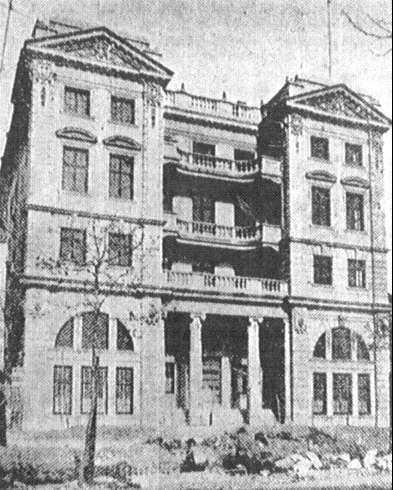
Figure 8.
The Ningbo Tongxianghui on Tibet Road. Source: Shanghai
huabao (Shanghai pictorial magazine) 6 (November 1985):38.
taining occupational statistics," "reforming social habits," "exchanging knowledge" and "promoting sanitation."[20]
The self-consciously modern social program of the Ningbo Tong-xianghui was not merely window dressing. In 1921 the tongxianghui managed five elementary and middle-level schools (with names like
[20] NLTY, 1921; Negishi, Shanhai no girudo , 48. These reformist goals prefigure concerns of the Social Bureau of the Shanghai Municipal Government, established in 1927 (see Christian Henriot, Shanghai 1927-1937: Municipal Power, Locality and Modernization , trans. Noel Castelino [Berkeley, Calif., 1993], 185-210).
"Ningbo Voluntary Republican School") for Ningbo children. This number increased to eight by 1927. The tongxianghui itself became an educational institution, offering a weekly adult lecture series on a range of topics concerning science, social progress and economic improvement. Among the lectures sponsored by the tongxianghui in 1921 (the numbers attending are noted in parentheses) were "Social Progress" (480); "Law and Morality" (352); "The Function of the Atmosphere" (220); "Epidemic Diseases" (189); "Social Darkness and Light" (450); "Product-Display Centers and Their Relation to Commerce" (285); "The Function of Coal" (293); and "The Key to Business Success" (257).[21]
In contrast to the Ningbo community, the socially more conservative Chaozhou sojourners did not establish a permanent tongxianghui until the late 1920s. As a result, although the Chaozhou Huiguan handled many of the new types of business thrust on native-place associations by the social problems of the Republican period, the organizational form and governing process do not appear to have undergone even superficial "modernization" or "democratization." Huiguan meetings were usually attended by ten to thirty directors. Although the directors deliberated as a group, the most powerful individuals among them routinely dominated discussion. Among these were the leader of the Shanghai pawnshop association, several wealthy businessmen with fortunes based originally on opium money but invested in diverse enterprises, and the director of the Mingxing Film Studio.
Although others in the Chaozhou community were nor powerful enough to overturn this oligarchy, challenges developed in the early 1920s. The huiguan was financially strained by increased public and private demands emanating from both Shanghai and Chaozhou. In 192l, struggling over scarce resources, the three constituent regional bang bickered over access to huiguan seals, and huiguan managers stressed the importance of unity in order to resist outside pressures for funds.[22] In 1923-24, financial pressures worsened and the dongshi resolved that no matter what group or government organ pressured them to fund military expenses, they would uniformly refuse.[23]
Challenges to huiguan oligarchic decision making came in the con-
[21] NLTY, 1921.
[22] CHYB, 1921.
[23] Police accusations against huiguan leaders in Shanghai may indicate a pattern of extortion, though the information in the records is inconclusive. Although local pressures on the Chaozhou Huiguan were greater than were those on the Siming Gongsuo (and Chaozhou resources fewer), one passage in SGY corresponds to the Chaozhou Huiguan's belt tightening. In 1916 Siming Gongsuo directors met to discuss an appeal from the Ning-Shao Philanthropic Association. They reluctantly agreed to contribute but noted that "the only reason we should contribute is that they are tongxiang . After this, if other provinces or prefectures raise money for disaster relief we will neither contribute nor consider this a precedent" (SGY, 1916). Such comments testify to the multiple claims on the capital of the Shanghai bourgeoisie.
text of competition for huiguan resources. In 1926 a group of Chaozhou students in Shanghai demanded the establishment of a more democratic native-place association. In that year the huiguan was considering what to do with a piece of property in the French Concession, formerly a burial ground, from which the remains had been removed to a newer cemetery. One influential huiguan member (whose wealth and power may be linked to opium) proposed the establishment of a hospital for indigent fellow-provincials. This traditional, conservative expression of benevolence was announced in the Shanghai newspaper as the decision of the huiguan .[24] Two days later a newly inaugurated Association of Chaozhou Students Sojourning in Shanghai published a counternotice calling for an immediate meeting of Chaozhou sojourners from all circles (gejie ) to meet and discuss the most appropriate disposition of the land. The students also sent this demand to the huiguan .[25]
Although this was not the first time the huiguan had received communications from students, it was the first time student demands were presented so publicly and so forcefully. The huiguan , accused of representing only the merchant elite, acceded to the student demand. In the meantime, probably at the instigation of the huiguan leadership, a no-rice entitled, "Repudiate the Spurious Association of Chaozhou Students Sojourning in Shanghai," appeared in the next day's newspaper. Signed by students outside the student association, it denounced the "bogus" student association as an improperly constituted minority faction.[26]
When the student association presented its case in huiguan meetings on November 13 and 21, the most outspoken representative was not actually a student but Zhang Jingsheng, a notorious fringe figure of the New Culture Movement.[27] Zhang put forth two "modern" lines of ar-
[24] CHYB, November 1926; SB, November 8, 1926.
[25] SB, November 10, 1926. More than two hundred people reportedly attended the student meeting.
[26] SB, November 11, 1926.
[27] Zhang advocated sexual enlightenment, published sexual surveys in a series tided "History of Sex," ran the Esthetic Bookstore and edited New Culture Monthly (Xin wenhua yuekan ), which featured drawings of nude women and sex-counseling correspondence (Fan Jiping, "Wo suo zhidao de Zhang Jingshen" [What I know of Zhang Jingshen], Daren 11 [March 15, 1971]:23-27).
gument as to why oligarchic management of tongxiang property had to end. First, the huiguan leaders were undemocratic. Second, current practices were unprofitable: "In the past the dongshi have had total authority, but in these matters they need to ask people's opinions. I believe we should ask everyone to assemble for discussion and hear the decision of the majority of people from Chaozhou. The [dongshi plan for using the land] is secure but would only produce a limited amount of money. I think there is better way. [Building a tongxianghui ] would not just benefit the scholarly community, but would serve the interests of all Chaozhou people." When the reluctant dongshi argued that indebtedness from the construction of the new cemetery precluded consideration of the students' project, Zhang criticized the lavishness of cemetery expenditures, a criticism which reflects a generational and political conflict between "enlightened" students, impatient with money wasted on old, "superstitious" rituals, and the older leaders of the huiguan .[28]
The students plan for the greater social welfare of the tongxiang was modeled after the already well-established and powerful Ningbo Tongxianghui:
Chaozhou people in Shanghai are increasingly numerous and they don't yet have a recreational meeting place. Although there are three huiguan their scale is small. . .. The [new] huiguan will have four stories. The first two floors will have shops. On the third floor a large hall will be constructed which will be rented out for marriages, funerals and all kinds of meetings. The fourth floor will have the association offices and other clubs. The form will be like the Ningbo Tongxianghui. Although it won't be as large or magnificent, it will be as nice as we can economically afford.
The shop and meeting-hall rentals would cover the operating costs of the tongxianghui . Any additional profits would support educational ventures and Chaozhou students in Shanghai.[29]
The students failed in their mission, but they damaged the dongshi claim to represent the larger community. Compelled to confront tongxiang who accused them of elitism, the dongshi finally argued that they had the authority to make the decision because they, not the broad community, had in fact purchased the contested land. The students chal-
[28] CHYB, November, 1926.
[29] CHYB, November 21, 1926.
lenged the huiguan leaders' preemptive action in court, embroiling the huiguan in troublesome litigation. Other groups of Chaozhou students also published notices expressing outrage at the unwillingness of the dongshi to meet with the greater tongxiang community. Forcing a modern democratic meaning onto the paternalist rhetoric of the Chaozhou huiguan , they argued that although the land was huiguan property, the huiguan was the institution of the Chaozhou people. Therefore, although responsibility lay with the huiguan , the overall authority lay with the Chaozhou people.[30]
The students' interest in native-place organization was both natural and calculated, heightened by their desire for access to huiguan resources. Three demands published by the student association—the first (involving foreign encroachments on Chinese territory) expressing nationalism; the second (involving a petition to Chaozhou officials in regard to land-rent matters) expressing involvement in native-place affairs; and the third calling for democratic measures contributing to their own well-being—together illustrate the compatibility in practice of multiple loyalties (native-place, national, and student) and old and new ideas.[31]
In its struggles with contending groups of fellow-provincials, the Chaozhou Huiguan held out much longer than did other huiguan .[32] Nonetheless, by the early 1930s the huiguan coexisted peacefully with a Chaozhou Tongxianghui, a broader-based, more overtly political association which threw itself into nationalist and anti-Japanese propaganda efforts, social welfare services in Shanghai and refugee relief.[33]
Student and Worker Native-Place Associations . Although huiguan and tongxianghui were the major forms of native-place association in this period, as the stories of tongxianghui formation demonstrate, they were not the only kinds of organization by native place. Both huiguan and tongxianghui subscribed to the rhetoric of an all-inclusive native-place community, regardless of class or social group.
[30] CHYB, November 1926; SB, December 6, 1926; SB, December 7, 1926.
[31] SB, November 10, 1926.
[32] CHYB, December 19:26; CHYB, January-March 1927. By the time of the formation of the Chaozhou Tongxianghui at the end of the 1920s, there were already fifty other tongxianghui in Shanghai. The precise date of the establishment of the Chaozhou Tong-xianghui is unclear (it was between 1927 and 1931).
[33] Chaozhou lü Hu tongxianghui tekan, juiguo hao (Special issue of the Association of Chaozhou Sojourners in Shanghai, national salvation edition) (Shanghai, 1932).
They were, nonetheless, understood to have a primarily elite constituency, with the huiguan representing the business elite and the tongxianghui including a larger commercial community as well as journalists, educators and intelligentsia. The growth of these native-place institutions, associated with commercial circles (shangjie ), was accompanied by the development and growth of associations of sojourning students (lü Hu xueshenghui ) and coexisted with a variety of native-place trade and worker associations (bangkou, she, gonghui ). Precise trends in the formation of these associations are difficult to outline: because their native-place composition is often not revealed by their name, many of these associations escape detection.[34]
Student associations followed a pattern of development similar to that of tongxianghui , finding their origins in the early-twentieth-century reforms and new educational institutions. Twenty-four student associations, associations of sojourning students among them, appear in the 1916 edition of Shanghai zhinan . Often student associations are listed according to school, masking the fact that many schools (particularly trade and business schools) were sponsored by native-place associations or dominated by students from one or two regions. Beneath the school-level organizations which are listed in guides and directories, students belonged to native-place student associations which are often not listed. Although there was a Fudan University Students' Association, for instance, there was also a Fudan Chaozhou Students' Association. There were also overarching native-place student associations that transcended school boundaries—for instance, the Association of Fujian Students, which met at the Fuzhou huiguan (San Shan Huiguan), and the Association of Zhejiang Students Sojourning in Shanghai.[35]
Although students criticized huiguan as superstitious and traditionalistic, the fact that "modern" students did not find native-place organization in itself objectionable is evident in the prevalence of native-place associations at the radical Shanghai University (Shanghai daxue , hereafter Shangda). The most radical students participated in Shangda tong-
[34] Although this is also a problem in studying huiguan and tongxianghui , worker and student organizations left fewer records.
[35] SB, May 5, 1919; SB, May 9, 1919; SB, May 13, 1919. On student fellow-provincial associations, see Jeffrey Wasserstrom, Student Protests in Twentieth-Century China: The View from Shanghai (Stanford, Calif., 1991), 127-45; Zhang Jishun, "Lun Shanghai zhengzhi yundong zhong de xuesheng qunti (1925-27)" (Regarding student formations in Shanghai political movements, 1925-27), in Shanghai: tongwang shijie zhiqiao (Shanghai: Gateway to the world), ed. Shanghai shi difangzhi bangongshi, Shanghai yanjiu luncong (Papers on Shanghai), vol. 4 (Shanghai, 1989), l04-10.
xianghui as a matter of course and as a matter of necessity.[36] A former Shangda student, Zhong Fuguang, who studied with the Communist labor organizer and party historian Deng Zhongxia, recalled the Sichuan tongxianghui as meeting both political and personal needs: "This was a form resulting from the party's method of organizing everyone into groups. At the time, if you didn't belong to an organization, there was no way to be politically active. Therefore there were many provincial tongxianghui at Shanghai University. Other schools were the same. The main activities of the tongxianghui were to bring together people's feelings and unite people. Everyone was studying outside his or her native place. If something came up it could be taken to the tongxianghui ."[37] Zhong's suggestion that the tongxianghui form derived from party initiatives is mistaken, of course, but it confirms that there was no perceived contradiction between native-place organizations and social revolutionary goals. Zhang's statement also indicates the usefulness of native-place sentiment and organization as vehicles for effective social mobilization.
Among Shanghai workers, native-place organization developed from the moment they immigrated or were recruited to work in the city.[38] A variety of native-place bang —among the most prominent in Shanghai, the Guangdong bang , Ningbo bang , Shaoxing bang , Wuxi bang and local Shanghai (ben ) bang —organized Shanghai labor from the opening of the port in 1843 through the Republican era.[39] Just as the contributions of tongxiang merchants in support of education strengthened (though by no means explains) student organization by native place, patterns of recruitment, deployment and labor control strengthened worker organization by native place. The owners of Chinese enterprises
[36] Zhang Chongde (1903-37) and He Weisheng (1902-26) were student activists at Shangda. Both participated in the Shangda Zhejiang Tongxianghui, the largest native-place organization at the school. Together with their fellow-provincial comrades, they studied social and economic conditions in Zhejiang to participate in revolutionary struggles in their native place. See Cai Xiyao and Wang Jiagui , eds., Shanghai daxue (Shanghai University) (Shanghai, 1986), 67-68.
[37] Cai Xiyao and Wang Jiagui, Shanghai daxue , 106-7. I am grateful to Jeffrey Wasserstrom for showing me this source.
[38] Perry (Shanghai on Strike ) details enduring patterns of worker native-place organization in the Republican era.
[39] Bang was the most common term used to describe native-place organization of labor. It does not necessarily imply a formal organization. The mere presence of Ningbo workers permits the use of the term "Ningbo bang ." That people from one native place will act as a group is assumed within the terminology. For a description of early native-place organization among Guangdong workers in Shanghai, see Chapter 2.
recruited tongxiang managers and foremen, who in turn recruited tongxiang workers. Foreign owners of Shanghai enterprises similarly relied on Chinese labor recruiters, who reproduced this pattern.[40]
Whereas regional groups monopolized specific trades in the late nineteenth century, by the early Republican period the shifting fortunes and populations of different groups led to a more complex situation of shared participation in specific trades and enterprises. That bang ceased to monopolize specific occupational niches did not mean that the various regional groups mixed or that the importance of bang diminished. Instead, labor and industry in the 1920s and 1930s were characterized by bang subdivision within the multi-bang work unit.
Shanghai textile mills were dominated by Shaoxing, Ningbo and Subei bang .[41] Workers at the British-owned Shanghai Tramway Company were divided between the Ningbo and Subei bang , which dominated separate divisions within the company. Shaoxing people, introduced by Shaoxing relatives and recruited by a Shaoxing forewoman, predominated in the leaf-packing department at the British-American Tobacco Company. Subei women worked in the more strenuous rolling department. Flour-mill workers at the Fuxin mills were divided between Hubei and Wuxi bang , each of which dominated different sectors of the machine room. Among those who worked on the riverfront, most of the dockworkers were from Subei; most of those who worked in warehouses, from Ningbo; and most of those who worked with cargo on the ships, from Guangdong.[42]
As with student associations, it is important to assess the social and political character of worker native-place bang. Bang divisions could
[40] Chen Laixin, Yu Xiaqing , 12-15; Cheng Renjie, "Yingmei yan gongsi maiban Zheng Bozhao," 130-35; Shanghai shehui kexueyuan, Jingji yanjiusuo (Shanghai Academy of Social Sciences, Institute for Economic Research), ed., Rongjia qiye shiliao (Historical materials on the Rong family enterprises), vol. 1 (Shanghai, 1980), 118; Bergère, L'âge d'or , 148-59; Emily Honig, Sisters and Strangers: Women in the Shanghai Cotton Mills, 1919-1949 (Stanford, Calif., 1986), 57-78.
[41] Zhu Bangxing et al., eds., Shanghai chanye yu Shanghai zhigong (Shanghai industry and workers) (Shanghai, 1939; reprint, 1984), 202; Honig, Sisters and Strangers , 57-78.
[42] Zhu et al., Shanghai chanye , 264-65, 625-26, 647; Elizabeth Perry, "Shanghai gongren bagong yu wuchan jieji de zhengzhi qianli" (Shanghai on strike: Work and politics in the making of a Chinese proletariat), in Shanghai: tongwang shijie zhiqiao. Shanghai yanjiu luncong (Papers on Shanghai), vol. 4, ed. Shanghaishi difangzhi bangongshi (Shanghai, 1989), 38-86; Shanghai shehui kexueyuan, Jingji yanjiusuo, ed., Yingmei yan gongsi zai hua qiye ziliao huibian (Collected materials on the British-American tobacco enterprise in China) (Beijing, 1983), 1028; Cai Xiaoqing, Zhongguo jindai huidang shi yanjiu (Research on secret societies and gangs in modern Chinese history) (Beijing, 1987), 333.
mean competition and rivalry, interethnic tensions, harassment and fighting.[43] In the same manner as student native-place organization, worker native-place organization occurred at levels which subdivided but could also transcend their institutions of work. In other important respects, however, the omnipresent native-place organization of workers differed from that of students. The leaders of worker bang tended not to be ordinary workers but foremen, labor contractors and even merchants and minor officials.[44] Moreover, membership and allegiance were more automatic than voluntary.
Communist labor organizers who surveyed Shanghai in 1921 noted that preexisting organic associations among workers—both regional bang and gang-type organizations—posed a major obstacle to the formation of worker unions. Nonetheless, although they viewed native-place bang as a kind of feudal tie which subjected workers to the manipulation of officials and compradors (not to mention retrograde gang bosses and contract brokers), in order to organize labor effectively party organizers learned that they had to work with the preexisting bang , making friends with their leaders and, through them, attempting to radicalize their members.[45]
Although native-place organization among Shanghai workers was enduring, this did not mean that worker organization did not change or "modernize." The continuity of the names of such organizations— bang, bangkou —as well as a variety of terms with religious associa-
[43] For references to fights between workers escalating to melees between their native-place bang , see Zhu et al., Shanghai chanye , 264-65; SB, May 3, 1919; SB, May 16, 1919; SB, June 2, 1919; and Cai Xiaoqing, Zhongguo jindai huidang , 332. Regarding the particular prejudice of Jiangnan workers against workers from poverty-stricken Subei (who often performed the most laborious, ill-paid and demeaning tasks), see Honig, Sitters and Strangers , 70-78; Honig, "Politics of Prejudice," 243-74.
[44] Cai Xiaoqing, Zhongguo jindai huidang , 331-32.
[45] Deng Zhongxia, Deng Zhongxia wenji (Collected works of Deng Zhongxia) (Beijing, 1983), 425; "Shanghai gongzuo jihua jueyi'an" (Draft resolution on Shanghai work plans) (1926), in Zhongguo zhongyang wenjian xuanji (Collection of documents of the Central Committee of the Chinese Communist party), ed. Zhongyang dang'anguan (Party Central Committee Archive), vol. 2 (Beijing, 1982), 182-83; Cai Xiaoqing, Zhongguo jindai huidang , 331-34. See also Chen Weimin, "Zhonggong chengli chuqi Shanghai gongren yundong shuping" (The Shanghai workers' movement in the first years of the CCP), in Shanghai: tongwang shijie zhiqiao, Shanghai yanjiu luncong (Papers on Shanghai), vol. 4, ed. Shanghai shi difangzhi bangongshi (Shanghai, 1989), 8-37. Chen finds that "locality factions" were more numerous and more complicated in Shanghai than elsewhere. In the early 1920s native-place bang involved a greater number of workers than did the Shanghai gangs, though the leaders of these bang often tried to gain gang backing to strengthen their position.
tions—tang, she —suggests a certain continuity in the character of these worker associations, at least through the May Fourth period. Materials from the mid-1920s, however, reveal the growth of more secular native-place worker associations, often called lü Hu gonghui (sojourners' union) or zhu Hu laogonghui (association of laborers staying in Shanghai), reflecting both labor-organizing efforts and the increasing radicalization of the Shanghai proletariat.[46]
The Subdivision of the Native-Place Community . Some idea of the plethora of native-place associations coexisting in 1919 is provided by the partial listings of associations of Guangdong and Zhejiang fellow-provincials that appear in Tables 1 and 2.[47] These lists are not comprehensive and are meant only to suggest the range of associations within each native-place community.
This varied list of associations indicates several important developments of the early Republican period. First, it demonstrates a growing articulation of "social circles" (jie ); that is, the separation, both in language and in organizational identity, of layers of businessmen and merchants, students, workers and sometimes journalists. Whereas several decades earlier, general appeals to the tongxiang community did not normally specify groups within the community, now appeals to fellow-sojourners "of all circles" (lü Hu tongxiang gejie ) or to tongxiang "of commercial, student, worker and journalist circles" (shang-xue-gong-bao jie ) expressed the differentiation of separate interest, status or economic groups. In the May Fourth period, appeals to greater tongxiang community were still possible, though no longer with the suggestions of brotherhood or ritual equality that characterized the nineteenth-century tongxiang community.
Second, although the formation of new associations certainly meant a splitting off from the old huiguan , this splitting was not necessarily antagonistic. New associations lacking their own buildings (as was especially the case when these associations were not commercial associa-
[46] See, for example, Shanghai shehui kexueyuan, Lishi yanjiusuo (Shanghai Academy of Social Sciences, Institute for Historical Research), ed., Wusa yundong shiliao (Historical materials on the May Thirtieth Movement) (hereafter referred to as WYS), vol. 1 (Shanghai, 1981), 398, 401.
[47] These lists are compiled on the basis of organizations mentioned in Shanghai shehui kexueyuan, Lishi yanjiusuo (Shanghai Academy of Social Sciences, Institute for Historical Research), ed., Wusi yundong zai shanghai shiliao xuanji (Compilation of historical materials concerning the May Fourth Movement in Shanghai) (hereafter referred to as WYZS) (Shanghai, 1980); also mentioned in SB, 1919, and in CHYB, SGY, and NLTY.
tions) commonly met at the building of the older association. For instance, the pawnshop association met at the Chao-Hui Huiguan; the Hangzhou Tongxianghui met at the Qianjiang Huiguan; the Suzhou Tongxianghui met at the Jiangning Gongsuo; the Jiading Tongxianghui met at the Cake- and Bean-Trade Gongsuo; the Fujian Student Association met at the San Shan Huiguan; and Ningbo workers' associations held important meetings at the Siming Gongsuo.
Third, the proliferation of groups reflects increasing geographical fragmentation. As the populations of fellow-provincials in Shanghai increased, there was increasing subdivision Within the community according to smaller geographical units of native-place origin. Nonetheless, the interaction of these groups, viewed through the meeting notes of Ningbo and Chaozhou associations, suggests that this type of division did not mean competition or antagonism among newly subdivided units. Geographic subdivision of the native-place community resulted, rather, from growth in Shanghai's immigrant populations over the course of this period and each group's attainment of a "critical mass," a combination of numbers and wealth. In practice, on major issues groups from the same province combined forces and worked together, issuing joint telegrams and meeting together in the largest of the tongxiang meeting places.[48] At moments of political urgency the increasingly diverse native-place groups coalesced into overarching federations. As Jiang Jieshi (Chiang Kai-shek) headed northward in the Northern Expeo-dition, many Shanghai native-place associations gathered under provincial-level umbrella associations, organized to preserve peace in their native provinces and to support the formation of a Shanghai Municipal Government. Among these were the All-Zhejiang Association (Quan Zhe gonghui ) and the All-Anhui Consultative Committee (Quan Hui xiehui ). Multiprovince regional associations were also formed, such as the Three Provinces Federation (Sansheng lianhehui ), created by Ningbo, Shaoxing, Wenzhou, Jiaxing, Hangzhou and other tongxianghui . One announcement of the formation of an all-province association explained that such an organization was needed to integrate the diverse Anhui native-place groups into a systematic and overarching organization.[49] In practice the flexibility of the native-place tie provided both the convenience of local communities for day-to-day purposes and
[48] CHYB and SGY, consulted for the period 1913-37.
[49] SB, November 22, 1926; SB, December 6, 1926; SB, December 9, 1926; SB, December 12, 1926.
Table 1. |
HUIGUAN |
Guang-Zhao Gongsuo |
Shunde Huiguan |
Nanhai Huiguan |
Chaozhou Huiguan |
Chao-Hui Huiguan |
Jie-Pu-Feng Huiguan |
TONGXIANGHUI |
Zhaoqing Tongxianghui |
jiaying Wushu Lü Hu Tonxianghui |
Lü Hu Dapu Tongxianghui |
OTHER |
Guangdong Club (Guangdong julebu) |
Guangdong Sojourners' Reconstruction Association |
Guangdong Sojourners' Commercial Association |
Chaozhou Sugar and Miscellaneous-Goods Association |
(Chao-Hui) Third-Class Pawnshop Association |
Fudan Chaozhou Students' Association |
Association of Guangdong Seamen |
larger combinations with greater political clout when the issue was the nation.
Native-Place Burdens and Business in the Early Republican Period
Although new images of native-place community and new strategies of organization appeared in the Republican era, both huiguan and tongxianghui struggled with the considerable social and financial burdens imposed by the deterioration of local order which characterized this period. In place of effective local government and as a defense against the disorders of war, native-place associations ministered
Table 2. |
HUIGUAN |
Siming Gongsuo |
Zhe-Shao Huiguan |
Zhe-Yan Huiguan |
Shaoxing Huiguan |
Haichang Gongsuo (Haining Huiguan) |
Huzhou Huiguan |
Dinghai Huiguan |
Jun'an She |
TONGXIANGHUI |
Ningbo Lü Hu Tongxianghui |
Shaoxing Lü Hu Tongxianghui |
Quan Zhe Lü Hu Tongxianghui |
Hangzhou Lü Lu Tongxianghui |
Wenzhou Tongxianghui |
Haichang Lü Hu Tongxianghui |
OTHER |
Shaoxing International Improvement Society |
Huzhou Studen-Commercial Sojourners' Association |
Ningbo Student Association |
Association of Zhejiang Sojourning Students |
Fudan Zhejiang Student Association |
Fudan Shaoxing Student Association |
Ning-Shao Cotton-Trade Welfare Association |
Ning-Shao Lacquerers' Association |
(Association of Ningbo Seamen) |
to the needs of their tongxiang communities, maintaining social infrastructure in their native places and contributing to similar social needs in Shanghai. To some extent this activity may be seen as an extension of huiguan roles of the late nineteenth century, when sojourning tongxiang sent money and contributed to public works in their native place. Nonetheless, as the following discussion of the activities of the Ningbo and Chaozhou associations illustrates, the changed situation of the countryside intensified the depth and scope of involvement in the native place.
The institutional division of labor in communities which developed tongxianghui in the early Republican period meant that these new na-
tive-place associations displaced huiguan as the primary organ for sojourners' appeals and redress. This was the case for the Ningbo Tongxianghui. In contrast, because the Chaozhou community did not produce a powerful tongxianghui in the early Republican period, the Chaozhou Huiguan continued to dominate the Chaozhou community until the 1930s. In respect to their management of the daily burdens of native-place business, the new Ningbo Tongxianghui in many ways functioned similarly to the early-Republican-era Chaozhou Huiguan. Although the two associations faced differing conditions in their native areas, with contrasting degrees of proximity and resources, both associations mediated among the different worlds of the native place and Shanghai, local residents, military forces and officialdom.
Involvement in the Native Place . Rich meeting records exist for the Chaozhou Huiguan, and they permit a sketch of the substantial native-place involvements of a moderately wealthy Republican-era huiguan . These included the management of commercial remittances and representation of Shantou shops in Shanghai, disaster relief, financing and management of local public works, support of Chaozhou charitable institutions and hospitals, tax reduction and the promotion of education.
The local Chambers of Commerce (established by law in 1904) were often ineffective or insufficiently powerful to be persuasive with provincial authorities. Although recent studies of Chinese cities have argued that a deparochialization of trade associations and commercial affairs began by the end of the nineteenth century,[50]huiguan records suggest that in practice this was not the case. Local business groups outside Shanghai with connections to wealthy sojourning fellow-provincials in Shanghai appealed to wealthy Shanghai huiguan to intervene for them in local and provincial matters, rather than limit their appeals to the local chamber. New institutions established for the more modern and rational management of business matters did not necessarily restructure
[50] Fewsmith, Party, State and Local Elites ; Rowe, Hankow: Commerce and Society . According to these accounts, such "deparochialization" involved both a weakening of native-place ties and the diminished involvement of sojourning merchants in the affairs of their native place, as well as the increasing takeover of local business matters by the newly established and more modern Chambers of Commerce. Although Bergère (Golden Age ) emphasizes the role of native-place tics among the Shanghai bourgeoisie, by focusing on the ways in which native-place ties served the development of the bourgeoisie, she does not examine the reciprocal responsibilities of Shanghai merchants back to the native place.
common practice. Local Chaozhou merchants in Shantou—and even at times the Shantou Chamber of Commerce—brought problems to the attention of the Shanghai Chaozhou Huiguan, which then mediated with Chaozhou and Guangdong officials.
The Shantou Liuyi Huiguan (representing local merchants in Shantou) maintained regular contact with the Shanghai Chaozhou Huiguan, coordinating shipping arrangements for sugar, rice, and beans and asking for help when problems arose. For example, when the Shantou Liuyi Huiguan complained about steamboat rates in March 1921, the Chaozhou Huiguan successfully negotiated with shipping companies for lower rates. In December of the same year a boat sank off the Shandong coast carrying Shantou cargo insured for ninety thousand taels. When the insurance company delayed payment, the Chaozhou Huiguan, Guang-Zhao Gongsuo and the Guangdong Merchants' Association of Shanghai (Yueqiao shangye lianhehui ) together pressured the company into payment. In a 1922 case the Chaozhou Huiguan, which had represented Shantou shops in reserving a large shipment of bean cakes (used as fertilizer), carefully resolved the complexities of a situation in which the northern bean-cake factory closed, bean-cake prices changed, and the Shantou clients demanded reimbursement.[51]
Native-place associations also managed financial transactions. Shanghai merchants kept accounts at the huiguan which also regularly managed remittances for shops in Shantou. When remittance tickets were lost, as happened in 1914, the huiguan sorted out the situation, registering each shop's remittance tickets, printing notices in the newspapers, annulling lost remittances in the court of the French Concession (where the huiguan was located) and spreading losses among the entire Chaozhou bang . When warfare obstructed the flow of remittances in 1916, the huiguan managed the affair jointly with the Shantou Chamber of Commerce.[52]
A byzantine incident demonstrating the role of a Shanghai native-place association in local finance (and the importance of sojourner financial networks for an area with many overseas Chinese) occurred in 1925. When the local Shantou currency, the longyin, suffered devaluation, the Chaozhou Huiguan rallied to bolster the currency and prevent market panic. The devaluation was rooted in the pattern of remittances to Shantou from overseas sojourners. Chaozhou merchants in South-
[51] CHYB, April 1917; CHYB, March 1921; CHYB, December 1921; CHYB, 1922.
[52] CHYB, November 1914; CHYB, Spring 1916.
east Asia remitted money to their native place through fellow-countrymen in Hong Kong. Fluctuations in the Hong Kong currency caused a decline in the dependent local currency. The Shanghai Chaozhou Huiguan coordinated a broad effort to support the longyin which involved the Shantou banks, the Shantou Chamber, the Shantou Remittance Association, the Hong Kong Chaozhou Merchants' Association, and (through the latter) tongxiang at each Southeast Asian port.[53]
Although these valiant measures did not revive the failing Shantou currency, this episode demonstrates the wide coordinating role of the huiguan . When local and sojourner institutions finally recognized the necessity of canceling the old currency and adopting dollars (yuan), the huiguan notified all old-style banks and shops, printed notices in the newspapers, sent word to the Shanghai Fruit Gongsuo and the Pawnshop Gongsuo (both Chaozhou interests) and canceled old remittance tickets. When the Shantou Finance Board contacted the Shanghai Sugar and Miscellaneous-Goods Association (also a Chaozhou concern), it was the huiguan that drafted the response. The huiguan also imposed a five-thousand-yuan fine against anyone not using dollars.
The huiguan sent representatives to Shantou to help regulate finance according to the yuan. These representatives came into conflict with Shantou old-style banks, which stood to suffer from the changes. When the banks threatened to take them to court, the huiguan paid their expenses. This incident demonstrates not only the wide regulatory power of the Shanghai huiguan in Shantou finance but, in addition, huiguan regulation of financial affairs among different Chaozhou concerns in Shanghai—sugar, pawnshops, and fruit—each of which was organized into a separate business association.[54]
The Ningbo Tongxianghui, which represented a wealthier and more powerful sojourner community than did the Chaozhou Huiguan, was similarly involved—and was highly influential—in local Ningbo affairs. Robbery victims routinely asked influential friends to appeal to the tongxianghui on their behalf. The tongxianghui then urged local officials to
[53] CHYB, February 1925; CHYB, March 1925.
[54] Involvement in Shantou business and finance in this period meant also longer-term and new-style investments. In June 1920 the Shanghai Chaozhou Huiguan pledged to raise five hundred thousand taels for a handicraft factory in Shantou. It also sponsored a professional school in Shantou (the Chaozhou bayi zhiye xuexiao ), which it funded and provided with management personnel until at least 1925. See CHYB, November 1919; CHYB, February 1920; CHYB, June 1920; CHYB, September 1922; CHYB, June-September 1925.
deal with the case. The repetitions of this process leave the firm impression that without influential letters of introduction the tongxianghui would not have intervened and that without the intervention of the tongxianghui the cases would have been ignored. Once the tongxianghui took up a case, local authorities acted promptly to hasten its resolution.[55] At times the Ningbo Tongxianghui initiated local administrative reforms and even selected local administrators. For example, in October 1921, after deciding that Zhenhai county needed a Dike Works Bureau, the tongxianghui asked the Ningbo Daoyin to order the Zhenhai Magistrate to direct local self-government committee members to organize this bureau. The Daoyin endorsed the plan and asked the Shanghai association to select the Bureau head.[56]
The Ningbo Tongxianghui also helped moderate local taxes and bureaucratic obstruction. In October 1921 sugar merchants in Shipu county complained to the Shanghai association of an oppressive sugar tax levied by the Shipu Chamber of Commerce. Pressured by the tongxianghui, the Shipu Chamber rescinded the tax. In the same year, Sijiao Island (Dinghai county) residents appealed to the tongxianghui because the Jiangsu Financial Bureau was interfering with rice transport to the island, delaying a required rice-transport license. The tongxianghui mediated with the Jiangsu office on behalf of the islanders.[57]
The substantial involvement of native-place associations in native-place affairs meant that when the native place suffered, association directors and sojourners reached deeply into their pockets. Guangdong province was beset by both natural and militarily induced disasters throughout the early Republican period.[58] When disasters occurred, Guangdong gentry and also officials appealed for help from their tong-
[55] NLTY, correspondence of November 4, 5, 28, 29, 30, 1921; October 3, 7, 10, 13, 1921. In a number of instances, the association clearly became involved in criminal cases, though tongxianghui regulations generally stipulated that tongxiang could only appeal in civil cases.
[56] NLTY, correspondence of October 15 and 19, 1921 "Daoyin" was the title used in the Republican period for the former office of Daotai.
[57] The resolution of the rice case is unclear. See NLTY, correspondence of October 1, 2, 3, 9, 10, 11, 12, 20, 1921.
[58] The death of Yuan Shikai in June 1916 is conventionally understood as the beginning of the warlord period in China, when national unity was destroyed by the rise of competing regional military governments with a pattern of shifting alliances and intermittent civil war which persisted until at least 1928. Warlord fighting and the rapacity of various warlord regimes tended to exacerbate the effects of natural disasters by depleting local resources and permitting local institutions of water control and welfare to deteriorate.
xiang in Shanghai. In the event of small and localized disasters, each Guangdong huiguan assisted its home area. In the case of large-scale disasters, as in 1915 when the three major Guangdong rivers flooded, the Guang-Zhao Gongsuo and the Chaozhou Huiguan coordinated their efforts, at times in conjunction with the Hong Kong Chaozhou Commercial Association (Xianggang bayi shanghui ). When an earthquake hit Chaozhou prefecture and Mei county in January 1918, the Chaozhou Huiguan provided primary relief, with help from the Guang-Zhao Gongsuo. Two Chaozhou Huiguan directors traveled from Shanghai to investigate the situation with the Shantou Chamber of Commerce, and the huiguan collected funds for dike repair to prevent spring flooding. As was common in the case of major disasters, relief organization on this occasion involved a multicity sojourner network. The Shanghai huiguan coordinated efforts with tongxiang in Guangzhou, Hankou and Beijing.[59] If huiguan meetings called to determine relief measures were occasions for hyperbolic expressions of native-place sentiment ("In philanthropy, there are no limits. Now we think of our native place—how could we not be moved to action . . . all good men dearly love our native place with fervent hearts"),[60] they do nonetheless demonstrate abiding commitments to the native place and a means of apportioning responsibility among the different groups of sojourning Shanghai tongxiang .
In times of extraordinary disaster the Chaozhou Huiguan acted as a local administration in exile, funding and managing relief and also directing local Chaozhou authorities and institutions. Catastrophic flooding in August 1922 destroyed Chaozhou dikes and homes. Huiguan investigators reported at least a hundred thousand deaths in Chenghai, Raoping and Chaoyang counties, When the scope of the disaster exceeded available funds, huiguan directors campaigned and swiftly raised seventy-five thousand yuan. Citing the losses due to flooding, the directors interceded with Guangzhou military authorities to reduce taxation in the area. They also directed a local Shantou benevolent institution (Cunxintang) to investigate the needs of orphans, ar-
[59] CHYB, March 1918; CHYB, February 1920. After the relief work was over and the dikes were all repaired, the Shanghai Chaozhou Huiguan distributed a report detailing the Shantou earthquake disaster contributions.
[60] CHYB, June-August 1913; CHYB, July 1915; CHYB, January-May 1918. Huiguan contributions to the maintenance of Chaozhou water control were common. Dike repair was the subject of meetings in May 1924; a major dredging project, involving substantial huiguan investment, is noted in CHYB, January 1919.
range for adoptions, and charge the expenses to the huiguan . Ten thousand sets of clothing for disaster victims were made in Shanghai and shipped to Shantou.[61]
These interventions took place outside official channels. If anything, local government acted as a hindrance to disaster relief. Noting the influx of huiguan -raised capital, Chaozhou officials attempted to deflect some money for their own uses, nominally to rebuild a local yamen . They were rebuked by the Chaozhou Huiguan, which embarked on the repair of local dikes, contributing another fifty-one thousand yuan. The huiguan also sent an inspector to traverse local dike networks for more than a year, to complete a comprehensive investigation of damage and reconstruction.[62] Clearly, at such times the Shanghai association was capable of stepping in and serving in the capacity of caretaker government for local Chaozhou affairs.
Zhejiang was not as disaster stricken in this period as was Guangdong, nor were Ningbo officials as unreliable; nonetheless, when calamity struck, the Ningbo Tongxianghui responded. In August 1921, for example, in response to flooding in Yin and Fenghua counties, the tongxianghui established a Ningbo Flood Disaster Collection Committee (Ningbo shuizai jizhenhui ), headed by Zhu Baosan, to care for refugees and bury corpses. The committee raised almost seventy-four thousand yuan, most of which was remitted to the Ningbo Daoyin, who organized local relief.[63]
In such cases the tongxianghui worked closely with Ningbo officials. Though Ningbo officials appear to have been more scrupulous than those in Chaozhou, when they were negligent the tongxianghui chided them. Residents of western Yin county, exasperated by frequent robberies, complained to the Shanghai tongxianghui , which prodded the
[61] CHYB, August-December 1922. Although sources do not permit measurement of these expenditures in comparison with total available Chaozhou sojourner funds, these were nonetheless major expenses. Such claims by the native place on sojourning merchants' resources diverted Shanghai capital away from the city and from more economically productive investments. For a discussion of the implications of this phenomenon in comparative perspective, see Joseph Esherick and Mary Rankin, eds., Chinese Local Elites and Patterns of Dominance (Berkeley, Calif., 1990), 333.
[62] CHYB, August 1922-December 1924. At the conclusion of these relief efforts, the huiguan paid for the purchase of a local cemetery for disaster victims, storing the Shantou cemetery deed in Shanghai.
[63] Siming Gongsuo records for 1921 do not mention the Yin-Feng disaster. Apparently huiguan directors decided that the Ningbo Tongxianghui would deal with the tragedy. See SGY, 1921; NLTY, 1921.
Ningbo Director of Police into action.[64] Residents of eastern Yin county complained of both robberies and harassment by a local "peace-keeping militia" (baoweidui ), producing a successful appeal by the tongxianghui to the Yin county magistrate to disband the militia.[65]
The urgency of warfare in the Republican era reinforced the mediating role of Shanghai huiguan in the networks of power that infused the native place and the nation.[66] When possible, huiguan mobilized to protect local property from military conflict. Threats of fighting between the northern Anfu clique which controlled Duan Qirui's Beijing government and the southern allied forces in December 1917 led local Shantou institutions to seek help from the Chaozhou Huiguan, which—together with the Guang-Zhao Gongsuo, Jiaying Tongxianghui and Dapu Tongxianghui—joined in telegraphing both sides to avoid war.[67] There were limits to the resources of huiguan in such matters, however. Ineffectual in preventing war in this and other incidents, the Chaozhou Huiguan took steps to manage its effects. In 1918 Yunnan soldiers posted in Chaozhou extorted money, took hostages and imposed levies on shops and charitable institutions. Together with the Guang-Zhao Gongsuo, the Shanghai huiguan contacted the Chaozhou authorities, Guangzhou military commanders, the Provincial Military Governor and the Provincial Assembly. The results reveal the limits of governance in warlord times. The Military Governor of
[64] The tongxianghui wrote on October 13; the Ningbo police responded by October 15.
[65] NLTY, correspondence of October 8, 10, 16, 1921.
[66] The examples in this section are from entries in the CHYB for the dates specified. Because Guangdong was particularly beset by military problems during this period, the Shanghai Guangdong huiguan were more preoccupied with military affairs than were huiguan representing areas with less warfare.
[67] In 1917 two governments claiming constitutional legitimacy came into existence, one in Beijing and one in Guangzhou (established by Sun Yat-sen). Each claimed to be carrying out the Provisional Constitution of the Republic of China. To suppress the dissident movement in the south, Duan Qirui decided in July to attack Guangzhou via Hunan. Hunan militarists declared independence from Beijing in August, and fighting broke out. This began the first major war of the warlord period. In late December, southern allied forces responded to the northern military intrusion by entering Hunan in order to help the Hunanese expel the northerners. Within Guangdong there was tension between the forces of Long Jiguang, Guangdong Military Governor (and former supporter of Yuan Shikai), and Yunnan forces allied with Lu Rongting, Guangxi Military Governor (Guangxi was allied with Yunnan and Guizhou in tenuous support of the Guangzhou Military Government). See Ch'i Hsi-sheng, Warlord Politics in China, 1916-1928 (Stanford, Calif., 1976), 18-27; Li Chien-nung, The Political History of China, 1840-1928 (Stanford, Calif., 1956), 343-88.
Guangdong responded with alacrity to the huiguan appeal, but the representative he sent to rectify the situation in turn used his position to extort.
In August 1920 conflicts between Guangxi and Guangdong forces led to appeals to the Shanghai huiguan from Chen Jiongming, Commander of the Guangdong Army and newly appointed governor of the province. The huiguan complied, affirming its determination to aid Guangdong and keep out outside troops.[68] But even tongxiang troops proved to be a burden for the native place. In November soldiers from the Military Expense Bureau of the Chaoyang County Magistrate occupied the house of Guo Weiyi, a member of the local Chaozhou gentry, demanding twenty thousand yuan. Because Guo had already contributed to the Guangdong forces, he begged his Shanghai tongxiang for help. The huiguan telegraphed the Chaoyang Magistrate and Governor Chen, asking them to discipline the Shantou Military Expenditure Bureau. Huiguan directors Huang Shaoyan and Jiang Shaofeng went the next day to plead their case with Sun Yat-sen, Wu Tingfang and Tang Shaoyi, leaders of the southern government.[69]
As the strains of local militarization produced increasingly demoralized behavior, not only did huiguan influence with civilian officials reach its limits but the huiguan itself became an object of extortion. Having exhausted local resources by the beginning of 1924, the Chaozhou government targeted sojourning merchants (lüwai shangmin ) for taxation. Although huiguan protests persuaded the Shantou Military Provision Board to cancel the tax, one county magistrate, Xie, refused to give up this source of funding and sent troops to extort funds from the families of sojourners.[70]
Such experiences both depleted huiguan resources and dampened en-
[68] The huiguan meeting notes do not specify the sum contributed. There is no doubt, however, that the Shanghai merchants were sympathetic to Chen's espoused program of consolidating self-government in Guangdong province, which the merchants saw as a means of protecting the province from outside troops.
[69] The effectiveness of this intervention is not dear. On December 4 the Chaozhou Huiguan received a response from Governor Chen, promising to rectify the matter, though Guo's complaints continued.
[70] The Chaozhou Huiguan records neither provide the magistrates full name nor identify the county in which he served. In this case, the huiguan could do little other than try to shame provincial officials into action by publicizing the situation in the newspapers, demanding the magistrate's dismissal and asserting that a Republican government should respect the people. Whereas the Chaozhou Huiguan dealt with the military exactions of Chen Jiongming's forces, the Guang-Zhao Gongsuo was more concerned with Sun Yatsen's military government in Guangzhou. The Guang-Zhao Gongsuo supported the Guangzhou Merchant's Association militia in defense against excessive taxation by the Military Government. In July 1924 the Guang-Zhao Gongsuo called all Shanghai Guangdong sojourners' associations together to discuss the militia organization and, in August, Sun's confiscation of the merchant militia's arms. See CHYB, July-August 1924. Unfortunately, the Chaozhou Huiguan meeting notes are brief, reporting little beyond the resolution to provide assistance to those involved in the militia and to their families, should they come to harm.
thusiasm for Chen's government. In February 1925, when Chen sent representatives with bond subscriptions to Guangdong sojourners' associations in Shanghai, they were politely but unenthusiastically received.[71] Perhaps in response (or simply desperate from lack of pay and provisions), in May troops entered a Chaoyang village and tied up the village elders. This time huiguan intervention coincided with the arrival of a more humane military commander,[72] who removed the offending soldiers. In recognition of his care for the Chaozhou people, the Shanghai Chaozhou Huiguan sent him an inscribed honorary plaque.
Such incidents and unremitting pressure on its funds caused the Chaozhou Huiguan to organize a Shanghai Chaozhou People's Livelihood Consultative Committee (Shanghai Chaozhou minsheng xiehui ) in 1926 to deal with military collections in the native place and with associated pressures on sojourning merchants. The committee went into immediate action to ward off the military requisitioning of merchant property in Chaozhou.
Minding Tongxiang Business in Shanghai and Beyond. While attempting to ameliorate the effects of war and ineffective government in the native place, sojourner associations continued to function as primary sources for the protection of sojourners' business, family and property interests. Both the Chaozhou Huiguan and the Ningbo Tongxianghui devoted considerable energy to managing the problems of their sojourning communities. The relative strength and centrality of Shanghai native-place institutions made Shanghai associations a resource for sojourners in areas beyond Shanghai, extending the management concerns of huiguan into distant areas where local tong-
[71] This reception may be compared with Sun Yat-sen's fund-raising activities among his Shanghai tongxiang in February 1923, when his Guangdong Military Collection Board, "noting the love of tongxiang for their native place," asked for loans from one hundred shops. The Chaozhou meeting notes comment that only twenty stores out of the group sent representatives to the meeting. CHYB, February 1923.
[72] Probably Xu Zhongzhi. The meeting notes mention only family names, when names are given at all. CHYB, May 1923.
xiang resources were much weaker.[73] The associations intervened in four general areas: family matters, disputes affecting property and reputation, charitable activities and problems with taxation or troublesome bureaucracy.
The Ningbo Tongxianghui, less preoccupied than the Chaozhou Huiguan with crises in the native place, spent proportionally more time resolving the personal problems of its Shanghai community. The family matters dealt with by the tongxianghui often concerned runaway or kidnapped wives and daughters, cases which appear in the records as affronts to (male) property and reputation. The tongxianghui investigated each such case and contacted local officials, with striking success in securing the return of the woman or girl in question.[74]
The Chaozhou Huiguan also played a mediating role in family matters, often supplying a distinctly traditional form of justice. In a case from 1922, the daughter of a Chaozhou person named Guo Guangshan married Cai Zaiqian (also from Chaozhou) as his third wife. Within a year she hung herself, unable to bear her mother-in-laws cruelty. At Guo's appeal, the huiguan convened a meeting to publicize the daugh-
[73] This is most obvious in the national Siming Gongsuo coffin-shipment network and in the work of the Chinese Society for Assistance to Women and Children discussed below, but it is evident also in the appeals even modest huiguan received from other places. The Chaozhou Huiguan aided fellow-provincials in nearby Nantong when their cemetery was threatened by construction plans of the Nantong gentry. It assisted the Suzhou Chaozhou Huiguan so regularly (funding or supervising building repairs, land rental, tenant relations, legal problems, debt collection, accounting procedures and housing construction) that the Suzhou association appears as an appendage. More distant Chaozhou sojourners received varied treatment. When a Chaozhou sojourner in Sichuan was arrested, the Chaozhou association combined forces with the Guang-Zhao Gongsuo to help. When the Hankou Chao-Jia Huiguan requested funds for renovations, it received only a lukewarm response. See CHYB, August 1914; CHYB, February-April, June, October 1917; CHYB, March, December 1918; CHYB, October-November 1921; CHYB, March, November 1923; CHYB, January, June 1924; CHYB, July 1925; CHYB, October 1926.
[74] NLTY, correspondence of October 1, 5, 9, 12, 13, 22, 1921; November 1, 3, 12, 23, 24, 25, 26, 1921. In one case which suggests both the extent and the limits of Ningbo Tongxianghui abilities, a woman named Zhang Asu was abducted and taken to Changchun in the northeastern province of Jilin. The Ningbo Tongxianghui worked with the Zhongguo furu jiujihui , which had no Changchun branch and was finally unable to help. The Ningbo Tongxianghui, lacking institutional connections in Changchun, worked through a tongxiang banker there. It is striking that in this case the tongxianghui did not contact local officials. This was perhaps because with a limited sojourning community it had little influence with such distant local governments. In a similar case in Wuxi, the tongxianghui dealt with the Wuxi Magistrate as efficiently as it dealt with local Ningbo magistrates.
ter's ill treatment and to demand punishment of the Cai family. The huiguan also registered the case with the Mixed Court. Threatened by this action, the Cai family requested a huiguan settlement. Two huiguan directors investigated and pronounced that the Cai family should pay a penalty of five hundred yuan to build a tomb for the girl in Chaoyang. The huiguan also contacted the local Chaoyang county court, which ordered the head of the Cai family to bring his son before the Guo family formally to apologize.[75]
The Chaozhou Huiguan regularly intervened to help tongxiang collect debts, as well as to investigate and clarify shop-accounting procedures and disputes. In such instances, the huiguan freely demanded (and received for review) account books of tongxiang businesses. One such case fell into huiguan hands in 1917, when the Mixed Court of the French Concession asked the Chaozhou Hniguan to examine forty-seven account-books dating back to 1893 in order to unravel the profit-sharing records of the Lin family's enterprises. Shareholders in the largely family concern were not all family members and were divided among Shanghai and Shantou residents, which complicated the research. Four huiguan members met daily for two hours a day to review the accounts. After several weeks they determined that Lin Yunqiu owed the other shareholders seven thousand yuan each. This did not settle the problem: "The Lin brothers, uncle and nephew, each maintain their prickly temperaments. They have repeatedly been urged to resolve things, but their relations are not harmonious." When attempts at reconciliation failed, the huiguan threatened the Lins with court action. This worked, and the huiguan supervised the transfer of the funds and signing of documents, notifying the court that the matter was concluded.[76]
Although specialized Chaozhou trade associations existed in Shanghai in the early Republican era, the Chaozhou Huiguan frequently mediated business disputes and commercial negotiations for sojourners in Shanghai and in other cities. The consistent activity of native-place associations in such matters makes it clear that trade associations did not displace the customary conduct of business by native-place associations. For example, the Chaozhou Huiguan played a decisive role in the general conduct of the north-south sugar trade, which was divided among
[75] CHYB, September-December 1922.
[76] CHYB, February-March 1917; CHYB, May-June 1917. In this case the huiguan had persuasive power because several of the Lins had accounts at the huiguan . Toward the end of the case, the huiguan withdrew one family member's funds in order to pay legal fees. See also CHYB, October 1919; CHYB, May 1924.
Chaozhou and Fujian bang. 77 The records of the Ningbo Tongxianghui provide similar evidence of involvement in trade issues. In some commercial disputes the tongxianghui resolved matters; in others, the tongxianghui referred the matter to the tongxiang trade association. The records leave the impression of an overlapping network of organizations, any of which disputants might approach, depending on where their connections were stronger (as opposed to hard-and-fast functional differences between organizations).[78]
Coffins, Hospitals, Schools and New Public-Welfare Projects . Both huiguan and tongxianghui invested in a range of public welfare and charitable services, though in this area a division of labor between their areas of focus is more apparent. Coffin storage remained the preoccupation of huiguan; tongxianghui , in contrast, focused energy on services for the living, at times through innovative institutional arrangements.
As in the nineteenth century, coffin storage and shipment drew huiguan administrative energy and resources. When sojourning populations grew, so did the numbers of the sojourning dead (or "sojourning coffins," lüchen ) and so did the complexity of the arrangements for storing and transporting coffins. Because warfare often obstructed transportation, unburied coffins accumulated in Shanghai, and burial grounds expanded.[79] A western guide to Shanghai of 1920 noted that the principal sights to be seen in the Xinzha (Sinza) district, north of Nanjing
[77] In 1917 the huiguan dealt with an appeal of the Jiyitang, an association of sugar merchants in Beijing (likely a Chaozhou concern). A group of merchants in Shanghai had stopped following customary trade regulations established by agreement with Fujian sugar merchants in Shanghai. The Beijing association apparently hoped to use this pretext in order to break with the former trade arrangement. The Chaozhou Huiguan reprimanded the Beijing association, reasserting Chaozhou commitment to the customary rules (CHYB, April 1917).
[78] NLTY, correspondence of October 4, 6, 13, 14, 17, 1921; November 6, 7, 9, 17, 18, 19, 20, 22, 29, 1921. Often these cases involved the distribution of dividends or profits among several partners or shareholders. Reading the accounts of family and business disputes in this period, one is struck by the frequency of cases involving women's property and of appeals to the association initiated by women who were independent property holders or shareholders. Widows often appealed to huiguan to defend holdings which were threatened by male relatives. This use of huiguan is striking and seems new in this period, though the paucity of records for the nineteenth century makes comparison difficult.
[79] This expansion took place largely outside the foreign settlements; nonetheless, CHYB and SGY both record incidents of friction with municipal authorities over cemetery boundaries. See CHYB, May 1917; CHYB, December 1918; SGY, August 1915; SGY, February-March 1916; SGY, January-May 1919.
Road, were the monumental coffin repositories and graveyards established by different native-place associations. Indeed, the guidebook remarks, "as Shanghai has more Chinese from other parts of the empire than any other place, its mortuaries are the largest and most numerous."[80] Such facilities (referred to as binshe, bingshe, binfang, chang or shanzhuang ) numbered at a minimum seventeen in 1910, twenty in 1914, thirty-three in 1919 and forty-one in 1931.[81]
These sojourner coffin repositories, which took up increasing amounts of space in the Chinese areas of the city, contained arbors, courts, trellises, kiosks, zigzag pathways, ornamental rocks and shrubs, elaborately carved wood and furniture, and calligraphic scrolls. Coffins were stored in locked rooms—with silk covers and plenty of space for the wealthy, and dormitory-bunk-type arrangements for the less fortunate.[82] By 1931 the sojourning Zhejiang community would have at least eleven cemeteries and coffin repositories, divided by Zhejiang locality. The Guangdong community in Shanghai would have eight.[83]
The Ningbo Siming Gongsuo built and managed an increasing number of coffin repositories over the course of the early Republican period. The 1920 guidebook describes the scale of one of these, located in Zhabei. "Of great vastness," its side walls extended for a quarter-mile. An immense hall on one end contained fourteen hundred coffins. More coffins filled rooms on either side of a long, arched passageway.[84] Huiguan officers coordinated a national system of shipment, storage and
[80] C.E. Darwent, Shanghai: A Handbook for Travellers and Residents (Shanghai, 1920), 68-70.
[81] These figures are from the 1910, 1914, and 1919 editions of Shanghai zhinan and from the Shanghai shangye minglu , section labeled gongmu bingshe . These figures are probably lower than the actual numbers, because smaller concerns went unlisted. The SXXZ (1918) list is very incomplete. Mortuary building in this period extended the borders of the city, because new mortuaries were generally built at the periphery for reasons of space and sanitation. Huiguan coffin repositories were thus a cause for the extension of roads and canals, to facilitate the transport of coffins. The meeting notes of both the Chaozhou and Ningbo huiguan are full of reports concerning the engineering and bureaucratic problems associated with road and canal extensions.
[82] An unpublished Shanghai Museum survey of extant huiguan buildings (Shanghai bowuguan, 1984) provides an ironic commentary on these coffin accommodations. One entry, marked "Chong-Hai Tongxianghui Huiguan," mentions a room from a former repository which had been built to house four coffins. At the time of the museum survey the room was occupied by eight living Shanghai residents.
[83] Shanghai shangye minglu , section labeled gongmu bingshe . In the case of Chaozhou burial grounds, burials were divided by county, with long ditches serving to divide coffins from different xian . Males and females were also separated. See CHYB, Fall-Winter 1920.
[84] Darwent, Shanghai , 106.
burial of the coffins of Ningbo fellow-provincials.[85] As part of this complex enterprise, between 1918 and 1922 the Siming Gongsuo embarked on four major construction projects, including the building of north, south and Pudong mortuaries and a Siming Hospital, as well as the renovation of older east and west mortuaries. The scale and expense of Ningbo mortuary construction provide eloquent testimony to Ningbo wealth in Shanghai. For each project the huiguan established collection teams (mujuan tuan ), which raised considerable sums from a large number of tongxiang in a short period of time. A 1918 funding drive produced five hundred twenty thousand yuan in all; for the north mortuary alone, two hundred three thousand yuan were collected in a single month.[86]
Smaller huiguan could not match the Ningbo coffin network but were nonetheless concerned with arrangements for the deceased, securing reasonable coffin-shipping rates from steamboat companies and printing obituaries. In 1922 the storm sewers in the overcrowded Chaozhou cemetery clogged, creating concern that the bones of the deceased were suffering from moisture. The three Chaozhou bang purchased a new site and embarked on complex arrangements to ship large numbers of old coffins back to Chaozhou, moving the rest to the new Chaozhou Shanzhuang in Zhabei (this entailed construction of a canal). The new coffin repository and yin huiguan were consecrated after geo-mantic consultation and three days of Daoist ritual, for which tongxiang enterprises contributed funds and sacrificial offerings. A representative from the Shantou Cunxin Benevolent Association assisted in these ceremonies.[87]
Although burial functions remained a primary and exclusive huiguan concern in the early Republican period, charity for the living (on the part of both huiguan and tongxianghui ) expanded and became more modern. Native-place associations established new, functionally differentiated charitable institutions. The Siming Gongsuo operated a sepa-
[85] SGY, May-June, 1915; SGY, December 1916; SGY, January 1919; SB, March 14, 1912; Hokari, "Shanghai Siming Gongsuo"; Hokari, "Kindai shanhai".
[86] SGY, 1918-19; Shanghai Siming Gongsuo si da jianzhu zhengxinlu lists the contributors and contributions. See also SYZX, 298-99; Negishi, Shanhai no girudo , 32-34. Otani Kotaro,who stressed the scale of these collections and their efficiency, calculated that the expense required for collecting this money was less than 6 percent of the total raised ("Shanhai ni okeru," 282, 285).
[87] CHYB, 1922; CHYB, July 1923; CHYB, January 1924.; CHYB, 1925; CHYB, April 1926. Chaozhou sojourners also supported a Lingnan Shanzhuang, together with the Guang-Zhao and Dapu sojourning communities.
rate clinic and hospital for needy tongxiang . It also provided housing for the poor. In 1920 the gongsuo established the Siming Number One Charitable School (Siming diyi yiwu xuexiao ) and paid for student fees and supplies. The fact that the school was set up in the great hall of the gongsuo suggests increasing disuse of the former religious and ceremonial center.[88] The Chaozhou sojourning community supported a number of schools beginning in 1913 with a Chao-Hui Elementary School, which provided free education for tongxiang children. In 1917 the Chao-Hui Huiguan established the Chao-Hui Industrial School for poor boys in the International Settlement, on land purchased for more than two hundred thousand taels.[89] In 1925 the community initiated a Chaozhou hospital project.
These new charitable projects followed trends in social reorganization involving increasing functional specialization together with the appearance of "modern," frequently western-influenced institutional forms. At the same time, organization by native place was preserved. This was true even for institutions which did not formally limit their services to people of their native-place group. A glimpse into the functioning of a new, apparently "modern" and public-minded institution reinforces this impression. In the first year of the new republic, the Shaoxing, Ningbo and Huzhou tongxianghui (all Zhejiang institutions) joined forces and established the Chinese Society for Assistance to
[88] SGY, March-April 1917; SGY, April 1918; SGY, November 1919. Huiguan still contributed to traditional Shanghai shantang in the Republican period, though they spent more on their own charitable enterprises. Shanghai cishan tuanti baogaoce (Statistical report of Shanghai charitable groups) (Shanghai, 1915) lists huiguan and trade groups among contributors to Shanghai benevolent associations. Although the Siming Gongsuo established the charitable school, the Ningbo Tongxianghui bore the larger share of educational work, operating eight schools by the 1920s (Shanghai xian zhi [Shanghai county gazetteer] [Shanghai, 1935; reprint Taiwan, 1975] [hereafter referred to as SXZ], juan 9); Kotaro,"Shanhai ni okeru," 156; SGY, November 1919.
[89] CHYB, November 1926; SXZ, juan 9; MCR for 1917, 211a-213a. The sum expended on the Chao-Hui School suggests the continued opium-based wealth of the Chao-Hui Huiguan. The Guang-Zhao Gongsuo established a Guang-Zhao middle school in 1913. There was also a Guangdong public school (Guangdong gongxue ), established in 1912, with 509 students in 1926 (Shanghai Guangdong gongxue shiwunianzhou jiniankan [Fifteenth anniversary publication of the Shanghai Guangdong Public School] [Shanghai, 1926]); and also, by 1920, a Guangdong elementary school (Guangdong xiaoxuexiao ) (see Guangdong xiaoxuexiao jiniance [Guangdong Elementary School yearbook] [Shanghai, 1920]). Systematic government development of a public-school system awaited the establishment of a municipal bureaucracy in Shanghai in 1927, after which various Chinese and foreign private schools came under the formal control of the Bureau of Education, which exercised some curricular control and supervision. See Henriot, Shanghai , 193-95.
Women and Children (Zhongguo furu jiuji zonghui , or CSAWC) to deal with the rise of kidnapping.[90] This was a public-spirited response to the growing social problems of the new republic. The association name also reflects the paradoxical embrace by native-place associations of institutions which announced themselves as Chinese, as opposed to representing local interests. But it is important to look beyond the name, Shaoxing Tongxianghui archives provide ample evidence of the efforts of this association on behalf of Shaoxing kidnapping victims, efforts which involved the CSAWC in activity over a wide geographic area; however, the CSAWC was not only less active on behalf of non-Zhejiang victims, it also harassed rival native-place groups under the guise of seizing potential kidnappers. In a revealing perversion of their "all-China" charitable function, Ningbo zealots associated with the CSAWC at times descended on Guangdong provincials en route home. Guangdong travelers with wives and children were questioned, dragged off boats, and separated from their belongings (which tended to disappear in the process).[91]
Other welfare activities included relief for the poor and return passage to the native place.[92] As in the nineteenth century, such benevolence reinforced structures of patronage and dependence that maintained community hierarchy. Despite the rhetoric of community, ordinary people could not gain admission into association buildings; without a letter of introduction they were stopped by guards at the gate. Huiguan opened to them only two or three times a year, on holidays when there were free opera performances and sometimes free noodles. Nor was charity automatic. For this, too, many associations required letters of introduction. Although some of my interviewees suggested that many people could not have requested assistance because they lacked necessary connections, others stressed that they would not have imagined asking because charity carried with it the brand of social disgrace. Some associations physically "branded" recipients to prevent cheats, marking the hands of those who received money or boat tickets.[93]
[90] Chen Boxi, Shanghai yishi daguan , vol. 3, 9-10; Zhongguo furu jiuji zonghui, Archives, Shanghai Archives.
[91] Shaoxing Tongxianghui, Archives, Shanghai Archives; CHYB, August 1914; CHYB, March 1917. The problem was resolved after the Chaozhou Huiguan and the Guang-Zhao Gongsuo negotiated with the CSAWC.
[92] CHYB, October 1926.
[93] Interviews with: Zhu Yongfang (Jiangsu native), Shanghai, October 1982; Yan Xianggu (Shaoxing native), Shanghai, February 25, 1983; Er Dingqi (Ningbo native), Shanghai, March 1983; Shen Yinxian (former Jiangxi Huiguan doorkeeper), Shanghai, October 1983; Tan Xiaochuang (Quanzhou [Fujian] native), Quanzhou, March 19, 1984; Lin Youren (former Chaozhou Huiguan janitor), Shanghai, November 13, 1983; Wang Shulin (former Chaozhou Huiguan watchman), Shanghai, November 13, 1983.
Defending Tongxiang. In the early Republican period, as before, native-place associations mediated disputes among tongxiang and between tongxiang and outsiders and influenced the course of justice in both Chinese and foreign courts. Associations intervened in and out of court and routinely responded to court inquiries. Although both the Chaozhou Huiguan and Ningbo Tongxianghui preferred to settle cases outside the courts, they also used the threat of legal action to enforce compliance within their community and rarely hesitated before interfering in formal lawsuits. Courts continued to call on native-place associations to vouch for individuals under suspicion, as well as to check shop accounts.[94]
As might be expected, the recipients of this aid tended to be among the more influential members of the native-place community, or at least those with connections to association directors. In cases involving individuals' reputations the associations investigated charges and worked with authorities to clear the besmirched individual's name. When a Ningbo Tongxianghui leader was himself accused of a crime, the association both protested to the local Chinese authorities and printed letters declaring his innocence in the Shanghai newspapers.[95]
The refutation of criminal accusations could also become a matter of saving native-place face. As in the nineteenth century, Guangdong people in Shanghai continued to struggle to overcome affronts to their reputation, though the gestures of face-saving in the twentieth century were restrained compared with the Yang Yuelou case decades earlien In 1914 a newspaper article contended that Chaozhou people operated huahui (a form of gambling considered to be particularly corrupting), to the detriment of honest Shanghai residents.[96] The matter was raised with some fanfare at a meeting of huiguan directors, who hyperbolically recorded their astonishment at the accusation. Incensed by the insult to the reputation of Chaozhou sojourners and determined to clear itself of all association with vice, the huiguan announced that it would conduct a public investigation and punish any wrongdoers. In this case the rhetoric of the meeting notes appears as part of the community public-
[94] CHYB, January 1915; CHYB, June 1921; NLTY, 1921.
[95] NLTY, correspondence of October 30, 1921; November 4, 14, 16, 20, 1921.
[96] This accusation was probably well grounded, though huahui were clearly not the exclusive preserve of Chaozhou people. Contemporary guides to Shanghai also associate huahui with Ningbo people.
relations work taken on by the huiguan.[97] A decade later huiguan director and Chao-Hui Industrial School sponsor Guo Zibin was arrested and accused of opium trafficking. Huiguan records for this matter insist on Guo's respectability and reputation, though they do not entirely remove him from suspicion ("For a long time he has not been involved in the opium business"). Declaring the police action an affront to their native-place group, the huiguan protested to the Mixed Court.[98]
This description of native-place associations in the early Republican period has necessarily focused on three contexts affecting the direction of change: 1) ideological developments of the period, in particular the ways in which Shanghai residents conceived of "modern" organizations and criticized what was "traditional"; 2) the institutional apparatus of early Republican society and the interactions of "old" and new-style institutions; and 3) the political and economic effects of the disorders of the warlord period and the social imperatives these posed for the native-place associations which coped with such difficult times. The combination of ideological, institutional and material contexts illuminates the concurrent possibilities and processes of change which affected native-place organization and the particular paths of "modernization" (ideal and practical) charted by Shanghai society. In the early republican period, concepts of ideal organizational structure, the imperatives and proliferation of social organization and the burdens managed by native-place associations all reflect the perceived and experienced limitations of government and the efforts of urban residents to bridge evident gaps (between tradition and modernity, between state and society and between the city and the countryside). These struggles all represented issues for Chinese nationalism, as Chinese nationalism focused increasingly on the construction of a strong state. In the process, as the following chapter will show, the nationalist preoccupations of native-place associations were increasingly engaged with the envisionment and rectification of the Chinese state.
[97] Although the meeting notes were not published for public consumption, they recorded resolutions which reflected wordings agreed upon for use in the huiguan's public response to various issues. Most of the actual discussion, particularly in regard to sensitive issues, was not recorded.
[98] The charge against Guo cannot be verified but is not unlikely. Chaozhou opium business was lively in this period (see Zheng Yingshi, "Chaoji yapianyan," 1-31; CHYB, February 1925). In this account the Chaozhou community refers to itself with the phrase bang tuanti , joining the more modern and public-sounding "tuanti " to the older (and more self-interested-sounding) "bang. "