
Fabrication of Cloth
If the finished garment is to be appreciated fully, it is necessary to understand the method of fabrication which has made it possible, because its final appearance is based upon this and upon the materials used. We must remember that cloth fabric is a result of a series of operations which convert a mass of loose fibers into a woven material. The kind of fiber and the manner in which it is treated distinguish one cloth from another. Thus a cotton yarn and a woolen yarn of the same weight, though woven in a similar manner, do not result in fabrics which feel or hang alike. On
the other hand, the same cotton yarn may be woven by two different processes and produce fabrics which vary in body and surface texture.
Weaving done by hand is a result of plaiting or braiding three or more strands of material. This is the most primitive method, but alongside of it we find the free use of mechanical devices such as the loom.
"In the Southwest, braiding was known to the earliest people of whom we have gained sufficient knowledge to venture upon giving them a name—the Basketmakers. It therefore has some two thousand years of antiquity in this instance, for these people were flourishing and making attractive braided sashes ... as early as the time of Christ."[1] These can be traced through prehistoric Pueblo periods down to the present day in the plaited white cotton ceremonial sash so commonly used.
One other form of yarn manipulation is that of looping, a process which we recognize as knitting or crocheting. It depends upon a continuous series of interlocking loops which do not require a foundation and which proceed in a transverse direction with a single strand of yarn. Originally a finger process, it soon developed simple tools—the needles for knitting and the hook for crocheting. The development of these instruments marked a decided advance in technique. "Ancient peoples used needles of wood or bone"[2] to fashion garments from vegetable fibers and hair as well as from cotton and wool. Today the best examples of this art are the crocheted or knitted legging and footless stocking and the crocheted shirt. Although it is likely that these garments were introduced by the Spaniards, it seems probable that the looping process itself is older.
Fiber.
—Many different materials have been used in the process of weaving. Milkweed fiber has been employed, as well as small quantities of the hair of dog, mountain sheep, and bear, and even that of human beings.[3] Early in the Basketmaker era it was discovered that a fiber could
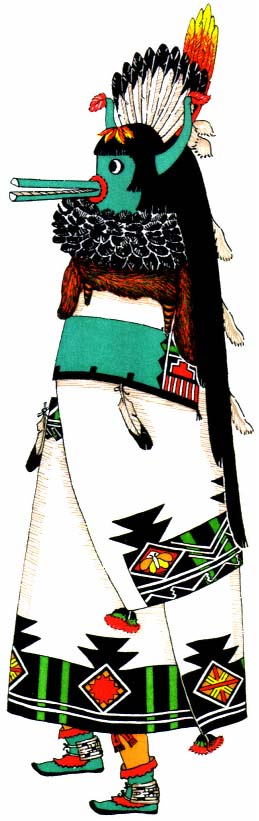
Plate 7.
Zuñi Shalako, one of six giant messengers of the gods. This ten-foot
effigy is balanced on a pole above the impersonator, who peeps
through an opening between the top of the ceremonial blanket,
used as a skirt, and the folds of the overlapping mantle.
be produced from the yucca plant. This "yucca fiber, alone or in combination with cotton, was of great importance as a weaving material. The fur of beaver, otter, or rabbit was incorporated with yucca cord or twisted around it to make warmer or more ornamental fabrics."[4] Even today the leaves of the yucca are softened by boiling with cedar ash, and when cool are drawn between the teeth in order to separate and cleanse the fibers. When soaking makes them pliable for use, they are rolled into rope or spun into a stiff thread for weaving.[5] Prehistoric remains have yielded us examples of bags, sandals, sashes, crude kilts, and clouts thus fashioned. Cedar bark was shredded and plaited and doubtless served the same purpose. Rabbitskins were cut while green into thin strips, and after drying and curing were woven into blankets and mats.
Materials so produced, however, were rough and clumsy: it was the use of cotton which introduced cloth and garments of an advanced kind. "Throughout the first four Pueblo periods cotton was the staple product from which cloth fabrics were made."[6] Cotton cloth has been unearthed in prehistoric ruins and burial places.[*] Cotton was grown wherever it could be cultivated, over almost the entire Southwest from the San Juan River on the north as far west as the Colorado and along the Rio Grande to the east.[7] In 1540 Coronado and his followers recorded its growth among the Tewa and its use at Zuñi[8] . By 1582 we learn from Espejo and Luzán[9] that it was in use among the Hopi, where, if we may judge by the great number and the beauty of the blankets displayed to them, weaving from cotton was undoubtedly a craft of long standing and high development.
About this time, also, feather mantles were in use. They were made by tying long eagle feathers in horizontal rows to a cotton base, in the process of weaving (pl. 2). The downy feathers of the eagle, the duck, and the turkey were twisted into the yarn in the process of spinning and this resulted in a cloth with a furry surface.[10]
* For example, on a body found in Cañada del Muerto, Arizona. The inner wrapping consists of two white cotton blankets, outside of which is a fine feather blanket bound by hanks of cotton yarn. Burial date, ca . 1000 A.D. Exhibit, Museum of Natural History, New York.
The Spaniards introduced sheep among the Pueblos, and thenceforth throughout their historic period woolen yarn and cloth played an important part; for all practical purposes woolen cloth replaced the former skin garments and the feather and cotton textiles. Cotton, however, has always been retained as a special ceremonial material, and it was always an article of luxury because of the small quantity which could be gathered within a single year and the tedious labor required to prepare it for use. Although it is not now grown, raw cotton and cotton batting are still sold to the Indians to be spun by hand into thread and woven by hand into cloth for certain sacred garments.
We are mainly concerned with the two fabrics, cotton and wool, which make up the principal woven articles of clothing.
Formerly this cotton (technically known as Gossypium Hopi Lewton), grew wild,[11] a small boll with a tawny fiber. Later it was cultivated.[12] "The cotton seed was planted in holes about one and a half inches deep and covered with white sand. The garden patches were divided into sections about a foot and a half square by little dirt borders to make watering easier."[13] The bolls were picked, broken open, and the fiber sorted, cleaned, and straightened by hand. This cotton was a distinct species with plants presenting ripened bolls within eighty-four days from the time the seeds were planted.[14]
Wool, after it was cut from the sheep, went through the same hand process of sorting, cleaning, and straightening, although it was often washed with suds made from the yucca root to remove all dirt and animal grease. With the coming of civilization the commercial wool card, a combing and straightening instrument, was introduced. This prepared the fibers of both cotton and wool[15] for spinning.
Spinning.
—The process of spinning produces a thread capable of being woven. The native spindle has a cylindrical wooden shaft about twenty inches long with one end rather sharply pointed. A whorl, or circular disk, of stone, bone, or wood is slipped over this shaft midway between
the center and the butt end. This acts as a flywheel and also serves to keep the yarn on the shaft. The spinner "takes one end of the roll of combed fleece in the left hand and holds it against the point of the spindle, rapidly revolved by the right hand, until it catches and twists spirally down the spindle shaft, the butt of which rests on the ground. As the loose roll twists around the spindle it reduces rapidly in size. The reduction is increased by drawing the thread away from the spindle with fairly

Figure 5.
Spindle, with yarn below disk. The disk is made of
born, bone, stone, or wood, with a shaft of wood.
hard jerks. When a section has been brought to a quite small diameter it is allowed to roll up on the spindle shaft, after which a fresh arm's length is drawn out for spinning. When the spindle is full the yarn is removed and rolled into a ball....
"The yarn produced by the first spinning is very coarse, lumpy and uneven, so that it has to be respun a number of times before it is fit for weaving. The finest and hardest yarn, used for warp, must be spun as many as six times."[16]
Good, hand-spun cotton produces a beautiful, coarse, irregular, creamy yarn. The woolen yarn is soft and lumpy. The differences in these yarns produce corresponding differences in the appearance and texture of the woven fabrics.
Weaving.
—Weaving is done on a hand loom of the two-barred type, which is set up in the kiva or in the house. In all probability this loom originated either in Peru or in Middle America,[17] and thence was introduced among the early Pueblos. It is always associated with cotton, and cotton is associated with corn in the most generally accepted theory of the New World origins of agriculture.
To prepare the warp a frame is made, consisting of two square side bars and two round end bars. The yarn is tied to one end bar, then strung from the ball in a series of figure 8's over the end bars until the required width of warp is obtained. These loops are called sheds. The side bars are then removed and the end bars replaced by loom strings, which are fastened to the loom poles by heavy cords wrapped spirally between the warps. A simple support is made by fastening a crossbar to the roof beam or to hooks in the wall. From this hangs the yarn beam, a small pole held in place by a rope wound spirally around the two. The tension of the warp can be adjusted by tightening or loosening this rope. The upper loom pole is now swung from the yarn beam by a series of loops, and the lower pole is fastened at the bottom to another beam, which in turn is secured to pegs in the floor or specially made sockets.
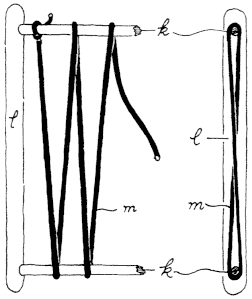
Figure 6.
Warp setup on end bars. Side bar l holds end bars k in position
so that warp m can be wrapped around them in figure-eight
loops. The first sketch, front view; second, side view.
For weaving, a shed rod is placed in the upper loop to retain the original order and to separate the lines of warp. Loosely tied to the front threads of the lower shed is a heddle rod, by which the alternate series of warp threads can be drawn forward, allowing a passageway for the shuttle or bobbin carrying the weft or filler which completes the fabric web. This passage is further opened by the use of a batten, a smooth,
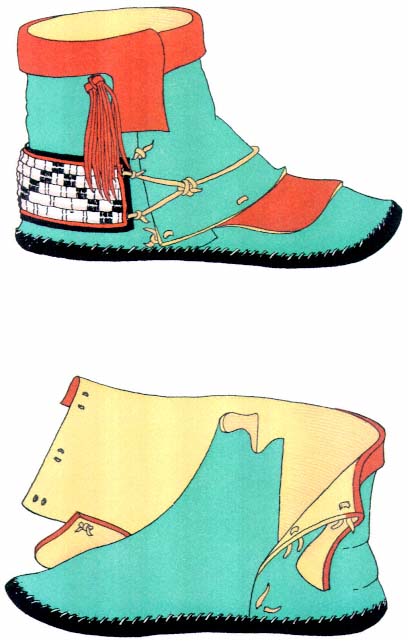
Plate 8.
Special two-piece dance moccasin. Heelpieces are
wound with white porcupine quills and black horsehair.
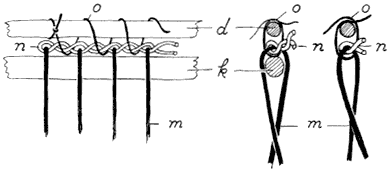
Figure 7.
End bars replaced by loom strings. Heavy cord n is twisted
between the warps m. Loom poles are tied to this twisted
cord by twine o. The end bars k are then removed.
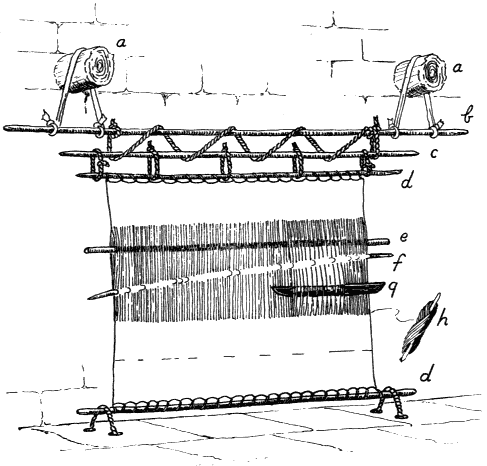
Figure 8.
A two-barred loom. A dress is being woven.
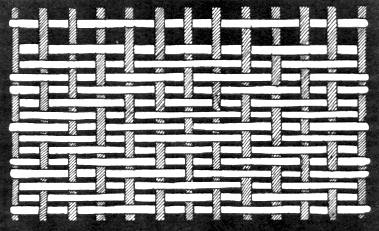
Figure 9.
Diamond twill.
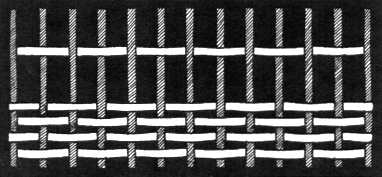
Figure 10.
Plain weave.
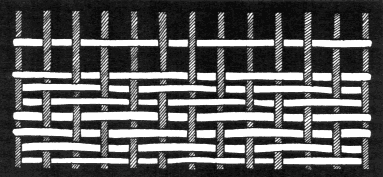
Figure 11.
Diagonal twill.
thin board with beveled edges, which is threaded between the warp and by a dexterous twist holds the shed open by its width. The weft is then beaten down with the same tool.[18] Self patterns and surface textures result from use of the different weaves and depend upon various heddle setups. A plain weave is the simplest and undoubtedly was the first ever to be
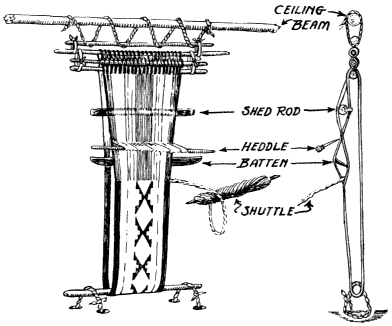
Figure 12.
Belt loom.
adapted to a loom. A simple 'over one, under one' formula produces a fabric in which each thread of weft intersects that of the warp on the same vertical line and both are equally visible.
A similar setup in which the weft becomes the dominant element and is pressed down so tightly that the warp is hidden is called a tapestry weave. This produces a firm, stiff fabric. Designs are effectively made by varying the number of warp threads behind which the weft is allowed to pass, a method called warp floating. This is done with the fingers, without the use of a heddle device. The designs are always limited by straight lines, which tend toward a constant repetition of a unit figure.
Pueblo examples of this technique are the belts, sashes, and garters. For these a smaller loom is required, which also differs slightly from that used for large fabrics. It is called a belt loom.[19]
A twilled basket weave is produced when each line of weft intersects the warp at constantly varying points, or when the regular alternation of the point of intersection produces ribs which trend diagonally across the face of the fabric. The width of the stitch may vary; but at least every other stitch must be two or more warp strands in breadth in order to provide for the alternation of the intersections in regular order. This makes the twill.[20] Two variations of this method are to be observed: a diamond twill, in the border of women's dresses, and the diagonal twill, often seen in maidens' shawls.
A brocade weave is used to decorate the ends of a special sash for men. This is made by the Hopi. The result simulates embroidery, but the method is weaving. It consists of a secondary or overlaid weft which is woven through the warp independent of the original weft. Color is introduced in this second thread, and by picking out certain warp threads with the fingers or by substituting another color simple designs are made. These are restricted, however, by the right-angled intersections of the loom setup.[21]
The Hopi of today is the Pueblo 'textile manufacturer'. He is the master craftsman and trader. From his villages on the three mesas overlooking the Painted Desert he carries on an extensive trade with the Zuñi and the Rio Grande Pueblos, who depend upon him almost entirely for their native textiles. In exchange for their turquoises, shell necklaces, and money he gives them dresses, robes, kilts, and belts, which they in turn "embellish with embroideries to their individual liking."
There is evidence that weaving was done in other pueblos. The Zuñi still produce some dresses, belts, and blankets.[22] It is known that loom weaving was practiced by the Acoma, the Santa Clara, the Nambé, and
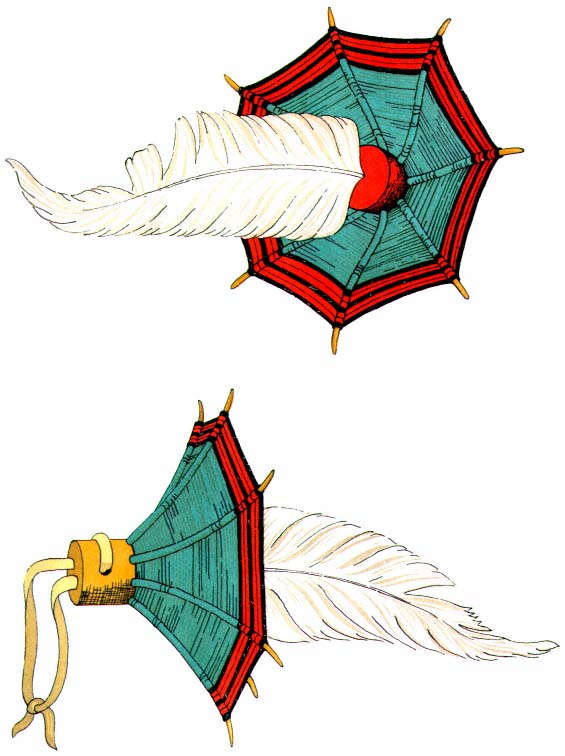
Plate 9.
Squash-blossom ornament used on headdresses and masks.
the Cochiti. However, these all depend upon Hopiland for those sacred garments which they carefully preserve for use on days of ceremony and entertainment.[23]
With very few exceptions men are the weavers[*] among the Pueblos.[24] They also make moccasins and the turquoise and silver jewelry, while the women make the pottery and weave the baskets.