
2. Challenges to Israeli Democracy
7. The Communal Split
The major cleavages in Israel illustrate the interplay of tradition, ideology, and modernization. They also illustrate the successes and failures of power-sharing based on consensus rather than undiluted majority rule, which is in theory more suitable to deeply divided societies like Israel. Israel is marked by a communal division between Jews of European background and those from the Middle East, Africa, or Asia, by a religious division between Orthodox and non-Orthodox Jews, and by an ethnic division between Jews and Arabs. The “Jewish” patterns of politics play out differently in these three different contexts, covered in the following three chapters: the comparison helps show where such patterns are relevant and where they are not.
Division among Jews from different communities is an inescapable result of Jewish history. Since the inception of Zionism, Jews have immigrated to Palestine or Israel from over a hundred countries of origin, bringing with them vast cultural, social, linguistic, and—by some definitions—ethnic differences. The most obvious distinction is between “Western” Jews from Europe, the Americas, or British Commonwealth nations, and “Eastern” Jews from Asia or Africa. This corresponds roughly to the traditional division between “German” (Ashkenazi) and “Spanish” (Sephardi) Jews. Ashkenazi Jews trace their origins and language (Yiddish) to medieval Germany and were concentrated historically in Eastern Europe, especially Poland and Russia, where by the late nineteenth century they constituted about 90 percent of world Jewry. Sephardi Jews are by strict definition the descendants of Jews forced out of Spain in the fourteenth and fifteenth centuries (most notably in the 1492 expulsion), who were dispersed around the Mediterranean world and often spoke a Spanish dialect (Ladino).
These traditional terms have been applied in Israel to the division between West and East: Jews of European cultural background are labeled “Ashkenazim,” while those of non-European background are referred to as “Sephardim” or as “Easterners.” The terms do not really fit; some European or American Jews are actually Sephardim, while many Jews in the Middle East, Asia, and North Africa were not linked historically with either Ashkenazi or Sephardi dispersions. But whatever terms are used, there is a very real division between Jews whose background was European—including the Eastern European and American variants—and those, largely from the Middle East, who came from a non-European (usually Islamic) environment. It is a bit superficial to divide Jewish Israelis simply into Western Jews and Eastern Jews, but the division is a reality in the life of the country and in struggles over secular ideas and particularistic tendencies.
The potential for conflict among Israeli Jews from different backgrounds should not be underestimated. European Jews founded the Zionist movement, dominated it, and overwhelmed the long-existing Sephardi community in Palestine. They imposed their institutions and values on the politics, society, and culture of the yishuv (the Jewish community in pre-1948 Palestine) and the State of Israel, assuming that Jews from “backward” nonEuropean areas would simply have to adjust to the established order. The bulk of Asian and African Jews, on the other hand, arrived on the scene only after the state was established, often as uprooted refugees who had been stripped of their property and other resources. Initially the gap—economically, socially, politically, or on any other dimension—was enormous, and resentment was further fueled by attitudes of paternalism and contempt for non-European culture on the part of the Ashkenazi elite.
| • | • | • |
The Reality of the Gap
Jewish-Arab differences are usually characterized as an “ethnic” division. That being the case, then for the sake of clarity differences among Jews should perhaps be termed “communal” or “subcultural” rather than ethnic. The difference may only be one of degree, but the interactions between Western and Eastern Jews are marked by less rigid boundaries, more common bonds, and less fundamental conflict than is usually associated with “interethnic” relations.[1] In any event, in this study Arab-Jewish differences are termed an “ethnic” split, while divisions between Western and Eastern Jews are characterized as “communal” (which is also the term used in Hebrew).
This is not to minimize the differences between the two communities. Jews of European ancestry had both different cultural baggage and a different ideological point of departure from their Middle Eastern counterparts. This starting point was their “pioneering, revolutionary orientation largely couched in Western secular terms” and aimed at creating a new kind of Jewishness, in contrast to the continuing adherence of non-European Jews to the Jewishness they had always known.[2] Not having been shaped by the currents of Western modernism, Jews from Asia and Africa were still attached to custom and ritual and viewed Zionism as, if anything, a reinforcement of traditional Jewishness rather than a revolution against it.
There was also an important difference in the time and character of the Western and Eastern immigrations. The European Jews in the early aliyot (waves of immigration) did not arrive as communities including all elements from the most traditional to the most radicalized. They were in large part an intellectual vanguard, highly Westernized and fairly unrepresentative of the Jewish world. Their Zionism was expressed in the secular language of European liberalism, nationalism, and socialism. As Conor Cruise O’Brien remarks, “it was not in practice possible for Zionists of European origin to teach Zionism to Orientals [Eastern Jews] without also trying to Europeanize them.” [3]
As the dominant element among early Zionists, European Jews established their own style as the accepted model for becoming a Zionist or, eventually, an Israeli. Apart from the universalistic elements of this style, many features of it were actually quite specifically Eastern European, though its practitioners often did not realize the extent to which this was true. Consequently a process of “Ashkenazation” became a norm to which Jews of other backgrounds were expected to adjust, abandoning their “primitive” folkways for the more progressive patterns to which they were now exposed. The cultural linkage of most Eastern Jews to Middle East societies was also a factor, since the Arab-Jewish conflict also increased hostility toward Arab culture. The attitude of veteran settlers was expressed in a Western-oriented educational system that ignored the heritage of Middle Eastern Jews and dismissed non-Western cultures.[4]
The starting point for Middle East Jews was quite different. Most came in mass migrations of entire communities in which the more traditional segments were not only fully represented but in some cases overrepresented. In North Africa, much of the educated elite moved to France while the bulk of the community immigrated to Israel. And of course these communities were far more traditional anyway, not having been deeply touched by Westernization or modernization.
The Zionist movement began in Europe and was dominated by Eastern European Jews. But that does not mean that Zionism, in the sense of a love of Zion and the idea of a return to Zion, was less intense among non-European Jews. Sammy Smooha points out that on a per capita basis, Iraqi Jews contributed to Zionism two to three times as much as Polish Jews in money and in immigrants during the Mandatory period.[5] European Jews dominated Zionism because they constituted 90 percent of world Jewry, not because they gave the movement greater proportional support. But while European Zionists formulated their program in the language of liberal democracy and national self-determination, Middle Eastern Jews had a more messianic vision expressed in traditional historical and religious terms. In Daniel Elazar’s words, “the former was a Zionism that demanded internal revolution as much as a transformation of the Jewish condition, while the latter was a Zionism of redemption, which sought continuity with a tradition that was not perceived as requiring revolution.” [6] There was never any doubt about the strong Jewish identity of Eastern Jews who arrived in Israel, whether as voluntary immigrants or as refugees, and the centrality of Jewishness on both sides made a “Jewish” approach to their differences inevitable.
In some ways Middle Eastern Jews were closer to the host cultures from which they came, and unlike many European Zionists they felt no ideological compunction to repudiate or reject patterns identified with galut (Diaspora) life or goyish (Gentile) influences. Their traditional lifestyles were not regarded as a threat to the realization of Jewishness; many of these customs and folkways were long identified with the Middle East, of which EretzYisrael was an integral part, and seemed as authentically Jewish as they were authentically Arabic or Islamic. From this perspective Eastern Jews could not really comprehend the upheaval, and wholesale rejection of galut patterns, through which Eastern European Jewry had passed in the late nineteenth century.[7] In the Middle East setting religiosity was simply assumed and woven into the fabric of daily life, while rabbinical leaders retained their customary role as respected elders and leaders of the community. Since religion was not under attack, it remained relaxed and nondefensive, never developing the suspicion of innovation and the fortress mentality that marked the emergence of reactive ultra-Orthodox (haredi) Judaism in Europe.[8]
The result was a dichotomization along Western/Eastern lines; differences among various groups on both sides were subordinated to the central feature of European or non-European cultural background. European Jews stereotypically lumped all others together as “Sephardim,” whether accurate or not, obscuring specific community differences and legacies. Similarly all Western Jews became “Ashkenazim.” The great divide also corresponded to those whose specific cultural traditions were associated with “Israeliness” and those who were expected to adjust to this model. As noted in a number of studies, this was to some extent even internalized by Eastern Jews, leading to self-rejection and denigration of their own traditions.[9]
A number of objective realities reinforced this dichotomization and the inferior status assigned to Eastern Jews. Most Middle Eastern immigrants came into an already existing system, and as newcomers were forced to start at the bottom of the ladder. Most lacked the educational background or skills that would have enabled them to compete successfully in the new setting, even against European immigrants, and certainly not against veteran settlers with their mastery of the language and the system, their established networks, and their accumulated resources. The dispersion of many Middle Eastern Jews to development towns on the periphery deepened their isolation and limited their mobility. At the same time the large influx of Eastern Jews in the 1950s, as Israel tripled its population within a decade, helped bring about mass upward mobility among Western Jews who moved up on the social ladder in a process of “deproletarization.” As Smooha notes, “the substantial mobility of Ashkenazim was predicated on the channeling of Oriental newcomers to the lower rungs of society.” [10]
This link between the Western/Eastern split and socioeconomic status has proved to be persistent over time, in contradiction to the long-dominant “nation-building” paradigm that postulated the “absorption” of all immigrants into a modernizing society. In retrospect this model appears Eurocentric and overly rational, ignoring the forces that work to perpetuate a gap between the two communities.[11] Despite signs of greater cultural similarity, evidence indicates that socioeconomic differences have been passed on from generation to generation. The lower levels of society remain overwhelmingly Eastern, despite the influx of immigrants from the former Soviet Union, while European Jews are overrepresented in the middle and predominate among the elite. While Eastern Jews have advanced in absolute terms, European Jews have in some ways advanced more. There has been a certain homogenization within each major community, with differences between subgroups (Moroccan and Iraqi Jews, or Polish and Romanian Jews) becoming less distinct. Most but not all of this seems explainable by the usual mechanisms that tend to reproduce class differences: disparities in family size, social environment, and access to opportunities, together with lack of effective intervention to overcome these structural impediments.[12]
This persistent gulf is less apparent in income than in other measures. By 1994 the average income of Jews born in Asia and Africa was actually higher, at 112.5 percent, than that of Jews born in Europe or the Americas, against only 65 percent in the 1956–1958 period and 80 percent in the 1978–1980 period.[13] (The 1994 income of European Jews was, of course, somewhat deflated by recent immigrants from post-Soviet states.) But differences in housing density, for example, were still substantial despite the influx of Russian Jews at the bottom; the average density for Israeli Jews born in Asia or Africa was 1.04 persons per room, while the density for those from Europe or the Americas was .88 persons per room.[14] In education, Western Jews on the average had about three more years of schooling than Eastern Jews in the late 1970s and still 2.4 more years in 1988, and this figure was back up to 2.8 years in 1993 after the immigrant influx. In the late 1970s Western Jews were five times as likely as Eastern Jews to have studied at a university, and this figure remained almost as high in 1994.[15]
The continuing disparities between the two communities, correlated with socioeconomic class, became a greater cause of resentment as expectations changed. As living standards improved generally and Eastern Jews themselves became “old-timers,” remaining inequalities were more visible and less easily tolerated. This was particularly true of the second generation of Eastern Jews, born in Israel, who were much less patient with handicaps that could no longer be dismissed as the fated destiny of newcomers. Those raised in Israel were more sensitive to the structural disadvantages they faced, in comparison with Jews of European background, especially given the official egalitarian ethos and their potential numerical strength (constituting, by most definitions, over half of the population by the 1980s). This created a level of intercommunal tension, usually submerged but occasionally erupting, that was a serious source of social conflict.[16]
| • | • | • |
The Ideology of Integration
Despite the persistence of the communal split, a strong sense of common Jewishness on both sides of the divide outweighed subgroup identities in most contexts. The importance of this shared Jewishness was greatly reinforced by the existence and intensity of the conflict between Israel and the Arab world and the fact that many Eastern Jews were refugees from Arab lands.
Jews of all backgrounds share a common religion (with minor differences between Ashkenazi and Sephardi practices), some common traditions, and by and large the sense of a common history. They also had in common strikingly similar experiences as a minority in a non-Jewish context, whether Christian or Islamic, and most of those who reached Israel, from West or East, shared the refugee experience. Jewishness had been central to their identity in nearly all countries of origin, and certainly no less so in the Middle East, where group identity was central, than elsewhere. All new Jewish Israelis could immediately relate to national symbols and myths, in everything from language to the holiday calendar, as well as a sense of shared fate in a critical struggle with a common enemy.
Contrary to some impressions, Jews outside the European orbit were not less receptive toward Zionism. They understood it, however, in terms of a traditional return to Zion rather than as a reaction to Diaspora existence or as a rejection of the Jewish past. Unlike the pious Ashkenazi Jews in the old yishuv, they had no ideological problems with Zionism as such or with participation in Zionist undertakings. As noted, in some cases they contributed more to Zionism on a per capita basis than did their Western counterparts. The role of non-European Jews in early Zionism was to some extent obscured by their smaller numbers in absolute terms, by the nature of their immigration (a slow, steady flow rather than waves of communities), by their joining urban communities rather than the agricultural settlements at the heart of the new yishuv, and by their lack of connection to “official” Zionist ideology and leadership.
Despite European attitudes of superiority and contempt toward nonEuropean cultures and immigrants,[17] the universal goal of integration, accepted by all parties, limited the scope of conflict and helped define methods for dealing with it. The ideal of mizug hagaluyot (integration of exiles) was universally accepted as a point of reference. Thus Western Jews were ready in principle to co-opt Eastern leaders into the system, and both sides tended to avoid group bargaining that might have suggested the permanence and sanctification of communal divisions. This may be the most decisive factor in the way the system has handled communal divisions: such divisions were regarded as transitional. It was easier to deal with a division that is seen as an artifact of history, and not as a legitimate and substantive split to be perpetuated in the institutions of the nation. Whatever the relative impact that European and Middle East inputs come to have on the final product of integration, striving to realize a common Jewishness is not challenged. Given the centrality of immigration to the raision d’etre of Zionism itself, the failure to achieve social equality in the course of time between Jews from East and West would be perceived by those on both sides as a failure of the entire enterprise.[18]
Consequently, demands of Eastern Jews do not focus on the perpetuation of differences. As Smooha has noted, “My survey of pronouncements by Oriental spokesmen, ethnic publications and programmes of ethnic election lists shows a broad consensus with the established ideologies. The stated target is definitely ethnic integration, and separatism is out of the question. The emphasis is on uniculturalism with minor subcultural pluralism.” [19]
This acceptance of integration as the desired goal has been matched by an expectation, perhaps unrealistic, that a fusion of the communities would indeed take place fairly quickly. In a 1967–1968 survey, 86 percent of Eastern Jews and 81 percent of Western Jews felt that significant differences between the two groups would disappear within twenty years.[20]
The “subcultural pluralism” to which Smooha refers has become more of an issue as Easterners strive for better recognition of their particular Jewish cultures, within the framework of a shared “Israeliness.” Even in this regard there is no strong ideology behind the preservation of particular cultural legacies from countries of origin (except, perhaps, in the religious sphere). If earlier European settlers brought such legacies with them, it was not done as a matter of belief or even done consciously, but was more a matter of habit and inertia. But growing awareness of such differences has led to de facto acceptance, and even encouragement, of particular traditions in folklore, music, and other areas of popular culture, as part of a broader shift in recognizing the legitimacy of the non-Western Jewish experience.[21] This remains, however, a consensus for pluralism on a relatively superficial level; on a more basic level both sides share a developing core culture that is basically Western in political and legal norms, consumerism, patterns of leisure activity, the role of mass media, and other important features.
Also, while communal differences do often correspond to class differences, there are cross-cutting affiliations that undermine the East/West division. Middle Eastern Jews may be disproportionately religious, but the Israeli-born generation is markedly less so and European Jews run the spectrum on religiosity. Given the greater prominence of religious issues (see chapter 8), such divisions often supersede communal distinctions. Both communities also represent a variety of political views, even if not in the same proportions; few political parties have focused exclusively on one community, and European Jews are again disproportionately represented on the two ends of the spectrum, accounting for most of both the extreme doves and the extreme hawks. On economic and social issues, as well, both Eastern and Western Jews are likely to find themselves divided from many in their own community and allied with some in the other. In the inclusive picture, other cleavages help to break down the boundaries between Jews from differing backgrounds or at least reduce them to secondary importance (the contrast with the Jewish-Arab division is striking).[22]
The centrality of the security threat is perhaps the most important mitigating factor. The Arab-Israeli conflict is a “cross-cutting affiliation” that put all Jewish Israelis, whatever their background, on the same side of a deep chasm. The perception of a threat to existence makes other issues appear inconsequential, if not trivial, in comparison. Not surprisingly, surveys taken during wartime or crisis periods have shown surges in feelings of communal solidarity.[23] Furthermore, the existence of the conflict and of an Arab minority within Israel enabled Middle Eastern Jews to be part of the majority on the really critical issues, and impelled them to demonstrate distance from an enemy with whom they had cultural similarities. In addition, their experience as refugees created by the Arab-Israeli conflict embittered many Middle Eastern Jews and further reinforced their hawkishness on issues related to the conflict. In Smooha’s survey, for example, 72 percent of Eastern Jews, but only 48.6 percent of European Jews, fell on the hawkish side of the spectrum as “hard-liners” or “exclusionists,” while in a study by the Israel Democracy Institute the mean score on a scale of hostility toward Arabs was 69 percent among Eastern Jews and 46 percent among Western Jews.[24]
The experience of facing a common threat, together with other reassuring developments over the course of time, eroded the fears some European Jews had expressed about the “Levantinization” of Israel. Consequently, overt prejudice and discrimination also diminished over time. Middle Eastern customs that had at first appeared threatening became less so with familiarity, and many accepted the notion that integration might entail synthesis as well as assimilation (for example, festivals associated with particular communities, such as the Moroccan mimouna, became a legitimate part of public life). But the bottom line was that such differences were tolerable because, in contrast to similar situations elsewhere and to the Arab-Jewish division, no strong forces in Israel were working to perpetuate the basic distinctions with which they were associated.
Most recent studies, in the words of one review, present “an array of evidence for homogenization and social fusion of European and Afro-Asian Jews.” [25] Middle Eastern Jews, by integrating into Israeli life, have acculturated to Western society. Families have become smaller and less patriarchal; fertility rates have decreased; women have entered the job market; “Western” consumer patterns and leisure activities have been adopted; religious observance and traditional customs have declined.[26] Differences remain, of course: residential patterns are still segregated to some degree, religious observance and traditional gender roles are still stronger among Eastern Jews, and families are still somewhat larger.[27] But the “social distance” between the two communities has diminished dramatically. For example, the percentage of high school students with reservations to “intermarriage” between the two communities dropped from 60 percent in 1965 to 21 percent only ten years later; in 1991 only 6 percent of an adult sample opposed marriage of their son or daughter to someone from a different community.[28] Other measures of intercommunal contacts and friendship show similar change. Strikingly, in a 1981 survey 69 percent of Eastern Jews said they were not being discriminated against, even though only 50 percent of Western Jews shared this belief.[29] Thus it is not surprising that communal identity is not considered very important to most Israelis; when asked recently to rank nine different components of collective identity, only 2.7 percent ranked their communal identity first, while 75.3 percent said it was not important at all.[30]
Some analysts have even concluded that the category of Eastern Jews is a “phantom,” since it is not based on significant observable cultural differences.[31] Not only do the general categories of Western and Eastern Jews lump together different groups, but the rapid assimilation to prevailing Israeli values and lifestyle has, in this view, removed all meaningful differences on the general level. The younger generation of Eastern Jews, in particular, appears to an anthropologist or ethnographer to be indistinguishable from its counterparts of European origin in any respect that would be considered culturally significant.[32] In some ways this is not reassuring, as it may be taken to imply that gaps remaining between the two communities cannot be explained as a product of objective cultural differences but only as the result of discrimination that persists despite the disappearance of any basis for discrimination. It may even be, as the “theory of perceived inequality” would have it, that the decline of real cultural differences sharpens the perception of inequality and the sense of outrage at such discrimination, intensifying frictions rather than relieving them.[33]
What seems most likely, however, is that the linkage between communal identity and class will continue to blur, with socioeconomic status gradually becoming independent of origin or background as these factors become less visible. Already much behavior associated with the Eastern working class seems more working class than Eastern, and there may be an emerging working-class culture cutting across communal lines; increasingly, “Israelis in the same socioeconomic level think and behave in the same way.” [34]
The ultimate outcome may be foreshadowed in the increasing rate of intermarriage between Jews of Western and Eastern background. Marriages between persons born in Europe or North America, or whose fathers were born in Europe or North America, and persons born in Asia or Africa, or whose fathers were born in Asia or Africa, have increased steadily over the years and in the 1975–1979 period stood at 20.0 percent of all marriages (a purely random distribution of marriage partners, it should be recalled, would raise this only to about the 50 percent level). By 1986, this percentage had increased to 24.3 percent.[35] Intermarriage in itself does not guarantee the disappearance of distinct communities; Calvin Goldscheider points out that it can even reinforce these identities when out-marriage involves mainly the more loosely affiliated and leaves a core of the more strongly identified.[36] By 1994 fully 61 percent of Israel Jews were actually born in Israel, and even if “origin” is defined as the father’s place of birth, fully 24 percent were Israeli by origin, 36 percent were from Asia or Africa, and 40 percent from Europe or the Americas.[37] Given these trends, statistics over communal differences become less reliable and less meaningful as an index of what is happening.
| • | • | • |
The Political Response
Given the potentially disruptive impact of the communal division, the Israeli political system has avoided the worst. With some delay, Eastern Jews have gradually been integrated into Israeli politics and are no longer grossly underrepresented in the corridors of power. Despite their arrival in an already established system, their lack of prior experience in democratic politics, and weaknesses in organization and leadership, Sephardim have become an integral part of the system and key players within it.
In contrast to the situation on the religious-secular front, this integration was not achieved by classic consociational methods of power-sharing; that is, by social bargaining and diffusion of power among contending elites (the rise of Shas, as a party representing Sephardi interests, is an exception to this statement). Before the rise of Shas there was little bargaining with and accommodation of Middle Eastern Jews as a group. Nevertheless the process of integration did reflect Jewish habits of communal solidarity, inclusion, informality, and compromise. Entrance into politics has usually proceeded on an individual rather than a collective basis, often by a process of co-optation, which was a hallmark of traditional Jewish politics.
Power-sharing between Western and Eastern Jews was institutionalized in only one limited sphere, in election of both Ashkenazi and Sephardi chief rabbis and a Chief Rabbinical Council explicitly composed of equal numbers from each community. Even this dualism is limited, extending to the election of two chief rabbis in the larger towns but not to most other religious offices and bodies. The official recognition of communal division in the religious hierarchy has a certain legitimacy because of long-standing historical differences between the two traditions in some matters of religious practice and because of the prior existence of a Sephardi rabbinate, recognized by the Ottoman government, before Ashkenazim arrived on the scene in large numbers.
Group bargaining might have suggested the permanence and legitimization of communal divisions generally, outside the religious orbit, and both sides hesitated on this score (apart from the fact that Eastern Jews were initially not organized for such bargaining). Instead, when discontent erupted (as with a “Black Panther” movement in the 1970s), the tendency was to look for ways to bring the outsiders into the system. One observer, discussing the response to those group protests that were made, identifies a number of typical measures: the protest is allowed, symbolic reassurances are given, benefits are dispensed, and some of the demands are actually fulfilled. At the same time, group protests were undercut by the upward social mobility and co-optation of their leaders.[38]
These responses are, however, reactive and piecemeal. Political representation lagged far behind reality both demographically and in comparison to progress in reducing the gap in other areas. Even reduction of economic differences proceeded more quickly; in the late 1970s Smooha could still note a “striking imbalance” between the achievement of material progress by Eastern Jews and their lack of success in gaining political power.[39] Their earliest success began in the development towns, where they constituted an overwhelming majority; from the 1960s Middle Eastern Jews began to dominate local council and mayoral elections in these areas, but they remained vastly underrepresented on the national level.
To use Knesset membership as an index, only 6 percent (seven seats out of 120) in the First Knesset (1949) were of non-European origin, and in the Eighth Knesset (1973) this had risen to only 10 percent (twelve seats)—at a time when Eastern Jews outnumbered Western Jews. This number rose to twenty-three with the electoral “upheaval” of 1977, and thereafter increased steadily: thirty in 1981, thirty-two in 1984, thirty-eight in 1988, forty in 1992, and forty-one in 1996.[40] By the late 1980s Eastern representation on the ministerial level had also improved considerably. In the government established after the 1988 elections, nine of the twenty-six cabinet posts were held by Eastern Jews, after the 1992 elections the figure was five of seventeen, and in 1996 it was seven of eighteen. Israel has had a Sephardi president, chief of staff, deputy prime minister, Speaker of the Knesset, and chairman of Histadrut. In the economic sphere, Sephardim have served as minister and director-general in the Ministry of Finance, and as managers of Bank Leumi and Bank Discount. Representation in the top echelons of the civil service, Histadrut, party central committees, and other centers of power, while not yet proportionate to numbers in the population at large, also increased substantially.[41]
In some respects the electoral system made it more difficult to increase representation of Eastern Jews on a national level. The single national list puts the focus on national issues rather than communal concerns, and tight control of party lists (at least in the past) made it difficult for Easterners to make good use of their advantage in numbers. Nor did the Eastern community constitute a well-defined voting bloc that could force the parties into intense competition for their favors. The logical response to this situation might be separate Eastern or Sephardi party lists, a strategy for which the system seems designed and the favored approach of other (especially religious) groups. Yet the efforts to establish such lists enjoyed little success in the past; Sephardi lists gained five seats in 1949 and three in 1951, but thereafter failed to win a single seat in elections over the next three decades. Only in 1981 did Tami, a Sephardi religious party, finally win three seats, and in 1984 Shas—also Sephardi and religious—appeared on the scene, supplanting Tami and winning four seats (and subsequently six seats in 1988 and 1992, and ten seats in 1996). Middle Eastern Jews have generally preferred to vote for mainstream parties, which moved to attract their votes by putting Middle Eastern candidates on their own lists, first in a kind of tokenism but increasingly as serious representation. Cross-cutting affiliations also undercut the separate lists, as Eastern Jews were pulled in different directions on religious, ideological, and socioeconomic issues that outweighed the communal considerations.[42]
Eastern Jews did, however, use the electoral system by another route as a vehicle of protest. The alienation of Middle Eastern Jews from the Labor Party, described in chapter 6, led them not to a separate, Sephardi party but to support of the major alternative—Likud—in disproportionate numbers.[43] This was especially true of the Israeli-born generation in development towns, who in the 1970s and 1980s turned in record numbers to the Likud and helped bring it to power.[44] This voting pattern, though sometimes overstated, remained consistent and cannot be explained on the basis of class, age, education, and other variables alone; clearly there was a communal component to it, based on a common belief that the Likud better represented the interests of Middle Eastern Jews.[45] This could, however, be a result of preference for Likud policies as much as a protest vote. Which factor is more important?
Eastern Jews were more hawkish on Israeli-Arab issues. However, they had no particular affinity for the Revisionist ideology of Likud true believers (at least those of the older generation), nor to other aspects of official Likud doctrine. The most penetrating study of the hawkishness of Middle Eastern Jews concludes that socioeconomic facts alone cannot account for it, nor is it a matter of intellectual predilection, but that it must be seen as an expression of discontent: a response to alienation, a path to integration, a bar against further deprivation, and an escape from ethnic identity. The case of Eastern Jews in Israel indicates, in short, “that sentiments, expectations, and frustrations emanating from ethnic affiliations may serve as important factors in determining foreign policy (in this case, hawkish) attitudes.” This is reinforced by the fact that “the object of the hard-line policies is the same people with whom the ethnic groups associated” before acquiring their current status.[46] The predominance of evidence indicates, in short, that communal voting among Middle Eastern Jews in Israel is more a function of domestic issues than foreign policy and that “hawkish” tendencies among this group are not ideologically determined.[47]
Observers tend to describe the political culture of Eastern Jews as nonideological and practical, rather than doctrinaire or dogmatic. Eastern Jews, it is argued, have not opposed peace with the Arab world as a matter of principle, but have focused on security issues to which they are particularly sensitive because of their background as refugees or children of refugees, usually from Arab lands. If they have tended to favor the Likud, it is “because they see in it, rightly or wrongly, a means for social mobility and status attainment.” [48] If they are less willing to contemplate withdrawal from territories occupied in the 1967 war, it is in part because incorporation of the large Arab population there into the Israeli system had the same impact that their own immigration had on European Jews: it gave them massive upward mobility by creating a new underclass of unskilled workers.[49]
The important motivations in Eastern Jewish voting can also be read in the nature of the one party that has established itself successfully on a communal basis. As a religious party Shas appeals to traditional Sephardi religiosity while at the same time avoiding the stigma of separatism that would apply to any nonreligious appeal. By focusing on domestic issues of direct concern to Eastern Jews and taking a pragmatic, centrist, and somewhat vague position on security issues, the party also reflects the agenda of its constituents. The formula has worked very well, enabling a rabbinical leadership of haredi leanings to build a faithful constituency among traditional religious Eastern Jews. Thus, while party leaders do not teach Zionist history or observe Zionist holidays, Shas has never labeled itself as a “non-Zionist” party, and most of its voters are enthusiastic supporters of Israel, who serve in the army (unlike many haredim) and fulfill all other civil obligations. The party platform rejects the secularism of Israel, but not the state itself. Most critically, it treats foreign and security issues as secondary to its main concerns as an ethnoreligious party.[50]
Shas has not taken a firm position, for example, on the central issue of the future of the occupied territories. Party leaders, reflecting their haredi leanings, take the position that withdrawal is permissible if it saves Jewish lives, while party voters tend to be more hawkish, though on anti-Arab rather than ideological grounds. It would therefore be prudent for party leaders to downplay such issues, even if their own priorities did not already dictate this. But they are already focused on other issues, such as funding for their own institutions (including their own school system), that are connected to the renewal and revitalization of the Eastern Jewish community.
The appeal of the Likud to Eastern Jews was noticeably weaker in the 1992 and 1996 elections, with large numbers defecting to parties of both the left and the right. The remaining Likud voters were still predominantly Easterners, but in 1992 the defection of some to Labor helped tilt the overall balance of power.[51] The correlation of voting to communal lines was blurred yet a little more, and the vote for Labor (35 percent from Eastern Jews, 50 percent from Western Jews, 15 percent from those whose fathers were born in Israel) was only a few percentage points from the actual population distribution.[52] In 1996, the separate vote for prime minister and for Knesset led many in the Sephardi community to split their vote, supporting Netanyahu for prime minister but turning to religious parties (especially Shas) in the party vote.
| • | • | • |
Prospects for Synthesis
The communal split in Israel parallels, to a great extent, the clash between the hold of tradition, on one side, and the challenges of both secular ideology and modernization on the other, in Israel’s development. It may even represent the kind of synthesis taking place more broadly: while the impact of ideology on the traditionally inclined was limited and is now receding, more general forces of modernity have replaced it as the main vehicle of civicness and secularization. The pioneer generation of Eastern European true believers may have had limited success in inculcating Labor Zionism among non-European Jews, but in the end television, computers, and Western-style consumerism may do much more to weaken customary patterns and lifestyles.
In other words, Western (or “Ashkenazi”) culture will continue to dominate in Israel, even after the reassertion of tradition and of pluralism in which Eastern Jews have played a key role. Though its grip may be loosening, the Western, secular model of Zionism is still the officially sanctioned version taught widely and systematically. The impact of modernization is almost synonymous with the penetration of values and models associated with the West. Furthermore, Western Jews established the overall framework that remains the basic point of reference, and they continue to dominate it in all important respects even as the division between the communities begins to blur. Almost all future influence, support, and immigration from the Diaspora will reinforce this Western orientation, since most Eastern Jews are already in Israel and the Jewish world outside Israel is today concentrated almost entirely in Europe, the Americas, and Commonwealth nations. Even within Israel itself the majority status of Eastern Jews has been reversed by the massive immigration of Russian Jews, and this influx has also undercut the upward mobility of Eastern Jews by sharpening competition for mid-level and professional positions.
The question is whether the underlying trends toward accommodation and assimilation will proceed quickly enough to prevent a buildup, and possible eruption, of discontent based on perceived communal differences. As the categories of “Western” and “Eastern” (or Ashkenazi and Sephardi) themselves become increasingly irrelevant with more Israelis possessing a mixed heritage, discontent will be defined differently. Inequalities and disparities will be expressed more in class or socioeconomic, rather than communal, terms. Or communal differences may meld into the distinction between modernizing “Israelis,” likely to be disproportionately of European background, and more traditional “Jews,” who would include most Middle Easterners (see chapter 6).
This distinction would, however, have to be seen in the context of the strong sense of commonness among Jews in Israel that is apparent in any examination of communal relations. An important index of this has been the use of power-sharing methods common to Jewish experience—inclusion, co-optation, informal bargaining and compromise, toleration of diversity, and appeal to common ties—without needing to resort to more formal consociational procedures (formal group bargaining, guaranteed representation, mutual veto) often used in more serious societal splits. It is also likely that moderation of the Arab-Israel conflict will serve to reduce communal tensions yet further, as Israel reorients itself to an Arab world and culture no longer seen as innately hostile and threatening, improving the status of Eastern Jews and giving them a key role as bridge between the two cultures.
At bottom, the communal split is not a major threat to Israel because both communities regard it as an artificial division that is transitory or at least ought to be transitory. There is no loud call for the preservation of basic cultural differences and no significant opposition in principle to integration of the various dispersions into a common society and culture. The importance of this can be seen by comparison to a sphere in which different worldviews are perpetuated from generation to generation as a matter of deeply held conviction. In dealing with religious divisions, in particular, the powersharing capacity of the system has been stretched to the limit despite the same reality of common Jewishness that tempers communal grievances.
Notes
1. See the discussion in Eliezer Ben-Rafael and Stephen Sharot, Ethnicity, Religion, and Class in Israeli Society (Cambridge University Press, 1991), 8, 45–46.
2. S. N. Eisenstadt, The Development of the Ethnic Problem in Israeli Society: Observations and Suggestions for Research (The Jerusalem Institute for Israel Studies, 1986), 26.
3. O’Brien, The Siege: The Saga of Israel and Zionism (Simon and Schuster, 1986), 347.
4. Moshe Shokeid and Shlomo Deshen, Distant Relations: Ethnicity and Politics among Arabs and Middle Eastern Jews (Praeger, 1982), 5; and Joseph Schwartzwald and Yehuda Amir, “Interethnic Relations and Education: An Israeli Perspective,” in Education in a Comparative Context, ed. Ernest Krausz (Transaction Publishers, 1989), 250.
5. Sammy Smooha, Israel: Pluralism and Conflict (University of California Press, 1978), 366. See also discussion in Bat Yeor, The Dhimmi: Jews and Christians under Islam (Fairleigh Dickinson University Press, 1985), 146–50.
6. Daniel Elazar, Israel: Building a New Society (Indiana University Press, 1986), 158–59.
7. Moshe Shokeid, “A Case of Ethnic Myth-Making,” in Cross-Currents in Israeli Culture and Politics, ed. Myron J. Aronoff (Transaction Books, 1984); see also Ben-Rafael and Sharot, Ethnicity, Religion, 45–46, 222.
8. Shlomo Deshen, “Towards an Understanding of the Special Charm of Religiosity on Eastern Jews” (in Hebrew), Politika, no. 24 (1989): 40–43; idem, “The Religiosity of the Eastern Jews: Public, Rabbis, and Faith” (in Hebrew), Alpayim 9 (1994): 44–58.
9. Judith Shuval, “The Structure and Dilemmas of Israeli Pluralism,” in The Israeli State and Society: Boundaries and Frontiers, ed. Baruch Kimmerling (State University of New York Press, 1989), 222–23; Eisenstadt, Development of the Ethnic Problem, 26; Schwartzwald and Amir, “Interethnic Relations,” 248; and Eliezer David Jaffe, “Ethnic and Minority Groups in Israel: Challenges for Social Work Theory, Value and Practice,” Journal of Sociology and Social Welfare 22, no. 1 (March 1, 1995): 152. On the furtherance of negative images by Middle Eastern Jewish intellectuals themselves, see Sammy Smooha, “The Grand Collapse of the Orientals,” Ha’aretz Supplement (February 3, 1995).
10. Sammy Smooha, “Class, Ethnic, and National Cleavages and Democracy in Israel,” in Israeli Democracy Under Stress, ed. Ehud Sprinzak and Larry Diamond (Lynne Rienner, 1993), 319; see also Shuval, “Structure and Dilemmas,” 224.
11. See the discussion in Smooha, Israel: Pluralism, 21–25.
12. See the studies in S. N. Eisenstadt, Moshe Lissak, and Yaakov Nahon, Communities in Israel and Their Social Standing (in Hebrew)(Jerusalem Institute for Israel Studies, 1993): Smooha, “Class, Ethnic, and National Cleavages,” 318; Smooha, “Jewish Ethnicity in Israel,” in Whither Israel? The Domestic Challenges, ed. Keith Kyle and Joel Peters (I. B. Tauris, 1994), 164, 172–73.
13. Israel, Central Bureau of Statistics, Statistical Abstract of Israel 1995, 331; Ben-Rafael and Sharot, Ethnicity, Religion, 32.
14. The gap was greater before recent immigration from Europe: 1.17 persons per room for Jews from Africa and Asian against .84 for Jews from Europe and the Americas in 1988; Statistical Abstract of Israel 1989, 311; Statistical Abstract of Israel 1995, 341.
15. In 1994, 31.9 percent of Jews from Europe or the Americas had university training as opposed to 7.5 percent of Jews from Asia or Africa. Smooha, Israel: Pluralism, 179; Statistical Abstract of Israel 1989, 601; Statistical Abstract of Israel 1995, 632.
16. Shokeid and Deshen, Distant Relations, 155–57; Smooha, Israel: Pluralism, 182; Smooha, “Class, Ethnic, and National Cleavages,” 324; Sharon Schwartz et al., “Separating Class and Ethnic Prejudice: A Study of North African and European Jews in Israel,” Social Psychology Quarterly 54, no. 4 (1991): 287–98. The Schwartz study demonstrates that communal prejudices remain even when socioeconomic differences are controlled.
17. See the evidence collected in Tom Segev, 1949: The First Israelis (The Free Press, 1986).
18. Pnina Morag-Talmon, “The Integration Processes of Eastern Jews in Israeli Society,” Studies in Contemporary Jewry 5 (1989): 36.
19. Smooha, Israel: Pluralism, 77.
20. Yochanan Peres, “Ethnic Relations in Israel,” American Journal of Sociology 76 (May 1971): 1037.
21. Ben-Rafael and Sharot, Ethnicity, Religion, 30, 227; Morag-Talmon, “Integration Processes,” 33; Shuval, “Structure and Dilemmas,” 222–23.
22. Ben-Rafael and Sharon, Ethnicity, Religion, 116, 214–15, 253.
23. Michael Wolffsohn, Israel: Polity, Society and Economy 1882–1986 (Humanities Press International, 1987), 145–46.
24. The two dovish categories, accounting for the remaining respondents, were “conciliationists” and “pragmatists.” Sammy Smooha, Arabs and Jews in Israel, vol. 1 (Westview Press, 1989), 193; Ofra Mayseless and Reuven Gal, “Hatred on the Rise,” Israeli Democracy (Fall 1990): 23.
25. Walter Zenner, “Ethnic Factors in Israeli Life,” in Books on Israel, ed. Ian S. Lustick (State University of New York Press, 1988), 49.
26. See, for example, the researches cited by Ben-Rafael and Sharot, Ethnicity, Religion, 29; and Schwartzwald and Amir, “Interethnic Relations,” 262; see also Smooha, “Jewish Ethnicity,” 171, and Avraham Diskin, “The Jewish Ethnic Vote: The Demographic Myth,” The Jerusalem Quarterly, no. 35 (Spring 1985): 55; Eisenstadt, Lissak, and Nahon, Communities in Israel.
27. Ben-Rafael and Sharot, Ethnicity, Religion, 30–31; Smooha, “Class, Ethnic and National Cleavages,” 167.
28. Smooha, Israel: Pluralism, 194–95; Shlomit Levy, Hanna Levinsohn, and Elihu Katz, Beliefs, Observations, and Social Interaction among Israeli Jews (The Louis Guttman Israel Institute of Applied Social Research, 1993), B-5.
29. Wolffsohn, Israel, 145–46.
30. Baruch Kimmerling, “Yes, Returning to the Family” (in Hebrew), Politika, no. 48 (March 1993): 42–43.
31. Arnold Lewis, “Phantom Ethnicity: ‘Oriental Jews’ in Israeli Society,” in Studies in Israeli Ethnicity: After the Ingathering, ed. Alex Weingrod (Gordon and Breach, 1985), 150.
32. For example, the conclusion of Orit Ichilov that “Eastern adolescents…do not differ in their civic orientations from the general Israeli public”; Ichilov, “Citizenship Orientations of Two Israeli Minority Groups: Israel-Arab and Eastern-Jewish Youth,” Ethnic Groups 7, no. 2 (1988): 134.
33. Ibid., 134, 136, 145–46; Schwartzwald and Amir, “Interethnic Relations,” 262–63; Smooha, Israel: Pluralism, 149; Eisenstadt, Lissak, and Nahon, Communities in Israel.
34. Smooha, “Class, Ethnic, and National Cleavages,” 323; see also Ben-Rafael and Sharot, Ethnicity, Religion, 29–30, 224; Schwartzwald and Amir, “Interethnic Relations,” 255.
35. Statistical Abstract of Israel 1987, 105. The figures exclude marriages in which at least one partner is a third-generation Israeli or the continent of origin is unknown.
36. Calvin Goldscheider, Israel’s Changing Family (Westview Press, 1995), chap. 10.
37. Statistical Abstract of Israel 1995, 95.
38. Eva Etzioni-Halevy, “Protest Politics in the Israeli Democracy,” Political Science Quarterly 90 (Fall 1975): 514–16.
39. Smooha, Israel: Pluralism, 179–80.
40. Avraham Diskin, Elections and Voters in Israel (Praeger, 1991), 171; Samuel Sager, The Parliamentary System of Israel (Syracuse University Press, 1985), 58–59.
41. Smooha, “Class, Ethnic, and National Cleavages,” 168–69.
42. Hanna Herzog, “Penetrating the System: The Politics of Collective Identities,” in The Elections in Israel 1992, ed. Asher Arian and Michal Shamir (State University of New York Press, 1995), 84–89; Elazar, Israel: Building a New Society, 162.
43. This process is also described in Maurice M. Roumani, “Labor’s Expectation and Israeli Reality: Ethnic Voting as a Means toward Political and Social Change,” in Israel Faces the Future, ed. Bernard Reich and Gershon R. Kieval (Praeger, 1986), 57–78.
44. Efraim Ben-Zadok and Giora Goldberg, “Voting Patterns of Oriental Jews in Development Towns,” The Jerusalem Quarterly, no. 32 (Summer 1994): 22.
45. Diskin, Elections and Voters, 115–16; Yochanan Peres and Sara Shemer, “The Ethnic Factor in Elections,” in The Roots of Begin’s Success, ed. Abraham Diskin, Dan Caspi, and Emanuel Gutmann (Croom Helm and St. Martin’s Press, 1984), 106.
46. Yael Yishai, “Hawkish Proletariat: The Case of Israel,” Journal of Political and Military Sociology 13 (Spring 1985): 63, 70.
47. See also Renee Taft, “Ethnic Divisions in Israel,” in Israel Faces the Future, ed. Bernard Reich and Gershon R. Kieval (Praeger, 1986), 79–92.
48. Smooha, “Class, Ethnic, and National Cleavages,” 323.
49. Baruch Kimmerling, “Boundaries and Frontiers of the Israeli Control System: Analytical Conclusions,” in The Israeli State and Society: Boundaries and Frontiers, ed. Baruch Kimmerling (State University of New York Press, 1989), 272–74.
50. On Shas generally see Aaron P. Willis, “Shas—The Sephardic Torah Guardians: Religious ‘Movement’ and Political Power,” in The Elections in Israel 1992, ed. Asher Arian and Michal Shamir (State University of New York Press, 1995), 121–39; and Willis, “Redefining Religious Zionism: Shas’ Ethno-politics,” Israel Studies Bulletin 8 (Fall 1992): 3–8.
51. Asher Arian and Michal Shamir, “Two Reversals: Why 1992 Was Not 1977,” in The Elections in Israel 1992, ed. Asher Arian and Michal Shamir (State University of New York Press, 1995), 27–39.
52. Ibid., 38.
8. Religion and Politics
It is rare to find a hopeful view of relations between the religious and secular communities in Israel. Both academic and nonacademic analyses paint a dismal portrait of sharpened conflict, unyielding dogmatism, and impending catastrophe. One observer notes that “far more than the Sephardi/Ashkenazi split, the conflict between the varying demands of religious observance is the most potentially disruptive threat to the unity of Jewish Israel.” [1] An academic analyst concludes that the demands of religious parties may be as serious as the Arab threat: “Indeed, the latter groups may be more willing to compromise their demands than the religious parties have ever shown a willingness to do.” [2] An Israeli long active in opposing religious demands states that “we are now witnessing the Judgment Day of the State’s domestic affairs.” [3]
Opinion surveys seem to indicate that most Israelis may feel the same way. In March 1988—soon after the onset of the Palestinian intifada against Israeli occupation—58 percent of a sample of Jews in Jerusalem considered religious-secular relations to be the most critical problem in the city, while only 23 percent identified Jewish-Arab relations as the most critical.[4] In 1991 a national sample showed that 71 percent of the Jewish population thought that religious-secular relations were “not so good” or “not good at all.” [5]
In some ways religious differences do seem less amenable to resolution than other cleavages in Israeli society. The split between Jews of European and those of African and Asian background, though serious and persistent, is regarded by both sides as a temporary phenomenon, the result of historic accident, that will eventually be erased or at least blurred in the forging of a common Israeli identity. The sharp differences between Israelis and Arabs can at least in theory be settled through compromise on the basis of mutual recognition. But religious differences seem less susceptible to such compromise; they are deeply rooted in opposed ways of life that often deny the legitimacy of coexistence and seek to undermine the enemy. Nor are these divisions a transitional phase; different degrees and definitions of religious observance and competing religious authorities have characterized Jewish life over the centuries.
The social distance between the religious (meaning Orthodox in the Israeli context) and nonreligious publics, reinforced by residential concentration and educational segregation, has been amply documented. One study of eleventh-graders in 1973 found, for example, that 65 percent of nonreligious respondents were unwilling to have a religious friend, and 81 percent did not want a religious neighbor; among religious respondents 68 percent rejected a nonreligious friend and 65 percent a nonreligious neighbor.[6] Such attitudes reflect not only the inconvenience of conflicting lifestyles in situations of close social proximity but also the fear that one’s own lifestyle might be threatened by changes in the neighborhood (a problem raised, for example, by the expansion of religious neighborhoods in Jerusalem). From the religious side, it seems normal to maintain sharp boundaries protecting the integrity of religious life, since “separation and distinction are characteristic of the halakhic legal system that lies at the heart of the Jewish world view.” [7]
Religious-secular relations are of special significance for the political system because of the historic blurring of civil and religious matters in Jewish life and the lack even today of strong support for the principle of separation of religion and state. In Jewish tradition, “religious” and “secular” matters overlapped; in fact, the very distinction would have made little sense to pre-modern generations. The weight of tradition was reinforced, in the Zionist and Israeli experiences, by the practical necessity of compromise on religious demands in order to preserve unity. Ultimately, this developed into ingrained habits of coexistence according to formulas that fit neither side’s worldview squarely but also impinged on neither’s basic way of life unduly.[8]
Of course this invites constant struggle and uneasy compromise over the role of religion in politics. But that is hardly novel in Jewish history; in fact, the traditional patterns of accommodation help to explain how the Israeli system has coped with religious cleavages and why these cleavages have not torn the system asunder. Religious politics in Israel, as much as any part of the system, reflect the bargaining pattern in Jewish political tradition. This tradition has enabled Israel to deal with religious division more successfully than most observers would credit, and certainly more successfully than those actively engaged in the conflict would concede.
The resemblance of religious-secular politics in Israel to the consociational pattern has been noted by several observers. Sammy Smooha points to the maintenance of separate institutions, the organization of religious Jews to procure a share of the resources and benefits of government, the ability of religious parties to cast a veto on religious issues, and the general pattern of accommodation and negotiation rather than confrontation and decisive outcomes.[9] Eliezer Don-Yehiya concludes that the consociational democracy model helps to explain, to a large extent, how “the Israeli political system has managed to resolve religious conflicts by peaceful means, while preserving its stability and democratic character.” [10]
In order to appreciate these arrangements, we should first look at the relationship of religion to politics in Israel and compare it to other states. Clearly Israel is not among the states committed to the maximum separation between religion and state (recognizing that even these states—for example, the United States—have never achieved total governmental neutrality toward religion). But neither is the modern Jewish state a theocracy, governed by religious clerics or religious laws. Rather, Israel ranks somewhere in the middle of the spectrum, together with European states that have “established,” state-supported religions but strong respect, at the same time, for religious freedom. Actually Israel does not even have a single state religion, as legally Judaism is but one of fourteen established and state-supported religions (together with Islam, Baha’i, the Druze faith, and ten Christian denominations).[11]
Thus, despite the absence of formal constitutional guarantees, the protection of minority religions is not the major issue; Israeli practice in this regard may even be superior to that of the United States, despite the latter’s written constitution.[12] The main controversy involves the application of Jewish religious law to the Jewish public. Secular Israelis characterize existing arrangements (such as the rabbinical monopoly over Jewish marriage and divorce) as a form of religious coercion. Non-Orthodox Jewish movements complain that only in Israel, among all democratic states, are they subject to legal discrimination. On the other hand, Orthodox advocates argue that without protection by the state (for example, guarantee of the right not to work on Sabbath), those faithful to religious precepts are effectively denied equal rights and full integration into the nation’s social and cultural life.[13]
This debate is complicated by the lack of clarity in Jewish law on its relationship to the state and by preexisting patterns of religious governance in the Middle East that carried over into Zionism and the State of Israel. Furthermore, both major groups within the religious population refused in principle to recognize the supremacy of state law over religious commandments: religious Zionists did so because their Zionism was linked to the state’s religious mission, while non-Zionist Orthodoxy disputed the state’s legitimacy from the outset.[14]
| • | • | • |
Tension between Zionism and Religion
Observers unfamiliar with Zionism’s inner history are sometimes astonished to learn that the movement was not an expression of religious impulses and that it actually developed in an atmosphere of mutual hostility between Zionists and religious authorities.
This antagonism was part of the larger struggle between those seeking to make Jewish communities part of modern secular European society and those clinging tenaciously to Jewish separatism and particularity. As noted in chapters 2 and 3, the Enlightenment and its Jewish echo (the Haskala) had seriously undermined the autonomy of the traditional Jewish community and the role of religious law in Jewish life. In reaction, much of the rabbinical establishment in Eastern Europe turned inward, rejecting the lures of the outside world and focusing religious law (halacha) increasingly and inflexibly on matters of ritual observance.[15]
In this context, Zionism was simply another threat to Jewish integrity from an alien and menacing universe. Religious leaders regarded it, with considerable justice, as a continuation of the secularizing Haskala movement; it was no accident that most early Zionist leaders were maskilim by background. Zionism was part and parcel of the Western secular nationalist tradition. It was a movement for Jewish national self-determination in the same mode as other nationalist movements of the nineteenth century. Furthermore, like other nationalist movements of the period, Zionism was anticlerical, opposed to basing public life on religious principle. Just as the nationalists of Europe sought to liberate themselves from all traditionalism, including clerical control of politics, Zionism sought new political paths free of religious restraints.
Consequently, the established religious leadership opposed Zionism with near unanimity, in defense of both their prerogatives and their principles. Naturally they saw it as a threat to their own position within the Jewish community, where their authority had long been accepted on matters both sacred and mundane. They also opposed it on theological grounds because Zionism aspired to create a Jewish state outside the religious framework, as a result of the endeavors of humankind rather than the intervention of God. They opposed such undertakings as the rebirth of Hebrew as a spoken language, preferring that it remain a sacred liturgical tongue. Traditional religious authorities were the most vocal opponents of Zionism within the Jewish community. While a religious version of Zionism did develop in the early twentieth century, it remained a minority both among Zionists and—until much later in the century—among Orthodox Jews as well.
Secularization of public life, it should be recalled, is a Western invention that does not appear even in Western history before the last few centuries, and it has probably been totally achieved only in a handful of avowedly “materialist” regimes (most of which no longer exist). Historically Judaism viewed itself as a way of life and not simply as a religion (originally there was no word for “religion” in Hebrew). Like Islam, it centered on a code of law that encompassed what we would now consider civil or political matters (consider the Ten Commandments). The traditions of Judaism provide little basis for the modern idea of separating religion and politics.
The same can be said about Middle East custom and practice, embodied particularly in Islam. Islam affirms religion (or what the West calls “religion”) as the organizing principle of state and society. In the Ottoman Empire this link between religion and politics was expressed in the millet system, under which each religious community governed itself in certain respects. Even before the British Mandate in Palestine, the rabbinical establishment in the area exercised certain governing powers within the Jewish community (the so-called “old yishuv ”), particularly in matters of personal status such as marriage and divorce.
The old yishuv was divided between a Sephardi community, led by a chief rabbi, and an Ashkenazi community, with its own rabbinical courts, that was supported by outside contributions (haluka) and led a largely isolated existence centered around acts of piety. Though both groups opposed Zionism, the Ashkenazim in the old yishuv were particularly antagonistic to this latest and most insidious challenge to their besieged way of life. It was this group that set the basic patterns for the non-Zionist and anti-Zionist haredi communities in Palestine and Israel.[16]
In some respects, the division between non- or anti-Zionist haredim and Zionist Jews, religious or nonreligious, was more fundamental than the more common distinction between religious Jews (whether haredi or Zionist) and nonreligious Jews. Apart from a much smaller number on the far left, the haredim were the only Jewish group in Israel outside the “Zionist consensus”; religious Zionists often had more in common with nonreligious Zionists than they did with religious Jews outside the Zionist fold. Despite their shared religiosity, the worldview of those who work fervently for the Jewish state—even one with secular leaders—differs in essence from the worldview of those who view that same state as an alien and illegitimate entity. In contrast to the haredim, religious Zionists stress the national as well as the religious aspect of Judaism, reject separatism as a way of life, and seek in many ways to become part of modern society.
Had members of the old yishuv been the leading element in the expansion of the Jewish settlement in late nineteenth-century Palestine, the governing principles of the new settlement would have been quite different. In fact, the settlers of Petah Tikva, the first settlement outside the old yishuv (1880), drew up regulations making their rabbi sole judicial authority within the settlement, with powers to enforce all religious laws (many of the settlers were from the old yishuv).[17] But the Zionist settlers of the “new yishuv ” did not adopt this model (nor, eventually, did Petah Tikva itself); they made use of experience with self-government in Eastern Europe and elsewhere to create autonomous, but basically secularized, villages and communes. When the new settlers finally convened a body to represent Palestinian Jewry—the Knesiya of 1903—they excluded from the electorate all those who subsisted on haluka, meaning most of those in the old yishuv, though they still constituted the bulk of the Jewish population.[18] Jews in the homeland were now sharply divided into two communities, neither of which respected the values or way of life of the other.
The division between old yishuv and new yishuv corresponds roughly to the division between haredi and Zionist, which has reemerged in recent years as a source of increasing trouble for Israeli politics. It is important to understand the depth of this divide. The leading analyst of haredi society, Menachem Friedman, describes its worldview as “a comprehensive historiographic conception which perceived of the central historical processes of the modern era—from the inception of modernization and secularization (i.e., the Haskala or Enlightenment), through the development of the Zionist Movement up to the establishment of the State of Israel—as a totality of a cause and effect expressing the great ‘rebellion’ against the unique essence of religious Judaism. . . .” [19]
Haredim are “fundamentalist” according to the definition developed by Martin E. Marty and R. Scott Appleby: “a tendency…which manifests itself as a strategy, or set of strategies, by which beleaguered believers attempt to preserve their distinctive identity as a people or group.” This involves the selective retrieval of “fundamentals” from a sacred past and their use as a bulwark against the dislocations of modernization. It is not a simple return to the past, but an innovative recreation of a political and social order characterized by authoritarian leadership, strong discipline, a rigorous moral code, clear boundaries, and an identified enemy.[20] All of these elements appear in haredi society, whose roots go back over two centuries to Jewish resistance to the Enlightenment and the prospect of integration into European culture.
As noted, most Jewish religious authorities initially saw Zionism as part and parcel of this threat. While religious Zionists came to terms with a largely secular process by ascribing messianic significance to the Jewish state as “the Beginning of Redemption,” anti-Zionists turned this on its head by labeling Zionism a “false Redemption” and promoting a messianism based on its rejection. The return of Jews to the Land of Israel may be a part of the process, but genuine redemption cannot take place in a secular framework. Some even believed that “the great sin which has prevented the coming of the Messiah is none other than Zionism!” [21] Cooperation and accommodation with the Zionist state was regarded by many anti-Zionists as a practical or tactical necessity but did not necessarily indicate recognition of its legitimacy.
| • | • | • |
Roots of Religious-Secular Accommodation
Despite the obvious problems, the Zionist movement from its earliest days made efforts to reach religious Jews, either by enlisting them as Zionists or (in the case of anti-Zionists) by drawing them into practical cooperation in the rebuilding of the homeland. Though religious delegates to the First Zionist Congress, in 1897, were a small minority, Theodor Herzl made an important gesture in their direction by attending services (for the first time in years) at a Basel synagogue on the Sabbath before the Congress opened.[22] The Zionist movement, which lacked even the slight aura of governmental authority enjoyed by Jewish community leaders, could attract religious Jews only by offering them a sense of participation and a proportional share of influence and benefits. By the early years of the century religious Zionists, or “national-religious” Jews, had organized as the Mizrahi movement and were participating in power-sharing arrangements within the World Zionist Organization. During this period there were acrimonious battles over efforts to establish a secular program of cultural education not controlled, as Jewish education had been historically, by religious authorities. The compromise eventually reached was to establish a dual set of cultural institutions, one Orthodox and one nonreligious. The same patterns carried over into the Mandatory period as Zionist institutions came to dominate there in the post-World War I period. Beginning in the 1930s, the secular leadership of the new yishuv made explicit arrangements with religious Zionist parties on the proportionate division of jobs and other benefits, beginning a forty-year period of partnership between Labor Zionists and religious Zionists.
Following World War I efforts were also made to bring Agudat Yisrael, the party representing what had been the old yishuv, within the purview of the new communal institutions. Zionist officials extended some funding to traditional religious schools (yeshivot) and offered additional assistance if the yeshivot would teach Hebrew as a language (the offer was refused). By late 1918 it became necessary to convene representatives of the entire yishuv, old and new, in order to select Palestinian Jewish delegates to the Paris peace talks and to prepare for the election of a constituent assembly. The gathering convened in Jaffa in December of that year with the participation of the non-Zionist old yishuv, who by that time constituted a minority within the Jewish population. Participation of the old yishuv in election of the assembly remained problematic, however, because of their objection to giving women the rights to vote and to be elected.
When elections for the Assembly of Delegates were finally held in April 1920, non-Zionists in Jerusalem held their own polls from which women were excluded. Nevertheless, the elected non-Zionist delegates were admitted to the Assembly, where they constituted 16 percent of the membership (religious Zionists, still a tiny part of the movement, received only 4 percent of the seats in a strictly proportional system, with the remaining 80 percent divided among non-religious Zionist parties). However, Agudat Yisrael and other groups in the non-Zionist religious community boycotted subsequent elections, and many in that community withdrew their names entirely from the registered Jewish electorate.
The continuation of the Turkish millet system, under which religious communities operated their own court systems, made the continuing separatism of non-Zionist religious Jews easier. The terms of the Mandate actually enjoined Great Britain to retain this arrangement, in order to avoid controversy. In the Jewish case, the office of Sephardi chief rabbi had been established in pre-Zionist days and continued to serve all Sephardi Jews, whatever their position on Zionism. The office of Ashkenazi chief rabbi was only created, however, in the early days of the Mandate, and fell at once under the control of religious Zionists. Consequently the non-Zionist Ashkenazi ultra-Orthodox, having previously rejected the authority of the Sephardi chief rabbi, also refused to recognize the new Ashkenazi chief rabbi and continued to maintain their own independent court systems as established under the Ottomans. This basic structure of religious life—unitary among Sephardim, divided along Zionist/haredi lines on the Ashkenazi side—persisted until the rise of Shas(see below).
Throughout the 1920s Chaim Weizmann, as head of the World Zionist Organization, sought to bring Agudat Yisrael into the Assembly of Delegates and the National Council that it elected, exploiting the fact that these bodies controlled the allocation of official funds within the Jewish community. In the first stage this led to a compromise providing for funding of institutions of the old yishuv but no active cooperation; finally, in 1934, an agreement of formal cooperation between Agudat Yisrael and the World Zionist Organization was reached.
The pressures of the Nazi era brought Zionists and non-Zionists into closer cooperation. All factions recognized the importance of Mandatory Palestine as one of the few havens to which European Jews might flee. After the Holocaust, most non-Zionists also came to accept the practical necessity of an independent Jewish state, even if that state (initially) was not religiously correct. Before supporting Zionist goals even on this conditional basis, however, Agudat Yisrael and other haredi groups sought assurance that this “Jewish” state would not publicly desecrate religious law.
David Ben-Gurion provided such assurance in a June 19, 1947, letter to the leadership of Agudat Yisrael; this letter became the basis of complex bargaining in which a status quo acceptable to both sides was defined.[23] This status quo, serving as a point of reference for future bargaining, included recognizing the Jewish Sabbath as a day of rest, maintaining kashrut (Jewish dietary laws) in governmental institutions, state funding of religious public schools, and leaving jurisdiction over marriage and divorce in the hands of religious authorities. On other matters the status quo meant recognition of anomalous situations that had developed; for example, banning public transportation on the Sabbath in the country as a whole but allowing it to continue in localities where it already existed.
On the basis of this understanding, Agudat Yisrael joined the provisional government of Israel in 1948, even receiving one of thirteen cabinet seats (the Ministry of Welfare). Mizrahi, representing religious Zionists, was allotted two ministries; by this time the relative strength of Zionist and non-Zionist Orthodoxy had been reversed. Furthermore, the two factions of the religious camp managed to form a joint list for elections to the first Israeli Knesset in 1949, and Agudat Yisrael continued to serve in the Israeli government until 1952.
For all this, however, Agudat Yisrael still recognized Israel only on a de facto basis, and other elements in the haredi community did not even go this far. None of them accepted Israel as a legitimate state and government according to Jewish law; the difference lay in the willingness to make practical, temporary accommodations—and thereby receive state funding—while working to transform the secular order into a truly Jewish state based solely on the laws of the Torah as authoritatively interpreted by their own rabbinical establishment. While accepting the validity of Knesset legislation as “temporary” laws, therefore, Agudat Yisrael opposed the drafting of a man-made constitution for Israel (as did, for that matter, the religious Zionists). Unlike the religious Zionists, however, haredi authorities also opposed the celebration of Israeli Independence Day (including the recitation of Psalms—Hallel—on that occasion), use of the Israeli flag or other national symbols, or service (at least by their own youth) in the Israeli army.[24] By the time of the 1951 elections to the Second Knesset, the fault line between Zionist and non-Zionist religious camps had reasserted itself; the joint list fell apart and has never been restored. A year later Agudat Yisrael left the government over the issue of military conscription of women (even though the religious population was to be exempted), and since then has never again accepted a ministerial post, even when supporting a government in the Knesset. The difference between religious Zionists and haredim is thus basic to Israeli politics, though both are a part—in differing degrees—of the broader religious-secular accommodation on religious issues.
| • | • | • |
Elements of the Accommodation
There are three major elements in the accommodation that have characterized Israeli secular-religious relations, as identified by Eliezer Don-Yehiya. The principle of proportionality, as implemented through “party key” arrangements, is of primary importance. The party key extends the idea of proportional representation beyond the electoral system and applies it to the division of offices, patronage, public financial support, access to state lands, and so on—in fact to all the “goods” that the political system has at its disposal. In this regard both Zionist and non-Zionist religious parties, as well-organized groups representing distinct subcultures with their own networks of institutions, have been very successful in getting benefits from the political system.[25]
The religious minority in Israel, more than the Sephardi community or even the Arab minority, has chosen the path of separate party lists to secure its interests. Occasionally there has been debate on this score, within religious circles, from those who argue that making the secular parties compete for an uncommitted religious vote would be more effective in gaining concessions.[26] It is argued that a comparison of the army to the educational system demonstrates the advantages of integration over separatism: in the integrated army kosher food is served to everyone, while in the divided educational system, the secular schools typically take no account at all of religious sensitivities (for instance, scheduling social events on the Sabbath). But the political system seems designed to reward the separatist strategy, and most religious political activists feel (with some justice) that the strategy of forming religious blocs able to play off the major parties against each other has proven itself over the years.
The second major element of accommodation is the autonomy of religious institutions and culture, which protects the religious subculture from the threat of assimilation by secular society.[27] This is especially marked in education but extends through a network of institutions designed to preserve the integrity and vitality of religious life within the national-religious community. There is even greater separation of the haredi community, which has its own courts, welfare institutions, religious authorities, and independent schools. This autonomy is not only an expression of Jewish traditions and customs, of course, but is also in some ways a continuation of the millet system of the Ottoman Empire. The existence of these networks gives most parties an additional stake in the status quo, since most of these institutions are state-supported despite their autonomy (even the “independent” schools in the haredi community receive government funding).
From the secular side, autonomy means that religious authorities make little effort in practice to impose their rulings on the secular majority, even when they are committed in principle to doing so. Despite considerable grumbling about secular patterns of entertainment on the Sabbath, for example, there is a de facto tolerance of secular diversions so long as they do not intrude directly on religious neighborhoods (and sometimes even when they do). To some extent, this element of accommodation is achieved by the unwritten practice of not enforcing statutes and regulations on the books. If the government were to enforce to the letter all legal provisions that have been enacted at one time or another as part of bargains with religious parties, the secular public would react strongly. Instead, those laws most likely to cause a backlash are simply ignored: a supposed ban on pork is not enforced, restaurants and places of entertainment defy local bylaws, and work permits for “essential public services” on the Sabbath are issued with a free hand (making possible radio and television broadcasts, for example). This arrangement may damage public respect for the rule of law, but it is also part of the modus vivendi by which secular and religious publics coexist.[28]
The third element in the basic secular-religious compromise is mutual veto: the recognition by each side that it cannot push the other past a certain point without threatening Jewish unity—which all regard as a supreme value—as well as endangering its own interests. Religious spokesman deny any intention of trying to use state power to regulate citizens’ private lives, while even ardent secularists agree that Israeli state and society should in some way reflect its Jewish roots. In this acceptance of informal limits, the status quo serves an almost sacred role as a “constitution” or “social contract” that forbids basic challenges to the existing order.[29] It serves as a basic point of reference that both sides respect in its essential features, though this does not rule out efforts to nudge current arrangements slightly in one direction or the other (particularly with new issues not covered clearly in the original understanding).
The veto power of the religious minority does not, contrary to conventional wisdom, rest primarily on its ability to deny a majority to government coalitions. Religious parties (and especially the National Religious Party, the successor to Mizrahi) participated in nearly every government since 1948, but in most cases their participation was not actually necessary for a majority. It is rather the fear of a broad-ranging Kulturkampf that has reinforced the respect for boundaries: “The religious minority’s veto powers in religious matters are not due to coalition politics but rather to their institutional capability to resort to mass dissent and disruption if necessary.” [30]
Fear of a strong backlash likewise deters religious leaders from pushing measures that would impinge significantly on the secular public. Being in a minority, religious parties have limited prospects of forcing their will on a recalcitrant majority. In addition they must consider that aggressive demands will undermine efforts to attract votes from the marginally religious or traditional, forfeit concrete gains they could make by cooperating, and create internal conflict when national unity is essential. Therefore religious parties, even the haredim, typically make modest demands and tend to focus on narrow interests (funds and patronage) rather than broader issues of principle.[31]
The limits to what religious parties can reasonably expect was clearly indicated in the aftermath of the 1988 elections, when haredi parties more than doubled their representation in the Knesset. Trying to make use of their increased leverage, these parties put on the table a new set of demands on Sabbath observance and other religious issues as a condition for helping to form a government. When these demands brought about a backlash in public opinion, Prime-Minister-designate Yitzhak Shamir backed away from a coalition based on their support and returned to a National Unity Government in which religious bargaining power was considerably reduced. And when the National Unity Government finally collapsed in early 1990 and Shamir turned once more to the formation of a narrow, right-religious, government, the haredi and religious parties did not renew their more far-reaching demands.
The reality of these arrangements, then, is that implied or open threats to disrupt the tenor of public life and charges that the other side is encroaching upon or endangering the status quo are built into the bargaining process on secular-religious issues. The constant jockeying for position over the status quo generates heated and noisy debate, and even violence, all of which creates the impression that the existing order may be torn apart at any moment. Both sides express dissatisfaction with the status quo, though neither is in a position to challenge it seriously, and the expressed fear of both is that the other side will challenge it. Nor within the status quo is there expressed any coherent and logical position on the issues in contention, since it simply registers the point beyond which neither side can push the other, given their relative strength (why, for example, should there be public transportation on the Sabbath in Haifa but not in Tel Aviv?) In such a situation, it may be that the mutual and roughly comparable dissatisfaction on both sides is in fact an index of the success of existing arrangements in balancing opposed worldviews.
Other moderating influences also operate on secular-religious relations. For national-religious Jews, at least, there are cross-cutting affiliations, as they are integrated fairly well into the economy, governmental service, the army, and the media (this is, of course, offset by separatism in education, culture, political parties, and to some extent residential patterns). The politicization of religious issues is itself a moderating factor since it means that these issues are threshed out in bargaining between party leaders rather than being worked out directly on the popular level. Also, the very existence of a vociferous debate on religious issues indicates an underlying sense of commonness and shared destiny: neither side is prepared to write off the other.
| • | • | • |
The Question of Relative Power
The success of religious parties in the consociational politics of Israel has, however, given rise to a widespread perception among secular Israelis that these groups enjoy more-than-proportional power over Israel politics and society and that the role of religion in public life is expanding. Although religious parties have never won more than 19 percent of the Knesset seats, they have won concessions in nearly every coalition agreement since the state was established. The power of the rabbinate in matters of personal status, marriage, and divorce impinges on every Israeli, no matter how secular. In everyday life, the expansion of religious neighborhoods and greater assertiveness in religious demands both reinforce the perception of a rising tide of religiosity. One 1986 poll found that 66 percent of Israelis felt that haredi-religious influence was increasing, and 67 percent characterized the haredim as “unacceptable,” against only 48 percent who put Israeli Arabs in that category.[32] The visible expansion of haredi presence and influence fed fears among the secular population, since the haredim represent a much more basic challenge to prevailing lifestyles than do modern religious Zionists. Thus the “haredization” of religious life in Israel, as seen in the victory of haredi-favored candidates for both chief rabbi posts in 1993, appears ominous both to the defeated religious Zionists and to the nonreligious public.
In a 1987 poll, 83 percent of those polled said they had little or no confidence in religious parties and the rabbinate—a level of respect below that toward nearly any other public institution.[33] Clearly the low respect for religious figures is partly a function of their involvement in politics. The aura of spiritual leadership is quickly dissipated by the posturing, electioneering, and bargaining inherent to the political process. Even the elections of the chief rabbis themselves have been politicized, presenting an unedifying spectacle of manipulation and protection of special interests.[34] This led some members of the religious community—Yeshayahu Leibowitz being the most prominent—to attack organized religion as “a kept woman of the secular power” and to call for a separation of religion and politics that would remove the former from the corrupting influence of the pursuit of power.[35]
The discontent about the role of religion in Israeli life is real, but it needs to be seen in perspective. The status quo represents no one’s preferred solution but is simply a compromise that most Israelis accept for want of a better option. Clearly the long-term goals of secularists and Orthodox are incompatible, but in the meantime the level of mutual dissatisfaction is in reasonable balance. Despite dissatisfaction, there is little actual challenge to the basic elements of the status quo or to the general division of territory between the secular and religious spheres of life. The only religious arrangement that impinges in a major way on the “freedom of conscience” of a secular Israeli is the monopoly of marriage and divorce matters in the hands of an Orthodox rabbinate; most other pieces of “religious legislation” are either matters of minor inconvenience, or are unenforced, or in practice affect only religious Jews. Furthermore, there is widespread support, or at least tolerance, among secular Israelis for many of the symbolic expressions of religion in public life (as will be seen below).
A close look at the specific issues on the religious-secular front shows that few, if any, of them involved real challenges to the status quo. They are either minor issues where the existing guidelines are murky or efforts to move the line very slightly to one side or the other; they represent border skirmishes rather than full-scale warfare. Typical examples include controversy over bathing suit ads in bus shelters, questions about organ transplants in Jewish law, proposals to include women on local religious councils, decisions on whether newly built facilities should be open on the Sabbath, charges of archeological digs desecrating ancient Jewish cemeteries, and controversy over the right of physicians to conduct autopsies without consent of the family. None of these questions are earthshaking; the only issue with broad significance for religious-secular relations is the “Who is a Jew?” issue: this is the question of recognizing non-Orthodox converts as Jews in immigration policy and legal status. This issue is critical to non-Orthodox religious groups in Israel and elsewhere and acquired wide practical significance with the high number of mixed marriages among immigrants from the former Soviet Union.
On these “border skirmishes” the religious camp was, contrary to secular Israeli belief, seldom victorious. Battles against radio and TV broadcasting on Sabbath and against public swimming pools with mixed bathing were lost long ago. In the area of Sabbath closings, the overwhelming trend has been toward the opening of more restaurants, theaters, and other places of entertainment; even in Jerusalem, dozens of establishments opened on Friday night and Saturday. The haredi community in Jerusalem lost battles to close a road and a swimming pool in Ramot on the Sabbath and to prevent the building of a new soccer stadium in Manahat.[36] From the religious side, in fact, there have been numerous complaints of “regressions from the status quo” over the years, on matters ranging from the increased number of Sabbath work permits issued by the minister of labor, to the inclusion of women on religious councils, to the continuing failure to resolve the “Who is a Jew?” issue according to Orthodox criteria.[37] Those few victories that religious forces could claim, in such matters as separate education and exemption from conscription for yeshiva students, came for the most part from Israel’s first few years.
Even the violence of extremists is usually seen by them as defense of the status quo. Only a small fraction of haredim engage in violence, and most of this is in-group, aimed at enforcing community norms on the occasional dissident or deviant. When violence is directed externally, it is also usually at targets seen as threats to the haredi lifestyle: Christian missions, intrusions of what the haredi categorize as pornography, and the like. In this case the militancy may even be a function of the “siege mentality and sense of fighting a perennial uphill battle”; the haredim are surrounded by what they regard as a hostile and secular culture that is stronger politically, economically, and in many other respects.[38]
Rather strikingly, therefore, there is not even agreement on which side is gaining. Both secular and religious Israelis tend to perceive themselves as losing ground to the other side. Both sides claim defeat. This mutual dread of impending loss undoubtedly helps to account for some of the bitterness and desperation in public rhetoric. For example, in the 1986 poll cited, those opposed to an expansion of haredi-religious influence (59 percent of the total) thought by a 6 to 1 margin that such expansion was nevertheless taking place, while those who welcomed such expanded influence (25 percent) believed by a 3 to 2 margin that it was not taking place.[39] It is difficult to understand such a gap in basic perceptions, except on the basis of deeply rooted habits of pessimism on all sides. But whose pessimism is more factually correct?
| • | • | • |
The Reality of Secularization
Modernization has in most societies been associated with secularization and decline of traditional religious practices. If Israel were indeed undergoing a growth of religiosity, it would be exceptional among modernizing states. But there is considerable evidence that Israel is not exceptional. Changes in leisure and recreation patterns have clearly undercut traditional religious practices, and the growth of Sabbath entertainment reflects this.[40] Challenges to strict observance abound in every sphere of modern life: in the sexuality and escapism of mass culture, in cosmopolitan cuisines that challenge dietary laws, in social and recreational activities that involve travel on the Sabbath, and in the penetration of Western cultural models and values.
There is a basic difference between this kind of secularization and the classical secularism of Labor Zionism. The classical secularism (characterized by Charles Liebman as “nationalist-secularism”) was an ideology: “a program of living and not simply an absence of religious observance.” Religious forms and authority were rejected as a matter of principle, but a strong Jewish consciousness and sense of identity remained.[41] Though secularism as ideology still exists, particularly in kibbutzim and other socialist strongholds, it has clearly declined along with Labor Zionist ideology generally. The more recent wave of secularism is “universalist-secularism,” which is more of a lifestyle than an ideology and which involves the dilution of Judaism in everyday life as Israel integrates more fully into modern Western society. This secularism as lifestyle, or secularism of “convenience,” is prominent among intellectuals and civic groups such as the Citizens’ Rights Movement; it is also clearly gaining ground as modernization proceeds.[42]
A closer look at demographic data indicates that religious observance, by Orthodox definition, is at best holding the line. For this purpose the simple division into religious and nonreligious, while having a certain reality in popular perceptions and in political divisions, does not adequately capture the range of practices. Most surveys of Israeli religious observance use a threefold self-categorization of “religious” (dati), “traditional” (masorti), or “secular” (hiloni or lo dati) to describe the population. The label of “traditional” describes a group in the middle, predominantly Sephardi Jews, who follow many time-honored Jewish practices as a matter of custom but are not devout or strict in a religious sense. Some of the data using these definitions are summarized in Table 4.
| 1979 | 1986 | 1989[*] | 1992 | |
|---|---|---|---|---|
| Religious | 17 | 15 | 17 | 20 |
| Traditional | 41 | 38 | 33 | 29 |
| Secular, nonreligious | 42 | 47 | 51 | 51 |
| Sources: 1979 data from Yehuda Ben-Meir and Peri Kedem, “Index of Religiosity of the Jewish Population of Israel” (in Hebrew), Megamot 24 (February 1979): 353–62; 1986 data from a poll by the Smith Research Center, Jerusalem Post, 15 May 1986, and personal interview with Hanoch Smith, 11 June 1988; 1989 data also from a Smith poll, reported in Hanoch Smith and Rafi Smith, Judaism in the Jewish State: A 1989 Survey of Attitudes of Israeli Jews (New York: American Jewish Committee, Institute of Human Relations, 1989); 1992 data from Yochanan Peres, “Religiosity and Political Positions” (in Hebrew), Democracy (Winter 1992): 26–31. | ||||
[*] Column totals more than 100 because of rounding. | ||||
These figures show remarkable stability in the percentage of Israelis who describe themselves as religious.[43] Apparently a higher birthrate among religious families and a higher percentage of observance among immigrants have been offset by attrition due to secularization. In addition, there is movement from the “traditional” category to a secular lifestyle, which reflects increased secularization among the Israel-born Sephardi population. In addition, the influx of largely secularized Jewish immigrants from the former Soviet Union adds large numbers to this category.
Further evidence for a decline in self-identification as religious can be found in surveys carried out among youth. In one poll reported in 1985, only 12.3 percent of fifteen- to eighteen-year-olds described themselves as religious, 27.3 percent as traditional, and fully 59.5 percentas secular.[44] In 1991, 37 percent of the youths surveyed reported that they were less religious than their parents, 46 percent that they were just as religious, and only 17 percent that they were more religious than their parents.[45] By 1996 roughly 20 percent of all marriages took place outside the official Orthodox framework, either as unrecognized marriages or as marriages abroad.[46] Polls among youth cannot be regarded as conclusive, since religiosity may increase with age, but clearly these surveys support the thesis of secularization more than the image of growing religiosity.
Study of voting patterns tells a more complicated story. The total vote for all religious parties together, Zionist and haredi, has never exceeded 19 percent (twenty-three seats of 120) in Knesset elections, and this was only after the changed electoral system in 1996 gave a boost to smaller parties (the previous high was eighteen seats). The real story has been a shift of power within the religious camp, with haredim gaining ground at the expense of religious Zionists. The haredi success has been due, in particular, to unusual success in attracting large numbers of Sephardi voters. At first glance this development seems highly unlikely, given the heavily Eastern European flavor of haredi culture (the use of Yiddish as a spoken language, for example). But in some ways Sephardi religiosity—conservative, traditional, nonideological—was more compatible with this lifestyle than with that of religious Zionists, who were seen as part of the modern Western world. Though Sephardi religious voters had initially supported the National Religious Party in great numbers, over the years a Sephardi-haredi subculture materialized, especially in largely Sephardi development towns and suburbs. In reaction to the dominant Ashkenazi character of Agudat Yisrael, leaders of this constituency established a separate party in the 1984 elections, Sephardi Torah Guardians or Shas, and captured a surprising four seats, the best showing for any explicitly Sephardi party since 1948. Building on this success by developing their own institutional network, Shas made an even stronger showing in 1988 and 1992, winning six seats, and, with the help of the new electoral system, ten seats in 1996.[47]
Other developments also challenge the notion that the power of the religious establishment is on the rise. One threat perceived by Orthodox circles in Israel is a “softening” toward non-Orthodox (Reform, Reconstructionist, and Conservative) forms of Judaism. In the past the general public attitude toward these movements, even among secular Israelis, was fairly negative, and only a tiny percentage of the public joined non-Orthodox congregations. This has been changing; a representative survey conducted for the Ministry of Religious Affairs in 1988 (and later leaked to that Ministry’s critics) reportedly showed that 12 percent of the respondents identified themselves as Orthodox, 3 percent as Conservative, and a surprising 9 percent (far beyond the movement’s actual members) as Reform. The selfdescribed Reform even included 19 percent of those who said they observed most of the religious commandments.[48] In 1991, 79 percent of a national sample favored giving equal status to non-Orthodox movements.[49]
Furthermore, beginning in 1989 Reform and Conservative Jewish movements won a series of court cases regarding government funding, membership in religious councils, recognition of non-Orthodox conversions, and provision for non-Orthodox burial. Following the success of the religious parties in the 1996 elections, the new coalition government, in which they controlled five ministries, was committed to rolling back some, but not all, of these “changes in the status quo.”
Overall, therefore, the (Orthodox) religious establishment in Israel is justified in feeling threatened from several quarters. But why have these developments not been perceived more clearly by the nonreligious public? The forces of secularization or liberalization have been disguised by a number of factors. First, with the much closer balance between the two major blocs since 1977, the bargaining leverage of the religious parties has actually increased even when (in 1981 and 1984) the number of seats they controlled declined. This has been reinforced by the greater visibility of religious figures, including some from the haredi camp, in positions of responsibility as ministers, deputy ministers, chairmen of key committees in the Knesset, heads of government corporations, and other positions where the religious community was underrepresented (in part by its own choice) in the past.
A second factor is the increased vitality and assertiveness of the religious subculture, as expressed in the scope of its activities, the proliferation of new institutions and publications, and its higher visibility in public life. The new prominence of the haredi community is important in this regard, since the haredim appear to the secular public as more visible and more vocal champions of religious causes viewed as a threat to secular patterns of life.[50]
A third development that contributes to an appearance of greater religiosity is the growth of what has been labeled a new “civil religion” in Israel, in which traditional religious symbols assume an increasing importance in public life.[51] This does not indicate a higher level of religious observance as such but, to the contrary, the appropriation and secularization of religious elements as part of national identity. As Liebman and Don-Yehiya put it, “whereas religious symbols play an increasingly important role in Israeli public or collective life, Judaism has no great significance to the individual in terms of spiritual and personal self-definition or his behavior.” [52] Holidays once observed mainly in prayer have become national commemorations marked by public ceremonies and events, while holidays that were once only secular (such as Independence Day) have begun to acquire some religious connotations and symbols.[53] The greater mixture of secular and religious does indeed make religion more visible in public life but at the cost of diluting its religious content—and it is therefore of small comfort to many religious leaders. Israelis are not becoming more religious but simply more traditional in some collective rituals.
The rise of the new civil religion is also made more significant and more visible by the general decline of ideology in Israeli society. The decline of Labor Zionist and “statist” ideologies, which served as competing civil religions, left a vacuum for the reassertion of symbols rooted more deeply in Jewish history and ritual.[54] Tied to this, and accounting for much of it, has been the growing Sephardi contribution to Israeli culture and politics. Israelis of African and Asian background never engaged in the same revolt against tradition that marked much of European Zionism (especially for Labor Zionists) and thus have clung to traditional Jewish symbols and customs even while undergoing a process of secularization.
This reality is reflected in continuing support for Jewish religious expressions in Israeli public life, going well beyond the community that defines itself as religious. In the 1991 Guttman Institute survey, respondents split almost evenly, 54 percent in favor and 46 percent opposed, on the question of separation of religion and state.[55] The widespread support for religious symbolism on the national level was also expressed in a 1987 survey that found that only 47.5 percent of the nonobservant supported the idea of making civil marriage available and only 41.1 percent of the same group wanted to end the ban on public transportation on the Sabbath.[56]
Again, this does not demonstrate the rise of Orthodoxy but rather the broad acceptance of religious symbolism in a civil religion mode. It also shows that customary frameworks for measuring religiosity in Israel do not capture all the dimensions of the subject. The dichotomous division of Israelis into “religious” and “nonreligious” has been superseded by the common, threefold self-classification as “religious,” “traditional,” and “secular” (or “nonreligious”). Even greater definition of actual observance is available in data from the Guttman Institute, which has been tracking religious observance for over two decades; respondents are asked to describe their observance of Jewish religious law on a scale of four categories. Some of the results are summarized in Table 5.
| 1962 | 1989[*] | 1993 | Range | |
|---|---|---|---|---|
| Observe strictly | 15 | 12 | 14 | 8–17 |
| Observe to great extent | 15 | 17 | 24 | 11–24 |
| Observe somewhat | 46 | 40 | 41 | 37–48 |
| Don’t observe at all | 24 | 30 | 21 | 21–38 |
| Source: All data originates from the Guttman Institute; the 1962 figures were reprinted in Aaron Antonovsky and Alan Arian, Hopes and Fears of Israelis: Consensus in a New Society (Jerusalem: Jerusalem Academic Press, 1972); the 1993 data is taken from Yosef Goell, “Religious Differences: A Chasm or a Crack?” Jerusalem Post International Edition, 22 January 1994; the remainder of the data was supplied directly by the institute. | ||||
[*] Column totals less than 100 because of rounding. | ||||
Clearly there are many degrees of religious observance, and important differences in what such observance signifies. Many who observe “to a great extent” think of themselves as “traditional” rather than “religious,” and some who observe religious practices “somewhat” tend to identify themselves as “secular.” In both cases it seems likely that much of this observance would fit the model of civil religion (that is, the appropriation and secularization of religious symbols as part of national identity). As this demonstrates, the threefold division into religious, traditional, and secular does not capture the real complexity of Israeli reality; apart from the division of the religious into national-religious Jews and haredi, the secular category includes different degrees of nonobservance. Kimmerling carried out a survey that identified six different patterns of religious observance (summarized in Table 6).
| Religious-haredi | 3.9 |
| Religious | 11.0 |
| Traditional | 26.7 |
| Secular, observe traditions | 23.3 |
| Secular | 30.2 |
| Antireligious | 4.6 |
| Source: Baruch Kimmerling, “Yes, Returning to the Family,” Politika (in Hebrew), no. 48 (1993): 43. | |
Note: Total is less than 100 because of rounding. | |
There is in fact a broad range of religious practice. In an important study published in 1979, Yehuda Ben-Meir and Peri Kedem checked the observance of specific religious practices and found a broad range of responses: only 6 percent went to synagogue every day, but 14 percent put on tefillin every morning, 22 percent refrained from travel on the Sabbath, 44 percent separated milk and meat utensils in their homes, 53 percent lit candles on Sabbath, 79 percent did not eat bread during Passover, and fully 99 percent participated in a Passover Seder. In conclusion: “The results of this study demonstrate that there is no clear-cut dichotomy in Israeli society between religious and non-religious Jews, but that there exists a continuum of religiosity, ranging from the extremely religious through various degrees of religious and traditional behavior, to the completely nonreligious.” [57]
It is doubtful that the development of civil religion in itself poses a serious threat to democracy; a recent poll of the Israel Democracy Institute (which surveys public opinion on matters relating to democratic values) found that only 12.6 percent of the respondents would “generally” or “always” give priority to rulings of the rabbinate over acts of the Knesset.[58] If this is the case, and if the general picture painted here is accurate, what if anything is the threat to the status quo?
| • | • | • |
The Two Threats
The major threats to the stability of secular-religious relations in Israel at the present time are (1) the rise of haredi influence within the religious camp, and (2) the strong link that has been forged between religious Zionism and uncompromising territorial nationalism.
The significance of the haredi resurgence was apparent in the May 1993 ceremony to install a new Sephardi chief rabbi elected with strong Shas support. Since this was a state occasion, marking the filling of a state office by official electors, the president of Israel was present and the national anthem (Hatikva) was to be sung. A number of those present, however, tried to prevent the singing of the anthem. As a television camera recorded the turbulent scene, Rabbi Ovadiah Yosef—spiritual and political leader of Shas and a former Sephardi chief rabbi himself—ostentatiously hid his face behind a pamphlet.
This refusal to acknowledge the State of Israel, even when one of their number was being inducted into a state office, fed the apprehensions many had about the increasing political leverage of haredi leaders. In the words of one editorial, Shas “treats the state as if it were a foreign entity, and it participates in its government for strictly materialist reasons.” A Labor member of the Knesset put it less elegantly: “The more tightly they are connected to the teat the more they kick the milk bucket.” [59]
When the State of Israel was founded, most secular Israelis assumed that the haredi way of life was disappearing and looked on the haredi neighborhoods of Jerusalem and B’nei Brak as living museums to be visited before they vanished entirely. To be sure the birthrate in these communities was very impressive (six to eight children per family on the average), but the experience in Eastern Europe and Palestine before the Holocaust had been one of rampant assimilation. Few of these children, it was felt, would resist the pull of the modern world. In this spirit, it was easy to be tolerant and even generous in granting haredi demands: military exemptions for yeshiva students, funding for their separate educational networks.
It was precisely under these conditions, however, that the haredim managed to halt the demographic erosion and to build the kind of closed community that could shut out unwanted influences. Though appearing to be a continuation of tradition, this “society of scholars” was in some respects a new phenomenon. For the first time, young men were kept in school not only through their childhood and adolescence but long past their marriage, and in an environment from which all secular education and influences were carefully excluded and a fairly complete social and cultural segregation was enforced. For example, ba’alei tshuva—“born-again” Jews—are not accepted into haredi schools because of apprehension that their previous exposure to secular life would be a source of contamination.[60] What made this isolation possible, paradoxically, was a greater flow of funds from the outside. In the Israeli case, most of these funds came from the state, either through direct subsidy of “independent” haredi schools or through the employment of haredi women as teachers in state religious schools.[61]
Observers speak of “the apparent retreat of modern Orthodoxy” before the haredi resurgence, noting that “the distinction between an ultraOrthodox and a modern religious person is as basic today as it once was in Eastern Europe.” [62] The particularism of the haredi lifestyle, with its hermetic closure to the outside world, has enabled it to withstand assimilative pressures better, while the ranks of the modern Orthodox, being exposed more fully to the inroads of modern secular culture, have been progressively thinned. Some religious Zionists have moved to a more nationalist stance, leading them to desert the National Religious Party (NRP) for Likud and the smaller nationalist parties of the right. As indicated, many Sephardi voters also deserted the NRP for Shas, as well as for secular parties; consequently, the NRP fell from twelve Knesset seats in 1977 to only four in 1984.[63] Religious Zionists were also being directly challenged by the haredim on a number of fronts, from the employment of haredi teachers in state religious schools to control of rabbinical institutions and the sale of newspapers in religious neighborhoods.
The gap in worldview between the haredi community and the rest of Israel—secular and “modern Orthodox” alike—constitutes a challenge to the nation’s integrative capacities. The haredim do not intend to be integrated. They reject modern Western society (apart from its technology) and proselytize for their own lifestyle as an alternative to secular Israeli culture. From the haredi perspective, there is no validity to a secular Jewish identity; as one of their leading intellects put it, “if they are Jews—they are not free, and if they are free—they are not Jews.” [64] Sometimes haredim reserve the label of “Jews” for themselves, as opposed to the “Israelis” who live in the surrounding society; secular Israelis, in other words, are equivalent to the goyim among whom Jews lived in the past.[65] Nor are haredi political parties committed in principle to democracy, even when playing Israeli politics according to the rules of the game. Agudat Yisrael had initially opposed establishment of a Jewish state based on majority rule, since this would deny the sovereignty of the Torah (in its authoritative rabbinical interpretation) as the only legitimate source of Jewish laws. The haredi parties (Agudat Yisrael, Shas, and Degel Hatorah during its brief existence) have never been operated by democratic procedures but rather have been governed by rabbinical councils whose decisions are final—a rare if not unprecedented situation for a democracy. This in return reflects the reality of haredi society, which makes no pretense of being democratic nor of recognizing a realm of personal freedom: “Though people join the haredi society voluntarily, it is a totalitarian system which does not recognize privacy.” [66]
The haredi position on security issues has often been characterized as relatively dovish. Those who rejected the idea of a secular Israeli state were not likely to seek its expansion or promote its aggressive defense; many did not even serve in the army. And indeed, many haredi leaders (Rabbis Schach and Yosef in particular) have decreed that peace and saving lives come before the acquisition or retention of territory. But the complete picture of haredi views on these controversial issues is actually more complex.
Haredim may avoid the use of state symbols, but most of them do relate to Israel as a Jewish society and to the Land of Israel as the sacred and inalienable legacy of the Jewish people. Arab hostility and attacks can also be seen as a continuation of classic patterns of antisemitic persecution, calling for Jewish resistance and defense. In this context haredim can identify with the Jewish struggle against an external enemy, support Jewish control of ancestral lands, and even oppose the withdrawal of Israeli forces from occupied territories while continuing to challenge the legitimacy of Israel itself.[67] The late Rabbi Menachem Mendel Schneerson (the Lubavitcher Rebbe, leader of Habad Hasidism) refused even to visit Israel during his lifetime, but his followers mobilized in vehement opposition to the Israeli-Palestinian agreement of September 1993. Furthermore, rank and file haredim are notably less dovish than leaders like Rabbis Schach and Yosef. In particular, Shas voters (many of them non-haredim) are more hawkish than the party’s leadership.[68] But even among the haredim alone, a survey in 1992 demonstrated that they were in fact more hawkish than religious Zionists on the issue of exclusive Jewish rights to the Land of Israel.[69]
Furthermore, while the haredi community is not committed in principle to the political system, it has nevertheless learned how to use it effectively and with increasing skill. In fact this community scores very highly on scales of access to and participation in the political system (even before the 1988 election).[70] They use the rules of the game to maximize their own benefits and to influence the entire system more in their direction, if only slightly. In playing this game, however, they also become a part of the system, however conditionally, and run the risk of a two-way flow of influences.
There remains the central contradiction in the haredi relationship to Israel: their isolation from secular Israeli society is made possible by the resources they receive from it. The more they impinge on this society, the greater the danger of a backlash that will force them to choose between their principles and their economic viability. Already they have been drawn into more active participation in the public life of Israel; while Agudat Yisrael has refused (since 1952) to become full partners in any Israeli government, ministers from Shas served in all the governments from 1984 to 1993 and again from 1996. Increasingly, pragmatism in pursuing political goals seems to characterize the leadership of all the haredi parties.[71] On a broader scale, observers also note the subtle ways in which the imprint of modern Israel penetrates into haredi society despite its attempted isolation.[72]
Other problems also face the haredim: there is no guarantee that the success of the last four decades will continue indefinitely. Particularism and rivalry among different haredi groups, intensified by involvement in politics, is on the rise and threatens the capacity for common action. For example, when Shas established its own Council of Torah Sages, the position of the Sephardi chief rabbi as the recognized rabbinical authority in that community was undercut—as that of the Ashkenazi chief rabbi had been from its inception. Also, despite the infusion of outside funds, economic pressures increase as the haredi community grows. Teaching jobs for haredi women, a major economic prop, have become increasingly hard to find, in part because of growing resistance among religious Zionists to haredi teachers in state religious schools. Women are therefore being prepared for jobs that involve greater contact with the outside world, creating the possibility of a culture gap between working wives and their still-cloistered husbands. Poverty is a serious problem and is getting worse; the chronic housing shortage forces some families to beg in order to provide for their married children. In Jerusalem, particularly, haredi separatism collides head on with the need for territorial expansion into areas where prevailing patterns of land use undermine such separation.[73]
Finally, success in sealing off the exits from the community also involves certain costs. Previously those who did not fit in could simply pass over to religious or secular Israeli society, but the chasm between the two sides now makes this difficult. For one thing, the lack of general education leaves young haredim with no marketable skills in the secular workplace. Those who are unsuited by temperament or by intellect for a life of Torah study find themselves with no viable options, and they constitute a growing group that strains the harmony of the haredi world.[74]
In light of these problems, the leading authority on haredi society asks: “Is the existence of a society of scholars that requires all its male members to study in yeshivot…for many years, to the exclusion of general or vocational education, viable in the long term?” [75] Its very dependence on outside support makes this society vulnerable to the influences it seeks to keep out, and every success that it achieves raises the level of resentment and opposition among the secular majority. Whether haredim can avoid becoming part of the modern world remains to be seen; as fundamentalists elsewhere over the last two centuries, they may win some battles but ultimately lose the war.
The second major problematic aspect of religion and politics in Israel is tied to broader political issues. Many Israelis have felt threatened by Orthodoxy not because of religious issues per se, but because of the linkage between religious fervor and exclusivist nationalism. The highly charged issues connected with Israeli-Arab relations, including such questions as Jewish settlement in the territories held by Israel after 1967, are widely seen as religious issues since many of the more fervent nationalists come from religious Zionist circles. With the decline in secular ideologies, the crusading commitment of such groups as Gush Emunim filled a spiritual vacuum.
Of course not all religious leaders espouse the sacralizing of territory in the name of religion. As noted many haredi leaders explicitly reject interpretations of tradition that forbid Israel withdrawal from the occupied territories, and some religious Zionists agree with them.[76] But the dominance of the religious-national view among religious Zionists (in the NRP) contributed to a fundamental shift in the Israeli political system. This development will be studied more closely in chapter 10.
Finally, there are some indications that the two threats to Israeli democracy may be merging. Despite past differences between non-Zionist haredim and religious ultranationalists, a growing number of people describe themselves as “nationalist-haredi. ” Contributing to this are twin processes of nationalization among haredim, as they come to identify with territorial claims, and the haredization of religious Zionists as they turn to stricter standards of religious observance. In the latter case religious Zionists, who in the past showed “an accommodationist rather than a rejectionist orientation toward modernity and secular culture,” have in Charles Liebman’s view come increasingly to show “signs of rejecting modernity and adopting a rather reactionary interpretation of the religious tradition.” [77]
What is emerging from this is a new Jewish fundamentalism that transcends old divisions between Zionists and anti-Zionists and which on religious-national grounds preaches a “higher law” that sanctions civil disobedience and threatens the principles of democracy. The two strands together promote an ethnic particularism “which includes suspicion of and hostility toward non-Jews, cultural isolationism including a suspicion of universalist moralist values, and…territorial irredentism.” [78] Can the Israeli political system continue to accommodate elements that make use of the existing framework while denying the universalistic premises upon which it is grounded?
The convergence of fundamentalism with nationalism is not surprising since both are “essentially modern constructs” that use similar language to engage in a process of self-definition and self-assertion against a hostile Other.[79] Like nationalism, fundamentalism is theoretically capable of universal extension as others also establish their sacred communities, but in practice it is “irredeemably particular” as each fundamentalism insists on its own exceptionalism. Thus, in the eyes of haredim and religious nationalists, their claims take precedence over those of others—secular Jews, Palestinian Arabs—because only theirs are authentic. Such a view is in its essence inimical to pluralist democracy, but in the case of Israel this is countered by the finding, among students of comparative fundamentalisms, that fundamentalists operating in democracies typically find it necessary to compromise and to confine their aspirations to the private sphere of life.[80] Whether this holds true for Israel will depend on its success in contending with the cleavage that traditional power-sharing has not bridged: that between Jew and Arab.
Notes
1. Peter Grose, A Changing Israel (Vintage Books, 1985), 46.
2. Rita Simon, “The ‘Religious Issue’ in Israeli Public Life,” Israel Horizons (Summer 1989): 29.
3. Uri Huppert, Back to the Ghetto: Zionism in Retreat (Prometheus Books, 1988), 183.
4. Charles S. Liebman, “Introduction,” in Conflict and Accommodation between Jews in Israel, ed. Charles S. Liebman (Keter Publishing House, 1990), xi.
5. Shlomit Levy, Hanna Levinsohn, and Elihu Katz, Beliefs, Observances and Social Interaction among Israeli Jews (The Louis Guttman Israel Institute of Applied Social Research, 1993), B-3.
6. Survey by O. Cohen, cited in Sammy Smooha, Israel: Pluralism and Conflict (University of California Press, 1978), 196.
7. Charles Liebman and Eliezer Don-Yehiya, Religion and Politics in Israel (Indiana University Press, 1984), 130.
8. See discussions of this point in Asher Arian, Politics in Israel: The Second Generation, rev. ed. (Chatham House, 1989), 238–39; and in Alan Dowty, “Religion and Politics in Israel,” Commonweal 110 (15 July 1983): 393–96.
9. Smooha, Israel: Pluralism, 43–45, 109, 143, 222.
10. Don-Yehiya, “The Resolution of Religious Conflicts in Israel,” in Conflict and Consensus in Jewish Public Life, ed. Stuart Cohen and Eliezer Don-Yehiya (Bar-Ilan University Press, 1986), 203.
11. Martin Edelman, “The Utility of a Written Constitution: Free Exercise of Religion in Israel and the United States,” paper presented at the 15th World Congress of the International Political Science Association, Buenos Aires, July 21–25, 1991.
12. Ibid., 21 ff. On freedom of religion in Israel generally see Zvi Berinson, “Freedom of Religion and Conscience in the State of Israel,” Israel Yearbook on Human Rights 3 (1973): 223–32, and Simon Shetreet, “Some Reflections on Freedom of Conscience and Religion in Israel,” Israel Yearbook on Human Rights 4 (1974): 194–218.
13. See the argument by Simha Meron, “Freedom of Religion as Distinct from Freedom from Religion,” Israel Yearbook on Human Rights 4 (1974): 219–40.
14. Dan Horowitz and Moshe Lissak, Trouble in Utopia: The Overburdened Polity of Israel (State University of New York Press, 1989), 144.
15. S. Zalman Abramov, Perpetual Dilemma: Jewish Religion in the Jewish State (World Union for Progressive Judaism, 1976), 99–100; Emile Marmorstein, Heaven at Bay: The Jewish Kulturkampf in the Holy Land (Oxford University Press, 1969).
16. A haredi is, literally, “one who trembles,” meaning one who lives in fear or awe of God; the term is in common use among haredim themselves, while the problematic label of “ultra-Orthodox” is not. The distinction between modern Orthodox and haredi is explained below.
17. Abramov, Perpetual Dilemma, 50–51.
18. Ibid., 53.
19. Menachem Friedman, “The State of Israel as a Theological Dilemma,” in The Israeli State and Society: Boundaries and Frontiers, ed. Baruch Kimmerling (State University of New York Press, 1989), 166; the struggle between secularization and tradition in modern Jewish history is outlined by Marmorstein, Heaven at Bay.
20. Martin E. Marty and R. Scott Appleby, “Introduction,” in Fundamentalisms and the State, ed. Martin E. Marty and R. Scott Appleby (University of Chicago Press, 1993), 3; idem, “Conclusion: Remaking the State: The Limits of the Fundamentalist Imagination,” 620.
21. Friedman, “State of Israel,” 178, 200.
22. See the account in Amos Elon, Herzl (Holt, Rinehart and Winston, 1975), 237.
23. Menachem Friedman, “The Structural Foundation for Religio-Political Accommodation in Israel: Fallacy and Reality,” in Israel: The First Decade of Independence, ed. S. Ilan Troen and Noah Lucas (State University of New York Press, 1995), 51–81; Susan Hattis Rolef, ed., Political Dictionary of the State of Israel (Macmillan, 1987), 287–88; Daniel Elazar, Israel: Building a New Society (Indiana University Press, 1986), 132; Abramov, Perpetual Dilemma, 127.
24. Abramov, Perpetual Dilemma, 140, 144; Friedman, “State of Israel,” 191.
25. Don-Yehiya, “Resolution of Religious Conflicts,” 206.
26. See, for example, Shubert Spero, “Who Needs Religious Political Parties?” Jerusalem Post, 26 May 1988.
27. Don-Yehiya, “Resolution of Religious Conflicts,” 207.
28. See the discussion by Allen Shapiro, “MK Porush, Civics Instructor,” Jerusalem Post, 24 May 1991.
29. Liebman, “Relations between Dati and Non-Dati Jews—Some Final Reflections,” in Conflict and Accommodation between Jews in Israel, ed. Charles S. Liebman (Keter Publishing House, 1990), 216–17; Don-Yehiya, “Resolution of Religious Conflicts,” 208; Shlomo Avineri, “The Violated Social Contract,” Jerusalem Post International Edition, 28 June 1986.
30. Smooha, Israel: Pluralism, 223.
31. Liebman, “Jewish Fundamentalism and the Israeli Polity,” in Fundamentalisms and the State, ed. Martin E. Marty and R. Scott Appleby (University of Chicago Press, 1993), 76–77; Ira Sharkansky, What Makes Israel Tick: How Domestic PolicyMakers Cope with Constraints (Nelson-Hall, 1985), 59.
32. Poll carried out by the Smith Research Center; Jerusalem Post, 15 May 1986.
33. Simon, “The ‘Religious Issue’,” 27.
34. Liebman and Don-Yehiya, Religion and Politics, 99.
35. See the description of Leibowitz’s thinking in Lawrence Meyer, Israel Now: Portrait of a Troubled Land (Delacorte Press, 1982), 369.
36. Abraham Rabinovich, “O, Jerusalem, Where Is Thy Sabbath Gone?” Jerusalem Post Magazine (2 June 1989): 7; see also the “scorecard” of Sam Lehman-Wilzig, “For the Sin of Ultra-Orthodox Bashing,” Sh’ma, 9 September 1990.
37. On the Sabbath work permit controversy historically, see Peter Y. Medding, The Founding of Israeli Democracy 1948–1967 (Oxford University Press, 1990), chap. 5.
38. Ehud Sprinzak, “Three Models of Religious Violence: The Case of Jewish Fundamentalism in Israel,” in Fundamentalisms and the State, ed. Martin E. Marty and R. Scott Appleby (University of Chicago Press, 1993), 468.
39. Jerusalem Post, 15 May 1986.
40. See, for example, Elihu Katz and Michael Gurevitch, The Secularization of Leisure: Culture and Communication in Israel (Harvard University Press, 1976).
41. Liebman, “Introduction,” xvi–xvii.
42. Ibid.
43. The slight increase in 1992 may result from better efforts to include haredim, who were underrepresented in earlier polls. Among the 20 percent “religious,” 10 percent identified themselves as haredim and 10 percent as simply religious; in 1989 only 7 percent were identified as haredim with the religious accounting for 10 percent.
44. Charles Liebman, “The Religious Component in Israeli Ultra-Nationalism,” The Eighth Annual Rabbi Louis Feinberg Memorial Lecture in Judaic Studies, University of Cincinnati, April 16, 1985. Poll results add up to 99.1 percent; the remaining .9 percent are not accounted for.
45. Levy, Levinsohn, and Katz, Beliefs, Observances, 330.
46. Haim Shapiro, “20% of Israeli Weddings Are Not Orthodox—Study,” Jerusalem Post International Edition, 9 March 1996.
47. Gary S. Schiff, “Recent Developments in Israel’s Religious Parties,” in Israel after Begin, ed. Gregory S. Mahler (State University of New York Press, 1990), 273–90; Eliezer Don-Yehiya, “Religion and Ethnicity in Israeli Politics: The Religious Parties and the Elections to the 12th Knesset” (in Hebrew), Medina, Mimshal, V’yahasim Benle’umiim [State, Government, and International Relations], no. 32 (Spring 1990): 11–54. On the phenomenon of Shas and the development of a Sephardi-haredi subculture, see Friedman, “State of Israel,” 175–85.
48. Haim Shapiro, “Reform Jews Charge Ministry Kept Their Strength a Secret,” Jerusalem Post, 17 May 1989; the poll was conducted by the Guttman Institute.
49. Levy, Levinsohn, and Katz, Beliefs, Observances, B-4.
50. Hostility among the secular public toward the religious sector is based much more on a “lifestyle defense,” reflecting broad negative perceptions of difference, than on actual threats to individual self-interest; see Kenneth Wald and Samuel Shye, “Inter-Religious Conflict in Israel,” paper presented at the annual meeting of the American Political Science Association, Washington, D.C., September 2–5, 1993.
51. For a full statement of this thesis, see Charles Liebman and Eliezer Don-Yehiya, Civil Religion in Israel: Traditional Judaism and Political Culture in the Jewish State (University of California Press, 1983).
52. Liebman and Don-Yehiya, Religion and Politics, 6.
53. Elazar, Israel: Building a New Society, esp. 124, 143, provides a fuller description of this process; see also Grose, A Changing Israel, 42–44.
54. Liebman and Don-Yehiya, Religion and Politics, 52–53.
55. Levy, Levinsohn, and Katz, Beliefs, Observances, 93.
56. Survey carried out by the Guttman Institute; see Simon, “The ‘Religious Issue’.”
57. Yehuda Ben-Meir and Peri Kedem, “An Index of Religiosity for the Jewish Population in Israel” (in Hebrew), Megamot 24 (February 1979): 353–62; see also Peri Kedem, “Dimensions of Jewish Religiosity in Israel,” in Tradition, Innovation, Conflict: Jewishness and Judaism in Contemporary Israel, ed. Zvi Sobel and Benjamin BeitHallahmi (State University of New York Press, 1991), 251–72.
58. Yochanan Peres, “Most Israelis Are Committed to Democracy,” Israeli Democracy 1 (February 1987): 17–18.
59. The Knesset member was Avrum Burg, who was himself religious. Both quotations from “Shas in Zionist land,” The Jerusalem Post, 28 May 1993.
60. Robert I. Friedman, Zealots for Zion: Inside Israel’s West Bank Settlement Movement (Random House, 1992), 156–57.
61. This analysis of haredi society is taken, for the most part, from Menachem Friedman, Haredi Society: Sources, Trends, and Processes (in Hebrew) (Jerusalem Institute for Israel Studies, 1991); for a summary in English see Friedman, “The UltraOrthodox and Israeli Society,” in Whither Israel? The Domestic Challenges, ed. Keith Kyle and Joel Peters (I. B. Tauris, 1993), 177–201. See also David Landau, Piety and Power: The World of Jewish Fundamentalism (Hill and Wang, 1993).
62. Liebman and Don-Yehiya, Religion and Politics, 122; Menachem Friedman, “‘If They Are Free—They Are Not Jews’,” Israeli Democracy 1 (February 1987): 22.
63. For an analysis of the NRP’s decline, see Menachem Friedman, “The NRP in Transition—Behind the Party’s Electoral Decline,” in The Roots of Begin’s Success: The 1981 Israeli Elections, ed. Dan Caspi, Avraham Diskin, and Emanuel Gutmann (Croom Helm and St. Martin’s Press, 1984), 141–68.
64. Rabbi Israel Meir HaCohen, the “Hafetz Haim” (d. 1933), quoted by Friedman, “If They Are Free,” 22.
65. Amnon Levi, “The Haredi Press and Secular Society,” in Conflict and Accommodation between Jews in Israel, ed. Charles S. Liebman (Keter Publishing House, 1990), 27.
66. Sprinzak, “Three Models,” 465.
67. Friedman, “State of Israel,” 198, 208.
68. Liebman, “Jewish Fundamentalism,” 71.
69. Among the haredim in the survey, 76 percent said that only Jews had rights to the Land of Israel, as opposed to 65 percent of the (non-haredi) religious, 43 percent of traditional, and 28 percent of secular Israelis. Yochanan Peres, “Religiosity and Political Positions” (in Hebrew), Democracy (Winter 1992): 26–31. See also Efraim Inbar, Gad Barzilai, and Giora Goldberg, “Positions on National Security of Israel’s Ultra-Orthodox Political Leadership,” International Journal of Comparative Religion 2 (Winter 1995).
70. Itzhak Galnoor, Steering the Polity: Communication and Politics in Israel (Sage, 1982), 354–55.
71. See the analysis by Yosef Fund, “Agudat Yisrael Confronting Zionism and the State of Israel—Ideology and Policy” (in Hebrew), paper presented at the annual meeting of the Israel Political Science Association, Ramat Gan, May 1991; Inbar et al., “Positions on National Security.”
72. See especially the study by Samuel Heilman, Defenders of the Faith: Inside Ultra-Orthodox Jewry (Schocken Books, 1992).
73. Joseph Shilhav and Menachem Friedman, Growth and Segregation—The Ultra-Orthodox Community of Jerusalem (in Hebrew) (The Jerusalem Institute for Israel Studies, 1989); Micha Odenheimer, “A Society in Flux,” Jerusalem Post International Edition, 14<$k$f$> January 1989.
74. Matt Wagner, “‘Modesty Patrol’ Targets Haredi Renegades,” Jerusalem Post International Edition, 1 January 1994; Friedman, Haredi Society.
75. Friedman, Haredi Society, 192.
76. For the religious arguments against the sacralizing of territory, see Adam Doron, The State of Israel and the Land of Israel (in Hebrew) (Hotsa’at Beit Berl, 1988).
77. Liebman, “Jewish Fundamentalism,” 70, 72; Ian Lustick, For the Land and the Lord: Jewish Fundamentalism in Israel (Council on Foreign Relations, 1988), 165–68.
78. Liebman, “Jewish Fundamentalism,” 73.
79. Marty and Appleby, “Conclusion: Remaking the State,” 621.
80. Ibid., 622, 641.
9. Arabs in Israel
One of the central puzzles of Israeli politics is the general strength of democratic institutions, given the fact that relatively few of the immigrants to Palestine or to Israel over the last century came from countries with a viable democratic tradition. A second puzzle is that one of the weaker aspects of these democratic institutions is respect for minority rights, though it is precisely as a minority group that Jewish historical experience is most extensive.
A number of influences have contributed to this outcome. The general currents of Western liberalism, the role of the British model, and populist aspects of East European socialist ideologies all pushed the Zionist movement and Israeli governance in a democratic direction. On the other hand, Zionism, like contemporary nationalisms to which it was both an imitation and a reaction, focused on the rights of those who shared a Jewish identity rather than their relations with those who did not. As Jews knew all too well from their own experience with modern nationalism, the place of minorities in a state based on the principle of nationality was highly problematic. Furthermore, Zionism functioned in a Middle Eastern context where ethnoreligious particularism—the delineation of rights and privileges according to group identity—was the rule even before the advent of modern nationalism. And finally, Zionism and Israel both have contended with an ethnic group viewed as a basic threat to the security or survival of the Jewish community.
The British Mandate experience did nothing to develop common frameworks or shared institutions transcending ethnic identities. The idea of a “civic realm” indifferent to ethnicity, in which all are equal as individuals, did not take root among Jews or Arabs. During the 1930s various schemes for developing “neutral” state machinery above both communities were floated, but none could resolve the clash between two nationalisms that were each bent on full self-determination. The idea of “binationalism” attracted few on the Jewish side and even fewer Arab Palestinians, while Jewish suggestions of “parity” between the two communities, with neither dominating the other, held little appeal to an Arab population that still constituted a clear majority. Ideas for power-sharing between Arabs and Jews withered before the fierce determination of each community to develop its own political identity, its own communal institutions, and ultimately its own unfettered sovereign state.
All of the institutions inherited by the new State of Israel were, therefore, ethnically defined. The political bodies—the Knesset, the National Council—were elected by Jewish voters only, and the Jewish Agency, the Histadrut, political parties, and other enterprises of the yishuv did not include Arabs (nor did Arabs seek to join them). The establishment of Israel theoretically created a civic space where none had existed: Arabs within the state became “Israelis” by citizenship without becoming Jews by nationality. But the name “Israel” had meaning only in a Jewish context; previous to this, the idea of “Israeli Arabs” was as self-contradictory as “Hindu Arabs” or “Persian Arabs.” Efforts were made to stretch the idea of “Israeliness” to encompass non-Jews, or to invent a new all-encompassing identity. Among Arabs, Rustum Bastuni led an early movement for a common Israeli identity, while on the Jewish side the advocates of a “Canaanite” or “Semitic” nation sought the same basic goal. Neither movement made any headway.[1]
Given this lack of a common identity, the Jewish-Arab split represents a bigger challenge to Israel than either the communal or religious cleavages. This is also clearly the public perception: in 1990, 85 percent of the Jewish public rated Ashkenazi-Sephardi relations as either “very good” or “good,” while 38 percent gave the same ratings to relations between religious and secular Jews—and only 10 percent thought that relations between Jews and Arabs in Israel were this good.[2] In Sammy Smooha’s words, “the Orientals are not-separate-but-unequal, the religious Jews are separate-but-equal, and the Israeli Arabs are separate-but-unequal.” [3] The accommodative and power-sharing features of Israeli politics in other contexts do not apply to relations between Jews and Arabs. Why should this be the case?
| • | • | • |
Minority Rights after Statehood
Despite all that had transpired before, only in 1948 did the problem of Arabs in a Jewish community become an operational issue. At this point both the confusion of the historical legacy and the lack of consensus on the issue became all too apparent. But another result of the new situation was, paradoxically, that the Arab minority within Israel became a secondary concern.
The 1948–1949 Arab-Israeli war shifted the focus of the Arab-Israeli conflict from interethnic strife within Palestine to a state-to-state confrontation between Israel and its Arab neighbors, who had previously played a marginal role in the conflict. Most of the Arab population in areas under Israeli control had fled or been expelled; the roughly 150,000 who remained were demoralized, largely leaderless, and cut off from contact with other Arabs. Their situation was now but a minor aspect of a much larger picture, and the new government of Israel instinctively tried to keep the internal Arab problem separate from the larger issues of Arab-Israeli diplomacy and war.
At the same time, these new circumstances did seem to offer a propitious opportunity to try integrative approaches to Arab-Israeli relations. Leaders of the new state were aware that, as Histadrut General Secretary Pinhas Lavon said in early 1948, “this state will in some ways be a glass house, and every time we yawn, and anything that we do, big or small, will be photographed by the entire world.” [4] The smaller size of the remaining Arab population would make integration easier. Finally, one of the strengths of Jewish and Israeli politics was precisely its capacity to deal with deep cleavages through techniques of inclusion and power-sharing, which performed remarkably well in keeping potentially explosive social and religious divisions from tearing the country apart.
But the place of the Arab minority in Israel—19 percent of the population in May 1948, and still 19 percent in 1996—is quite different from that of any part of the Jewish population. While Israeli Arabs enjoy the formal rights of citizenship, including voting and access to the political system, they stand outside the sphere of traditional Jewish politics. There has been no meaningful power-sharing with the Arab community, and, despite the great absolute progress made by Israeli Arabs since 1948, there is still significant material inequality. For the first four decades there was no independent nationwide Arab political party or organization, dedicated to the vigorous pursuit of Arab rights within the Israeli political system and speaking credibly for the Arab community or a large part of it. Nor were there truly independent Arab newspapers of significance or Arab leaders of national stature. In the bargaining process that characterizes Israel politics, there was, in short, no Arab negotiating partner: “There simply does not exist an elite cartel within which leaders of the Jewish and Arab communal groups engage in quiet ethnic bargaining and careful apportionment of social, political, and economic resources.” [5]
Perhaps Israeli leaders truly believed that achieving a Jewish majority would easily resolve minority issues in democratic style. Before statehood, the question of a non-Jewish minority had seemed very remote and had received scant attention, and when it was discussed the tendency was to invoke the principle of “equality” as a self-evident solution. In 1943, for example, David Ben-Gurion called for a policy of “complete equality of all inhabitants,” together with independent Arab municipalities and a gradual equalization of living standards.[6] Jewish leaders repeatedly referred to “absolute” equality as a standard, sometimes qualified as civic or legal equality in recognition of the fact that equality in objective conditions might take time, and Israel’s Declaration of Independence promised “complete equality of social and political rights to all inhabitants irrespective of religion, race, or sex.” There seemed to be little recognition at the time, despite long Jewish experience as a minority, of possible tension between this promise and the declared mission of Israel as the state of the Jewish people.[7]
The definition of Israel as a Jewish state is expressed in a number of ways. The national flag is inspired by the Jewish prayer shawl and features the Shield of David, and the national emblem is the seven-branched candelabra associated with the First and Second Temples. The national anthem (Hatikva) actually has no legal status, but is sung on most official occasions and is decidedly Jewish in content (“As long as a Jewish soul beats . . .”). The 1950 Law of Return, which grants all Jews the right to Israeli citizenship, is the very embodiment of Israel as a Jewish state and will be discussed below; however, it is not the only legal reflection of Israel’s Jewishness. A 1952 statute gives the World Zionist Organization and the Jewish Agency special status, while the State Education Law (1953) invokes “the values of Jewish culture.” The Foundations of Law Act (1980) calls for reference to “Israel’s heritage” when courts face a gap in existing statutes. Though all religious communities in Israel have their own courts in matters of marriage and divorce, the Jewish Chief Rabbinate has unique statutory status and powers. The Jewish Sabbath and holidays are official days of rest (though non-Jews observe their own days of rest), and laws dealing with cultural, educational, and memorial institutions (for example, the Holocaust Memorial, Yad Vashem) relate to Jewish culture and history.[8] As a second official language, Arabic may be used in courts, Knesset, and governmental transactions, but naturalized citizens are required to know Hebrew; furthermore, outside of Arab localities few government documents, official announcements, or street signs actually appear in both languages.
This Jewishness of the state has clear implications for the proposition of civic equality for all Israelis, Jewish or non-Jewish. Before the event, however, little thought appears to have been devoted to fitting these two elements together. When equality was discussed, it was usually in terms of individual rights that would be guaranteed equally to Jews and Arabs: the right of voting and political participation, due process of law, freedom of speech and assembly, the right to practice one’s religion, the right to education in one’s own language. The fact of a collective national identity, and demands stemming from it, raised issues for which this approach had few answers and for which Jewish tradition and experience, prior to 1948, offered no precedents or guidelines. It is hardly surprising, therefore, that when the problem of dealing with a large non-Jewish minority within a Jewish setting first arose, there was tremendous intellectual confusion and incoherence over how to go about creating a previously nonexistent category of “Israelis” who would be equal while remaining non-Jewish.
Those who appreciated the strength of Arab national identity sometimes pursued far-reaching schemes of integration as a means of weakening it. Lavon proposed integrating Arabs into all spheres of life including the army, stressing the army’s “political function in national and social education.” [9] Yitzhak Ben-Zvi, later the second president of Israel, called in 1950 for the integration of Arabs into Hebrew culture and language so that “Hebrew will become the state language also for them.” [10] As late as 1951 Prime Minister David Ben-Gurion himself convened a group of experts to discuss the possibility that Israeli Arabs might be “Judaized.” [11]
Policy proposals ran the gamut from such fantasies of total assimilation to arguments for total separation between the two communities. But no Israeli government followed a clear, consistent policy of either integration or separation, or a clear, consistent policy of any kind, toward the Arab minority. The main feature of government policy in this area, in the eyes of most observers, has been its lack of coherence. Suddenly faced with a large non-Jewish minority and without clear guidelines based either on traditions or experience, the government’s policies reflected this confusion. The formative stage in particular was a period of contradictions, with differing tendencies—separatist and assimilationist, Revisionist and socialist, conciliatory and hard-line—all competing for influence. The lack of coherence was magnified by the lack of clear lines of authority, with responsibility for issues involving Arab citizens diffused among a number of ministries and other governmental actors. This brought into play not only differing bureaucratic perspectives but also the differing worldviews of the competing parties controlling the various ministries.
The result was that no one overriding conception or approach was adopted and that nearly all of the competing perspectives were, at some time and to some degree, reflected in actual policies. In fact, says one historian, “it is impossible to talk about ‘the Israeli Arab policy’ as a clear-cut notion in the early 1950s.” [12] A former advisor on Arab affairs has confirmed that “no government in Israel has ever formed any plan or any comprehensive policy towards [Israeli Arabs]. No government in Israel thought the Israeli Arabs’ position abnormal enough to merit even one session of the cabinet.” [13] In the absence of an agreed-upon overall strategy, it is also difficult to characterize the intent of Israeli policy as primarily “modernization,” “internal colonialism,” “exclusionary domination,” or “control,” to mention some of the paradigms that have been suggested.[14]
The policies (in the plural) actually followed have vacillated and often contradicted each other. Benziman and Mansour argue that four different tendencies have at various times and to varying degrees been observable: expulsion (“transfer”), arbitrary imposition of inferior status, Arab-Jewish coexistence based on recognition of differences, and full integration of Arabs into public life.[15] Policies have swung from the pole of integration to the pole of isolation, defying any single logic and operating at cross-purposes to defeat the achievement of either set of goals.
In part, this confusion prevailed because of an astonishing lack of attention on the policymaking level. Consistent with their failure to recognize the dilemma of Arab citizens in a Jewish state, and also with a natural desire to keep the issue quiet, top policymakers devoted little time and energy to internal Arab issues. Like some early Zionists, they adopted a posture of avoidance. Reportedly the Israeli cabinet has never held a comprehensive discussion or review of policy toward the Arab sector; specific Israeli Arab issues have been discussed in regular cabinet sessions on perhaps a dozen occasions, but no overall decisions or guidelines have ever been adopted by the government as a whole.[16] The tendency to avoidance can be further documented with any number of quaint illustrations; for example, in the 1952 Israel Government Yearbook Prime Minister Ben-Gurion wrote that the new state of Israel “was virtually emptied of its former owners.” [17] Ben-Gurion’s failure to notice the state’s remaining Arab citizens was perhaps understandable in light of the fact that he did not visit any Israeli Arab community until eleven years after the establishment of the state.[18]
In the light of such indifference and in the absence of clear and agreed-upon guidelines, short-term security interests became the touchstone of government policy. Security became, in a sense, the “default setting” on minority policy: when there was no consensus on a coherent alternative policy—and in most cases there was not—the security interest became the basis of decision, even when it was relatively trivial. Sometimes very marginal security considerations outweighed all political, diplomatic, and human factors, as in the case of Biram and Ikrit, two small Arab villages on the Lebanese border whose inhabitants were evacuated after the fighting in 1948 and were not allowed to return.
Security was in any event the dominant concern in Israeli thinking, especially in the early years. In the context of the recent Holocaust and a war for survival, Israeli Arabs were seen first as part of a Palestinian Arab community with which the yishuv had been in violent conflict for decades, and second as part of a vast Arab world that was threatening a “second round” to destroy Israel. Israeli Arabs were also bound by both ethnic and family links to a hostile refugee population increasingly involved in infiltration and violence against Israeli targets, and they were concentrated in border areas where control was most difficult.
These circumstances, added to underlying assumptions of a hostile external world, produced an attitude of deep suspicion toward Arabs who remained in Israel. Fears regarding Israel’s survival, given Arab superiority in numbers, were easily transferred from the external realm to the population at hand. To some extent, Israeli leaders may also have been extrapolating from their own politicized and ideologized worldview, expecting Arabs to behave “as Arabs” in the same way that Zionists were expected to adhere to a fervent and self-sacrificing nationalism. Phrases such as “fifth column,” “Trojan horse,” and “completing Hitler’s work” characterized official discourse regarding Israeli Arabs.[19] A favored historical analogy was the German minority in Czechoslovakia’s Sudetenland, which had presumably paved the way for Hitler’s conquest of that land. Little account was taken of the actual weakness of Israeli Arabs in the aftermath of the 1948 war, of their continuing fear of being expelled as others already had been, or of their experience in dealing pragmatically with alien governments. The prevailing attitude was deep suspicion; in David Grossman’s words, “sometimes it seems as if Israeli-Jewish DNA, after being modified by long generations of oppression and pogroms and blood libels and mass extermination, contains no gene for any other attitude toward people who might also be dangerous, even if their deeds, for almost half a century, prove the exact opposite.” [20]
Consequently, military authorities and military considerations prevailed in almost every decision affecting the Arab population. Initially a Ministry of Minority Affairs—the only entirely new government ministry not based on yishuv institutions—was set up to handle Jewish-Arab relations within Israel. The new ministry was headed by Behor Shalom Shitrit, born in Ottoman Palestine and speaking native Palestinian Arabic, who was the only Sephardi Jew in the first government. Shitrit was a career police officer who served simultaneously as minister of police; he was therefore very sensitive to security concerns and in fact shared prevailing doubts about the likely loyalty of Israeli Arabs.[21] Nevertheless, as Minorities minister he tried to promote the integration and civil equality of the Arab community, and during its brief period of existence his ministry found itself in a constant, and usually losing, struggle with the Military Government, established in October 1948, which held actual military control of most Arab areas after the war.
The military establishment, including the Military Government, was answerable to Prime Minister and Defense Minister Ben-Gurion, as was the General Security Service (Shin Beit or Shabak, the Israeli equivalent of the American FBI), which was also very active in the Arab sector. Thus the institutional arrangements gave Ben-Gurion, backed by a military and security apparatus in actual control of Arab areas, the decisive voice in determining what transpired there. The Prime Minister’s concerns were exemplified by his long list of occupations which, for security reasons, were to be closed to Arabs; he also vetoed Shitrit’s proposal for an Arab advisory council in the Ministry of Minority Affairs, and within a few months (in July 1949) BenGurion eliminated the nettlesome ministry itself. From this point on coordination of Israeli Arab matters was handled by an advisor on Arab affairs working directly out of the office of the prime minister.[22]
The appointees who filled this position through the years often derived their credentials as Arabists from a security or intelligence background. Despite this predisposition, by virtue of their role as liaison with the Arab community many advisors made serious efforts to arouse governmental interest in Israeli Arab issues and to reduce some of the obvious inequalities. These efforts were generally ineffective, however, because of the weak bureaucratic position of the advisors and the lack of continuity from one advisor to the next. The dominance of security concerns was also expressed in the structure of the Central Committee, which set and implemented specific policies; on this committee the advisor was outnumbered by representatives of the army, police, and General Security Service.[23] Only under the National Unity Government (1984–1990) did these issues again get ministerial-level attention, as three consecutive ministers without portfolio (Ezer Weizman, Moshe Arens, and Ehud Olmert) were assigned responsibility for Israeli Arab affairs, working with the advisor on Arab affairs.
With security as the touchstone, the army continued to expel Arab residents from sensitive areas up to two years after the war, as in the Biram and Ikrit cases already cited or in the general eviction of Arabs from Majdal (Ashkelon) in 1950. The spirit of the times was conveyed by Foreign Minister Moshe Sharett—generally one of the more conciliatory members of the government—in his reminder to his fellow ministers that all dealings with Arab citizens should be channeled through local military government officers and should be “in full cooperation” with them.[24] Such policies, as a practical consequence, distanced Arabs from the regular government machinery, localized the focus of Arab-related issues, and helped to block the emergence of a unified Arab leadership. These results fit the deliberate goal of those key policymakers who explicitly promoted separation as the answer; Yehoshua Palmon, the first advisor on Arab affairs, later stated that “I opposed the integration of Arabs into Israeli society. I preferred separate development.” [25]
Those pushing integration in theory were slow to act in practice. The Histadrut, which as a labor federation might have been expected to embrace “the principle of binational class solidarity,” was more concerned at first with the protection of Jewish jobs and did not accept Arabs as full members until 1959.[26]
The government thus found itself working at cross-purposes, having never made a clear choice between integrative and isolating strategies. Had it been decided, for example, to counter discontent by a concerted policy of assimilation and material well-being, then the unequal distribution of benefits would have been addressed. Had it been decided, on the other hand, to maintain the peace by working with, and even reinforcing, the traditional social structure of Arab village life (with which it was always easier to bargain), then modernization and other outside forces would have been kept out as much as possible. As it happened, the mixed and inconsistent policy that was followed—combining some modernization with continuing systematic discrimination—created a desire to achieve real equality without providing the means to do so.
Because of this inconsistency, criticism of Israeli policy may also overstate that policy’s coherence and purposefulness. The Israeli government can be charged justifiably with both neglect and overly tight control, with policies of both isolation and co-optation, with creating dependence on one side and refusing assistance on the other—but identifying these often opposed tendencies as part of a coordinated design is as illogical as the policy itself. Ian Lustick, in his 1980 study, described “a sophisticated system of control” in which apparently conflicting elements of governmental actions are seen as mutually reinforcing elements of a conscious policy.[27] The components of this system were defined as segmentation (isolating and fragmenting the Arab population by various means), dependence (blocking Arab development and independence), and co-optation (using favors and benefits to encourage cooperation and neutralize opposition). Certainly specific government actions can be identified with each of these themes, but this does not mean that these actions were carefully coordinated with each other according to a coherent master plan. Though his framework tends to suggest a purposeful and consistent policy, Lustick added that it was not “a massive and brilliant conspiracy on the part of Jewish officials responsible for Arab affairs.” [28]
Many of the obstacles to Arab integration did not result from government policy but stemmed from such structural factors as the nature of Arab society, the vastly different starting points of the two communities, and prevailing attitudes among the Arab public (see the following section). Israeli policy exploited some of these obstacles, but a more telling criticism would be that it made almost no effort to accommodate or overcome them. There is little evidence of a sustained, coherent strategy to prevent Arab social and economic development, but there is likewise little indication that Israeli policymakers felt that it was urgent, or even worthwhile, to address the structural impediments that perpetuated the gap between Jews and Arabs. For example, not only did the Arab population receive a disproportionately low share of governmental benefits but in addition support from world Jewry continued to flow exclusively to the Jewish community, thus helping to maintain or enlarge, rather than close, the gap. Related to this is the fact that much of the actual governance in the Israeli political system is carried out by quasi-governmental or nongovernmental bodies, such as the Histadrut, the Jewish Agency, the Jewish National Fund, the kibbutz movement, religious bodies, and major banks and economic organizations, most of which predate the state and are conceived as strictly Jewish institutions, in which Arab participation is not seriously proposed. In this situation economic development of the Arab sector, however impressive on an absolute scale, did little to relieve the sense of relative deprivation.
| • | • | • |
Obstacles to Power-Sharing
The objective difficulties in achieving equality were tremendous by any account. Palestinian Muslims lacked any experience or precedent for living as a minority under the rule of Jews, who had always been a subject minority (dhimmi) in Muslim lands. In fact the legitimacy of non-Muslim rule over Muslim populations is problematic in the Islamic tradition and relatively infrequent in the historical record.[29] This matched the lack of precedent on the Jewish side, which had no historical experience and few useful guidelines on how as a majority to rule over a well-defined minority from which it differed in ethnicity, language, religion, culture, and economic development.
The two communities lived in near-total separation before 1948 and began from vastly different starting points. The Arab population, under the Ottoman millet system and the British Mandate, was not included in any of the institutions established by the Zionist movement. As a result, no groundwork had been laid for Arab participation in frameworks organized and dominated by Jews. Israeli Arabs lacked an understanding of how Jewish politics worked and of how organized groups within the system could fight to protect their interests. They began with an almost total ignorance of Jewish society and politics; in the words of one prominent Arab writer and activist, “in general, few of us knew what was happening in the Jewish community. People mostly ignored what was happening there.” [30] Even more important perhaps, they lacked an inclination to pursue the possibilities that were at least partly open, not being a part of the Zionist consensus upon which Israeli politics was premised. As another Israeli Arab literary figure has put it, “Our failure to struggle against discrimination and humiliation…[derives mostly] from the feeling that this is not our country. We are strangers to it. So what should we protest about? Who has any expectations of this country?” [31]
Related to this is the tendency, in traditional Arab political culture, to accommodate rather than rebel when subjected to alien rule; though hardly accustomed to Jewish rule, Palestinians had for centuries contended with non-Arab governments. There was also a continuing fear of expulsion if they openly challenged the Israeli government, as well as the belief or hope (at least in the early years) that the existing situation was not permanent and might be reversed in the near future.[32] And even after Israeli Arabs became more familiar with Israeli politics and began to seek access to it, the sense of alienation remained: “It became apparent to me that not only newspaper advertisements but also most other things in this country, apart from laws and taxes, were not for Arabs.…It was as though we did not exist.” [33] Subordinated suddenly to an alien order that they neither understood nor accepted (and until 1965 subjected to direct military control of most areas in which they lived), their reticence to play the game by the rules was understandable. But it was equally inevitable that, as a result, they would lose out in the shuffle, even if no special obstacles had been placed in their way. In the Israeli system, resources tend to be distributed to groups according to their success in playing the game.
Other circumstances reinforced this “quietism.” While the Jewish community had developed and operated a nearly full set of governmental institutions, the Arab community had relied on the Mandatory government to provide most local services. Unaccustomed to organizing on their own behalf beyond the limited and largely confessional institutions of the millet system, Israeli Arabs were prone to take a passive posture toward the government, expecting continued delivery of services provided in the past (a highly unrealistic expectation, in view of how the Israeli system operates). In addition, the Arab community had been decimated and demoralized by the departure of most of its members, including nearly all of its natural leadership. The community remaining was fragmented and dispersed, mostly in small villages. Only one city of significance, Nazareth, remained; otherwise villages were cut off from their natural centers in the West Bank and isolated from the Arab world generally, while a large part of their economic infrastructure was either destroyed by the war or (in the case of land) confiscated afterward.[34]
Beyond this, Arab political culture was even less prepared than Jewish political culture to move beyond particularism toward the Western idea of a civic state that transcends ethnic and other differences (the idea that Ben-Gurion tried to promote as mamlachtiut). As in traditional Jewish thought, basic differentiation by religious or communal identity was a given, and Arabs were themselves slow to push for equality as citizens in a state that, committed to democratic ideals, was in theory committed to equal civil rights. Nor did they organize to bargain with the Israeli government as a community. The tendency, instead, was to pursue particular or local interests in the form of favors from the government, a strategy that made it relatively easy for government officials to play off Arab groups against each other and to buy peace with minimal concessions.
Government policy alone does not explain such things as the underrepresentation of Arabs in the Knesset. Even though there are informal obstacles and national political organization is weak, there is no formal obstacle to Arabs voting for Arab party lists and achieving a level of representation proportionate to their share of the population. Only one suggested Arab party list—the El Ard movement in the 1960s—has been disqualified from participation in the elections (on grounds that the movement rejected the legitimacy of the State of Israel as a Jewish state). Yet in the 1996 elections only eleven Arabs were elected to the Knesset, as opposed to the fifteen to sixteen that could have been elected if Arab voters all mobilized behind Arab lists. Furthermore this represented a high point in Arab representation, which had never risen above six seats until 1992, when eight Arabs were elected. Many Arab votes have gone to Jewish parties that “bought” Arab support in various ways, or to joint Arab-Jewish parties (principally the Communist Party) whose Knesset candidates were disproportionately Jewish (compared to their voters). The Arab public is politically fragmented and has consistently failed to unite behind a single list. Some remain opposed in principle to participating in Israeli politics, at least on the national level; the turnout among Arab voters has averaged around 70 percent in recent elections, as opposed to roughly 80 percent in the Jewish sector, though in 1996 it rose to 76 percent. Those who do vote remain divided not only ideologically but also tactically, with many voting for Jewish parties because the Arab lists are not likely government coalition partners and are therefore not considered an effective route to influence. Consequently the Arab public has not exploited the possibilities of a proportional representation system almost perfectly designed for the interests of minorities, and only slowly has a new leadership attuned to this possible strategy emerged and made its mark.
Arab unpreparedness or unwillingness to join in the scramble helps to explain why their share of the spoils has been so meager. But another major obstacle is Jewish opposition to the idea of sharing power with the Arabs. Surveys of Israeli public opinion consistently show that strong support for democratic values in principle is often dramatically contradicted on specific policy questions involving the Arab minority. In a 1980 survey, for example, 90 percent of Jewish Israelis supported minority rights generally but only 40 percent were willing to extend full civil equality to Israeli Arabs.[35] In another poll 36 percent of the Jewish public would deny the right of Israeli Arab citizens to hold demonstrations, and 37 percent had reservations on the subject. In 1988, fully 43 percent of a sample favored denying the right to vote to Israeli Arabs, and 68 percent would deny the vote to “non-Zionists who support the formation of a Palestinian state in the West Bank and Gaza alongside Israel.” [36] These patterns have been confirmed in numerous studies and have remained fairly consistent since the first serious survey research was carried out.[37]
This attitude is not simply a product of security concerns but is reinforced by strong ethnocentric sentiments. Surveys have repeatedly shown that a majority of the Israeli Jewish public have not had Arab visitors in their homes and do not want Arab families living in their building or neighborhood (though most are ready to have friendly personal relations).[38] There is widespread sentiment that the government does “too much” for Arabs, and a vast majority (74 percent in a 1988 poll) believe that Israel should, in fact, prefer Jews to Arabs in the allocation of resources.[39]
The legal limit, foreshadowed by the El Ard case, was formalized in a 1985 law that was initially aimed at Kach, the racist party of Rabbi Meir Kahane. In addition to barring any party with a racist or antidemocratic program from Knesset elections, this law also ruled out any list that denied the existence of Israel “as the state of the Jewish people.” This represents a dilemma for Arab groups that accept the State of Israel as a point of departure but challenge its “Jewish” character; they must either frame their aims in sufficiently ambiguous language or else forego the use of the parliamentary channel (as the Islamic Movement party did before 1996). In the 1992 elections the Progressive List for Peace (PLP), a joint Arab-Jewish party on the dovish end of the spectrum, was challenged on these grounds and was allowed to run only on the basis of the factual determination that there was insufficient evidence that it denied the legitimacy of Israel as a Jewish state; had such evidence existed, it would presumably have been disqualified. In deciding this case, a majority of the judges on the Israeli Supreme Court held that a minimal definition of Israel as the state of the Jewish people included maintenance of a Jewish majority, preference for Jews in immigration (the Law of Return), and recognition of ties with Jews outside of Israel. By this standard a list that advocated the repeal of the Law of Return by regular parliamentary procedures would be disqualified, which narrows the permissible range of debate more than in other democratic states, where only violent challenges to the existing order are ruled out.[40]
Furthermore, this weakness on minority rights, like Zionist attitudes toward Arab nationalism in the past, shows a particular sensitivity toward recognition of Arab rights and activities as a group. There is less reluctance to accord rights on the individual level, particularly in matters of personal advancement, fair treatment by institutions and courts, and material well-being. Even on a group basis, questions related to cultural differences, such as religion and language, are less contentious. The problem arises in moving from these “ethnic” aspects of minority status to collective political and civil rights of Arabs as a national minority. The image of Palestinians as a competing national movement within the same territorial domain arouses some of the deepest insecurities within the Jewish public; dealing with Arabs on a humane basis as individuals is much less problematic. There is strong instinctive resistance to the emergence of autonomous or independent Arab entities in any form, which conflicts with the opposite impulse—to keep the two communities separate. Majorities of 75 percent or more consistently oppose the formation of independent Arab media, universities, unions, or parties and oppose the idea that “Arabs in Israel should organize independently, like Orthodox Jews, in order to advance their vital interests.” [41]
Even though access to organized political activity is formally open, therefore, the government has acted in a variety of ways to discourage truly independent national organization. El-Asmar states that “any independent initiative was met with resistance. Everything was done to ensure its failure and to present it in a bad light.” [42] Political activity was directed to approved channels, rivalries within the Arab community were exploited, some groups and leaders were “bought off” by minor concessions, and any effort at organization above the local level was likely to encounter obstruction (the universities, for example, generally refused to recognize separate Arab student unions). Even after the National Committee of Heads of Local Arab Councils began operating as a de facto representative of Arab interests, government spokesmen refused to meet with it except on municipal issues. Given this resistance to recognition of, and power-sharing with, the Arab minority as a group, neither full integration nor separate development proved to be a workable path to meaningful Arab participation in public life.
| • | • | • |
Inequality in Law and Practice
The separateness of Arabs as a linguistic and cultural minority is accepted as a fact of life, and group rights that follow from this—in language, education, religion—are not challenged. But in the political arena Arabs remain, in Menachem Hofnung’s apt phrase, in the “outer circle” of the system, excluded in ways that go beyond the formal provisions of law.[43] There are no laws that discriminate explicitly against non-Jewish citizens, but the statutes that uphold Israel’s Jewishness promote inequality by legitimizing preference for Jews. In addition, other laws and arrangements that are formally indifferent to ethnicity nevertheless operate de facto to differentiate between Jews and Arabs. For example, Israeli citizenship law was formulated to make the principle of citizenship by descent (jus sanguinis) applicable to Jews everywhere, while to Arabs was applied a carefully limited version of citizenship by physical presence (jus solis) designed to prevent a massive influx of Arab refugees (in 1980 a new naturalization law adopted more equal terms).[44] As noted (chapter 5), emergency regulations have been implemented disproportionately against the Arab minority.
The importance of quasi-governmental institutions in Israeli life also contributes to de facto preferential treatment for Jews. The World Zionist Organization, the Jewish Agency, the Jewish National Fund, the United Jewish Appeal, and other organizations that grew out of the Zionist movement are all explicitly Jewish organizations, funded by world Jewry (not the Israeli taxpayer) and serving Jewish goals. Yet given their role in the development of Israel, they have a legal status defined by special statutes, and they continue to provide services that are a government responsibility in most modern states. The Jewish Agency, for example, is central in support of immigration and rural settlement, coordinates a massive urban renewal program, and provides numerous other cultural, social, and educational services to the Jewish population. The Jewish National Fund (JNF) acquires and leases land in the name of the Jewish people; even though these lands are administered by the Israel Lands Authority (a government body), under established JNF policy they cannot be “alienated” to non-Jews. This precludes Arab purchase or long-term lease of most land in Israel, and with the remaining non-JNF lands there is still considerable de facto discrimination in favor of Jewish agricultural movements.[45]
Army service is another basis for de facto discrimination, since nearly all Jews but very few Arabs (apart from the Druze community) do the obligatory tour of duty. The military interlude is not only a defining rite of passage for both men and women in Israeli society but is also the source of important benefits in employment, housing, and education during the critical years of young adulthood. Though few in either community suggest compelling Arabs to serve in the army, many Jewish Israelis justify the lack of equal rights on grounds of lack of equal duties. And there is a general tendency to regard the structural impediments, such as JNF land policy or soldiers’ benefits, not as discrimination against Arabs but as legitimate preferences accorded Jews in a Jewish state. Preference for one group logically means relative disadvantage for others, but public attitudes often do not admit this logic.
The most significant use of “neutral” state machinery in de facto discrimination was the widespread appropriation of Arab land for public use, which almost always meant Jewish settlement or cultivation. During the first three decades of statehood a substantial portion of land owned by Arab citizens was expropriated under these procedures.[46] Other lands of Arab residents were put under the control of the custodian for Absentees’ Property, who in theory dealt only with the abandoned property of Arab refugees; these lands were made available (like refugee land generally) for Jewish settlement. The legal basis in this case involved creating the oxymoronic category of “present absentees” for Arabs still living under Israeli jurisdiction who had not been in their regular place of residence when official registration took place. The Military Government generally prevented such people from returning to their homes and reclaiming their property, based in part on the assumption that their absence was proof of hostility to Israel.[47]
The end result was that major disparities in political power, economic well-being, and most other measures remained substantially unchanged over time. Though in 1992 Arabs constituted 19 percent of Israel’s population, they held only seventeen of 1,300 senior government positions, and only ten of 5,000 university posts. In total government employment in eight governmental departments, according to a cabinet subcommittee report of 1987, they held only 5 percent of the positions. There has never been an Arab cabinet minister or Supreme Court justice, nor has any large economic institution in Israel ever been headed by an Arab; the highest positions achieved have been as district judges, deputy ministers, and (once) as Deputy Speaker of the Knesset. Even more striking was the lack of Arab appointees as head of the Arab Department in the Ministry of Education, as head of the Department of Muslim Affairs in the Ministry of Religious Affairs, or as director of Arabic-language broadcasts on radio.[48]
The economic gap also remains substantial; for example, in 1994, the average density in Jewish homes was .99 persons per room, compared to 1.70 persons per room in non-Jewish homes. Among Jews, 32.9 percent held scientific, professional, or managerial positions, while among non-Jews the figure was 14.4 percent. The median years of education for persons fifteen years and over was 12.1 for Jews and 10.0 for non-Jews.[49] In 1991 a report to a Knesset committee concluded that Arabs constituted 55 percent of those below the poverty line in Israel.[50]
Measured against the situation in 1948, on the other hand, there was dramatic progress in absolute terms and significant progress in reducing the gap between the two communities. In 1961, for example, the median years of schooling had been 8.4 for Jews and only 1.2 for non-Jews.[51] The economic gap, though substantial for a developed economy, was considerably reduced over time, and Israeli Arabs were higher on most measures than the West Bank Arab population with whom it shared a common point of departure (though not in all regards; West Bank Arabs had a far higher rate of participation in higher education, for example).[52] Of course comparison to the West Bank and Arab countries does not relieve the sense of relative deprivation that Israeli Arabs feel toward the Jewish society with which they are in closest contact. In addition, integration into the Israeli economy has high costs: as a recent survey demonstrated, the shift from agriculture to a service-based economy has meant less self-employment, greater dependence on jobs in the Jewish sector (involving large-scale commuting), and a growing problem of lack of opportunities for better educated and better skilled young Arabs.[53]
Since the Jewish and Arab school systems are inevitably separate, if only because of language, they provide a clear index of de facto discrimination despite formal equality and impressive advances in the Arab sector. As Kretzmer notes, by almost any measure—expenditure per pupil, teacher training, facilities, dropout rate—“the system still has a long way to go” before Arab schools are “separate but equal.” [54] Government policy toward Arab schools has been more concerned with control of content than with the overall quality of education, while the inequality in budgetary allocations is part of the general inequity in public services.
The inferiority of Arab schools puts graduates at a double disadvantage on the university level; as there is no Arab university, they must continue their studies in Hebrew and at a level geared to Jewish secondary schools. This factor together with the lack of jobs for college graduates as well as psychological and practical obstacles (such as the difficulty of finding housing near Israeli universities) help account for the low rate of university attendance compared both to Israeli Jews and to Arab populations elsewhere.[55]
The shift from self-employment to jobs in the Jewish sector has also exposed more of the Arab work force to job discrimination. Though Israeli law explicitly forbids discrimination in employment on religious, ethnic, or national grounds, there is no enforcement mechanism outside normal criminal procedures. Consequently such discrimination is basically unchecked and prevails widely; in practice it is sanctioned by the norms of Jewish economic and social life.[56] Of course Jewish workers begin with enormous educational and social advantages, to which are added “security considerations” and “local preferences” that exclude Arabs. While the occupational structure has changed radically, therefore, this in itself has done little to improve Arabs’ relative economic standing. As they enter the general Israeli labor market, Arabs are segregated into low-status jobs. While the percentage of employed Arabs engaged in agriculture dropped from 46.8 percent in 1960 to 7 percent in 1990, the percentage of skilled and unskilled workers grew from 31.7 percent to 52 percent (among Jews, agriculture fell from 14.4 percent to 3.4 percent and manual labor from 32.6 percent to 23.3 percent). While Arabs in the professions grew from 4.2 percent to 12.2 percent of all working Arabs, the proportion in the Jewish labor force went from 12.3 percent to 26.9 percent.[57]
In short, despite considerable improvement in absolute terms, Arabs within Israel remain on the periphery of the system. While inequality between the two communities has been reduced, it remains substantial. Israeli Arabs occupy a position similar to that of Diaspora Jewry seen through Zionist lens: not actors in history but the objects of actions by others. Would the response to this perceived weakness be assimilation to prevailing patterns or assertion of particularity and independence? The Zionist response had been a complex synthesis of both responses; trends among Israeli Arabs are no less complex.
| • | • | • |
Israelization or Palestinization?
One clear trend among Arabs in Israel has been variously labeled as “Palestinization,” “radicalization,” or “politicization.” It includes the growth of solidarity with Arab Palestinians outside Israel, the rise of radical movements, and a generally greater level of political activism and self-assertion, with the choice of label reflecting the relative emphasis among these elements. The trend results from both external and internal forces: the growth of Palestinian nationalism as represented by the Palestine Liberation Organization (PLO), and important transformations within the Arab community in Israel.
The resurgence of “Palestinianism” among Arabs outside Israel, following the 1967 war, was bound to touch Israeli Arabs also. The war brought the two populations back into direct contact after two decades of artificial separation. Arabs in the West Bank and Gaza, and Arabs in Israel, were now part of a single “control system.” [58] Inevitably the line that had been drawn became increasingly blurred over time as contact was renewed and deepened, not just in politics but also in social, cultural, and economic spheres. Furthermore, contact with Israeli Arabs did not greatly moderate the attitudes of other Palestinians to Israel, as some Israeli Jews hoped. Instead, what developed was largely a “one-way channel,” with the West Bank and Gaza influencing the attitudes of Israeli Arabs.[59]
Changes within the Arab community include a higher level of education, rapid growth of professional and middle classes, emergence of new leadership to fill the initial vacuum, accumulation of grievances and frustrations over time, and development of political skills and tactics geared to Israeli reality. Increased resort to radical tactics, including extraparliamentary methods, was a predictable response not unlike that of Jewish groups seeking to secure their interests. Those who see the process more as “politicization,” such as Sammy Smooha, emphasize these internal developments and the efforts to achieve concrete results.[60] In any event the trend in Arab voting, at least since 1959, was abandonment of establishment-oriented “moderate” Arab parties (which eventually disappeared) and growing support of “radical” parties, first the Communists and after 1984 the Progressive List for Peace. Both of these parties, while formally offering joint Jewish-Arab lists, appealed primarily to Arab voters, spoke the language of Arab nationalism, and sought the unofficial favor of the PLO.[61]
Even more radical movements had appeared by the 1970s, among them the Sons of the Village and the National Progressive Movement. These groups not only supported the undiluted original PLO program, which called for armed struggle and refused any Jewish claims in Palestine, but also denied any distinction between Palestinian Arabs on both sides of the border. During the 1980s resurgent Islam, nourished by contact with Islamic life in the territories and the general advance of Islamism in the Arab world, became the rallying point for rejectionists among Israeli Arabs. Paradoxically given an operational freedom in Israel not enjoyed by its counterparts in most Arab states, the Islamic Movement established a firm foothold in Arab towns and villages by the end of the decade, winning control of several municipalities. Though stating its goals in terms that did not directly challenge Israel’s right to exist as a Jewish state, the Islamic Movement did not enter Knesset elections until 1996. According to some estimates, the Islamic Movement had the allegiance of one-quarter to one-third of Israeli Muslims and was “poised to become the leading force” among Israeli Arabs generally.[62] But later in 1995 an Israeli Arab researcher reported that Islamism had peaked and was now waning; in 1988, 28 percent of Israeli Muslims had declared themselves as “very religious,” 43 percent as “traditional,” and 24 percent as “not religious,” while in 1995 the respective figures were 22 percent, 27 percent, and 52 percent—not that different from the figures among Israeli Jews.[63] Furthermore, when the Islamic Movement finally did compete in the 1996 Knesset elections in coalition with the Arab Democratic Party (ADP), it won only four seats (the ADP alone had won two in 1992).
Whatever the extent of Palestinization or radicalization, it is only one dimension of the total picture. Arabs in the Jewish state were also subject to a process of “Israelization” that over time differentiated them from their fellow Palestinians in the West Bank and Gaza. However imperfectly integrated into Israeli economy and society, Arab citizens were exposed to Israeli life and to the cultural patterns of a modernizing state. They could not totally identify with Israel, but its impact on their thinking and behavior was undeniable, and over time they came to recognize that their future was tied to Israel.
Despite the lack of a consistent policy promoting integration, assimilative influences made their mark over the decades. Participation in what had been exclusively Jewish frameworks gradually increased; by the end of the 1980s, Arabs accounted for almost 15 percent of Histadrut membership, close to their proportionate numbers in the work force.[64] Almost three-quarters of Israeli Arabs could speak Hebrew (among men eighteen to twenty-five years old the figure was 92 percent), and nearly as many (72 percent) could also read and write Hebrew. Over 53 percent claimed to read Hebrew newspapers regularly.[65] The number of Israeli Arabs who are literate in the Jewish national tongue is clearly greater than the number of non-Israeli Jews who can speak, read, and write modern Hebrew. In addition, despite the recent visibility of the Islamic Movement, Israeli Arabs (like Israeli Jews) have as noted become more secular over time.
Smooha’s surveys of Israeli Arabs in 1976, 1980, 1985, and 1988 represent the most extensive study of attitudes within that community. While opinion surveys do not tell the entire story, they are clearly one important measure and certainly provide a sense of trends over time when the same questions and methods are repeated. Smooha’s results provide massive evidence of Israelization, as well as Palestinization.[66] By 1988, for example, 55.5 percent of Israeli Arabs surveyed felt that their style of life and daily behavior was more similar to that of Jews in Israel than to that of Arabs in the West Bank and Gaza.[67] Fully 64.3 percent said that they felt more at home in Israel than in an Arab country, and only 13.5 percent rejected Israel’s right to exist (down from 20.5 percent in 1976). This did not mean that fundamental disagreements disappeared; a consistent majority in all surveys continue to regard Zionism as racism and to oppose Israel as a Jewish-Zionist state.[68] In other words, while they accept Israel as a state and their own citizenship within it, they object to aspects of Israeli ideology that they see as exclusivist principles barring Arabs from true civic equality. In the words of an Israeli Arab researcher, they generally accept “the legitimacy granted by the international community…to Israeli sovereignty over the part of Palestine that became Israel. This is the distinction between Israel’s a priori right to exist and its right to exist ex post facto. ” [69]
Consequently there is also general consensus that the fight to achieve equality should be conducted within the limits of Israeli law. Other surveys have confirmed that nearly all Israeli Arabs consider themselves strongly loyal to the state, and a majority even favor the conscription of Arabs to some form of national service as a parallel to military service among Jewish Israelis.[70] The number of Israeli Arabs convicted of security offenses has been very small; even during the peak periods of unrest and violence in the West Bank and Gaza, comparatively few Arabs within Israel chose to challenge Israeli rule outside normal channels.[71]
Israeli Arabs certainly identify with West Bank and Gaza Arabs and favor the establishment of a Palestinian state in those territories, but they also distinguish between this issue and their own interests within Israel. Only a small minority (14.4 percent in 1976 and 7.5 percent in 1988) stated a definite willingness to move to a Palestinian state alongside Israel.[72] As observers of Israeli Arab politics repeatedly note, priority is given to local issues such as unequal budget allocations rather than to broader nationalist issues, and speakers who dwell on the latter are often interrupted by demands for attention to “peace at home.” In certain respects the aspirations of Arabs within Israel have diverged significantly from those of Arabs living under occupation, reflecting the substantial difference in their status, experience, and prospects.[73]
Arab residents on both sides of the border separating Israel from the West Bank and Gaza testify to its continuing importance despite decades of Israeli presence in the territories and the assertion of Palestinian identity among Israeli Arabs. In spite of increased contact, there has been little social and cultural integration and very little intermarriage between the two communities. As a leading Israeli Arab intellectual remarks, “the gap between us and them has never closed. They are, for most of us, foreigners.” [74] While supporting the drive of Palestinians outside Israel to independence and statehood, most of those within Israel distinguish this sharply from their own fight for recognition and equality as a national minority. There is a sense of different situations with different goals and different strategies. Since accepting the framework of a two-state solution to the Israeli-Palestinian conflict (instead of single Palestinian state in all of Palestine), the PLO has also dealt with Israeli Arab issues as an internal Israeli matter and not as part of the international negotiating agenda.[75]
Palestinization and Israelization appear at first to be contradictory processes, and indeed they often do pull in different directions. Yet both trends are clearly taking place at the same time, and in some senses they may even reinforce each other. Growing skill in Israeli politics, for example, makes possible more effective assertion of Arab or Palestinian identity; “nationalistic awakening shows an integrative as well as a divisive pattern of behavior.” [76] Many are in any event influenced simultaneously by both developments, while others are pushed more in one direction than the other. This helps account for the spectrum of attitudes that exists within the Israeli Arab community.
Based on his surveys, Smooha divides Israeli Arabs into four major groups politically: roughly 11 percent are “accommodationists,” who are ready to work through the system as it is; about 39 percent are “reservationists,” who seek to change some aspects of the system but are reconciled to doing so within the existing framework; 40 percent are “oppositionists,” who accept Israel as a state but not its Jewish-Zionist character; and 10 percent are “rejectionists,” who oppose Israel’s existence and advocate replacing it with an Arab Palestinian state, if necessary by extralegal or even violent means. This division has been fairly stable over the period of the surveys, with some drop on both ends of the spectrum—accommodationists and rejectionists—and some increase in the oppositionists in the middle, reflecting the growth of militancy without radicalization of goals.[77] The typology also corresponds roughly to Arab voting patterns since 1977, with about half (accommodationists and reservationists) supporting Jewish parties and the other half backing “outside” parties (in the case of oppositionists) or not participating (the rejectionists).
Before the 1970s, fewer than a quarter of Arab voters voted for oppositionist parties (the various Communist lists), while around half had supported minority lists affiliated with Jewish parties and the rest had voted directly for Jewish parties. The major shift took place in the 1970s when, as the minority lists disappeared, the remaining accommodationists and reservationists voted for Jewish parties, the ranks of the oppositionists grew, and the rate of participation dropped. This pattern remained fairly consistent thereafter, though new groups appeared within the various camps.[78] The results of the 1967 war had helped to stir the Arab population out of its previous passivity and fragmentation. The renewed contact with other Arabs, and especially the spillover from unrest in the West Bank and Gaza, served as stimulus and inspiration. The growth of a deep split among Israelis over the future of the territories also created a greater opportunity for Arabs, voting as a bloc, to gain political power. Arabs could, in theory, act as holder of the balance (the historic role of religious parties) or at least form part of a “blocking majority” keeping narrow right-wing governments out of power.[79]
The rise of Arab protest followed patterns of Jewish protest: both had a practical focus, a low level of violence, and an emphasis on “self-help,” and both took forms indicating “that sector’s acceptance of the country’s democratic norms.” [80] Much Arab political activity focused on the local level where it could be more effective, given the concentration of Arab population geographically and the fact that, unlike elsewhere, Arabs remained in villages after they left agriculture. The localization of politics is also tied to the strength of kinship structure (hamula or clan) in towns and villages, which was initially revived by Israeli authorities as a tool of control but survived the end of military rule.[81]
From its local base Arab politics inevitably moved to develop independent organizations and voices on a national level. The Committee for the Defense of Arab Lands, established before Land Day, became prominent as a result of it. Land Day—March 30, 1976—was a day of protests against land expropriations and marked the emergence of Israeli Arab protest. By 1980 leading figures in Arab public life across the political spectrum planned a “Congress of Arab Masses” to organize politically; as minister of defense, Menachem Begin banned the congress under the 1945 emergency regulations, but the momentum continued to build.[82] The most important body, the National Committee of Heads of Local Arab Councils, emerged directly from the local Arab governments. The National Committee evolved into a national body bargaining with the government over budgetary allotments and other practical issues, using such accepted techniques as work sanctions, strikes, and demonstrations. As the most representative and truly national Arab body, it became the de facto spokesman for the community and its most influential voice, even though the Israeli government formally refused to deal with it on anything but local issues. During the 1980s a “Higher Surveillance Committee of the Arab Population,” based on the National Committee together with Arab Knesset members and representatives of other Arab bodies, was formed to coordinate demands and strategies in the Arab sector.[83]
The outbreak of the uprising or intifada against Israeli rule in the territories, in December 1987, immediately raised the prospect that the spirit of rebellion would spread into Israel itself. Would Israeli Arabs follow the lead of Arabs in the West Bank and Gaza, blurring the line that had divided the two communities? There was little doubt of a strong sense of identification with fellow Palestinians: the Israeli Arab press and leaders praised the intifada and condemned Israeli occupation in language hardly different from that used in the territories. A one-day general strike, called as a demonstration of solidarity, was almost universally observed in the Arab sector; some thirty-five strikes and demonstrations linked to the uprising took place in its first eighteen months. The number of politically related acts of violence attributed to Israeli Arabs rose from sixty-nine in 1987 to 208 in 1988.[84]
At the same time, this sense of solidarity did not translate into a significant shift in basic political aims and attitudes. Most of the protests were organized locally and followed the legal requirements for demonstrations. The level of violence, though increased, was still very low—a tiny fraction of that in the West Bank and Gaza. Israeli Arab leaders perceived themselves not as having joined the intifada but as extending moral support to it within the limits of Israeli law. Events in the territories strengthened their belief in independent organization to secure their own interests by democratic means, but this was already the direction of their thinking. Some Arab observers asserted that the intifada actually brought differences between the two communities into sharper focus and pushed Israeli Arabs to the periphery in the Palestinian arena.[85]
By the early 1980s, the decline of affiliated lists led Jewish parties to put Arab candidates on their regular party slates instead. But Arab Knesset members elected by this route, though relatively moderate in their aims, tended to be more assertive in their style.[86] The question was a practical one: would it be more effective to work through Jewish parties or to establish totally independent frameworks? In either case, Arab leaders were becoming more proficient in playing the political game according to the rules. In June 1989, Arabs used their numbers in the Union of Local Authorities (representing 48 of 173 localities) as a bargaining lever in elections, demanding proportional representation in all the union bodies. In March 1990, a strike of local Arab councils led to the rescheduling of municipal debt payments, and in July and August of 1994, Arab mayors held an extended protest opposite the Knesset, in classic Israeli style, to secure implementation of promised parity in Arab municipal budget allocations.
The question was whether to make Jewish parties compete for Arab votes or to organize Arab lists that were truly independent but still moderate enough to work within the system, unlike the oppositionist Communist lists or Progressive List for Peace. The second strategy was natural and logical under the conditions of Israeli politics, but would be effective only if such lists could win enough seats to bargain as potential members of a governing coalition and if Jewish parties would in fact bargain with them. The intifada sparked a move in the second direction when Labor Knesset Member Abd el-Wahhab Darawshe resigned from his party in protest over the army’s handling of the uprising and formed the Arab Democratic Party to contest the 1988 elections. If such a party were to gain half a dozen seats—less than half of the potential Arab vote—it could conceivably put Israeli Arabs in an unprecedented position to bargain in consociational style. The ADP platform stressed this strategy, presenting itself as a potential coalition partner within the broad Israeli consensus while at the same time supporting Palestinian statehood in the territories and trying to gain favor with the PLO.[87]
The ADP won one seat in 1988, two seats in 1992, and (in coalition with the Islamic Movement) four in 1996. During the extended governmental crisis of 1990 Shimon Peres had invited Darawshe, as the sole ADP Knesset member, to join a projected (but stillborn) Labor-led government, lending encouragement to proponents of this approach. But in 1992 Yitzhak Rabin, new leader of the Labor Party, was able to form a center-left government without the ADP, knowing that in any event he could count on their two votes and the three votes of the Democratic Front for Peace and Equality (DFPE, the Communist list) as part of a “blocking majority” that would prevent Likud from forming a narrow government with right-wing and religious parties. Rabin could also count on ADP and DFPE support on critical votes involving the peace process, such as the narrow 61 to 59 approval of the Interim Peace Agreement on October 6, 1995, without including them in the government. Arab political forces were not yet real players in the system, despite greater recognition of their presence.
| • | • | • |
The Test of Israeli Democracy
Israeli Arabs are not yet partners in the political system, but if present trends continue the power-sharing patterns of Jewish politics could come to encompass the non-Jewish population. From an initial situation of overwhelming suspicion and de facto domination on one side, against overwhelming alienation and demoralization on the other, the overall trend was toward gradual, if halting and incomplete, liberalization. The passage of discriminatory laws (though not their application) ended in the early 1950s. The Military Government in Arab areas, and most related “security zones,” were phased out by the early 1970s (one particularly controversial zone, Military Area 9 in the Galilee, was finally opened in 1986). The expropriation of land, beyond legitimate public need, came virtually to a halt. Laws and procedures were regularized over time; by the 1980s little use was made of emergency regulations in the Arab sector.[88]
By the early 1990s there was visible representation of Arabs in some fields of public life, especially health, education, police, media, arts, and the Histadrut. The first Arab ambassador representing Israel (to Finland) was appointed in 1995. Though the Rabin government did not take Arab parties into the coalition, it was more active in the Arab sector than its predecessors. It established a Committee of Directors-General of Ministries, under the director-general of the prime minister’s office, to oversee implementation of its commitments toward Arab citizens. The post of advisor on Arab affairs was abolished; instead, a new head of minority affairs was given the more modest role of coordinating the Committee of Directors-General. The idea was to put Arab citizens on the same footing as Jewish citizens, dealing directly with governmental ministries rather than being relegated to a special supervised channel.[89]
Civic organizations became more active in pressing the government on these issues. Sikkuy (the Association for the Advancement of Equal Opportunity), a joint Jewish-Arab body promoting equality and integration, began to monitor government performance systematically on the model of human rights groups elsewhere. By 1996 it could report considerable progress: committed to closing the disparity in allocations to local governments, the government had in fact increased the budgets in the Arab and Druze sectors almost threefold in 1996 as against 1992. The process of equalizing education budgets and child allowances had nearly been completed. The number of Arabs in the civil service, though still low, increased as specific slots were created for qualified Arab applicants.[90]
Jewish-Arab relations within Israel are the acid test of Israeli democracy. Critics on both ends of the spectrum argue that Israel cannot be both Jewish and democratic if it has a large Arab minority; either it must shed its Jewishness in order to remain democratic (the position of Arab oppositionists), or it must exclude or expel Arabs in order to remain Jewish (as Israeli ultranationalists urge). Posing this as a stark “either-or” choice, however, ignores the reality that all nation-states must in some fashion balance the demands of cultural, ethnic, and historical particularity against universalistic principles. Israel faces the difficulty, in Kretzmer’s words, of managing the tension between two conceptions of nationhood: “As a democratic state Israel must serve the needs of all its citizens; as the state of the Jewish people its function is to pursue particularistic goals.” [91] This tension helps explain the contradiction between formal equality, where laws reflect universal standards, and informal discrimination where Jewishness serves as the de facto point of reference. But Israel is hardly the only state facing this dilemma.
Sammy Smooha has suggested that Israel belongs to a category of “ethnic democracies” that combine a dominant ethnic character with democratic rights for all. He posits this category as a third democratic alternative for deeply divided societies, in addition to majoritarianism and consociationalism, and defines it as “the extension of political and civil rights to individuals and certain collective rights to minorities with institutionalized dominance over the state by one of the ethnic groups,” or as “a system that combines a genuine democracy for all with institutionalized dominance for one of its constituent groups.” [92] Yoav Peled has developed the idea of ethnic democracy, in the Israeli case, as a confluence of two types of citizenship: “republican” citizenship with communal dimensions for Jews, and “liberal” citizenship with civil and political rights, but no share of communality, for Arabs.[93]
But does “ethnic democracy” represent a third type on the majoritarian-consociational axis? The distinction between majoritarian and consociational (or consensus) democracies is in the broadest sense a question of undiluted majority rule against a broader diffusion of power, and operationally it is defined by such measures as the size of governing coalitions, the presence of checks and balances, unicameralism or bicameralism, two-party or multiparty systems, the number of important political dimensions, proportional vs. nonproportional electoral systems, federalism or centralization, and entrenchment of basic laws. These are features in terms of which any democratic government, including those “with institutionalized dominance of one ethnic group,” could be measured. Ethnic democracies do not, in other words, constitute a third type opposed to majoritarian or consociational democracies but may like other democracies be measured in terms of their majoritarian or consociational elements. We expect successful ethnic democracies to tend to consociationalism, but in fact some have majoritarian features (such as parliamentary dominance, district elections, or weak federalism).
Ethnic democracy as defined does not measure the mechanics of majority rule but addresses the relationship of nations to states. In this role it is an extremely useful concept in discussion of minority rights. The basic idea—dominance by one ethnic group in a democratic framework—comes suggestively close to the classic definition of a nation-state. A “nation” has been defined as “a people connected by supposed ties of blood generally manifested by community of language, religion, and customs, and by a sense of common interest and interrelation.” [94] As the idea became prevalent that every such nation had a democratic right of self-determination, the dominant model became the nation-state: “A state organized for the government of a ‘nation’ (or perhaps two or more closely related nations), whose territory is determined by national boundaries, and whose law is determined, at least in part, by national customs and expectations.” [95] Since ethnic borders seldom correspond perfectly to political borders, the “national” majority in any given state constitutes a dominant ethnic group with respect to minorities not identified with that nationhood, no matter how democratic the procedures. All nationalisms have a potential problem with minority rights, as Jewish history demonstrates very well; a hostile majority can suppress a minority by democratic as well as nondemocratic means. The critical question is how far ethnonational identity is intertwined with the very definition of the state, and this is a matter of degree.
In theory liberal democracy is indifferent to distinctions among citizens. But no political system exists in a social, cultural, linguistic, and historical vacuum; even the most liberal regime is shaped by its particular context. A nation-state, formed around a central “nation” however defined, bears some particularistic features. This imprint will be lighter where the prevailing model of nationality is assimilative and where it corresponds to the concept of citizenship. In this “New World” model, state forms nations: there is a territorial focus, citizenship is extended to those born within its borders (jus solis), and naturalization is not tied to ethnicity, culture, or descent. Such a pattern predominates not only in New World nations formed by immigration but also in some states with natural borders (for example, islands), in some older states where borders shaped identity (France, Britain), and in newly emerging states where “artificial” borders are beginning to shape identity. Even here, however, a sense of particularity—Americanness, Australianness, Frenchness—remains and may be a strong political factor.
Clearly this sense is stronger in the “Old World” model, where nation forms state: there is an ethnic focus with citizenship distinguished from nationality and often extended on grounds of descent (jus sanguinis), while naturalization is more difficult since it is tied to ethnicity, culture, or language. This pattern predominates in some areas with well-defined historical nations (Central and Eastern Europe, Asia), in newer states formed when the concept of nation-state was at its peak (post- World War I), and in some situations where the mismatch between ethnic and political borders is especially dramatic (Vietnam, Korea, Bangladesh, Yugoslavia).
As a product of the nation-state idea at its most intense, Israel ranks toward the more ethnic end of this continuum. It is not, however, in a category by itself; there are other states in which ethnicity is likewise closely intertwined with the definition of the state. Many states, for example, confer citizenship by descent or ethnicity (or both) to those who can establish an ancestral link.[96] The Israeli Law of Return is an unusual case of jus sanguinis in that it recognizes an ancestral link over two millennia, but other states have similar policies. Germany, which generally follows the concept of a community of descent, has as part of its 1949 Basic Law a provision granting the right of return to refugees of German ethnic stock, which led to a massive influx of “Germans” from Eastern Europe whose ancestral link was measured in centuries.[97] The Soviet Union, following World War II, adopted similar laws of return for persons of Armenian, Russian, Ukrainian, or Byelorussian national origin who wished to enter the Soviet Union and receive Soviet citizenship. During the decolonization process the imperial powers (Britain, France, Netherlands, Italy, Belgium) readmitted “nationals” who were generations removed from the home country.[98]
Israel’s link to ethnicity is not unique. But the Law of Return and other explicitly Jewish features do place it among the more ethnic nation-states, and thus among the more problematic in terms of ethnic minorities. How does it compare in this regard to other ethnic democracies? In 1995 there were approximately seventy-one states in the world with a dominant ethnic group, defined by language, of over 50 percent but less than 95 percent (less than 50 percent would indicate a multiethnic society, while states with less than 5 percent linguistic minorities can be considered homogeneous).[99] Of these seventy-one states with a dominant ethnic group but a significant minority or minorities, twenty-six were ranked as “free” on political rights and civil liberties in the annual Freedom House survey of 1994–1995.[100] This could serve as an operationalized, if somewhat relaxed, definition of “ethnic democracies,” but by any label it is a relevant comparison group.[101]
From Israel’s perspective an important question is how many of these twenty-six states (which include Israel) practice some form of ethnic power-sharing and how many do not, and whether this is related to the size of minorities. Arend Lijphart’s four basic characteristics of power-sharing are (1) participation in the governing coalition or executive, (2) a high degree of group autonomy, (3) proportionality in representation and allocation, and (4) a formal or informal minority veto on matters of fundamental importance.[102] Addressing only ethnic divisions, eleven of the twenty-six states meet at least three of these four conditions (see Table 7: the numbers following each state indicate the size of the dominant ethnic group, or linguistic majority, as a percentage of the total population; for each state, linguistic minorities larger than 5 percent of the total population are listed in descending order of size).
| No Ethnic Power-Sharing | Ethnic Power-Sharing | ||||
|---|---|---|---|---|---|
| Size of Dominant Ethnonational Group | Sizes of Linguistic Minorities | Size of Dominant Ethnonational Group | Sizes of Linguistic Minorities | ||
| Bahamas | 85 | 15 | Belgium | 58 | 39 |
| Belize | 60 | 25, 8, 7 | Benin | 66 | 14, 13, 5 |
| Bulgaria | 85 | 8 | Botswana | 75 | 12, 6 |
| Cape Verde | 70 | 30 | Canada | 62 | 25 |
| Ecuador | 93 | 7 | Finland | 94 | 6 |
| Estonia | 65 | 32 | Guyana | 78 | 21 |
| France | 87 | 7 | Malawi | 59 | 15, 14 |
| Israel | 81 | 19 | Mauritius | 54 | 39 |
| Latvia | 54 | 33 | South Africa | 55 | 20, 16, 9 |
| Lithuania | 80 | 11, 6 | Spain | 70 | 21, 7 |
| Mongolia | 90 | 7 | Switzerland | 65 | 19, 12 |
| New Zealand | 81 | 9 | |||
| Panama | 81 | 14 | |||
| Slovakia | 87 | 11 | |||
| U.S. | 89 | 6 | |||
| Sources: Maps ’N’ Facts (Broderbund Software, 1994); Freedom in the World: The Annual Survey of Political Rights and Civil Liberties 1994–1995 (Freedom House, 1995), 683–84. | |||||
In the fifteen ethnic democracies without ethnic power-sharing, the average size of the dominant group was 79 percent, while in the eleven power-sharing states the dominant group averaged only 67 percent (64 percent without the exceptional case of Finland). Put differently, only one (Finland) of the twelve democratic states with linguistic minorities smaller than 20 percent of the total population used power-sharing techniques in its ethnic relations, while ten (all but Belize, Cape Verde, Estonia, and Latvia) of the fourteen democratic states with minorities larger than 20 percent did so.[103] Clearly accommodation of ethnic groups above this threshold, in an ethnic democracy, ordinarily involves the use of explicit power-sharing techniques that by their nature dilute the prevailing ethnicity of the state. With an Arab minority of about 19 percent, Israel stands near this threshold, or fulcrum: close to the upper limit on the size of minorities that states have generally been able to incorporate successfully into functioning majoritarian democracies, and already in the range where most states have found consociationalism more applicable.[104] To judge by experience elsewhere, it would appear that Israel could conceivably integrate this minority without wide use of power-sharing techniques, but that such techniques may be advisable and would have been absolutely essential if Israel had tried to incorporate the occupied territories democratically.
Does the existence of a broader Arab-Israeli conflict make Israel’s minority issue unique? One of the more curious defenses of de facto discrimination is the argument that Israeli Arabs, as an ethnic minority linked to an external threat, represent a unique security problem. This is not a unique case: there are Greeks in Turkey and in Turkish Cyprus as well as Turks in Greek Cyprus; Hindus in Pakistan and Moslems in India; Tamils in Sri Lanka; Arabs in Iran; Albanians in Macedonia; Chinese in Vietnam and elsewhere in Southeast Asia; Somalis in Ethiopia; and many potentially hostile tribes with cross-border links in Africa. In the past, the presence of ethnic Japanese in the United States and Canada, Armenians in Turkey, of Germans throughout Eastern Europe, and of various “suspect” ethnic groups in the Soviet Union has been a source of concern to these governments.
The treatment of these “enemy minorities” has usually been dismal. The fate of Armenians during World War I, of Japanese in the United States during World War II, and of German minorities during and after World War II all testify to the corrosiveness of wartime suspicions. In recent decades the expulsion of suspect minorities has been commonplace, long before civil strife in the former Yugoslavia gave “ethnic cleansing” a bad name. It is noteworthy that among the twenty-six ethnic states rated as democratic, only the Baltic states parallel Israel in having sizable minorities linked to a potentially hostile neighbor. Clearly such links do put minority groups in a more complicated and vulnerable position.
One useful index related to this pattern is the exclusion of ethnic minorities from military service; again, Israel is not unique in selective conscription. Among democratic nations, Britain did not apply the draft to Ireland in World War I or to Northern Ireland in World War II, while in Canada the conscription of French Canadians was a contentious issue in both world wars. Elsewhere minorities have been excluded from the armed forces, in whole or in part, in Burma, Fiji, Guyana, Iraq, Malaysia, Pakistan, Sri Lanka, and a number of African states.[105] Military service often serves minorities as a path to gaining legitimacy and acceptance, as it has with the Druze community in Israel.
Given the depth of the ethnic division, lessons from experience elsewhere, and the particular strengths of Israeli politics, the growth of consociationalism in Arab-Jewish relations seems inevitable. Israeli Jews wish to remain Jewish: that, after all, was the basic idea of Zionism. By the same token, Israeli Arabs are a nonassimilating minority with their own culture, language, and identity. Democratic governments—and even many nondemocratic regimes—usually achieve long-term stability in such cases by power-sharing based on the explicit recognition of two or more ethnic communities.[106]
This may require development of an overarching identity, a common framework that transcends the division into Jew and Arab, to counter the feeling of Israeli Arabs that they do not belong. Though the name Israel is decidedly Jewish in origin, Arab citizens have often expressed interest in expanding the concept, as a territorial label, to encompass non-Jews as well. This would in essence create the common civic space that has existed only in theory. Israeli Arab novelist Anton Shammas has asked for “a new definition of the word ‘Israeli,’ so that it will include me as well.…” Responding from a Jewish perspective, A. B. Yehoshua—a leading Israeli literary figure—noted that during the First Temple period “Jewish religious identity was not at all a necessary element of Israeli identity” and projects a gradual cultural symbiosis leading to a common Israeli identity.[107]
Introduction of power-sharing would be eased by the fact that it already works on the Jewish side. Power-sharing among Jewish groups, messy and contentious yet effective, already serves as a model of independent organization, collective bargaining, and direct action within the framework of law. On the municipal level, a “system of elite consultations” kept Arab-Jewish peace in Jerusalem for many decades, providing another model.[108] Survey data show that support for consociationalism has risen over the years both among Jews and Arabs.[109]
Whether conceived as consociationalism or as reform of ethnic democracy, specific proposals for Jewish-Arab accommodation tend to be similar. Most involve explicit recognition of Israeli Arabs as a national minority with rights as a group, such as an act of the Knesset affirming that “the Arab minority in the State of Israel is an integral part of the Jewish State and is entitled to full recognition of its specificity within the framework of law.” [110] Recognition of Arabs as a minority could involve making state symbols and practices more inclusive; for example, by having “Israeli” holidays that draw in both communities.
Second, following from such recognition would be group autonomy in cultural and educational affairs, with election of a representative body for the purpose and possibly including establishment of an Arab-language university. Functional autonomy in these areas may be necessary to counter the growth of support for territorial autonomy or total separation.
Finally, interethnic consociationalism will get a tremendous boost when Arab parties that accept the framework of a Jewish state are brought into government coalitions. Nothing else would provide as clear an index of the extension of Israeli power-sharing to the Arab community.
This is in addition, of course, to a fair allocation of resources and equality before the law. Nothing in the “Jewish” nature of the state inherently compels discrimination in local government budgets, health and welfare services, education, economic opportunities, or treatment in the courts. In fact all of the above measures could be implemented without renouncing the essential Jewishness of Israel as a nation-state or ethnic democracy. What they involve is some dilution of the relationship between ethnicity and statehood, moving Israel more toward the center of the spectrum on this dimension. There always remains some sense in which an ethnic minority “does not fully belong” in a nation-state with a dominant ethnic group, but Israel would become more of a “normal” nation-state with “normal” minority problems.
A majority in both communities—roughly two-thirds, in fact—believe that a solution based on Israeli statehood and recognition of Arab rights as a national minority is both preferable and workable.[111] This assumes, of course, that the process of delinking the Israeli Arab situation from developments in the West Bank and Gaza continues. The 1988 acceptance by the PLO of a two-state solution to the Israeli-Palestinian conflict, based on mutual recognition between Israel and a Palestinian state in the West Bank and Gaza, accelerated this process—even at the peak of the intifada—by setting clearly different courses for Arabs in the occupied territories and Arabs in Israel. Subsequent progress toward Palestinian self-rule in the territories (the 1993 Declaration of Principles, the 1994 Gaza-Jericho agreement, and the 1995 Interim Agreement) separated the two situations further. The idea of Palestinian statehood or self-governance also helps to legitimize Israel as a Jewish state; a Palestinian state as a homeland for Palestinian Arabs (perhaps with its own “Law of Return”) would mirror Israel as a nation-state with a dominant ethnic character. It would lend a sense of symmetry to the situation, helping Israeli Arabs achieve a sense of equality (and providing them with an option if they wanted to live in an Arab state). Palestinian spokesmen on the West Bank have declared that they would recognize Israel’s right to exist as a Jewish state if a Palestinian state is established.[112] In this framework, PLO leaders prefer to keep issues of the Israeli Arabs off their agenda—which is complicated enough—and to have Israeli Arabs work on their behalf as a pressure group within Israel.
For Arabs within Israel, the sense that the basic conflict is being resolved also frees them to focus further on their own problems and demands. Resolution of broader Arab-Israel issues could conceivably intensify their struggle, in the sense that they could no longer be put off by security arguments. But on the whole, peace and stability on the international level should reduce tensions within Israel, remove legitimate security issues, help expand civil rights, and make Israelis more willing to accept independent Arab organizations and Arabs’ control of their own education and internal affairs. In such a setting Arabs could also perform military service, or another form of national service, as a path to integration and equality.[113]
Reading in the other direction, this implies that there is no real solution to ethnic relations within Israel as long as the larger problem impinges. The future of Israeli democracy is inextricably linked to continued moderation of the Arab-Israeli conflict and in particular to the fate of the larger Arab population in the territories that Israel has occupied since 1967.
Notes
1. For an account of Bastuni’s movement see Ian Lustick, Arabs in the Jewish State: Israel’s Control of a National Minority (University of Texas Press, 1980), 116–17. For recent overviews of the Israeli Arab issue, see Ori Stendel, The Arabs in Israel: Between Hammer and Anvil (in Hebrew) (Academon, 1992), and Elie Rekhess, The Arab Minority in Israel: Between Communism and Arab Nationalism (in Hebrew) (Hakibutz Hameuhad, 1993).
2. Elihu Katz, Hannah Levinsohn, and Majid Al-Haj, “Attitudes of Israelis (Jews and Arabs) towards Current Affairs,” Guttman Israel Institute of Applied Social Research Publication No. (S)EK</1129/E, January 10, 1991. See similar findings in Sammy Smooha, Arabs and Jews in Israel: Change and Continuity in Mutual Intolerance, vol. 2 (Westview Press, 1992), 168.
3. Smooha, Israel: Pluralism and Conflict (University of California Press, 1978), 263.
4. “Problems of Histadrut in the State,” February 1948, Labor Party Archive, 7/69/48, quoted in Tom Segev, 1949: The First Israelis (The Free Press, 1986), 45–46.
5. Lustick, Arabs in the Jewish State, 5.
6. Zionist Archive, S25, File 22200, quoted in Uzi Benziman and Atallah Mansour, Subtenants (in Hebrew) (Keter Publishing House, 1992), 13–14.
7. Benziman and Mansour, Subtenants, 11.
8. The legal expression of Israel’s Jewishness is succinctly summarized by David Kretzmer, The Legal Status of the Arabs in Israel (Westview Press, 1990), 17–22.
9. “Problems of Education in the State,” June 1948, Labor Party Archives, 7/1/48, quoted in Segev, 1949, 45.
10. Protocol of Mapai Secretariat meeting, July 9, 1950, quoted in Benziman and Mansour, Subtenants, 154–55.
11. Ben-Gurion diary, January 31, 1951, cited in Benziman and Mansour, Subtenants, 51.
12. Ilan Pappé, “An Uneasy Coexistence: Arabs and Jews in the First Decade of Statehood,” in Israel: The First Decade of Independence, ed. S. I. Troen and N. Lucas (State University of New York Press, 1995), 634–35.
13. Moshe Sharon, review of Arabs in the Jewish State by Ian Lustick, Middle Eastern Studies 18 (July 1982): 337; see also Don Peretz, “Early State Policy towards the Arab Populations, 1948–1955,” in New Perspectives on Israeli History: The Early Years of the State, ed. Laurence J. Silberstein (New York University Press, 1991), 82–102.
14. See the discussions in Lustick, Arabs in the Jewish State, and Smooha, Israel: Pluralism.
15. Benziman and Mansour, Subtenants, 53.
16. Benziman and Mansour (ibid., 52) state that, on the basis of available evidence, three cabinet discussions took place in the 1948–1967 period, five during the 1970s, and five during the 1980s; Joseph Ginat, a former advisor on Arab affairs, recounts one preliminary discussion during Golda Meir’s term as prime minister (1969–1974) and another when Ezer Weizman, as minister without portfolio during the first two years of the National Unity Government (1984–1986), dealt with Israeli Arab issues; see Ginat, “Voting Patterns and Political Behavior in the Arab Sector,” in The Arab Vote in Israel’s Parliamentary Elections, 1988 (in Hebrew), ed. Jacob M. Landau (The Jerusalem Institute for Israel Studies, 1989), 15. See also Sharon, review of Arabs in the Jewish State.
17. Quoted by Peretz, “Early State Policy,” 87.
18. See the note on his 1959 visit to Baka el-Gharbiya (“Mr. Ben-Gurion’s First Visit to an Arab Community since the Establishment of the State”) in “30 Years Ago,” Jerusalem Post, 17 May 1989.
19. See the quotations in Benziman and Mansour, Subtenants, 19–21.
20. Grossman, Sleeping on a Wire: Conversations with Palestinians in Israel (Farrar, Straus & Giroux, 1993), 315.
21. Benziman and Mansour, Subtenants, 21.
22. Ibid., 30–35, 71–72, 198, 211–12.
23. Ibid., 32, 214.
24. Sharett to Cabinet Ministers, February 24, 1950, State Archives, Dov Yosef Archive, Correspondence and Memoranda, 703/16, quoted in Segev, 1949, 65.
25. Interview, June 6, 1983, quoted in Segev, 1949, 67.
26. Michael Shalev, “Jewish Organized Labor and the Palestinians: A Study of State/Society Relations in Israel,” in The Israeli State and Society: Boundaries and Frontiers, ed. Baruch Kimmerling (State University of New York Press, 1989), 103, 107–8.
27. Lustick, Arabs in the Jewish State, 25–26.
28. Ibid., 78. Writing a decade later, Lustick emphasized the shift of Israeli Arabs toward a more active political role; Lustick, “The Changing Political Role of Israeli Arabs,” in The Elections in Israel 1988, ed. Asher Arian and Michal Shamir (Westview Press, 1990), 120.
29. William Brinner, “Muslim Minorities in non-Muslim Societies,” paper presented at the conference on The Arab Minority in Israel: Dilemmas of Political Orientation and Social Change, University of Tel Aviv, June 3–4, 1991; see also Smooha, Arabs and Jews, vol. 2, 1.
30. Fouzi El-Asmar, To Be an Arab in Israel (The Institute for Palestine Studies, 1978), 22; on the relationship of Israeli Arabs to Jewish political culture see Majid Al-Haj, “Strategies of Mobilization among the Arabs in Israel,” in Whither Israel? The Domestic Challenges, ed. Keith Kyle and Joel Peters (I. B. Tauris, 1993), 140–57.
31. Azmi Bishara, as quoted in Grossman, Sleeping on a Wire, 296–97.
32. Writing of conversations with Israeli Arabs in the late 1980s, David Grossman notes that “the threat of transfer continued to echo, and I felt the living fear” (ibid., 324–25).
33. El-Asmar, To Be an Arab, 57.
34. Kretzmer, Legal Status, 49–76; Lustick, Arabs in the Jewish State, 48–49; Ofra Seliktar, “National Integration of a Minority in an Acute Conflict Situation: The Case of the Israeli Arabs,” Plural Societies 12, nos. 3–4 (1981): 36–37; Shmuel Sandler, “Israeli Arabs and the Jewish State: The Activation of a Community in Suspended Animation,” Middle Eastern Studies 31 (October 1995): 932–52.
35. Alouph Hareven, “Israeli Arabs as a Jewish Problem” (in Hebrew), in One of Every Six Israelis, ed. Alouph Hareven (The Van Leer Jerusalem Foundation, 1981), 7.
36. Sammy Smooha, Arabs and Jews in Israel, vol. 1, Conflicting and Shared Attitudes in a Divided Society (Westview Press, 1989), 141; idem, Arabs and Jews in Israel, vol. 2, 155.
37. See also Michal Shamir and John L. Sullivan, “Jews and Arabs in Israel,” Journal of Conflict Resolution 29 (1985): 283–305; Asher Arian, Ilan Talmud, and Tamar Hermann, National Security and Public Opinion in Israel, Jaffee Center for Strategic Studies, Study No. 9 (Westview Press, 1988); and the public opinion surveys of the Israel Diaspora Institute published in the journal Israeli Democracy (especially Fall 1987: 35–39; Spring 1988: 15–19; Winter 1988: 42–46; and Winter 1988: 16–18). For a good summary of earlier surveys, carried out by the Israel Institute for Applied Social Research, see Russell A. Stone, Social Change in Israel: Attitudes and Events, 1967–1979 (Praeger, 1982).
38. See the summary in Michael Wolffsohn, Israel: Polity, Society and Economy 1882–1986 (Humanities Press International, 1987), 162; also, Hareven, “Israeli Arabs as a Jewish Problem.”
39. Smooha, Israel: Pluralism, 199; Smooha, Arabs and Jews, vol. 2, 58, 149.
40. See discussion of the court case in Kretzmer, Legal Status, 30–31.
41. Smooha, Sammy. “Minority Status in an Ethnic Democracy: The Status of the Arab Minority in Israel,” Ethnic and Racial Studies 13 (July 1990): 404–5; see also Smooha, Israel: Pluralism, 271; Smooha, Arabs and Jews, vol. 1, 50–51, 100–101, 109.
42. El-Asmar, To Be an Arab, 42.
43. Menachem Hofnung, Israel—Security Needs vs. the Rule of Law (in Hebrew) (Nevo, 1991), 140.
44. Ibid., 140–48.
45. Kretzmer, Legal Status, 66, 68, 96–97; Smooha, “Minority Status,” 401.
46. The difficulty of measuring the exact extent of such expropriations is discussed by Kretzmer, Legal Status, 59–60; see also Hofnung, Israel—Security Needs, 166, 169, 173–74.
47. Regarding the concept of “present absentees,” Grossman writes that “every time I write that pair of words I can’t help imagining the shiver of delight that must have run through the entrails of the bureaucratic octopus when the term was first ejaculated in clerical ink.…Did an entire company of chalky perukes sit in intense deliberation until this dicotyledon suddenly spawned?” (Sleeping on a Wire, 83)
48. Jacob M. Landau, The Arab Minority in Israel, 1967–1991 (Clarendon Press, 1993), 16; Grossman, Sleeping on a Wire, 314–15.
49. Statistical Abstract of Israel 1995, 341, 384–86, 629–30.
50. “Arabs 55 percent of Poor,” Jerusalem Post, 20 June 1991.
51. Statistical Abstract of Israel 1995, 629–30.
52. Smooha, Israel: Pluralism, 140–41; Fanny Ginor, Socio-Economic Disparities in Israel (Tel Aviv University and Transaction Publishers, 1979), 207.
53. Noah Lewin-Epstein and Moshe Semyonov, The Arab Minority in Israel’s Economy: Patterns of Ethnic Inequality (Westview Press, 1993), 57. As the authors point out (60), a similar percentage of Jewish Israelis are overeducated for the jobs they hold, but the trend in the two communities is in opposite directions.
54. Kretzmer, Legal Status, 170; see also Sami K. Mari, Arab Education in Israel (Syracuse University Press, 1978), and Majid Al-Haj, Education, Empowerment, and Control: The Case of the Arabs in Israel (State University of New York Press, 1995).
55. In 1994 Arabs comprised 6.2 percent of Israeli undergraduates; see Statistical Abstract of Israel 1995, 674.
56. Lewin-Epstein and Semyonov, Arab Minority; Kretzmer, Legal Status, 83.
57. Lewin-Epstein and Semyonov, Arab Minority, 25–26.
58. Baruch Kimmerling, “Boundaries and Frontiers of the Israeli Control System: Analytical Conclusions,” in The Israeli State and Society: Boundaries and Frontiers, ed. Baruch Kimmerling (State University of New York Press, 1989), 265–84.
59. Elie Rekhess, “Israeli Arabs and the Arabs of the West Bank and Gaza: Political Affinity and National Solidarity,” Asian and African Studies 23 (November 1989): 121–22, 147; Grossman, Sleeping on a Wire, 13, 63.
60. Smooha, Arabs and Jews, vol. 2, 129–39.
61. Avraham Diskin, “Statistical Aspects of the Vote in the Arab Sector,” in The Arab Vote in Israel’s Parliamentary Elections, 1988 (in Hebrew), ed. Jacob M. Landau (The Jerusalem Institute for Israel Studies, 1989), 27; Rekhess, Arab Minority, 142.
62. Steve Rodan and Jacob Dallal, “A Fundamental Gamble,” Jerusalem Post International Edition, 10 September 1994. See also Rekhess, “Israeli Arabs,” 133–34; Rekhess, “Resurgent Islam in Israel,” Asian and African Studies 27 (March/July 1993): 189–206; Grossman, Sleeping on a Wire, 233.
63. Dr. Massoud Eghbarieh of the Givat Haviva Center for Arab Studies, as reported in Haim Shapiro, “Islamic Movement Waning,” Jerusalem Post International Edition, 15 July 1995.
64. Landau, Arab Minority, 154.
65. Smooha, Arabs and Jews, vol. 2, 38–39; the figures are from the 1988 survey.
66. The 1976 survey is reported in Smooha, The Orientation and Politicization of the Arab Minority in Israel, rev. ed. (Institute of Middle Eastern Studies, University of Haifa, 1984); the 1980 survey in idem, Arabs and Jews, vol. 1; and the 1985 and 1988 surveys in idem, Arabs and Jews, vol. 2. For Smooha’s response to criticism of survey data and his own in particular, see Arabs and Jews, vol. 1, 29–30, and vol. 2, 21.
67. Smooha, Arabs and Jews, vol. 2, 84.
68. Ibid., 51, 58, 163, 267.
69. Nadim Rouhana, “The Intifada and the Palestinians of Israel: Resurrecting the Green Line,” Journal of Palestine Studies 19 (Spring 1990): 71.
70. Hanna Levinsohn, Elihu Katz, and Majid Al Haj, Jews and Arabs in Israel: Common Values and Reciprocal Images (Guttman Israel Institute of Applied Social Research, 1995), 22; see also Rouhana, “The Intifada and the Palestinians,” 59.
71. See the figures in Rekhess, “Israeli Arabs,” 126–27; see also Smooha, Orientation and Politicization, 3–5, 101–3; Hareven, “Israeli Arabs as a Jewish Problem,” 9–10; and Orit Ichilov, “Citizenship Orientations of Two Israeli Minority Groups: Israel-Arab and Eastern-Jewish Youth,” Ethnic Groups 7, no. 2 (1988): 132–33.
72. Smooha, Arabs and Jews, vol. 2, 87.
73. Ginat, “Voting Patterns,” 13; Ginat, “Israeli Arabs: Some Recent Social and Political Trends,” Asian and African Studies 23 (November 1989): 204; Grossman, Sleeping on a Wire, 15 (statement by Azmi Bishara); see also Rouhana, “The Intifada and the Palestinians,” 59, on the emergence of Israeli Arabs as a “democratic force” in the country.
74. Atallah Mansour, as quoted by Marda Dunsky, “The Thin Green Line,” Jerusalem Post International Edition, 24 June 1989.
75. Smooha, “The Divergent Fate of the Palestinians on Both Sides of the Green Line: The Intifada as a Test,” paper presented at the conference on the Arab Minority in Israel: Dilemmas of Political Orientation and Social Change, University of Tel Aviv, June 3–4, 1991; Ginat, “Israeli Arabs,” 200; Al Haj, “Strategies of Mobilization”; Emile Sahliyeh, “The PLO and the Israeli Arabs,” Asian and African Studies 27 (March/July 1993): 85–96.
76. Ginat, “Israeli Arabs,” 192; see also Smooha, “Minority Status,” 398.
77. See the summary in Smooha, Arabs and Jews, vol. 2, 174–78, 201–5.
78. Avraham Diskin, Elections and Voters in Israel (Praeger, 1991), 92; Wolffsohn, Israel, 169.
79. Diskin, “Statistical Aspects of the Vote,” 25; Lustick, “Changing Political Role,” 118–19.
80. Sam Lehman-Wilzig, “Copying the Master: Patterns of Israeli-Arab Protest, 1950–1990,” Asian and African Studies 27 (March/July 1993): 129–48.
81. Majid Al-Haj, “Kinship and Local Politics among the Arabs in Israel,” Asian and African Studies 27 (March/July 1993): 47–66; Al-Haj, “Strategies of Mobilization,” 156.
82. Nadim Rouhana, “The Political Transformation of the Palestinians in Israel: From Acquiescence to Challenge,” Journal of Palestine Studies 18 (Spring 1989): 46.
83. Majid Al-Haj and Henry Rosenfeld, “The Emergence of an Indigenous Political Framework in Israel: The National Committee of Chairmen of Arab Local Authorities,” Asian and African Studies 23 (November 1989): 205–44.
84. Rouhana, “Political Transformation of the Palestinians,” 60–61, 64.
85. Ibid., 64, 67–68, 72; Majid Al-Haj, “Elections in the Arab Street during the Intifada: Propaganda and Results,” in The Arab Vote in Israel’s Parliamentary Elections, 1988, ed. Jacob M. Landau (The Jerusalem Institute for Israel Studies, 1989), 35–49; Yitzhak Reiter, “The Arab Democratic Party and its Place in the Orientation of Israeli Arabs,” in ibid., 77. Smooha’s surveys for 1985 and 1988, cited above, also testify to the limited impact of the intifada; see Smooha, Arabs and Jews, vol. 2, 228–32.
86. Rekhess, “Israeli Arabs,” 144–45.
87. Al Haj, “Elections in the Arab Street,” 39; Reiter, “The Arab Democratic Party,” 70, 72.
88. Hofnung, Israel—Security Needs, 148–57, 221–23; Smooha, Arabs and Jews, vol. 2, 8, 260–61.
89. Alouph Hareven, “Equality and Integration: An Annual Progress Report 1992/1993” (Sikkuy, 1993): 7, 19.
90. Alouph Hareven and As’ad Ghanem, eds., Equality and Integration: Retrospect and Prospects 1992–1996 (Sikkuy, 1996), 9–10.
91. Kretzmer, Legal Status, 176.
92. Smooha, “Minority Status,” 391; Smooha, Arabs and Jews, vol. 2, 13.
93. Peled, “Ethnic Democracy and the Legal Construction of Citizenship: Arab Citizens of the Jewish State,” American Political Science Review 86 (June 1992): 432–43.
94. Louis L. Snyder, Encyclopedia of Nationalism (Paragon House, 1990), 230.
95. Roger Scruton, A Dictionary of Political Thought, 2nd ed. (Harper and Row, 1982), 313.
96. This includes some states that also recognize jus solis; a partial list would include Belgium, Bulgaria, Finland, France, Germany, Hungary, Liberia, Poland, Sri Lanka, Switzerland, and the United Kingdom as well as the Soviet Union and most Soviet successor states. Donner, The Regulation of Nationality in International Law, 2nd ed. (Transnational Publishers, 1994), 32, 69, 114–19; UN Legal Department, Laws Concerning Nationalities (UN ST/LEG/ser.B/4, 1954), 222–24, 386–87. The Israeli Law of Return can also be defended as a policy of selective immigration rather than as extension of a particular conception of citizenship; since all states practice selective immigration, the question then becomes the legitimacy of selection on ethnic grounds, and again Israel is not unique in this regard.
97. Claude Klein, Israel as a Nation-State and the Problem of the Arab Minority: In Search of a Status (International Center for Peace in the Middle East, 1987), 4; UN Legal Department, Supplement to the Volume on Laws Concerning Nationality (UN ST/LEG/ser.B/9, 1959), 118; William Rogers Brubaker, “Immigration, Citizenship, and the Nation-State in France and Germany: A Comparative Historical Analysis,” International Sociology 5 (December 1990): 386–87, 396, 400; Manfred Steger and F. Peter Wagner, “Political Asylum, Immigration, and Citizenship in the Federal Republic of Germany,” New Political Science 24–25 (Spring 1993): 65, 67.
98. UN, Laws Concerning Nationalities, 466.
99. Based on the data in Maps ’N’ Facts (Broderbund Software, 1994); closely related languages were grouped together and microstates were eliminated.
100. Freedom in the World: The Annual Survey of Political Rights and Civil Liberties 1994–1995 (Freedom House, 1995), 683–84.
101. Smooha’s definition specifies institutionalized dominance of one ethnic group, not just numerical predominance; however, apart from the most clearly consociational cases like Switzerland, nearly all of these twenty-six states appear to be characterized by at least some degree of institutionalized ethnic dominance.
102. Lijphart, “The Power-Sharing Approach,” in Conflict and Peacemaking in Multiethnic Societies, ed. Joseph V. Montville (Lexington Books, 1990), 494–95, 503.
103. To strengthen the observation, linguistic divisions in Belize and Cape Verde do not appear to be politically significant, while the controversy over citizenship for Russians in Estonia and Latvia remains a contentious international issue.
104. At the end of 1994 Arabs constituted 19 percent (1.03 million) of a total population of 5.46 million. This was expected to rise to about 21 percent by 2005. Historically the higher birthrate in the Arab sector has been offset by Jewish immigration, and this birthrate has been declining with improved living standards. Consequently demographers project relative stability in the population balance within Israel. Statistical Abstract of Israel 1994, 90; Central Bureau of Statistics, “Israel’s Population—5.46 million,” Israel Information Service, December 29, 1994, INTERNET; Calvin Goldscheider, “The Demographic Embeddedness of the Arab-Jewish Conflict in Israeli Society,” Middle East Review 21 (Spring 1989): 21.
105. Cynthia Enloe, Ethnic Soldiers: State Security in Divided Societies (University of Georgia Press, 1980), 54–63, 78–82, 136, 182–83, 189–90.
106. This argument is developed by Oren Yiftachel, “The Concept of ‘Ethnic Democracy’ and Its Applicability to the Case of Israel,” Ethnic and Racial Studies 15 (January 1992): 125–36.
107. The exchange between Shammas and Yehoshua is in Grossman, Sleeping on a Wire, esp. 257, 270–71.
108. Alex Weingrod, “Shadow Games: Ethnic Conflict and Political Exchange in Israel,” Regional Politics and Policy 3 (Spring 1993): 190–209.
109. Smooha, Arabs and Jews, vol. 2, 113.
110. Klein, Israel as a Nation-State, 24; see also Sammy Smooha, “Class, Ethnic, and National Cleavages and Democracy in Israel,” in Israeli Democracy under Stress, ed. Ehud Sprinzak and Larry Diamond (Lynne Rienner, 1993), 325–26; Smooha, “Minority Status,” 409–10.
111. Smooha, Arabs and Jews, vol. 2, 112, 168; Levinsohn, Katz, and Al Haj, Jews and Arabs in Israel, 23.
112. For example, Faisal al-Husseini, quoted in Smooha, Arabs and Jews, vol. 2, 412.
113. The likely impact of a peace agreement on Jewish-Arab relations within Israel is surveyed in Sammy Smooha, “Arab-Jewish Relations in Israel in the Peace Era,” Israel Affairs 1 (Winter 1994): 227–44; see also Rouhana, “The Intifada and the Palestinians,” 73; Elie Rekhess, “Israel’s Arab Citizens and the Peace Process,” in Israel under Rabin, ed. Robert O. Friedman (Westview Press, 1995), 189–204; and Clyde Haberman, “Israeli Arabs Say P.L.O. Pact Is a Path to First-Class Status,” New York Times, 24 November 1993.
10. The Impact of the West Bank and Gaza
From 1948 to 1967 the issue of integration with or separation from Palestinian Arabs was dormant in Israeli politics. The Arab minority in Israel had not become part of the power-sharing arrangements in the country, and beyond Israel’s borders the reality was one of stark separation. Partition was reinforced by the 1949 armistice lines, which acquired legitimacy and permanence as lines dividing Israel from the Arab world. On the Arab side of those lines, what was to have been the core of Arab Palestine was under Jordanian or Egyptian rule.
The 1967 war, however, revived the pre-1948 debate; old divisions and dormant claims were reopened. Once again those who favored a largely homogeneous Jewish state in part of Palestine contended with those who promoted a Jewish presence and claim in an undivided Palestine with a large Arab population. Even the terminology was disputed; proponents of partition tended to use the political term “West Bank” as defined by the Jordanian presence before 1967, while the opponents of division preferred “Judea” and “Samaria,” the historic Jewish geographic designations for roughly the same area.
Lack of clear consensus on an underlying conception was bridged by unspoken agreement to live indefinitely with a “temporary” military occupation that presumably did not prejudice the final resolution of the political issue. Occupation could end either with a negotiated withdrawal (in return for a credible peace treaty) or with a more permanent Israeli status in the territories. Where there was consensus on remaining, as in East Jerusalem and the Golan Heights, the government did extend Israeli jurisdiction in 1967 and 1981 respectively. Where there was no consensus, the matter could wait; in any event, there was no bargaining partner at the time.
But as occupation stretched into decades, did options really remain open? As time passed and patterns hardened, wasn’t de facto fusion of Israel and the territories taking place? Increasingly, it made more sense to describe this total area as a political unit, as a single “system of control” in which the land of the occupied territories was being integrated while its population served as a source of labor and as a market.[1] This posed a dilemma: if this population was not to be integrated politically into Israel with full civil rights—a solution favored by very few on either side—how could such a control system remain stable over time? Those who favored permanent Israeli control offered two categories of answers: some form of functional Jordanian link for Arab residents of the territories, or some form of autonomy. Both answers sought to address West Bank and Gaza populations on an individual basis rather than as a community with collective rights, thus avoiding the need to redraw boundaries. But neither proved to be a workable basis for a mutually acceptable solution, and eventually a majority in Israel came to favor renewed separation as the basis for stability. Consequently Israel began to disentangle its system of control, attempting to remove itself from the role of occupier of a hostile population without sacrificing its essential security.
| • | • | • |
Legal Issues
Legally the status of the West Bank and Gaza fell under the international law of belligerent occupation, as distinguished from nonbelligerent occupation that follows an armistice (as with Germany or Japan after 1945) or a peace treaty (as with foreign troops in the Rhineland after 1919). In the absence of anything more than a cease-fire, belligerent occupation assumes the possibility of renewed fighting and accords the occupier broad leeway; there are few precedents for such situations enduring for more than a brief period, with the German occupation of Belgium from 1914 to 1918 being the most prominent case.[2] A second singular feature of the occupation was that neither the West Bank nor the Gaza Strip were generally recognized as part of the territory of any sovereign state: Jordan’s annexation of the West Bank had been recognized only by Britain and Pakistan, and Egypt had made no claim to the Gaza Strip. There being, in legal parlance, no “reversioner” for these two areas, sovereignty was generally held to be in suspension, and Israel (as the only successor state to the Palestine Mandate) was held by some to have a status there beyond that of military occupier alone.[3]
The Israeli government recognized the applicability of customary international law, including the Hague Conventions, to its occupation, but not that of the Fourth Geneva Convention of 1949, on grounds that acceptance of this convention would imply recognition that the West Bank is the sovereign territory of another state (Jordan). This reading of the Geneva Convention is disputed by many legal experts,[4] but in any event Israel announced that it would abide by the “humanitarian” provisions of the convention; the document is routinely cited in Israeli court cases dealing with occupation powers and is incorporated into many military orders and other occupation directives.
Another legal issue concerned the applicability of the Defense (Emergency) Regulations issued by Great Britain, as the Mandatory authority in Palestine, in 1945. These regulations, most of which are still in effect in Israel itself, gave the government wide and controversial powers in such areas as deportations, detentions, and censorship. Israel claimed they were also in effect in the West Bank and Gaza, since these areas had been part of Mandatory Palestine. The Jordanian government and West Bank residents argued that they were implicitly annulled on the West Bank, first by a 1948 proclamation of the Jordanian military commander that canceled any laws in conflict with the Jordanian Defense Law of 1935, and second by two Jordanian acts that also invalidated any conflicting provisions.[5]
Israeli jurists replied that the conflict with these laws was nonexistent, that the 1948 and other Jordanian proclamations all provided that existing regulations would remain in force, and that in the absence of explicit repeal they were therefore part of Jordanian law when Israel assumed control in 1967. In 1979 the Israeli High Court of Justice reviewed the arguments and concluded that the Defense Regulations were indeed still in force. Among other things, the court cited two Jordanian court decisions that had upheld the validity both of the regulations and of detention orders issued under them.[6]
But even if the Defense Regulations were set aside, the latitude of Israeli authorities would hardly be reduced. First of all, Jordanian laws provide draconian measures against political unrest or opposition, including trials in military courts not bound by ordinary procedures and use of the death penalty. But even more important, the customary international law of belligerent occupation allows a wide range of measures without legislative or judicial review. An occupier, in the words of one authority, “may take such measures of control and security in regard to protected persons as may be necessary as a result of the war.” [7] This may include freezing political activities, curtailing freedom of speech and assembly, limiting free movement, limiting the right to return, requisitioning material and services from the population, increasing taxes to cover occupation expenses, using state property, or issuing currency. An occupier may control the content of educational curricula, change local laws, establish military courts in place of the local courts, and control the media and the mails. Those who resist this authority as members of “resistance movements” are not granted the status of prisoners-of-war unless they are members of “a Party to the conflict” and meet four conditions: (1) command of a person responsible for his subordinates, (2) distinctive insignia recognizable at a distance, (3) open carrying of arms, and (4) conduct of operations in accordance with the law and customs of war.[8] In sum, as the leading authority puts it, “it is unfortunate but true that severity will and must appear a dominant characteristic of the military government of any occupied enemy area.” [9]
Given such wide latitude in the customary powers of an occupier, the question of the validity of the British Defense Regulations assumes a secondary importance. The occupying power can simply restate the content of such regulations in the form of military orders. In fact, Israel did this soon after the 1967 war; Military Order 224 (1968) explicitly reaffirms the Defense Regulations, and Military Order 378 (1970) repeats the provisions on administrative detention.[10]
The wide powers of military commanders under the law of belligerent occupation constitute an open invitation to excess and abuse, whatever the political system of the occupier. Furthermore, this law was designed for a short-term situation rather than a protracted occupation extending over decades, and for the relationship between an army and an occupied civilian population rather than frontal contact between two societies. Inevitably, serious legal and political issues regarding the rights of occupier and occupied grew sharper over time.
| • | • | • |
Military Occupation and Human Rights
Since the international law of belligerent occupation is designed for temporary situations, the implications of prolonged occupation for the population involved are very problematic. Israeli military and civil administrations in the territories responded by proclaiming an enlightened and “benign” occupation that operated with a light hand, interfering minimally with the daily life of inhabitants, and that was symbolized by the “open bridges” that enabled the West Bank to maintain contact with Jordan and the broader Arab world. They pointed out that Israelis at the top of the Civil Administration comprised less than 5 percent of the staff, that they essentially exercised the powers that Jordanian ministers had exercised, and that at lower levels (especially municipalities) Arab administrators actually had more power than in the past.[11] The idea of devolving authority to local Arab bodies actually meshed well with the idea of fostering integration between the territories and Israel, which was especially prominent under Likud governments. While at one level Likud occupation policy tried to make renewed separation difficult or impossible, at another level it sought to make a permanent Israeli role in the territories acceptable by developing as much de facto autonomy or self-rule on the local level as possible.
The integrative processes were documented in painstaking detail by the West Bank Data Project, which between 1982 and 1989 published about three dozen studies of the West Bank and Gaza under occupation. These studies focused attention on the scope of Israeli government activity and spending in the territories, on the extent of land appropriation (about one-third of the total area), and on the growing degree of interdependence due to interlocking infrastructure, Jewish settlement, economic integration, and other aspects of occupation over time. In the view of Meron Benvenisti, director of the project, these trends pointed to the increasing irreversibility of Israeli control and incorporation of the territories, a conclusion welcomed by the advocates of integration and resisted by its dovish opponents.[12]
Official occupation policy, particularly in its earlier years, stressed the benefits imparted by Israeli values and expertise. Municipal elections held in 1976 were said to be the most democratic ever, with the entire adult population including women enfranchised for the first time (after a pro-PLO sweep, however, no further elections were held). Freedom of religion and worship was not contested; for the sake of peace, Jewish claims in contested holy sites were not pushed strongly. The only interference in the education curriculum was the removal of anti-Israel content, while in the first twenty years of occupation schools expanded to cover 87 percent of school-age children, against 56 percent in 1967. By this time there were also eight academic universities and colleges, where none had existed before. Health care was also better by most (if not quite all) measures; infant mortality was roughly half the previous level.[13]
In terms of economic development, occupation authorities proclaimed (on the eve of the intifada, as it happened) that there had been “unprecedented” economic growth in the two decades of occupation: an increase of 400 percent in the Gross Domestic Product (GDP) of Judea and Samaria and of 430 percent in the Gaza Strip. Agricultural production had increased by an average of 10 percent annually. The percentage of households with electricity had climbed from 23 to 91 in Judea and Samaria and from 18 to 88 in Gaza; of households with a refrigerator from 5 to 74 in Judea and Samaria and 3 to 77 in Gaza; of households with television from 2 to 72 in Judea and Samaria and 3 to 78 in Gaza; and private car ownership from 2 to 10 in Judea and Samaria and 3 to 14 in Gaza.[14]
Growth in private consumption is not, however, the only measure of economic progress. Improvement in living standards was due more to income from work in Israel than from economic development in the territories themselves, while the growth of a large unskilled or semiskilled commuter labor force brought its own political and economic problems. The Israeli government had little incentive to invest in West Bank or Gaza industries that would compete with Israeli producers in the new captive market they had acquired. The industrial work force in the territories increased from 16,500 to 25,000 in the first twenty years, but this was actually a decrease as part of the total work force; industry as a share of GDP fell from 9 percent to 8 percent during this period.[15]
The onset of the intifada, shortly after completion of the self-congratulatory twenty-year report, revealed the hollowness of the occupation’s social and economic benefits in two respects. In the first place, more refrigerators and more schools would not buy Arab acquiescence to continued Israeli control of their lives. Second, the economic relationship that had been nurtured was itself ruptured by the intifada. Arab workers were cut off from their jobs, Israeli goods were boycotted in the territories, and Israeli employers found new sources of cheap labor. Surprisingly, some indices of consumption continued to rise in the West Bank and Gaza even during the intifada,[16] but the paternalistic optimism of earlier years was dead. Military occupation was still military occupation, even if carried out by a democratic state and even if it included material benefits.
There were safeguards against abuse in the Israeli system. First was the open nature of Israeli society itself: open access to the press and human rights groups, vigorous domestic criticism, and questioning and publicizing of occupation policies and practices by critical Knesset members. Second were internal regulations of the army and police, which are often quite explicit and quite restrictive (in the first six years of the intifada, the army indicted 260 soldiers for intifada-related criminal offenses, of whom 225 were convicted and 25 acquitted as of October 10, 1993).[17] Finally, there were quasi-judicial appeal boards, and eventually an actual Court of Military Appeals, to contest military orders in the occupied territories, and these decisions could be appealed to the Israeli High Court of Justice. At the peak of the intifada about 40 percent of the petitions to the High Court came from the occupied territories.[18]
But some practices violate international standards even when they are strictly governed by well-established and consistent internal directives. A major criticism of Israeli occupation involves methods of interrogation used to extract information. As William V. O’Brien notes, there is a “notorious gap” between law and practice in this area: “Torture, while clearly illegal, has occurred in most contemporary revolutionary/counterinsurgency wars.…the issue is the control and minimization of physical and mental ‘pressure’ on prisoners of war and detainees.” [19]
Following two public scandals involving the General Security Service (Shin Beit) in the mid-1980s, a governmental inquiry (the Landau Commission) in 1987 set guidelines for interrogation of security suspects that allowed “moderate physical pressure” but not “torture” by standard international definition. Israel maintains officially that the Landau Commission guidelines do not contradict the 1984 International Convention against Torture, to which it is a party, or other prohibitions in international law, and the High Court of Justice upheld the guidelines in a 1993 decision on grounds that they were subject to legislative oversight.[20] However, the precise definition of methods of “pressure” that are allowed remains classified, reflecting the inherent tension between an obsession with legal precision and the use of interrogation techniques that cannot withstand public scrutiny. Furthermore, the adoption of such guidelines on the eve of the intifada served to legitimize and regularize practices that soon became more widespread and routinized than ever. While according to Amnesty International about half the governments of the world sanction systematic torture in some form,[21] few if any have perfected its rationalization and bureaucratization as Israel has.
Reports of various monitoring bodies make it clear that standard procedures include sleep and food deprivation, verbal abuse and threats, intense noise, hooding, forced standing, binding in painful positions, solitary confinement, enclosure in tight spaces, exposure to extreme temperatures, denial of access to toilets, genital abuse, “shakings,” and beatings.[22] Revealingly, a leaked form for examining physicians asks whether there are any medical limitations to the prisoner’s stay in an isolated cell, to chaining, to wearing head or eye cover, or to prolonged standing.[23] The conclusion of the U.S. Department of State annual report is that “Israeli security forces are responsible for widespread abuse, and in some case torture, of Palestinian detainees,” while Amnesty International reports that “Palestinian detainees continued to be systematically tortured or ill-treated during interrogation.” [24]
Another frequently questioned practice is the use of undercover units, disguised as Palestinians, to seize suspects. Though the government claims that such units observe the standard rules of engagement, they are often accused of “extrajudicial executions” in the killing of targeted individuals who could have been apprehended alive. According to the U.S. Department of State, these units killed ten Palestinians in 1995, a decrease from thirteen in 1994 and twenty-seven in 1993.[25]
Many Israeli policies are not invalid on their face but have to be measured against the security concerns of the occupier. This is especially true of restrictions on speech, assembly, and movement, of the various economic measures, and of the changes in existing laws. In addition, some of the restrictions are more apparent on paper than in reality. For example, in theory any printed matter requires a permit, and the occupation regime maintains a list of publications that are explicitly prohibited. But while most expressions of Palestinian nationalism are censored, considerable material finds its way into circulation anyway. In fact, given the movement across the Jordan River as well as constant penetration of radio and television from neighboring countries and the relatively freer press of East Jerusalem, censorship efforts on the West Bank are often an exercise in futility.[26]
Some of the more controversial measures merit a closer look. The practice of demolishing or sealing off the homes of presumed security offenders has been one of the most heavily criticized methods both inside Israel and abroad, as the Geneva Convention allows for destruction of property only when “rendered absolutely necessary by military operations.” It is also a collective punishment, which is just as clearly forbidden by the Geneva Convention and other international law. An Israeli court case in 1979 upheld the legality of demolitions and sealings under the British Defense Regulations, but legally the measure seems indefensible. Only in 1990 did the High Court of Justice seriously limit it by requiring a judicial hearing before any house demolition, because of the irreversible nature of the punishment.[27]
Another controversial Defense Regulation used in the occupied territories was deportation. The close ties between the West and East Banks of the Jordan made expulsion across the river a convenient way of dealing with problematic individuals. During the 1967–1978 period, according to one compilation, 1,151 individuals were deported from the West Bank and the Gaza Strip (an official Israeli source actually gave a slightly higher figure: 1,180).[28] Most of these deportations came in the first four years, with 406 in the peak year, 1970. By the end of the decade the figure had fallen to fewer than ten each year. Israeli authorities claim that the majority—whether originally from the area or not—had infiltrated back into Israeli-held territory after the 1967 war, and that some of the others chose deportation as an alternative to serving prison sentences.
Deportation is difficult to reconcile with Article 49 of the Geneva Convention, which forbids “individual or mass forcible transfers, as well as deportations of protected persons from occupied territory to the territory of the Occupying Power or to that of any other country.” Israeli authorities responded that, as Jordanian citizens, the deportees were not being transferred to the occupier’s territory or to “another country,” but merely to a different part of their own country. It was also argued that Article 49 had been aimed at the kinds of mass deportations, for purposes of forced labor or physical annihilation, that had taken place during World War II, and not at the expulsion of individuals, acting as enemy agents, to the territory of that enemy.[29] But the wording of Article 49 would seem to forbid even a forcible transfer to one’s own country. It is also a well-established principle that no country can be forced to accept deportees from another state, so that deportation to Lebanon or elsewhere (as became the practice after Jordan began turning back deportees at its border) clearly has no legal basis. Moreover, with Jordan’s relinquishment of claims to the West Bank in July 1988, even the thin claim of returning “Jordanian citizens” to “their” country was undercut.[30]
The Israeli Supreme Court upheld deportations from the occupied territories, arguing that the prohibition was aimed at mass deportations rather than individual deportations for cause.[31] But this was seriously challenged in December 1992, when the Israeli government expelled 415 leaders of Hamas and the Islamic Jihad from the territories to Lebanon. In this case the Supreme Court again upheld the expulsions as a series of individual orders rather than a mass deportation but required that a right to be heard be granted on an individual basis.[32] Because of the intense international reaction to this deportation, however, the Israeli government permitted the piecemeal return of the deportees over the course of the following year, and no further deportations were ordered in the ensuing period.
The use of administrative detention is a more complicated issue. Detention as a legal measure is regarded as preventive rather than punitive; it exists in a number of democratic countries, where it is used to restrict individuals who, according to good evidence, plan to commit a crime or otherwise threaten public order. It ordinarily involves a judicial proceeding involving an independent review of evidence and some avenue of appeal, even if it does not have all the safeguards of a criminal trial. In Israel itself, the administrative detention provisions of the British Defense Regulations were replaced in 1979 by a regular legislative act.
Prior to the period of the intifada, the use of administrative detention on the West Bank was most extensive in the period immediately after the 1967 war. In 1970 Defense Minister Moshe Dayan put the total number of administrative detainees at 1,131, all but thirty-four of them from the occupied territories. In later years this dropped to fewer than a hundred, and eventually the use of detention was temporarily phased out both in Israel and the territories, with the last detainee released in March 1982.[33]
Following the enactment of the 1979 Israeli law that replaced the British regulation, changes were also made in the West Bank and Gaza. A new military order brought practice there into line with the reforms of the 1979 law: more limited authority for issuing orders, the requirement of approval by a qualified judge at the time of detention, and expanded judicial review of detention orders.[34] As noted, these changes occurred simultaneously with an overall phasing out of administrative detention in Israel and the territories. However, a series of violent incidents in late 1985 led to its reintroduction, after a lull of over three years.
The legal criticisms of administrative detentions involve loose rules of evidence, withholding of evidence from the accused, and the unwillingness of courts to substitute their own judgment for that of the military officer on the merits of the case.[35] Perhaps a more serious problem, however, is that the entire administrative detention system breaks down when it is flooded with large numbers of detainees; rather than the individual consideration that each case receives in theory, the process becomes a parody of proper legal procedure.
The legality of Jewish settlement in the occupied territories is also challenged on the basis of the Fourth Geneva Convention, which forbids an occupying power from transferring its own population into occupied territories. Some observers make the argument that, since Israel is the only successor state to the Palestine Mandate, Israeli citizens may move anywhere within the former Mandate lines, and that in any event the prohibition in the Geneva Convention was aimed at the kind of massive population displacements carried out by Nazi Germany in World War II.[36] But Esther Cohen makes a more convincing argument that such movements are legal only if they are (1) voluntary, (2) individual, (3) based on military necessity, (4) temporary in duration, and (5) not a prelude to annexation or displacement of the existing population.[37] Few of the existing settlements, if any, would meet these criteria. Furthermore, the presence of Jewish settlers beyond Israel proper raises the issue of two systems of law, since Israeli law has been extended to the settlers on a personal basis while the Arab population remains under the occupation regime.[38]
Israeli courts have been asked to rule on the requisitioning of land “for military purposes” as a step in making it available for Jewish civilian settlement. One such expropriation, at Beth-El (near Ramallah) was upheld by the Israeli High Court of Justice, which accepted the claims of military necessity. But in a subsequent case, involving land at Elon Moreh, near Nablus, the court ruled otherwise. Reviewing the security claims made by the chief of staff, the judges concluded that the motives were primarily ideological rather than military and ruled the requisition illegal. Of some importance was the fact that the minister of defense did not back the chief of staff and that prominent former military commanders disputed the claims of military necessity before the court.[39]
Finally, there is the question of whether school or business closures, curfews, restrictions on movement, and similar measures constitute “collective” punishment, which is expressly forbidden in international instruments. There can be no definitive answer; if used legitimately to ensure the security of the occupier’s forces and general public order, such measures are defensible, but if the primary intent is punitive, they are not. By this standard some of the measures used would seem legitimate and others would not.[40]
The onset of the intifada in December 1987, did not change this general picture. Measures used against the intifada did not differ in kind from those used before 1987; what changed was the ability of the Israeli army to maintain, within its stated guidelines, order within the territories and discipline among its own troops. Guidelines on the use of live ammunition and other forms of force broke down in the face of massive demonstrations. Administrative detention was used as a broad weapon rather than as an individual measure; in the first six years of the intifada, over 105,000 Palestinians passed through the detention or prison system, and in mid-November 1995, some 4,000 remained (2,751 sentenced, 1,059 awaiting trial or detention proceedings, and 203 in administrative detention).[41]
Also in the first six years of the intifada, 434 houses were demolished and 314 were sealed. However, the 1990 court decision requiring a prior hearing caused a shift from demolition to sealing of houses—a reversible procedure—and the new Rabin government reduced demolitions to isolated cases (three in 1994, six in 1995). Also some sixty-six Palestinians were deported from the territories during the intifada prior to the mass deportation of December 1992, which as noted marked an end to that measure.[42]
The intifada underlined, however, that legal issues were not the core of the conflict. Even if deportation, demolition, Jewish settlement, and other questionable measures were halted, while such methods as administrative detention were to be employed strictly within acceptable legal standards and all Israeli soldiers were to adhere strictly to the “rules of engagement” and other accepted norms of law enforcement, basic demands on both sides would remain unmet. Palestinians would continue to oppose the very fact of Israeli occupation, however civilized and refined it might become. But for Israelis also the basic issue was not legal; while there was vigorous debate within the country over the legality of particular measures, the legality of the occupation itself was not an issue on the public agenda. The issue was the political question of what was to come after the occupation, and this debate was in essence a replay of the historic debate between the partisans of partition and the advocates of a unitary solution in various forms. This became the defining issue of Israeli politics and for over two decades deadlocked the Israeli political system.
| • | • | • |
The Occupied Territories: Political Issues
Israel’s Labor Party leadership emerged from the 1967 war still committed to the principle of partition. They envisioned limited changes in the 1949 armistice lines: Jerusalem would be reunited under Israeli sovereignty, and there would be minor rectifications in Israel’s favor on the West Bank. The Straits of Tiran, for which Israel had fought twice, and the Golan Heights, from which the Syrians had bombarded Israeli settlements, would also remain under Israeli control. Jordan was seen as the key to future negotiations, based on the return of the bulk of the West Bank (particularly the Arab population centers) to King Hussein. But there would be no withdrawal except as part of a final peace treaty. With the West Bank and Sinai as leverage, Israel could afford to wait for the Arab states to come to the negotiating table.
As a consequence, the Israeli government adopted an open-bridges policy on the Jordan River and discouraged the emergence of independent Arab leadership on the West Bank. Both of these measures served to protect the Jordanian presence in the territory, in anticipation of a peace treaty with Hussein. The government established settlements in those areas where border changes were anticipated. Policy in this area was guided by what was called the “oral law,” since Israel’s claims could not be presented formally at this stage. In accordance with the oral law (a concept borrowed from Jewish tradition), settlements were concentrated in the Jordan Valley, on the Golan Heights, and on the border between Egypt and the Gaza Strip. The settlements in the Jordan Valley were also connected to what became known as the Allon Plan. In this conception, Israel would establish a security frontier, distinct from a political boundary, on the Jordan River. Most of the West Bank and nearly all its Arab population would be demilitarized and returned to Jordan, to which it would be connected by a corridor through the Israeli security belt on the Jordan.
But the Labor approach was challenged from the outset by Herut and others who opposed any return of the West Bank to Arab rule. Herut, which came to dominate the Likud bloc after its formation in 1973, represented the historic position of the Revisionist movement. In this view, Israel had a claim to Judea and Samaria on both historic and security grounds, and should act toward realizing this claim. Palestine west of the Jordan River should not be redivided, no “foreign sovereignty” should be reintroduced in this area, and there should be no restriction on Jewish settlement anywhere in the historic homeland. Arabs in the occupied territories would be offered autonomy as individuals but should express their national identity in the framework of one of the existing Arab states (especially Jordan, seen as basically a “Palestinian” state). The peace process was thus basically conceived as a negotiation between Israel and these Arab states, on the basis of existing lines of demarcation; the Palestinians did not appear as an independent body.
Behind these opposed conceptions, there was a fair degree of consensus on certain basic issues: both major parties (and most of the Israeli public) opposed the creation of an independent Palestinian state between Israel and Jordan, and both opposed recognition of and negotiation with the Palestine Liberation Organization as then constituted and represented. Also, Likud, like Labor, favored the continuation for the foreseeable future of the “temporary” military occupation in the West Bank and Gaza, given the fact that immediate annexation (a course favored only by small groups on the right) would at once pose the question of the civil rights of Arab inhabitants, who still comprised 95 percent of the population there after two decades of Jewish settlement. Nevertheless, the basically opposed conceptions of Labor and Likud prevented development of a coherent foreign policy during periods when the two parties shared power, and the Likud’s opposition in principle to Israeli withdrawal from the occupied territories stymied diplomacy based on this quid pro quo—the only one in which Arab interlocutors were interested—during periods of Likud dominance.
Interwoven with the opposition to withdrawal was the rise of religious nationalism, representing “the first attempt by a religious community to determine political-religious objectives for the entire Jewish People since the beginning of the Haskala [the Jewish Enlightenment, at the end of the eighteenth century].” [43] The main expression of this perspective came from Gush Emunim, an extraparliamentary movement founded in 1974 to secure Israeli sovereignty over the West Bank (Judea and Samaria) through massive Jewish settlement there. Religious nationalism in the Zionist context shares the characteristics of other fundamentalist movements, drawing selectively from tradition to formulate an activist ideology that challenges modern secular culture.[44] It differs, however, from the fundamentalism of the ultra-Orthodox (haredim) in Israel, which draws strictly from religious sources; Gush Emunim advocated a “political theology” that drew from both religion and from modern nationalist thinking, and its success was in large part due to a simultaneous rise of secular nationalism.[45]
Consequently religious Zionists, who had been marginal players in classical Zionism, emerged as the most fervent practitioners of the pioneering Zionist settlement ethic. This gave them an ideological importance far beyond their actual numbers, as Israelis in general respected an ideological commitment and intensity that were increasingly hard to find in secular Israeli society. The ability of Gush Emunim to incorporate values and methods of secular Zionism, together with the rise of “civil religion” that increased receptiveness to traditional Jewish symbols, created a favorable atmosphere for religious nationalism and a “permissive” attitude toward settlement in the territories. Though activists numbered only in the thousands, a large part of the public supported their endeavors in spirit.[46]
The key figure in the development of religious nationalist ideology was Rabbi Zvi Yehuda Kook, whose father—Rabbi Avraham Yitzhak Hacohen Kook—was the first Ashkenazi chief rabbi in Palestine. The elder Rabbi Kook had provided important intellectual underpinnings to religious Zionism by defining secular Zionists as unwitting agents of a divine plan for Jewish restoration and redemption. Rabbi Zvi Yehuda Kook took this traditional messianism further, declaring that redemption was to be achieved in the present age by restoring Jewish rule to the remaining areas of the Land of Israel that had been by divine providence captured in the 1967 war. A religious vision thus became a radical political program to carry out the sacred task of reclaiming Judea and Samaria by intensive Jewish settlement in all areas of the historic homeland. Land itself became a supreme moral and religious value; Israeli authorities were forbidden by religious decree from relinquishing control over any part of the ancestral domain.
As with other fundamentalisms, this worldview posed issues for democratic governance. In the first place, the idea of a “higher law” legitimizes or even requires resistance to a government that derives its authority from society; in this context, the commandment to settle the land takes precedence over the democratic procedures of Israeli government. In the eyes of Gush Emunim settlers, it is the government that acts illegitimately when it abandons any part of the homeland.[47] Second, there is no sense of Arab rights to be measured against Jewish claims, since the latter are absolute. Given the focus on Jewish rights, religious nationalists do not have an agreed-upon position on the future of the Arab population in Judea and Samaria. Some would grant citizenship to those who accepted the Zionist framework, leaving others in a second-class status. Others argue that even granting autonomy or limited self-rule to Palestinians in a Jewish state is not permitted, and some openly urge voluntary or compulsory “transfer” (that is, expulsion). The most extreme position, expressed by Rabbi Yisrael Hess in a student publication of Bar-Ilan University in 1980, is that Arabs are descended from Amalek and that the Bible therefore commands their destruction.[48]
| • | • | • |
The Structure of Israeli Opinion
Given the influence of both secular and religious nationalism, there was a substantial gap between support of the “land-for-peace” formula, as espoused by the Labor Party, and a more hawkish public opinion. Already in the period immediately after the 1967 war, most of the public (up to 95 percent in some polls) were unwilling to return most of the West Bank to Arab rule. This stood in stark contrast to a government policy based precisely on leaving such a possibility open. Yet, rather paradoxically, 80 percent of the public (on the average) also said they were satisfied with the government’s general performance.[49]
Some of the seeming contradiction is explained by general disbelief in the possibility of a peace treaty, which was regarded as a necessary condition for return of the West Bank. The persistence of a basic pessimism in Israeli opinion is striking. The Continuing Survey of the Israel Institute of Applied Social Research (IIASR) has tracked Israeli opinion on the territories since 1967, asking what territorial concessions respondents would be willing to make “in order to arrive at a peace agreement with Arab countries.” A closer look at this data contradicts much conventional wisdom.[50] In the first place, opposition to Israeli withdrawal did not grow slowly over time but appeared in full force almost at once; overwhelming majorities opposed territorial concessions in the West Bank, Gaza, or the Golan Heights (though not, it should be noted, in the Sinai Peninsula). The general long-term trend has actually been toward greater willingness to make territorial concessions.
Second, opposition to withdrawal differed greatly according to the area in question. The greatest opposition, initially, was to giving up the Golan Heights or the Gaza Strip, confirming the dominance of security considerations over ideology in public attitudes. Though the West Bank was the focus of ideological aspirations and also had strategic significance, there was greater reticence to leaving the Golan Heights or Gaza, where the perceived strategic risk was greater because the states involved, Syria and Egypt, were Israel’s most dangerous military foes.
Third, there was great sensitivity to dramatic events such as the Yom Kippur War in 1973 or the Sadat initiative in 1977. Apparently sudden jolts, whether positive or negative from Israel’s perspective, tended to increase willingness to withdraw, while periods of relative quiet increased opposition to such withdrawal by making the status quo appear both more livable and more inevitable. Short-term shifts in opinion also show considerable fluidity, if not volatility, in Israeli opinion and voting patterns. Much of this fluidity has been masked by the fact that shifts take place in both directions, leaving the appearance of stability in the overall pattern. But much of this stability is illusory; for example, Katz and Levinsohn found on the very eve of the 1988 election that 40 percent of those polled claimed to be undecided not just between parties within the same bloc, but between the blocs themselves.[51]
A fourth point is that poll results in Israel, as elsewhere, show great sensitivity to the wording of the question. This is nowhere more apparent than in questions on the occupied territories, where the choices as seen by Israelis ranged, in Avner Yaniv’s words, “from the unfeasible to the unthinkable.” [52] The wording in the earlier IIASR surveys pushed somewhat in a hawkish direction by leaving open the possibility that the suggested withdrawal would not necessarily lead to a satisfactory peace agreement. Polls that made the return of territory explicitly conditional on conclusion of a satisfactory peace had different results; for example, in a 1975 poll commissioned by Ha’aretz almost 50 percent of the respondents said they would be willing to return to the pre-1967 lines, with only minor adjustments, in the context of a peace treaty.[53] This contrasts with the fewer than 20 percent willing to concede “all” of the territories, in IIASR data during the same period.
On the eve of the intifada, close to half of the Israeli public continued to oppose any territorial withdrawal in the West Bank and Gaza. A poll in April 1987, recorded 46.4 percent opposed to withdrawal, and other polls were similar. At the same time, a large part of the Israeli public, clinging to visions of a Jewish presence in all of Palestine, took a permissive approach to Jewish settlement in the occupied territories: 37.9 percent opposed the idea of a freeze on new Jewish settlements, and only 35.2 percent were willing to evacuate existing settlements.[54] A clear majority of the public favored leaving the rights of West Bank inhabitants as they were, in the absence of an overall solution; in a 1984 survey, only 23.2 percent favored increasing their civil rights under prevailing conditions, while 59.7 percent wanted to leave the situation as it was, and 17.1 percent wanted to decrease existing rights.[55]
There was no clear consensus on what kind of an “overall solution” the Israeli government should pursue, and in the absence of such a consensus a majority preferred the status quo. Israeli Jewish public opinion toward the territories divided into four ideal types, each of which corresponded to key defining positions.
On one end of the spectrum were the ideological doves, who took a principled position against permanent occupation, called for withdrawal from all or most of territories, and tended to favor a Palestinian state alongside Israel. These positions, represented by parties of the left and the dovish wing of the Labor Party, drew the support of 20 to 30 percent of the electorate.
The ideological hawks, on the other end of the spectrum, argued in principle for permanent control of the territories, opposing withdrawal and favoring annexation or integration in one form or another. These positions, also supported by 20 to 30 percent of the public, were identified with parties of the far right and with the hawkish wing of Likud, including most of the traditional leaders from Revisionist backgrounds.
Those in the middle, amounting roughly to half the electorate, took positions on the territories according to practical security considerations more than issues of principle. Consequently their opinions were less rigid and more reactive to events, changing over time as realities and threat perceptions changed. They were themselves divided, roughly equally, into pragmatic doves and pragmatic hawks. The former, corresponding to much of the Labor Party including traditional leaders such as Rabin and Peres, historically favored a Jordan-based solution that would involve withdrawal from most or at least some of the territories and eventually came to support such an arrangement with the PLO. The pragmatic hawks, on the other hand, argued that security needs required permanent Israeli control of most or all of the West Bank, combined perhaps with autonomy for its Arab population; much of the Likud electorate, and some of its leadership, supported these positions.
The lack of consensus was reflected in the evenness of the balance between the two major blocs. By the time of the 1984 elections, most observers expected that the pendulum would swing back to Labor’s direction: the unpopularity of the Lebanese war and continuing Israeli occupation there, economic crisis with inflation well into three-digit figures, and the resignation of the colorful Menachem Begin as standard-bearer, all seemed to indicate a break in the deadlock in Labor’s favor. This was not to be, however. In defiance of expectations, the 1984 elections produced a balance so delicate that Labor and Likud were forced to embark on an era of powersharing and mutual veto, rotating the prime ministership within the framework of a National Unity Government. On foreign policy issues the National Unity Government was stalemated by the opposed approaches of its components. No major diplomatic initiative could gain the support of both Labor and Likud; in early 1987 Shamir (recently “rotated” to the prime ministership) blocked the effort of (newly rotated) Foreign Minister Peres to convene an international conference that would sponsor talks between Israel and a joint Jordanian-Palestinian delegation.
| • | • | • |
The Inevitability of Separation
Throughout this period, it seemed, time was working in favor of integration of the territories with Israel. Despite the political deadlock, developments on the ground were erasing the “Green Line,” which separated pre-1967 Israel from the West Bank and Gaza. The main wedge of this integration was Jewish settlement beyond the Green Line, and in this case the nature of Jewish politics favored the settlers. Apart from the sympathy they gained by laying claim to Zionist pioneering values, the settlers benefited from the inability of the government to take a clear negative position on settlement, from the ability of independent groups to force the issue, from the tendency to view the issue simply in Jewish terms and ignore the Arab presence, and from compromises that inevitably gave expansionists at least some of what they demanded. Furthermore, settlement was a cumulative process; so long as it inched forward even in the absence of consensus, the end result would be a new reality.
In light of this ongoing “organic” process, arguments against settlement sounded like a loss of faith in the Zionist enterprise. If the original settlers had been so easily discouraged, would Israel ever have come into existence? Furthermore, the territorial minimalists were making the case for a narrowly Jewish state, presenting Zionism as exclusivism at its worst, while the settlers were keeping alive the old assimilationist ideal of a state in which Jews and Arabs could leave together peacefully.
The Labor Party itself favored Jewish settlement in areas that were considered strategically important and had few Arab inhabitants, and therefore set the process in motion during the first decade after 1967. These efforts focused on border areas: the Golan Heights opposite Syria, the Jordan Valley opposite Jordan, and the Rafiah salient (Gush Katif) between Gaza and Egypt (plus the Etzion bloc south of Jerusalem, where Jewish settlements had existed before 1948). When the Likud came to power in 1977, there were already seventy-six Jewish settlements in the territories, with a total of about 8,500 settlers.[56] Though most of these were “security” settlements in the above areas that fit within the context of the Allon Plan, there were also a few established in the heart of the West Bank, over initial government opposition, that challenged these limits; Kiryat Arba, on the outskirts of Hebron, was established in 1971, and Gush Emunim began its efforts in 1974.
Likud governments favored Jewish settlement throughout the territories in order to integrate them demographically and make the reestablishment of Arab rule impossible. By 1992, there were 175 settlements: 128 in the West Bank, 32 on the Golan, and 15 in Gaza, with a total population of 115,000–120,000.[57] However, the focus of settlement efforts shifted in the early 1980s as it became clear that the potential number of ideologically committed settlers willing to live in isolated outposts amidst a hostile population was limited. Instead, the government subsidized “bedroom communities” just across the Green Line, within commuting distance of greater Tel Aviv and greater Jerusalem, making new homes available on financial terms far more favorable than comparable housing within Israel. These new suburban settlements, based more on economics than ideology, actually contained a majority of the total number of settlers.
This strategy did not, however, produce a new demographic reality. Though Jewish settlers constituted almost 10 percent of the West Bank population, they were concentrated in areas bordering Israel, and in Gaza they were about 0.5 percent of the population. The entire settler population was offset within two years by the natural increase of the West Bank and Gaza Arab population.[58] Even with financial inducements it was difficult to attract settlers to scattered and often besieged sites with an uncertain future, with hostile neighbors, with no economic viability on their own, and with no real roots in their immediate environment; Prime Minister Rabin said of one such settlement, “if Netzarim is a settlement, I’m a kugalager [ball bearing].” [59] Jewish settlements in the heart of the West Bank were blocked from contiguity with each other and “contained” by existing Arab towns, villages, and cultivated fields; furthermore, having learned from past experience, the Arab population in these areas was now fully mobilized to block Jewish expansion by their own building, cultivation, and resistance to land sales or transfers. By the end of the 1980s it was clear that the hope of transforming the demography of Judea and Samaria was hollow.[60]
Moreover, the effort to integrate the territories threatened to dilute the Jewishness of Israel itself. In the total area of Israel plus the West Bank and Gaza, Arabs constituted about 39 percent of the population by 1995, and various projections (including those of the government itself) predicted an Arab majority within twenty to thirty years, due to the higher Arab birthrate.[61] The influx of Jews from the former Soviet Union, by these calculations, only delayed the inevitable; each 100,000 new immigrants pushed back the date of parity by one year. Consequently, if Israel chose to integrate the territories politically, it could not remain both Jewish and democratic: it would either become a binational (Arab-Jewish) state, or it would have to deny full civil rights to non-Jewish residents. In order to drive home this dilemma, West Bank leaders proposed, in mock seriousness, that Israel annex the territories and extend citizenship to all inhabitants—following which a democratic majority would eventually vote to change the name, symbols, and very character of the state, creating “Palestine” in place of Israel.[62]
How could Israel remain both Jewish and democratic while absorbing the occupied territories with their hostile populations? Opponents of withdrawal responded to this question in various ways, many of them reminiscent of initial Zionist reactions to the Arab issue. Avoidance was a common feature; many arguments for integration simply focused on the positive security, historical, religious, and other grounds for continued Israeli control, skirting the issue of the Arab population or addressing it in very general terms. Often, in the eyes of critics, proponents of Greater Israel seemed to be relying on a miracle to resolve the dilemma, based on their perception that all of the historical successes of Zionism had been miraculous achievements against great odds.
Denial of the reality of the threat was a second line of argument. In 1988 Benjamin Netanyahu, on the rise to leadership of the Likud, pointed out that according to official government numbers, Arabs comprised 37 percent of the total population of the Land of Israel (including Judea, Samaria, and Gaza) in 1967 and only 38 percent in 1987; with an increase of only one percent in twenty years, where was the demographic threat? Clearly the higher Arab birthrate had been offset by Jewish immigration and an outflow of Arabs from the territories. Demographers were quick to point out, however, that there had been an unusually large net Jewish influx, and an unusually large Arab exodus (largely a rush to jobs in the oil-producing states), during the first decade after 1967, and that during the 1980s these trends were reversed as Jewish emigration increased (sometimes offsetting immigration) and the collapse of the oil boom brought Arab workers back from the Gulf. If 1977 were used as the base, then the increase in the Arab population was three percent within a decade, a rate that would indeed create an Arab majority within about three decades. The aftermath of the 1991 Persian Gulf War brought a further influx of returning Palestinians to the territories; this was offset by the renewal of mass Jewish immigration from Soviet successor states, but as noted this influx at most postpones the day of parity by another decade.[63]
Denial was sometimes succeeded by wishful thinking: perhaps the Arab birthrate would fall as their standard of living rises and “drowns them in luxury,” as one West Bank settler leader predicted.[64] (Given the age structure of the two populations, this would not prevent an Arab majority.) Perhaps low Jewish fertility could be raised by campaigns and policies to raise the birthrate—though such programs have never succeeded in other developed urbanized societies and have failed in the past in Israel. Strongest hopes were pinned on immigration: perhaps new waves of Jewish refugees would preserve a Jewish majority. This was, after all, how a Jewish majority was achieved in the first place, despite faster Arab population growth.
Comparison to past patterns leads, however, to pessimism rather than optimism on future immigration. Past immigration came largely from Jewish communities under pressure, from “push” rather than “pull” factors. With the exhaustion of the last major reservoir in the former Soviet Union, there remain only a few relatively small Jewish populations that are “in distress” or likely to become so. Over 80 percent of Jews outside Israel are in the advanced industrialized states of the West, and these communities have never contributed significantly to immigration to Israel. Furthermore, given current assimilative trends, they are not likely to: “Any effort to increase the Jewish population [of Israel], or at least to preserve the current demographic balances, will have to turn to other sources of growth.” [65]
Even when pools of potential immigrants existed, moreover, Jewish settlement historically was successful only in areas with sparse Arab populations. Efforts to penetrate Arab population centers and alter their basic demography generally failed. If this was the case in earlier years, there is even less reason to expect success when the Palestinian population has been thoroughly aroused and mobilized and when international attention is fixed on every major or minor development in the Arab-Israel conflict.
Integrationists who moved beyond avoidance, denial, and wishful thinking and who recognized the need to choose tended to prefer Jewishness over democracy. If the numbers couldn’t be changed, then Arabs in Judea, Samaria, and Gaza would have to be given something less than equal status with Jews in the integral Land of Israel. Usually such proposals involved autonomy or local self-rule for Arabs, or a two-tiered system of citizenship in which only those accepting Zionism would have full citizenship; in either case, there was no recognition of Palestinian national rights on a par with the rights of Jews as a people. A more sophisticated variant would begin with Jordan as the Palestinian state, leaving the West Bank to be divided between this new Palestine and Israel along pragmatic lines, and with Arabs remaining on the Israeli side given the two-tiered choice of Zionism or limited rights.[66] There is no evidence, however, that any significant number of Palestinians ever have been, or ever will be, willing to accept a solution that does not include total equality on a national level between Israelis and Palestinians.
This left the advocates of a negotiated withdrawal—the Labor Party and other groups on the left—and the advocates of expulsion—the late Meir Kahane’s Kach and other groups on the far right—as proponents of a state with a clearly Jewish population.
No one has skewered right-wing solutions to the demographic problem better than Kahane:
In this the “hawks” are as hapless as the “doves”; they have no answer for what to do with either the Arabs of Israel or the liberated lands.…Those who demand annexation of the liberated lands, no less than the “doves,” blithely ignore the question of Arab population or fall back on evasive answers.…[W]e hear evasions such as: No clear demographic projections are really possible (why it is not made clear); the past is no guide to the future (why not is again not spelled out); Jewish immigration to Israel will make up for the higher Arab birthrate (a delusion of major dimensions). The truth is that, having no answer to problems, the “hawks,” no less than the “doves,” ignore them.[67]
In Kahane’s view, to the contrary, any significant number of Arabs in a Jewish state—even if not a majority—constituted a serious threat. In this he shared the basic assumption of the radical anti-Zionist left: any Jewish-Zionist state must inherently be exclusivist and undemocratic. He drew, however, the opposite conclusion: to achieve its Jewish calling, Israel must abandon democratic pretenses and get rid of non-Jews. The idea of expulsion, or “transfer” in sanitized language, came to be legitimized in political discourse and varying percentages of the public (in the 15 to 40 percent range) expressed some degree of sympathy for the idea, depending on the wording of the survey.[68] Much of this support can be taken, however, as expression of the wish that the Arabs would simply go away (a wish no doubt reciprocated in Arab feelings toward Israelis) and did not necessarily reflect active support for such a program; no party explicitly advocating “transfer” has ever won more than three seats in the Knesset.
If expulsion is unthinkable and integration is impossible, logic leads back to partition: to separate, independent (though intertwined) political destinies for Jews and Arabs in the Land of Israel/Palestine. There was also growing awareness of the costs of occupation, which, like some of the integrative processes, were cumulative over time. Was Israel, perhaps, worse off with the occupied territories than without them? In the words of Jonathan Frankel, occupation had recreated the troubled “Pale of Settlement” that had existed a century earlier in tsarist Russia; Jews lived insecurely among a hostile population, and a cycle of violence (this time in both directions) was turning the Zionist dream into the Zionist nightmare.[69]
Efforts to expand the area of control ran the risk of weakening Israel within the pre-1967 lines. The diversion of human and material resources to the territories meant less for development and basic needs at home, such as absorbing the new wave of immigrants from the former Soviet Union. It also had an adverse impact on the demographic balance within Israel itself, as “reverse penetration” brought more Israeli Arabs into Jewish areas; better to put the Jewish settlers, demographers argued, into the western Galilee and other areas of Israel that were becoming more Arab.[70]
There was also a more general, “spillover” impact on the position of the Arab minority within Israel. In a reasonably stable environment, a permanent minority of 20 percent could be accommodated peacefully within an ethnic (Jewish) democracy, judging from experience in Israel and elsewhere (see chapter 9). But as part of a much larger minority poised to become a majority, Arabs within Israel present an altogether different kind of challenge. Jewish Israelis would no longer enjoy the luxury of numbers and would be less willing to share power. Continued confrontation between Jews and Arabs in the territories also clearly intensified hostility to Arabs as such, increased readiness to curtail minority rights within Israel, and made Israeli Arabs themselves less inclined to reach accommodative solutions.
Another cost was the spillover into Israeli democracy generally. Can democracy coexist indefinitely with domination of a neighboring people, especially when strong efforts are being made to erase the border between the two sides? If democratic principles are not applicable in the “administered” territories, then why in the long run should they be so valued within Israel? Some Gush Emunim activists indeed drew the logical conclusion: “If democracy becomes inimical to the fundamental interests of the State of Israel, then it has to be reconsidered and analyzed and maybe eliminated.” [71] Prolonged occupation erodes the rule of law in subtle ways: external threats are increasingly viewed as internal threats that justify internal restrictions; use of emergency powers becomes more deeply routinized both without and within; continued violent confrontation fortifies the tendency to give primacy to security considerations in political and judicial decisions; a legal double standard between Jews and Arabs becomes rooted in practice and thought; the political system realigns along this single burning question, with cross-cutting cleavages reduced and particular issues becoming “too sensitive” to be settled by mere majority rule. In short, the legitimacy of democracy as the authoritative arbiter in society is undermined.[72]
Observers also identified spillover from the occupation into Israeli society, in popular attitudes toward democracy and toward Arabs. There was particular concern about the impact on youth, who because of their army service were most exposed to the raw edge of the conflict. The steady drumbeat of conflict and hostility was likely to coarsen attitudes and create a more permissive climate toward the use of violence generally. Society became more polarized and confrontational, with a weakening center and increasingly rabid fringe groups.[73] The growth of intolerance, and delegitimization of political opponents, climaxed in the minds of most Israelis in November 1995, when Prime Minister Yitzhak Rabin was assassinated by an opponent of Israeli withdrawal from the territories.
Critics of occupation argued that over the course of time the domination of others inevitably corrupts the dominator. Those with the upper hand come to see their advantaged position, and the subordination of the unfavored, as the normal state of affairs. Standards of conduct decline over time; the “benign” occupation of the West Bank and Gaza evolved by the time of the intifada into a brutalizing experience in which torture was routinized and hundreds of Palestinians were killed. Other symptoms of growing dehumanization included explosions of violence and vigilantism among West Bank settlers and the appearance, in the early 1980s, of a Jewish terrorist “underground” targeting Arab civilians and Muslim holy sites.[74]
By the standards of Western liberal democracy, denial of individual and national rights of others undermines one’s own claim to self-determination. If the legitimacy of Zionism and of Israel as a nation-state is grounded in a universal right of all peoples to freedom and self-expression, then how can others, including the Palestinians, be excluded? Those who relied on Jewish law to make such distinctions also met strong objections: though Judaism does distinguish between Jews and non-Jews, mainstream rabbinical opinion from Maimonides through Rabbi Avraham Yitzhak Hacohen Kook regards an Arab in the Land of Israel as a ger toshav, with the right to remain and the right to equality under the law. Furthermore, leading rabbinical authorities (particular Rabbi Ovadiah Yosef, former Sephardi chief rabbi) have ruled that an Israeli government may relinquish control over parts of the Land of Israel in order to save human life, the highest value in Jewish law.[75]
Continuing rule over another people also runs counter to the traditional Jewish suspicion of power and resistance to strong authority, from within or without. Though the experience of being powerless and persecuted does not necessarily produce tolerance and virtue once one has acquired power, the weight of Jewish history could not be entirely ignored. It is no surprise that the most telling critiques of Israeli occupation came from within Israel itself. In a debate that could hardly have taken place anywhere else, Yehoshafat Harkabi, former chief of military intelligence, attacked the “mystical orientation of unrealism” in post-1967 Israel by drawing a historic parallel to the disastrous Bar-Kochba rebellion against Rome in 132–135 C.E.[76] Harkabi and others, in “speaking truth to power” and in reaffirming the priority of prudence and morality toward others over hubris and temporal power, harkened back to the classic prophetic tradition in Jewish history.
Even in the realm of security, the case for separation rather than integration looked stronger with the passage of time. While an independent Palestinian state in the West Bank and Gaza would pose serious strategic issues, so did continued occupation of that area. Jewish settlements did not contribute to strategic depth but stretched the resources of the Israeli army in providing protection to scattered and isolated outposts. The army itself was diverted from its basic missions by the tasks of occupation and the increasing need to focus on control of civilians rather than training and readiness for military combat. The lack of internal cohesion within Israel was reflected in growing confusion over a security policy torn by conflicting demands and pressures. Strategists pointed out that a settlement with the Palestinians, by furthering the trend among Arab states to drop out of the conflict, would lessen the greater dangers that Israel faced. It would also strengthen Israel’s international position immeasurably, leading to final universal acceptance and legitimacy. At some point, security arguments alone became a strong incentive for “territorial compromise” (under the right conditions) in the territories.[77]
By the mid-1990s it was clear that, in the words of one study, “the overall tendency among the Israeli political elites is to support greater separation between Israelis and Palestinians.” [78] Even the Likud was not totally assimilationist, in that its proposed program of autonomy aimed for maximum separation consistent with continued Israeli sovereignty over the West Bank and Gaza. The strategy of separation was also a strategy for reducing the Arab-Israeli conflict to its pre-1948 intra-Palestinian core: by allowing Palestinian Arab self-determination to be realized within Palestine, alongside Israel, the major cause and incentive for external Arab involvement would be neutralized. Israel would remain in a very strong position in dealing with a separate Palestinian entity that in itself posed no military threat (apart from the problem of terrorism, to which continued occupation was also not a solution). Within such a state it was reasonable to expect that native West Bank and Gaza residents, rather than the refugee community, would dominate and would choose to coexist with Israel.
The missing ingredient was a negotiating partner willing to deal with Israel on this basis. The preferred partner for Israeli doves was Jordan, but King Hussein was never in a strong enough position to play the role, and finally in July 1988, he renounced any Jordanian claim to the West Bank. This left the Labor Party and others favoring separation in an awkward position, since the only body that could credibly represent West Bank and Gaza Palestinians—the PLO—remained committed to a unitary Palestine achieved by armed struggle. The PLO had adopted a program of “phases” in 1974, under which a state in part of Palestine might be established as an interim step toward total liberation of Palestine, and through the years its public declarations focused increasingly on Israeli withdrawal from the occupied territories. But it still rejected the Camp David agreement of 1978, which called for Israeli withdrawal in the framework of an autonomous elected Palestinian authority and a five-year period of transition—essentially the terms finally accepted by the PLO in the 1993 Declaration of Principles and the 1995 Interim Agreement. In theory, the five-year transition could have ended as early as 1983.
During the 1980s the PLO continued to move toward the option of a political and diplomatic, rather than military, solution. Its fighting forces were expelled from Lebanon, which meant the loss of the last actual fighting front against Israel. The intifada after 1987 instilled confidence needed to face negotiations, while it also shifted power among the Palestinians from the 1948–1949 refugees to West Bank and Gaza residents, who were generally readier to consider a two-state solution. But while the intifada could put the Palestinian issue back on the agenda and impose higher costs on Israel, it could not force unilateral Israeli withdrawal. The intifada might make Israelis more willing to leave the territories, but in order to reap this benefit the Palestinians would have to negotiate.
In December 1988, PLO leader Yasir Arafat renounced terrorism and called for a negotiated peace based on coexistence of Israel and a Palestinian state. This statement clearly changed the rules of the diplomatic game, leading to the opening of direct contact between the United States and the PLO, but it did not go far enough to qualify the PLO as a bargaining partner in the eyes of most Israelis. The Persian Gulf War in 1991 put further pressure on the PLO, as Palestinian support for Saddam Hussein led to loss of support from the oil-producing states and a severe financial crisis for the organization. The end of the Cold War and the collapse of the Soviet Union also changed the rules, as the PLO and other former clients could no longer count on Soviet diplomatic, political, and military backing. Instead, they would have to deal directly with the West, and with the United States in particular. Finally, the rise of Islamic fundamentalism (Hamas and other groups) in the occupied territories gave both the PLO and Israel reason to move while the window of opportunity was open and before religious extremism could slam it shut. The stage was set for a new chapter in the Arab-Israel conflict.
The onset of the intifada in December 1987, also had a major impact on Israeli opinion. With striking consistency about half of the respondents in different polls claimed that the intifada had made them either more hawkish or more dovish—but the proportion pushed in each direction was roughly similar, resulting in a very small net change for the sample as a whole. This pattern is illustrated with remarkable consistency in the three polls reported in Table 8.
| Arian et al. October 1988[*] | Peres January 1990 | Goldberg et al. May 1990 | |
|---|---|---|---|
| Intifada did not change opinion | 49.9 | 51 | 50.2 |
| Became more dovish | 20.8 | 21 | 17.6 |
| Became more hawkish | 29.4 | 28 | 32.2 |
| Sources: Asher Arian, Michal Shamir, and Raphael Ventura, “Public Opinion and Political Change: Israel and the Intifada,” Comparative Politics 24 (April 1992): 323 (survey conducted by Dahaf Research Institute); Yochanan Peres, “Tolerance—Two Years Later,” Israeli Democracy (Winter 1990): 17 (survey conducted by Dahaf Research Institute); Giora Goldberg, Gad Barzilai, and Efraim Inbar, The Impact of Intercommunal Conflict: The Intifada and Israeli Public Opinion, Policy Studies No. 43 (The Leonard Davis Institute for International Relations, 1991), 9 (survey conducted by Modi’in Ezrachi). | |||
[*] Column totals more than 100 because of rounding. | |||
The perception of a slight net shift in a hawkish direction, in response to the intifada, was true only in certain respects. It was most apparent on “short-term” issues in which emotions aroused by the intifada were most likely to be evident. The reaction of most Israelis to the intifada was colored by a tendency to see Palestinian violence and hostility in nonpolitical terms: not as opposition to occupation but as simple anti-Jewish hostility. The first response, therefore, was a demand for order. There was a clear hardening of public responses; throughout the intifada about half of Israeli Jews thought that the army was “too soft” in dealing with the uprising, while only about 10 percent thought it was “too hard.” [79]
But at the same time, and despite the seeming contradiction, there was a discernible trend in a dovish direction on “long-term” questions such as preferred solutions to the conflict. As Asher Arian summarized these trends: “The reaction for most of the public seemed to be twofold: to tighten the grip and to be harsh in the short term, but to find a long-term solution which would extricate Israel from the dilemmas of the territories.” [80] For most Israelis the intifada showed that maintenance of the status quo was not tenable over the long run; support for the status quo as a permanent solution, which had previously ranged from 11 to 47 percent in various polls, dropped to around 2 percent in one survey.[81] Even if the occupation brought material benefits to West Bank and Gaza residents, and even if the denial of civil and political rights were no worse than in most Arab states, continued Israeli occupation was unacceptable to Arabs in a way that suppression by their own regimes was not. It was the underlying ethnic conflict, not the flaws of the occupation regime, that fueled violent resistance to the continuing Israeli presence. And often it was military commanders, responsible for dealing with the intifada, who were first to point out that there was no military solution to this conflict and that a political solution must be found (Yitzhak Rabin, minister of defense during this period, personified this shift of views). In a 1992 survey of retired military and intelligence officers, 75 percent felt that Israel’s security could be adequately maintained in a withdrawal from the West Bank and Gaza.[82]
Within a year or so after the onset of the intifada, surveys recorded a dovish shift of about 10 percent on the basic question of territorial compromise. Some of these results are shown in Table 9. In response to a slightly different question asked by Asher Arian, the percentage of those willing to return territories increased from 43 percent in 1986 to 60 percent in 1993.[83]
| “What concessions would you make on the West Bank (Judea and Samaria) in order to reach a peace settlement with the Arab states?” | |||
|---|---|---|---|
| March 1987[*] | January 1989 | May 1991 | |
| Some, most, or all of the territories | 54 | 65 | 69 |
| None of the territories | 45 | 35 | 31 |
| Source: Continuing Survey of the Israel Institute of Applied Social Research, reported by Elihu Katz, Jerusalem Post International Edition, 27 August 1988; Katz, “Majority Hawkish, But Dovish Trend Seen,” Jerusalem Post International Edition, 18 February 1989; Katz and Hannah Levinsohn, “Poll: 75% Support the Return of Territories for a Peace Agreement” (in Hebrew), Yediot Ahronot, 21 June 1991. | |||
[*] Column totals less than 100 because of rounding. | |||
The dovish trend on basic issues can also been seen in regard to the controversial question of Israeli negotiations with the PLO. Support for negotiation with the PLO, provided it recognized Israel and renounced terrorism, grew from 43 percent in September 1986, to 58 percent by March 1989, in figures from the Smith Research Center.[84] Conditional support for talking with the PLO thus moved from a minority to a majority opinion after the intifada.
Support for an independent Palestinian state in the West Bank and Gaza, as a solution to the Israeli-Palestinian conflict, also grew from roughly 10 percent at the end of the 1970s to 25 to 30 percent a decade later. The IIASR survey of April 1990, for example, showed 25 percent support for a Palestinian state, while Asher Arian’s survey of March–October 1990 recorded 28 percent in agreement with this solution—and 61 percent who thought that a Palestinian state would come whether they supported it or not (against 51 percent with this view before the intifada).[85]
Both Labor and Likud moved very gradually in a dovish direction in apparent response to shifting public opinion and, on a deeper level, to changes in the Arab world.[86] In Labor, the Allon Plan (for the return of most of the West Bank to Jordan), once championed by those on the left in the party, became the position of those on the right. The focus for resolving the conflict shifted from Jordan to the Palestinians. The Likud dropped its earlier call for eventual annexation (present in its 1969 and 1973 platforms), moving to advocacy of various autonomy schemes, and also accepted UN Resolutions 242 and 338, which it had originally rejected. During its long tenure in power, it also accepted the previous international border with Egypt and legitimized the role of Arab states as parties to negotiation over the future of the West Bank (in the Camp David accords). Even where the substance of its positions remained hawkish, Likud arguments over the years became notably less ideological and more oriented to security issues.
The electorate was still divided between those who favored partition solutions in their various versions (a Palestinian entity of some kind, redivision with Jordan, or a Palestinian-Jordanian confederation) and those who favored unitary solutions (autonomy or other forms of functional compromise based on continuing Israeli control of the territories), but the tide was running in favor of the former. Even 27 percent of those who voted for Likud and other right-wing parties in 1988 favored a compromise based on territory withdrawal in return for peace, indicating the potential for a mobilizable majority in Israel for territorial compromise.[87]
| • | • | • |
The Process of Disengagement
Pragmatic security concerns are the dominant variable in Israeli opinion. This opinion is remarkably sensitive to Arab words and actions; events and changes in the Arab world seem to provide the best explanation for the long-term moderation of Israeli thinking since 1967. Positions supposedly based on deeply held beliefs and convictions have shifted with startling rapidity in response to dramatic developments. Furthermore, the experience of the intifada demonstrates that changes can take place in contradictory directions simultaneously and that the impact of violent or negative events in the short term does not necessarily undercut or reverse positive trends in basic attitudes.
By the early 1990s there was a mobilizable majority of the Jewish Israeli public behind practical measures to moderate the conflict by disengaging from the occupied territories. The status quo enjoyed next to no support in principle from any segment of Israeli opinion; ideological doves and pragmatic doves, working together, could potentially dominate. The decisive consideration was security, not ideology. What once sounded radical had become less so; negotiation with the PLO and the idea of a Palestinian state, once outside the mainstream of political debate, became part of it.
How did the political system process the anomaly of increased dovishness on territorial issues—the dominant issues of Israeli politics—with little or no change in party loyalties? Clearly the electorate was voting somewhat to the right of its opinions on security issues.[88] A number of reasons for this anomaly can be suggested: the influence of other issues that favored Likud, continuing Sephardi alienation from the Labor Establishment, and—not least—the appeal of Likud as tougher bargainers who would better defend Israeli interests in any negotiations that took place (Likud electoral slogans and other moves to establish its credentials as a serious peace negotiator lent additional credence to this interpretation). Whatever the causes of this inconsistency, the phenomenon of an electorate voting to the right of its opinions on substantive issues provided an ironic contrast to the earlier pattern, in the 1960s and 1970s, of an electorate that voted to the left of its fundamental beliefs in a number of respects (see chapter 6).[89]
Elections in 1992 and 1996 confirmed a continuing split right down the middle of Israeli politics. In 1992 Labor and other parties of the left secured a bare majority of sixty-one in the Knesset, and in the first direct vote for prime minister (in 1996), Benjamin Netanyahu defeated Shimon Peres by less than 1 percent of votes cast. Netanyahu’s victory also illustrated the continuing success of the right in attracting pragmatic hawks from the middle of the spectrum; his platform called for “making secure peace” and promised a continuation of the peace process.
In 1992 Yitzhak Rabin, returning to the prime ministership after a hiatus of fifteen years, had a narrow but workable advantage in the Knesset. Even without including the two far-left parties (Democratic Front for Peace and Equality and the Arab Democratic Party) in the governing coalition, he could count on their five Knesset votes as part of a “blocking majority” of sixty-one to bar any alternative government of right-wing and religious parties, who together could muster only fifty-nine votes. In addition, an even balance does not necessarily prevent decisive government action in Israel, given the amorphous state of opinion and the tendency to defer to strong leadership. Israel leaders have considerable latitude as long as party discipline holds; public opinion is responsive to strong direction on security issues, and especially to peaceful initiatives (such as the 1977 Sadat visit and the 1993 breakthrough with the PLO).[90]
In negotiating withdrawal from the territories, however, Israel faced two structural problems. The first was that, even in the framework of separation, there was initially no agreed-upon endpoint acceptable to a majority of both Israelis and Palestinians. Israelis who were ready to part with the territories tended to prefer a Jordan-based solution or some form of self-rule short of a Palestinian state; Palestinians who now accepted a state alongside (rather than in place of) Israel would not accept anything less than total sovereignty and independence from all Israeli control. Thus the interim solutions had to be open ended, leaving a number of possible outcomes on the table; it was indeed a peace process, as it was labeled, since it was only with the completion of each phase that sufficient agreement was built for the next.
The second problem is that, from Israel’s perspective, the “Land-for-Peace” formula involves the surrender of tangible assets (territory, strategic advantages) for intangible commitments that can be quickly and easily renounced. For this reason, Israeli negotiators try to structure any agreement so that territorial withdrawal will be balanced by compensating security arrangements making renewed belligerency unappealing to the other side. It might be more accurate to term this approach “land for security” rather than “land for peace.” In the peace treaty with Egypt, the return of the Sinai was combined with its demilitarization under international verification; in essence, given the superior mobility of Israeli forces, the Sinai serves as hostage for Egyptian adherence to its commitment of nonbelligerence.
Following the 1991 Persian Gulf War the United States had brokered a diplomatic effort that produced a formal framework for negotiations. At the Madrid Conference in October 1991—the first direct Arab-Israeli peace talks with representation of all major parties—separate but parallel multilateral and bilateral tracks were set in motion. The multilateral forums, which included the nations of the Middle East and some outside powers, met periodically in the following years to discuss the issues of water, environment, arms control, refugees, and economic development. The real action, however, was focused in four sets of bilateral talks between Israel and Jordan, Israel and Palestinians, Israel and Syria, and Israel and Lebanon. (Initially the Palestinians appeared as part of a joint Jordanian-Palestinian delegation, but this quickly became a polite fiction.)
With the Likud government unwilling to move beyond autonomy for West Bank and Gazan Arabs, early negotiations between Israel and the Palestinians made little progress. But continuing pressures on the PLO, together with the change of government in Israel, led to a breakthrough following months of secret contacts between the two parties. In September 1993, Israel and the PLO extended mutual recognition to each other and, in a dramatic ceremony on the White House lawn, signed a Declaration of Principles on Interim Self-Government Arrangements (DOP) to serve as an open-ended framework for a settlement.
The DOP was strikingly similar to the Camp David “Framework for Peace in the Middle East” negotiated between Israel and Egypt fifteen years earlier and rejected by the PLO at the time. Both agreements called for a five-year transition period in the West Bank and Gaza, during which Arabs in these areas would enjoy full autonomy under an elected Self-Governing Authority (which emerged as the “Palestinian Authority”), Israeli military and civil government would be ended, and Israeli troops would be redeployed out of Arab population centers and into specified security locations. Both agreements called for final status talks, covering borders, security measures, refugees, and other unsettled issues, to begin no later than the third year of the transition. The major difference was that Camp David had reserved a major role for Jordan and a lesser role for Egypt, while the DOP treated the West Bank and Gaza as a bilateral Israeli-Palestinian concern. The DOP also specified an early Israeli withdrawal from Gaza and from the Jericho area as a first step.
In a sense the DOP marked the “re-Palestinization” of the conflict, as Israel reestablished the border that had been blurred since 1967, recognized the Arabs within historic Palestine as its major negotiating partner, and reduced the role of external Arab states in the conflict.[91] This strategy gained strong public support, even though the Likud—sponsors of the Camp David accords—found grounds as an opposition party to reject the DOP and the subsequent agreements negotiated within its framework.
The timetable for implementation of various stages of the agreement was very ambitious, due to Palestinian pressure for quick Israeli withdrawal. Agreement on the details for the first-stage withdrawal, from Gaza and Jericho, was reached only in May 1994, rather than as scheduled in December 1993. Agreement on “Early Empowerment” of the Palestinian Authority throughout the territories was reached in August 1994, and finally in October 1995, the full Interim Agreement of some 400 pages, known as Oslo II, was finalized. Under this intricate arrangement, Israeli forces redeployed out of Arab cities and towns, the Palestinian Authority assumed control of the Arab population (total control in the cities, civil control in rural areas), and elections were held for a Palestinian council with legislative and executive powers, headed by an elected president (Yasir Arafat). Israeli forces still controlled 70 percent of the West Bank, however, including for the time being all of the Jewish settlements, a fact that gave the Palestine leadership a strong interest in not allowing the process to stall at this stage (see Map 4).
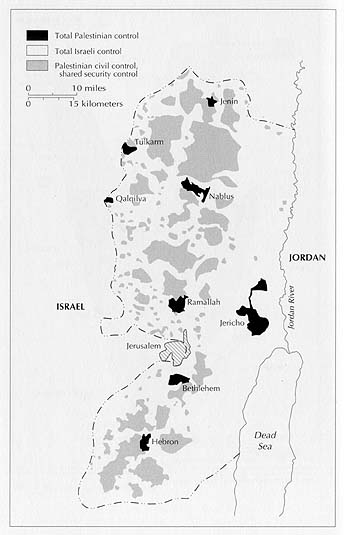
Map 4. West Bank under the Interim Agreement, 1995
Support for the peace process within Israel fluctuated significantly in response to events, including the ups and downs of the process itself but, even more, a wave of suicide bombings perpetrated by Islamic extremists, who sought to derail the process. Nevertheless a strong, and even growing, majority of 60 to 65 percent continued in principle to support talks with the PLO, the return of territories, and the peace process in general. Support for the DOP in particular was eroded by the perception that the PLO was not acting in good faith to prevent terrorism, and support fluctuated in early 1995 between 30 and 35 percent (with a similar proportion opposed explicitly and up to a quarter of the respondents on the fence).[92] This support rose when Oslo II was signed, and the assassination of Prime Minister Yitzhak Rabin, on November 4, 1995, caused a strong backlash of support both for the peace process (to over 73 percent) and for the Oslo agreement in particular (to 58 percent).[93]
By this time the Israeli government could also enumerate concrete benefits of the peace process. Normalization of Arab relations was progressing: the Arab boycott was withering, and Israel was developing economic ties with a number of Arab states. The “cold” peace with Egypt seemed to be warming, and the 1994 treaty with Jordan promised full normalization, the repeal of anti-Israel laws, and a number of joint development projects along the Israel-Jordan border. The “Eastern front” threat diminished considerably with Jordanian guarantees against the stationing of hostile forces on its territory, while the detachment of Jordan from West Bank issues also lessened the risk of eventual Palestinian dominance on the East Bank. Lower-level relations were established with Morocco, Tunisia, Mauritania, and Oman; by late 1995 Israel had diplomatic relations with nearly all non-Arab Muslim states, and with 155 nations altogether (against only 68 a decade earlier). The changed political climate also helped the economy, with big jumps in tourism and foreign investment (following upgraded credit ratings in international markets).
Rather strikingly, the vast majority of Israelis—74 percent by 1994—had come to believe that a Palestinian state would in fact be established, whether it was their preference or not.[94] As the Israeli army moved out of Arab population centers, it seemed very unlikely that it would move back in, barring a total breakdown of law and order that spilled across Israel’s frontiers. Public figures spoke with increasing candor about the likelihood that self-rule for the West Bank and Gaza was, as the opponents of the peace process charged, leading to eventual Palestinian statehood. It might appear under a different label and be constrained by demilitarization and other security arrangements, as Sinai had been and the Golan Heights would be in any settlement with Syria, but a Palestinian state in one form or another appeared as the logical outcome of the process that had been set in motion.
As for borders, the intentions of the Rabin and Peres governments could best be gauged by policies toward Jewish settlements across the Green Line: where was continued building encouraged, where was it frozen, and in what other ways was the government redrawing the boundaries? Initially the Rabin government had differentiated “security settlements” from “political settlements” and had retained generous government benefits only for the former while freezing public expenditure and new housing starts elsewhere in the territories. Consequently it seemed likely the government would try to include the bedroom communities of western Samaria and greater Jerusalem, the Etzion bloc south of Jerusalem, and the Jordan Valley settlements on the Israeli side of the final border. According to a study by the Jaffee Center for Strategic Studies, a redrawing of the Green Line to incorporate 11 percent of the West Bank in Israel could bring in 60 to 70 percent of the Jewish settlers (and very few Arabs), thus making this thorny issue less contentious.[95]
Netanyahu’s razor-thin victory in 1996 put the process back on the slow track, however. The new government’s opposition in principle to further Israeli withdrawal from the occupied territories, to Palestinian statehood in any form, or to any compromise on Jerusalem, made further agreements with the PLO, or any agreement with Syria, much more difficult. But while the process could be stalled, or even disrupted, it did not seem to be reversible. Despite detours and heartaches, it would inch forward.
It is possible that we are in the last phase of the Arab-Israel conflict. Its re-Palestinization encourages the gradual, grudging acceptance of Israel as a fact by Arab states, based on their recognition that it cannot be defeated militarily and by their own shift of focus to domestic problems and priorities. This acceptance is not based on conviction but on necessity; it will not be a “warm” peace in the near future (with the possible exception of Jordan), but it can be a workable and stable long-term settlement.
The detachment of external enemies requires settlement of Israeli-Palestinian differences in a way acceptable to most Palestinians; this in turn requires, realistically, a disentanglement of the two peoples. After flirting with other conceptions, the Israeli public has returned to the conventional wisdom that good fences make good neighbors; roughly 75 percent agreed in 1995 with the statement that “from Israel’s point of view, also in a state of peace, it is preferable to have a clear and closed border between it and the Palestinian entity, in order to create maximum separation between Israelis and Palestinians.” [96] Even more striking, perhaps, is the public response to the closures between the territories and Israel periodically implemented since March 1993, in response to terrorist incidents. Despite the fact that these closures contributed substantially to the process of disengagement, they were supported wholeheartedly by all segments of the population except the ideological hawks.
Separation is seen by some as the defeat of Jewish values, as failure to fulfill a historic mission. But disengagement may be the key to the preservation of a newly created Israeli culture within a re-created Jewish state. There is, as most observers on both sides note, a struggle between the universalistic values of the peace process and particularistic claims of those aspiring to an undivided Land of Israel, paralleling a presumed choice between democracy with limited Jewish character or an ethnic state with limited democracy. History rarely proceeds by such clear choices, however; Jewish history in particular is a continuing synthesis of the universal and the particular. Disengagement clearly preserves democracy, but it may also be the strongest bulwark of Jewishness.[97]
Notes
1. Baruch Kimmerling, “Boundaries and Frontiers of the Israeli Control System: Analytical Conclusions,” in The Israeli State and Society: Boundaries and Frontiers, ed. Baruch Kimmerling (State University of New York Press, 1989), 265–84.
2. Julius Stone, Israel and Palestine: Assault on the Law of Nations (The Johns Hopkins University Press, 1981), 693; Yoram Dinstein, “The International Law of Belligerent Occupation and Human Rights,” Israel Yearbook on Human Rights 8 (1978): 104–43; Moshe Drori, “The Legal System in Judea and Samaria: A Review of the Previous Decade with a Glance at the Future,” Israel Yearbook on Human Rights 8 (1978): 144–77.
3. For a statement of this claim see Stone, Israel and Palestine, 119, and Yehuda Blum, “The Missing Reversioner: Reflections on the Status of Judea and Samaria,” Israel Law Review 2 (1968): 279, 289–291.
4. See the well-reasoned argument in Esther Rosalind Cohen, Human Rights in the Israeli-Occupied Territories 1967–1982 (Manchester University Press, 1985), 52–53. The Geneva Convention also has a one-year time limit on the applicability of some of its provisions, but Israel has not invoked this clause (ibid., 50–51). See also Theodor Meron, “West Bank and Gaza: Human Rights and Humanitarian Law in the Period of Transition,” Israel Yearbook on Human Rights 9 (1979): 106–20.
5. Michael Goldstein, “Israeli Security Measures in the Occupied Territories: Administrative Detention,” Middle East Journal 32, no. 1 (Winter 1978): 37 (summarizing the claims made by the UN Special Committee to Investigate Israeli Practices Affecting Human Rights of the Population of the Occupied Territories). The applicability of the Defense Regulations to the Golan Heights or Sinai was altogether dubious, as neither had been part of Palestine, but in both cases the affected population was small and the question became moot (in Sinai by the return to Egyptian sovereignty, and on the Golan Heights by the extension of Israeli law).
6. Dov Shefi, “The Protection of Human Rights in Areas Administered by Israel: United Nations Findings and Reality,” Israel Yearbook on Human Rights 3 (1973): 344–45; Fania Domb, “Judicial Decisions: Supreme Court of Israel,” Israel Yearbook on Human Rights 9 (1979): 343–44; Israel National Section of the International Commission of Jurists, The Rule of Law in the Areas Administered by Israel (1981), 68 (includes citations of the Jordanian court cases); Menachem Hofnung, Israel—Security Needs vs. the Rule of Law (in Hebrew) (Nevo, 1991), 317.
7. Gerhard Von Glahn, The Occupation of Enemy Territory (Minneapolis: University of Minnesota Press, 1957), 57; see also Dinstein, “International Law of Belligerent Occupation,” and Drori, “Legal System in Judea and Samaria.”
8. Cohen, Human Rights, 285; Stone, Israel and Palestine, 693–722; Von Glahn, Occupation of Enemy Territory, 54, 62–63, 98, 100, 110–11, 139–41; Geoffrey Best, Humanity in Warfare: The Modern History of the International Law of Armed Conflicts (Methuen, 1983), 297–98.
9. Von Glahn, Occupation of Enemy Territory, 264; for a description of the extreme measures used under the laws of war by the Germans in Belgium during World War I, see Best, Humanity in Warfare, 226–27.
10. Cohen, Human Rights, 95; Emma Playfair, Administrative Detention in the Occupied West Bank (Al-Haq [Law in the Service of Man], 1986), 11; Hofnung, Israel—Security Needs, 317.
11. For a good statement of the low-profile policy see the chapter by Raphael Vardi, one of the key Israeli figures in occupation policy, “Israeli Administration and Self-Rule in the Territories: The Israeli Perspective,” in Judea, Gaza, and Samaria: Views on the Present and Future, ed. Daniel Elazar (American Enterprise Institute, 1982), 171–80.
12. See in particular the annual reports issued by the West Bank Data Project, as well as Meron Benvenisti and Shlomo Khayat, The West Bank and Gaza Atlas (West Bank Data Project, 1988).
13. Israel Ministry of Defense, Office of the Co-ordinator of Government Operations in Judea, Samaria and Gaza District, Judea, Samaria, and the Gaza District, 1967–1987: Twenty Years of Civil Administration (Carta, 1987), 45–46, 53, 54.
14. Ibid., 14, 17, 84.
15. Ibid., 25; Benvenisti and Khayat, The West Bank and Gaza Atlas, 42.
16. Particularly the ownership of durable goods; see Israel Central Bureau of Statistics, Statistical Abstract of Israel 1994, 802.
17. Statement by Israel Defense Forces (IDF) spokesperson, Ha’aretz, 28 October 1993, reported in B’tselem [The Israeli Information Center for Human Rights in the Occupied Territories], Human Rights Violations in the Occupied Territories 1992/1993 (B’tselem, n. d.), 46.
18. Cohen, Human Rights, 76–92.
19. O’Brien, Law and Morality in Israel’s War with the PLO (Routledge, 1991), 254.
20. Statement by the Ministry of Justice in B’tselem, Human Rights Violations, 142; O’Brien, Law and Morality, 135.
21. Inge Genefke, “Evidence of the Use of Torture,” in Torture: Human Rights, Medical Ethics and the Case of Israel, ed. Neve Gordon and Ruchama Marton (Zed Books for the Association of Israeli-Palestinian Physicians for Human Rights, 1995), 98.
22. Also confirmed by the results of a survey of 700 ex-detainees reported in Eyad El-Serraj, “Torture and Mental Health: A Survey of the Experience of Palestinians in Israeli Prisons,” in Gordon and Marton, Torture, 105.
23. The Israeli government responded that the form was only being used experimentally at one prison and that its use would not be continued; see Ruchama Marton, “The White Coat Passes like a Shadow: The Health Profession and Torture in Israel,” in Gordon and Marton, Torture, 37, 39.
24. U.S. Department of State, Country Reports on Human Rights Practices 1996, INTERNET; Amnesty International, Amnesty International Report 1996, 186; see also B’tselem, Human Rights Violations, 131–44; Hofnung, Israel—Security Needs, 128–29, 276.
25. U.S. Department of State, Country Reports 1996.
26. Virgil Falloon, Excessive Secrecy, Lack of Guidelines: A Report on Military Censorship in the West Bank (Al-Haq [Law in the Service of Man], 1986), 8–18.
27. The 1979 court case is Sakhwil et al. v. Commander of the Judea and Samaria Region, H. C. 434/79, 34(1) P.D. 464; see Domb, “Judicial Decisions: Judgments of the Supreme Court of Israel Relating to the Administered Territories,” Israel Yearbook on Human Rights 10 (1980): 345–46. The 1990 case is Israel Civil Rights Association v. Commander of Southern Region, H. C. 4112/90, 44(4) P.D. 626. For a definitive analysis see David Kretzmer, “High Court of Justice Review of the Demolition and Sealing of Houses in the Territories,” in Klinghoffer Book on Public Law (in Hebrew) (Faculty of Law, Hebrew University of Jerusalem, 1993), 305–57; see also Cohen, Human Rights, 103; O’Brien, Law and Morality, 243–45.
28. Ann M. Lesch, “Israeli Deportation of Palestinians from the West Bank and the Gaza Strip, 1967–1978,” Journal of Palestine Studies 8 (Winter 1979): 102–3; the Israeli figure is given in Financial Times, 9 December 1977.
29. Attorney General Meir Shamgar, “The Observance of International Law in the Administered Territories,” Israel Yearbook on Human Rights 1 (1971): 274–75; Shefi, “Protection of Human Rights,” 348–49; Thomas S. Kuttner, “Israel and the West Bank: Aspects of the Law of Belligerent Occupation,” Israel Yearbook on Human Rights 7 (1977): 213–14, 216.
30. For a definitive statement of the illegality of deportation under the Fourth Geneva Convention, see Yoram Dinstein, “The Israel Supreme Court and the Law of Belligerent Occupation: Deportations,” Israel Yearbook on Human Rights 23 (1993): 1–26; see also Cohen, Human Rights, 110–11.
31. The key court case was Abd el Afu et al. v. Commander of the IDF Forces in the West Bank et al., H.C. 785/87, 42(2) P.D. 4, published in English in Israel Yearbook on Human Rights 23 (1993): 277–86; see Dinstein, Israel Supreme Court, 12–22.
32. H.C. 5973/92, The Association for Civil Rights in Israel et al. v. Minister of Defense et al., published in English in Israel Yearbook on Human Rights 23 (1993): 353–61.
33. Playfair, Administrative Detention, 3–5; Goldstein, “Israeli Security Measures,” 44.
34. Itzak Zamir, “Directives of the Attorney General on the Matter of the Emergency Powers (Detention) Law, 5739—1979,” Israel Law Review 18 (Winter 1983): 157–58.
35. Kuttner, “Israel and the West Bank,” 211–12; Playfair, Administrative Detention, 14–15, 19; Cohen, Human Rights, 128, presents the case for a qualified acceptance of administrative detention as a legal measure.
36. See, for example, Stone, Israel and Palestine, 123, 177–81.
37. Cohen, Human Rights, 162–63.
38. Moshe Drori, “The Israeli Settlement in Judea and Samaria and its Organizational and Municipal Structure: Legal Aspects” (in Hebrew), City and Region 4, no. 3 (1981): 28–45; Hofnung, Israel—Security Needs, 294–95.
39. The Beit El case is Ayub v. Minister of Defense, H. C. 606/78, 33(2) P.D. 113; Elon Moreh is Dweikat et al. v. the Government of Israel et al., H. C. 390/79, 34(1) P.D. 1; see Domb, “Judicial Decisions: Supreme Court of Israel,” 345–49.
40. Cohen, Human Rights, 138–39.
41. B’tselem, Human Rights Violations, 110; Amnesty International Report, 1996, 186; also data supplied by B’tselem.
42. Al-Haq [Law in the Service of Man], personal communication, February 17, 1996; B’tselem, Human Rights Violations, 67, 79–82; U.S. Department of State, 1996.
43. Menachem Friedman, “The State of Israel as a Theological Dilemma,” in The Israeli State and Society: Boundaries and Frontiers, ed. Baruch Kimmerling (State University of New York Press, 1989), 206.
44. On Gush Emunim as a revitalization movement see Myron J. Aronoff, “Gush Emunim: The Institutionalization of a Charismatic, Messianic, ReligiousPolitical Revitalization Movement in Israel,” in Religion and Politics, vol. 3 of Political Anthropology, ed. Myron J. Aronoff (Transaction Books, 1984), 63–84. See also chapter 6.
45. Charles S. Liebman, “Jewish Fundamentalism and the Israeli Polity,” in Fundamentalisms and the State, ed. Martin E. Marty and R. Scott Appleby (University of Chicago Press, 1993), 74. For overall studies of Gush Emunim and related movements see Ehud Sprinzak, The Ascendance of Israel’s Radical Right (Oxford University Press, 1991), and Ian S. Lustick, For the Land and the Lord: Jewish Fundamentalism in Israel (Council on Foreign Relations, 1988).
46. See the analysis by Eliezer Don-Yehiya, “Jewish Messianism, Religious Zionism and Israeli Politics: The Impact and Origins of Gush Emunim,” Middle East Studies 23 (April 1987): 215–34; and by Sprinzak, Ascendance, 12–21.
47. Charles S. Liebman and Eliezer Don-Yehiya, Religion and Politics in Israel (Indiana University Press, 1984), 135–36.
48. The Hess article is quoted by Yoram Peri, “Expulsion Is Not the Final Solution” (in Hebrew), Davar, 3 August 1984; on the law against “strangers in the land,” see article by Yisrael Ariel in Nekuda 79 (2 November 1984): 24.
49. Rael Jean Isaac, Israel Divided: Ideological Politics in the Jewish State (The Johns Hopkins University Press, 1976), 134.
50. The IIASR, now known as the Guttman Israel Institute of Applied Social Research, carried out 204 surveys in the 1967–1992 period. There are four major polling organizations in Israel using sophisticated survey methods that produce results similar enough to each other to instill some degree of confidence; all use stratified sampling techniques and a sample size (generally around 1,200) that gives a 3 to 4 percent margin of error. The polls reported here cover only the adult Jewish population within Israel proper, not Arabs within Israel nor Jewish settlers in the territories. Earlier IIASR data is summarized in Russell A. Stone, Social Change in Israel: Attitudes and Events, 1967–1979 (New York: Praeger, 1982); for more recent years, see Jacob Shamir and Michal Shamir, The Dynamics of Israeli Public Opinion on Peace and the Territories, Research Report No. 1 (The Tami Steinmetz Center for Peace Research, 1993), 5–12; Asher Arian, Security Threatened: Surveying Israeli Opinion on Peace and War (Cambridge University Press, 1995), 95–96.
51. Elihu Katz and Hannah Levinsohn, “Too Good To Be True: Notes on the Israel Elections of 1988,” International Journal of Public Opinion Research 1, no. 2 (1989): 117.
52. Yaniv, “Israel National Security in the 1980s: The Crisis of Overload,” in Israel after Begin, ed. Gregory S. Mahler (State University of New York Press, 1990), 107.
53. Ha’aretz, 27 June 1975; reported, with a comment on the dovish push in the question, by Isaac, Israel Divided, 150. Polls conducted by Modi’in Ezrachi during the 1980s consistently showed more hawkish attitudes, by about 10 percent, than other polls, and the wording of the questions seems relevant; for example, Modi’in Ezrachi offered the option of tsiruf (“joining together”) rather than the more blatant sipuah (“annexation”) to describe the permanent incorporation of the territories into Israel.
54. The April 1987 poll was conducted by Modi’in Ezrachi and reported in Ma’ariv, 12 May 1987.
55. Survey conducted by the Dahaf Research Institute in July 1984 and reported in Asher Arian, “Israeli Democracy 1984,” Journal of International Affairs 38 (Winter 1985): 268–69.
56. Benvenisti and Khayat, The West Bank and Gaza Atlas, 32; Herb Keinon, Israeli Settlements: A Guide (Anti-Defamation League, 1995), 4–5.
57. By 1996 the number of settlers grew to around 140,000 to 145,000, including 15,000 on the Golan Heights, according to best estimates; on problems of estimation amidst conflicting claims, see Keinon, Israeli Settlements, 15–18.
58. The annual Arab population increase in the mid-1990s was between 75,000 and 80,000; Statistical Abstract of Israel 1994, 786.
59. Keinon, Israeli Settlements, 48.
60. Ian Lustick, in Unsettled States, Disputed Lands (Cornell University Press, 1993), analyzes Israel’s attempt to integrate the West Bank in the framework of a general theory of state expansion and contraction, making use of comparison with the British in Ireland and the French in Algeria.
61. Israel, Central Bureau of Statistics, Projections of Population in Judea, Samaria and Gaza Area up to 2002 (Central Bureau of Statistics, 1987). For fuller discussion of “the demographic dilemma” see the writings of Arnon Soffer: On the Demographic and Geographic Situation in the Land of Israel: End of the Zionist Dream? (in Hebrew) (Gestlit Press, 1988); “Population Projections for the Land of Israel,” Middle East Review 20 (Summer 1988): 43–49; “Demography and the Shaping of Israel’s Borders,” Contemporary Jewry 10, no. 2 (1989): 91–105. See also the various publications of the West Bank Data Project, which include a wide range of population data and projections.
62. See, for example, the interview with Sari Nusseibeh in Koteret Rashit, 13 November 1985 (in Hebrew).
63. For responses to Netanyahu see A. Schweizer, “Statistics on the Brain” (in Hebrew), Ha’aretz, 22 July 1988; and Don Petreanu, “Numbers and Politics,” Jerusalem Post International Edition, 27 August 1988; also, the cited works by Arnon Soffer and Statistical Abstract of Israel 1994, 786.
64. Elyakim Ha’etzni, quoted by Yair Kotler, Heil Kahane (Adama Books, 1986), 177.
65. Sergio DellaPergola, “Will There Be More Mass Immigration?” in On the Way to Year 2000: More War or Progress to Peace? (in Hebrew), ed. Alouph Hareven (Van Leer Institute, 1988), 58; see also DellaPergola, “On the Differential Frequency of Western Migration to Israel,” Studies in Contemporary Jewry 1 (1984): 292–315; and Della Pergola, “ Aliya and Other Jewish Migrations: Toward an Integrated Perspective,” in Studies in the Population of Israel, ed. Usiel O. Schmelz and Gad Nathan (Scripta Hierosolymitana 30, Magnes Press, Hebrew University, 1986), 172–209.
66. This is developed most completely by Raphael Israeli, Palestinians Between Israel and Jordan (Praeger, 1991).
67. Meir Kahane, They Must Go (Grosset and Dunlap, 1981), 102.
68. Dahaf Research Institute poll reported in Davar, 3 August 1984; Hanoch Smith poll, Jerusalem Post, 2 October 1986; Modi’in Ezrachi poll, Ma’ariv, 15 July 1987.
69. Frankel, “A Pogrom Situation in the West Bank,” Jerusalem Post, 23 July 1987.
70. Soffer, “Population Projections”, 10–23.
71. Quoted in Lawrence Meyer, Israel Now: Portrait of a Troubled Land (Delacorte Press, 1982), 384.
72. Israelis have written extensively on the impact of occupation on Israeli democracy; see, in particular, Alon Pinkas, “Garrison Democracy: The Impact of the 1967 Occupation of Territories on Institutional Democracy in Israel,” in Democracy, Peace, and the Israeli-Palestinian Conflict, ed. Edy Kaufman, Shukri B. Abed, and Robert L. Rothstein (Lynne Rienner, 1993), 61–83; Hofnung, Israel—Security Needs, esp. 281–347; and Asher Arian, “Israeli Democracy 1984,” 259–76.
73. For an excellent collation of evidence on this score, see Edy Kaufman, “War, Occupation, and the Effects on Israeli Society,” in Kaufman et al., Democracy, Peace, and the Israeli-Palestinian Conflict, 85–133; see also Yoram Peri, “The Arab-Israeli Conflict and Israeli Democracy,” in Israeli Democracy under Stress, ed. Ehud Sprinzak and Larry Diamond (Lynne Rienner, 1993), 343–57.
74. On settler violence see David Weisburd and Vered Vinitzky, “Vigilantism as Rational Social Control: The Case of the Gush Emunim Settlers,” in Cross-Currents in Israeli Culture and Politics, ed. Myron J. Aronoff (Transaction Books, 1984), 69–87.
75. Moshe Zemer, “Halacha and Occupation,” Jerusalem Post, 20 May 1995.
76. Harkabi, The Bar-Kochba Syndrome (Rossell Books, 1983). Harkabi wrote voluminously for two decades against Israeli expansionism; see in particular The Fateful Hour (Harper and Row, 1988). On the traditional Jewish critique of power, see Shlomo Avineri, “The Historical Roots of Israeli Democracy.” (Second Annual Guest Lecture, Kaplan Center for Jewish Studies and Research, University of Cape Town, March 31, 1985), 8–9. More radical Israeli critiques discussed the “original sins” of Zionism against the Palestinians; see Benjamin Beit-Hallahmi, Original Sins: Reflections on the History of Zionism and Israel (Pluto Press, 1992).
77. On security policy see Avner Yaniv, Deterrence without the Bomb (Lexington Books, 1987), and idem, “Israel National Security,” 93–109.
78. Gad Barzilai and Ilan Peleg, “Israel and Future Borders: An Assessment of a Dynamic Process,” Journal of Peace Research 31, no. 1 (1994): 69; for a vivid portrait of this period of transition see Glenn Frankel, Beyond the Promised Land: Jews and Arabs on the Hard Road to a New Israel (Simon and Schuster, 1994).
79. Asher Arian, Security Threatened, 68–69.
80. Ibid., 263.
81. Goldberg, Barzilai, and Inbar, The Impact of Intercommunal Conflict: The Intifada and Israeli Public Opinion, Policy Studies No. 43 (The Leonard Davis Institute for International Relations, 1991), 12.
82. Jerusalem Post, 21 June 1992.
83. Asher Arian, Security Threatened, 97–98, 274.
84. Smith Research Center, as reported in Jerusalem Post, 2 October 1986; Near East Report, 25 July 1988; and New York Times, 2 April 1989. Similar figures are reported by Asher Arian, Security Threatened, 106.
85. Elihu Katz, Hanna Levinsohn, and Majid Al-Haj, “Attitudes of Israelis (Jews and Arabs) towards Current Affairs,” Guttman Israel Institute of Applied Social Research Publication No. (S)EK/1129/E, January 10, 1991; Asher Arian, “Security and Political Attitudes in Israel: 1986–1991,” Public Opinion Quarterly 56 (Spring 1992), 125.
86. Inbar and Goldberg, “Is Israel’s Political Élite Becoming More Hawkish?” International Journal 45 (Summer 1990): 631–60; Goldberg, “The Likud: Moving toward the Center,” in Israel at the Polls, 1988–1989, ed. Daniel J. Elazar and Shmuel Sandler (Wayne State University Press, 1992), 45–66.
87. Asher Arian, “Security and Political Attitudes,” 125.
88. Goldberg, Barzilai, and Inbar, Impact of Intercommunal Conflict, 48–49, 53, 56; Gad Barzilai, Giora Goldberg, and Efraim Inbar, “Israeli Leadership and Public Attitudes toward Federal Solutions for the Arab-Israeli Conflict before and after Desert Storm,” Publius: The Journal of Federalism 21 (Summer 1991): 206. In the first of these two studies (49), the authors even delineate a profile of Likud doves, who are generally older, more educated, less religious, and with higher incomes than the average Likud supporter.
89. For an analysis of the gap between elite (Labor) opinion and the general public during this period see Asher Arian, Ideological Change in Israel (Case Western Reserve University Press, 1968), 36, 43, 52–53.
90. The potential for shaping of opinion by leaders is a major theme in Asher Arian’s summary study of Israeli attitudes on security; see Arian, Security Threatened, esp. 256–61.
91. This theme is developed by Gad Barzilai and Ilan Peleg, “Israel and Future Borders,” 63–64.
92. On PLO talks and the return of territory: Arian, Security Threatened, 100, 107. On the peace process and Oslo: 1995 monthly polling data supplied by the Tami Steinmetz Center for Peace Research, Tel Aviv University.
93. Tami Steinmetz Center for Peace Research, Tel Aviv University.
94. Arian, Security Threatened, 104.
95. Joseph Alpher, “Settlements and Borders” (in Hebrew), in Final Status Issues: Israel-Palestinians, Study No. 3, (Jaffee Center for Strategic Studies, Tel Aviv University, November, 1994), 36–41, 62 (map 10).
96. Polls of March 27 and April 25, 1995, supplied by the Tami Steinmetz Center.
97. For a more extended, and somewhat less optimistic, view of the clash of values within Israel, see Ilan Peleg, “The Peace Process and Israel’s Political Culture: A Kulturkampf in the Making,” paper presented at annual meeting of the American Political Science Association, Chicago, September 1–4, 1995.
11. Epilogue
The May 1996 Israeli elections underlined, in a way previous elections had not, the continuing struggle between two different Israels. Since 1977 the body politic has been roughly divided into two halves, between left and radical/Arab blocs on one hand and right and religious blocs on the other (see chapter 6). This bifurcation had been obscured somewhat by the usual kaleidoscopic shifts among parties and by conflicting preferences for prime minister and for party. But in 1996 voters could for the first time vote separately for prime minister, and the two-way race between Labor’s Shimon Peres and Likud’s Benjamin Netanyahu forced voters to identify with one or the other of the two Israels (though a surprising 5 percent cast blank ballots). Netanyahu’s narrow victory, by 50.5 percent to 49.5 percent, provided a clear if momentary measure of the continuing close division between “traditional” Israel, looking distrustfully on the prospects of Israel becoming “a nation like other nations,” and “civic” Israel, fervently pushing the normalization of Israel’s domestic life and external relations.
Clearly the precise outcome of the prime ministerial vote also reflected the personal appeal of the two candidates, the skill of their campaigns, and recent dramatic events such as Rabin’s assassination seven months before the election (which created a wave of support for Peres) and the “Nine Days of Terror” in February–March (which created a backlash against Peres). But what was evident throughout the campaign was the polarization of the political scene down the middle as traditional Israel mobilized behind Netanyahu and civic Israel rallied to Peres. Religious and haredi leaders and parties came together behind Netanyahu despite his personal nonobservance and fervent appeals from the other side; leftists and Arab voters gave Peres overwhelming support despite their dislike of his “Grapes of Wrath” campaign in Lebanon just before the election. The flavor of the campaign reflected not just opposed views of the Oslo peace accords but opposed lifestyles: on the one hand, appeals to tradition, attacks on pop culture and “yuppies,” the blessing of amulets and of Netanyahu himself by an aged kabbalistic scholar, and the slogan that “Netanyahu is good for the Jews”; on the other hand, the argument of economic prosperity, the vision of Israel’s integration into the Middle East, popular comedians and a pop “Song of Peace,” and the call for an Israel that would be “the state of all its citizens.”
Israel still struggles between its calling as “a nation that dwells alone,” in the words of Balaam’s blessing, and the natural attraction of normality. Traditional Israel is more particularist, primordial, communitarian, religious, conservative, and hawkish where civic Israel—the “New Israel” created in the century since Herzl—is more universalist, modernist, cosmopolitan, secular, liberal, and dovish. Traditional Israel values affective thinking (“from the heart”) as embodied in traditional cultures; civic Israel subscribes wholeheartedly to rationalist models (“from the head”) associated with Western civilization. Traditional Israel conceives of collective identity in terms of ethnicity (“Jewishness”); civic Israel tends to define identity in terms of territoriality (“Israeliness”).[1] In traditional Israel one is usually a Jew first and an Israeli second, while in civic Israel the order is reversed.
Of course these correlations are not perfect; real life is multidimensional. Israel has religious doves and secular hawks, antimodernists of European origin and “Westernizers” from non-Western backgrounds. But it is still possible, given a very few variables, to predict with reasonable accuracy which Israel a particular voter will choose, especially when these variables all point in the same direction. A lower-income Sephardi religious voter did not tend to back Peres in 1996, just as Netanyahu did not get the support of the average college-educated, native-born, higher-income secularist Ashkenazi (a category that he fit himself).
The basic division was most evident in the almost-even polarization of the 1996 prime ministerial vote, but the party vote in the Knesset also reflected it. While parties of the left and far left together lost their blocking majority of sixty-one, dropping to fifty-two, the parties of the right also lost nine seats (from forty-three to thirty-four). The new electoral system drained votes from the larger parties by enabling voters to cast a ballot for both their prime minister of choice and for the party closest to their heart. Smaller parties accordingly urged voters “not to put bread into pita” (that is, “don’t vote twice for the same party”). The religious parties benefited greatly, moving from sixteen to twenty-three seats, but the real news was the appearance of a previously nonexisting centrist bloc, with eleven seats, consisting of the Third Way, a splinter group from Labor, and Yisrael B’aliya (Israel in Ascent), led by former Soviet dissident Natan Sharansky, which made history as the first immigrant-based party to gain representation in the Knesset and even seats in the cabinet.
The impact of the electoral reform, therefore, was to put more coalition bargaining power into the hands of smaller centrist and religious parties; Netanyahu’s coalition was built of eight parties (including three in the Likud electoral alliance), and only twenty-three of his majority of sixty-six were members of the Likud itself. This was balanced by the increased powers given the prime minister in the reform, and in particular the fact that only the elected prime minister could form a government. The potential coalition partners thus had either to deal with Netanyahu or force new elections—never a popular option among newly elected legislators. The overall impact of the reform was thus limited; Netanyahu formed a government committed in principle to the peace process, though a majority of its members had opposed the Oslo accords in practice.
The balance of power between the prime minister and the Knesset was not changed profoundly, nor did the system as a whole shift more perceptibly to majoritarianism because of the reform. In fact, it seemed increasingly unlikely that any electoral reform would or should dilute the basic consociationalism of the system, as one sine qua non of any proposed reform, in practice, has been that it would maintain the representation of key groups (religious, minorities).[2] Following an election in which the power of smaller parties was further enhanced, it was unlikely that they would willingly yield the additional ground gained, let alone retreat beyond the original line.
Does this mean that Israel is doomed to paralysis by indecision between its two halves? Can it not overcome what has been termed by various observers “a Kulturkampf, ” “a deadlock [between] opposing camps of nearly equal strength,” or “two contradictory unbridgeable conceptions”?[3] Are these conceptions indeed unbridgeable—or will there be “a creative synthesis of both primordial loyalties and universalistic values inherent in traditional Jewish culture that have been vital aspects of Zionism in the past”?[4]
Haven’t Jewish history and the Zionist enterprise both been characterized by an ongoing synthesis of the tribal and the universal? Increasingly in Israel one sees signs of a blurring in the middle, of a less sharp dichotomy between “Jewish” and “Israeli.” The outcome of the two-person prime minister’s contest was decided by appeals to the large group of voters in the middle of the spectrum; Netanyahu was forced to emphasize his commitment to the peace process while Peres stressed his toughness on security. With the general decline in ideological commitment there is added fluidity in politics, and the emerging center is where the game is won or lost. In the center particularism and universalism meet, and Israel finds it can neither live in isolation nor cut itself off from its Jewish roots.
No nation these days can totally ignore the civic principle that all citizens ought to be equal before the law despite racial, ethnic, religious, social, or political differences. This idea is now near-universal as a standard (if not as a practice), and Jews have always been among those foremost in promoting it. Indeed no people has gained as much from application of the civic ideal, or have as much continuing interest in furthering it, as the Jewish people; it would be inconsistent with Jewish history and with Jewish interests to suggest that a Jewish state is somehow exempt from this standard.
Nor can Israel escape being part of an increasingly interdependent and technologically oriented world. In Israel no less than elsewhere, modernization involves challenges to tradition, the decline of ideology, and convergence with other societies. Some describe contemporary Israel as “post-Zionist,” though the term has been used in so many contexts—as loss of ideology, as critique of Zionist historiography, as attack on pop culture, as argument for a nonethnic state—that it has no commonly agreed-upon meaning.
But conversely Israel cannot cut its ties to Jewish tradition. As one secular critic concludes, “a Hebrew national consciousness will always have affinities to Judaism.” [5] Without Jewish tradition, what would Israel have of its own? “A few Jewish Agency songs, a bit of Palmach style, some pioneering memories, and the idea of the kibbutz…,” in the words of Amos Oz?[6] Zionism drew heavily, if selectively, on Jewish tradition, and the human reality of a population not in rebellion against this tradition guaranteed the reemergence of much more of it.
The result is not so far from that envisioned by Ahad Ha’am, who saw Zionism as a higher stage in the development of Jewish civilization rather than as a break with the past. Ahad Ha’am personified the synthesis that has emerged and is yet emerging: “secular, liberal, but nonetheless embedded…in the fundamental teachings of Judaism.…because anything else would be humanly inauthentic, intellectually deadening, itself a curious and perverse exercise in parochialism.” [7]
Speaking of the two opposed conceptions now at war in Israel, The Economist declares: “Which is the true Zionism? Both.” [8] By extension: Which is the authentic Judaism? Both. Judaism, like other traditions, includes both particularist and universalist elements. Some on the nationalist fringes have selectively ignored the humanistic dimension, interpreting Judaism in wholly parochial terms. But if selectivity is inevitable with such a complex legacy, why not choose to stress the universalist ethics as Israel integrates into the family of nations? When tradition offers contradictory messages, why choose limited visions of the past rather than the timeless truths of the Hebrew prophets?
Perhaps the most valuable legacy of Jewish history is the principle of pluralism itself. Diversity was not only a central reality of Jewish life but was also a principle in Jewish law. As the Talmud says regarding differing schools of thought, “these and these are the words of the living God.” But Judaism in Israel has resisted pluralism in its broader aspects. Clinging to a narrow view of tradition, “it is much the poorer for failing to develop non-Orthodox models of authenticity, for failing to extend adequately the meaning of Judaism to the personal domain, and for failing to engage and adapt for Jewish purposes non-Jewish cultural elements.” [9] The growth of non-Orthodox religious movements—Reform, Reconstructionist, Conservative—seems inevitable in light of the fact that patterns of observance among large segments of the Israeli public already fit into these molds, being neither totally secular nor totally Orthodox.[10] Even staunch secularists have proposed enriching the religious studies in state secular schools by, among other things, including all the streams of modern Judaism in the curriculum and stressing Jewish heritage and history broadly.
Of what, minimally, does the “Jewishness” of the Jewish state consist? Interestingly the Israeli Supreme Court, in dealing with the eligibility of parties to participate in elections, has tried to answer that question. Acceptance of “Israel as a Jewish state,” the court ruled, means at the least: (1) maintenance of a Jewish majority, (2) the right of Jews to immigrate (the Law of Return), and (3) ties with Jewish communities outside Israel.[11] None of these features are inherently inconsistent with liberal democracy, and none of them are in fact unique to Israel. As detailed in chapter 9, there are at least two dozen ethnic democracies in the world (among several dozen ethnic states), and a large number of states grant citizenship on the basis of ethnic identity or descent. Nor is the existence of a dispersion peculiar to the Jewish people, save perhaps in duration and extent, and the growth of sentiment for “normalizing” Israel-Diaspora relations would lessen any remaining differences (by limiting the Law of Return, reducing the role of world Jewry in Israel, or even reversing the flow of influence as Israel becomes the dominant force in the Jewish world).
As for non-Jews in Israel, pluralism may actually mean creating a new distinction between “Israeli” and “Jewish.” Is it possible to develop an Israeliness that includes, but is not limited to, Jewishness? Can Palestinian citizens be made a part of “us” on at least one level? No nation-state, indeed, is entirely neutral in matters of particular ethnicity or culture, but this does not mean that a Jewish state by definition must be inhospitable to other ethnic groups. The acid test of Israeli democracy will be whether it can take Arab citizens into full partnership.
This should not be impossible. The genius of Jewish politics has always been its power-sharing, or consociationalism in political science terms. Consociationalism is a concept that itself synthesizes the civic and communitarian dimensions of politics; its point of departure is a clear recognition of the permanence and legitimacy of diversity within society. In the Jewish context it has functioned reasonably well even where the lifestyles of groups were so diametrically opposed as to defy comparison. It has enabled the haredi (ultra-Orthodox) community in Israel, for example, to become increasingly involved in the system even while questioning some of its basic premises. A balance of mutual dissatisfaction preserves stability, though it is sometimes hard to perceive this through the clamor of complaint.
Can Israel be both Jewish and democratic? The answer is yes, though there will be continuing tension between the two ideals. Furthermore, there is no precedent for a stable ethnic democracy with a minority of 40 percent or more, as would be the case in an Israel extended over the whole of Mandatory Palestine. Successful accommodation of Arab citizens within a Jewish Israel clearly assumes a divorce from broader Israel-Palestinian and Israel-Arab issues, if not an overall resolution of the broader conflict. Separation of Israel from the West Bank and Gaza is a process begun but not concluded, and even when concluded a high degree of mutual dependence will remain. But good Zionist principles would indicate that only independent nation-states, interacting as equals, can hope to achieve relative stability. The dilemma of post-Rabin politics in Israel is that the current situation cannot be reversed and can hardly be advanced, but also cannot be left as it is. In the end it will have to advance.
Another basic element of continuity in Jewish history is that insecurity still permeates Jewish politics. The establishment of a Jewish state displaced this fear and mistrust onto a new and unaccustomed plane, but the sense of being “a people that dwells alone” still pervades the nation. Israelis are reluctant to recognize success even when it is apparent; the historic achievement of at least de facto acceptance by most of the Arab world and contractual peace on the country’s two longest borders are hardly felt. Despite tremendous change for the better in Israel’s security position, and enviable success economically and otherwise, the gevalt syndrome still prevails. The capacity to extract gloomy premonitions from even the most promising turn of events remains undiminished.
In his inaugural address to the Knesset on July 13, 1992, Prime Minister Yitzhak Rabin addressed this sense of insecurity:
It is our duty, to ourselves and our children, to see the new world as it is now—to discern its dangers, explore its prospects, and to do everything possible so the State of Israel will fit into this world whose face is changing. No longer are we necessarily “a people that dwells alone,” and no longer is it true that “the whole world is against us.” We must overcome the sense of isolation that has held us in thrall for almost half a century.
The stunning irony is that while “dwelling alone” Jews have had perhaps the most interactive experience of any nation in human history. Jews have been a part of most major world civilizations while still maintaining their own identity and essential unity. The maintenance of separation amidst dispersion has been the central dynamic of Jewish life and has produced a wide variety of responses. In this context Zionism was simply another attempt to resolve the dilemma, this time by reinventing Jews as a normal nation in order to make possible a positive assimilation into human history. It was an attempt at assimilation through insistence on identity; in Hannah Arendt’s words, “it represents the only logically consistent effort at assimilation.” [12]
In this sense, also, it is of a piece with Jewish history. As Leonard Fein has characterized this history:
We are the tribe that proclaimed the universality of God, but insisted on remaining a tribe. Others, not understanding why we have felt such urgency about remaining apart, have asked—and sometimes demanded—that we follow our universal insight to its logical conclusion and ourselves become universal. We have steadfastly refused.[13]
Notes
1. Myron J. Aronoff and Pierre M. Atlas, “The Peace Process and Competing Challenges to the Dominant Zionist Discourse,” in The Israel-Palestinian Peace Process: Interdisciplinary Perspectives, ed. Ilan Peleg (State University of New York Press, 1996).
2. See Arend Lijphart, “Israeli Democracy and Democratic Reform in Comparative Perspective,” in Israeli Democracy under Stress, ed. Ehud Sprinzak and Larry Diamond (Lynne Rienner, 1993), 107–23.
3. These terms are from, respectively, Ilan Peleg, “The Peace Process and Israel’s Political Culture: A Kulturkampf in the Making,” paper presented at the annual meeting of the American Political Science Association, Chicago, September 1–4, 1995; Erik Cohen, “Israel as a Post-Zionist Society,” Israel Affairs 1 (Spring 1995): 211; Zeev Ben-Sira, Zionism at the Close of the Twentieth Century: A Dilemma (The Edwin Mellen Press, 1993), 102.
4. Myron J. Aronoff, “Political Polarization: Contradictory Interpretations of Israeli Reality,” in Cross-Currents in Israeli Culture and Politics, ed. Myron J. Aronoff (Transaction Books, 1984), 20.
5. Boas Evron, Jewish State or Israeli Nation? (Indiana University Press, 1995), 210.
6. Oz, “The Secret of the Zionist Magic,” in idem, Under the Blazing Light (in Hebrew) (Sifriat Po’alim, 1979), 155.
7. Steven J. Zipperstein, Elusive Prophet: Ahad Ha’am and the Origins of Zionism (University of California Press, 1993), xix, xxiv.
8. “Zionism Now: Land for People,” The Economist, 11 July 1992, 26.
9. Charles S. Liebman and Steven M. Cohen, Two Worlds of Judaism: The Israeli and American Experiences (Yale University Press, 1990), 175.
10. See Uri Regev, “Israel: The Real Challenge—A Response,” CCAR Journal: A Reform Jewish Quarterly (Spring/Summer 1996): 1–17.
11. E.A. (Election Appeal) 2/88 Ben Shalom v. Chairman of Central Elections Committee 43(2) P.D. 221.
12. Letter from Hannah Arendt to Karl Jaspers, September 4, 1947, in Lotte Kohler and Hans Saner, eds., Hannah Arendt—Karl Jaspers: Correspondence, 1926–1969, quoted in “The Idea of the ‘Chosen People’: An Exchange,” New York Times, 19 September 1992.
13. Fein, Where Are We? The Inner Life of America’s Jews (Harper and Row, 1988), 168.