
Bhaktapur's Pantheon As A System of Signs: Classes of Meaningful Forms
Each of Bhaktapur's urban supernaturals is from one point of view a somewhat fuzzy clump of ideas and feelings and urges to action in peoples' minds. These are usually manifest in or focused on concrete material objects or, in the case of spirits and ghosts, an imagined object. Whatever the ideas, emotions, and calls to action understood to be associated with these objects, it is the concrete objects that exist in some sort of external space, make an impact on the senses, and have perceivable boundaries. Many of these objects can be manipulated, placed and fixed in space or moved through it and used as central references for action. The object is a part of the meaningful deity considered as a "sign," but it is important for our purposes to distinguish it from other meaningful aspects. It is something like what Charles Morris (1938) called a "sign vehicle." The sign vehicle, in concert with the other sorts of meanings that it focuses makes up a sort of "god sign," which, following the semiotic analogy somewhat further, can be combined and contrasted with other such signs in various ways making possible an infinite variety of symbolic statements.
The meaning of a city god, like all "natural" sign systems (in contrast
to logically constructed ones) is a multilayered, context-dependent, and sometimes ambiguous fabric. The god-bearing objects and man-made images not only carry great quantities of history, myth, and legend but also absorb the implications of their uses, their relation to status, space, time, and specific symbolic enactments, and that absorbed meaning, in turn, makes them fit for new relations from which they again absorb meaning in a continuing process. However, the objects and images are not just sponge-like units absorbing any meaning of placement and use, Humpty Dumptyish terms that can mean anything one chooses to make them mean. Certain aspects of their meaning are more central, less fluid than others, and give to the gods as signs their adequacy to be used or located in certain ways. This can be called, for want of a better term, their "primary contribution" to the field of meaning. These "primary" aspects include the major legendary characteristics ascribed to the god in Hindu tradition. Much of their "primary contribution" comes from very general aspects of their form, however, and that form is at the same time—and in specific relation to its context-resistant contribution to their meaning—an important aspect of their classification.
The formal aspects that may be used to sort the pantheon into classes of deities are different from those that differentiate the members of the various typological groups. The members are usually differentiated by conventional iconographic features. Hierarchical relations among members, where they obtain, may be indicated by relative features—comparative size or position (right vs. left, center vs. periphery). The classes of gods are distingusihed by neither conventional iconographic signs nor relation, but by discontinuous and "directly meaningful" (rather than "conventional") contrasts.
The classes of deity differentiated by "directly meaningful," easily understandable, contrasts of form are those fundamental contrasting sets we have discussed throughout the chapter, the sets that are put to extensive symbolic use in the city. Let us recall those classes, rearranged for present purposes in an order different from that in which we presented them above. These classes are: astral deities, ghosts and spirits, stone deities, and major civic deities (of which there were two sub-classes, benign and dangerous). The other deities we discussed (e.g., royal pilgrimage gods, household gods) belong in their form to one or another of these groups.
The contrasts that serve to sort the types of supernaturals and bear on their meaning and use are in the following dimensions:
1. Proximity.
Proximate forms are present in city space (including its bordering outside where they may be directly encountered, and are in contrast to the distant impersonal forces represented by the astral deities, who are for the most part, the distant heavenly bodies.
2. Materiality.
Among the proximate beings are those having a fixed material form, which may be contrasted with those whose forms are immaterial , the ghosts and spirits.
3. Artifice.
Among the beings with material forms, there are those whose forms are humanly worked in contrast to those whose forms are aniconic "natural " forms.
4. Ordinary versus uncanny humanly worked forms.
Among forms that are humanly worked there are the ordinary forms , whose imagery is closely derived from the forms, logic, and relations of the social world of objects and persons, in contrast to the dangerous forms , whose imagery is derived from dream-like or hallucinatory forms, logic, and relations. A diagram of these contrasts indicates certain aspects of this branching typological schema:
The main movement of this classification as the contrasts at each level are isolated—the right-hand terms above—is a progressive movement toward the everyday moral life of the city, ending with the ordinary deities, those deities that are thought of and dealt with as "persons," and who represent community ideals and norms. They are proximate, material, shaped through culture, and not demonic. Let us recall some of the aspects of the formal sets distinguished by these contrasts to suggest their contributions to meaning.
1. Proximate versus distant.
This first distinction separates the astral deities from all the rest. The astral group are essentially impersonal cosmic forces. Their movements are regular and they provide the external rhythm and tempo that must be understood and adjusted to, as opposed to the manipulations and avoidances possible within other realms. This is true of both the calendar-determining phases of the moon and movements of the sun and the influences on "luck" of the whole astral set. The function of the astrological expert, the Josi, is to map the exact state of the astral realm and help individuals and priests adjust to it. Most ritual activities addressed to other kinds of deities are fitted in various ways to one or another indication of cosmic rhythms given by the astral bodies. Although they may have some iconic representations, the astral deities are embodied in their existent forms as distant astronomical forms and events in the skies. In contrast to the astral deities, all the other divinities and ghosts and spirits are immediately present and closely encountered in and around the city, and in contrast to the regular clockwork movements of the distant deities, the proximate beings have minds and passions and whims and thus have some freedom of action, make decisions, and can be influenced by individuals in one way or another.
2. Material versus immaterial.
The proximate beings can be divided into those that are embodied in some concrete form for most city purposes, and those that are not so embodied, which remain "immaterial." The nonembodied forms are the spirits and ghosts. The identification and classification of the nonembodied forms are, as we have noted, comparatively vague. These beings have relatively little cultural construction, local tradition providing only vague identifying sketches. They are not objects of any cult or community religion, and are the only beings we have listed here who are not in one or another context referred to as dya : or "gods." They are of personal and immediate local concern only. They are only rarely, fleetingly, and haphazardly encountered, although they provide the basis for many exciting accounts. The work they do for the community is to give some shared name and vague form to a range of vague private encounters, perceptions, and psychological states. The embodied beings, in contrast, constitute the working civic gods. Because of their embodiment in material objects they can be perceived in common, and can be related to significant space, either as fixed in a particular spot or carried through some particular area. The embodied deities are public objects, and as they are objects that affect
the senses in a discrete and controllable way, they serve perfectly as civic "sign vehicles."
3. Worked versus natural.
The embodied material beings can, in their turn, be sorted into two groups, "worked"—those that are given some conventional form through the efforts of artists and craftsmen following the traditional canon for the production of valid images—and "unworked"—naturally occurring objects that are credited with embodying a divinity. The unworked objects of importance in the public city religion are, for the most part, stones, almost always embedded in the ground. These unworked stones represent in local conception as they do in their form something intermediate between the formless spirits and the crafted deities, having both spirit-like features and god-like features. The gods they represent are vague in their conception and classification when compared to the gods of the worked images. The stone gods are never portable, and thus never used to mark out an area through their movements; they mark or protect fixed boundaries between some socially differentiated interior unit and its less social or nonsocial outside. They belong mostly to that vague outside, and mark the outer, the relatively nonsocial face of the boundaries at which they are fixed. They share some features with one division of the worked divinities to form a crosscutting group of "dangerous" divinities.
4. Benign versus dangerous.
When we turn to the divinities who are represented by humanly worked and formed images, icons, we enter the realm of the major gods of Hinduism, those that are usually considered as constituting a pantheon. These gods all have anthropomorphic images, although some part of the image, usually the head, may have an animal form. We are now encountering figures that not only are sentient beings but also have at least external human characteristics. They represent a movement away from uncanny beings, toward something more understandable—understandable, that is, in a particular way, the way we understand humans as "persons." It is this group that is the focus of most calendrical festivals, whose myths, legends, and relationships order most ritual action. These divinities have houses and temples, and may be fixed in a position in space or be carried in festival processions or embodied in human agents. They are present in the city at rest or in movement as anthropomorphic, embodied beings, very much as the citizens of Bhaktapur are so present.
This final division of classes of divinity is within the set of culturally
worked anthropomorphic gods. Here the distinguishing formal contrast is the appearance of the images themselves. One set has various features that suggest emotionally driven dream-like images, features that escape from the constraints of ordinary everyday reality. They include fangs, cadaverous bodies, bulging eyes, garlands of decapitated heads or skulls, mantles of flayed human skin, and multiple arms. The arms carry human calvarias (understood to be drinking cups full of human blood) and various destructive weapons. The female forms of this type (and not the male ones, which, when shown as being sexually aroused, maintain their demonic forms [fig. 17, chap. 9]) included images of exaggerated seductive sexuality, with exaggeratedly rounded, youthful faces, hips, and breasts. Their hands, however, bear the same objects as those of the frightening figures. Both versions—beautiful and horrible—may be conceived of as dream-like and hallucinatory images. This group represents the "dangerous anthropomorphic gods"—"dangerous anthropomorphic gods" because the group of "dangerous gods" also includes the stone gods, with whom these deities share some characteristics. These anthropomorphic dangerous gods are the foci of many city festivals. They and the associated stone gods are the major symbolic resources for the marking of significant city space. The anthropomorphic dangerous gods have potentialities beyond the stone gods. They, like the benign set, may be arranged in differentiated sets; they can move through space, and they thus allow for differentiated and specialized statements in their use in the various symbolic enactments that mark, relate, and protect various units of the city.
With the group of culturally crafted anthropomorphic gods, we begin to have identified individuals who are embedded in characterizing relations with similar beings. We have something like a socially created, morally controlled person . The dangerous deities, however, as we have noted in earlier sections, are uncanny persons; they are too dream-like, shifting and flowing in their forms and in their logical relations with each other. When we have followed our main axis from distant to proximate, to materiality, to anthropomorphic form, and finally to ordinariness , however, we are at the end very close to full "persons," as defined by the roles, needs, and possibilities of a social community. These residual "ordinary" anthropomorphic gods are heroic persons, with extraordinary—albeit not unlimited—powers and with graspable minds. This is manifest in their prevalent imagery as idealized human types. Even if they are partially animal in form, such as Ganesa[*] , Hanuman, or Visnu's[*] vehicle Garuda[*] , they are humanized animals, in con-
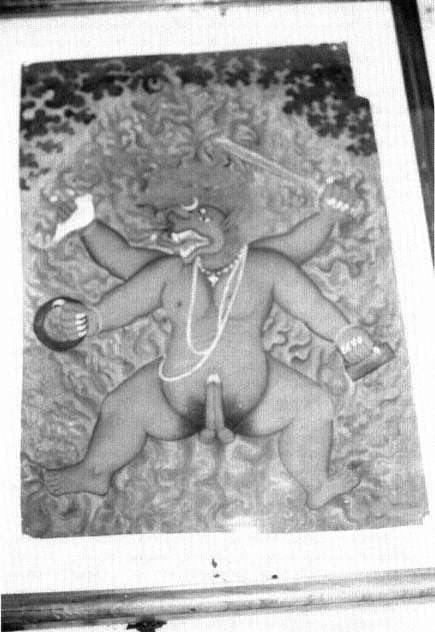
Figure 17.
An esoteric image of a Bhairava.
trast to the frequently bestialized humanoid forms of the dangerous anthropomorphic gods. They represent the moral interior of the city and both represent and are models for the moral dimensions of human relations (above all, those of the household and other intimate relations) and of the self.
Walter Burkert argues that the Greek Homeric gods move beyond the anthropomorphic gods of the Near Eastern and Agean neighborhoods of Greece. Those gods "speak and interact with one another in a human way, . . . love, feel anger, and suffer, and . . . are mutually related as husbands and wives, parents and children." But the Greeks, he says, add something to this. "The Greek gods are persons , not abstractions, ideas or concepts. . . . The modern historian of religion may speak of 'archetypical figures of reality,' but in the Greek, locution and ideation is structured in such a way that an individual personality appears that has its own plastic being. This cannot be defined, but it can be known, and such knowledge can bring joy, help, and salvation. These persons as the poets introduce them are human almost to the last detail" (1985, 182-183 [emphasis added]). Jean-Pierre Vernant, on the contrary, asserts that "the Greek gods are powers, not persons" (1983, 328). He argues this on the basis of their difference from what he takes to be the essence of social persons—namely their being as "autonomous focuses of existence and action, ontological units." Claiming that "a single person cannot be several," he calls attention to the various states and conditions referable by term such as "Zeus." However, this does not affect the argument that in particular temporal and spatial contexts and uses these gods are "persons" in a way that the members of some other pantheons are not, and that this quality as manifest in these contexts is of considerable importance for understanding the ancient Greeks and their religion. It is their person-like aspects that most clearly locate the forms, meanings, and uses of the ordinary gods as members of a particular class in Bhaktapur's civic pantheon. When, in contrast, a member of this set is considered in historical perspective, and its uses in other settings and conditions and in differently arranged pantheons are all added to the identity of the divinity, another type of figure, of great mythic complexity, emerges. As we have noted, such histories surround all the gods of the pantheon but are distant background to the choices and simplifications that must be made for the god's synchronic civic uses.
"Person" refers to a universal social invention, "someone" as the
legal definition has it, "who is capable of having rights, and being subject to duties and responsibilities," that is, a relatively fixed actor in the give and take of a moral system. Not all individuals in a community are "persons" in this sense; infants and often the mentally ill and defective are not. The benign gods have many of the characteristics of persons in this sense. They look like humans, and their special differentiating aspects are all social. They are embedded in and defined by social relations, out of which a larger community of related divine individuals is built. Their relations to each other are in part moral, matters of understood obligations and limits, and in part passionate. But their passions and motives—annoyance, rage, lust, compassion, respect, and fear—are ordinary social ones. The benign gods are in large part fixed in their forms and in their relations, and usually work things out within the constraints of logic and ordinary reality to which is added a superhuman (but limited) power that they use in times of special need. Like ordinary persons, they are subject to pollution (compare the discussion of the Nine Durgas in chap. 15), which indicates that they must, like all mature citizens of Bhaktapur, take care in order to maintain their social definition as persons (chap. 11). The dangerous gods have no such concern.
The benign gods as persons represent, as Babb has proposed, "certain key values of Indian civilization" (1975, 224). But they represent not only ideal values but also aspects of "normal" behavior, that which is tolerable for humans. What they do not represent (except transiently in the history of that generative and bridging form, Siva) is "insanity" and other modes of operation and understanding of the mind peripheral to the "person." This is done by the dangerous deities in various ways. As representations of the ideal and "the human," the benign deities become foci of identification and guides for proper behavior and moral standards, and also for tolerant understanding. Their soteriological functions have to do with reward or punishment of the atma , the particular spiritual entity that is for most people closely connected with the idea of the self and its persistence after death. This reward or punishment is based on moral performance within everyday life and with the proper devotion or "service" to the god and, in marked contrast to the effects of encounters with the dangerous gods, with inner intentions as well as external behavior. The benign gods, like all the gods, are subject to ritual manipulation. But their proper devotion and ritual manipulation consists primarily of a mimesis of honorific and respectful behavior, in the course of which they are offered the same honor, hospi-
tality, gifts, and services that would please any honored guest or person of high status. Such rituals reinforce and reaffirm the worshiper's social relation to the benign deity. All this does and can go on only within a rational, dependable world. These gods are "ordinary" and not "dangerous" precisely because they respond dependably to anyone with adequate social and moral skills, anyone who has, in part with their help, become a competent person by Bhaktapur's standards.
For other tasks and meanings Bhaktapur employs other types of divinities, divinities who are much more peripheral to the moral world of persons than the ordinary gods, and who thus represent other realms and ideas and who must be dealt with in other ways. The dangerous anthropomorphic gods vividly represent this nonmoral realm precisely because they have some characteristics of persons—names, forms, and anthropomorphic embodiments. They are radically peculiar and unacceptable persons, however, persons in flux—to recall Vernant, they are not quite "ontological units." They are outside the constraints of both logic and morality that are the essence of true persons. They represent the bordering outside of the ordinary world in a variety of ways—they are related to the forces and forms of "nature" beyond the city, wild and dangerous but at the same time vital, and also to certain psychological modes—dream, insanity, and those passions and impulses (e.g., cannibalism) that are beyond what are acceptable even to a tolerant view of what a person is or should be. As they do not operate through moral interactions and manipulations, they operate in the only other available mode, through power, and that is the way they, in turn, must be dealt with. This constellation of characteristics used to portray the hinterlands of any moral community has many familiar echoes throughout the world,[72] but the uses of the dangerous gods have a particular development, force, and legitimacy in Bhaktapur. In contrast to many other Hindu communities (below), the dangerous gods have a special status in Bhaktapur as legitimate and high-ranking members of the pantheon, and as Tantric gods they are (as we will see in the next chapter) in many ways the foci of aristocratic and royal worship.
The dangerous deities represent not only the nonmoral exterior of the city but also the relatively nonmoral aspects of the exteriors of various of the city's component units. In some contexts, they are associated with individual's bodies and, particularly, with danger to those bodies in contrast to people's selves, souls, or "personhood," all associated with the benign moral deities. Most generally the dangerous gods protect the perimeters of the community, of its components, and of its
members, within which the ordinary moral life, represented by the ordinary gods, can go on, while at the same time representing aspects of the external dangerous forces. In protecting the boundaries of moral units and civic spaces, however, they also represent and protect such units as a whole . It is in this way that they can be made to represent the city as a whole, a lineage, guthi , or a neighborhood.
The use of dangerous deities as the representatives of a moral maximal unit warrants more comment. Let us recall the emergence of Devi in the Devi Mahatmya . When the world of the gods is threatened by danger from the Asuras—that is, when that world emerges as an entity precisely and only because it is set against a dangerous, contrary world—the Devi arises. She uniquely represents the world of the gods, even though she is not a "normal" member of that world. if she were, she could not protect them. She can protect them only by sharing in the nonmoral power of the external forces she has to defeat. In analogous ways Bhaktapur uses nonmoral deities to represent, as well as protect, moral units.
There is another important aspect of the use of nonmoral dangerous deities to represent a moral unit. They protect that unit in a very real way (as we will discuss in later chapters, particularly in relation to the Nine Durgas in chap. 15) by helping to ensure the adherence of its members to its moral system. The dangerous deity, usually a goddess, in concert with the meanings of blood sacrifice offered to her, represents the destruction that will overtake members of a group if they violate their adherence to the moral system and moral solidarity of the group. She binds members into the group as well as defending the group's boundaries and representing it as a whole.
Insofar as the dangerous deities themselves represent the kinds of external dangers they protect against, they must first be captured in order to be put to work for the community. As we will see in later chapters, this is done in local legend through the Tantric power of exceptional individuals. For ordinary individuals the dangerous deities can be controlled, albeit somewhat tenuously, not through social deference and good behavior as are the ordinary gods but through an individual's initiation into secrets of power, and the use of spells (mantras ) and, above all, through the use of one of the most important ritual resources in Bhaktapur, blood sacrifice, whose meaning in relation to the dangerous gods we will discuss in later chapters. Most of the time one deals with these powerful and erratic deities by trying to avoid them, or not to anger them or—if one has reason to assume that they
are angry—asking forgiveness and making restitutive offerings, even if (in contrast to the moral deities) they may have become angry "without cause." As the dangerous deities do not represent moral values, they cannot be, as the ordinary deities are, models for ideal or tolerable behavior. Their psychological functions for individuals, like their uses for th city, are quite different from those of the benign deities with whom they contrast within the formal supernatural class of humanly worked deities.
A few classes of deities differentiated among themselves by a few structural features do, as classes, much of the work of organizing realms of meaning in Bhaktapur. Their contrasts use kinds of meanings—near versus far, vague versus clearly formed—which are easily apprehended, and require minimal special cultural knowledge. The situation changes radically in relation to the organization and uses of the differentiated supernaturals within the classes of deities.