
Eight—
Women Patrons and Crusaders for Modernist Music:
New York in the 1920s
Carol J. Oja
Rising young American composers of the 1920s have been vigorously acclaimed in histories of this country's music. As the legend goes, something special happened during that decade, and New York City was the central place where it occurred. Struggling against a conservative and inhospitable music establishment, figures such as Aaron Copland, Henry Cowell, and Edgard Varèse struck out on their own, forming performance societies and publishing enterprises to promote their work. They cultivated an image of autonomy and iconoclasm, and that image has been retained with little question by historians, who have tended to enshrine these composers within two cherished American mythologies, those of the pioneer and the inventor. This began in writings by the composers themselves. Henry Cowell, for example, described his colleagues during the 1920s as "experimental," "uninhibited," and "untamed," and the British historian Wilfrid Mellers echoed that language in a survey of American music, titling his overview of composers since World War I "The Pioneer and the Wilderness."[1]
While this view contains elements of truth, it also involves exaggeration. For although these composers certainly dominated the foreground and achieved much, they did not do so alone, but relied on a strong network of supporters. Theirs was a community effort rather than one of isolated trailblazers, and women were central to its success. Working behind the scenes, women financed, published, organized, and promoted the newest music with energy and imagination. When in 1923 Walter Damrosch wrote, "I do not think there has ever been a country whose musical development has been fostered so almost exclusively by women as America,"[2] he was not only reflecting on some distant past but revealing much about the present—about the world in which the musical avant-garde took hold. By exploring women's contribution to the new-music movement, striking perspectives on the decade emerge, revealing close connections to patterns of support in literature
and art; suggesting what might on the surface seem an unlikely alliance between social feminism and the American avant-garde; and posing the question of what role the "New Woman," as the feminist slogan of the day put it, played in the growth of modernist music.
The full impact of women on New York's new music is a sizeable topic. A complete account would include not just those few women who were composers (to date, they are the only ones who have received much attention) but also those who edited the modernists' magazines (and they edited all of them).[3] Others worked as performers, and still others as patrons, promoters, and organizers. The focus here will be on several key figures from the latter group—first, Gertrude Vanderbilt Whitney, Alma Morgenthau Wertheim, and Blanche Walton, who were New York's most important patrons of new music, and, finally, Claire Reis, who was its indefatigable organizer. Together, they show various dimensions of the female contribution. Most of these women have previously been absent from chronicles of the period. In part this is because they kept such a low profile and because documentation of their work is extremely uneven. But attitudes toward them have also shaped the telling of history. The Daniel Boones of American music did not tackle the frontier alone. They had a group of hard-working women by their sides.
Women As Patrons
In 1925 George Antheil, a young American composer soon to become celebrated for his audacity, wrote to Mary Louise Curtis Bok, the woman who had been financing his work for several years. While his outcry was typically histrionic, it articulated the central economic issue for his generation: "If you want composers like Beethoven or Chopin, you shall have to be prepared to do what the princes of other days did for these people. The joke of it is that the rich and wealthy people of our States want these thing[s] without paying for them [underlined twice]. For nothing ! The princes of other days had to pay for them. So will the princes of today."[4]
Antheil made his appeal, of course, to the American equivalent not of a prince but of a princess , as would so many of his contemporaries. Women, more than men, stepped forward as patrons. Whether Mary Louise Curtis Bok in Philadelphia, Elizabeth Sprague Coolidge in Washington, D.C., or Alma Morgenthau Wertheim in New York City, women of means put their energy and dollars behind young, often experimental, composers. This was not just a musical phenomenon or an American one: wealthy European women subsidized the avant-garde in music, and women on both sides of the Atlantic supported writers and visual artists. Private patronage experienced a major revival during the 1920s. In Paris, for example, the princesse de Polignac (an American from the Singer sewing-machine family) supported Igor Stravinsky; he dedicated his Piano Sonata of 1924 to her, and many of his new compositions received private auditions in her salon. She also subsidized Ravel and Satie, among others.[5] A legion of wealthy women
also supported writers and painters of the period—for example, Lady Gregory, who financed Yeats; Harriet Shaw Weaver, who subsidized Joyce; and Mabel Dodge Luhan, who supported D. H. Lawrence and others. In discussing early-twentieth-century modernist writers—both European and American—the literary critics Sandra Gilbert and Susan Gubar have observed: "A striking characteristic of the twentieth-century avant-garde, after all, was its determinedly anti-commercial cast. Perhaps there has been no circle of writers since the sixteenth century which was more dependent on private patronage, and, like such sixteenth-century figures as Sidney and Spenser, many prominent modernists were subsidized by a series of wealthy women or publicized by a set of powerful women."[6]
Such was certainly the case among concert-music composers in New York, where Whitney, Wertheim, and Walton provided essential financial help and moral support. Yet for Americans, private patronage of composers was a relatively new concept. In the late nineteenth century, as an American wealthy class rose to prominence through expanding railroads, mines, and industry, it became involved in supporting cultural improvement. However, in music that support most often had gone toward performance, not composition, and its focus had been on the European repertory.[7] Just as the notion of being a patron was modeled on European precedents, so was the choice of music to promote. The same applied to the patronage of American museums: supporting European masterworks brought a cachet of sophistication and cultivation. Therefore America's wealthy citizens munificently funded the Metropolitan Museum of Art, the Metropolitan Opera, the New York Philharmonic, and Carnegie Hall. With the exception of Isabella Stewart Gardner, who in Boston at the turn of the century subsidized Charles Martin Loeffler, patrons paid little attention to native composers.
Things began changing in the late 1910s, especially with the work of Elizabeth Sprague Coolidge, and by the early 1920s patronage of composers had become more frequent. Many patrons continued to support the performance of European masterworks. Yet others reached out to composers, and they made quite a difference. Suddenly an ambitious group of young musicians did not need to spend time earning a living outside of composition, as had William Billings who worked as a tanner in late eighteenth-century Boston, or Charles Ives who built a successful insurance business in early-twentieth-century New York. Instead they could devote themselves fully to practicing their art.
Gertrude Whitney, Alma Wertheim, and Blanche Walton, then, were continuing an old tradition but giving it a new twist. Each allied herself with a different faction of the avant-garde, and each shaped her giving in an individual way. Yet all sought personal satisfaction by contributing to a cause that seemed both adventuresome and important.
Although remembered primarily as a patron of visual artists, Gertrude Vanderbilt Whitney (1875–1942) advanced modernism in America in a variety of art forms,
including music. An accomplished sculptor, she was a major benefactor of the famous 1913 Armory Show, through which European modernist painting first reached New York, and she later founded the Whitney Museum of American Art in New York. Her involvement in music, while brief, had a similar purpose: to promote modernism in a society reluctant to accept it. Beginning in the late 1910s, she championed the music of Edgard Varèse and helped support his ill-fated New Symphony Orchestra, which served as one of music's answers to the Armory Show by revealing works of European modernists, such as Alfredo Casella and Béla Bartók, that were unknown to New Yorkers.[8] Later Whitney became "one of the principal sponsors" of Varèse's International Composers' Guild.[9]
In embracing philanthropy, Whitney followed the example of older members of her family, most of whom were male, at the same time as she sought personal satisfaction. Among the inheritors of the Vanderbilt family fortune, built on ships and railroads, she expanded her financial base by marrying Harry Payne Whitney, whose money lay largely in oil and tobacco. Yet in the first decade of the twentieth century, when Whitney turned to living artists as the target of her gifts, she chose her own version of the family's philanthropic mission, which had centered on major institutions such as Columbia University and the Metropolitan Museum of Art. For her, patronage became a way of relieving what the historian Anne Firor Scott has described as "the inchoate sense of uselessness which afflicted young women of leisure."[10] It also became her weapon for dealing with an unhappy marriage. After bearing children and submitting herself to the constraints of New York's high society, Whitney began to seem like a wealthy counterpart of Lily Bart in Edith Wharton's House of Mirth , whom Wharton characterized as "so evidently the victim of the civilization which had produced her that the links of her bracelet seemed like manacles chaining her to her fate."[11] Whitney struggled with those chains, waging a moral battle against the limitations of privilege. In 1901 she wrote in her journal of feeling useless: "I pity, I pity above all that class of people who have no necessity to work. . . . [The wealthy are] the great and grand unemployed—the dregs of humanity."[12] Whitney wanted to avoid such immobility, turning to both sculpture and patronage as a means of finding fulfillment.
Whitney's support of Varèse appears to have been her primary activity in new music. Besides helping to underwrite his performance organizations, in 1921 she gave him what has been described by his wife, Louise, as "an adequate allowance" so that he would not have to take a job. She also hosted after-concert parties and lectures.[13] But details of her substantial support of the International Composers' Guild remain obscure. Louise Varèse shares some information in her account of the early years of the guild, as does B. H. Friedman, Whitney's biographer.[14] Little else about Whitney's contribution survives in her papers, however, and Varèse's personal correspondence remains inaccessible to scholars.[15]
Because information about Whitney's music patronage is so spotty, her importance could easily be diminished. Yet her assistance in launching the first major organization for American modernist composers made her one of the earliest pa-
trons to subsidize new music in New York. She simply extended the support she was giving visual artists to those who wrote music. Whitney's efforts in the late 1910s and early 1920s helped turn the attention of American music patrons away from support for the performance of European classics and toward the encouragement of creative ventures.
Alma Morgenthau Wertheim (1887–1953) expanded on the work that Gertrude Whitney had begun. Among several subsidiary financers of Whitney's big cause, the International Composers' Guild, Wertheim went on to become a substantial underwriter of both composers and new-music organizations.[16] Although Whitney's deepest connection had been to the visual arts and her direct participation in music projects—outside of financial support—had been slight, Wertheim took much more of a music-focused, hands-on approach. She was among the dissenters who broke from the International Composers' Guild in 1923 to form the League of Composers, and she became an active member of the league's board. She even founded her own publishing firm for issuing new scores.[17]
In yet another contrast to Whitney, Wertheim's work as a music patron has been better documented, but its sources are still scattered. The Morgenthau archive at the Library of Congress contains materials mostly about male family members, especially Alma's father, the financier and ambassador Henry Morgenthau, and her brother, Henry Morgenthau, Jr., who became Secretary of the Treasury under Franklin Roosevelt.[18] Thus information about Alma's legacy largely comes from the files of composers—especially Aaron Copland, Virgil Thomson, and Louis Gruenberg—and from interviews with Claire Reis and Minna Lederman, two women with whom she worked at the league. Even her daughters (who included the late historian Barbara Tuchman) saved few of her papers.[19]
Wertheim's efforts took several forms. First there were contributions to organizations. In addition to providing cash to both the guild and the league, she also underwrote the league's journal, Modern Music , for several years.[20] Then there were her stipends to individual composers, most of whom fell within the league's orbit. Aaron Copland was a central recipient of her help and became a kind of hub around which her patronage spun.[21] Ironically, considering that the new-music movement focused on breaking with the past, Copland's link to Wertheim began within the social conventions of old New York. In 1925 he made at least two pilgrimages to her Upper East Side apartment for tea. Both times he played some of his music, and as a result she handed him a check for $1,000. Copland later recalled, "I don't know how, without that, I would have managed in the year that followed while I was composing Music for the Theatre ."[22] Wertheim helped others as well. She presented Roy Harris with at least $1,800 so that he could study with Nadia Boulanger, and she provided smaller cash stipends to Israel Citkowitz, among others.[23]
The third aspect of Wertheim's work was by far the most monumental: the founding of Cos Cob Press in 1929 (see frontispiece), which in the next nine years
published some thirty-five volumes of music by young Americans—music that commercial houses would never have considered releasing. With this effort Wertheim took a bold risk. Cos Cob Press gained distinction as Copland's first major American publisher, and it also gave publication premieres to Roy Harris, Walter Piston, Roger Sessions, and Virgil Thomson.[24] Wertheim underwrote the expenses of the press entirely, and through it she joined other women, especially in Paris, who were publishing the work of young writers. For example, Nancy Cunard ran The Hours Press in the late 1920s, counting Samuel Beckett among her major literary discoveries, and Caresse Crosby started Black Sun Press with her husband, Harry, and managed it singlehandedly after his death.[25] Wertheim assumed a similar function, not only funding her press, but being involved in its operation. She designed the cover used for the scores and had some say in the pieces chosen.
Yet Wertheim's relationship to composers was highly volatile. Minna Lederman, a member with Wertheim of the league's board, has described her as "a very special figure in her own circle . . . with beautiful taste for decor, personal and otherwise, and a very hot, passionate temperament."[26] That passion appears to have directed her patronage. Just as her tenure with the guild had ended explosively, so it did with the league. In the November-December 1928 issue of Modern Music , Wertheim's name did not appear in the list of the league's executive board. It never reappeared. According to Claire Reis, Wertheim resigned because of a confrontation over the design of Modern Music and a belief that her opinions were not being taken seriously by the board.[27] The next year she struck out on her own and founded Cos Cob Press.
Blanche Wetherill Walton (1871–1963) presents an altogether different case. Whereas Whitney allied herself with Varèse, and Wertheim with Copland and his circle, Walton befriended another faction of the new-music community: Henry Cowell and some of his colleagues, including Ruth Crawford, Carl Ruggles, and Charles Seeger. By no means as wealthy as Whitney or Wertheim, she gave modest cash stipends. Her largest contribution came through offering composers housing and presiding over a kind of salon for modernists. In other words, she used the traditional female domain of the home to help the struggling avant-garde, becoming a kind of domestic impresario. Carl Ruggles acknowledged the value of her work in a 1928 letter, "Keep on, and you will become such a power in musical circles that all we poor, damned composers will have to do is to take our scores and our troubles to you and everything will be 'velvet.'"[28]
Like Whitney and Wertheim, Walton took up her work as part of a search for personal satisfaction. Unlike them, she had professional potential as a musician. A gifted pianist who had studied with Edward MacDowell, she was later described by Henry Cowell as "a pianist of professional calibre in the days when a public career was unthinkable for a girl of good family."[29] Instead, after raising two chil-
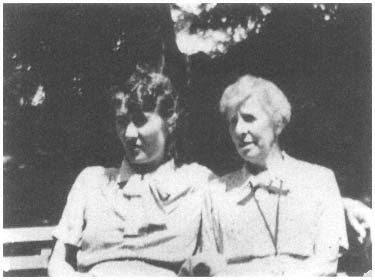
Fig. 25.
Marion Walton Putnam and Blanche Walton in the early 1930s.
Photograph in the collection of Marion Walton Putnam.
dren, she sought a new life in contemporary music, and her various New York apartments—in Bronxville, at West Sixty-Eighth Street and Central Park West, and in Washington Square—became havens for experimentalists. Walton later recalled: "The one contribution I could make to the gifted and struggling pioneer composer was to turn my apartment on Central Park West into a meeting place. It was then a shabby elderly house which had a large corner room which proved to be excellent for a music room with Steinway piano. My rooms were comfortably apart which left other rooms for visiting composers of whom Cowell was a frequent one."[30] Walton's path to patronage came about through two principal contacts: with Edward De Coppet, her husband's employer, who as a major early-twentieth-century patron founded and supported the Flonzaley Quartet, and with Cowell, whom she met through the singer Radiana Pazmor during a visit to California in the early 1920s.[31]
Walton was involved in the modernist movement from the very beginning of the 1920s. A few remaining letters, part of a small collection of her papers at the New York Public Library, suggest the dimensions of her efforts.[32] She gave money to the International Composers's Guild and helped support Cowell's New Music Society and its various offshoots, especially New Music Editions.[33] Principally, though, she established a kind of boardinghouse for vanguardists. Bartók used her West Sixty-Eighth Street apartment as a base during his 1927 tour of the United States; Carl Ruggles and Henry Cowell stayed with her for long periods during
their many trips to New York; and during the winter of 1929–30, the young Ruth Crawford lived with Walton while she began studying with Charles Seeger. The first meeting of what would become the American Musicological Society was also held at her apartment in 1930.[34]
Walton's private musicales served an important function for the young modernists. In early December 1929, for example, she arranged an informal concert in her apartment for Ruth Crawford, which featured the premiere of Crawford's Suite No. 2 for Four Strings and Piano.[35] Another musicale, probably scheduled that same year, centered on Aaron Copland's work, suggesting that Walton's generosity extended beyond the circle surrounding Henry Cowell.[36]
Because Walton did not take on huge financial responsibilities with new music, like Whitney and Wertheim, or step forward as an outspoken activist, as will be seen with Claire Reis, her legacy is more difficult to assess. Measured against today's standards of feminine achievement, her work might easily be devalued because of its domestic nature. Yet by establishing a base of operation for struggling young composers and by hosting musicales, as well as after-concert parties, she gave essential assistance. In 1959, Henry Cowell paid tribute to Walton, calling her "one of the most important and best beloved sponsors that modern music has had here." He went on to pinpoint the substance of her contribution: "Much of the activity of composers of modern music was centered in her home, and we owe to her hospitality an early focusing of modern musical thought in New York. She created a stimulating atmosphere where nothing but generosity toward divergent ideas was possible."[37]
As patrons, then, these women provided the support necessary for composers to write, publish, and perform new works. While their gifts took different forms—whether giving stipends to individual composers, subsidizing performance organizations, underwriting the publication of music and journals, hosting social functions after concerts, presenting musicales, or housing composers—they shared a commitment to advancing modernism in America. Yet an important part of their role as patrons was to stay modestly in the background. Louise Varèse called Gertrude Whitney "self-effacing," and the same adjective could be applied in varying degrees to all three.[38] A woman's place as patron was to be generous as well as selfless. Her creative energy went into discovering and encouraging others, not into drawing attention to her own work. No matter how crucial her role, it fit into a well-established hierarchy based on gender and occupation, making her subsidiary to the mostly male composers she aided.
Volunteering for the Cause
While women patrons generally stood discreetly behind the scenes, Claire Raphael Reis (1888–1978), perhaps the single most indispensable woman to modernist musicians, was much more visible, as executive director first of the International Composers' Guild and later of the League of Composers. Her "luminous,
nourishing energy," as the writer Waldo Frank once characterized it, became legendary.[39]
Diverse ideologies converged to inspire Reis. Ironically, given modern music's small, elite audience, she approached her task with the tools and ideals of the settlement-house volunteer. If Gertrude Whitney embodied the high-society ambivalence of an Edith Wharton character, Claire Reis felt the social mission of a Jane Addams or Lillian Wald. A consummate organizer, she had deep roots in important feminized spheres—social service and the woman's club—and she embraced the goals of social feminism: to promote reform through vigorous action. While some of her female contemporaries labored for the rights of children, new immigrants, and the poor, Reis took on another of society's underdogs, the composer. Her activism and progressive roots closely paralleled those of Katherine Dreier, one of the founders and driving forces behind New York's Société Anonyme, an organization begun in 1920 to exhibit contemporary art.[40] Reis's career also reveals much about early musical modernism in New York—especially the years between 1910 and 1920, a decade that remains almost completely overlooked by music historians.
Like Blanche Walton, Claire Reis was a gifted pianist inhibited from becoming a professional by the conventions of her time and class. While Reis later claimed that her teachers had encouraged a concert career, "playing for charity was my mother's idea of bringing up a musical daughter."[41] And musical charity became her principal pursuit. But she also happened upon modernism while both she and it were young, especially through piano studies with Bertha Fiering Tapper at the New York Institute of Musical Art (now the Juilliard School).[42] Tapper held Saturday-afternoon musicales at her home, and it was there that she presented Leo Ornstein, another of her students, whose career she helped promote. Reis later recalled bringing both the writer Waldo Frank and another of her good friends, the future critic Paul Rosenfeld, to hear Ornstein at one of Tapper's Saturday-afternoon concerts.[43] For all three, as well as for others, these musicales gave a valuable introduction to music that was just beginning to reach America. Frank vividly recounted one of Tapper's afternoons, which probably took place in 1914:
The long room [in Tapper's home on Riverside Drive] with a façade of windows giving on the Hudson was astir like a convention of birds with the elegant gentlemen and ladies perched on their camp stools. . . . [After Ornstein played some Debussy, Ravel, and Albéniz], Mrs. Tapper stood up and announced to her guests that Leo would now play some of his own music. Leo responded with a voluminous, cacophonous broadside of chords that seemed about to blow the instrument in the air and break the windows. Chaos spoke.[44]
For Reis, encountering Ornstein "was really the beginning, the ear opening, if not the eye opener for me."[45] In the spring of 1916, eight months after Tapper's death, Reis took up her teacher's mission, presenting Ornstein in a series of "Four Informal Recitals" at her home on Madison Avenue.[46] Those events were an important harbinger of developments in art music in the 1920s. The critic Paul
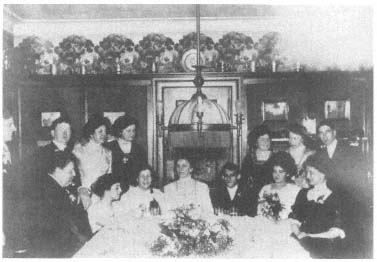
Fig. 26.
Bertha Fiering Tapper and students, ca. 1908. Mrs. Tapper is at the
center. To her left are Leo Ornstein and Claire Raphael. To her right
are Kay Swift and Pauline Mallet-Provost (who later married Ornstein).
Photograph in the collection of Vivian Perlis.
Rosenfeld had proposed the concerts in letters to Reis, and as he wrote, a portent of her future unfolded: "The point is, that in the back of my mind there is a desire to help organize a modern music club, . . . and I wonder whether an audience gotten together for Leo's recital couldn't help form a nucleus for such a society? There's really a crying need for such an organization to make headway against the sluggish conservatism in musical circles."[47] Although no such organization materialized immediately, Rosenfeld's letter shows that the idea for the International Composers' Guild and the League of Composers was germinating in the mid 1910s, long before either organization became a reality.
At the same time as Reis was aiding the career of a rising modernist, she was also helping the poor. In 1911, she had fulfilled her mother's vision of musical charity by establishing the People's Music League, an organization that presented some two hundred free concerts for newly arrived immigrants each year in New York schools.[48] It was an extension of the settlement house—of places such as Henry Street Settlement House in New York or Hull House in Chicago, where education and social services were provided for struggling newcomers to America. Reis later described it as her "first satisfying experience combining music and social service in a civic project. . . . [It] stirred great sympathy [for] people poor and hungry for music."[49] For the tenth anniversary of the People's Music League in 1922, Reis staged a concert of contemporary music, which included works of Rebecca Clarke, Louis Gruenberg, Frederick Jacobi, A. Walter Kramer, Lazare
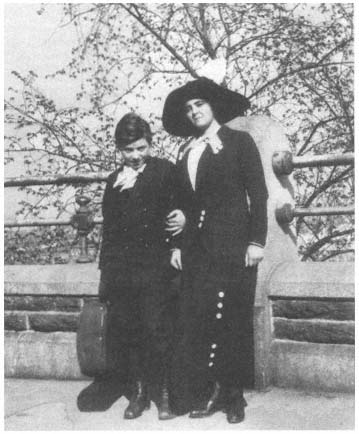
Fig. 27.
Claire Raphael Reis and the violinist Max Rosen, whom she
accompanied in New York during the early 1910s.
Photograph in the collection of Hilda Reis Bijur.
Saminsky, and Deems Taylor, almost all of whom would become major figures in the League of Composers.[50] For Reis, it was a pivotal event, as she later recalled, "My reputation with the Cooper Union Composers' concert led me into the next phase of music—this time with a feeling of service to composers . . . . My sympathy for the masses and for music seemed to begin a new chapter; sympathy for the composers ."[51]
That fall, after the People's Music League ended, Reis became executive director of the International Composers' Guild. It was a productive but unhappy appointment. She moved the concerts uptown to the Klaw Theater, which she obtained from a family friend at low rent; she put Alma Wertheim and the art dealer Stephan Bourgeois on the board; and she brought the guild out of debt. Yet. according to Louise Varèse, her husband felt Reis had "[taken] over" the guild, and
he disdained her after-concert receptions as "those delicatessen parties."[52] In giving her side of the story, Reis recalled "great disorder" at board meetings of the guild and puzzlement at the organization's pride in obscurity: "People like Ruggles would loudly voice their opinions. His was: If more than a dozen people [were] in [the] hall they were catering to the public."[53]
Yet Reis worked vigorously for the guild, even turning to journalism as a means of promoting it. In a 1923 article titled "Contemporary Music and 'the Man on the Street'" and published in the guild's unofficial journal, Eolian Review , Reis made an unusual suggestion: that the audience for new music might develop, not from the "so-called musically educated class," as she put it, but from those less acquainted with the European classics. She went on: "'The man on the street,' as signified by the average person without esthetic standards which belong to the past, this man can hear, can see, can sense an art belonging to his age because it is part of his life, because he has not been educated to accept definite laws based upon tradition ."[54]
This hope that the newest art would find an accepting audience with the most unsophisticated listener might seem naive, if not downright condescending. Yet it grew out of Reis's experience working with the poor, and its intent was genuine. She was applying social feminism to contemporary male composers. Not surprisingly, then, Reis's article was greeted with charges hurled at other social feminists of the day. Jerome Hart, a conservative freelance music critic, wrote that her theory gave evidence of the depths to which modernism had plunged: "Of course, this is but a phase of present-day unrest and revolutionism, which finds its extreme expression in Bolshevism, under which anarchists are elevated into prime ministers, incendiaries and criminals into judges, and all the rules of decent and orderly living are thrown into the discard. It is a passing phase, in which ugliness, both moral and physical, boldly asserts itself."[55]
Hart published this not long after the Red Scare of 1919–20, when the epithet "Bolshevist" had been hurled at many espousing new ideas. It hit social feminists especially hard. The pioneering Sheppard-Towner Maternity- and Infancy-Protection Act of 1921, for which women had campaigned vigorously, was dubbed "Bolshevist" by its opponents, and four years later such name-calling defeated a child-labor initiative in Congress. Hart, then, applied the language used against women as social reformers to Reis as a reformer in music. In viewing as subversive both the music she supported and the audience she anticipated, Hart also echoed contemporaneous indictments brought by his colleague Daniel Gregory Mason against modernism and jazz and foreshadowed the charges that composers, especially those involved in any way with folksong, would face decades later during the McCarthy hearings.
Another crucial element in Reis's background was her early membership in the Women's City Club of New York, which was begun in 1916 by a group of suffragists.[56] Just as her work for composers reflected social-feminist concerns, it likewise drew upon the organizing methods of the women's club. Women's music clubs (with
which Reis seems to have had no association) played a major role from the 1870s on in educating and elevating taste. But the women's club movement as a whole provided the principal means for women to become active outside the home.[57]
Reis's work in social service and the women's club thus prepared her for activism in new music. As leader of the group that seceded from the International Composers' Guild in 1923 to form the League of Composers, she became executive director of the new organization, which was also a successor in name as well as spirit to the People's Music League.[58] It became a major forum in New York for the presentation of both European and American new music, and unlike the guild, which disbanded in 1927, the league remains active today. Reis conceived the organization in a democratic spirit, similar to other leagues that were being founded in the late 1910s and early 1920s. Some, such as the National League of Women Voters and the Women's International League for Peace and Freedom, were the inspiration of women activists. Another, the League of Nations, had a broader base.
From the outset, Reis mobilized the composers' league. She organized its concerts, staged publicity campaigns, negotiated with conductors and performers, hosted social functions, raised money, provided office space in her home, and made her car and chauffeur available for league business. Directing the league became the equivalent of a full-time job—a job for which she was not paid but volunteered. Aaron Copland later characterized her as "a pro. Her day was as highly organized as that of any modern career woman," and his words provide an important clue to the context in which she should be viewed.[59] By no means a radical feminist, Reis belonged to a particular breed of "modern" woman. Proud to have marched with the suffragists—or so her daughter, Hilda Bijur, recalls—she embraced a feminist ideal that combined activism with a Victorian sense of womanly duty.[60] The historian Dorothy Brown has observed that social feminists campaigned for suffrage not to advance themselves but rather "to win the power to clean up America. Social feminism was serviceable and safe."[61] Reis later acknowledged her model to be one of social feminism's great architects, Jane Addams, who advocated combining home and family with public service. Addams also supported volunteerism for women, and Reis later articulated the same philosophy: "In those days if a girl did not need to earn money [she did not work]. Neither Jane Addams nor Lillian Wald—both very modern, liberal women—[did. They] were adamant that girls should not work for money."[62] To Reis and others of her generation, social service was modern, and volunteering provided an acceptable way of accomplishing it.
Also striking, in light of Reis's connection to women's clubs, was one of her methods for raising money. To finance the league's special staged productions, such as those of Igor Stravinsky's L'Histoire du soldat in 1928, his Les Noces in 1929, and Schoenberg's Die glückliche Hand in 1930, Reis formed an auxiliary board, probably modeled on a parallel appendage of the New York Philharmonic.[63] The league's auxiliary board seems to have been established in 1927 and had a slightly
fluctuating membership of around thirty-five, most of whom were women. Each gave a small gift of approximately $100 to $200 for individual stage presentations.
Yet while the auxiliary board made it possible for the league to produce these special events, most of which were American stage premieres, it also faced some scorn, both for the gender and social pretensions of its members. This was partly true because the auxilliary's contributions focused so singularly on splashy productions, many of which took place in the Metropolitan Opera House. But it also reflected a prevailing attitude about the network of "ladies" that supported America's cultural institutions. Louise Vàrese, for example, recalled somewhat disparagingly that Vàrese's New Symphony Orchestra had a "large Ladies' Committee" that did "whatever ladies' committees do."[64] The league's "ladies' committee" sponsored stage productions featuring major conductors such as Pierre Monteux, Leopold Stokowski, and Tullio Serafin. It chiefly funded performances of works by European modernists, however, not by young Americans. When Reis tried to persuade the auxiliary board to raise money for a composers' fund that would commission new American works, she found that its members' aesthetic boundaries were firmly set: "We were keenly disappointed when not a single response came from any of the hundred-odd 'pillars of art,' although they had gladly spent $250 for a box from which to see and be seen for one evening. . . . They seemed little aware of the composer as a fellow human being."[65]
Among Reis's many other achievements, a final item deserves attention: her publication in 1930 of American Composers of Today , the first catalogue of music by American modernists. Although today the compilation of bibliographies and work lists has become almost commonplace, in 1930, for these composers, such a source was unique. It served as an invaluable and highly practical means of giving conductors, performers, publishers, and critics a sense of existing contemporary literature, and it made access to these works possible. Two years later Reis produced a revision of the catalogue with two and a half times as many entries (expanding from 55 names to 135). Subsequent editions appeared in 1938 and 1947.[66]
The Critical Response
If the involvement of Reis, Whitney, Wertheim, and Walton in new music during the 1920s has been obscured in the ensuing years, attitudes at the time helped prepare for its eclipse. While the female leaders of composer organizations may have disparaged the social pretensions of "the ladies" on their auxiliary boards, men viewing these same groups often had an even broader disdain, which extended to women organizers and patrons. Certainly, some composers expressed gratitude for all the good work done on their behalf and the hard cash they received. Copland and Cowell, for example, publicly acknowledged their debts to Reis and Walton.[67] But others demonized their benefactors. Music critics tended to be the most outspoken, often attacking women as a group rather than singling out any individu-
Earlier versions of this essay were presented as part of the Project for the Study of Women in Music at the Graduate Center of CUNY and at the 1991 annual meeting of the American Musicological Society in Chicago. Another version appeared in Modernism/Modernity (January 1997). Research has been aided by a Mellon Faculty Fellowship at Harvard University and a grant-in-aid from the American Council of Learned Societies. Judith Tick has been extraordinarily generous in suggesting sources and giving comments. I am grateful to others as well, especially Adrienne Fried Block, Minna Lederman, Ralph Locke, Vivian Perlis, Catherine Smith, Mark Tucker, and Linda Whitesitt. Throughout the notes, the following abbreviations are used for the location of manuscripts: DLC (Music Division of the Library of Congress) and NN (Music Division of the New York Public Library at Lincoln Center). The names of individual collections are abbreviated (e.g., "Antheil-DLC" refers to the George Antheil Collection at the Library of Congress).
als. Intolerance was widespread and openly expressed in the 1920s. Like the racism in critiques of jazz and the anti-Semitism directed toward the high percentage of Jews in new music, misogyny flowed freely in America during the period. Its sources were many.
The 1920s witnessed not only the birth of a new American art, straining to free itself from ties to the past and to Europe, but the continuing struggle of the "New Woman," whose desire for freedom was equally intense and ambitious. She threatened cherished traditions. This, after all, was the first decade after the Nineteenth Amendment, when women gained the right to vote. As Minna Lederman, the editor of Modern Music , has said, "We thought we could do anything."[68]
That was the "modern" side of the issue. For musicians, however, there was an even stronger attitude—the notion of music as a femininized sphere—which had roots in the nineteenth century. As stewards of the parlor, as supporters of the opera and symphony, as teachers, and as vigorous local activists through music clubs, women had gained control over certain aspects of music making in the United States. For many men, this gave music a disturbing whiff of effeminacy. Women had been strong supporters of art in the genteel tradition of the late nineteenth century, and when that tradition faced rejection, women suffered accordingly. This was a major issue in early modernism, and it remained strong throughout the 1920s. Charles Ives is well known for labeling his detractors "old ladies," but he by no means stood alone in doing so.[69] Enough others felt similarly for Musical America to run an editorial in 1924 titled "Music and Manliness," discussing the effect of the "manliness complex" on American musicians.[70] And in an article published in 1929, Nicolas Slonimsky, a member of the young generation of composers, illustrated how views of women were twisted into the tensions between new and old, "Yes, we want our musical tastes to be governed by the young sophisticates rather than by Mrs. Carrie Jacobs Bond."[71]
The 1920s opened with one such indictment, penned by no less than the critic Paul Rosenfeld—the same Rosenfeld who was a close friend of Claire Reis and who would become one of the most enlightened voices of the decade (at least in his concert-music tastes). In a 1920 article for the Dial , written to mark the end of Varèse's tenure with the New Symphony Orchestra—subsidized primarily by Gertrude Whitney—Rosenfeld analyzed the orchestra's failure to succeed in performing contemporary music as "one of the innumerable consequences of the fact that in America musical organizations have patronesses more often than they have patrons." He continued:
Great musical bodies cannot exist in America today, it is a commonplace, without subsidies. . . . But in our civilization, the man is not interested in art. . . . The control of the purer forms of music are [sic ] almost entirely left to the distaff side. . . . But, unfortunately, the control by women of art is not the health of art. . . . In consequence, artistic activity remains, for the majority of those who engage in it, a lightly social expression.[72]
In 1928, a year after Varèse's next organizational effort, the International Composers' Guild, had come to an end, Rosenfeld again articulated this bias. In an article titled "Thanks to the International Guild," he hailed the group for its achievements and drew a comparison with its principal rival, the League of Composers, which he claimed had "a social function where the performance of music served the ambitions of mediocrities; handsomely dressed people conversed up and down the aisles; and music preluded to an apotheosis of personal projections and chicken salad in close quarters."[73] Women are indicted here by implication. The parties they hosted were not just an opportunity to use the good silver; rather, they made it possible for composers to forge crucial alliances with publishers, performers, concert managers, and even other composers. For example, an annotated list of guests that Aaron Copland sent Blanche Walton for a party she was to give after a Copland-Sessions Concert bears witness to the care taken in making the right connections (see Vignette I).[74]
Other damning pronouncements followed, including one by Deems Taylor, a firmly established composer and critic of the 1920s, who contributed an essay on music to Civilization in the United States (1922), perhaps the most important contemporaneous assessment of American culture. In it, Taylor featured women as first-string players in American music and blamed them for many of its limitations: "Women constitute ninety per cent of those who support music in this country. . . . It is no disparagement of their activities to say that such a state of affairs is unhealthy." He went on to criticize women for "demand[ing] that art be edifying" and for encouraging chauvinism among American composers.[75] Through his indictments, Taylor acknowledged the power of women in America's musical life, and he chafed under its force.
As the decade wore on, critics increasingly connected women to the new-music movement, and they continued to question whether those on the "distaff side" were capable of intellectual engagement with the bold new sounds they fostered. Satire became a frequent weapon. The critic W.J. Henderson published an article in the New Yorker in 1926 entitled "The Modern Music Jag" in which he sarcastically pointed out that women were giving up the Charleston for another fad: new music.[76] And in 1929 a caricature in Vanity Fair by the Mexican artist Miguel Covarrubias, captioned "A Salon Recital of Modern Music: One of Those Awesomely Elegant Evenings Which Society Has to Suffer," ridiculed the wealthy women who presented musicales of new compositions (fig. 28), an attitude in keeping with the magazine's arch commentary on many aspects of New York's high society.[77]
Over the years, the disparagement of women patrons and promoters has recurred. In Marc Blitzstein's The Cradle Will Rock (1937), a painter and composer mock their patron as "a stupid woman . . . what she doesn't know about music would put Heifetz back on his feet again"—and then eagerly accept an invitation to visit her country home for the weekend. And in the early 1980s the composer Jerome Moross wrote the scholar Catherine Smith that the League of Composers
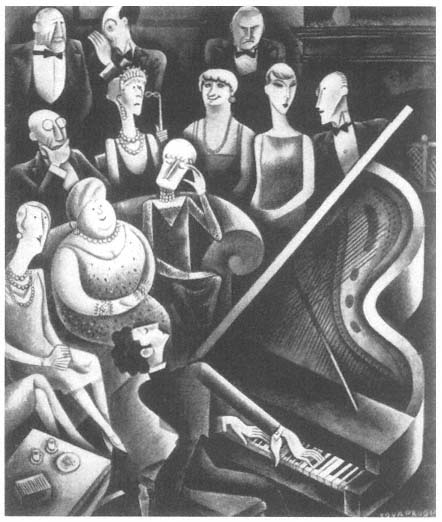
Fig. 28.
Miguel Covarrubias, "A Salon Recital of Modern Music: One of Those Awesomely
Elegant Evenings Which Society Has to Suffer—Seen by Covarrubias," Vanity Fair ,
February 1929, 54. The caption (Covarrubias's own?) continues with a snide
explication du texte : "In the forefront of mondaine [sic ] musical circles is M . Pierre
Paravent, the most recently imported Parisian pianist. Not to have heard Paravent
is to be completely out of the present season. He has therefore been rented for the
evening by Mrs. Bartow Blodgett, the monumental matron at left-center, for the
entertainment of a number of tremendously important people. This he is
endeavouring to do by rendering a program of his own compositions, in which he
specializes. This is no stuff for weaklings and the auditors are taking it according to
their several capabilities. The hostess is flanked by her daughter who is entranced by
both the piece and the performer, and by her mother, Mrs. Holzderber, who is resting
easily on her pearl dog-collar. In the center row, from left to right, are Horace Bankhead,
critic, Lady Cragsmoor and lorgnette, Mrs. Dapper, wearing her famous Mona Lisa
smile, and the young Camberwells who are plotting an escape. In the background two
low-browed husbands are talking about the stock market while the host, at right,
ponders grimly on the cost of all this noise Paravent produces."
"was not a dues paying organization, but . . . a pet project of two rich ladies who were constantly struggling over the leadership."[78]
Such stereotyped views do not, however, change the fact that women championed modernist music with gusto, freeing young composers to pursue their artistic vision. The work of these women was indispensable to the growth of American music in the 1920s, and it has had lasting implications. Today, performance societies, including the League of Composers, continue to provide an essential forum for the newest pieces, and the idea of giving financial help to composers remains alive—although private benefactors, such as Betty Freeman in Los Angeles, now stand out as exceptional, while universities and foundations provide most of the support. Gertrude Whitney, Blanche Walton, Alma Wertheim, and Claire Reis, then, set an important precedent by dedicating themselves to the avant-garde. Their vigorous activism belongs not just to women's history but helps explain how modern music came to be in America.
Vignette I—
The Power of Social Events:
Aaron Copland's Guest List for a Post-Concert Reception Given by Blanche Walton
Annotated by Carol J. Oja
Sometime during the spring of 1930, Aaron Copland sent Blanche Walton a handwritten list of suggested guests for an after-concert party, presumably given at her New York apartment.[1] The list provides an unusual view of how the social events hosted by women helped composers build power bases. Although the document is undated, it was probably drawn up for a party after the Copland-Sessions concert on 13 April 1930. There were a number of Hungarians among the invitees—the Hungarian consul general, the violinist Leopold Auer, the violinist and composer Sándor Harmati—and the program that evening included three new Hungarian works, István Szelényi's Recitative , Pál Kadosa's Sonatina , and Imre Weisshaus's Piano Study . Walton may well have had a personal interest in these young Hungarians perhaps through Béla Bartók, who stayed with her during his 1927 visit to the United States. The probability that the reception followed this April 1930 concert is further strengthened by the presence of the Polish violinist and composer Joseph Achron on the guest list, for the young Polish composer Jerzy Fitelberg's Piano Sonata No. 2 appeared on the same program. Also performed were Roy Harris's String Quartet and Israel Citkowitz's Five Songs from "Chamber Music" by James Joyce and Sonatina for Piano.[2]
Copland and Roger Sessions had founded their concert series two years earlier "in the interests of the younger generation of American composers," hoping to provide the same service for their contemporaries that the League of Composers offered to older Americans and Europeans.[3] They also reached out occasionally to young composers abroad, especially in this particular 1930 program. Largely funded by Mary Senior Churchill, another of modernism's unsung female supporters, the Copland-Sessions Concerts lasted for three years, giving eight programs in New York and one each in Paris and London.
Copland's choices for the party hosted by Walton reveal a shrewd political sense. The guests included leaders of the League of Composers (Claire Reis and her husband, Arthur, as well as their co-founders Emerson Whithorne and Frederick Jacobi),[4] concert managers
The Blanche Walton Collection in the Music Division of the New York Public Library at Lincoln Center is cited in these notes as Walton-NN.
(especially Arthur Judson and F. C. Coppicus, two of the most important of the day), and the press (especially the British critic and composer Leigh Henry and Robert Simon of the New Yorker ). Other subtexts resonate from the list as well. For example, Citkowitz's Five Songs , which appeared on the April program, was published that same year by Alma Morgenthau Wertheim's Cos Cob Press, and she appears on the party list, as does Whithorne, who in addition to his role in the league was one of her principal advisors.