
Structure
Discernible corresponsions on either side of a self-contained central section reveal the same basic tripartite structure seen in the last episode. After departing from Lemnos the Argo sails to Samothrace, where Orpheus initiates the Argonauts in the rites of the Cabiri (915–21); the episode will conclude with the inauguration of a cult of Meter on Mount Dindymon for which Orpheus will provide the music (1117–52). Moreover, as the Argonauts reach Samothrace by rowing (911–14), they will eventually row away from Oros Arkton to their next destination, Mysia (1151–52). In addition to this, details mentioned in the second initiation on Mount Dindymon recall points in the narrative describing the journey from Samothrace to Oros Arkton: the Argonauts pass by Mount Ida (930) » they will later set up a cult to the Idæan Meter, with whom the Idæan Dactyls are associated (1128–29); the phrase





The central section itself (B) unfolds in an extended ring: the two ascents of the mountain (a–a ) enclose the two battles (b–b ), while at the center of the two battles there lies the incident that brings about the second and tragic battle with Cyzicus: namely, the shift in the winds (c). In addition to this, elements in the second ascent of the mountain (a ) clearly echo by way of similarity and contrast details in the first (a): the provision of food and wine for the Argonautic sacrifice and the subsequent feast (965–84) » the fast after the deaths of Cyzicus and Cleite (1070–77);
the omen stating that Cyzicus will die at the hands of a

| ||||||||||||||||||||||||||||||||||||||||||||||||||||


[14] Since the corresponding elements in sections A and A do not occur in exactly the same or in an inverted order, I have listed them in their order of occurrence without reference to subsections.
| ||||||||||||||||||||||||||||||||||||||||||||||||||||||||||||||||



A—
The Samothracian Mysteries and Passage to Oros Arkton (910–60)
Apollonius did not invent the detail regarding the Argonauts' stop at Samothrace. In his satyr play The Cabiri (cf. Athenæus 10.428f [= 95–97a Radt]), Æschylus portrays the Argonauts in a drunken celebration on the island. Moreover, Diodorus (4.43.1–2) recorded a tradition wherein the Argonauts were saved in a storm as a result of Orpheus's initiation into these rites. Apollonius's innovation would appear to be his integration of this detail of the Argonautic tradition in the episode involving Oros Arkton. Of particular note is the fact that the poet has so neatly associated the rites on Samothrace with those on Mount Dindymon through the structure of the episode and the several verbal correspondences noted
above. In addition to this, one can observe that certain mythological and legendary details regarding the Samothracian Mysteries parallel the events on Oros Arkton, which I shall examine below. I shall point out here instead that the manner in which Apollonius presents the two corresponding rites parallels the embassies of Æthalides and Iphinoë in the previous episode. There, Apollonius explicitly refused to mention Æthalides'


The rest of the first section contains an account of the journey from Samothrace to Oros Arkton and a brief description of the island-peninsula and its people. In describing the passage through the Hellespont, Apollonius has his eye on Homer's brief description of the area in the Iliadic Catalogue; in particular, for lines 928–35 the poet is indebted to Il. 2.819–43, about which Delage stated: "L'ordre suivi par Apollonius est à remarquer; il a énuméré toutes ces villes à leur place exacte, dans l'ordre où on les trouve en remontant l'Helléspont comme s'il avait eu sous les yeux une carte ou un périple. Il a donc complété en les précisant les renseignements que lui fournissait Homère."[16] In his adaptation of these Homeric verses the poet would appear to have gone beyond a mere updating of geographical details. We learn in the second and central section of the episode (B) that Cleite, the wife of Cyzicus, who will commit suicide after her husband's death, is the daughter of Merops of Percote:
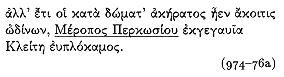
But still at home his wife, fair-haired Cleite,
offspring of Percosian Merops , had no experience
of the pains of labor.
[15] See Chapter 6, pp. 114–16.
[16] Delage 93.
Homer mentioned this same Percosian prince within the Iliadic passage that inspired Apollonius's description of the journey to Oros Arkton:[17]
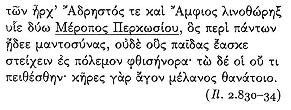
These men were in the charge of Adrastus and Amphius of the
linen cuirass,
the two sons of Percosian Merops , a man who excelled all others
in the knowledge of prophecies and thus did not allow his sons
to go to war, the destroyer of men. Yet the two sons
did not obey, for the fates were leading them on toward black
death.
As we observe, Merops was the father of two other children in addition to Cleite, sons whose premature deaths in the Trojan War he had foreseen and in vain tried to prevent. Quite appropriately, then, he is also the father of Cleite, who married a man whose death in battle has been foreseen and who will herself die young. From this Iliadic model, Apollonius may well have conceived the idea of using a prophecy to motivate Cyzicus's welcome of the Argonauts, which tragically leads to his death.
Homeric references in the brief description of Oros Arkton in section A, which immediately follows the account of their journey there, similarly look forward to certain details of the narrative in section B. The first occurs in the identification of the island:
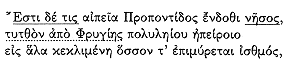
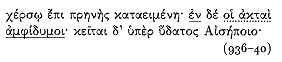
There is a steep island within the Propontis,


It lies out in the sea as far as its flooded isthmus stretches,
sloping toward the continent. On it are twin

In this description, Apollonius has the following Odyssean passage in mind:[18]
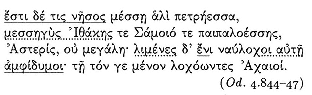
There is a rocky island in the middle of the sea,

Asteris, not very large in size. On it are twin

[sc. Telemachus].
Although the phrase



[18] Cf. Ardizzoni ad 936, Campbell ad 1.936ff.
[19] For an important discussion of the status of Cyzicus, see F. Vian, "L'isthme de Cyzique d'après Apollonios de Rhodes (1.936–941)," REG 91 (1978) 96–106.
isthmus. Silting was also responsible for connecting Cyzicus to the mainland in historical times.[20] In fact, there was a geographical controversy regarding the status of Cyzicus that went back at least to the fourth century B.C. : some held that Cyzicus was an island (Anaximenes of Lampsacus; cf. Strabo 14.635); others, that it was a peninsula with an isthmus (Scylax 94 GGM ).[21] Apollonius in typically Hellenistic fashion would seem to be responding to the disputed question by alluding to an answer; the imitation is Apollonius's erudite way of saying, "Cf. Asteris." And yet the reference is not purely academic. The context of the passage is germane to an important element of the Cyzicene episode: Asteris was also the place where the suitors set an ambush (


In the course of the episode, the Argonauts encounter both a hospitable and a hostile reception from the Doliones.[22] At first, when Cyzicus learns the identity of the Argonauts, he entertains them graciously. Later, however, when the wind blows them back during the night in their first attempt to leave the island, the young king leads an attack against the returning guests in the mistaken belief that they are enemies, the Pelasgian Macries. Apollonius sets the scene for this double reception with a subtle contaminatio of two Odyssean passages in the concluding lines of section
[20] See A. Philippson, "Reisen und Forschungen im westlichen Kleinasien," Petermanns Mitteilungen 167 (1910) 50ff., cited by Delage 97–98.
[21] For other ancient opinions that likewise were split over this issue, cf. Ruge, "Kyzikos," RE 12.1.295, who provides an intelligent discussion of the issue.
[22] A. R. Rose, "Three Narrative Themes in Apollonios' Bebrykian Episode (Argonautica 2.1–163)," WS 18 (1984) 117–18 (cf. Lawall 152, whom she cites in note 7), points out that in this respect, the present episode represents an inversion of the previous: the Lemnian women at first armed themselves for combat against the Argonauts and then, after receiving their embassy and after Hypsipyle spoke with Jason, welcomed them into their city; on Oros Arkton, the Doliones at first welcome the Argonauts and later, on their unexpected return, go to meet them in battle.
A that anticipate both hospitable and inhospitable receptions in Section B.
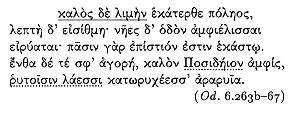
The first place where the Argonauts land is the port of Kalos Limen,[23] near which lies the Artacië Fountain, where the Argonauts will leave their anchor.[24] The phrase referring to this harbor recalls an Odyssean passage where the phrase

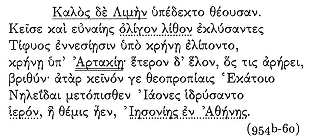
The port of Fair Harbor received the ship in its course.
There they removed the

and, on the advice of Tiphys, they left it under a fountain,
the

that suited their needs. The Ionian Neleids years later,
in obedience to the oracle of Apollo, duly set up the first anchor

[24] The place where the Argonauts left their first anchor varies in some accounts: Callimachus locates it in Panormus, on the eastern side of the isthmus connecting Oros Arkton to the mainland (Ætia fr. 108 Pf.); Dionysius of Byzantium (87) set it at Ankyraion near the exit of the Bosporus, and Arrian (Periplus 9.2) at the mouth of the Phasis.
[25] Noted by Mooney, Ardizzoni, and Campbell ad 1.954, and Vian 261 ad 954.
A fair harbor lies on either side of the city
with a narrow entrance where curved ships
are docked; for there is a ship shed for all vessels.
Here there is also an agora near


an area marked off by

Apollonius not only borrows the phrase but appears also to have adapted an important detail of the Phæacian harbor, near which lay a sanctuary of Poseidon. For near the Cyzicene harbor the Ionians will build in time to come a sanctuary in honor of Jasonian Athena. We should also note a minor detail in which Apollonius seems to have inverted his model. The Phæacian sanctuary was located in the vicinity of the agora, where large quarried stones were sunk into the ground; conversely, the Argonauts leave their small anchor stone, which will eventually be dedicated in the sanctuary of Athena, at the Artacië Fountain.
This Odyssean passage comes from a speech of Nausicaa (ibid., 255–315) in which she offers to lead Odysseus to the house of Alcinous, her father. There he will eventually be welcomed and entertained. On the other hand, mention of the Artacië Fountain calls to mind another passage in the Odyssey where the exact opposite occurred:[26]
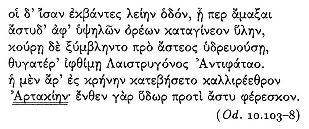
After disembarking, they [sc. Odysseus's men] went on a level
road, along which wagons
brought wood down from the lofty mountains to the city.
There before reaching the town they met a young girl fetching
water—
the virtuous daughter of the Læstrygonian Antiphates.
[26] Mooney, Ardizzoni, and Campbell ad 1.957 refer to this passage without comment on the possible relevance of the Homeric context to the Argonautic.
She had come down to the crystal-clear fountain,

In this passage, Odysseus's men meet the daughter of Antiphates, king of the Læstrygonians, also at an Artacië Fountain; like Nausicaa, the princess will lead them to her father's home. But rather than being welcomed and entertained, they are savagely killed and eaten by the cannibalistic Læstrygonians, who according to Homer resembled giants:



B—
The Two Ascents of Mount Dindymon:
The Deaths of the Gegeneis and Cyzicus (961–1117)
Once the Argonauts make contact with the inhabitants of Oros Arkton, Cyzicus first inquires who they are;[28] for, as Apollonius tells us, he received a prophecy warning him not to engage in combat with a group characterized as an

[27] Delage 100–101. On the connection between the Læstrygonians and the Gegeneis, see also F. Vian, "Les G HG ENEIS de Cyzique et la Grande Mère des Dieux," RA 37 (1951) 19–20 n. 6.
[28] Levin 92 believes that Cyzicus was going against Homeric etiquette by asking questions first and feeding afterwards. F. Vian in his review of Levin's book, Gnomon 46 (1974) 350, shows, however, that this is actually the regular practice in the Argonautica .
[29] On the plausibility of this scenario, cf. Delage 100.
learns of their mission, and the Argonauts in turn seek information regarding the journey ahead of them. Since Cyzicus does not know what lies beyond the Propontis, the Argonauts decide to climb Mount Dindymon the next day to get more information than the king could offer about what lies before them.[30]
At dawn, Heracles and the younger men move the Argo into Chytus Harbor while Jason and the others head to the top of Mount Dindymon along what in the future will be called the Jasonian Path (a). Suddenly the Gegeneis, finding Heracles isolated from the others with only a small group of the younger Argonauts, attack from their place of ambush. In their attempt to trap the men and the ship, they throw boulders down from above. The result is the creation of Chytus—or "Heaped Up"—Harbor. Allusion to the Læstrygonians and the suitors in the previous section looked forward to such an attack. The ensuing battle, a parergon concocted for Heracles by Hera, draws the other Argonauts back from the mountain, and in the end the heroes kill all the Gegeneis (b). The Argonauts then decide to give up the idea of reclimbing Mount Dindymon and to move on instead, without a clear idea of what to expect.
The heroes leave under sail and continue until night, when suddenly the wind shifts and they are blown back to the island. Here, at the center of the central section of the episode (c), Apollonius has indicated that his model for this incident is another wellknown Odyssean episode. When Odysseus visited Æolus on his island, he and his men were entertained by the king, who inquired about their experiences; Odysseus, like the Argonauts, also asked information regarding the continuation of his journey home:

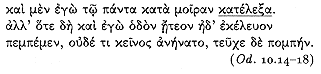
For a whole month he entertained me and asked me all sorts of
questions,
about Ilion, the ships of the Argives, and the return of the
Achsæans.
And I told him exactly how everything happened.
Then when I asked him for permission to leave and insisted
that he let me go, he did not refuse, but even assisted my departure.
This incident parallels Jason's experience on Oros Arkton at the home of Cyzicus, where host and guest likewise question each other:[31]
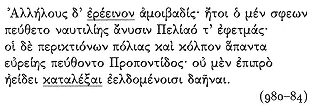
They asked each other questions in turn. The king learned about
the goal of their expedition and about the commands of Pelias;
the men learned about the cities of the neighboring peoples and
the
entire gulf of the wide Propontis. But he was not able to tell them
about the areas beyond the gulf, despite their desire to learn.
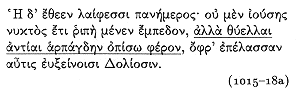
More significant, after a friendly reception and exchange of information, the wind blows the Argonauts back to a hostile reception on Oros Arkton:
[31] Cyzicus's ignorance significantly contrasts with the knowledge of his model, Æolus.
The ship ran all day under sail. As night fell,
the current of the wind no longer remained steady, but squalls
coming from the opposite direction carried the ship by force
backwards
until they approached once again the hospitable Doliones.
This is precisely what happened to Odysseus, who also experienced an unfriendly welcome upon his return to Æolus's island home because of an unexpected blast of wind:[32]
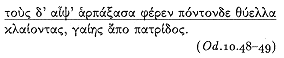
Immediately a squall seized them and carried them out to sea
weeping, far away from their homeland.
When Odysseus returned to Æolus's island, his former host, now no longer hospitable, required him to leave at once because, in his (Æolus's) eyes, Odysseus was hated by the gods (ibid. 72–75, quoted below); when the Argonauts return, their former host, Cyzicus, unwittingly leads his army against them and tragically dies in the fray (b ). The poet, as we have seen him do so frequently, highlights an important Homeric imitation by placing it at the center of its section, and, as in this case, also at the center of the episode. The imitation of the Æolus episode not only is a subtextual reflection of the friendly and unfriendly receptions that the Argonauts encounter on Oros Arkton, but also provides the link between two unrelated stories, one about the deaths of the Gegeneis and the other about the death of Cyzicus, brought together by Apollonius almost certainly for the first time.
In the wider context of the borrowed verse in question, Æolus refused to entertain Odysseus when he showed up for a second time on his island, because in his eyes Odysseus's return was an indication that he was hated by the gods:
[32] Mooney ad 1.1017, and Campbell ad 1.1016–17 both observed the verbal echo. Apollonius will look to this Odyssean episode once again in Book 3; there Jason's interview with Æëtes recalls Odysseus's unfriendly second reception by Æolus; cf. Hunter ad 299–438.
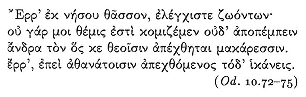
Depart from this island quickly, most hated of all people alive.
It is not right for me to assist or send off
a man who is hated by the blessed gods.
Depart, since you have come here hated by the immortals.
Comparison between the Odyssean and Argonautic situations suggests that in their return to Oros Arkton, the Argonauts too have somehow angered the gods. In fact, the men soon learn from the seer Mopsus that they must propitiate the mother of all the gods (

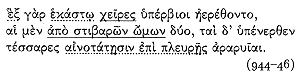


two emanating from their powerful shoulders , four
attached

[33] E.g., Æschylus Supp. 892, Sophocles Ph. 391; see Rapp, "Rhea," Roscher 4.92–93.
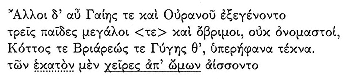
[34] Vian 95 n. 1 and Campbell ad 1.944–45 observed the borrowing; N.B.Th. 150–53 are repeated once again at lines 671–73 in the Hesiodic poem.
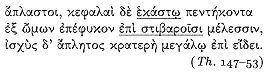
Three other sons were born from Gaia and Uranus,
huge, powerful, and indescribable:
Cottus, Briareus, and Gyes, hybristic offspring.

unapproachable, and they each had fifty heads
growing from their shoulders

the enormous strength in their awesome presence was terrifying.
Although Apollonius nowhere says so, Rhea would seem to have been responsible for sending the winds that drove the Argonauts back to Oros Arkton, and the only apparent reason suggested by the text is the death of the Gegeneis. In turn, the Argonauts, forced to go back to Oros Arkton as a result of the first battle, must then face the second, in which Cyzicus dies. In this way the young king fulfills his destiny by dying at the hands of a

After the battle, dawn appears—it was also at dawn that the Argonauts began their ascent of Mount Dindymon, which led to their fight with the Gegeneis—and reveals the disaster (a ). There follow three days of lamentation, with a funeral that consists of a triple procession around the body of the king, and then the solemn burial in the Leimonian Plain (1057–62). Thereafter, the king's wife, Cleite, commits suicide out of grief, and the nymphs of the region cry so profusely that their tears become an everlasting fountain, which they call Cleite after Cyzicus's hapless bride (1063–69).[36] The double tragedy instigates a fast. This ritual
[35] In addition to generating sympathy by emphasizing Cyzicus's youthfulness (cf. Fränkel ad 1.972c), Apollonius also casts him in the role of the young vegetation god who, like Atys and Adonis, favorites of the earth goddess, dies in his prime; cf. Vian (supra n. 27) 20–21.
[36] Cf. A. Ardizzoni, "Cleite, ovvero la fonte delle lacrime," Mythos: Scripta in honorem M. Untersteiner (Genoa 1970) 37–42, who has argued quitepersuasively that the fountain was formed not from the tears of Cleite, but from those of the local nymphs. As he points out (42), Apollonius's account, unlike his models' (Deiochus and Neanthes), does not emphasize the wonder of the metamorphosis, but the sympathy that nature reveals at the passing of the young bride. Cf. Giangrande 5–6.
fasting corresponds structurally with the banquet at the beginning of this section. The Doliones not only abstain from food; they even stop milling grain for a long time, and afterwards, when they break their fast, they eat only uncooked meals. This practice, we are told, will evolve into the annual custom of milling the grain for sacrificial cakes at public mills among the future Ionian inhabitants of Cyzicus (cf. 1071–77).[37]
Despite the apparent reconciliation with the Doliones, however, the Argonauts are not yet in the clear; they face further problems with the winds. Harsh storms keep them from leaving for twelve days. The number, I believe, is significant. Since twelve Doliones perished along with Cyzicus during the battle (cf. 1040–47), it would appear that the Argonauts must stay on the island one day for each of the warriors they killed.[38] From this, one would conclude that Rhea's anger springs from the deaths of Cyzicus and
the Doliones in addition to those of the Gegeneis.[39] Afterwards, on the thirteenth night, a halcyon, sent by the goddess Rhea, appears over Jason's head—a detail, as the scholiast ad 1.1085–87b reports (noted above), that Apollonius borrowed from a Pæan of Pindar (fr. 62 Snell). Mopsus, who is on guard duty, observes the bird and interprets its cries as a signal that the end of the storm is near. He arouses Jason from sleep and informs him both of this sign and of the need to propitiate Rhea. Mention of Rhea may at first appear surprising, even intrusive; but, as we have seen above, details in the narrative show how fitting the earth goddess's interest in the battles on Oros Arkton is. The slaughter of the Gegeneis, who are children of Earth (Ge), points to such an interpretation, as does the premature death of Cyzicus, which is reminiscent of the death of the young male associate of the earth goddess. The description of the Argonauts' celebration of Rhea, which follows in the third and final section of the episode, will thus prove to be a fitting conclusion to the events on Oros Arkton.
In response to Mopsus's interpretation of the halcyon's message, the Argonauts make a second ascent of Mount Dindymon, this time without incident. Just as in their first attempt, they move their ship to a different harbor before the climb and leave several men behind (1109–11). At this point, the Argonauts view the area that prompted their first attempt to scale the mountain. The sojourn on Oros Arkton offered the Argonauts the possibility of securing both provisions and information about the voyage ahead of them. Both needs initiate a series of violent events, including the destruction of the Gegeneis and the death of Cyzicus, which result in the foundation of the cult of Rhea on Mount Dindymon.
A—
The Mysteries of Rhea on Mount Dindymon and Departure from Oros Arkton (1117–52)
The initiation of the rites in honor of Rhea (A ) structurally balances the Argonauts' initiation into the Samothracian rites on their way to Cyzicus (A).[40] I have already mentioned several
[39] Such a conclusion is also tempting given the similarity between Cyzicus and the young male associate of the earth goddess, as Vian pointed out (cf. supra n. 35).
[40] D. A. van Krevelen, "Der Kybelekult in den Argonautika des Apollonios von Rhodos 1.1078–1153," RhM 97 (1954) 75–82, stated that Apollonius'sinterest in this cult was propagandistic: the Ptolemies promoted the development of the cult of Cybele. Although this may be so, the episode gives no explicit or implicit indications that this is the case. Van Krevelen's argument that the cult stands apart from the rest of the action is incorrect, as I hope my analysis shows.
verbal and thematic details shared by the two sections that underscore the corresponsion. In addition to these explicit points of contact, certain ritual and legendary elements of the Samothracian Mysteries that Apollonius does not describe, but that we know from other sources, resemble salient features of the Argonauts' sojourn on Oros Arkton and their celebration of Rhea on Mount Dindymon:[41] the inhabitants of Samothrace were called Pelasgians (cf. Herodotus 2.51) » the inhabitants of Oros Arkton, whom the Argonauts meet in Deiochus's account (cf. Sad 1.987a), and the enemies of the Doliones in Apollonius's version are likewise Pelasgians (1024); the Dactyls were associated both with the Samothracian (cf. Ephorus FGrHist 70 F 104) and the Cyzicene (1126–30) Mysteries; the Samothracian initiation took place at night (cf. Val. Flacc. Arg. 2.439–42) » the Argonauts likewise celebrate a pannychis (1150–52); in both the Samothracian (cf. Nonn. D. 3.61–78) and the Cyzicene (1134–38) rites the celebrants perform an armed dance.[42] Moreover, in Samothracian legend Dardanus, the son of Zeus and the Atlantid Electra, left the island because, in some accounts, he killed his brother Eëtion (cf. Servius ad Æn. 3.167); from there he sailed on a raft to Phrygia and established on Mount Ida a cult to Meter (cf. Diod. 5.49). This feature of Samothracian mythology might well explain the poet's association of the two cults. For as it turns out, the Argonauts' journey to Oros Arkton closely parallels that of Dardanus in that, like Dardanus, they sail from Samothrace to the region of Phrygia (cf. 937, 1139), establish a cult to Meter, identified as Rhea, and, as he is, they are held accountable for killing a young man.
Apollonius begins his account of the Argonauts' cult in honor of Meter/Rhea with mention of the cult statue that Argus makes
[41] On the Samothracian Mysteries, see, for example, W. Burkert, Greek Religion , trans. J. Raffan (Cambridge, Mass., 1985) 281–85; and S. G. Cole, Theoi Megaloi: The Cult of the Great Gods at Samothrace (Leiden 1984).
[42] See Cole (supra n. 41) 29.
from a vine stump (1117). There follows a description of the sanctuary that they construct (1120–24). The men then call upon Meter Dindymië and her assistants, Titias and Cyllenus, two of the Idæan Dactyls, who were born in a cave on Mount Dicte in Crete (1125–31). Jason offers prayers and libations to the goddess while Orpheus leads an armed dance to drown out the cries of the Doliones, who are lamenting their king. This scene recalls a practice that continued among the Phrygians, who used the rhombus and tambourine instead of weapons and armor to honor Rhea (1132–39). There appear thereafter miraculous signs indicating the goddess's acceptance of the ritual: the vegetation blooms, wild animals leave their lairs and rub up tamely against the Argonauts, and a fountain suddenly appears in a place that up to that moment was dry; in the future, people will call this the Jasonian Fountain (1140–50). Finally, the men celebrate an all-night banquet and leave at dawn after the winds have died down (1151–52).
Apollonius's description of the Argonautic rite contains many striking points of contact with Callimachus's Hymn to Zeus .[43] I summarize the relevant section of the hymn: following a humorous introductory section in which he establishes Zeus's place of birth (H. 1.1–9), Callimachus briefly describes the god's birth to Rhea and the goddess's subsequent quandary: there is no water for cleansing the blood of childbirth (ibid. 10–17). Rhea then strikes the earth, which produces the waters of Arcadia, a place that up to that time lacked water (ibid. 18–32). The nymph Neda, who will give her name to the largest river of Arcadia, carries Zeus from Arcadia to Thenae and from there to Cnossus, where he will live in a cave. He will be attended by the Dictæan Meliae and Adrasteia, suckled by Amaltheia, and protected by the war dance of the Curetes from exposing his existence to Cronus through his cries (ibid. 33–54). Accordingly, the following explicit correspondences exist between the two poems:
· Rhea is the goddess featured in both accounts.
· Rhea produces water in Arcadia and on top of Mount Dindymon, both of which up to that time lacked water.
[43] Fraser (supra n. 2) 1.635–36, although acknowledging Apollonius's debt to Callimachus and referring specifically to his hymns, does not list the Hymn to Zeus among the examples cited (cf. ibid. 2.897 ad n. 162).
· Both the Curetes and the Argonauts perform a war dance to drown out crying.
In addition to these, there are other, more subtle points of contact between the two poems. A. H. Griffiths observed a neat geographical trick that Callimachus played in the Hymn to Zeus .[44] At line 42, we learn that Neda left Thenae, and in the next line the poet notes parenthetically that Thenae was near Cnossus. The location of Thenae was a matter of dispute: some placed it in Arcadia, and others on Crete. Since Neda begins her journey in Arcadia, one naturally believes that the poet locates Thenae in Arcadia. But in line 43, we are disabused of this notion with the statement



Other points are to be noted: the






Although the dating of these two poems is by no means secure, few would deny that the Hymn to Zeus is one of Callimachus's earliest extant poems.[46] If, as seems most likely, this hymn antedates
[44] "Six Passages in Callimachus and the Anthology," BICS 17 (1970) 32–33; cf. G. R. McLennan, Callimachus: Hymn to Zeus (Rome 1977) ad 42.
[46] I have discussed this issue elsewhere: cf. "Lies and Allusions: The Addressee and Date of Callimachus' Hymn to Zeus," ClAnt 5 (1986) 155–70,in particular 156–57 n. 5 for citations of earlier opinions regarding the date of the hymn. Vian 230 n. 3 too believes that the Callimachean hymn was the earlier piece and that Apollonius had it in mind at 2.1123–24 and 1179–80.
the Argonautica ,[47] and if Apollonius had this piece in mind when he wrote the Cyzicus episode (as the many points of contact lead one to believe), the question arises: Does recognition of the imitation affect or enhance in any way our understanding of the Argonautic passage?
As we have seen above, Apollonius never explicitly tells his reader why the Argonauts return to Oros Arkton or why Rhea needs to be propitiated. Rather, the reader is asked to draw implications from elements in both the text and subtext. One of these lies at the center of the episode, where the poet highlights a Homeric imitation that appears to confirm what one infers from the connection between the Gegeneis, the sons of Earth killed by the Argonauts, and Rhea, the earth goddess, who Mopsus later states requires propitiation: the Argonauts, like Odysseus, have offended a divinity who is to be seen as responsible for having them blown back to Oros Arkton. The structural connection with the Samothracian Mysteries, as I suggested above, sheds further light on the significance of the rites on Mount Dindymon. Like Dardanus, Jason and the Argonauts must atone for bloodshed by instituting a cult. Reference to the Hymn to Zeus , I posit, exerts a similar effect on our understanding of the events atop Mount Dindymon. In the Callimachean poem, Rhea needed water to cleanse the blood of childbirth, and so she caused the earth to bring forth water in Arcadia for the first time. Observing this similarity, one might well conclude that the purpose for the water is related. The Argonauts, like Rhea, can now cleanse themselves of the blood both of Cyzicus and of the Gegeneis, the latter being, like Zeus, children of the same divinity.
At the beginning of the episode, the Argonauts were initiated into the Samothracian Mysteries; and at the conclusion, following the first blood that they will shed on their mission, they are initiated into the Mysteries of Rhea on Mount Dindymon. It would appear that the experience on Oros Arkton marks an important,
[47] This would be the case even if one places the writing of Book 1 as early as the mid- to late 270s; cf. Vian x, and T. B. L. Webster, "Chronological Problems in Early Alexandrian Poetry," WS 76 (1963) 68–78.
almost liminal, stage in the Argonautic expedition. Before they go on to the next phase of their journey, they encounter death, and then, like Rhea in Callimachus's hymn, they undergo purification for the blood they have spilled.[48] For the Argonauts, and for Jason in particular, Oros Arkton proves to be a crucial phase in the expedition to Colchis. They have already affirmed their commitment to the mission by refusing the tempting offer of the Lemnian women. Now they must overcome further obstacles to their advance: monsters sent by an angry stepmother and, oddly enough, a timorous young man who lives in fear of his fate. The first obstacle was sent specifically against Heracles; Jason forms a close bond with the second, both being the youthful leaders of their groups. The identification of Heracles and Jason with their victims once again sets the two heroes in vivid contrast. Moreover, as becomes clear through the structural parallelism of the two battles on Oros Arkton, their involvement in the killings parallels their divergent approaches to heroic action.
When Heracles and several of the younger men had moved the Argo into Chytus Harbor, the Gegeneis attacked, and a battle ensued (Bb). Two similes frame the battle. In the first, Apollonius compares the attempt to trap Heracles and the others within the harbor to fishermen trying to catch a sea creature (991). The incident concludes with the laying-out of the bodies of the dead monsters on the shore. Some of the monsters have their heads and chests in the water; others, their legs. The Argonauts are likened to lumberjacks who set out logs on the beach for soaking (1003–5). Each simile features the occupation of people who control some facet of nature in their profession. The similes, then, furnish apt comparisons for an armed encounter arranged by Hera against Heracles, the great monster killer and, as Burkert calls him, "Master of Animals."[49]
In the corresponding battle with the Doliones (Bb ), once again two similes frame the conflict. In the first, the vehement attack of the combatants is likened to a swift fire that falls on dry brush
[48] This episode would seem to be balanced by the purification Jason and Medea undergo in Book 4 (659–752) for the murder of Apsyrtus.
[49] W. Burkert, Structure and History in Greek Mythology and Ritual (Berkeley and Los Angeles 1979) 78ff.
(1027–28). It is during this battle that Jason unwittingly kills Cyzicus, who thus fulfills his destiny, and that twelve other Dolionian soldiers fall at the hands of the Argonauts. Apollonius compares the surviving Doliones in their flight to doves who flee before swift hawks (1049–50). In this second battle, it was the wind, a force that can fan a fire out of control, that drove the helpless Argonauts back to Oros Arkton; and in the bloody battle that ensued the helpless Doliones, attempting a vain defense against their recently departed guest-friends, fled like doves back to the protection of their walls. Like the fire and hawks that characterize the victors, their leader can be seen as the instantiation of an uncontrollable force of destruction, lacking any feeling or rational planning for his actions because of his ignorance of the enemy he faces in an unexpected battle.
The differences between the two battles and the Argonauts associated with each are telling. When it comes to heroic feats, Heracles, like the fishermen and lumberjacks, is in complete control. It is only in matters of love and passion that he is outmatched, as will be seen in the very next episode. Moreover, in his overbearing self-confidence, Heracles will even choose to act contrary to


from which neither will be survived by children (on Cyzicus, cf. 973–75).
If this identification of victor and vanquished is valid, a more speculative implication of the killings on Oros Arkton suggests itself. In an episode framed with scenes of initiation and lustration, Heracles and Jason might be thought of as immolating virtual representatives of themselves. Since in Mystery religions—the cults at Samothrace and on Mount Dindymon are

THE episode of the sojourn on Oros Arkton is striking indeed. Apollonius has succeeded in creating a unified and convincing story out of many heterogeneous elements, interweaving at the same time many academic points of interest (e.g., topographical, cultural, and historical) into the fabric of the narrative. In this daring version of the Cyzicus tale, one can observe the felicitous marriage of Alexandrian scholarship and the kind of tragedy one
associates with the classical era,[51] and in the course of this Cyzicene tragedy, Apollonius affords us another glimpse of the stark contrast between Jason and Heracles. Both are dangerous men, but for dissimilar reasons and with distinctive results.
[51] Levin 96 appropriately makes the comparison between Apollonius's Cyzicus and Sophocles' OEdipus[*] ; cf. Stössl (supra n. 1) 13 n. 14 and 19 n. 27, who, despite his overall negative view of this episode, calls attention to the Herodotean manner in which the oracle has been fulfilled.