
Two
Revolution and Festivity
All human affairs have two opposite aspects; so that what at first glance seems to be death, on closer inspection is seen to be life, and life on the contrary is seen to be death. The same is true of what is apparently beautiful and ugly, rich and poor, shameful and glorious, learned and ignorant, noble and base, joyous and sad, friendly and inimical, healthful and harmful. In short, you find all things suddenly reversed.
Erasmus, In Praise of Folly
Tsarist celebrations were traditionally composed of two elements: a dynastic observance—a coronation or anniversary—and popular entertainment, with fairground shows, rides, and plenty of food and drink. Solemnity and merriment stood side by side. Bolshevik festivals evolved into a similar pattern by late 1918. Holiday mornings were marked by long demonstrations, eulogies, and speeches. Evenings, if funding was forthcoming from war-pressed budgets, featured fireworks, carnival games, sometimes even burnt effigies. For citizens born before the Great War, celebrations seemed incomplete without both elements.
Voronezh celebrated the first anniversary of the Revolution on November 7, 1918, with a day-long affair. It began with a "Eulogy of the Revolution":
The stage showed a craggy locale. As the curtain rose there was complete darkness on stage. Suddenly the sacrificial altar located on a platform center-
stage was illuminated. A chorus dressed in Greek tunics was distributed along the base of the platform. The show opened with a musical introduction. Then the chorus began to sing, explaining in song the hard life of the oppressed people. Then the leader appeared near the altar, and between him and the chorus a dialogue on the power and oppressiveness of Capital began. All this was accompanied by music and ballet numbers. The dialogue ended. A tremole [sic] in the orchestra, fanfares thunder. The altar burned brighter and Destiny [female in Russian] appeared, approving the people. A fugue in the orchestra. Three elders appeared, illuminated by violet reflectors, and three old women. The old women were terrified by the possibility of revolution, and tried to convince the people not to think of it. In reply, the chorus sang of growing rebellion and the necessity of punishing capitalists—perpetrators of the war and the people's hardship. Evil Fate [male in Russian] appeared with his companions to turbulent and triumphant music, rejoicing at the evil he brings people. Destiny supported the people's spirit, which was conveyed by appropriate music. Seven old women appeared, warning the people of their mistake. A conversation was struck up between the chorus and Destiny. The mood of the people kept rising. Unexpectedly Revolution [female] appeared with her companions. The dance of the victory of Revolution was danced. Evil Fate and the old women disappeared. The chorus sang of its readiness to build the future and glorified the Revolution. Children entered, singing joyful songs and promising to follow in their fathers' footsteps. Total ecstasy.[1]
The revolution's bloodier side was celebrated the same night in Voronezh with The Burning of the Hydra of Counterrevolution , inspired by a French revolutionary holiday described by Tiersot.[2] A certain Faccioli, visiting town with the Cinizelli Circus, took upon himself construction of the hydra, an art learned in the carnivals of his native Italy. A wire carcass was covered with bast and painted green, and a tail of springy wire was attached. The tail bobbed up and down in unison with the creature's three heads, which featured glistening green eyes and were topped with speaking platforms. The entire effigy was sixty meters long, and it was accompanied through the streets by a mounted guard of forty. An orator atop the hydra's head summoned people to the central square; his call clashed with the laments of 200 "counterrevolutionaries" towed alongside in cages. The procession was greeted in the square by a panel of judges that pronounced a death sentence on the unfortunate monster. Chopped into four sections and doused with kerosene, it was burned; the burning was celebrated with readings from the verse of proletarian poets and Whitman, and it was followed by dancing and fireworks.
Clearly, Bolshevik festivals had many forms. The ideology that inspired the Revolution was often a distant echo; when it was featured, it
was sometimes distorted. There are a number of explanations. Local officials were often uninformed about the policies and writings of central party leaders; experts hired to design the festivals were rarely Bolsheviks; and dry ideology could seem tedious to the populace. A more subtle and fundamental cause was the origin and shape of festivity itself. Festivity has an ancient pedigree as both a public forum and an artistic medium. Though festivals seemed democratic to many revolutionaries, the tradition of celebration inherited from Russian culture and from the West was highly ambiguous. When the Bolsheviks celebrated their new holidays, they entered a dialogue with that tradition.
Examining the role of public celebration in the Russian Revolution begs the question of how festivals projected the party's program. In the previous chapter, the Russian and Western traditions were examined. Now the medium itself will be studied. What is festivity and what are its attributes; what is its structure and how does it mold what is celebrated? What parts of the Revolution were most suited to celebration; what parts were not; how was history reenacted?
Of parallel import is the kinship between festivity and revolution, which was perceived then and has been again many times since. Lenin himself claimed that "revolutions are festivals of the oppressed and the exploited. At no other time are the people in a position to come forward so actively as creators of a new social order as at a time of revolution. At such times the people are capable of performing miracles."[3] He expressed the giddy and transient exultation felt at moments of abrupt change, when a new world seems possible, and the old has yet to resurface. There was a another metaphor beneath the phrase, which became evident during the Revolution. Festivity thrives on extremes; it polarizes the world socially, morally, and aesthetically. The experience of revolution has much in common with festivity; both divide the world into clear and discrete camps, and both merge personal and collective experience. Festive expression, in fact, can give the revolutionary experience a clarity it might otherwise lack.
A final point that bears consideration and should shed light on the above questions is the Russian theater world's enthusiasm for revolutionary celebrations. Bolshevik festivals were not the creation of party workers, who were often inattentive sponsors; they were directed and decorated by artists, many of whom were exploring festive culture fifteen years before the Revolution. Turn-of-the-century artistic currents had a profound impact on Bolshevik celebration because of the formative influence of directors such as Meyerhold and Evreinov, who either
directed the festivals or mentored the directors. Some artists saw theater as a powerful tool of revolution, but others apathetic to the Revolution saw it as an opportunity to realize their artistic ambitions. Their work, and particularly the collaboration of Meyerhold and Vladimir Mayakovsky on Mystery-Bouffe , exemplified the festivalization of culture that first foreshadowed and then distinguished Bolshevik festivals.
The Forms of Festivity
Celebration has performed a unique function in human culture. Societies have traditionally reserved special places and times for the celebration of their fundamental beliefs. Prehistoric man retreated into caves to worship the gods; the priestly caste in Pharaonic Egypt segregated itself in temples, holy ground inaccessible to the laity; medieval monks walled themselves off from the squalid cities of Europe. Guardianship of space and time was an ecclesiastical prerogative: Egyptian priests scanned the heavens for signs of the celestial order; monks created the first daily schedules to chart the pattern of their prayers.
As Mona Ozouf notes in regard to the French Revolution, civic festivals were used to manipulate the value of space and time in modern times.[4] Revolutionaries inherited the Old Regime's civic spaces, which reflected its hierarchy of values: central squares housed monuments to the upholders of autocracy; the nobility lived behind walls along the finest avenues. Festivals reshuffled the urban hierarchy by selecting new routes to be taken through the city, new places to be honored, and new spaces to be declared sacred. Space itself acquired new meaning. Revolutionaries spurned dusty urban squares for sprawling parks whose openness modeled egalitarian society and where fête participants were not divided by class or enclosed in the walls of authority. Time was reset inside the festive circle to show the revolution, and those moments in it that organizers chose to emphasize, as a new beginning to history.
Several aspects of festivals recommended them to revolutionaries. Time and space could be disintegrated in a festival and then reintegrated. A festival is a recollection, a temporary transcendence of time and space that links past and future. Ideally, it refers back to an experience common to all participants and evokes a time of unity. Participants can leave the conflicts of the present behind and return to a common origin in the past. The past is selected and organized to meet the needs
of the present; and during the celebration the mythicized past becomes real. Society experiences moments of harmony and order that allow it to function as an entity under the revolutionary party's aegis once the holiday has lapsed.
Robespierre was inspired most by the power of festivals to sway minds, as were the Bolsheviks and many other future revolutionaries. The enthusiasm was founded on a perceived correspondence between festivity and society that proved unfounded. The error has been shared by thinkers ancient and modern, from the left and right of the political spectrum, and it informs influential contemporary theories. In festive space and time, Ozouf sees a model of open society; Mircea Eliade, a hierarchy of sacred space and time; and Mikhail Bakhtin, a temporary utopia of demotic power.[5] Yet function does not always follow form. Autocracies have sponsored carnivals; democracies and revolutions have promoted hierarchical rituals. The forms of celebration exist apart from the purposes they serve and the meanings society attributes to them. A festival is festive not because of the ideas or events it celebrates, not because of its social function or the rank of its celebrants, but because it is a special, separate time and place. To be festive is to stand apart from the quotidian; the festival aesthetic is festive only if it is distinct from the everyday.
The sponsors of revolutionary celebrations assumed that revolution would transform festivity and that any celebration of revolution would be necessarily revolutionary. In practice, however, the effect was reversed: when the October Revolution was celebrated, it was festivalized. A static historical event was re-created, and during the process it assumed the forms of celebration. The misconception was compounded by the sponsors' assumption that festive art was a realistic—that is, transparent—depicter of ideas. When the Bolsheviks hired artists to arrange festivals, they assumed that the medium would match the message. This was an unwise assumption, regardless of the artists' intent. Each age, each school of art has its own principles of selection and reassembly independent of the subject matter: the French Revolution in its bloodiest days projected an epic calm from the neoclassical canvases of David. Politicians could sponsor a festival; ideologists could determine what should be said; but artists were the medium of transmission.
This chapter will examine the revolutionary festivals as a medium. In their missionary zeal, the Bolsheviks intended them as a school of socialist ideas. Yet the messages invested and those transmitted were not
always the same. Festivity has a shape all its own that is common to the celebrations of revolutions and autocracies and must be considered as part of the festival's social impact. Along with festive form, Bolshevik celebrations were shaped by the prerevolutionary artistic currents that predisposed artists to collaborate on festivals. Many people of the theater worked in styles eminently suited to festive celebration. Prerevolutionary society offered few opportunities to exploit that potential, but when the October Revolution made festivals a medium of public importance, the artists were ready, and they imported their aesthetic programs into the Bolsheviks' festivals. They helped make revolutionary festivals brilliant expressions of their time and shaped the Revolution as they celebrated it.
Festive Time and Space as Continuity
Public festivities help a political party claim legitimacy by occupying the city center (the seat of political power), decorating it with partisan symbols, and filling it with supporters. The uses of celebration were evident in prerevolutionary Russia. The political opposition used demonstrations to claim a voice in national affairs, and the autocracy defended its monopoly on power by banning them. Bolsheviks participated in illegal May Day marches, and their newspaper Pravda encouraged workers to do likewise. The holiday, which commemorated the slaughter of Chicago workers in the 1886 Haymarket Riot, had great symbolic power, but its primary purpose was to show the strength of semilegal and illegal political organizations and spotlight the regime's crumbling foundations.
Festivity can project another type of legitimacy that, though absent from earlier demonstrations, gained importance after the Bolsheviks had taken power. This is a monumental legitimacy—noting the roots of "monument" in memory—that links a party to the past. Festivals, the monuments, commemorate the past in ways that exalt it and emphasize the proper connections to the present.
Eliade describes a cosmic sense of history in which actions are judged legitimate, and thus real, only inasmuch as they repeat "eternal" mythic patterns.[6] Time and space seem to be an undifferentiated, unoriented mass punctuated by "hierophanies," points of legitimate, sacred activity fundamental to the social order. Cosmic time recognizes real moments,
when myth is repeated, and nonreal, insignificant moments when it is absent. A festival suspends the everyday experience of time and space and joins distant events across the historic abyss. The immediate and tangible are defied, physical and temporal juxtaposition is declared coincidental. Participants are transformed into their historical ancestors and reenact moments that laid the foundations of the present. The past is retold to reflect the future it created, and the present is legitimized by animating the past within it.
Legitimacy claimed through an eternal past would seem alien to revolutionaries, whose foremost goal is to break history's repetitive cycle. Yet revolution itself was not new with the Bolsheviks, and Lenin and his comrades felt a kinship to all who had once rejected the status quo. They understood their historical mission through a mythic frame in which their movement was a lone island in an ocean of the bourgeoisie, linked with similar islands by symbolic bridges across time and space. When they narrated history in the mythic frame, the Bolsheviks did not follow the tsars or the Provisional Government, they merely occupied the time after; they followed the French Revolution, the Paris Commune, and other great rebellions.
There was abundant cause for the Bolsheviks to retell revolutionary history in 1918. Though the party held the organs of power, it had never established its legitimacy with much of the population, nor could it claim exclusive rights to the revolutionary tradition. Other leftist parties had strong followings, and their ideologies and histories in the underground qualified them no less than the Bolsheviks for leadership of a popular uprising. It was eminently possible in 1918 to consider the Bolshevik coup a historical anomaly, a stroke of chance, whereas to claim legitimacy the party needed to demonstrate the inevitability of the Revolution and the sole right to be its initiators.
Monuments could forward this claim. They are marked by an extended sense of time and space, which is suggested by a stability and durability of form. Such a style was demanded by a reviewer in the provincial city of Saratov in 1918 who asked for revolutionary art distinguished by "harmony of form, the connected equilibrium of separate parts that defines true art"—and that also lends cultural values the veneer of eternal truths.[7] Monuments express a search for the universal in the parochial, the permanent in the temporary. They depict those moments when ideals become manifest in human affairs: the October Revolution could be seen as a hammer and sickle descending from the heavens over Smolny, as in V. Fidman's poster (Figure 5).[8] Monumental
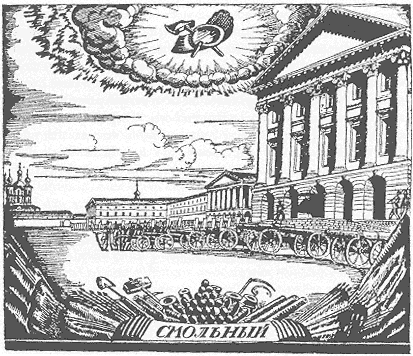
Figure 5.
V. Fidman, Smolny, engraving
(A. A. Sidorov, Russkaia grafika za gody revoliutsii, Moscow, 1923).
art idealizes by simplification and amplification. Contour becomes line, shading color: the visible parts of a greater whole. Malevich noted during the Revolution: "Monuments represent systems of perfect stamps recommended for life. In fact the representation of a man in a monument is not the representation of a portrait as it is usually understood. It is rather the presentation of a system or plan which is represented by the individuality in itself."[9] A similar impulse was manifest in the revolutionary theater as well as in statuary. Certainly it explains the otherwise anomalous popularity of medieval mystery plays.
The medieval spirit represented by mystery plays was never entirely alien to socialists; one need only remember the chivalric romances of William Morris, the utopian socialist. It appealed to other artists as well. Wagner used medieval legends for his operatic cycles; Reinhardt considered the Everyman mystery exemplary monumentalism; Ivanov saw mystery as the summit of theater. Even Nikolai Punin, a futurist critic,
praised the artist's position in medieval society.[10] Medieval theater—as it was understood by modernists—was mythic. It spoke of ideas and issues fundamental to its culture and drew an audience representing the whole of society.
This virtue was compounded by the access mystery plays had to monumental time. Time was sealed off from everyday time and corresponded not to a natural but to a spiritual cycle. These plays represented spiritual states as time: the time before salvation; the time after salvation; and the present, in which good and evil do battle. These times were eternal, in a sense coeval, and could be entered and exited at will. Byron wrote in his mystery play Cain:
With us acts are exempt from time, and we
Can crowd eternity into an hour
Or stretch an hour into eternity,
We breathe not by a mortal measurement,
But that's a mystery.[11]
Space operated according to similar principles; in fact, as they corresponded to the same spiritual states, time and space were fused. A single movement on the stage, an ascent or descent through a trapdoor, was a step across centuries or into salvation. Up was Heaven, down Hell, and in between was the life of man.
The creator of a revolutionary mystery could move freely and easily between past, present, and future, using them all to legitimize the October Revolution. The form allowed for high solemnity and vulgar jest, abstract philosophy and topical politicking, monumental pageants and mobile skits. It was quickly absorbed into the revolutionary idiom, injected there by artists who had experimented with the form in prerevolutionary years.
Reform in the Prerevolutionary Theater
Turn-of-the-century theater left many observers dissatisfied. Chekhov's plays featured lost souls groping for a meaning that life did not seem to offer; Tolstoy and Gorky, two other leading playwrights, depicted the hopeless struggles of the disadvantaged. Modern theater could not conjure up life's transcendent, intangible truths, truths once found in religion.
The medieval mystery, which had evolved from religious rites, offered a forum in which cosmic themes could be addressed with metaphysical assurance. Modernists had a particular understanding of the genre that excluded the coarseness and humor of the original. Mystery was to them the presence of the divine in the theater; it was a miracle play. In Maurice Maeterlinck's Sister Beatrice, the heroine is graced by immaculate conception; in Björnstjerne Björnson's Beyond Human Might (Gaideburov's biggest draw) life is preserved by the miracle of faith—which is signaled by an avalanche. A miracle is a moment when the laws of everyday life are transcended, revoked by a higher power; it is an intrusion of the sacred into the profane. The presence of the holy is marked by a suspension of normal laws of time and space.
In a 1902 article, "Unnecessary Truth," the symbolist poet Valery Briusov suggested that there was a limit to the Stanislavsky method then at the height of its success: it was incapable of conveying the new, "miraculous" content.[12] Briusov made a point valid for most symbolists: truth is something spiritual, internal, and intangible, and the reproduction of life—should such a thing be possible—can only hide truth in a profusion of detail. Life and art are not the same. Briusov saw a truth of essences to be apprehended by art, which in its purity was something greater than life. The task of art was not to reproduce details but to distill the truth from them. It required a different, nonrealistic style of play, which Briusov called "conventional" (uslovnyi ).[13]
The theater of convention established its own rules and language; given only the barest indications, spectators were asked to imagine the rest of the stage. Conventionalism allowed symbolists to discuss eternal questions without superfluous detail. Only essentials, things with symbolic value, were allowed on stage. Malevich later echoed the selective principle as described here by Briusov: "The ultimate aim of art is to apprehend the universe by a special artistic intuition. To this end it strives to single out one aspect of reality, isolating it, making it possible to fix our attention on it. Out of the infinitely multitudinous world of colors, sounds, actions, and emotions surrounding us, each art selects a single element, as if inviting us to bestow contemplation on it alone, to seek in it a reflection of the whole."[14] Symbolist drama sought the universal in the particular. Things appeared on stage in two aspects: as part of the stage's assumed reality and as part of a greater whole. Locality disappeared under a flood of universalized settings that, like most utopias, were not only nowhere but everywhere. They were points of existence in an ocean of nonexistence.
Maeterlinck's plays were frequently performed in prerevolutionary Russia, most notably in the Komissarzhevskaia Theater under the direction of Meyerhold, a former Stanislavsky actor who had forsaken his mentor. Under Meyerhold's direction Mgebrov learned the style he would apply at Proletkult. Meyerhold's first attempt at Maeterlinck was a 1906 production of The Death of Tintageles . In the play, as in monumental art, space and time were not specified. Although the castle suggested a medieval setting, the play had broader symbolic meaning extending to the present. As Meyerhold said, "The significance of the play's symbol reaches tremendous heights. It's not Death but he who brings death that arouses indignation. And then the Island on which the action takes place is our life."[15] The island exemplified symbolist dramatic space—a hermetically sealed space into which nothing could intrude but that nevertheless represented all space. In a later production of Maeterlinck's Sister Beatrice at the Komissarzhevskaia, Meyerhold used a "bas-relief" setting; the stage was spread out like the flat surface of an icon. Slow, rhythmic speech and choreographed movement mimicked the cadences of a ritual. Lines were chanted, not spoken; actors were distributed about the stage in static, monumental groupings; and, as Mgebrov noted, the performers did not so much act as conduct a religious service.[16]
Space and time in the symbolist theater were marked as in a religious celebration. Meyerhold experimented with mises en scène for his new style, and his first attempt bore a striking resemblance to a church. Russian Orthodox ritual is conducted in a shallow space in relief against a vertical iconostasis. Movement is rhythmic, regulated by choral chants, and the iconostasis is flat, depthless. The artistic simplification suited to eternal principles is often accompanied by a loss of the third dimension: essentials are thrown into stark relief against a flat background. Flattened and idealized against the backdrop, action takes on new significance. Meyerhold said:
New devices of conventional depiction are intentionally worked out in the mise en scène and actors' play. Theatrical art is informed with a premeditated condensing—nothing on stage should be accidental. In certain situations the actors are placed as close as possible to the spectator. This frees the actor from the accidental lifelike details of the ever-preponderant stage apparatus. This gives the actor's movement the freedom for more refined expressivity. This helps the actor's voice give more subtle shading, heightens the spectators' receptivity, and destroys the line separating them from the actors.[17]
Theatrical conventions condition spectator response. They frame social interactions and thus serve as social models.[18] Symbolists looked
back to the mystery play as a means to reform their audience and the society it represented. Spectators trained by Stanislavsky were unaccustomed to active viewing: they were held captive by the darkness of an unlit auditorium and forbidden to applaud until the performance ended. Because Stanislavsky depicted reality complete onstage, the spectator was allowed little interpretive freedom. Meyerhold realized that for the conventional theater to work, the spectator would have to "employ his imagination creatively in order to fill in those details suggested by the stage action."[19] Spectators were to be a creative element in the theater, actively perceiving the intangible reality behind the action. The director's business was to create a space in which everything would be interpreted symbolically. Moreover, the director would have to signal the viewer that the stage action was not to be perceived and understood as real life: "there must be a pattern of movement on the stage to transform the spectator into a vigilant observer."[20]
The Moscow Art Theater was identified with its building, the famous work of the architect Fedor Shekhtel: it was a theater of one place. Ivanov and Meyerhold dreamt of a theater that could travel to the people and their open spaces: a marketplace, city square, or open field. For the Russians, like the French revolutionaries, open outdoor space was egalitarian. Stanislavsky's theater segregated space (as did most turn-of-the-century theaters); the play was onstage, the audience was isolated in the dark, and the two spaces were separated by a proscenium. Symbolists sought to rupture the proscenium arch; it was to be the threshold over which art crossed into life and life into art. Painting offers a useful parallel: in eras when mimesis is important, pictures are framed; when artists aspire to create reality (as would the later constructivists), the frame is dropped.
Time at the Moscow Art Theater, like space, was "bourgeois": the show schedule conformed to the life of the industrial city. The Industrial Revolution introduced precise scheduling to city life; it regularized time, making it independent of nature. Theatrical performances were repeated daily at the same time. Mystery plays, however, were creatures of feast days, most of which fell in times of slack. Performances were, like the natural clock, irregular; they began when they began. This irregularity created a different audience; because the performance was given only once, all people gathered, undifferentiated, at one place, one time.
The symbolists were assuming that function follows form, that a mystery play would create its own audience, and that the audience would emerge from the theater and change society. The assumption
would later appeal to the cosmic aspirations of revolutionary times. Yet symbolists might also have noted that mysteries could be used by more than a single ideology, class, or institution. Probably the most popular mystery play of 1917–20 was King of the Jews, written by Grand Duke Konstantin, uncle of the reigning tsar.[21]
The odd history of this play begins with its prewar banishment from the stage by the Church: no figure from the Bible could be represented on stage, regardless of how piously. If the Romanovs would not disobey a church they themselves headed, they could bend the rules a bit. Because no public performance of the play was permitted, in 1913 a production was mounted in the Hermitage Hall of the Winter Palace for a "select" audience of friends—about three thousand people for ten performances. Each of the ten performances was designated a dress rehearsal; an eleventh rehearsal was added for review by the press. The play was a great success with the public and a critical success with the press; even Teatr i iskusstvo, published by Aleksandr Kugel, no friend of the Romanovs, had a good deal of praise for it. But the Church, unmoved, still forbade public performance. The ban was finally lifted after the February Revolution, and by November a full production was ready. Its premiere on November 6, 1917 (November 19, new style) was ironically one of the first under the Bolsheviks, whose embarrassment was aggravated when the play repeated its success of 1913.[22]
Though subsequent Soviet critics dismissed it as a mere curiosity,[23] the mystery represented a genre of great relevance during the Revolution. It was an account of the Passion and Resurrection of Christ through the eyes of an average person, written in blank verse. For a member of the ruling family the author expressed some liberal opinions: he claimed, for instance, that the right to rule was based on the mandate of both God and the people—betrayal of either would invite downfall. There was also an attack on capitalism—more from an aristocrat's than a communist's point of view, to be sure. That the play was sometimes anti-Semitic did nothing to impede its popularity.[24] The production at the Nezlobin Theater mobilized some of Russia's best talent. Nikolai Arbatov of the Petrograd Maly Theater directed it; the dances were choreographed by Michel Fokine; and the music was written by Aleksandr Glazunov (Glazunov's student Dimitri Tiomkin claimed it was his best work).[25] In short, it provided a ready example of how mystery plays could have public impact and appeal to a broad audience, both of which had eluded the symbolists.[26]
Time and Space as Discontinuity
Sacred time, when divine order was manifest in human affairs, was the setting of a mystery play. The genre traced humanity's progress from sin to piety, from damnation to salvation. During the Revolution, the notions of the sacred and the historical were often conflated; mystery plays reimagined history to legitimize revolutionary movement. Time was divided into history, when popular movements urged civilization toward its progressive destination in October 1917, and nonhistory, when reaction set in and progress ceased.
The mystery format offered Bolsheviks a unique public forum and lent the party's ideology a mythic dimension. Yet it did not correspond fully to the nature of the October Revolution, which was a violent seizure of power that had split the country and would plunge it into civil war. Families, neighborhoods, and communities were broken, and a nation on the brink of ruin slid toward catastrophe. Revolutionaries could offer a vision of universal equality and justice, popular enfranchisement and progress, but spectators noticed a disparity between this vision and the revolutionaries' violence and frequent disregard for human life. To enlist popular support, the Bolsheviks needed a format that could accommodate both their movement's lofty aims and its visceral politics, that could stake its claim to the legacy of human history while making a radical break with the immediate past. The urgency and impetuosity of revolution were better fit by a carnival, the complementary half of the festive tradition.
Mystery and carnival were integrated elements of the festive tradition; they mirrored and depended on each other. The medieval mystery was performed during a festival; it preceded a riotous carnival, which was followed by a solemn mass and fast. Each aspect drew on a unique understanding of time and space. In the solemn mystery, time and space were continuous. The mystery selected those elements that corresponded to its rules and ignored the rest. Carnival was discontinuous; it overturned and shattered time and space, and was nonselective. The experience was brief, bracketed by the term of the feast; it was a compression of time, a temporary state to be exploited intensively. Carnival was dynamic because it was fleeting.
Any discussion of carnival must contend with the work of Bakhtin, a scholar active in postrevolutionary Russia whose work on Rabelais and carnival culture has been fundamental in defining that culture's aesthetic
and social dimensions. Bakhtin's sojourn in GIII in the 1920s likely brought him into contact with thinkers like Piotrovsky and Aleksei Gvozdev, who shaped the Soviet debate on festivity.[27] Although Bakhtin rejected his contemporaries' Marxist slant, he often shared their assumptions and probably profited from their critiques of other thinkers.
Bakhtin, like his colleagues, recognized qualities of celebration alien to the symbolists: it was riotous, excessive, and full of coarse humor. Nothing could be further from the piety of Ivanov and Scriabin than the medieval carnivals that fascinated Bakhtin. The carnival was a rite of reversal in which the underclass enacted (temporarily) its ascendance to the ruling heights of society and subverted the ecclesiastical and social hierarchy. Claiming that carnival was an activity of the church subdeacons (the ecclesiastical underclass) and citing the oft-quoted disapproved of select members of the upper clergy, he claimed that carnival undermined authority. In the Feast of Fools, the strict hierarchy of the mass was inverted: subdeacons and choirboys donned the mantle of ecclesiastical authority and presided over a mockery of sacred rites and symbols.[28] Priestly accoutrements were placed in profane hands; liturgy was recited as gibberish; the commemorative feast became a riotous banquet. Vestments were turned inside out and hymnals upside down. Most of all, the strict discipline of religious law was dissolved in general license.
Bakhtin shared with his colleagues two assumptions concerning carnival's social dynamic that, when applied to contemporary Soviet society, could lead to misconceptions. One is that the mystery and carnival embodied innately incompatible spirits; the other is that carnival represented the popular viewpoint and challenged the ruling order by encouraging role reversal. Bakhtin ignored the interdependence of carnival and mystery (captured vividly by Victor Hugo in the first chapter of Notre-Dame de Paris ). Each celebrated (in its own way) the same religious holidays. Mystery embodied the higher secrets of the church; carnival turned them upside down. Carnival was dependent on the higher mysteries; like any parody, it needed a subject to distort. Nietzsche understood the two spirits' independence, and in the Birth of Tragedy he defined them as the Dionysian and the Apollonian, the essential components of tragic vision. The Greek tragic festivals grew out of an ecstatic popular celebration, and the tragic cycle was not complete without a satyr play.
Bakhtin's second assumption, that carnival expressed the "common folk's" (narodnaia ) culture, in opposition to that of the elite (like Wagner and Ivanot, he posited a hermetic isolation) was even more mislead-
ing. It led to a frequent equation of festival with revolution.[29] The assertion, contestable even in Western cultures, simply did not apply to Russia. Doubtless, there was an old Russian tradition of popular urban carnivals: indeed, seventeenth-century travelers described masked "Pharisees" roaming Moscow and lighting the beards of unwary passersby. Yet the tradition that inspired Bolshevik festivals was more likely autocratic carnivals. Antirites were a feature of court life under Ivan the Terrible (the oprichina ) and Peter the Great (Most Drunken Council of Fools and Jesters).[30] Masques and rites of reversal were celebrated under Anna Ioannovna (the marriage of dwarf jesters) and Elizaveta Petrovna (masques of gender reversal). Carnival processions were a favorite pastime of Peter; and carnivals were part of coronation festivities from the age of Catherine to that of the final Romanov, Nicholas II (the Khodynka disaster).
To associate the poles of festive activity, carnival and mystery, with specific themes or social groupings leads to contradictions and narrows our understanding of festivity. Festivity is a highly conventionalized discourse appropriate to a wide range of occasions, cultures, and classes; it can be used by mystics and materialists, royalists and revolutionaries. Festive conventions serve not a specific idea or class but rather to isolate festive experience from everyday behavior and discourse. During a celebration, a society focuses on the past and relives memories germane to the present. Foundation events are selected from the past and strung together in a sequence that simulates historical progression. The conventions provide patterns of selection and, once a selection has been made, help string the events into a new whole.
The reason the Bolsheviks, like other revolutionaries before them, turned to festivals in a time of upheaval was that they were a way to grapple with history. Mystery and carnival, the poles of festive expression, could embody the contradictions of the Bolsheviks' historical situation—grand visions of the future and tumult in the present—and their conventions provided the structure of a historical myth.
History is not simply what has happened in the past but a remembrance of the past within a progressive time frame. History is time subdivided; it recognizes both the unity of time and its division by moments of change. Both senses of time are as old as history itself and can be found at the advent of historical consciousness in Western culture. The Egyptian religion was ahistorical and did not segregate time; the myth of the creation was the myth of beginning. This was true of the primitive Greek religion, but as the Hellenes developed a historical
sense, new generations of gods conquered the gods of creation; time was subdivided by new myths. The Hebrews, who had a piercing sense of history, had both a creation myth and a separate beginning to religious history—the Covenant.
The relevance of historical myth to Bolshevik Russia and its festivals is demonstrated by a festival spectacle planned for November 1918 (but never realized). Evgeny Vakhtangov, a student of Stanislavsky's who was gradually abandoning his master's strict realism, contemplated staging the Book of Exodus. The Covenant had a particular appeal; it was easily translated from religious terms into the historical terms of social struggle.
1. Moses (tongue-tied). His wife. Aaron. Perhaps he saw an Egyptian beating a Jew. He killed him. That night, aroused, he tells him about it in his tent. At night God speaks with him. God commands him to go to the Pharaoh and as a sign gives him the ability to work miracles (the Rod). Moses, suffering for his people, burning with the thought of liberating his people, prepares to go to the Pharaoh the next morning.
2. Moses before the people. A speech.
3. At the Pharaoh's.
4. In the desert.
5. Moses before the people with the tablets.
6. The ages pass.
7. Dispersed.
8. Night. Far beyond the boundaries of tangible space, a fire. In the night the song of a thousand breasts filled with hope is heard. The people go, go to build their freedom. Curtain.[31]
The Covenant was a moment when the cosmic history described by Eliade, with its repetitions and returns to the moments of creation, was subdivided in the historical present.
Another Stanislavsky student, Valentin Smyshliaev, directed a stage adaptation of Verhaeren's short poem "La Révolte" for the November 6, 1918, opening of Moscow's Proletkult Theater Studio. The play began with a creation scene harkening back to Genesis and to the Gospel according to John. Revolution emerged from the primeval, undifferentiated chaos of prehistory.
The entire auditorium is sunk in darkness, from which the formless, fleeting sounds of music are born, which slowly grow into an ecstatic hymn. The curtain slowly parts, and the spectator cannot make out anything onstage. Streams of
golden sparks shatter the darkness and merge with the stars. The howl of a formless, perturbed crowd, the trampling of running feet. Slowly the red reflections of fires disperse the dark. The spectator begins to make out some lines reminiscent of the angles of houses, a window, a door; but these are not sharp lines, rather quivering, smashed, rebelling. He sees a seething, stirred-up crowd. Out of this chaos rise the words.[32]
Revolution was the great beginning.
The Second Symbolist Influence
Integrating these two festive conventions into a single artistic production was a challenge faced by younger symbolists in the decade preceding the Revolution. Although motives and circumstances differed from 1918, the solutions were relevant to revolutionary times and laid the groundwork for Bolshevik festivals.
The mystery plays favored by Briusov and Ivanov offered some advantages, including cosmic reach, but they also locked theaters in a stasis exemplified by Maeterlinck's dramas.[33] The dilemma was more pressing in matters of audience interaction: modernist mysteries proved unable to accommodate an active and diverse public. Overcoming these deficiencies was essential to the poets Aleksandr Blok and Andrei Bely, who saw them as obstacles to their philosophical and social aims. Their ventures in the theater attracted the attention of Meyerhold, whose collaborations with older symbolists were becoming increasingly fruitless. His subsequent work on Blok's dramas suggested new venues, such as fairgrounds and cabaret theaters, that would eventually prove of great benefit to the producers of revolutionary festivals.
Meyerhold encountered frustration in two productions of Calderón's Adoration of the Cross, the first in 1910 at the "Tower Theater" (Ivanov's living room), the second, starring Mgebrov and Chekan, on an outdoor summer stage in the Finnish resort of Terijoki in 1912. The productions were attempts to revive medieval theater: its mystery, broad popular audience, and intimacy with the audience. The first performance of Calderón's auto (perhaps the best translation of deistvo ), on Easter Sunday, was radically simplified. The stage was a cubicle marked off by draperies. Candles provided the lighting; the curtains were parted by stage attendants; and there were no set changes, indeed hardly any set at
all. The acting was unaffected, almost motionless and in direct contact with the audience.[34] The production realized all but one of Meyerhold's goals: intimacy was achieved by limiting the audience to friends and colleagues.
The 1912 performance was to be larger and attract all classes. The play was presented "at night, in the light of blazing torches, with a tremendous crowd of the local population."[35] It was mounted in a white tent, bare of decorations; footlights were eliminated, and lanterns were set above the stage. The acting space itself was clearly established; "the white curtain had a border of painted blue crosses and represented the symbolic boundary between the setting of the religious drama and the hostile outside world."[36] The last comment suggests a fatal contradiction. Meyerhold had returned theater to the open air, where the people could gather as one and become part of the presentation. Yet he still assumed that life and art were opposed, and that art was superior to life. His open-air public theater broke down the architecture of the bourgeois theater but retained its hermetic stage space.[37]
In a fragmented society, there could be no universally accepted language of truth because there was no universal truth. Theater was without a full public language. Bely pointed this lack out sarcastically: "Picture yourself, reader, in this role for just a moment. Is that us spinning around the sacrificial altar—an art nouveau lady, a stockbroker, a workingman and a member of the Privy Council? I am sure that our prayers will not tally. The art nouveau lady will pray to some poet in the image and likeness of Dionysos, the workingman will pray for a shorter workday, while the state councillor—to what star does his gaze aspire?"[38] He added presciently, "So long as the class struggle goes on, appeals to aesthetic democracy are grotesque,"[39] a conclusion reached by Wagner before him.
Blok, Meyerhold, and their contemporaries noted the aesthetic and social limits of Ivanov's vision of festivity. It deprived the theater of the coarseness and suddenness of carnival, and kept the popular audience outside its walls. Change was difficult to enact onstage. Action progressed on a principle of continuity; change, when it occurred, was from one substance or level of being to a higher power. Drama was supposed to be a threshold, a point of transition; yet when everything is of a single quality, there can be no change. Blok, after the unrest of 1905, could only ask, "But where is life with its contradictions and its acute and profound struggles?"[40]
Blok himself provided an answer in 1906 when, in his Balaganchik (Fairground Puppet Booth ), Harlequin stood center-stage and announced:
Hello World! You're back with me again
Your heart has long been close to me!
I'm going to breathe your spring-freshness
Through your golden window.[41]
Blok turned to a form of popular carnival theater, the commedia dell'arte, to remedy the shortcomings of symbolist drama. The commedia offered a rich tradition—layered like the strata of an archeological dig—and Blok and Meyerhold, who directed Balaganchik several times from 1908 to 1914, drew on them all: the original Italian players, roaming the country with a mixed bag of scenarios; the stationary commedia dell'arte of seventeenth-century France; the Venetian commedias of Carlo Gozzi and Carlo Goldoni. The commedia dell'arte had a history in Russia too. It was imported from Germany during the reign of Anna Ioannovna (1730–40) in its courtly French variety.[42] Pierrot and Harlequin were stock figures in Russian vaudeville from 1830–40; and the commedia provided a pictorial language for modernists, like Picasso in the West and Benois and Konstantin Somov of Russia's World of Art movement. The title of Blok's play suggests another important source: the Italian characters were Russified and thrived until the late nineteenth century in theaters and puppet booths set up on fairgrounds for market days and holidays. These were the balagany of Blok's play.
In Balaganchik, Blok tackled two problems whose solutions would reappear in revolutionary festivals. First, his use of the commedia broke down the division between popular and elite art forms. Born as a theater of the city square, the commedia was embraced by the Parisian court; from there it moved to Russia, into the court and back to the popular fairground theater, and was assimilated by modernists from there. With each transfer, standard devices and features took on new functions and meanings, and both levels of Russian culture were enriched.
Blok's second concern was to reintegrate the two aspects of festive expression into a single artistic work. To achieve this unification he exploited the traditional device of the commedia, the unmotivated and sudden jump from farce to mystery.[43] Blok structured Balaganchik so that its farcical elements parodied the serious. In this new context, the jumps were no longer formal and meaningless, as they had been in the puppet
booth; they became a sharp commentary on the dogma of mystery. Blok mocked symbolism in its more solemn, monolithic variety, turning against his own former dreams with what he called "transcendent," renewing irony.[44] The play opens with a solemn quorum of "mystics" seated at a central table; Harlequin then impishly crawls out from under the table. In the course of the play, characters ask one another whether they understood it; they do not. A clown loses his head and spouts cranberry juice. And Pierrot, poor Pierrot, the hapless puppet who represents the poet in Blok's world, leaps through a window to his death, only to discover the window is a stage prop painted on paper.
Balaganchik was a powerful influence on prerevolutionary theater; it made new demands on the audience and offered new freedom to directors. Spectators were confronted with abrupt shifts from high solemnity to low farce, from refined aestheticism to coarse mockery; directors were forced to develop mises en scène accommodating extreme and rapid transformations. The need for structural mobility led them away from the large dramatic genres preferred by their elders to small forms like the skit. New intimate sites, cabarets foremost among them, were opened to house the new genres.
Cabaret had its various masters and locales in those years: the Bat, the Stray Dog, the Comedians' Haven.[45] Even Meyerhold, director of the imperial theater, moonlighted as Doctor Dapertutto (from an E. T. A. Hoffmann story), cultivator of the ironic. Cabaret programs were usually an assembly of short pieces tied together by a conferancé or emcee , who roamed the stage apron and bantered with the audience. Cabaret brought a new spirit and flexibility to the Russian theater: light, intimate, and ironic. Oddly enough, it was also a training ground for directing revolutionary mass spectacles.
Meyerhold established a small studio in Petersburg devoted to the lost craft of commedia dell'arte. Meyerhold and his main assistants, Sergei Radlov and Vladimir Soloviev (no relation to the philosopher), future directors of mass spectacles in revolutionary Petrograd, initiated a program of studio exercises and a theoretical journal, Love for Three Oranges . They sought a nonliterary theater; recent literature had denervated the stage, filling it with pessimism and stasis, and they looked to popular traditions to breathe new life into it.
Meyerhold's rival in the world of Petersburg cabarets was Evreinov, another master of the small theater, who in 1920 would direct The Storming of the Winter Palace, the grandest of all the mass spectacles. Evreinov had a lightness of touch and a carefree spirit alien to symbol-
ism or, for that matter, to any other creed. Evreinov worked on the Spanish drama, medieval mysteries, and commedia dell'arte simultaneously with Meyerhold and the symbolists, but his motives were different, as he concentrated on their mixture of the solemn and comic, and on theatrical transformation.[46]
Like the symbolists, Evreinov tied the theater and religion into one bundle; but he understood their common mission differently. The instinct for theater was, to Evreinov, prereligious; religion was born of the theater, not the theater of religion: "In order to believe in gods man had first to acquire the gift of conceiving these gods, of personifying them as a dramatist personifies ideas, feelings and passions. Were it not for the gift of transfiguration, of imaginative creation of things and beings that cannot be seen on this earth, man would have no religion."[47]
He asked the same questions as the symbolists, used the same models, and spoke the same language, but somehow Evreinov's answers were unique. He considered the theatrical instinct to be part of a greater instinct for transformation, a need to assume a finer, more beautiful mask. Evreinov shared the symbolist passion for masked drama but with a difference: he was concerned less with the result of the transformation than with the process. The purpose of theater was to find a new identity or inhabit a different personality. The question of truth was irrelevant: theater was not ritual but a game.
The 1907–8 season at Evreinov's Ancient Theater was devoted to medieval moralités and mysteries, the 1911–12 season to Spanish Golden Age theater; a commedia dell'arte cycle was planned for the 1914–15 season. His treatment of the repertory differed from his predecessors'. Meyerhold interpreted the Spanish drama in the spirit of a holy day; Evreinov captured the full spirit of the medieval holiday, including its coarse buffoonery. His "holiday theater" went beyond Meyerhold's vision; it re-created the entire holiday spectacle, both the art and its spectators. The life on stage was the life of the medieval city.
The Ancient Theater's premiere production, Three Magi (1907), an eleventh-century miracle play, included an eleventh-century audience on stage. The miracle was performed unseen in the depths of a church, while the "audience" center-stage displayed a gamut of emotions: the piety of early comers waiting for the prologue, the fanaticism of flagellants, the outraged reaction to Herod's order to slaughter the innocents. A stage-upon-the-stage was also used in a production of Fuente ovejuna (1911). It was a rough wooden platform on barrels surrounded by an outer set designed to look like a sixteenth-century Spanish town square.
Evreinov repaired Meyerhold's neglect; the audience of sixteenthcentury Spaniards on stage provided the second audience of twentiethcentury Russians with a model of festive behavior.
Theater and Revolution
Even before the Bolsheviks took power, there was a strongly perceived analogy between theater and revolution; theater lives in a similar emotional atmosphere and draws its energy from the polarities that drive revolution. Many, like Aleksandr Tairov, director of Moscow's Chamber Theater, understood revolution in theatrical terms: "Motor vehicles, troops, and guns swept past us. Powerful waves of workers rolled by, flooding the snowy streets—and we stood on the sidewalks, behind the cordon, the audience at an incomprehensible mystery play that was taking place before our eyes."[48]
Others, like Ivanov and Lunacharsky, often interpreted social phenomena in the light of Nietzsche's duad, the Apollonian and the Dionysian.[49] Revolution, in this scheme, was a struggle of popular Dionysian forces for Apollonian expression—a new social order. Festival performance (deistvo ), which embodied a similar duality, was thus a ready medium for enacting the revolutionary myth. The disposition was manifest in a plan that Lunacharsky submitted to the Moscow Soviet for the 1918 anniversary festival. He proposed "repeating the emotional experience of the October Revolution." The festival would be "split into three parts: struggle, victory, the intoxication of victory. . . . Initially the mood culminates, then attains its high point and ends in general gaiety. . . . Festivals should not only be official, as May Day [was], but should have deep internal sense. The masses should relive the revolutionary impulse."[50]
The foundations of the theater of revolution were present in the work of Meyerhold, Evreinov, and their contemporaries long before the Revolution itself. In mystery plays they mastered the continuous time of cosmic history; from the carnival theater, they learned the art of discontinuity.
Yet without a great event their theaters were empty shells without an appropriate subject or audience; revolutionary Russia could not be, as the Middle Ages had been, created onstage. Meyerhold said at the outset of the First World War: "Working for the sake of joy, in the name of a rebellion or a manifestation, in which can be found so much of theatrical-
ity's charms, . . . the contemporary theater's playwright will surely find a point of contact with the country's emotion. . . . The most intensive merging of the auditorium with the stage occurs precisely at the moment when the people are strongly shaken or strongly aroused."[51] Revolution was the only context in which festivity could attain its full significance. There could be no dualism without a demarcation; revolution, the threshold, provided the line. As a critic would soon note, it filled the formal conventions of theater with historical content: "Only in revolutionary eras do all the voices heard from the stage, . . . all the laughter and sobbing, sound like a mighty symphony of the terrible prologue-road that must lead society to its true life. Only in these eras do we catch the trumpeting of revolutionary horns in the harmless tinkling of Harlequin's bells and the call to action on Pierrot's white face."[52]
Several mass spectacles were produced in the five years preceding the 1917 Revolution. In August 1912, for instance, Evreinov staged a "mass production," 1812, in Luna Park for the centennial of the Battle of Borodino. The scenario, written by his friend Iury Beliaev, consisted of seven acts with a total of thirty-three scenes.[53] At the outbreak of hostilities in 1913, Meyerhold and two assistants, Soloviev and Iury Bondi, set to work on Fire, a mass open-air play about the war.[54] Artillery Fire, battles swung by betrayal, and a burst dam were all part of the show, the entire thing to be concluded by an apotheosis. Interpreted as political gestures, these productions were unsuccessful. It would be more accurate, however, to call them misfires, plays in search of an audience.
The October Revolution gave Meyerhold the audience he needed; the proper script was provided by Mayakovsky, the futurist poet who would be Meyerhold's comrade-in-arms for the next decade. Meyerhold directed Mayakovsky's Mystery-Bouffe in Petrograd's Musical Drama Theater for the 1918 first-anniversary celebration.[55]Mystery-Bouffe reworked the Biblical story of the flood into a revue of revolutionary politics: the mystery of the title referred to the proletariat's progress toward the gates of paradise; the bouffe came at the expense of the declining bourgeoisie. It was very much a festival play, written for a special celebration and combining both aspects of the festival aesthetic.
Mystery-Bouffe, as one of the first revolutionary plays, guided subsequent dramatic re-creations of revolutionary history. It was a puzzling mixture of apocalypse, modernism, and folk theater: a concoction that established a pattern for Civil War propaganda. The play was filled with the spirit of revolution: its prologue claimed "we glorify the days / of uprisings, / rebellions / and revolutions"—but it was conceived before
the October Revolution and did not mention the Bolsheviks.[56]Mystery-Bouffe was a play of revolution, but of revolution in general: the overthrow of the tsar, the petty bourgeoisie, and the old theaters (p. 170):
Today
above the dust of theaters
our motto's ablaze:
"Everything new!"
Stand up and take notice!
Curtain!
[The actors separate. They shred the curtain, painted with the relics of the old theater .]
Old world and old theater, new world and new theater were not notions that the poet and the director differentiated.
Led by the booming voice of Mayakovsky, futurists—during the Revolution, the term covered much of the avant-garde—claimed an exclusive ability to speak for the new society. Their claim was based on an aesthetic program that had evolved before the Revolution rather than on the Bolsheviks' approval. To futurists, the October coup was just a beginning, and futurism an engine to drive revolution along. They cultivated the art of upheaval and displacement, which they credited with the ability to shake society out of its bourgeois torpor. The movement had an ability to express violent change without the symbolists' overwrought eschatology. Punin phrased the relationship between futurism and revolution well when he called futurism "a moment that deepens and widens the cultural base of communism by introducing a new element: a dynamic sense of time."[57] It was the art of displacement and discord: what the Revolution was to society, futurism was to the depicted figure—the great displacement.
The futurists, like Blok and Bely, were shaped by their critique of symbolism. Mayakovsky excelled in depicting the life of the modern city so noticeably absent in Ivanov's work. The twentieth-century city was not like the Greek polis or the walled city of the Middle Ages; it was tense, compact, and dynamic. Conflict and not harmony, discontinuity not continuity were the rule. It was a city that bred revolution, not marble temples. Here the influence of the Italian futurists—the poetperformer Emilio Marinetti, the artist Umberto Boccioni—and their fascination with the modern city. Their art favored dynamism and displacement, confrontation and discord: fragmented paintings tracing frenzied motion; noise machines replacing music with urban cacophony; manifestoes provoking the audience.
The Italian futurists sought to shatter the architectural barrier between the stage and audience; they refused to let the bourgeoisie sit passively in their seats. Ivanov had dreamt of uniting the audience (and the nation) by the magnificence of tragic art; the Italians—like Bely—realized that social conditions made such unity impossible. They chose smaller forms based on popular theaters—the puppet booth or cabaret—and broke down the stage barrier by insulting the audience and instigating its angry reaction.
Futurists both Italian and Russian toured the provinces with variety shows, reading mocking manifestoes and verse. Their antagonism toward the audience was demonstrated in the 1896 production of Alfred Jarry's Ubu roi, later considered the first futurist performance, in the Théâtre de l'Oeuvre in Paris. The play had a thematic reach later rivaled by Mystery-Bouffe: it was set "in Poland, that is to say: nowhere," but the stage was painted to represent "indoors and out of doors, even the torrid, temperate and arctic zones at once." The first word spoken by a performer was merde, and as the play progressed, members of the audience clapped and whistled (depending on their preferences), and fistfights broke out in the orchestra pit.[58] The drama had become, as Ivanov hoped, a real event, but only through conflict, not harmony. Theater controls audience reaction according to its vision of society: prewar futurists exacerbated conflict, just as Mystery-Bouffe, a play of revolution, would unfailingly split its audience.[59]
Unique to the Russian variant of futurism was a utopian strain. The Italians, as the poet Vadim Shershenevich noted, preferred destroying the city to re-creating it, while the Russians had a vision for the future.[60] The utopian element that rounded out Mystery-Bouffe first found expression in Malevich's abstract paintings and the retrospective Slavism of Velimir Khlebnikov's poems, and it found its first dramatic voice in two 1913 performances: Mayakovsky's Vladimir Mayakovsky: A Tragedy and Victory over the Sun, an opera by Aleksei Kruchenykh and Mikhail Matiushin.[61]
Mayakovsky's tragedy opens in Hell-City, his vision of modern life. The first act features a "holiday of beggars," a frenzied harbinger of revolution spiced with Nietzsche's Dionysian rites and Bakhtin's Feast of Fools. Overwrought monologues about urban alienation culminate in revolt, when things "shed the rags of worn-out names." The next act takes place in a utopian city, where the poet-protagonist, like Christ the Saviour, accepts the suffering of humanity. Victory over the Sun, for the few spectators (including Blok and Mgebrov) who understood it, in-
volves mankind's struggle against the power of the sun. The battle ends with the stabbing and capture of the sun, a triumph that in the final act leads to a utopian Tenth Lands of the future, where the residents attempt to adapt to their new life. Many of these features would find a prominent place in Mystery-Bouffe .
Mystery-Bouffe: Apocalypse and Utopia
Mystery-Bouffe, which was begotten by years of experimentation and ferment, festivalized revolution. This version of the Revolution featured seven pairs of the "clean" (the bourgeoisie) and seven pairs of the "unclean" (the proletariat), oppressed and ready for rebellion. They gather on a Noah-less ark to survive the deluge and create a new world afterward. The bourgeoisie, including assorted Europeans and an Abyssinian negus, quickly reassert the old regime onboard. They institute a "democratic republic," banish workers to the hold, hoard foodstuffs, and perform no labor themselves. The unclean suffer but soon recognize the state of affairs. Realizing their own strength, they enact a revolution. With the sudden appearance of A Simple Man (played by Mayakovsky) the revolution has its leader, who guides the unclean through Hell, Heaven, and beyond to the Promises Land.
Mystery-Bouffe drew on the unique abilities of Meyerhold and Mayakovsky. Their prewar experiments shaped a new vision of revolution that gained increasing currency during the Civil War. Mayokovsky's revolution was, like the story of an earlier revolution, a tale of two cities: the revolutionary city of earlier acts and the utopian city of the finale. What these cities were and how their revolution took place were envisioned through festival theater styles, ranging from the commedia dell'arte to the mystery play. They provided the structure of space and time, their resolution as apocalypse and utopia, and the creation and interaction of characters.
Festival theater was, in effect, a model of society. In Mystery-Bouffe it was a concentration of hostile extremes. (Figure 6 is a poster for the 1918 production.) There was no passage between the two cities, only an abrupt threshold, an apocalypse. This viewpoint, which many contemporaries shared and associated with Mayakovsky's name, was inspired less by revolution than by artistic change. Its elements existed long before 1917, in the productions of Meyerhold and the futurists.
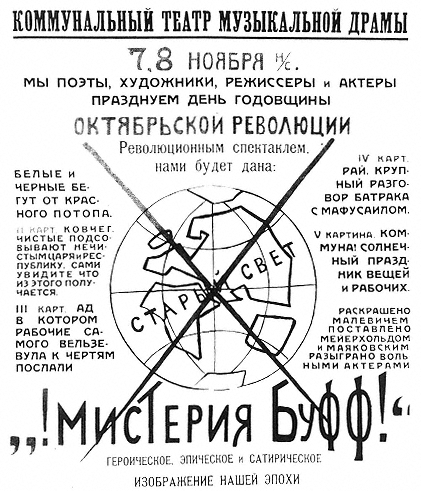
Figure 6.
Poster for Meyerhold's production of Mystery-Bouffe, 1918
(Mikhail German, ed., Serdtsem slushaia revoliutsiiu. iskusstvo pervykh let oktiabria,
Leningrad, 1980).
The world of Mystery-Bouffe was remarkable for its incapacity for compromise: the very idea had strongly negative connotations for the poet and his contemporaries. On the stage, no meeting of worlds was possible. The revolutionary city was divided into two camps, workers and nonworkers, locked in a territorial struggle. Conflict—the revolution—was a meeting of opposites that could not end in a truce. Mayakovsky did not complicate the struggle by depicting more than a
single interest in each camp. To subjugate the proletariat, the bourgeoisie elects itself a tsar; the tsar then declares his sole right to all food. But when the bourgeoisie finds itself hungry, it adopts democratic principles and declares a republic. This makes no difference to the workers; the republic is "the same old tsar, just with a hundred mouths" (p. 204).
When it is festivalized, revolution shuns gradual change for apocalyptic suddenness. Apocalyptic thought flourishes when the gap between two worlds seems unbreachable. Apocalypse is a radical solution, a onetime threshold that closes a gap by eliminating one side of it. It is time compressed to fusion: "the beginning and the end" of the Book of Revelation. Such revolutions are terrible to live through, but they can be aesthetically satisfying, which might explain the attraction felt by artists as diverse as Blok, Bely, Meyerhold, and Mayakovsky.[62]
The model's second attraction was its strongly utopian element. Apocalypse and utopia, like carnival and mystery work best together. Apocalypse precedes utopia. The clash of worlds leads to the elimination of one, followed by the harmonic reign of utopia. An apocalypse is the "no time" that precedes "all time"; utopia is the "no-where" that is everywhere. Mystery-Bouffe 's Promised Land is the final sum of the apocalyptic equation; it is Mayakovsky's image of the city of socialism.
The characters of Mystery-Bouffe —the citizens of the two cities—were imported from festival theater, with a strong dose of the fairground. Popular theater—for example, the Petrushka puppet theater or the Tsar Maximilian play—incorporated little character development; the introductory epigram determined a character's actions through the entire play. In Mystery-Bouffe the clean are portrayed in the mocking tones of carnival, with a particular flair for exaggerated detail: the nose ring of the Abyssinian negus or the top-hat of the Frenchman (see Figure 7).[63] Entrances of the clean are marked by Petrushka-like self-introductions, and national conflicts are reduced to slapstick brawls.[64] Performance style was developed from the prewar work of Meyerhold and Evreinov, with new additions taken directly from the popular theater and the circus. In the future, Meyerhold would even invite a clown, Vitaly Lazarenko, to play a demon in the inferno scene. The unclean were depicted in the monumental tones of the mystery play.[65] They performed collectively, as a chorus, much of the time, and their lines were read with a "firm, strong principle, heroic pathos, and plastic monumentality."[66] Costumes for the unclean repeated a pattern found in "Apotheosis of the Worker," V. V. Lebedev's street decoration for the holiday, and in Vladimir Kozlinsky's drawings to Mayakovsky's verse in a holiday pamphlet: simple lines, uniformity.[67]
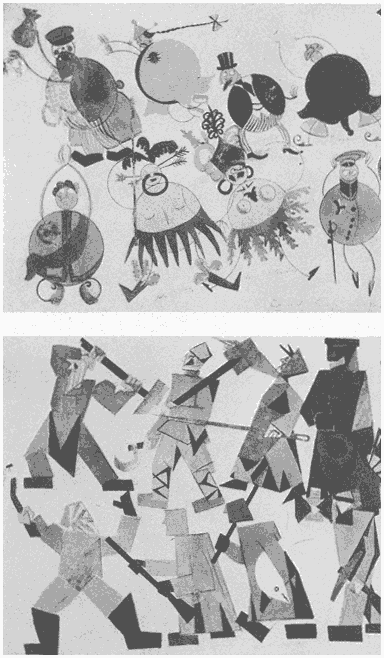
Figure 7.
Costume sketches by Mayakovsky for the "clean" and the "unclean,"
Mystery-Bouffe, 1918 (Mikhail German, ed., Serdtsem slushaia revoliutsiiu.
Iskusstvo pervykh let oktiabria, Leningrad, 1980). Photos courtesy of Aurora Publishers.
The revolutionary city of Mayakovsky's play featured endless movement. It was an eternal threshold, and it required a stage space accommodating sudden, unexplained transitions. Unfortunately, Malevich's flat, static decor did not fit the bill.[68] Mayakovsky's own background sketches were a more apt illustration. They depicted the city as a hub; factories, railroads, apartments revolved around the fissionable center.[69] It was the modern city found in his prewar poetry—compact, dynamic, and discordant. Trams put the slums within a few minutes of the palace; neon lights shone on dreary streets.
Once again, festival theater provided the most appropriate model for Mystery-Bouffe, this time in the definition of space. The entrance to the Promised Land was depicted as simply as in a medieval mystery, by opening the gates and having the players step in; and Mayakovsky's entrance as A Simple Man used a circus trick: he flew onto the deck along a guy wire.[70] An ark-stage represented the revolutionary city. Boats have an ancient tradition as the symbolic vessels of threshold states. Noah's ark is an obvious model, but there were also Ulysses's ship in the Odyssey, Charon's ferry across the Styx, and the medieval Ship of Fools.
The ark-stage provided a graphical representation of revolution as threshold. It was divided into the deck, occupied by the clean, and the hold, where the unclean were banished. The two levels were connected by a trapdoor. When in the third act another set was introduced, the same spatial division was applied: on top was Heaven, below Hell, and in between a trapdoor. This trapdoor, fully motivated by the use of a ship's deck as the stage, traced its genealogy to mystery stages. Its forbears were the English pageant cart, used both as a stage and as a transport for mystery cycles, and the Russian vertep (crèche), an itinerant puppet booth featuring the Christmas story on a two-level stage: the Slaughter of the Innocents on top followed by comic interludes below. The trapdoor was suggested by Alekseev-Iakovlev, who showed Mayakovsky the model of a balagan hell-mouth when he was first planning Mystery-Bouffe .[71]
Drawing on futurism and carnival theater, Mayakovsky provided a rousing version of the old regime's fall; but to satisfy the duality of festivity, and to offer a compelling vision of the future, he had to speak of what lay beyond the threshold. The apocalyptic equation, like the Revolution itself, begged for a utopian solution. Here too, Mayakovsky profited from Blok's experimentation. Blok's response to the Revolution, The Twelve (1918), was a poem of chaos: figures emerge from a
Petersburg blizzard and are swallowed again as the violence of revolution plays itself out. Blok looked to the carnival theater—the puppet booth—for his central character, Petrukha (Petka), and his misadventures resembled those in a balagan melodrama.[72] At the poem's conclusion a sudden clearing in the whirl of snow gives a glimpse of the potential future: Christ, clad in white with a crown of red roses standing out against the blizzard, leads the twelve.
The final act of Mystery-Bouffe was set in the Promised Land—beyond Hell, beyond even Heaven—a utopia in which the curses of modern life, differentiation and alienation, were absent. Like Blok, Mayakovsky looked to Christianity, particularly the poetic Christianity of Ivanov, for his image of utopia. If the city was socialist, it was only because it lacked individuality. The social order's greatest virtue was a lack of conflict between things and people. Mayakovsky looked back for his embodiment of the future: the Simple Man, the savior come to lead the final revolution, was none other than a new Christ, complete with a "new Sermon on the Mount":
In my paradise, halls are packed with furniture,
the rooms fashionable with electrical services.
There the sun plays such tricks
that each step sinks in a sea of sunlight.
Here the age pores over the gardener's experience—
flooring of glass, manure embankment,
and from roots of dill
pineapples grow six times yearly.[73]
Mayakovsky's progress from revolution to socialism reversed the course of symbolist history; a layered grotesque gave way to a world of oneness. His festival drama, one of the first in revolutionary Russia, ended aptly with a festival of the new city; yet it was celebrated as Ivanov (and Rousseau before him) might have wished, with a hymn and a choral dance. Festivity and its many forms had given Mayakovsky a model for his play of revolution; his collaboration with Meyerhold familiarized him with the experiments of his symbolist predecessors. The combination made for a convincing story of revolution that would last many years in Soviet culture.