
Riparian Vegetation and Wildlife
Beyond 46–91 m. of the Howe and Watt Avenue access points, the full diversity of riparian plant and animal associations can be found. Cottonwood, ash, and willows in combination with wild grape, blackberry, wild rose, and other vegetation are essentially in an undisturbed condition. Wildlife is abundant. Beaver, muskrat, and waterfowl can be observed throughout the Howe and Watt Avenue portion of the American River Parkway[6] (fig. 1).
Some access points along the river do show impacts resulting from recreation use. Obvious erosion is in evidence at the popular put-in and take-out sites for boaters particiating in rafting, canoeing, and kayaking. Because these are essentially instream uses, the impact on the shoreside terrestrial areas is minimal and limited to launching and retrieval areas (fig. 2). Popular trails have exposed soil, but this is a localized condition and frequently involves no more than a narrow footpath through a portion of the riverside vegetation.
| ||||||||||||||||||||||||||||||||||||||||||||||||||||||||||||||||||||||||||||||||||||||||||||||||||||||||||||||||||||||||||||||
[5] Rominger, Gary, 1981. Personal conversation. Chief Ranger, American River Parkway, Sacramento County Park Department, Sacramento, California.
[6] Ingles, Steve, 1981. Personal conversation. Manager, Effie Yeaw Interpretive Center, American River Parkway, Sacramento County Park Department, Sacramento, California.
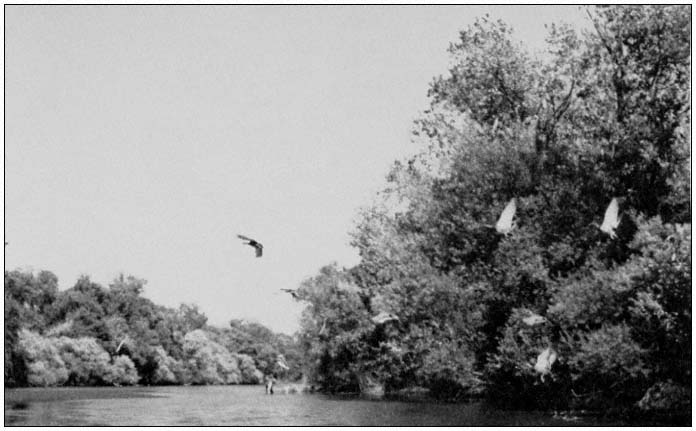
Figure l.
Resident and migratory waterfowl along with other wildlife on the American
River can be found within easy access of over 1 million people.