
Temple, Trustees, Donors, and the Civic Community
A Tamil villager once told me that a community without a temple was unfit for residence. The temple, he said, indicates that the community is graced by the presence of God and that its citizens form a moral community. A community identifies and is identified by others with its temples. Bala and other Beeri Chettiars went to considerable length to explain to me the nature of their community's identification with the
Kandasami temple and the role that big-men played as its patrons and managers. The temple and its functions symbolize the caste community, and publicize its leading associations and who its leading men are. Stories about the temple's history and endowments reveal as much.
That night in the temple office, Bala and his friends described the Kandasami temple as a "denominational" temple, meaning a temple controlled and managed by a single caste community, in this instance, themselves, the George Town Beeri Chettiars. What makes the temple a particularly important institution of big-man leadership among the Beeri Chettiars today is that it is the primary and by far the wealthiest institution controlled by the caste as a whole and, in much the same manner that villagers use their temples, it is used by leaders to represent the caste as a civic and moral community to the world at large. It is also importantly a charitable institution, the caste's central repository of resources that exist for the benefit of the caste as a civic community. An individual who is elected to the managing board of trustees of the temple is elected, therefore, to a position of leadership within the Beeri Chettiar community with control over its main assets. Among the five trustees of the temple, the head trustee, the dharmakarttaa , is preeminent. It is Bala who holds this position. He is the periyar , the big-man, and he is a preeminent figure in his community.
Until 1980, the electorate of the Kandasami temple included only male Beeri Chettiars who lived in Muthialpet, Mannady,[6] and Park Town, but because by that time increasing numbers of families had moved to other parts of the city, caste leaders changed the bylaws of the temple to include in its congregation male Beeri Chettiars living or doing business anywhere in greater Madras City (Madras High Court records). The Madras Beeri Chettiars, therefore, today form the temple leaders' constituency. And this constituency, as a group, constitutes the caste's civic community defined most broadly. But even with this change in bylaws, the Park Town-Muthialpet Beeri Chettiars constitute the core congregation of the temple, and temple trustees have always been selected from among the caste's George Town leaders. It is these leaders who are and always have been the principal donors to the temple and sponsors of temple functions, and it is because of them, and because of the location of the temple, that George Town remains the geographic heart of the Beeri Chettiar's sense of their civic community in Madras City.
Because popular temples such as the Kandasami temple are important institutions of civic leadership, control of them is often contested. In George Town, the leaders of several castes would like to gain special
rights in the temple, and some conspire to dislodge the present temple trustees with this aim in mind. These contenders pursue a variety of strategies, among them bringing lawsuits claiming that members of other castes have made donations to the temple and so, since the Beeri Chettiars are not its sole financiers, they should not be its exclusive managers.
In and out of court, Bala and his allies have countered these pleas, asserting that the caste's right to exclusive control of the Kandasami temple is based on what they argue has been more than three hundred years of unbroken management and on a legend that the temple was founded by two old friends, Velur Mari Chettiar, a Beeri Chettiar, and Kandappa Achari, a Viswakarma man. According to this legend, the two friends were on their monthly pilgrimage to worship Lord Murugan at Tiruporur, fifty-six kilometers away, when they miraculously discovered the idol of Kandasami hidden in an anthill and brought it back to Madras. There, on an auspicious day in 1673, they installed and consecrated the deity in a temple dedicated to the elephant god, Vinayakar, located in the garden of one Muthiyalu Naicken of Pedda Naickenpet. Subsequently, when Mari Chettiar sought to build a temple for the deity, funded in part by his wife's generous gift of her jewelry, Muthiyalu donated the Park Town lands on which the temple now stands. When Mari completed the temple, he handed its management and that of its financial trusts to the "eighteen group" Beeri Chettiars, the eighteen named clusters (gumbuhal ; sing., gumbu ) that composed the Town Beeri Chettiar community at that time. In commemoration of his services, the Beeri Chettiars installed a statue of Marl Chetti near one of the temple's sanctums, where he is worshiped today as a god. Here we see an individual, Mari Chetti, being commemorated for what he had done.
Aside from this legend, lists of donations, and a few undocumented stories, little specific historical detail is known of the temple. Nonetheless, challenges by covetous leaders of other castes to the exclusive control of the temple by the leaders of the George Town Beeri Chettiars have been unsuccessful so far. What historical evidence there is of Beeri Chettiar control has been too strong.
From archival materials, endowment records, and stone inscriptions in the temple we do know that Beeri Chettiar control of the temple is at least two hundred years old. F. L. Conradi's 1755 map (map 3) of "Madraspatnam," as the city was then called, depicts a small unnamed shrine at what is the temple's location today (Love 1913, 2: endpocketmap). We know that the temple was renovated and sanctified as a brick temple in 1780 by the "eighteen group Beeri Chettiars." We know that
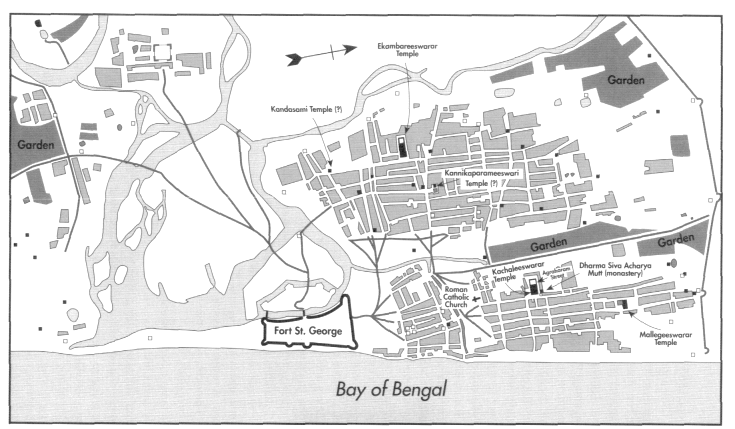
Map 3.
Madras in 1755. Based on "A Plan of Fort St. George and The Bounds
of Madraspatnam" by F. L. Conradi.
about 1865 the temple was rebuilt of stone in its present form, and that in 1869 a generous man named Vaiyabari Chettiar donated Rs. 66,000, an enormous sum in those days, to establish a trust to fund various temple functions. He also built the large temple car (teer ) in which the processional idol of the god is carried on the seventh day of the main annual festival (brahmootsavam ). We also know that around 1880 Akkamapettai Govinda Chettiar and Narayana Chettiar donated the land next to the temple for the purpose of building a large community hall, the Spring Hall (Vasantha Mandabam). And we know that in 1901 Kali Rattina Chettiar, a wealthy businessman and the father-in-law of Bala's father-in-law, donated Rs. 50,000 to build the temple's entrance tower (gopuram ) and, in a dramatic gesture still spoken of with awe, gave a cup of diamonds for jewelry to decorate the idol.
Richly endowed, the temple today owns more than sixty houses, most located on prime urban land. The head temple priest's house, which is rented to him by the temple, gives an idea of values. In 1986, its worth was estimated at Rs. 10-15 lakhs (1 lakh equals 100,000 rupees), $100,000 or more at a 1986 rate of exchange. A few of the endowments have been especially grand. The previously mentioned gift of a cup of diamonds and Rs. 50,000 by Kali Rattina Chettiar is one of these, a gift that in those days was worth many times the value of a house. Another is Bala's uncle Venugopal Chettiar's gift to the temple of ten grounds of urban land, which are today the site of a one-thousand-student Beeri Chettiar grammar school founded under Bala's administration. Other endowments sponsor particular festivals; they buy flowers and textiles for rituals and clothes for the deity. Yet others fund building, renovations, and cultural events. Today the temple controls hundreds of millions of rupees in assets.
The rich endowment of the temple reflects its popularity and the affluence of the Beeri Chettiars. As a measure of the temple's lively appeal, the temple concession that looks after the sandals of worshipers annually earns about Rs. 36,000 by charging customers a small fee of ten paise[7] for safeguarding their footwear while they go barefoot into the temple. Given that many locals leave their sandals at home when they are going to the temple and avoid the charge, this sum equates with at least 360,000 individual visits to the temple each year. This popularity is especially evident during the Spring Festival (Vasantha Brahmootsavam) when the god, garlanded in flowers and bedecked in gold and diamond jewelry, is taken on lengthy nighttime processions. On these nights, when the processions are longest, crowds gather in the streets for
miles. These crowds are the audience before whom the trustees play out temple pageantry depicting the trustees' role as patrons and the wealth and importance of the Beeri Chettiar civic community.
The temple's rich endowment also reflects the sense each endowment donor has of his or her civic individuality, since endowments state something about who each donor is in relationship to the Beeri Chettiar community: that he or she is an acknowledged member of the community and makes his or her gift in the interest of the caste's collective good. Through his gift, the individual achieves for posterity a respected reputation within the community congregation. Over the centuries Beeri Chettiars, singly and as associations, have made numerous donations, both large and small, slowly building the temple's wealth. Individual donors without children who have left houses and property to the temple are commemorated in inscriptions and posters that list donations. Without descendants, their donations must preserve their identity within the civic community and keep alive a memory of who they were.
A Viswakarma once told me that a person with lots of gold has abundant strength and fertility. So, too, a community. On the night of our initial meeting, demonstrating the temple's wealth, Bala first described the gold ritual vehicles and processional objects possessed by the temple, and then, with the others at the meeting, we left the office to examine them in their locked sheds. He made clear the connection between donors and sponsors and particular ritual objects: the Beeri Chettiar Iron Merchants Association donated the gold crown worn by the processional idol and all the gems that encrust it; the Town's betel leaf[8] merchants donated approximately 2.5 kilograms of gold for the gold peacock processional vehicle (vahana ); the shroff (bankers and dealers in bullion) merchants donated 4.0 kilograms of gold for an elephant processional vehicle. And the Town Beeri Chettiars as a community donated 3.0 kilograms of gold for the processional palanquin of the supernatural warrior-hero and ally of Kandasami, Surabatman.
The temple also has a silver-plated car, strung with colored lights, constructed with temple funds. Temple cars have a pyramidal form, ornately decorated with carvings, temples on wheels. Some are huge juggernauts, towering twenty to thirty feet or more. Electric wires obstruct the passage of these biggest of cars, and today only a few are taken on procession in the city. Others, smaller, are designed to pass below the city's electrical lines. The garlanded and jewel-bedecked idol is carried in the car-shrine during processions, often with priests sitting before it in order to accept and present offerings submitted by worshipers. In
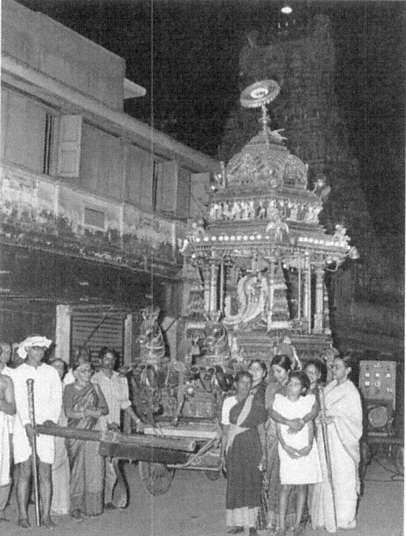
Figure 5.
Gold-plated temple car (teer ) with the Kandasami gopuram in the
background. The processional idol of Kandasami may be seen riding in the car.
1984, in his role as head trustee of the temple, Bala himself built for the temple with temple funds a gold teer plated with 7 kilograms of gold, one of twelve in southern India, and a significant new expression of the temple's claim to importance.
In their opulence, each of these ritual objects declares to all who see or hear of them the vitality of the George Town Beeri Chettiars and ide-
alizes the altruistic commitment to the civic community of the associations and leading citizens who gave. Of course, everyone recognizes that the objects also make great advertisements for the donors and the Beeri Chettiars as a community and boost reputations. Bala and the others were showing me that the Kandasami temple is regarded by the Beeri Chettiars as a key institutional symbol not only of their community as a whole, but also of its leading citizens and associations.