
The Tulsi-Parampara
The guru-sisya[*] (teacher-disciple) relationship is as central to the art of Katha as it is to other Indian performance traditions, and most expounders conceive of themselves as belonging, however symbolically, to a parampara (chain, or succession) that ultimately extends back to the very sources of the tradition. Anjaninandan Sharan identifies two main
[52] Biographical sketches of both men, including lists of their writings, are given in Singh, Rambhaktimem[*]rasik sampraday ; that of Vishvanath Singh is on pages 431-36; that of Raghuraj Singh is on pages 469-74.
[53] A similar observation has been made by Peter van der Veer, who attributes the upsurge in royally patronized temple building in Ayodhya to the leisure and security provided by British overlordship; Gods on Earth , p. 39.
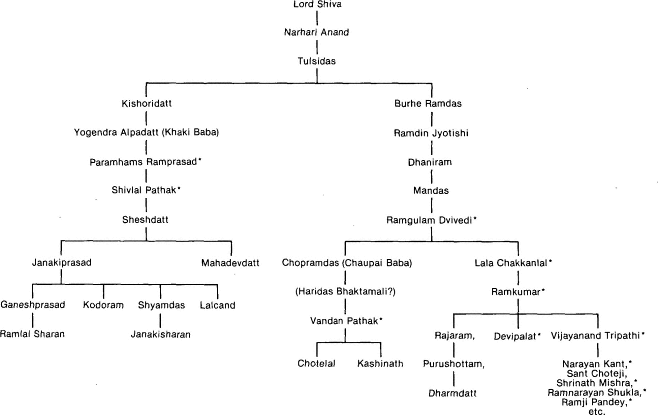
Figure 15.
The Tulsi-parampara according to Anjaninandan Sharan.
Source: Sharan, "Manas ke pracin tikakar[*] ," 910. Names followed by an asterisk are
those of famous expounders to whom additional reference is made in the text.
"schools" of Manas interpretation, which may be labeled the "Tulsi" and the "Ayodhya" traditions respectively. The first traces itself back to Tulsidas (and ultimately to Shiva, the first narrator of the Manas ), but historically it can be most clearly traced through its two branches, which represent the traditions of Shivlal Pathak and Ramgulam Dvivedi, influential expounders of the early nineteenth century. Banaras was the most important center for this tradition, and most of its major figures enjoyed, at one time or another, the patronage of the Ramnagar kings. The Ayodhya parampara , on the other hand, was the Katha tradition of the various Ramanandi ascetic lineages that had their base in Ram's holy city; Sharan, himself an Ayodhya sadhu, did not attempt to trace this tradition back to the time of Tulsidas, but each of the sadhu lineages has its own chain of transmission, usually leading back to Ramanand and sometimes including Tulsi, if the sadhus claim him as a member of their order.[54] In the pages that follow, I discuss figures from both traditions as well as a number of commentators who do not seem to belong to either; the majority of names that I introduce, however, belong to the Tulsi-parampara . Accordingly, it is useful to begin with a chart of this tradition (fig. 15), based on one in Sharan's 1938 article but with a few additions to bring it up to date.
This diagram cannot be taken as a historical or even a strictly chronological schema; rather it is a symbolic representation of a tradition as some of its practitioners conceive of it. In certain cases, successive figures on the chart were indeed connected by a teacher-disciple relationship that spanned many years of intensive instruction in Manas interpretation. In other cases, a pupil's contact with a given teacher may have been fleeting; he may have had the darsan (auspicious sight) of the guru, perhaps heard him expound on several occasions, and received (or felt that he received) his blessing (asirvad ). The situation is complicated by that fact that a pupil may have several gurus: a siksa-guru[*] , who imparts teachings; a diksa-guru[*] , who initiates and bestows a mantra; and additional gurus for specialized instruction. He may choose to place himself in the lineage of any or all of these.
In this context, it is important to understand that it is not primarily intellectual knowledge of empirical information that is communicated through the teacher-pupil succession, but rather authority (adhikar )—the authority to practice a particular sadhana and repeat a mantra, or to interpret and expound a particular text. Such authority may also be the
[54] Charts of these lineages are given in Singh, Rambhaktimem rasik sampraday , 333-56.
outcome of "grace" (krpa[*] ), and the guru who imparts it may not be a human being at all; many expounders attribute their understanding of the Manas to the grace of Hanuman, the special patron of their tradition, bestowed in an extraordinary spiritual encounter.