
The Phlegrean Fields in Italy
One of the Earth's more famous volcanic fields is the Phlegrean Fields (Campi Flegrei), which lies adjacent to the city of Naples and forms not only much of the margin of the Bay of Naples but also part of the Campanian Plain. Nearly all the volcanism there has occurred during the past 50,000 years and most of it has been phreatomagmatic. Trachytic magmas rose to the surface to mix with groundwater and/or sea and lake water; this interaction produced volcanic forms that range from small tuff rings to the Phlegrean caldera complex. The information for the following discussion was condensed from papers and reports by Barberi et al . (1978), Cameli et al . (1976), Rosi et al . (1983), Lirer et al . (1987), and Rosi and Sbrana (1987) as well as unpublished work by G. Orsi.
One of the major events in this area was the eruption of the Campanian Ignimbrite 32,500 years ago (Paterne et al ., 1988). This widespread ignimbrite, chemically zoned from phonolite to trachyte, is believed to have had a volume of ~80 km3 (dense rock equivalent). Barberi et al . (1978) and Rosi et al . (1983) proposed that caldera collapse during this eruption left a crater 13 km in diameter that covered what is now the Phlegrean Fields and a portion of the Bay of Naples (Fig. 4.21). Authors have referred to this caldera complex as the "Campanian Ignimbrite caldera" and the "Phlegrean caldera," which we use here. Caldera-fill deposits range from 500 to >3000 m thick and consist of tuffs, tuff-breccias, and nonwelded pyroclastic rocks; these deposits may be partly the Campanian Ignimbrite and partly tuffs from younger explosive eruptions that are interbedded with conglomerates and sandstones (Bruni et al ., 1983).
More recent geophysical research by R. Scandone (personal communication, 1990) interprets a negative gravity anomaly located on the Campanian Plain northeast of Naples near Mount Vesuvius as the source of the Campanian Ignimbrite.
The Neapolitan Yellow Tuff (NYT) and Gauro Yellow tuff (GYT), dated at ~12,000 years BP, are exposed over a large area surrounding the Phlegrean Fields and are also encountered in geothermal drillholes within the caldera complex. Lirer et al . (1987) proposed that the NYT eruption formed a smaller caldera, ~6 km in diameter, that is centered on the town of Pozzuoli and the Gulf of Pozzuoli. These tuff units resulted from the largest multiple, significant phreatomagmatic eruptions since that of the Campanian Ignimbrite. The caldera complex of the Phlegrean Fields is also most likely a composite structure that was formed during several eruptions.
Some of the younger rocks of the Phlegrean fields make up tuff rings, tuff cones, and scoria cones, for which crater diameters range from a few hundred meters to 2 km. The youngest eruption formed Monte Nuovo in 1568 AD, and structural resurgence of the caldera has continued intermittently throughout historical time. The latest activity—between 1970 and 1985 AD—affected much of the Phlegrean Fields. The maximum uplift (240 cm) was centered in the town of Pozzuoli; resurgence is believed to be the result of magma injection at shallow depths. Recent movements along active faults are common throughout the volcanic field. There are numerous surface manifestations of geothermal systems, including the fumaroles and acid alteration found at Solfatara Crater and numerous hot springs.
Drilling within the Phlegrean Fields has revealed a high-temperature hydrothermal system that developed within the siltstones and sandstones of prevolcanic rocks and the tuffs and lavas of the caldera deposits. Temperatures range from 335°C at a depth of 2.5 km to 420°C at a depth of 3.04 km, and the average thermal gradient is 150°C/km.
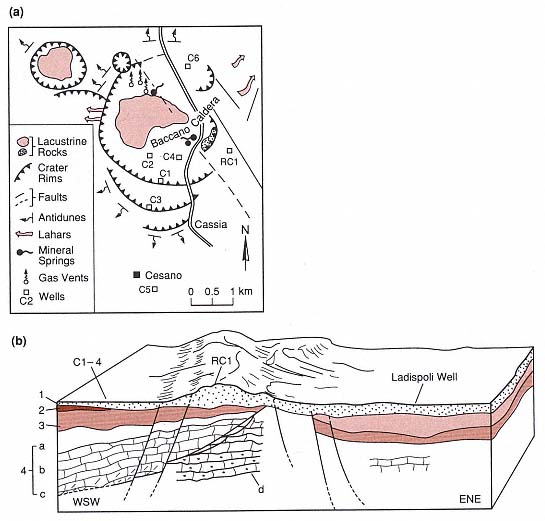
Fig. 4.20
Baccano caldera in Italy. (a) Structural sketch map showing the concentric ring faults around this
small caldera, flow directions of surge deposits and volcanic mudflows (lahars), caldera lake
deposits, and spring and well locations. (b) Cross section through the Baccano caldera (left) into the
larger Sacrafano caldera (right). The caldera is underlain by Mesozoic- and Cenozoic-age limestones
and marls (1 = volcanic rocks; 2 = Neogene-Pleistocene sedimentary rocks; 3 = Argille Scaglisose; and
4 = Mesozoic and Cenozoic sedimentary rocks. a = marl and limestone; b = limestone; c = limestone
and dolomite; d = anhydritic dolomite). Abundant groundwater and permeability within these
units probably provided the water needed for phreatomagmatic activity at Baccano.
(Adapted from Funiciello et al ., 1979.)
Fig. 4.21
The Phlegrean Fields of Campania, Italy. These maps are composites of those by Rosi and Sbrana (1987)
and Lirer et al . (1987). (a) Outlines of the Phlegrean and Neapolitan Yellow Tuff (NYT) calderas within
and around the Bay of Naples and the cities of Pozzuoli and Naples. Submarine topographic contours
are indicated in meters. (b) Volcanic-tectonic sketch map of the Phlegrean and NYT calderas
(the Phlegrean Fields), showing the location of all postcaldera craters and lava domes. Within the
Phlegrean Fields, most of the volcanic activity has been phreatomagmatic; the rising magma
has interacted with groundwater and sea water. The cross section in (c) is based mostly on
data from the deep geothermal wells noted on this map.
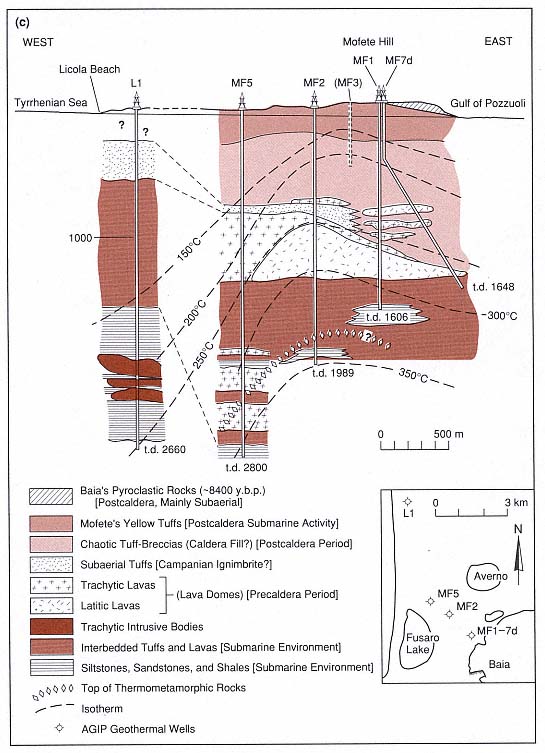
Fig. 4.21
(c) Cross section of the Mofete
geothermal area of the western Phlegrean caldera. The "chaotic tuff-breccias" and
"subaerial tuffs" could be caldera-fill materials that were
deposited during the eruption of the Campanian Ignimbrite.
(Adapted from Rosi and Sbrana, 1987.)
Hydrothermal fluids have risen along the faults bounding caldera structures and those that cross the volcanic field [Fig. 4.21(c)]. With the exception of fluids that rise along these faults, hydrothermal activity has been restricted to deep caldera fill, as is evident from the observation that the upper 500 m of pyroclastic deposits are not altered. These deposits overlie thick zones composed of argillic and illitechlorite alteration products. Hydrothermal fluids circulate within intensely fractured rocks near the caldera center, whereas low vertical permeability is characteristic of the outer caldera margins. Nearly all hydrothermal circulation within the caldera takes place within areas that have fracture permeability. There is no formation permeability except within near-surface aquifers. Thermally metamorphosed tuffs, sandstones, and lavas were found in the deepest wells, where rocks have been replaced by amphibolite-biotite and diopside, scapolite, garnet, and epidote. Similarly metamorphosed rocks have been found as lithic clasts within tuff units of the Phlegrean Fields.
In the Mofete geothermal field located near the western edge of the Phlegrean caldera, Carella and Guglielminetti, (1983) identified three water-dominated reservoirs in which water is the continuous, pressure-controlling system and there is little vapor [Fig. 4.21(c)]. The deepest reservoir, at a depth of 2700 m, contains hypersaline fluids at a temperature of 360°C; the intermediate reservoir, at a depth of 1900 m, contains low-salinity fluids at a reservoir temperature of 340°C; and the shallowest reservoir, between 500 and 1500 m deep, contains low-salinity water at temperatures of 230 to 308°C. The two deep reservoirs are located within thermally metamorphosed pyroclastic and epiclastic deposits; whereas the thick, shallow reservoir is sited within fractured volcanic rocks—mostly lavas—and is capped by tuffs that have been altered to clays.