
APPENDIX N—
COMPARATIVE STATISTICS OF SEVEN TOWNS
Certain statistics developed for each of the seven towns merit being tabulated together for purposes of comparison and because of their usefulness to scholars.
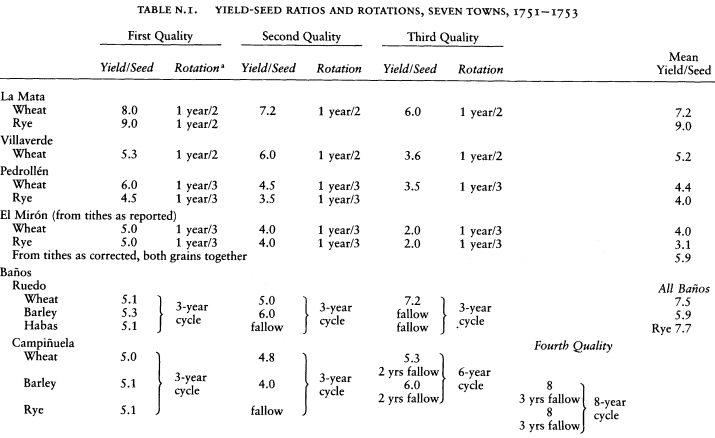
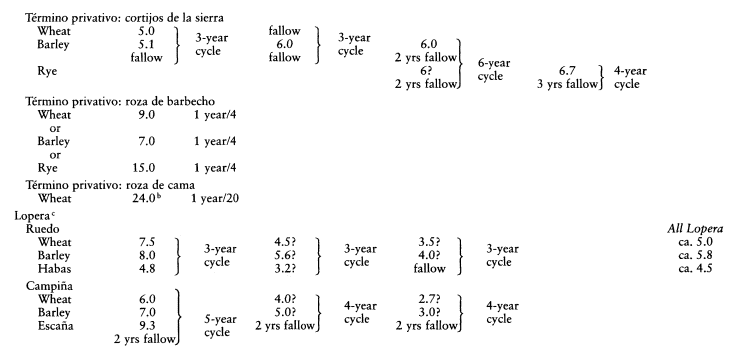
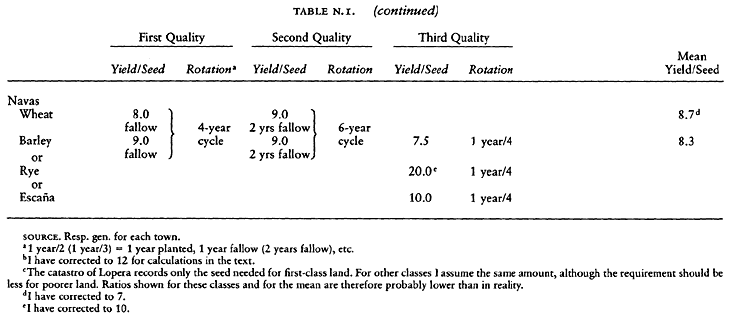
The yield-seed ratios for grains and some pulses (Table N.1) have been derived from the information in the catastro. This source states the harvest in grain for one unit (usually a fanega) of each different quality of land (resp. gen. Q 9 and the introduction to maest. segl.) and the amount of seed needed to sow one unit of each quality of land (resp. gen. Q 12). Table N.1 also states the rotation for each quality of land, since this has an influence on the yield.[1]
Another way in which yields are frequently measured, especially today, is in hectoliters of grain per hectare of land. Table N.2 gives the expected yield in the year of harvest, using the conversion 55.2 liters = 1 fanega of volume and the metric equivalent of the local fanega of area shown in Table N.5. For some towns the reported tithes have shown the predicted yield to be inaccurate. Estimates based on the reported tithes are shown in the last column of the table, but they are also approximations, because the extent of each quality of land sown with each crop can only be based on the use described in the catastro, which the tithes show is not always accurate.
2
In calculating the income of vecinos of the seven towns, I have used as a measure the equivalent value in fanegas of wheat (EFW), converting harvests of other crops and income from other sources into this unit, using the local prices reported for the crops in the catastro. The measure could be misleading if the prices were indeed very local, varying widely from one place to another. Table
[1] For comparable statistics on other times and places in Europe, see Slicher van Bath, Agrarian History, Tables 2, 3.
N.3 summarizes the prices of the major grains in the seven towns and also of olive oil in those of Jaén province.
The price reported for wheat is remarkably constant, either fourteen or fifteen reales per fanega except in Las Navas, where the price of eighteen reales is 20 percent above the higher of these two. The use of EFW as a measure thus appears warranted, and it is a measure that avoids the swings in grain prices that were typical of the old regime. The effect of the difference of price in Las Navas on my analysis was considered in its place.
It is worth noting that the prices recorded by Earl Hamilton for New Castile in these years are considerably higher. For wheat they run from 50 percent to nearly 300 percent more than the fourteen to fifteen reales range reported by most towns. His information comes from the account books of a hospital and two convents in Toledo,[2] but he does not state if the institutions were buying from peasants or selling on the market at this price.
This difference means that one cannot translate EFW income in rural communities into monetary terms and compare directly the result with urban incomes. For instance, I have calculated the mean income of the top labradores of La Mata as 280 EFW, which converts to 3,920 reales. In Madrid at this time, according to David Ringrose, one needed 3,000 to 4,000 reales to enjoy more than minimal food, housing, and clothes. It is clear that the labradores lived far above such a level, better comparatively than those in Madrid with the 5,000 reales needed "to achieve a measure of 'bourgeois' comfort." (A surgeon-barber in Madrid averaged 4,800 reales per year; a lawyer, 5,900.) In Baños and Lopera, the wealthiest notables averaged 350 to 400 EFW, 5,000 to 6,000 reales. These were the incomes of Madrid guild masters with shops of their own, below that of the average doctor (13,500 reales). The highest income we have come across was that of the widow doña Francisca Luisa de Molina de la Zerda y Soriano of Baños, 1,800 EFW, 25,000 reales, placing her in what Ringrose calls the middling class of Madrid (10,000 to 40,000 reales). Obviously in social status wealthy local notables were far above middling. Hamilton's figures suggest that in economic terms too, local incomes should be raised considerably to determine comparable buying power in Madrid.[3]
3
Table N.4 compares the proportion of male heads of household (vecinos) whose income comes primarily from agriculture with the per capita income of each town (see Table 14.1). It reveals a clear inverse relationship between the two statistics, except in the case of Pedrollén, which is not properly a town, and to a lesser extent Villaverde. The relationship is somewhat tautological because the lowest income for each town is usually that of agricultural labor. A high percentage of households drawing their income from agriculture usually means that there is a high percentage of jornaleros. Even so, the relationship deserves to be pointed out, because this information is readily available: the respuestas
[2] Hamilton, War and Prices, xxv and 229.
[3] Ringrose, Madrid and the Spanish Economy, 80–81.
| ||||||||||||||||||||||||||||||||||||||||||||||||||||||||||||||||||||||||||||||||||||||||||||||||||||||||||||||||||||||||||||||||||||||||||||||||||||||||||||||||||||||||||||||||||||||||||||||||||||||||||||
|
| |||||||||||||||||||||||||||||||||||||||||||||||||||||||||||||||||||||||||||||||||
generales give the number of vecinos in Q 21 and the number of men engaged in agriculture in QQ 33, 34, or 35. For comparative purposes, the percentage of vecinos engaged in agriculture can be used as a surrogate measure of per capita income of the town, a statistic that can be determined only with considerable effort.[4]
4
The makers of the catastro asked each town, "What measure of land is used in that town, and how many paces or square Castilian varas does it consist of?"
[4] All respuestas generales for Castile are available in AGS.
| ||||||||||||||||||||||||||||||
| |||||||||||||||||||||||||||||||||||||||
| ||||||||||||||||||||||||||||||||||||||||||||||||||||||||||||||||||||||||||||||||||||||||||||||||||||||||||||||||||||||||||||||||||||||||||||||||||||||||||||||||||||||||||||||||||||||||||||||||||||||||||||||||||||||||||||||||||||||||||||||||||||||||||||||||||||||||||||||||||||||||||||||||||||||||||||||||||||||||||||||||||||||||||||||||||||||||
| ||||||||||||||||||||||||||||||||||||||||||||||||||||||||||||||||||||||||||||||||||||||||||||||||||||||||||||||||||||||||
The answers showed that this enlightened concern for a standard measure was indeed justified, for the basic measure varied widely, as our seven towns reveal (Table N.5).
The basic measure was similar to an English acre and was known variously as a fanega, fanegada, huebra, or cuerda. When it was defined mathematically, it consisted of a number of estadales (similar to square rods in English), each consisting of a specified length in varas squared. (The vara castellana was 0.8359 meters.) The responses of the towns of Jaén show the complexity of the matter. The province had two different estadales. The estadal of the military order of Calatrava was 4 1/8 varas squared. The rest of the province used an estadal of 3 2/3 varas squared. (In La Armuña it was 4 varas squared.) The fanega of Calatrava had 480 estadales. The rest of the province was divided among zones with 480 estadales (a small area in the southwest), 500 estadales, and 666 2/3 estadales. A number of towns in the middle group reported a second measure ("cuerda" in this region) of 435 estadales for the ruedo and irrigated lands. Scattered through the province were towns that had no numerical measure but continued to define the fanega as the area sown with a fanega of grain.