
16.
Questions Without Answers
The Questions
What will happen to me when I die? Why did disaster strike me? What will occur tomorrow? next week? in a thousand years? How did everything begin? How will it all end?
We all want to know more than we can know. From the moment the seers at Ezkioga connected with heavenly beings, people used the new circuit to ask questions. The questions they asked point to problems that the design of the Catholic religion, the political economy of Western society, and the human condition itself raise but cannot resolve. My father committed suicide; is he now in heaven, purgatory, or hell? My husband does not go to church; is he in a state of grace? My son is retarded; can he be cured? My sister is blind; can she regain her sight? Is God angry or pleased with me and my family?
The internal logic of Catholicism governed how people put these questions. And people asked them only after addressing prior doubts: Do the Virgin, the saints, the devil, and God exist? Is the Virgin here? or is this the
devil in disguise? Does the Virgin speak to humans? Is this seer really talking to her?
Religion gives order to people's emotions and meaning to their lives. The way any religion does so raises problems even as it solves others. This is the nature of a dynamic system. Normal procedures have unsettling by-products.
Like most religions, Catholicism left unclear where individuals went after death. The partial solution—a purgatory from which most people eventually went to heaven—was not solution enough. For those whose dear ones died suddenly or without absolution or in a dubious state of grace or totally out of the church, it was no solution at all. Survivors yearned for news about loved ones who were in danger of damnation. The apostasy of much of Europe in the Reformation and in the age of progress strained purgatory to the limit. The living knew they had to put the dead to rest. For the living purgatory raised as many worries as it resolved. The living could shorten the suffering of loved ones in purgatory, but only if they knew for sure that loved ones were there and only if they found out what to do. Ghosts came only rarely with this kind of news. Contact with the Virgin Mary was more efficient: she could answer questions about many different souls and could even intervene to help them.
Yet this uncertainty in final destination was to the immense advantage of the church. It could direct behavior by establishing rewards and disincentives with indulgences and jubilees in much the way modern states use tax codes. And uncertainty had an emotional and moral logic. The despair of a living relative at the sure condemnation of a loved one would be too much to bear, and theologians avoided stating categorically that any particular person was damned.[1]
Alonso Getino, Del gran número, 35-48.
Conversely, the salvation of egregious sinners, were it to be known, might reward or encourage sin. So the stipulation of an afterlife organized in thus-and-such a way without certainty of destination served the organization and helped maintain an ethical order.This gap between what people knew and what they wanted to know was especially troubling for rural Basques. Members of a Basque household were responsible not just for the family dead but also for the household dead. Neighbors had obligations to the dead of neighbors. The living formed a web of collective responsibility for the eternal repose of souls they might not even have known. But the problem is not just Basque, not just from the 1930s, and not just Catholic. People depend on one another and this dependency continues after one of them dies. We find it especially difficult to part with those who die before their time. Writing about a woman she knows, a Galician physician put it this way: "The official explanations about life after death do not satisfy her, and she continually wants to know about the destination and the state of the spirits of her dead."[2]
Personal communication, Ana González Vázquez, Santiago de Compostela, May 1993.
There are other dilemmas. The scrupulous can never rest easy. Was my confession complete? What did I forget, repress, silence, or half-explain? Was a
transgression major? Or was it minor? While priests can give absolution for sins, the possibility of new sins begins the moment you leave the confessional. Priests have various answers to these questions; it depends on which clergyman you consult. And the scrupulous worry that priests make mistakes. So finding peace with God can be hard for the living as well as the dead. Those for whom grace is a minute-to-minute struggle search for relief, and we find the devout wanting to know how they stand straight from the divine.
Is Spain, Catalonia, the Basque Country, San Sebastián, Zumarraga in a state of sin or a state of grace? It is even harder for groups to determine their spiritual standing than it is for individuals. For social bodies there is no sacrament of confession and no absolution. Yet the rhetoric of Catholicism, like that of many other religions, constantly refers to polities as responsible moral units. Since ancient times town governments have made vows, sacred contracts of obligation and allegiance, to particular sacred figures on behalf of inhabitants. The consecration of households, towns, and even nations to the Sacred Heart of Jesus revived this procedure. At El Cerro de los Angeles outside Madrid in 1919 King Alfonso XIII unilaterally consecrated Spain to the Sacred Heart. Some city governments erected oversize statues of Jesus in prominent locations. Non-Catholics and liberal Catholics hotly contested the revival. In 1932 and 1933 non-Catholic town councils removed these statues, most notably in Bilbao. In other places people bombed and defaced them.[3]
For Bilbao see BOOV, 1 March 1933, pp. 103-108; vivid description of destruction of image in a village in Jaén during carnival 1932 in La Verdad (Pamplona), 8 May 1932, p. 4, from Pueblo Católico, Jaén, 23 February 1932. When the Second Republic was proclaimed in 1931 some men allegedly tried to place a phrygian hat and republican banner on the Sacred Heart at El Cerro de los Angeles, according to Semanario Católico de Reus, 6 June 1931, p. 391.
In the long history of religious apparitions, saints addressed towns, cities, and nations as moral bodies, offering protection in exchange for devotion. In some apparitions the divinity made it clear that it was punishing the town for its immorality. But there were other visions in times of disease or battle in which the holy figure seemed simply to be providing celestial help and sharing in the travail of the human group. In the eighteenth century Bernardo de Hoyos heard the Sacred Heart voice a preference for Spain; in the nineteenth century Catherine Labouré heard Mary prefer France. Such appearances were rewards rather than punishments. Some Italians took the apparitions in the Papal States in 1796 and 1797 as a reward for massive public penitential processions. The apparitions started in Ancona when the troops of Napoleon were on the point of invading. Subsequently in over fifty towns people saw celestial signs of support—images opening eyes or smiling, candles lighting themselves, holy bodies revolving in their coffins to turn and face the town—all usually after prayers at mass.[4]
Christian, Local Religion and Apparitions; Cattaneo, "Gli Occhi di Maria."
Given the recurrence of apparitions as warning and as moral support, it is clear that at least in times of trouble many Catholics want to know the attitude of the divine toward human groups as moral bodies.Was the Virgin appearing to a virtuous Basque Country or to a sinful Spain? Were there sins enough in the Basque Country, with its working-class indifference and sybaritic beaches, to provoke her tears? Engracio de Aranzadi, a devout Nationalist, was sure that the apparitions were signs of divine support for
Euskadi. But the signs were ambiguous: after all, it was the Sorrowing Mother who appeared, and she was in evident distress. Hence the essential, anguished question Ramona Olazábal put to the Virgin on 23 July 1931: "Do you appear because we are good or because we are sinners?"[5]
"The Virgin did not answer, but the angels smiled" (PV, 24 July 1931).
Where do we stand?This yearning for certainty about the intrinsically uncertain applies to grace in another sense.[6]
Pitt-Rivers, "Grace in Anthropology."
Some people obtain more grace than others. Like the grace from a bishop giving a blessing or offering his ring to be kissed, the blessing from the pope for a well-connected wedding, the baraka available in holy bones or special sacred images, or the touch of holy water, holy earth, or a holy twig or leaf, this kind of grace is there for the asking. You can accumulate it. And there is no end to the enterprise: the cup is never full. Visions immediately become a way to garner personalized grace. Many of the Catalan pilgrims to Limpias returned to Barcelona with some kind of glance from the Christ; so too many returned from Ezkioga with a divine smile or a cryptic phrase a seer passed on from the Virgin. Every member of a seer's entourage in every session hoped for some heavenly attention. Those without reward experienced their exclusion with anguish. In daily life there was no way to know if you were accumulating blessings, but at Ezkioga you could know.Groups seek to know they have God's blessing as much as individuals do. Surely the Aliadas, the Parish Exercises movement, and the Obra of Magdalena Aulina were not the only organizations convinced they had found a special grace from the Virgin on the Ezkioga hillside. Other religious orders claimed a special relation to other apparitions: some Claretians and Dominicans to Fatima, some Jesuits to Paray-le-Monial, and some Capuchins to Limpias.
How will my illness turn out? On which day should I take a trip? Should I leave in the morning or in the afternoon? Some believers also wanted guidance in secular matters. For those of a providentialist turn, the kind that predominated at Ezkioga from 1932, every event, act, and sensation had deeper meaning. Providentialism was one of the main currents among Basque seminarians and priests in the 1930s.[7]
Baroja, El Cura de Monleón, 46-47; Apolito, Cielo in terra, 216.
The bishop Manuel Irurita and the parish priest Amundarain were prime examples. And Magdalena Aulina led her Catalan followers into a system in which Gemma governed every turn and might reward any act with perfume. Followers wrote Aulina for advice on the most trivial matters. So this was yet another dilemma: if all is providential, how can the individual discover what providence wants him/her to do? Such persons needed not just spiritual direction but secular direction as well. Through the seers, it seemed they could get such guidance directly from heaven.Some questions were more philosophical. Why do the wicked often prosper and the righteous often fail? Why is there injustice and inequality? Why is there sin? For those believing the apocalyptic visions the seers brought a solution to the existence of evil. The reign of the Sacred Heart would right the age-old signs of a bad world. The wicked would perish in the great chastisement, there would
be no more sin, all would speak the same language, and the dead would rejoin the living.
No human agency seemed to be concerned with these questions: the reigning rationalism could not bless or forgive social groups; it left chance, progress, and contingency in charge. And the church sometimes hindered more than it helped. For it stood between people and their dead and people and their gods, and it told people what they could or could not see or hear. At Ezkioga women and children challenged the male priests' tight control over the distribution of grace and access to the other world. With flowers, messages, and blessed rosaries the seers gave absolution, distributed grace, and answered the unanswered questions.
The apparitions were in part a rebellion by an agrarian world still close to the spirits against a system of explanation, a distribution of blessings, and an access to heaven people found unfair. In effect, seers and believers were rejecting the city and the world of commerce that devalued rural sharing and mutual help.[8]
Schneider, "Spirits and the Spirit of Capitalism." Estornés Zubizarreta, "Las Apariciones de Ezkioga," 590, calls the Ezkioga phenomenon "one of the last gasps of Basque pre-industrial society."
But the mass response to visions in the twentieth century throughout the Catholic world demonstrates that the essential issues are not just rural. While Medjugorje and other prominent vision sites are in rural locations, the tens of millions of pilgrims who have gone there are largely urban residents who share a need for answers that their parishes and societies do not provide.Hope and Anguish
For many people the apparitions at Ezkioga were simply a great divine event. These people went to the site as they might go to see a solar eclipse. For them Ezkioga was part of a skein of divine intervention that ran back for centuries. In this skein trances, messages, and prophecies repeated and adapted themselves. Seers heard and read what had gone on in the past and what was going on elsewhere; they knew the religious orders and shrines that visions had inspired in the past and present, in Spain and elsewhere.
The skein took on meaning and maintained coherence in a more practical way. "Carriers" were at work before Ezkioga, persons dedicated to receiving, understanding, and propagating communications from the divine. In the last years of sixteenth-century Madrid connoisseurs quite like Padre Burguera elicited the political dreams of Lucrecia de León. The French prophet Thomas Martin had his expert Louis Silvy, Catharine Labouré had Père Aladel, the Italian David Lazzaretti had two priests of the Congregation of San Felipe Neri and the monarchist Le Vachat, and Anna Katerina Emmerich had Clemens Brentano. The type is entirely recognizable and surely goes back to the time of Moses.[9]
Kagan, Lucrecia's Dreams, 86-113; Boutry and Nassif, Martin l'Archange, 69-70, 93-94; Lazzareschi, David Lazzaretti, 102, 190; Staehlin, Apariciones, 347-349.
These carriers passed on meaning and enthusiasm like a torch, from one set of visions to another. Several of our protagonists connected Limpias with Ezkioga. Both Juan Bautista Ayerbe and Catholic activist María de Echarri had previously interpreted the visions of the Christ of Limpias. Juan José Echezarreta,
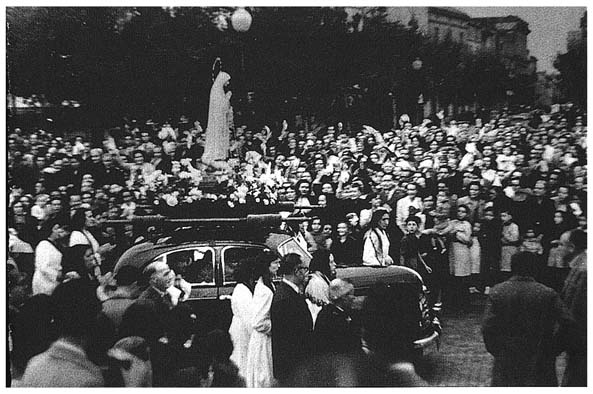
The Virgin of Fatima enters Terrassa on García Cascón's car, 13
October 1951. Courtesy Arxiu Salvador Cardús i Florensa, Terrassa
owner of the Ezkioga field, had gone to Limpias, had a vision, and wept there. Joaquín Sicart, chief photographer at Ezkioga, had been cured after a vision at Limpias in 1919, as had the priest Francisco Aguirre, who took down Evarista Galdós's messages. Remigio Gandásegui, the archbishop of Valladolid who encouraged Baudilio Sedano's interest in Ezkioga, had been the most assiduous episcopal visitor to Limpias. Raimundo Galdeano was a Navarrese farmer who linked Ezkioga both to Limpias and Piedramillera. By paying for parish missions by the Capuchins who stimulated the visions at Limpias, he unwittingly prepared a zone of Navarra for visions in 1920. He paid for a mission in the Barranca in 1931, when he accompanied a seer from Lizarraga to Ezkioga.
The skein runs forward as well as backward. Many of the major propagandists took their agendas from Ezkioga to subsequent visions in other parts of Spain and Europe. Raymond de Rigné wrote about the apparitions of Assisi and La Codosera. Several of the seers from Torralba de Aragón in 1931 went to Cuevas de Vinromà in 1947 for the great miracle, and Padre Burguera talked to the seer there. Salvador Cardús was in Solsona when to enormous excitement a traveling image of the Virgin of Fatima entered the town. He immediately bought an image to install in Terrassa. On 13 October 1951 the statue entered the city
on top of Rafael García Cascón's car. Three children dressed as the shepherd seers met it in the town square. García Cascón himself never ceased his frenetic visits to apparition sites, whether Fatima, Lourdes, La Codosera, Garabandal, Monte Umbe, or Cerdanyola. He always wanted the cars to go fast and he opposed rest stops. He brought the Utrera seer María Marín to his house in Terrassa and almost had a heart attack when a woman seer at El Palmar de Troya told him he held the Baby Jesus in his arms.[10]
Rigné to director of ABC (Madrid), Zumarraga, 27 February 1948, carbon copy, private collection. Cardús described the Fatima entry at length in an unpublished manuscript, ASC. For García Cascón: family member, Terrassa, 19 October 1985.
José Javier Martínez Sarrasa hunted out seers all over Spain. In particular, he made friends with those who had visions in La Codosera in 1945, but he also was acquainted with seers of Garabandal (Cantabria) in the 1960s. José Martínez Cajigas, a devout photographer who lived in Santander, took pictures for postcards at Limpias and Ezkioga; some of his descendants befriended the seers at Garabandal. Several seers from Gipuzkoa and many of their followers went to Garabandal in the 1960s. In turn busloads of Garabandal devotees visited the Ezkioga seer Rosario Gurruchaga in Bergara. I first heard of the Ezkioga visions in 1968 from my friend Jon Leemans, a Dutch devotee of Garabandal. He knew a Spanish diplomat who had been a correspondent of Juan Bautista Ayerbe and Pedro Balda and owned what was then, in 1968, one of the few copies of Burguera's book in circulation. In the 1950s and 1960s Padre Pio, the Italian Capuchin, served for many of these people as the same kind of spiritual fulcrum as Thérèse Neumann did in the 1930s.[11]
McKevitt, "San Giovanni Rotondo," and his doctoral thesis at the London School of Economics. For the worldwide aspect of the modern phenomena, see Stirrat, Power and Religiosity.
Some of the older surviving devotees in Gipuzkoa and Navarra went to the visions that started at Monte Umbe near Bilbao in the 1970s. The Basque believers are in touch with newer Catalan groups, like one in Barcelona called the White Army.[12]Basque believers in Ezkioga showed me a number of mimeographed sheets, for example, Felix Sesma, "Ejército Blanco de María Madre, Circular," Barcelona, 6 January 1970, 1 page, announcing special grace for a select few who resist the devil's dominion over the world as apocalyptic events approach, and Félix Sesma, "Consideraciones, Marzo 1971: El Ejército Blanco como tremendo anuncio de Dios y como Ilamada de la Reina de Cielos y Tierra," 5 pages, mimeo.
Juan Roig Gironella, a Jesuit who counseled the seers on the outskirts of Barcelona in the 1970s, told me his mother had been one of the Catalan pilgrims to Ezkioga in the 1930s. His opinion was that all apparitions start out being authentic and then because of a lack of spiritual direction almost all get on the wrong track.Visions spawn devotions. Devotions lead to cures. Cures elicit visions. Some persons cured miraculously feel they have special grace, much as survivors of lightning bolts are thought to have a gift for healing. Thérèse Neumann, Magdalena Aulina, La Madre Esperanza, Anna Pou i Prat, and María Agueda Aguirre began their visions after cures. Pepita Pugés, a visionary who started a shrine in Cerdanyola del Vallès, near Barcelona, in the 1970s, had been cured at Lourdes.
Starting in the early 1970s a specialized magazine, Maria Mensajera, and a publishing house, Editorial Círculo, have brought seers and believers of different Spanish visions in contact. The owner of both, Francisco Sánchez-Ventura y Pascual, has promoted certain apparition sites—to the point of buying land and erecting chapels. Since the end of compulsory church approval of religious literature, similar publishing houses and magazines have sprung up throughout the Catholic world. A growing body of Catholics consumes this literature avidly.
The ephemeral nature of any particular event should not distract us from the vital, routine way grace makes credible and freshens ideals, dogmas, and rules. Any organization that is highly adaptive continually renews itself. Each of the Catholic church's established holy places, persons, times, and institutions was once fresh and exciting. The church depends on successive layers of creativity. In the constant process of renewal, grace plays a role similar to that of oxygen in the bloodstream or new water in a tide pool. For many Catholics grace is an energy that reawakens interest and provides hope and direction.
Contact with new grace in heavy concentrations can be intoxicating. The Spanish Jesuit Carlos María Staehlin judged it unhealthy and called it marvellism.[13]
Staehlin, Apariciones, 72-91. Carlos Maria Staehlin and the English jesuit Herbert Thurston were exceptional in their careful attention to contemporary "marginal" religious enthusiasms and devotions in Catholicism. Kenneth L. Woodward's Making Saints is a more recent, sensitive study.
Visions, stigmatics, prophets, new devotions, new institutes, and new sources of grace in trees, soil, stones, and water make up a kind of ever-changing (yet never changing) world. It is a world unto itself, and some devout persons like Burguera and Ayerbe dwell almost entirely within it, moving from one hot spot to another.For those who are a part of this inspired environment, a kind of luminous community develops.[14]
Turner and Turner, Image and Pilgrimage.
I experienced this gentle, generous mood vicariously when I lived in the town of San Sebastián de Garabandal in the late 1960s. The remote mountain village was then paradoxically a crossroads for Catholic enthusiasm in the Western world. Many of the pilgrims who turned up there in search of divine help and love were open and vulnerable. They shared their experiences and their sorrows and listened well to those of others. The cuadrillas of Ezkioga believers were rather more intense, but we have seen the joy they found in penitential prayer.Sacralization is a process, but institutional religions like to understand the sacred as inherent. A place is either sacred or profane; it cannot be part-sacred, part-profane. Such an attitude toward places applies as well to persons, doctrines, visions, and organizations.[15]
See Christian, Sr., Doctrines of Religious Communities.
Because this attitude limits what evidence the public can have access to, it affects the thinking even of outsiders. Traditional church history—until recently the only history of these matters—tends to exclude the outer margin of enthusiasm. We have many documents for apparitions to which the church has granted credence, but few for those the church shunned. It discreetly files away its careful compilations about persons it judges insufficiently saintly, places it deems unworthy of cult, devotions it holds dubious, stigmatics it considers to be fakes, prophecies it judges spurious. Virtually all we know from the church about persons, visions, and orders are success stories. The failures and half-saints, the orders and obras and institutes the church culled—and these are surely the vast majority—are unavailable.Yet, as at Ezkioga, much religious excitement occurs precisely during the ambiguous period prior to church action, in the margins of what people know and what the church approves, around persons whose works, visions, or organizations the church has not yet judged, at places that are in doubt.[16]
Zarri, Finzione; Kleinberg, Prophets.
Part of theattraction of the not-yet-approved is precisely its novelty, its dynamic, changing nature, its very fragility. The believer can add little to approved, official devotions. By praying at new places, by venerating uncanonized holy people, by joining groups not yet approved, Catholics make a statement about the way heaven ought to be.
The church channels and domesticates religious enthusiasm by organizing memory. Here I understand the church to be a decentralized, collective, articulated process that serves the spiritual needs of Catholics and perpetuates itself, a community of memory with a particular purpose. The mass is a remembrance of the Passion of Christ, a remembrance in the body that entire societies learn by bending knees, by making the sign of the cross with the hands, by hearing a solemn story at the moment of consecration thousands of times over a lifetime, by ingesting the body and blood of Christ. Holy Week brings this memory alive. Those carrying the crosses and floats carry the weight of the cross to Calvary, and still in places there are those who flay themselves and prolong the physical memory of the flaying of Christ.[17]
Connerton, How Societies Remember; Mitchell, Passional Culture.
This exaltation of memory applies to the lives of saints. Religious orders, dioceses, and sodalities all depend on the enthusiasm of their members and their clients for survival and fruitfulness. By remembering particular people these societies define their mission. For the believer holy acts in the present show that God is inspiring individuals now; historical holy lives and holy acts demonstrate that God's wisdom and the Holy Spirit dwell in the organization and its rule.
My inquiries in dioceses and in religious orders about persons involved in the Ezkioga apparitions revealed a certain sensitivity and reticence. I found this difficulty to a lesser or greater extent in regard to memories about Amundarain, Aulina, Degrelle, Vallet, de la Torre, Irurita, Corbató, and Naya. Some—like Corbató, Naya, and Degrelle—their dioceses or orders would prefer to forget. Others had an involvement with Ezkioga that their communities now consider embarrassing.
But these people's stories, and that of Ezkioga as a whole, are necessary and useful. The selective memory that removed this story from church history, Spanish history, and Basque history removed the opportunity for us to learn from the phenomenon. Only through reflection on historical events in all their human detail can we understand a process and avoid the same tragic result. In 1931 Basques, Catalans, and Spaniards seized on people to voice collective hopes. For some of the children especially, the episode hopelessly distorted their lives and confused their family relations. Some lived with fear until their death.
Tens of thousands of older people in the Basque Country were left perplexed by what they saw and heard. The silence the bishop imposed left them ashamed of their own enthusiasm. They too need a historical explanation that makes these events understandable. Hundreds of families of the seers throughout Navarra and Gipuzkoa, especially the rural and small-town families who have not moved,
have borne the stigma of Ezkioga in total silence for sixty years. Whatever variations the seers themselves introduced, the visions at Ezkioga were a collaborative enterprise of hundreds of thousands of people in search of meaning and direction. At the turn of the century psychologists suggested that crowds responded to skilled persons who manipulated them, the meneurs . At Ezkioga the press, the religious and civic elites, and in the last analysis the general public were the meneurs. How else can we explain an entire Catholic society that delegated its direction to its children and to some of its least prestigious members? These seers gave voice to the society's hope.
Selective memory is a problem not just for the Basques, the church, churches, or institutions. Remembering and forgetting are equally important for all of us. But we generally conceal the way we accumulate, discard, and distribute meaning. In the rush of grace in time of upset—in the visions of Ezkioga as in the cargo cults of New Guinea or in the ghost dances of the American West—we can see the process at work more easily.[18]
See Fernandez, Bwiti.
The process works by trial and error. From an immense range of alternatives we reject some material even before we know it. By the nature of awareness itself, we are never aware of the alternatives. By the very way we know and perceive, we block out information that we cannot use. What remains as information, news, fact, is the recognizable and believable item.Before the church even starts to confer or deny holiness, people have been at work, consciously or unconsciously eliminating persons, times, places, and messages they consider inappropriate. At Ezkioga the public never saw certain seers and quickly dismissed others. There were vision sites the press in hundreds of articles never mentioned. Seers did not tell about certain supernatural figures—devils or witches, for example. People ridiculed certain visions and locations. Photographers did not portray bizarre visionary poses. People rejected some messages as demonic or invented. In short, there was a constant, intensive weeding out, the elimination of cultural material that did not fit. Conversely, there were rewards for seers who addressed certain problems—the collective predicament of Catholic Basques, Catalans, or Spaniards or the everyday problems of the dead, the missing, the unforgiven, the unabsolved. Wittingly or not, every person who went to see the visions or merely read a newspaper about them was doing this kind of evaluating and rewarding. Certain selectors and patrons played a powerful role in determining which visions and seers prevailed.
It must also be obvious by now, however, that the seers were not puppets of these forces or these guides. We have seen that some of them were better than others at understanding and serving the needs of the society, the general public, and the promoters. The seers who became famous were those who were most alert, sensitive to human feelings and needs, open to strangers, and able to absorb written material. These kinds of skills must also serve seers in other times and places.
After her husband's death, Marie de Rigné wrote that what he most wanted was for people to remember him. Some of the seers simply wanted people to know them while they were alive. But the events at Ezkioga had an internal dynamic and momentum that carried forward seers, believers, and disbelievers alike. This maelstrom of hope and anguish swept along many who had no thought of fame. Now, if not totally forgotten, they are all well on their way to oblivion. Let this work be a memorial to their spiritual adventure.