
7
To Chengtu
(1906)
Bob slowly began to walk about in the Davidsons' garden. We used to take a path around the hillside nearly every morning and sit at the cliff's edge to look down at Chungking, below and across the river, where it lay in a mantle of smoke and river fog. Slowly his convalescence progressed.
Our first letters from America brought the sad news of the death of my grandmother in Iowa. I had lived with her during eighth grade and the first three years of high school. We were married from her home and had started from there to California in the summer of 1905. She was always an inspiration; a staunch New Englander; quick and discerning in judgment and speech, with a clever turn at apt phrases; always hospitable and tolerant; clever with sewing and knitting. I remember her as she sat so often in her big rocker by the east window of the sitting room in her old home. Her work box was close at hand on a table, and near it lay the two weeklies, the Presbyterian Interior and the Springfield Republican , ready for reading. Grandma often read aloud and we loved to hear her. The most memorable articles were those accounts of Siberian political exiles as told by George Kennan in one of the magazines of the day.[1] The effect on me has never entirely disappeared, and long after I heard those readings I was sending postcards to Katherine Breshkovsky, then in Siberian exile. She could receive no letters, only postcards without messages.
After Virginia's death, followed so closely by the news of Grandma's passing (which actually came first but slow mails delayed our knowing it), life
[1] The George Kennan that Grace refers to was a cousin of the grandfather of George F. Kennan, the famous diplomat, ambassador to Russia, and diplomatic historian. The first George Kennan traveled extensively in Siberia in the late 1880s. His reports, first published in magazine articles and then in the two-volume Siberia and the Exile System , were widely read and lastingly influential.
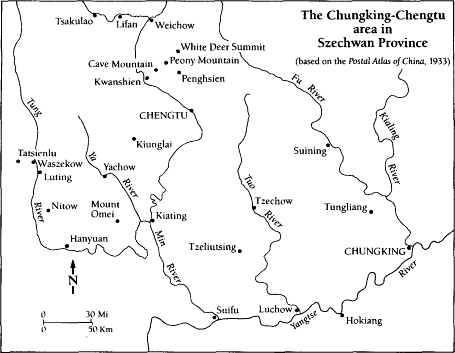
The Chungking-Chengtu area in Szechwan Province (based on the Postal Atlas of China, 1933)
seemed very changed. I looked at my husband, recently a great California athlete. Now he was pale and weak. The scrubby beard and mustache, the hollow eyes and pallor gave him the appearance of the so-called "lungers" who in my childhood used to flock to California in search of health. Most of them came too late and were soon in their graves. One of my maternal uncles, not knowing the sturdiness of the Service family, had criticized Bob's appearance before our marriage, saying that he was "too blonde and looked like a consumptive." Sometimes life seemed difficult, but fortunately I was not of a dependent nature.
Soon Bob showed real improvement. The Warburton Davidsons were preparing to set out overland to Chengtu to attend a Friends' Meeting early in May. It would be a great opportunity for us, and it was decided that we could join them. They were to stop for a weekend in the small town of Tungliang, which would provide a rest for Bob. Warburton and Hetty were famous overland travelers and had a well-developed procedure which their servants followed with meticulous care. They arranged every detail so that the trip would be as easy as possible for us. We appreciated this at the time, but did not understand its full import until later when managing our own overland travels. As Tungliang carriers were considered especially good for long trips, Warburton sent there for men. They were excellent bearers.
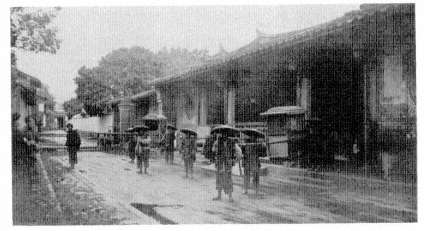
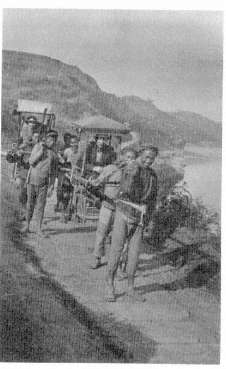
Hetty, Bob, and I rode in comfortable four-man closed sedan chairs of the old style. At that time practically no one used the "open chair," which is little more than a simple rattan chair mounted unenclosed between two poles. The old Chinese closed chairs were somewhat bulky, but they were also easy
9
These are "four-man closed sedan chairs of the old style" similar to those in
which Grace and Bob traveled from Chungking to Chengtu. The scene is the
Service front gate in Chengtu.
10
Later, foreigners came to prefer the less
claustrophobic "open chair." Theseare the
Heldes on the road in 1918 (see chapter 30).
for riding. They were made of bamboo and wood and had enveloping roof and sides covered with blue cloth. Curtains of green oilcloth were provided to keep out rain. There were also cloth curtains for privacy, and finely split bamboo sun blinds. The seats were hard bamboo slats, but there were straw-stuffed cushions for seat and back. In addition, one could fold a pugai to cushion both seat and back. Bob had a pugai and also a large pillow for his back. There was space under the seat for toilet articles: a wash basin, soap and towel, and perhaps a candle. A few other things could be stuffed in as well, perhaps some reading matter and a snack in a biscuit tin. Above, at the front of the chair's roof, there was usually a small shelf with a retaining edge which could hold some fruit or a book. Across the front of the chair, resting on ledges under the side windows, was a removable cloth-covered lapboard four to six inches wide on which one could rest a book or lean arms or elbows for relaxation.
This was the daily routine. Early in the morning, the servants saw to it that we had hot water betimes for face washing. Then the coolies came in and soon were taking down beds and mosquito nets, packing bedding and
cots, and stowing things in load baskets and sedan chairs. After this came our breakfast, and a hurried packing by servants of food supplies, dishes, and everything in the commissary department. We then started off, and some seven or eight miles would be traveled before the bearers stopped for their breakfast. By the time this halt was over, our cook and food baskets would have pushed on ahead, and after our next lap of travel we would stop to find the tiffin table ready for our noon meal. Hot water would be available for washing, and we would walk about a bit to rest our limbs before we sat down to eat. Then up again and off for the afternoons stretch, with several stops for the men to rest and smoke.
At the end of the day's stage we were welcomed by the cook, who had again forged ahead and found accommodation for us in what we fondly hoped was the best inn the town afforded. It might be a fairly new building or an old dilapidated place. In either case, dirt and smells were sure. Innkeepers always kept swine and for some reason preferred to build their pens near the guest rooms. We chose the best rooms available; the coolies set up cot beds, hung nets, filled kerosene lanterns, and got everything ready for the night. Meantime, the cook was fully occupied with preparing a complete meal. He usually bought meat, prepared soup, a meat or fowl dish, vegetables, and probably served tinned fruit for dessert. He also baked in the evenings and cooked porridge to be quickly heated for the next morning's breakfast.
After our evening meal we wrote a hasty letter or made entries in diaries while waiting for hot water for good sponge baths. This affair of a bath might have to be accomplished behind one's bed net, or perhaps even in total darkness, for a constant crowd of onlookers stood closely around us to watch every movement. In 1906 foreigners were still a vast novelty to the inland Chinese. Many people pressed tightly around us every time our chairs were set down. At meal times the cook often could hardly serve us for the pressure of humanity. We would politely ask them to stand back, but in no time they would stand again at our elbows, watching each mouthful we ate, trying to smell our bread, and exhibiting the curiosity of overgrown children. People followed us to our bedrooms, scrutinizing every move through doors and windows; and when these were closed, damp fingers on soft paper windows easily produced apertures for many an unblinking eye to continue close study of the foreign devils.
After we went to bed we often heard the cook at work in the courtyard. The aroma of baking bread mingled with the stale flavors of the stuffy inn rooms. You will have noticed from this description of overland sedan chair travel in those days that the cook played an important part. He could not loaf on his job very much; a good one was well worthy of the Szechwanese title of
dashifu , or "manager of important affairs." Usually, one gave the cook a two-man chair and made the food loads light so the kitchen could make quick time on the road.
Warburton, who was general of the expedition, rode a horse; this helped him keep close track of his caravan. At one time he would be in front, later riding by his wife's chair, then joking with Bob and pointing out some new sight to us. His care in rounding up straggling carriers made the journey go smoothly, for of course each night must see all our loads safely in the inn where we lodged.[2]
Our weekend stop in Tungliang was spent in the home of two fine English people of the Friends' Mission. Their house was a simple one, semi-Chinese, and with a rare and charming hospitality. Here in Tungliang we saw hundreds of Chinese gather for meetings addressed by the foreign missionaries, and we could feel something of the influence that our host and his wife were exerting.
As Bob had stood the trip well so far, we went on toward Chengtu. We broke the journey by stopping for a day at Tzechow, where we stayed in the home of the Manlys of the American Methodist Mission. They gave us a warm welcome, and plenty of freshly prepared food supplies for the remaining four days. of our trip. The spring weather was delightful for most of our journey, though enough rain fell to show us the disadvantage of chair travel in a downpour. Rain in China often seems to attack from all directions and to descend with a force we never expect elsewhere. The early mornings were lovely in the pearly mists of the little valleys between the hills. We watched with interest the farmers go into their fields and plod about their work. On market days, the roads were long lines of blue-clad figures with shoulder poles, taking vegetables, fowls, or other farm produce to the village of that day's trade.
At last we crossed the Lungchuanyi hills. Spread before us was the Chengtu plain, the rich, verdant heart of Szechwan's great Red Basin. Soon we saw the massive walls of Chengtu rising beyond paddy fields. Then we were in the long, winding street of the suburb outside the East Gate.[3]
[2] After a spartan introduction to missionary accommodations at Ichang, Grace had good luck on this stage. If my memory is correct, the Davidsons were in the small but fortunate minority of missionaries who were not wholly dependent on what their missions were able to provide. Certainly this overland travel seems a bit more "first class" than the usual Service family travel that I remember in later years. The general organization and daily routine were similar, but some things were different. For one thing, we usually ate Chinese food, prepared by our own cook, which we boys thought was great. Also, I don't recall the emphasis on the daily sponge bath. In fact, we considered overland travel to be a great lark.
[3] The distance from Chungking to Chengtu by the road they traveled was about 250 miles. Normal travel time was ten days. With a weekend stop at Tungliang and a day at Tzechow, they probably took twelve or thirteen days.