
A Pelaecista Postscript
It will appear odd to the reader that Manuel Peláez came in out of the cold for Alvaro Obregón. After all, back in 1915, Obregón had defeated his ally, Pancho Villa, upon whom Peláez had relied to gain the local autonomy that he and his serrano constituents had desired. The hero of Celaya had also been present, though not
actually a constituyente, at the Constitutional convention that wrote Article 27. Obregón supported the 1917 Constitution, while Peláez still advocated the 1857 model. Of course, if Peláez had really been the puppet of the oil companies, he would not have submitted to Obregón at all. Just what did Peláez expect to gain from this new national leader in 1920? Local autonomy. The agreement under which the cabecilla of the Huasteca joined the Plan of Agua Prieta was his appointment as military commander in the oil zone. Peláez had expected that such a position would make him the supreme political arbiter of the region stretching from Tampico to Furbero. And he was willing to give up all his other cherished, though shallow, political ideals to get it. Thus, in a meeting in mid-May with Alvaro Obregón, Peláez accepted the latter's national program in exchange for Obregón's (perhaps reluctant) confirmation of Peláez as zone commander. Peláez had apparently really desired the governorship of Veracruz — like his old rival, Cándido Aguilar.[150] But he did not get it.
It cannot be said that Peláez was an ardent obregonista. Even before he traveled to meet Obregón in mid-June 1920, he had voiced reservations about the new regime's "radicalism," which he defined not in terms of its positions on labor and agrarian reform and on economic nationalism but in terms of the appointment of non-pelaecista public officials in Tampico and Tuxpan.[151] Already, the zone commander was feeling some constraints on his cherished autonomy. Well he might. Unflattering articles soon began to appear in the nation's newspapers about the money that Peláez had received from the oil companies during his days as a rebel in the Huasteca. The news stories made him appear a venal tool of the foreign interests.[152] Some persons in high places wanted Peláez out of the way. In September 1920, after having faithfully collected for the government the oil taxes at the old carrancista levels, General Peláez took leave of his position. He traveled to San Antonio and Los Angeles for the standard political reason: he needed to seek medical attention for an old war wound. He remained in the United States and was feted everywhere he went. Chicago hailed Peláez as "the man who saved the oil industry in Mexico."
Manuel Peláez was not yet discredited with the new regime, but another serrano rebellion among his former followers finally vaulted him over the pale. In July 1921, Gen. Daniel Martínez Herrera revolted against the Obregón government in the old pelaecista districts around the Potrero del Llano. Obregón ordered Peláez from the United States to Mexico City, where the latter repudiated the rebellion, which had
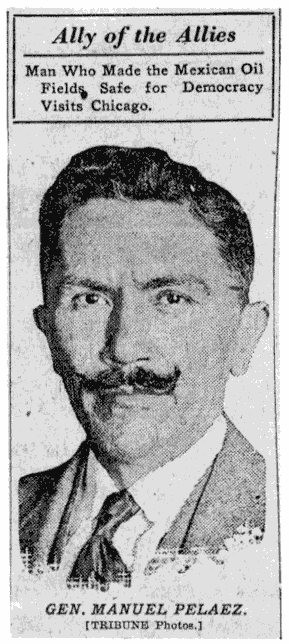
Fig. 13.
General Peláez, 1921. This photo of the cabecilla
of the Huasteca Veracruzana appeared in the
Chicago Tribune while Peláez toured the United
States after another of his periodic retirements. His
reputation was greater in the United States than in
Mexico, judging from the Tribune's caption. from
the Albert B. Fall Collection, courtesy of the
Huntington Library, San Marino, California.
embarrassingly invoked his name. Peláez told Mexican journalists that Huasteca's William Green was behind the rebellion, apparently settling a grudge with an old antagonist in the oil industry. Back in the Huasteca, after a brief flurry of taking supplies and money from The Texas Company and the International Petroleum Company, the small rebel force was quickly surrounded by loyal troops under Gen. Arnulfo Gómez. Martinez Herrera gave up, but the harm was done. No one in the Obregón regime would trust Peláez any longer as a military commander. Peláez found it expedient to head back to the United States for additional medical treatment. Obregón's agents tailed him throughout what amounted to a political exile. They linked him with a number of plots with other revolutionary castoffs. Subsequently, Peláez returned at a most inauspicious time — or perhaps he had planned it that way. Peláez moved back to his hacienda at Tierra Amarilla in time for the antigovernment rebellion of Adolfo de la Huerta in December 1923. The government forces immediately imprisoned Peláez, first in Tampico and then in Mexico City. As fate would have it, Carranza's assassin found rehabilitation in the De la Huerta revolt. Rodolfo Herrera, who had lost his military commission after killing the former president, regained his rank and pension by retaking Papantla for the government. With the rebellion subdued, Peláez gained his freedom, retiring to Tierra Amarilla and surviving into his seventies.[153] By the time he died, in 1959, the oil industry had passed from the hands of the foreign interests to the national government. But the Huasteca Veracruzana endured, and so did the dominant families of Spanish heritage that he had represented in his rebellion. Who can say that Peláez lost his struggle?