
Latium Volcanoes of Italy
The Latium Volcanoes of central-western Italy are a 340-km-long, northwest-trending line of volcanic fields that extends from the Alban Hills near Rome to Bolsena Lake 180 km northeast of Rome (see Fig. 2.49). These fields consist of multiple small vents, including cinder cones, tuff rings, and calderas (De Rita et al ., 1983). Lavas and tuffs are alkalic and consist of trachytes, phonolites, and leucitites that are usually <1 million years old. The Latium volcanic chain is parallel to grabens that were active until mid-Pliocene time (Barberi et al ., 1984). The volcanic fields overlie Triassic and Eocene carbonate rocks, Lower Cretaceous to Eocene flysch deposits, and Miocene to mid-Pliocene clastic rocks. The carbonate rocks have high permeabilities; they served as excellent aquifers that supplied water for large phreatomagmatic eruptions, and now, in several fields, these rocks act as hydrothermal reservoirs. Calderas of the Latium Province were mostly phreatomagmatic; many have low, broad profiles in which the outer slopes are 1 to 1.5°. The thin, extensive ignimbrites surrounding the calderas are made up of fine-grained, nonwelded tuffs. Numerous surge deposits are interbedded with the ignimbrites. Phreatomagmatic eruptions during caldera formation and postcaldera activity within these young calderas is a good indication of the presence of hydrothermal systems.
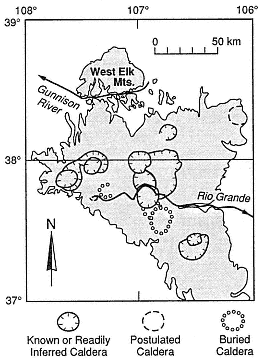
Fig. 4.16
Calderas of the San Juan volcanic field in
Colorado, showing overlap and clustering of
calderas. For every caldera, there is a large-
volume sequence of ignimbrites within
and surrounding it.
(Adapted from Steven et al ., 1974.)
Latera Volcanic Complex
The Latera complex, consisting of a 10- by 8-km caldera that is oriented north-northeast to south-southwest, lies adjacent to the much larger Bolsena Lake, which may also be a caldera. The complex's oldest volcanic rocks are between 0.9 and 0.4 Ma (Barberi et al ., 1984). Sparks (1975) felt that both Latera and Bolsena are calderas because of their shapes and their association with nine major and six smaller ignimbrites.
At Latera, the most voluminous pyroclastic flows were erupted 0.4 million years ago. It is possible there were multiple collapses of the caldera; this theory is consistent with the presence of multiple ignimbrite units that range from 0.3 to 0.15 Ma. Figure 4.18 shows
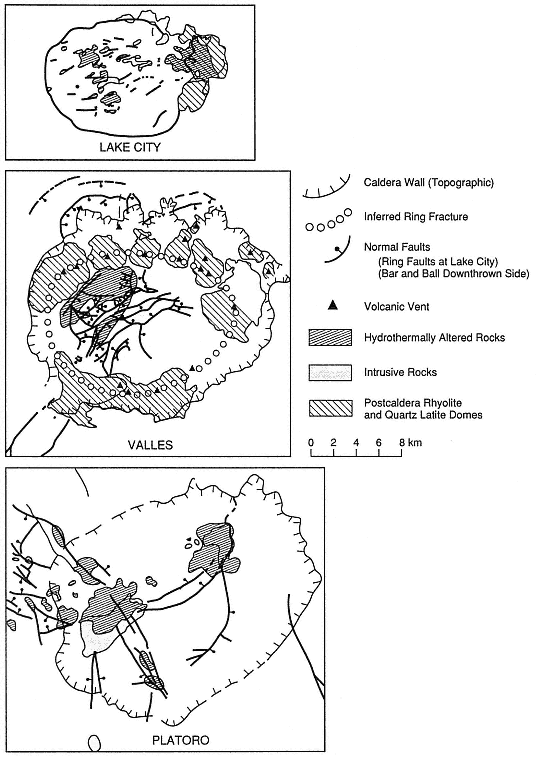
Fig. 4.17
Comparison of a young caldera (Valles/Toledo), its active hydrothermal systems, and its surface acid
alteration zones with two older, eroded calderas (Platoro and Lake City in Colorado), their intrusions,
and zones of hydrothermal alteration. In all three calderas, most of the hydrothermal activity has
taken place along faults within caldera-fill deposits and above lobes of an intrusion.
(Adapted from Smith et al . 1970, Dondanville, 1978, and Lipman 1975; 1976b.)
the pyroclastic rock sequences exposed on the flanks of Latera; the sequences consist of interbedded surge deposits and massive pyroclastic flow deposits that include lag breccias. These tuffs are composed of very fine grained ash, which is now altered to clays, zeolites, and iron oxides. The vesiculated tuffs and abundant accretionary lapilli present are all indicators of phreatomagmatic activity. Lithic clasts within the tuffs include metamorphosed mudstones (flysch), trachyte, marble, and tephrite.
Strombolian and Vulcanian eruptions followed caldera collapse within and along the caldera margins. D. De Rita (personal communication, 1985) indicated that Latium volcanoes with a history of phreatomagmatic volcanism during caldera formation followed by magmatic volcanism (in this case, Strombolian activity that formed cinder cones) eventually develop hydrothermal systems of the greatest geothermal resource potential. Intensive hydraulic fracturing may accompany phreatomagmatic eruptions when the main source of fluid is groundwater (see discussions in Chapter 2). This activity creates a large-volume system of fractures that, when associated with a thermal source, can become a hydrothermal system.
To test the observations described above, 14 geothermal wells had been drilled into Latera caldera, one of the Latium volcanoes, by 1985. Latera caldera deposits, which range from 250 to 1500 m thick, consist of coarse tuff-breccias and interbedded pyroclastic rocks and lavas (perhaps megabreccias). The caldera is filled with mostly pyroclastic material erupted during the first caldera-forming activity, as is depicted in Fig. 4.19. The caldera tuffs contain up to 50% basement lithic clasts (flysch). Several geothermal wells have been drilled into the carbonate sequence along a structural high located on the eastern caldera margin. Barberi et al . (1984) reported that they encountered a syenite intrusion—potassium-argon data indicate that it is ~0.86 Ma—close to the caldera center, at depths of between 2000 and 2700 m. This intrusion into carbonates underlying the caldera is marked by a thermometamorphic aureole that contains garnet, idocrase, diopside, and phologopite. The thermally metamorphosed rocks are strongly fractured, and the fractures are partly filled with anhydrite, calcite, epidote, and hydrogarnet.
Of the 14 wells drilled in the Latera caldera, 9 are producing hot water and steam from limestone reservoirs and fractures in the overlying flysch units. The temperature is 150°C at a depth of 1 km, and 210 to 240°C at depths of 2 to 3 km. The production wells are located primarily within the area of youngest caldera collapse where basement rocks are highly fractured.
Baccano Caldera
Baccano caldera is one of several calderas, cones, and maar volcanoes of the Sabitini volcanic complex, which has developed within a graben. Figure 4.20 shows the concentric normal faults that bound a low depression 4 km in diameter. Baccano may be located within the older Sacrofano caldera. The eruption and accompanying collapse of the Baccano caldera occurred, perhaps in stages, during multiple hydromagmatic events between 0.36 and 0.08 Ma. Most of this activity was phreatomagmatic; the water was probably supplied from aquifers in limestones underlying the caldera or from nearby Lake Bracciano.
Ignimbrites and surge deposits are exposed on the caldera rim and outer slopes, where they overlie an 85,000-year-old travertine deposit. The ignimbrites consist of small pumice clasts with accretionary coats of fine ash in a matrix of very fine ash. The surge deposits are rich in mineral clasts and subrounded lithic clasts (phonolitic lava, mudstone, and limestone). All of the pyroclastic deposits are partly altered to clays.
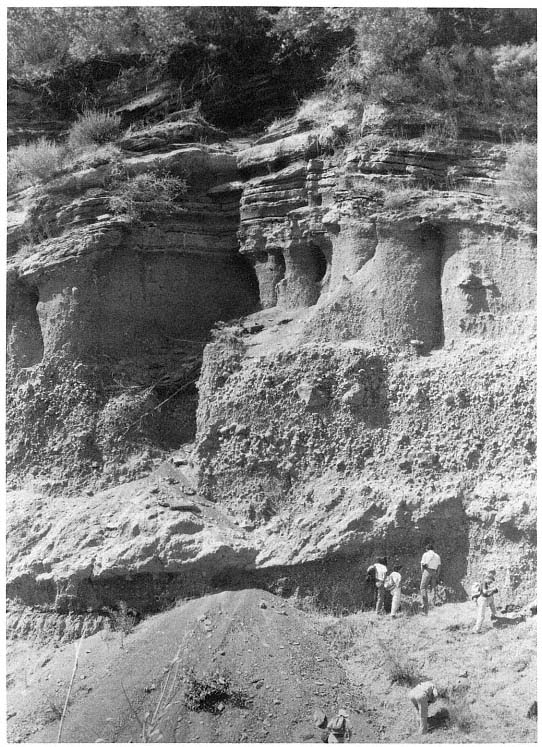
Fig. 4.18
Photograph of the pyroclastic sequence along the flanks of Latera Volcano in Italy, which consists of
interbedded scoria fall, surge, and ignimbrite deposits. The outcrop, along Poggio della Valicella,
follows the western shore of Bolsena Lake.
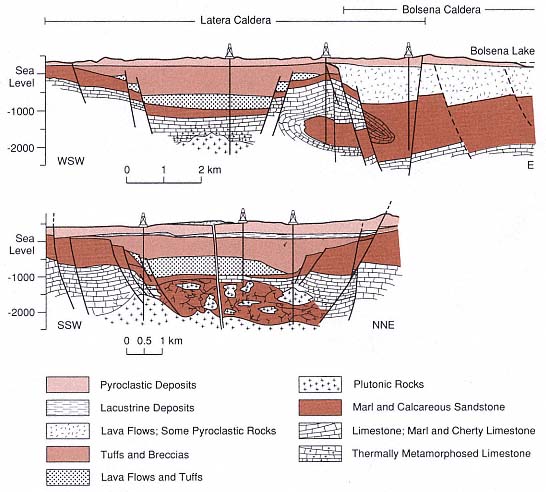
Fig. 4.19
Interpretative cross sections of the Latera and Bolsena calderas in Italy. The caldera-forming
eruptions of these calderas had a large phreatomagmatic component as a result of magmas
interacting with groundwater within permeable limestone units underlying the volcanic field. The main
hydrothermal reservoirs are located within the sedimentary rocks (mostly limestones) beneath
Latera caldera and along one margin within a horst. Cross sections are based upon geologic mapping,
geophysical surveys, and drilling samples. The magma body that provides heat to the hydrothermal
system was intersected by drilling below the center of Latera caldera.
(Adapted from Barberi et al ., 1984.)
Four geothermal wells (C-1 to C-4), with depths of 1400 to 3000 m, have been drilled within the Baccano caldera (Funiciello et al ., 1979). Temperatures of 300°C were measured in drillholes at depths of 3 km. Underlying the caldera are shales, marls, sandstones, and limestones of Middle Cretaceous age; Miocene flysch deposits; Upper Triassic to Oligocene carbonates, including marls, limestones and interbedded chert; and Triassic black limestone. The main hydrothermal reservoir is located in fractured carbonate rocks under a cap of the shaly rocks of the argille scagliose (a thick sheet of chaotic, slickensided clays that was displaced along low angle faults). The reservoir
consists of mixed hydrothermal fluids and shallower groundwater within the caldera deposits (Calamai et al ., 1976).