
Lanoy, Missa Fragment, SPB80, Folios 21-25
The Lanoy Sanctus and Agnus originally belonged to one of the most modem Masses in the manuscript. Truncated when two fascicles of SPB80 were removed, these movements are now sandwiched in between the partial copy of Du Fay's Missa Ave regina coelorum and his motet Ave regina coelorum . Along with the complete Kyrie, Gloria, and Credo, the excised folios also must have contained the missing superius of the Sanctus and Pleni. All three voices survive for the
[1] Speciálník has only the Credo and Sanctus movements (on fols. b7v-b11r; or pp. 48-55). The concordance of the anonymous Sanctus in SPB80 with the attribution in Speciálník was found by Bob Mitchell. I would like to thank Rob Wegman for this information and for graciously providing me with a transcription of the Credo.
Osanna, Benedictus, and entire Agnus. From these sections and those in Speciálník, it is clear that the Mass—with a g final and a two-flat signature in all voices[2] —was not based on a cantus firmus in the tenor, nor does it appear to have had a motto.
Certain stylistic traits of the Mass, as noticed by Rob Wegman, resemble another work copied in the 1470s, the Missa Quinti toni by Ockeghem.[3] The Missa Quinti toni also has no cantus firmus, although, unlike the SPB80 Missa , it does have a perfunctory motto in the bass, consisting of three triadic descending notes,


Wegman's valuable observations not withstanding, Martini exercised a much greater influence over Lanoy than did Ockeghem. To begin with a few random observations, neither of Ockeghem's three-voice Masses, and neither of his Masses in


[2] The tenor occasionally has only one flat.
[3] Rob Wegman, "An Anonymous Twin of Johannes Ockeghem's Missa Quinti toni in San Pietro B 80." This article includes a transcription of the surviving parts. The Missa Quinti toni was copied into Br5557 between 1476 and 1480 (Rob Wegman, "New Data concerning the Origins and Chronology of Brussels, Koninklijke Bibliotheek, Manuscript 5557," 14).
[4] On this basis Wegman argued not only that these Masses were paired as "twins" but also that Ockeghem is the most probable composer (Wegman, "An Anonymous Twin," 25-48).
Benedictus in coloration, nor with the dotted rhythmic pattern which in this Mass begins both the Benedictus and the Osanna. He prefers longas and breves. This opening rhythm is perhaps most typical of chansons by Hayne, but Martini was also familiar with it, using it both in chansons and Mass movements.
The Agnus II violates many stylistic norms for Ockeghem's settings of this text. In no Agnus II in


But the most striking differences with Ockeghem's style are in the cadences. The cadential patterns of the Missa differ from Ockeghem's in their counterpoint, their much greater frequency, and the regularity with which they occur on the final. Taking the last point first, the Missa clearly demonstrates the hand of another composer at the penultimate cadence of each section. They occur much closer to the final cadence than one finds in Ockeghem, and they are invariably on the final. Just as predictably Ockeghem will turn to another scale degree, often the fifth. The strong emphasis of the final in the Missa extends to the last three cadences of the Agnus I and III and the last four of the Benedictus. The greater tonal feel of the composer of this Missa marks him as a younger man than Ockeghem. Indeed, some of the unconventional cadential counterpoint indicates a youthful inexperience with a three-voiced texture. In the comparison of cadences in Example 39, the un-Ockeghemian leaps away from the final stand for the Missa , and the elegant, graceful, and unsurpassed ability to suggest closure without resorting to a suspension cadence represents the Missa Quinti toni . Martini was quite capable of the former, as a cadence from Il est tousjours (Ex. 39c) attests.
In the absence of a cantus firmus or a unifying motto, this Mass is
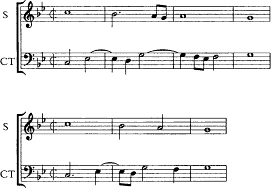
EXAMPLE 39. Comparison of cadences by Lanoy, Ockeghem, and Martini: (a) Lanoy, Missa (SPB80, fols. 21-25), Osanna, mm. 3-5, and Agnus III, mm. 21-22; (b) Ockeghem, Missa Quinti toni , Agnus I, mm. 42-45; and (c) Martini, Il est tousjours , mm. 27-28
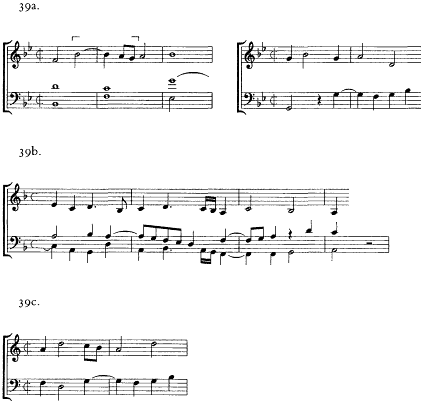
unusually chansonlike in the details of its counterpoint. Several contrapuntal and melodic passages in the Mass can be found almost note for note in two chansons by Martini. Very much like both Hayne and Martini is one particular postcadential syncopated figure in the Agnus I. Hayne had used it in De tous bien plaine after the cadence marking the end of the first phrase. In the Agnus I it also comes after the first phrase, accompanied in parallel tenths (Ex. 40), which is exactly the
EXAMPLE 40. Comparison of postcadential phrases in (a) Lanoy, Missa , Agnus I, mm. 4-8; and (b) Martini, Tousjours bien , mm. 9-14 (transposed down a major second)
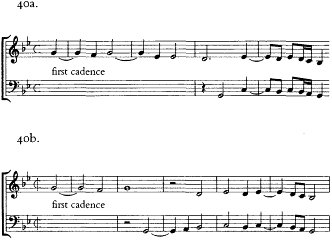
way we find it in Martini's Tousjours bien (here transposed down a major second).[5] This chanson and the Missa share another contrapuntal segment, a point of imitation that commences with a cadential suspension (Ex. 41). Once again I have transposed the chanson.[6] While the motivic and imitative use of suspensions exists in the works of most contemporaries of Busnois, it is only one hallmark of Martini's style present in this work.
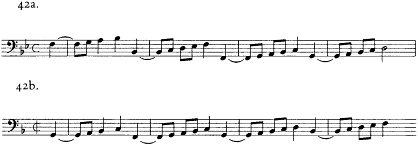
Hayne may ultimately be the stylistic inspiration for another phrase in the Agnus I, but this rising sequential figure also turns up in a Martini chanson, the (presumably) instrumental Fuge la morie (Ex. 42). Further, two of the recurring bass motives in Fuge la morie appear in the Missa . The head motive of the chanson and the beginning tenor motive of the triple meter section in the Agnus II are closely related (Ex. 43). Then, after three statements of this idea in Fuge la morie , the bass takes up a second motive (mm. 15-18), which begins the Agnus II
[5] This figure also appears in Martini's Se mai il cielo e fati fur benigni (Flor229, no. 5), mm. 34-37.
[6] See also Martini, Malheur me bat (Flor229, no. 11), mm. 38-42.
EXAMPLE 41. Comparison of counterpoint in (a) Lanoy, Missa , Agnus II, mm. 13-17; and (b) Martini, Tousjours bien , mm. 19-23
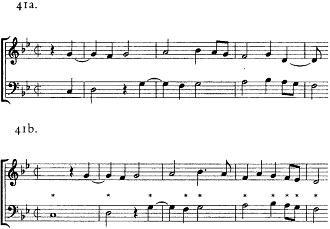
EXAMPLE 42. Comparison of sequential figures in (a) Lanoy, Missa , Agnus I, mm. 27-31; and (b) Martini, Fuge la morie , mm. 44-48 (rebarred)
EXAMPLE 43. Motivic comparison of (a) Lanoy, Missa , Agnus II, mm. 36-40; and (b) Martini, Fuge la morie , mm. 1-3
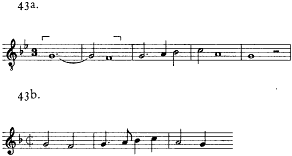
EXAMPLE 44. Motivic comparison of Lanoy, Missa, and Martini, Fuge la morie
EXAMPLE 44A . Lanoy, Agnus II, mm. 1-3

EXAMPLE 44B . Lanoy, Benedictus, mm. 31-34
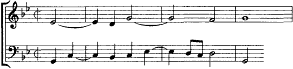
EXAMPLE 44C . Martini, Fuge la morie , mm. 15-18
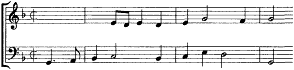
and also appears in the Benedictus (mm. 31-34) with a similar contrapuntal treatment (Ex. 44).[7]
In one imitative passage Lanoy quotes directly from his popular chanson, Cela sans plus , but here too the imprint of Martini is visible. In the Benedictus the second entrance of the superius is quickly answered by the tenor. These voices cite the second phrase of the chanson (Ex. 45a). Contrapuntal citations were not limited to the begin-
[7] The title Fuge la morie occurs in the Ferrarese source Rome 2586, while in the later Spanish source, Segovia (fol. 189v), it is called Scoen vint . Jacobus Barle, about whom nothing is known, wrote what appears to be a parody of Fuge la morie in his presumably instrumental work Moyses . It appears in Segovia with that title on fol. 191, two folios after Fuge la morie .
EXAMPLE 45. Motivic comparison of Lanoy, Missa ; Lanoy, Cela sans plus ; and Martini, contra for Cela sans plus
EXAMPLE 45A . (i) Lanoy, Missa , Benedictus, mm. 11-16 (superius and tenor); (ii) Lanoy, Cela sans plus , mm. 7-12 (superius and tenor)
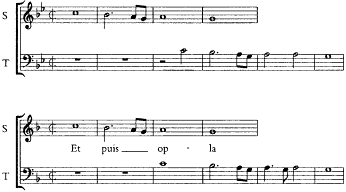
EXAMPLE 45B . (i) Lanoy, Missa , Benedictus, mm. 11-16 (superius and contra); (ii) Martini, contra for Cela sans plus , mm. 1-3 (transposed from G)
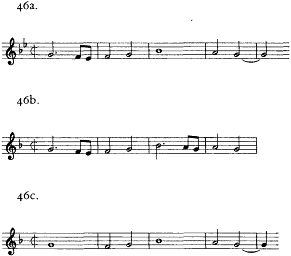
EXAMPLE 46. Motivic comparison of (a) Lanoy, Missa , Benedictus, mm. 1-5; (b) Martini, La martinella (Rome 2856, fol. 138v), mm. 1-5; and (c) Martini, La martinella (Rome 2856, fol. 55v), mm. 1-5
nings of chansons or to the start of the second parts any more than were tenor citations. Thus Richafort quoted in his Requiem both music and text from an interior phrase of Josquin's Faulte d'argent (at "c'est douleur non pareille"), and Du Fay in his Missa Ave regina coelorum quoted the end of his motet.[8] Interestingly, Martini made his own arrangements of Lanoy's chanson. In Rome 2856 Cela sans plus appears with a si placet bass part attributed to Martini. The opening bass counterpoint is also present in the Mass (Ex. 45b). Martini cared enough for this chanson—or its composer—to base an entire Mass on it (as did also Obrecht).
A final motivic detail: The Benedictus and Patrem begin with a melodic turn that resembles closely the opening motive of a few of Martini's Martinella compositions (Ex. 46). It is true that one can find this turn in works of Busnois, Josquin, and others. But given the com-
[8] On the former, see Alejandro E. Planchart, "Parts with Words and without Words: The Evidence for Multiple Texts in Fifteenth-Century Masses," 251; and Paul Kast, "Jean Richafort," cols. 439-43.
pelling similarities already noted and Martini's penchant for this motive, the prominent use of this particular figure as an opening motive further points to Martini as the composer whose style exerted a formative influence over this three-voice Missa . Indeed, were it not for the Speciálník attribution, the many passages related to Martini's chansons would suggest that these movements constitute the tail end of a Mass by Martini, perhaps another Missa La Martinella .[9]
Even if Martini was not the composer, he could not have been far away when it was composed. Just as Martini's influence on the creation of this Mass may be deduced from the many stylistic similarities, so too is his probable connection with it after its composition, indicated by the presence of the Mass in the first fascicles of SPB80, which contains the very repertoire that Martini is presumed to have brought to Rome from Ferrara in 1473.[10] In later years Martini and Lanoy evidently knew each other well. Lanoy was in Ferrara in March 1491. That is when illness delayed his trip from Ferrara to the Mantuan court of Isabella d'Este; by mid-October he had left Mantua without permission in the company of a singer named Alexander. Indeed, on 1 October both Lanoy and Alexander Agricola had joined the choir at the Annunziata in Florence, Karolus as a singer of the San Giovanni chapel. "Launoy" settled in Florence and married the Florentine sister-in-law of Heinrich Isaac. Earlier Martini and Lanoy may have met in Milan. "Launoy" is listed among those departing from Milan in February 1477. The length of his service in Milan cannot be determined because no other references to him there are known.[11] But these encounters are too late for Martini to have had possession of this work by early 1473. What little is known about the two musicians before this does not place them in close proximity: In 1472 Lanoy served as a
[9] There is a three-voice Mass by Martini in Ver759, the Missa In Feuers Hitz on fols. 15v-20 (J. Peter Burkholder, "Johannes Martini and the Imitation Mass of the Late Fifteenth Century," 485-86).
[10] See chapter 4, pp. 97-98.
[11] See Prizer, Courtly Pastimes: The Frottole of Marchetto Cara , 6-7, 10-11; Frank D'Accone, "The Singers of San Giovanni in Florence during the Fifteenth Century," 344; Lowinsky, "Ascanio Sforza's Life: A Key to Josquin's Biography and an Aid to the Chronology of His Works," 40-41; and the note and bibliography in Howard M. Brown, A Florentine Chansonnier from the Time of Lorenzo the Magnificent: Florence, Biblioteca Nazionale Centrale MS Banco Rari 229 , text vol., p. 50, nn. 54 and 55.
choirboy under Basiron at Bourges, and Martini is presumed to have worked in Constance by December 1471.[12]