
PART TWO—
LIVING IN A NEW LAND
Chapter III—
Material Culture:
Settling the Calapooia Foothills
When immigrants from the Midwest and the upper South came into the Oregon Country in the early 1840s, it was not an untouched wilderness. Native peoples had made it their home for millennia, shaping its environment through their cultural practices. In addition, the Oregon Country had been the scene of European and American activities for a number of years: explorers had probed its shores and interior beginning in the 1500s; trappers had exploited the fur-bearing animals by sea since the 1780s and by land since 1809; and by 1840 the British Hudson's Bay Company's properties in the Pacific Northwest included several trading posts in the western and eastern portions of the region, the Fort Vancouver headquarters, and the Puget's Sound Agricultural Company.[1]
The timing of the earliest permanent settlement in the Willamette Valley is disputable. Some evidence suggests that retired trappers may have resided there as early as the later 1810s. But the best evidence indicates a more likely date of the mid 1820s. By 1831-32, at least three permanent farms existed in the northern Willamette Valley. In October 1838 the Willamette's Euro-American population included fifty-seven adult males: twenty-three French-Canadians, eighteen American settlers, and sixteen clergy and laymen connected with Jason Lee's Methodist Mission. The first large-scale overland emigrant party to the Willamette arrived in 1842. That group consisted of between 105 and 140 new settlers. The "Great Migration" of 1843 brought between seven hundred and one thousand more to the valley. By September 1845 the
Willamette settlement population had reached five to six thousand, with French-Canadians and other British subjects totaling no more than twelve hundred.[2]
Until 1844, new settlers of the Oregon Country followed the pattern of their predecessors and located in the northern portion of the Willamette Valley. In that year, though, about a decade and a half after permanent settlement commenced in the northern valley and only one year after large-scale settlement began in the Willamette, immigrant John Packwood crossed the Santiam River, sixty miles south of the Willamette Falls, and became the first Euro-American to settle permanently in the southern Willamette Valley, in what became Linn County (map 1). A year later Isaac Hutchens became the first to settle on the Calapooia, though he did not remain. The lateness of settlement in the southern as compared to the northern part of the Willamette Valley is best revealed in the population distribution of 1850, the first year the United States government conducted a census there. In that year the three northern Willamette Valley counties, Clackamas, Yamhill, and Washington, had a population of 6,023. The two midvalley counties, Polk and Marion, provided homes to 3,800 settlers, while the two physically larger southern valley counties, Benton and Linn, at that time had a population of only 1,808.[3]
The exigencies of the local landscape, along with settlers' habits from life in the Midwest and upper South, influenced settlement patterns in, and material culture responses to, the Willamette Valley environment during initial years of occupation. During settlement, the early Willamette Valley immigrants came in contact with a new land, discovered its idiosyncrasies, and learned to accommodate themselves to it, but they also changed it in significant ways in the hopes of making it better satisfy their own needs. In this process, both the settlers and the landscape worked on each other and produced a new western Oregon culture that differed subtly from the Ohio Valley culture and that also resulted in tremendous environmental change in the Willamette Valley.
Historically, culturally, and environmentally, the small tributary Calapooia Valley is in many ways a microcosm of the Willamette. This and the following chapters use that microcosm to examine in detail the collective pioneer experience on the western Oregon landscape. These chapters demonstrate that, on the level of material culture and in the realm of the mind, the relationship between the Euro-American settler and the wilderness environment can be described only as complex.[4]
The Calapooia Landscape
The Calapooia River, little more than a stream, rises in the western Cascades and tumbles down a narrow, forested canyon in a northwesterly course for about twenty-five miles before flowing out onto the level plains of the lower Calapooia Valley. In its canyon the river winds its way around foothills that rise above the level, narrow valley—not more than a mile wide—for about six miles. One small but important stream, Brush Creek, joins the river before it cascades down a waterfall of less than ten feet in height and enters the wider—up to three miles—lower valley of the Calapooia, still surrounded by foothills reaching fifteen hundred feet in elevation. For another six miles the Calapooia hugs the foothills along the northern wall of its little canyon, and then the river finally flows out onto the floor of the Willamette Valley; trending in a north-northwesterly direction, it winds its way sluggishly through numerous oxbows for thirty-one miles to its confluence with the Willamette. Over this distance it drops only 145 feet, or roughly five feet per mile.
During the winter of 1852–53, six years after permanent settlement began in the Calapooia Valley, federally hired surveyors came to the locale to fix township, range, and section lines. Their detailed notebooks make it possible to reconstruct the early geographic and vegetative landscape of the Calapooia (map 2). The surveyor described the southern wall of the Calapooia as "high broken hills & mountains with numerous deep ravines and rocky ridges timbered principally with fir with a thick und[er]gr[owth] of hazel vine maple wild cherry fern & briars." The hills to the north of the river, with a southern exposure, he reported as drier and less densely forested. They were "covered with scattering" of oak, fir, and pine and produced "a fine quality grass."[5] At the western terminus of the small Calapooia Valley, its prairies mingle with the Willamette's. At this point, the foothills of the Cascade mountains continue to the north until broken by the South Santiam River valley. From the south side of the Calapooia Valley's mouth, foothills, now known as the Coburg Hills, stretch southward in a high, unbroken chain to the McKenzie River.
When settlers first arrived in the Calapooia Valley, its floor, from its eastern extension to its opening onto the Willamette, consisted principally of open prairie with a scattering of ash and oak trees. The ash thrived in thickets and low-lying swales while the oaks grew either as
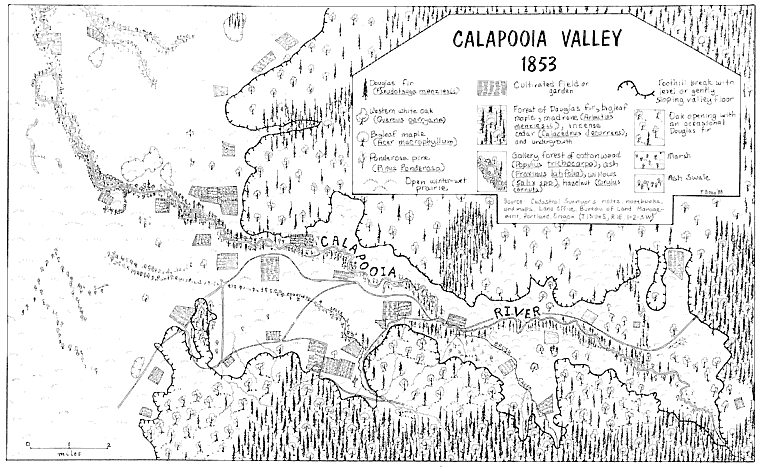
Map 2.
The Calapooia Valley, 1853.
solitary giants on the prairie or in the form of savanna or oak groves. The eastern portion of the Calapooia, through which Brush Creek flows, was more heavily forested with oaks than was the western portion adjoining the Willamette Valley, which the surveyor described as having a "scarcity of timber." The prairies of the Calapooia and adjoining Willamette Valley he noted as "level . . . with a rich soil of clay loam which produces an abundance of superior quality grass. The prairie being nearly level is very wet in the rainy season." Surveyors described lower Brush Creek as either marshy or simply a swamp. Courtney Creek, a slightly smaller brook in the western portion of the Calapooia, typified the valley's "several small streams that head in the mountains but sink on reaching the prairie." Along the Calapooia River, bottomland ranged from one-fourth to one-half mile in width and was "subject to inundation to the depth of 5 or 6 feet & is well timbered with fir maple ash & balm [cottonwood] undgr[owth] hazel vinemaple & briars." The river's characteristics varied from one end of the valley to the other. In the eastern portion it reached only fifty-five links (about thirty-six feet) in width and in the west one hundred links (sixty-six feet). Its current was described as rapid throughout its length in the Calapooia Valley proper.
In 1846 the first Euro-American settlers permanently located at the base of the hills and mountains on the banks of the Calapooia. They did so at a time in American history when, according to the landscape architect John R. Stilgoe, steam, iron, and a developed market economy, as well as new systems of organization inherent in the industrial revolution, were effectively changing the relationship between people and the land in some parts of the country.[6] On the Calapooia, still newly settled and relatively distant from the influences of the industrial revolution, early settlers experienced a time lag of a few years during which they had few intermediaries, such as a developed market economy and industrial systems, to distance them from the land. Rather, during the initial years of contact, settlers related directly to the land and acquired an intimate understanding of its physical configuration and idiosyncrasies as they molded a midwestern and upper southern culture to it. While settlers had to contend with natural catastrophe and components of the landscape that they never could accept, they also, through their daily activities, developed a positive relationship with their new landscape.[7]
Early Life and Culture on the Calapooia Landscape, 1846–60
After traversing the Oregon Trail during the late spring, summer, and early fall, immigrants to the Oregon Country generally arrived in the Willamette Valley just as the wet season began. Sometimes they immediately continued south to find a new home, as did Benjamin Freeland, who came to the Calapooia in 1853–54: "We was six months in Crossing the plains and after we got in the Valle we started up the Valle and to look for a home we traveled slow we would stop and look and we traveled over one hundred mieles till we Crost the Calapooya river and on the Calapooya we found A Clame and bought it which we paid fore yoak of oxen. Claims is skerse." Other settlers wintered in the north near Oregon City and then headed south in the spring to choose a claim that they could immediately begin to work. For instance, although John Courtney's family arrived in Oregon in autumn 1845, they reached the Calapooia only the following spring.[8]
In the winter of 1852–53, after completing the first survey of the township that extends from the mouth of the Calapooia Valley out onto the Willamette's prairies, the federal surveyor wrote a brief description of the area he had just traversed. In his notes he captured the essence of the Calapooia's early settlement pattern: "township contains about 20 settlers principally along the hills on the Eastern side and on the Calapooia on the Northern side. . . . The prairie part of the township is principally vacant owing to the scarcity of timber and the wet state of the land in the winter."[9]
Examples abound of settlers' determination to avoid the Willamette's winter-wet plains in preference for the foothills that bordered smaller valleys such as the Calapooia. Before resorting to the better-drained hills of the Calapooia, John Wigle's family attempted to make a go of it on the open prairies of the Willamette. But they soon gave up that notion when, within a few days of their arrival in the winter of 1852, they experienced, in the words of Wigle, "an Oregon rain with [a] continuous blow for three days and nights." In no time their "little log house" and "the low ground" nearby "was flooded and we were anything but jubilant." John Grath Bramwell remarked in later years that "before drainage ditches were opened the whole valley was like a swamp. The streams, many of them, had no definite channels but spread
out over the floor of the valley, wandering here and there all over the land."[10]
Settlers were concerned not only by standing water, but also by the full-fledged floods that regularly inundated the prairies. When John McCoy looked to settle on the plains between the Willamette and Calapooia rivers, he examined first a "beautiful claim" before choosing another, for during one of his "several trips of investigation" he discovered "signs of driftwood . . . upon one of its highest point[s]." He became convinced that "at some time past, high water from the river overflowed the entire claim." Fifteen years later he began to think that at first he had been misled, but "in December 1861 a flood of the Wallamet river came that swept over the ground to a depth of several feet." The threat of high water forced Americus Savage, who claimed land along the Calapooia out on the floor of the Willamette River in the 1850s, to build his home on the top of a low butte whose summit stood almost forty feet above his prairie claim. Dissatisfied with this inconvenient location, during the great flood of 1861 he "resolved that it was time to see just where in the neighborhood it was safe to build . . . [and] he therefore took a boat and rowed across the [flooding] river inspecting the country."[11]
In the near-subsistence agricultural community that developed on the Calapooia during the early years of settlement, settlers had neither adequate technology nor a large enough labor force to check floods and drain the prairies for cultivation. Lack of drainage simply made it impossible to put in essential crops until very late in the season. But by settling along the lower slopes of the foothills, the earliest pioneers on the Calapooia and the southern Willamette Valley found well-drained soils ready for the plow. The soil there, commented Wilson Blain in 1851, "is a deep loose, black loam, resting on a substratum of rock or blue clay. This land is adapted, in eminent degree, to all the productions of the farm."[12]
The environmental consequences of Kalapuya burning practices also influenced settlement patterns during initial years of contact. First, settlers needed wood for construction, heating, and cooking purposes, but the 1852 surveyor noted that the open prairies had a "scarcity of timber." The absence of trees on the prairie caused another problem: persistent rains waterlogged the Willamette prairies in winter and spring, but because burning had left them essentially treeless, during the warm
summer months the flow of spring's and small streams decreased or completely vanished, leaving the plains without water. Settlers looked instead to the unburned forests and stands of timber along the well-drained foothills, which provided all the necessary resources. There they had access to timber, and the cooler, moister conditions of the forest environment, according to Thomas Kendall, also provided along "the base of the buttes and hills . . . small collection[s] of water, which after running slowly the distance of a few rods [onto the prairies], entirely disappear." Therefore, as Kendall noted in 1852, "What are now called the best claims, that is those seized upon primarily by the settlers, as combining the three great elements of convenience, good land, timber, and water, are principally held by claimants under the present law." Finally, in choosing to settle along the edge rather than in the deep forest, settlers still had access to the open prairies needed for the grazing of livestock. In later years, Calapooia resident Archie Frum recalled, "All of the first settlers to this valley chose their homes on the foot-hills of the Cascades or about the various buttes. The reason was that good springs and plentiful wood was found there and they could live conveniently and still pasture their stock all over the open valley."[13]
Natural exigencies of the landscape, such as drainage, and Kalapuya-caused changes in the environment, such as the absence or presence of prairie, trees, and springs, influenced Euro-American settlement patterns in the southern Willamette Valley. Because the Kalapuya could move seasonally between different valley ecosystems, they could obtain the variety of resources they depended on for food, clothing, tools, and housing. By contrast, Euro-American settlers' culture of private landholding resulted in a relatively sedentary life-style, necessitating access to a great variety of resources on their individual claims. The earliest settlers, aware of the benefits and drawbacks that the single ecosystem of prairie could provide them on the open, flat plains of the southern Willamette Valley, reconciled themselves to the natural facts and headed instead for the forest-prairie edge along the foothill periphery. In balancing themselves with the Calapooia terrain, early settlers understood their natural setting and adjusted their lives accordingly.[14]
Map 3 shows the progression of land claiming in the Calapooia Valley between the years 1846 and 1855. To 1851, settlers claimed the vast majority of the periphery of the Calapooia where wooded foothill met open prairie. A few early settlers took land on the Willamette
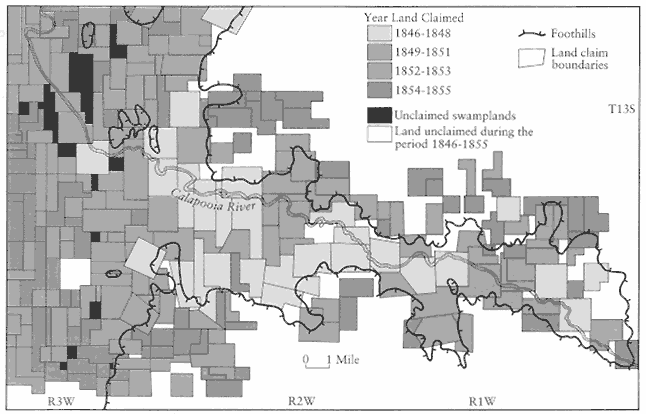
Map 3.
Land claiming in the Calapooia Valley and on the adjacent Willamette Valley Plains, 1846–55. The area represented in the
map is larger than the study area and thus includes more land claims than have been used for statistical purposes in this study.
Sources: Genealogical Forum of Portland, Genealogical Materials ; surveyors' maps and Donation Land Claim maps, Land
Office, Bureau of Land Management, Portland; Linn County, Oregon ; Manuscript Population Census Returns, Linn County, 1850.
prairie right along the banks of the Calapooia, for there, too, in addition to available fresh water, they also found the special features of the edge: timber growing in thickets along the riverbanks, plus open prairie extending beyond this narrow wooded band. These prairies close to the river, in fact, included what later proved to be some of the best agricultural lands, being fertile and well drained because they rested atop cobble. But claimants during the early years never ventured far from the foothills or the river. Early settlement throughout the southern Willamette Valley followed a similar pattern (map 4). Most settlers located claims at the base of the foothills, while a few settled in the gallery forests of larger streams. No settlers centered their claims in the midst of the valley's wide, open prairie. Only later, between 1851 and 1855, when the best claims were gone, did settlers begin to take up the initially less desirable land on the open, winter-wet, summer-dry, and timberless prairie, as well as on less desirable lands higher in the rugged foothills.
However, it is important to note that although early settlers consciously avoided the prairies, as they initially had in the Midwest, they viewed them positively in futuristic, pastoral terms. Thomas Kendall commented in 1852 that "the best land, the most sightly locations, in the very heart of the grazing portions, and what will one day be the great agricultural spots, I mean the central portions of the prairies, are yet as the Creator left them, uncultivated, unclaimed."[15]
The settlement pattern along the Calapooia valley demonstrates the influence that nature, cis-Appalachian precedent, and the Kalapuya had on Euro-Americans. It also shows that Euro-American settlers had an intimate understanding and closeness to the natural world—prairies, trees, hills, and plains—on which they depended. Settlers' intimacy with the Calapooia landscape also developed through the actual laying out of the boundaries of individual claims.
During the years 1846 to 1851, before federal surveyors imposed the cadastral survey on the Calapooia wilderness and before new methods and technology made it easier to mitigate certain features of its terrain, the natural landscape guided the laying out of land-claim boundaries, just as it had in the early cis-Appalachian West. However, the Oregon Donation Land Law, which went into effect on 1 December 1850, called for the imposition of the rectilinear cadastral survey on the valley and required that new claims adhere to these north-south, east-west survey lines. From 1843 to December 1850, only the basic laws of the provisional and
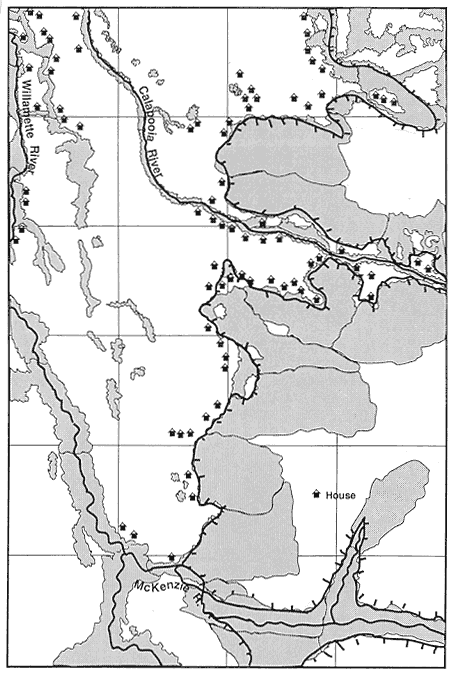
Map 4.
Location of southern Willamette Valley households, 1850.
Source: William A. Bowen, "Mapping an American Frontier: Oregon in 1850."
territorial governments guided the settlers' land claiming as they attempted to balance themselves, their cis-Appalachian culture, and the need for natural resources with what the landscape afforded.[16]
The provisional and territorial governments stipulated no pattern for land claiming according to cardinal points of the compass, as did the later federal Donation Land Law. The geographer Harlow Zinser Head has concluded from this circumstance that "the objective of the federal land policy . . . was to halt further settlement in the haphazard manner" of years prior to 1851.[17] In fact, the territorial and provisional governments did not necessarily encourage a "haphazard manner" of land claiming in the Willamette Valley, for certain rules did force a minimal regularity to land claim boundaries. On 5 July 1843, for instance, the Oregon provisional government enacted its first land law. Article 1 required that a person "holding or hereafter wishing to establish a claim to land . . . shall designate the extent of his claim by natural boundaries, or by marks at the corners, and on the lines of such claim, and have the extent and boundaries of said claim recorded in the office of territorial recorder." Article 3 stipulated that a claimant could take no more than 640 acres (one square mile). It also required that claimants take land "in a square or oblong form" but granted an exception to what "the natural situation of premises" afforded. A new comprehensive land law, passed a year later (25 June 1844), slightly revised requirements for taking out land claims. Section 2 ordered that all claims made after that date "shall be in a square form, if the nature of the ground shall permit; and in case the situation will not permit, shall be in oblong form." Section 3 excepted claims already made: where lines had already been agreed on, claims did not have to be "in a square or oblong form."[18] Thus, the early Oregon governments at least attempted to bring regularity to the landscape and prevent the sort of problems that had arisen in the east, particularly in Kentucky.
Theoretically, then, up to June 1844 the provisional government allowed settlers to take their claims in any form they desired. Between 1844 and 1850, laws still allowed settlers to orient square or rectangular claims according to what the local landscape afforded. Calapooia settlers between 1846 and 1850 took advantage of this allowance, and although most did use cardinal points of the compass to lay out their rectangular claims, some did not. A study of the early land claims reveals that settlers used both regular and, not surprisingly, irregular claims to take advantage of the variety of lands available along the
prairie-forest edge. Those who had "regular" boundaries placed large claims in areas where they could take advantage of as many resources as possible. Since they were the earliest and first settlers, they could readily do so.
Though Jared Michael's 1847 claim (map 5) and Thomas Ward's 1850 claim (map 6) were both perfectly square claims of roughly 640 acres each, they also stretched the limit of the law that required imposing rectangular lines on a landscape that had no semblance to "rational" order. Both claims tilted away from the cardinal points of the compass in order to take into account local geographic features and the exigencies of landscape that nature and the Kalapuya had shaped. Michael's took advantage of both water that collected from springs at the base of a foothill on his claim and of timber at the top of the slope. The gently fanning prairie that made up two-thirds of his claim was readily cultivable and in fact made up the entirety of his farmland when the surveyor sketched his claim in 1852–53. Ward's claim had an even more unusual configuration. By the time Ward made his claim, earlier settlers had already taken most of the best land along the foothills. So Ward took a claim on the plains, but this claim completely surrounded a steep, conical butte that rises almost six hundred feet above the valley floor. In essence, Ward's claim is an isolated microcosm of land-claiming patterns along the foothills. Settlers like Michael and Ward worked within early land-claiming laws and still positioned their claims to take advantage of the natural topography and environmental conditions.
The Michael and Ward claims exemplify the general pattern of land claiming in the Calapooia and southern Willamette Valley as a whole: the claiming of land where the lower flanks of the foothills gently fan out onto the prairie. Calapooia settlers preferred to claim land at the base of the foothills and occasionally on the Calapooia River itself (map 2); many of these early claims, especially those tucked alongside the foothills, had "irregular" forms (map 3).
Although provisional and territorial laws proved plastic enough for settlers to mold them—through the boundaries of an actual land claim—to the special nature of the land they governed, these laws also encouraged the claimant to gain knowledge of his or her local landscape. Claim laws stipulated the claimant's responsibility for surveying his or her own property "by natural boundaries, or by marks at the corner." This process of defining land according to landscape features, and then recording it by the use of natural markers (essentially the old
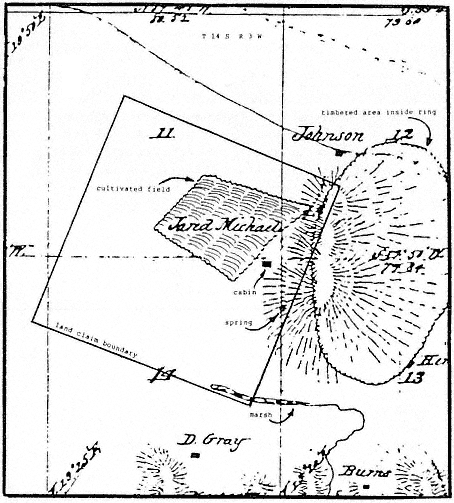
Map 5.
Jared Michael's land claim.
Sources: Surveyors' maps and notes and Donation Land Claim maps, Land Office, Bureau of
Land Management, Portland; U.S. Geological Survey, topographic maps, Halsey quadrangle.
metes and bounds system from colonial and early cis-Appalachian settlement days), forced the early Calapooia settlers to gain intimate knowledge of—and therefore connection with—the landscape. For instance, on 15 July 1848 William Robnett claimed 640 acres situated "on the Calapooia river about 2 1/4 miles above Finley[']s mill . . . and bounded
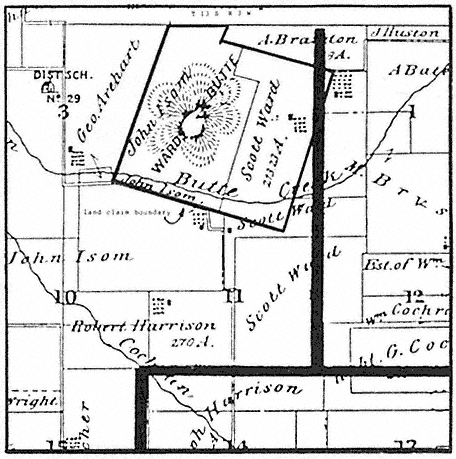
Map 6.
Thomas Ward's land claim.
Source: Illustrated Historical Atlas Map .
as follows To Wit Commencing at the SW corner an Ash tree marked on the S side of the river—Thence running N crossing the Calapooia river one mile to a stake—Thence E one mile to a stake—thence S one mile recrossing the river to a stake thence W one mile to the place of beginning." Jonathan Keeney's 640-acre claim of 26 April 1847 had an even more primitive definition, requiring great knowledge of the local landscape. The claim was located "about 5 miles above the Calapooiah river on the first branch near the foot of the mountain. Beginning at the NE corner a stake on the prairie about 100 yards W of a bunch of Ash trees,
joined at the roots, standing on the N side of the branch, marked thence running W one mile, thence S one mile crossing said branch, thence E one mile, thence N one mile to the place of beginning." Other landscape features in early claim descriptions included "a stake on a hill," "an ash swale," "a fir on the mountain," "a white oak tree," and "the falls of the Calapoiah."[19] By relying on such features, the earliest Euro-American settlers appropriated into their minds and activities fixtures of landscape the Kalapuya had incorporated into myths and legends explaining creation and their own connection with the land. Though the new "Calapooians" had very different emphases and reasons than had their predecessors, these fixtures of landscape still played significant roles in settlement culture. This chapter examines the role these landscape features played in everyday activities, the next analyzes them on the level of the settlers' imagination.
During the early years on the Calapooia, 1846–51, settlers took up land through a process requiring an intimate knowledge and understanding of their new landscape. They used natural features when surveying claims, and they had great leeway (of which they readily took advantage) in positioning claims in a manner that suited their own tastes, their past experience, and the configuration of the Calapooia landscape. Essentially, the special configuration of the Calapooia and southern Willamette valleys redefined and gave new meaning to the subsistence-oriented agricultural life-style that early settlers brought with them. Virtually forced to live among the hills, settlers developed an intimate association with this fixture of the landscape at the same time that they looked onto the plains with desire. The tension between foothills and plains is essential to the cultural meaning of pioneering in the Calapooia Valley.
The cis-Appalachian experience did, in a small way, influence settlement patterns and land claiming in the Willamette. In addition, it influenced other aspects of Willamette Valley settlement culture, in particular the style of houses constructed on the new landscape. After deciding on a suitable site, immigrants constructed homes from resources the land provided—timber, clay, moss, and rocks—and thus they came into intimate contact with the Calapooia landscape; however, they fashioned these natural resources into traditional architectural styles. First homes tended to be log cabins—a form that pioneers had carried across successive American frontiers from the colonial period. When Timothy Riggs and Asa Moore settled on Brush Creek in the fall of 1847, their
first duty was to "cut logs for our cabin." In building more elaborate structures, Calapooia immigrants used traditional styles brought with them from the Midwest and upper South. John Wigle's first residence, though crude, relied on a midwestern architectural style. "Our dwelling house consisted of one room, a round log house very similar to our school house in Illinois." He described his bedroom as a "pole pen about ten feet square." John McCoy, who settled not far from the Calapooia in the late 1840s, built a house typical of the log cabins that these settlers had previously built on other American frontiers. The McCoys built their home
after the style of the usual pioneer cabin, of logs laid up in a square, notched on the corners, to make them lay properly, faced down with a broad-axe inside and out after being laid up; cracks chinked and daubed—sometimes with clay and sometimes with moss from the trees—to keep the cold out. A fireplace, the jambs and back made of baked clay with chimney, built with split stick daubed inside and out with clay. A puncheon floor, and the roof covered with clapboards held down by weight-poles to keep from blowing off, nails being out of the question at that early date. Door with wooden hinges, opened by a latch string always hung out.
Later, McCoy built a similar cabin "nine or ten feet away in line with the first" and eventually "the space between the two was enclosed." Hugh Brown of Tennessee settled in the Calapooia in 1846 and built a similar abode of two cabins connected with a breezeway. Settlers carried this particular style, a typical double-pen log house, with them in their cultural baggage from the upper South and Midwest. Settlers naturally incorporated local materials into their homes.[20]
After selecting an appropriate claim and building their homes, settlers prepared their property for cultivation. In the process, they found that the Calapooia landscape influenced their cis-Appalachian agricultural practices. After settling on the Calapooia, Thomas Kendall wrote to an Indiana friend who had concerns about cultivation in the Willamette Valley. On the "most heavily timbered parts," Kendall confided, clearing land was
much less difficult . . . than on the heavily timbered bottoms of Ohio and Indiana. . . . A large portion . . . of the timbered country consists of open woods, with little and often no undergrowth of shrubbery, sometimes several acres bearing only a few large trees, and those not so very difficult to remove: chop or bore with an auger through the bark, and the white wood, which is not deep, then apply fire, and with little attention they will burn down.[21]
Calapooia and Willamette settlers generally found the valley soils of their new home much easier to plow than the prairies of the Midwest, which are thousands of years older than the Willamette Valley's. Also, the Willamette's mild, wet winters cause vegetative matter to decompose relatively quickly. Thus, whereas Midwestern sod consists of years' accumulation of undecomposed, tough grass roots reaching several feet deep, the sod of the Willamette is relatively thin. Settlers commented on the ease of plowing in the Willamette and Calapooia. In 1849 Gustavus Hines suggested that Willamette prairies were "unlike those of any other country. They are naturally mellow, and appear . . . as though it had been but a year or two since they were cultivated." Hines also noted that the Willamette soils were not "swarded over with a thick strong turf, as in Western States" and that they could be "easily ploughed with one good span of horses the first time." George Atkinson found in 1848 that "a man can live with half the labor [in the Willamette] done in the States. . . . An immigrant will come during the autumn, put himself up a log house . . . [and] break eight or ten or twenty acres of prarie." In 1846 Neil M. Howison found the Willamette prairies "free from the encumbrance of trees or other heavy obstacles to the plough, stretch along, ready for the hand of the cultivator." Although settlers could cultivate midwestern prairies successfully only with steel plows, settlers in Linn County and the Calapooia Valley often found wooden plows adequate. With a plow constructed simply out of a "twisty pice oak," Robert Earl's family plowed twenty acres their first season of residence in Linn County. The Wigle family settled just south of the Calapooia Valley's mouth in 1852 and "got along with a wooden toothed harrow and brush drag," even though John Wigle admitted "those were poor tools with which to work sod ground." And John McCoy's first plow in 1847 was simply a "wooden mold-board, carved by himself out of a pice of oak wood" with a "steel lay and land-bar" and "stocked with wheels sawn from a tree." Although he needed three yoke of oxen, he did plow thirty-eight acres that spring alone.[22]
Settlers also found that certain crops grew poorly in the soil of the Calapooia. Though corn was central to the development of the Midwest, settlers could not successfully cultivate it in western Oregon because of the cool summer nights. One late nineteenth-century traveler in the Willamette summed up the problem: "For this plant the nights are too cold. That refreshing coolness following quickly upon the retreat of the sun, hastening down from the mountains to close our eyes in well-
blanketed and undisturbed sleep, is fatal to Indian corn, which glories in the blaze of the midsummer heat, and waxes fat and succulent through the damp and sultry midnights." Of the twenty-nine farms in the Calapooia reporting cultivated land in the 1850 agricultural census, none harvested corn, while eighteen farmers produced 2,265 bushels of wheat and 70 pounds of oats. Inhabitants produced only 573 bushels of corn in the entire Willamette Valley that year, while wheat production totaled 199,558 bushels, and oats 54,524 bushels.[23]
Although settlers could not successfully transplant corn, the key animal fodder in the Midwest, to the landscape of the Calapooia, they still had a predilection for raising livestock during the early years. As had been the case in the cis-Appalachian region, the exigencies of economy and transportation in large degree determined the hog and cattle culture of settlers on the Calapooia, but it was especially the unique configuration of the Calapooia and southern Willamette that encouraged age-old husbandry practices. The nature of the local prairies and prairie-forest edges made the southern Willamette and Calapooia valleys an excellent place to run both cattle and swine. Calapooia settlers chose claims along edges in order to have access to the prairies as well as the forests, as they had in the Midwest. They could then simply turn their livestock out onto the unclaimed, unfenced, open prairies during early years. Thomas Bird Sprenger remarked that each "farmer had a few acres broke up and some fenced to protect the crops from ranging cattle. . . . Stock raising was a most important part of our work. Cattle ran at large everywhere." In 1850 Wilson Blain wrote, "Here cattle roam at large, summer and winter, asking nothing from the care of man, and are always in the finest condition. One portion of the country is known as the land of Bashan." Swine also ranged about the countryside, feeding on oak mast and various roots growing on the prairie-woodland edges of the valley. One of the primary foods for hogs proved to be the bulb of the camas plant, the staple of the Kalapuya diet. John Minto noted that swine "lived on the grasses and oak mast . . . [and] the roots which were the chief foods of the natives." In the summer of 1846, Thomas Kendall "procured one full grown sow and two others about half grown." Because of the abundant provender, especially the camas, which when in bloom gave the valley the appearance of "a big blue lake . . . at least a thousand acres of it," by just turning his three hogs out onto the prairie "without any feeding . . . except a handful of something now and again, . . . to keep them domesticated," Kendall had in "nine months . . . more than 50 head."[24]
Because of mild conditions and the only recently ceased Kalapuya burning, livestock found adequate forage in the valley year-round, something different from experience in the Midwest. In an 1856 petition to the territorial government to force cattle owners to confine animals running at large and ravaging the petitioners' own "grass claims," citizens of Linn County even regarded the "grass claim of each settler as being to him here what his Corn-Crib was in the States." Kendall summed it up best:
For rearing cattle and horses, I have no doubt that Oregon is one of the best countries in the world. During the crop season you labour hard to lay up [corn and hay] for your stock in the winter. Amid its storms your cattle and horses look to you for food and shelter, ours, "like the wild deer and wolf," look to the wide canopy of heaven as their stall, and to the vast fields which God of nature has spread before them, for their food. Through the wet season through dry, they never call at your barn for a meal.[25]
Southern Willamette settlers depended on livestock raising in early years. The 1850 census reveals that in the Calapooia community, twenty-four people owned 247 cattle, with Hugh Fields having 75, Isaac Hutchens 40, and William Cochran 57. In addition, the census taker found 153 milk cows and 122 oxen on the Calapooia. Thirty people owned a total of 709 hogs. William R. Kirk alone maintained a herd of 100, Hugh Fields claimed 60, and three others owned 50 apiece. The 1852 tax assessment rolls show Calapooia residents owning 972 cattle, while Linn County as a whole had 5,784. The number of hogs equaled 900 for the Calapooia, and 4,970 for the county. Calapooian Jonathan Keeney alone owned a herd of 224 swine.[26]
The interplay between nature and the Kalapuya created a landscape in the Willamette that proved in many ways beneficent to the subsistence agricultural community that developed on the Calapooia during the first few years of settlement. Foothill slopes, grasslands, trees, prairie-forest edges, springs, and camas meadows provided for the needs of Euro-American settlers and their livestock. This same landscape also supported an abundance of wild game that proved to be a blessed addition to the diet. Albert Waggoner recalled that other than livestock, what his family "could bring in with their guns was their living for a number of years."[27]
The natural and Kalapuya-created landscape influenced the quantity of deer and other types of game and animals inhabiting the valley.
Deer—especially white-tailed, which are attracted to grasslands rather than forests—abounded year-round in the southern Willamette. Silas V. Barr recalled that deer ran "freely over all of these hills, especially in winter. There were some black-tailed deer but perhaps more white-tails. The black-tails would come down from the mountains in winter. The white-tails were permanent residents here." Redman Pearl recalled, "The white-tailed deer were then common all through the valley." A.J. Shank remembered that "deer could be seen daily, grazing in the pastures with the cows," on his father's land claim. Although undoubtedly an exaggeration, during the first year John McCoy lived in the southern Willamette Valley, 1846–47, he reportedly "killed one hundred and sixty two deer without drawing the blood on one that he did not get." Lewis Tycer stated simply, "The hills were full of deer . . . and it was never any trouble to get plenty of meat."[28]
The grasslands of the southern Willamette Valley, which innumerable ponds and marshes inundated during winter months, also provided perfect feeding ground and habitat for wintering and migrating geese, ducks, swans, cranes, and other fowl. The annual number of geese alone flocking through the Willamette was so great that a Linn County newspaper humorously reported in 1876, "The number of wild geese that have passed . . . going northward, during the past two weeks, is placed at 3,713,811." Extant diaries and memoirs indicate that early settlers spent much of their time during the fall and winter months hunting fowl. For instance, in November 1866 Jasper Cranfill went goose hunting almost every day; by the twenty-sixth of that month, he could muster only enough energy to confide to his journal, "Remained at Home tired of Hunting etc." Calapooian Andrew Kirk remembered that one year he shot four hundred ducks just for family use, once getting thirteen in a single shot.[29]
Geese also caused serious problems for Calapooia and other Willamette Valley farmers. As soon as grain crops like wheat began to grow, flocks of geese invaded the fields. According to one Calapooian, they would "clean two or three acres off in a single night" so that a field that looked "green and thrifty one day" might the next morning "look as bare and black as though it had never been sown." Some farmers spent nights walking up and down their fields shooting guns to scare birds, while others hired boys to do the patrolling or even resorted to "twining." As Redman Pearl recalled:
[Twining] a field was done by driving stakes, perhaps twelve or fifteen feet tall, in rows all across the field. These rows of stakes were in squares or "checks," perhaps one hundred feet, or one hundred and fifty feet apart each way. Across the tops of these stakes twine was stretched. When the birds attempted to alight on the grain fields their wings would strike the stretched twine and it would scare them away. . . . [Or] it was very likely to become twisted in the cord and hang helpless and trapped.
This practice also made it easy for settlers to gather even more fowl for the table.[30]
Settlers had mixed reactions to wildfowl, but they roundly condemned wolves, bear, and cougar. Linn County resident Robert Earl reminisced about his brother William, who one night in the late 1840s heard hogs squealing near their house. William jumped out of bed and ran to the scene, but with neither pants nor gun. "[When] he got there he found a cogar hold of a hog he scared him loose [The cougar] acted like [it] wanted a man for super [William] started home there was another man had got up and Started down ther to See what was the mater and he meet William coming with his Shirt tail standing out Strait."[31]
Grizzly bears, though not as numerous as cougars, proved just as troublesome. Although they naturally ate camas bulbs, tubers, roots, berries, acorns, fish, and carrion, they occasionally attacked settlers' livestock. In the 1840s a grizzly took a swipe at one of John McCoy's calves, nipping its tail. But the lost "tail was the only damage done. . . . The steer was ever after known as Bob." Albert Waggoner, probably exaggerating a bit, recalled the extermination of the last grizzly in Linn County, which had been marauding the settlement.
[Father] took an old musket and loaded it heavily . . . [and] tied it to a big crooked rail in the fence near his home and set a bait nearby so that taking the bait would discharge the gun. That night the grizzly came and took the bait. The recoil of the gun broke the big rail, and the charge blew a hole in the grizzly's side and lungs large enough so that my father could run his arm into it up to the elbow, nevertheless that grizzly walked for a full mile before he dropped.[32]
Although accounts of wolves in the Calapooia are few—Kendall briefly mentioned them in an 1852 letter—they inhabited the Willamette Valley in large numbers at the time of settlement. In 1846 Neil M. Howison reported, "Wolves are numerous, and prey upon other animals, so that the plains are entirely in their possession." When Charles
Wilkes traversed the valley in 1841, he reported that "bands of wolves were met with, and heard throughout the night in various parts of the valley." Wolves did cause serious depredation. In response, northern Willamette Valley settlers called the first "wolf meeting" in early 1843 to work out some type of defense against wolves and other fearsome wildlife. At subsequent wolf meetings, settlers considered other problems the youthful Willamette settlement faced. Eventually, these meetings developed into the provisional government. The first resolution of the wolf meeting held in March 1843 was for the community "to take immediate measure for the destruction of all wolves, bears and panthers, and such other animals as are known to be destructive to cattle, horses, sheep, and hogs." Bounties of $3 for large wolves, $.50 for small wolves, $5 for "panthers," $2 for bears, and $1.50 for lynx were approved. Over the next decade and a half the provisional and territorial governments would continually revise bounties paid for "noxious" animals. Linn County itself provided bounties on wolves, bear, and cougars during the nineteenth century.[33]
Euro-American settlers responded to the wild animals of the Willamette paradoxically. On the one hand, they appreciated the bounty of game; on the other hand, they feared the grizzly, cougar, and wolf. Euro-American settlers also encountered other inhabitants of the landscape: a few surviving Kalapuya. The settlers held racist attitudes toward their predecessors. Linn County resident Mrs. James Miller wrote in 1852, "They are dying here as elsewhere, where they are in contact with civilization. . . . I used to be sorry that there was so much prospect of their annihilation. . . . Now I do not think it is to be much regretted. If they all die, their place will be occupied by a superior race." Part of this racist attitude can be explained by the fact that the Kalapuya, as Miller noted in her letter, had just undergone demographic collapse. Their culture was in a shambles, their villages destroyed, and communal food-gathering activities no longer existent. To Euro-Americans, these starving people must have appeared as little more than, as Miller wrote, "heathens."[34]
The half-starved Kalapuya, never posing a real threat to those who replaced them, only looked to the settlers for food. One evening soon after settling on the Calapooia, Clarissa Brown "had just a little flour and decided to make . . . bread to surprise" her husband, Hugh. As she was baking in her Dutch oven before the fire,
a shadow fell across the open door and looking up a big buck Indian was seen advancing into the room and muttering something she could not understand, whatever he may have been saying . . . he meant to have the bread. [Clarissa, who] never weighed over 100 pounds, was just as determined that he should not have the bread intended for the Brown family. She grabbed the tea kettle of boiling water . . . and started for the Indian. This was a foot race . . . but he beat. . . . He never came again.
Folklorists will note that this tale is strikingly similar to other tales told on other frontiers. It relates important information about the settler-Native American relationship in the West as the former replaced the latter, but it is also rooted in factual basis. Documents reveal that numerous similar incidents actually occurred on the Calapooia. In the fall of 1847, for example, Calapooia settler Timothy Riggs occasionally fed a Kalapuya who showed up at mealtime. Soon a number of Kalapuya began consistently to show up for supper. Fearing he "would run out of provisions before spring," Riggs was obliged to "quit feeding them." In another instance, shortly after Richard Finley settled on the Calapooia in 1847, Kalapuya "stole" one of his oxen. Finley and neighbor Riggs tracked the "thieves" to the Santiam River, where they found them "camped and . . . drying the beef." In retaliation, Finley opened fire and wounded one of the Kalapuya. When Timothy riggs and Asa Moore began building a cabin on Brush Creek in the autumn of 1847, "Indians appeared on the scene and inquired what [they] were doing there." After Riggs told them that he and Moore were settling, the Kalapuya demanded payment. Riggs and Moore "made a bargain with them agreeing to pay them wheat and pease after the next harvest."[35]
Although a few remaining Kalapuya caused occasional consternation among the new Euro-American residents, the only serious threat they posed to settlers was in the settlers' minds, made fertile by experiences in cis-Appalachia. For example, after the Keeney family arrived in the region, local Kalapuya entered their living quarters: "The children, having heard so many stories of Indian scalping parties, thought they were doomed." Also, Finley's shooting of one of the Kalapuya who had stolen his ox "caused quite an excitement in the settlement." Many settlers feared that it would "cause an outbreak among the Indians." And finally, in the 1850s reports of rampaging tribes in other parts of the West and Northwest brought tensions to a high point in the Willamette and Calapooia valleys. Wilson Blain noted in a letter dated 30 October 1855 that "the panic was universal, and such another time of
alarm and excitement, I have no wish ever to witness. One might have supposed on last Thursday, that the Willamette Valley was full of bristling, and savage warriors." Blain went on to point out that in fact "there was not a hostile Indian in the whole valley."[36]
In retrospect, it is easy to see that the settler-Kalapuya relationship was a painful moment in history. The Kalapuya and Euro-American civilizations converged for a few years in the Willamette Valley. This period of overlap occurred at the worst time for the possibility of humane settler-native relations. The few remaining Kalapuya, having suffered the loss of tradition, wandered about the land in a starving, dying condition, while the Euro-Americans, fresh from cis-Appalachia, harbored militant attitudes toward all Native Americans. A treaty of 4 January 1855 forced the remnant Kalapuya officially to cede the Willamette Valley to the United States.[37]
When the Euro-Americans replaced the Kalapuya, new attitudes toward landscape and environment invaded the Willamette. Chapter 1 presented two passages from the Kalapuya's perspective concerning their loss of the Willamette to the Euro-Americans. One passage referred to a shaman who long ago had seen the earth all black in his dream. Later on, the Kalapuya saw the dream come true as the whites plowed up the land. The other passage went further and noted that "this countryside is not good now. Long, long ago it was good country (had better hunting and food gathering)." These and the following few excerpts from the Euro-American perspective highlight the differences in the conception of land and property between the Kalapuya and the settlers, and thus offer much for understanding the environmental change the Euro-American's wrought in the Willamette during the nineteenth century. As an example, for the payment of land to the Kalapuya, Timothy Riggs resorted to "wheat and pease," fruits of Euro-American cultivation from the very land he was taking from the Indians. Interestingly, he believed that the natives demanded payment for the land he claimed as his own, when in fact natives had no concept of private property. And Richard Finley bore arms to recover the private property (in the form of an ox) that natives "stole" from him. By contrast, the natives told no tales of begging and "stealing" from whites for food. The Kalapuya's view of their interaction with the white settlers at this time directly concerned their altering relationship with the landscape. The whites "plough[ed] up the ground," and thus the Kalapuya's own relationship with it. The plowing rendered the environment "not good."
The land was good only when Kalapuya occupied it and men hunted and women gathered. The Kalapuya viewed themselves as living in symbiosis with nature, a symbiosis destroyed by the arrival of Euro-Americans. The Euro-Americans viewed the settlement process, in part, as one of the advancement of their environmental conception, which included private property and deriving money from the land. As the next chapter demonstrates, however, Euro-Americans did not necessarily see themselves totally separated from the land.
Early settlers looked at the few remaining Native Americans with a combination of skepticism, fear, and occasional regret. They viewed the wildlife and climate of the Calapooia with mixed emotions, too. Settlers could at least defend against the worst of the marauding wolves, cougar, and bear and the perceived threats from their human predecessors. However, the weather and climate of the Willamette posed greater problems. Winters caused great concern, primarily because of persistent rains and flooding. When Charles Wilkes visited the northern Willamette settlement in 1841, he interviewed a Mr. Walker, who had come to the country with his family the previous year. According to Wilkes, Walker "did not like the country, and wished to go to California by the first opportunity. His principal objection was to the climate, which was too wet for business." Wilkes's British counterparts Henry J. Warre and Mervyn Vavasour found in 1845–46 that "notwithstanding the advantages to be found in this valley, many of the American emigrants become dissatisfied, and remove to California, where the climate is more salubrious." During the winter of 1852–53, Wilson Blain remarked in a letter, "Heavy rains, deep snows, high waters—perfect floods, great destruction of property along streams, a considerable amount of live stock perished, poor homeless emigrants badly discouraged, these and some other matters of a like nature were 'wafted' on 'Chill November's surly blasts.'"[38]
Rainfall in winter months usually resulted in flooding and high water. Lewis Tycer recalled that the school term at the McHargue school "usually lasted only a few months in the spring when the rivers and creeks had gone down enough to make it safe for the children to cross." On 18 January 1866, Jasper Cranfill dramatically stated that "Muddy [Creek] nearly as high as yesterday. Sharp cold wind blowing—all communications with the outside world cut off by high water. About four hundred yards of fence gone." Three days later he recorded that "over one hundred & sixty of J.L. Coons sheep—were drowned by high water" and that he had found "a fish in the Prairie some six inches long
in the Puddles." But the weather in 1866 was not particularly atypical. In 1861, though, the largest flood in postsettlement history occurred in the Willamette Valley. During November of that year, precipitation fell in amounts more than twice the normal for the Willamette basin. The heaviest rainfall occurred between 30 November and 2 December. Added to this precipitation was heavy snowfall in the mountains; moderating temperatures at the end of November resulted in snowmelt, which compounded the problem. Settler Michael Plaster kept a weather log at his home on Diamond Creek, just south of the Calapooia. In it he noted that from 15 November to 9 December rain fell every day, and on "December the 1 the big fresh on Calapooya all the bridges & Rigg's mill went off." The flood also destroyed Richard Finley's gristmill on the Calapooia, and settlers soon ran out of flour and were forced to use cornmeal. Two other major floods, one in January 1881 and the other in February 1890, occurred in the Willamette Valley before the end of the nineteenth century.[39]
Flooding and poor drainage, most apparent in winter, influenced settlement patterns and movements on the land and also determined where settlers developed roads. The earliest route to the Calapooia, which twisted and turned along the base of the eastern Willamette Valley foothills, was formed through wagon use, the drivers desiring to stay off the winter-wet prairie. In 1848 the territorial government commissioned a survey of this path, officially designating it the east-side Territorial Road and appointing Calapooia settler Alexander Kirk as commissioner of the survey. After viewing the route, Kirk described it in a passage full of natural features of the landscape: the road touched "a point of timber," went "through a field" and "to an ash tree," and was often "meandering along the hills"; and it ended simply by "crossing the Calapooa."[40]
Settlers developed other roads through the valley proper in much the same fashion that they had developed the Territorial Road. Thomas Bird Sprenger, who grew up along the Calapooia, recalled in later years, "When we wished to start for town . . . we just headed off across the country in the general direction . . . avoiding low places in winter as best we could." Early settlers also developed a road, actually a succession of interconnected farm lanes, that followed the base of the foothills on the south side of the Calapooia Valley (map 7). The road began on the west at Wilson Blain's claim and continued east several miles to Richard Finley's claim on the Calapooia.
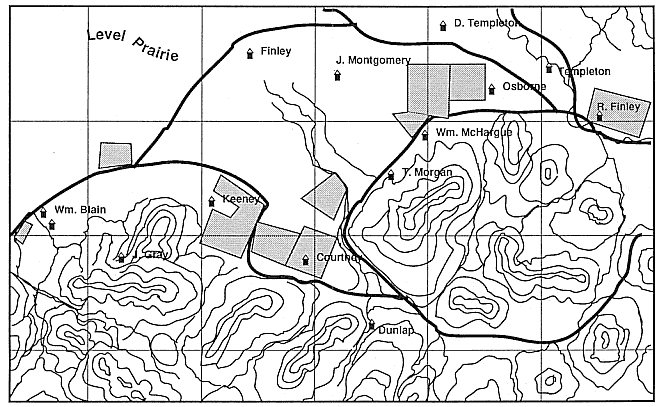
Map 7.
Early roads in the Calapooia Valley.
Source: Surveyors' map, Land Office, Bureau of Land Management, Portland.
Despite attempts to locate roads in well-drained areas, routes remained notoriously bad throughout the nineteenth century. When the Oregon and California Stage Company tried to raise rates to fifteen cents a mile on the Territorial Road in the early 1860s, a local newspaper chided, "We suppose the advance [in rates] is caused by bad roads. The more the passengers have to walk and the harder they work to pry the vehicles of that company out of the mud, the more they are charged for the privilege." In later years, residents of the Calapooia Valley desired a connection with the railroad, remarking that it was "impossible to make a wagon road that is passable over six months of the year." Sarah Jane (Savage) Cornett recorded in her diary on Sunday, 7 January 1883, a trip to visit nearby friends: "we come back around the lane whew it was muddy the water was pretty high today." Three weeks later, on 29 January, after her husband had returned home from a local funeral, Cornett noted that the weather that day was "foggy heavy mist and rain most all day" and "the roads were terrible terrible." Two and a half months later, Cornett noted a common occurrence when she wrote that her son "got stuck in the mud" while hauling wood.[41]
The rains and floods of winter months influenced settlement patterns and road construction in the Willamette and the Calapooia valleys. They also destroyed homes and livestock herds. But while winter months often provided stormy, rainy, and unpleasant weather, they also proved generally mild, something that pleased settlers. On 16 January 1865, for instance, Jasper Cranfill noted in his diary that the day was a "cloudy gloomy day characteristic of the Oregon winters." A year later, he commented, "As Oregonians may expect continuers rain for about two weeks then fine weather." And in February 1853, Wilson Blain remarked, "The sun is bright—the grass is green—the birds are singing gaily, and all hands are vigorously prosecuting their agricultural and horticultural operations."[42]
If harsh weather occasionally occurred in the winter, summer months were "sufficiently delightful to counter balance all this," according to Gustavus Hines. In the Willamette Valley during the summer, "the howl of the storm and roar of the southern winds" of winter "are hushed to silence" by the gently fanning "western zephyr." Inhabitants described the occasional summer showers as "angels' visits, few and far between." Although summer evenings required "two quilts and a flannel blanket" to keep warm, temperatures during the day ranged from "sixty-five to eighty degrees at noon."[43]
Though these descriptions tended to put the best face on the situation, settlers genuinely noted an agreeable difference between summers in the Willamette Valley and the Ohio and Mississippi valleys. As a late nineteenth-century Linn County Immigration Agent declared, "When the thermometer here marks 90 degrees, the heat is not so oppressive as the same degree in the Mississippi Valley." He further commented that in "the east, when in summer the thermometer gets to 80, people seek the shade—in this state they seek the sunshine from choice; there is a tonic in it at this temperature." Blain noted in 1851, "Those sweating and sweltering nights you suffer in the [cis-Appalachian] West are to us forgotten, or remembered only as unpleasant dreams of the past." It is true that the Willamette Valley experiences markedly less humidity in the summer than do the Mississippi and Ohio valleys, but it still occasionally gets quite warm. Thus, one Linn County resident frankly described one summer day as "hot enough to make a fellow throw stones at his grandmother."[44]
Early residents and travelers in the Willamette and Calapooia also noted the lack of thunderstorms there as compared to the midwestern states. Kendall remarked in 1852, "Thunder and lightning are of rare occurance." One 1846 observer declared this a "consoling circumstance to our countrywomen, who had been previously subject to its terrifying effects, on the banks of the Illinois and Mississippi."[45]
Thus, although settlers of the Calapooia and Willamette valleys sometimes grumbled over the persistent winter rains, they also appreciated some of the ways in which the climate of the Willamette Valley differed from that of the Midwest and upper South. In comparing the negative and positive aspects, settlers in the Willamette and Calapooia were essentially coming to terms with a new land. Nineteenth-century Calapooia residents even went so far as to suggest that the climate and configuration of the Calapooia landscape actually resulted in a healthier atmosphere than that of the Midwest. Kendall commented to a correspondent in Indiana:
You can no doubt trace on your rich Wabash bottoms the elements which impregnate your atmosphere with the miasma from which pestilence and death are shot through society. . . . Apply the same principles to the land of my adoption. During the rainy season our winds and rains are directly from off the Pacific . . . in passing over the vast expanse of water, the miasma, containing elements of disease and death have principally at least been absorbed. . . . Through the dry season, though from another direction, we still
have the pure ocean breeze. Neither have we the extremes of heat and cold to which the Atlantic countries are subjected.
Kendall argued further that vegetation decomposes slowly in the Willamette Valley, keeping the air purer: "From this source [i.e., rotting vegetation], therefore, our atmosphere cannot be vitiated."[46] In fact, in western Oregon organic matter actually decomposes very rapidly, and although the relation to illness in this case is questionable, Kendall obviously felt that this difference explained why the Calapooia landscape was healthier than the Midwest.
Kendall and other residents of the Calapooia and the Willamette also noted the relationship between the landscape—such as "pure water dashing from the mountains" in brooks, creeks, and rivers—and health. Blain remarked that "where pure water prevails, we have one of the best guarantees of healthfulness." Blain also recognized that the valley's standing waters and swamps sometimes "engender even ague in Oregon," but this illness was limited—at least among the Euro-American population. In fact, settlers' draining of land and confining of rivers and streams to narrower channels eliminated malaria from the Willamette Valley by the end of the nineteenth century.[47]
Whether referring to atmospheric conditions, decomposition of organic material, or pure water, Calapooia settlers attempted to understand, through environmental explanations, why the Willamette, according to Blain, had "restorative power for all kinds of invalids." Sick and "broken-down" miners coming in from California, for instance, "soon experience the bracing and healthfulness of our climate, and are restored to health." The thousands of persons in the Midwest states "whose constitutions are worn out with the various forms of bilious disease," Blain further noted, "would in a few months be restored to health by a residence in Oregon." After emigrating to the Calapooia from the Midwest, Fielding Lewis wrote home in 1853, "I am in better health than I have bin in fifteen years."[48]
Sickness on the Calapooia frontier was not unknown. Blain occasionally commented on "ague" or malaria. He further declared that "a man knowing that he lives in a world of sin , would simply be insane to suppose that he would never be sick here." A diphtheria epidemic ravaged the banks of the Calapooia in 1876–77, and the same disease continued to crop up throughout the nineteenth century. In 1885, Herman Gragg wrote to his sister from the Calapooia town of Brownsville about diphthe-
ria. And, scarlet fever, smallpox, cholera, and other diseases commonly occurred in Oregon in the nineteenth century. During the earlier years, however, with a small population on the Calapooia, illness seemed to be limited. Blain commented in 1854 that "only some four adult persons have died in the bounds of my congregation since we came here four years since." W. B. Mealey, doctor in Linn County, had stated in 1852 that "most physicians are complaining of the want of business [and] are obliged to go at some other business for a lively-hood."[49]
Although the evidence is subjective, and therefore only suggestive at best, a number of Calapooia settlers did believe that the climate, weather, and configuration of the Willamette landscape rendered Ohio and Mississippi valley diseases less potent. This belief is one example of how living in a new land differed significantly from living on the older landscape of the Ohio and Mississippi valleys.
Settlers' experiences in the western Oregon environment, as this and the next chapter suggest, shed light on the ways in which the frontier both affirmed and challenged cis-Appalachian culture as it was brought West. As settlers attempted to replicate that culture in the Willamette environment, they had to impose it on an unfamiliar landscape, one whose central components were foothills and plains. This landscape made the settlement culture on the Pacific Northwest frontier of the Willamette and Calapooia slightly different from the culture of cis-Appalachia.
Living in a new land included shaping old habits to new environmental conditions, often with agreeable results. Settlers continued the age-old practice of plowing the soil, though they found it an easier task in the Willamette. They continued to plant most of the crops that they had before, though because of lack of humidity and cooler weather (something they found most agreeable), they grew more wheat than corn. They continued to build the same style of houses, but with new materials. And they continued to favor the raising of livestock, though the mild climate of the Willamette allowed a greater reliance on nature than had been possible on the Ohio. Kalapuya burning presented settlers with unparalleled livestock forage, the grasses and camas of the Willamette supplanting midwestern corncribs. Nature and the Kalapuya had rendered in the Willamette a landscape filled with an abundance of wild animals, which both had benefits and drawbacks. Wolves, cougar, and bear created numerous problems and Native Americans were feared, though without real reason; nevertheless, settlers on the Calapooia appreciated the abundance of game the landscape of the Willamette provided.
The Willamette landscape that Euro-American settlers came on was not simply "natural," though nature had played a role in its definition. The Kalapuya had also helped create the landscape. Natives needed various ecosystems from which to gather plants and hunt game. To ensure these commodities, they consciously manipulated the environment and moved from place to place. By contrast, Euro-American culture prized private property and a sedentary existence. Under such a system, to gain access to as many resources as possible, settlers had to choose carefully from a large geographic area a single piece of property that could offer them various necessities for daily living. Euro-American settlers needed wood and water, which they obtained from the forests of the valley. They also needed land for grazing, which they obtained from the extensive prairies. In addition, settlers sought out well-drained lands for early planting. Wood, water, grasslands, and well-drained soil influenced settlement in the Willamette as they had in the Midwest. All these qualities of landscape, the variety of ecosystems necessary for comfort in a new land, came together along the base of the foothills, where the Kalapuya-created forest-prairie edges also existed. There the earliest arrivals took the first claims. In choosing carefully, earliest settlers showed an understanding of the unique exigencies of the southern Willamette landscape. Through land-claiming procedures, furthermore, settlers came into intimate contact with contour and vegetation. This intimacy is demonstrated in their land-claim descriptions and in contemporary maps showing painstaking positioning of claims. In daily activities, then, earliest settlers developed an intimate connection with the foothills, though they also looked to the plains as the future.
Material evidence from the early settlements on the Calapooia shows that the westering process can be described only as complex. It was not a story of settlers simply desiring to and then actively forcing an objective will on the land. The landscape, partly natural and partly artificial, influenced settlers, too. And settlers' responses to the land also included a large degree of the positive. In the process of coming to terms with the new physical circumstances of the Willamette, settlers attempted to define a harmonious relationship with the environment, which is seen most effectively—at least on the level of material culture—in the way they physically placed themselves on and in that landscape. With limited technology to permit a change in the natural exigencies of the environment, settlers related to it, especially to the terrain of the valley, in an intimate way. Intimacy formed the linchpin of settlers' relationship to the wilderness.
Chapter IV—
Aesthetics:
Responding to the Calapooia Landscape
John McLoughlin, chief factor of the Hudson's Bay Company's Columbia River Department from 1824 to 1846, resided during these years at Fort Vancouver on the north side of the Columbia River, just across from the mouth of the Willamette Valley. During this period he observed rapid change in the Oregon Country and especially in the Willamette Valley, where all but a few of the early migrants to Oregon settled. On 20 November 1840, McLoughlin wrote to the governor of the company:
If there was more Prairie Land at the Cowelitz it would be possible to encourage emigration to that place but the Puget Sound Association requires all there is and though the soil is equally as good as that of the Wallamatte the larger extent of the Prairies of the Wallamette and the abundance of Deer on them and their more beautiful Scenery causes them to be preferred to the Cowelitz and Settlers will never settle on it till the Wallamatte is settled or till the wood at the Cowelitz comes in demand.[1]
In this passage, McLoughlin relates his belief that the Willamette Valley enticed more immigrants than did the Cowlitz Valley, north of the Columbia River, at least partly because of the former's "more beautiful Scenery." He also suggested, however, that in time the economic factor would outweigh the aesthetic as a consideration for settlement, noting that one day the Cowlitz Valley's wood would be "in demand." Early Oregon Country settlers did not initially participate in a market economy, instead depending primarily on near-subsistence patterns—
hence their concern for "an abundance of Deer." Given their independence, they could afford to include natural beauty as a criterion in their selection of a place to live. Settlers' concern for the aesthetic is only one type of evidence suggesting that western pioneers had a positive and complex relationship with the environment.
McLoughlin, though a longtime resident of Oregon, was not an actual settler. Thus, his appraisal of settlers' motivations is that of an outsider. What then of the actual settler? A careful reading of early documents, coupled with evidence from material culture offered in the last chapter, demonstrates that Willamette Valley settlers had an appreciation of, and intimate relationship with, the environment: an experience strikingly different from the older historical interpretation, which pits the ax-wielding pioneer against the forbidding wilderness.[2] History does show that Euro-American settlers wished to alter the environment, and their actions consequently destroyed the wilderness. But the concept of pioneers versus wilderness, on the levels of both the real and the imaginary, fails to account for the complexities and subtleties of the relationship between settler and environment in the Willamette specifically and the West generally. Like the explorers before them, early Calapooia setters conceived of their environment in terms of the positive, romantic conventions of primitivism and pastoralism. Unlike the earlier transient observers, however, settlers came to stay and therefore developed a more intimate and multifaceted relationship with the land based not only on pastoral and primitive conventions but also on the exigencies of the environment, changing ecology, aesthetics, utilitarian potential, fear, and praise.
Primitive Aesthetics and Intimacy
One Calapooia settler, the Reverend Wilson Blain, noted at length both the aesthetic appeal of, and his emotional attachment to, the valley's primitive landscape during his early years of residence. Born in 1813 in Ross County, Ohio, Blain was living in Indiana in 1847 when the General Synod of the West of the Associated Reformed (Presbyterian) Church appointed him missionary to the Oregon settlement. Blain and his family migrated to Oregon, arriving in 1848. First they settled at Linn City, across the falls of the Willamette from Oregon City, where Blain edited the Oregon Spectator from October 1849 to September 1850. He also served on the first territorial legislature at this time.[3]
After ministering to members of his church up and down the Willamette, including for the first time the Calapooia settlement on 18 June 1849, "and after carefully and prayerfully considering the whole subject," in 1850 Blain relocated his home to the juncture of foothill and prairie at "the western extremity of the Diamond Hills, and just where the valley of the Calapooya loses itself in the extended prairies of the Willamette." There he built a church—the first United Presbyterian church—an academy, and a small village he named Union Point. Blain glowingly wrote that his location "is in the midst of one of the most beautiful neighborhoods in the valley."[4]
The primitive beauty of the Calapooia, as well as the whole of the southern Willamette Valley, greatly affected Blain. He devoted extensive passages in his letters to his developing relationship with this landscape. For instance, he wrote to a friend residing in Pennsylvania about a particularly memorable experience on the landscape he had in the winter of 1851. In noting that "all the circumstances surrounding . . . serve to lend a strange enchantment to the scene," Blain reveals that his experience was multisensual. In his letter he first leads his correspondent "to the summit of yonder green hill," for it is only from this eminent vantage that his own experience is possible to comprehend. To further help recreate the scene, Blain invokes imaginary olfactory and tactile sensations, urging his correspondent to "imagine now that you are breathing the air of the first week of February" and that "a soft balmy breeze [is] fanning your brow." Then, commanding his reader to "cast your eye abroad on the landscape," Blain commences to describe the vista imprinted in his own memory: "The prairies broad and smooth, in all directions and generally the south sides of the hills, are covered with a rich verdant sward of green and clover . The forest trees—the pine, fir, cedar, yew, laurel, etc., are all clothed with the foliage of perpetual verdure. With this fresh green world around, the deep azure of a cloudless sky above, . . . tell me is not this beautiful, glorious winter?" Once he has created a general panorama of splendor, Blain then defines specific textural features of the landscape:
Looking eastward, the eye rests on the western slope of the Cascades, penetrated at frequent intervals by sweet little valleys. To the westward and far to the north and south, lies the valley of the Willamette, interspersed with lines and clumps of timber. And in the distance beyond, reared aloft, are the undulating summits of the Coast Mountains. All around this scene of ver-
dure, and marking a brilliant and lofty line between earth and heaven, the snow rests on the mountain's brow.[5]
In both the above letter and in one of 1851, the valley's buttes and foothills play a central role in Blain's intimate, even ecstatic, experience with the landscape of the Calapooia and southern Willamette valleys.[6] In the second letter, Blain wrote that one day, "while out on pastoral duty," his way led him "over a smooth, grassy ridge, whose summit was, perhaps, some two hundred feet above the level of the Williamette prairies." On reaching the top of this rise, Blain "was permitted to contemplate a singularly beautiful combination of natural grandeur." He vividly described this startling vision. First he commented on his immediate surroundings: the "surface of the ground on which I stood was covered with a species of small yellow flowers." On the "higher slope of the mountain" above "waved a luxuriant growth of flowers of unsullied whiteness; above these the dark forest frowned; higher yet . . . the mountain's brow was wrapped in chilling snows."
Although he was taken with the scenery of the foothill on whose lower flank he perched, it was, significantly, "in the opposite direction," down to the valley, that Blain's vision was pulled, for there the true "beauty of the scene was exhibited." "Almost on a level with the point of which I stood hung a cloud, which formed a dark blue canopy over the entire country. It seemed like a vast awning stretched from the Cascades to the Coast Mountains." This "awning" provided a protected place under which, according to Blain, "the whole valley of the Willamette . . . reposed calmly in verdure and bloom. . . . On the upper surface of the cloud the sun shed its mild radiance. And around the further edge of the cloud the Coast Mountains reared their snowy crests, and glittering in the light of noon-day sun a waving margin of dazzling brilliance." What particularly struck Blain about this unique, "magnificent picture" was the ability of the southern Willamette landscape to afford a beautiful arrangement of a variety of seasons at one time, including stark opposites: "The warm sun and balmy breeze of summer, the verdure and bloom of spring, and the snows of winter."
Blain's letters reveal an intimate and complex connection with the primitive landscape of the Willamette. In the first he explained an experience of communion with the Calapooia and southern Willamette environment. Through multiple sensations—the "soft balmy breezes fanning" his brow, "breathing the air of the first week of February," and
viewing the great expanse of the open valley—Blain actually blended into and became part of the landscape. In the second letter Blain successively described "frowning forests," a valley that could "repose," flowers that "waved," and a mountain whose "brow" was wrapped in chilling snows. The physical landscape, through the prism of Blain's mind, took on animate qualities.
It is important to reiterate the key role of the valley's foothills in the bond Blain had with the landscape. Although the hills had a beauty of their own, they were not the focus of Blain's attention, for he continually describes the character of plains below him. In fact, at one point he notes specifically that "it was in the opposite direction," away from the foothills and toward the valley, "that the beauty of the scene was exhibited." However, it was only from the vantage of the foothills and buttes that these visions of the landscape and experiences with the local environment became possible for Blain. As the last chapter demonstrated, foothills played a key role in the physical reality of early settlement history of the southern Willamette Valley. The tension between foothills and plains also found its way into the settlers' psychological and emotional connection to landscape.
Granted, as a missionary settler of the Calapooia, Blain's tasks included encouraging others of his faith to go West and settle, and he undoubtedly wrote with that intention. But it is significant that he often chose the primitive over the pastoral landscape to inspire others to journey west. He also meant what he said. He had a strong attachment to the environment as it was. Once other settlers did begin to arrive, he felt equivocal about their encroachment on the landscape he so loved. He particularly questioned the exclusive attitudes he perceived them as harboring toward the environment. In his letters of 5 March and 1 April 1851, he commented that while his reports on the countryside resulted in only "feeble attempts to describe . . . [his] object of admiring observation," this world was "after all, not a paradise," for it "is truly a portion of the world of labor, sin and trouble." "Our attachment to Oregon," he wrote, "does not all arise from the charm of its scenery or its climate. With the people of this utilitarian age these things would have little influence. It is a country of vast resources, which are easily developed."[7]
The primitive landscape held special meaning for Blain, and he wanted others to come West and settle it; however, he also felt uncertain about how they would relate to it and thus what the consequences for the landscape would be. In a way, Blain proved an important ob-
server of the settlement process, a process he viewed paradoxically. Although he proved correct in his assertion that the new residents of the Calapooia did harbor utilitarian designs on their new landscape, he nevertheless failed to gauge the depth of their appreciation for the same primitive landscape that he enjoyed. Though perhaps not as eloquently as Blain, they also expressed their admiration for the "charm of its scenery," as had the explorers and travelers who had preceded settlement. Thomas Kendall, for instance, remarked in an 1852 letter that "the plains on either side of the [the Calapooia River], presenting as handsome and good and pleasant locations as any country. . . . In the quality of their soil, in the grass with which they are covered, in the kamas with which they abound, and in their healthfulness, I venture to say, they are unsurpassed in almost any country." Even settler Benjamin Freeland, less proficient in written expression than his neighbors Blain and Kendall, could not help but appreciate the beauty of his primitive surroundings on the Calapooia when he wrote to his brother on arrival in early 1854:
We have a good piraier [prairie] Clame. I dont beleave it Can be beat in oregon or in any Other Country for production and for beauty the prere [prairie] or butts [buttes] and parts of the mountains are coverd over with grass as fine in quality and in goodness as your blew grass in the states . . . and the ballance of the Cuntry are Covered with timber as good as ainy timber . . . it are one of the hamsomest site in the World you can see the prairie all covered with green grass and look a round you and you can see the mountains all covered with green trees at all seasons of the year.
Other Calapooians felt similarly about the landscape. George Waggoner proclaimed the Calapooia "a beautiful place of gently rolling grassy lands, a great mountain peak above, and the broad beautiful valley in full view below." Another settler simply remarked in later years: "You can not imagine the beauty of this country when we first came here."[8] Though perhaps neither as poetic nor emotionally expressive as Blain, who "gazed with rapture" on "many delightful scenes," Kendall, Freeland, Waggoner, and other early settlers of the Calapooia appreciated the primitive beauty of the land they came to settle.
Sentiment
Analysis of settlers' admiration of the primitive landscape is one way to ascertain their connection to the western wilderness environment. For
instance, Blain's very thick descriptions also reveal his emotional attachment to the land. Other observers, such as Kendall and Freeland, tended to be terse in their evaluations, and so we can only speculate how landscape may have moved them.
Another way to illuminate the elusive feelings of connection that early Calapooia settlers had with the environment is through an evaluation of their activities on the land and the words they chose to describe them. Fleeting yet telling moments of intimacy with landscape come from the words and activities of settlers Amelia Spalding and John Wigle. The Henry Harmon Spalding family settled in the Calapooia Valley in 1848, a year after the gruesome Whitman Massacre (in which Henry and Eliza Spalding's companion missionaries, Marcus and Narcissa Whitman, were murdered by Native Americans at the Waiilatpu Mission). One informant reported that when Henry Spalding considered making a will, he had two parcels of property. He initially wanted to bequeath the "old home place" to his daughter Amelia. But Amelia, realizing that her sister Eliza had "always wanted the old place," wished not to create animosity between herself and her sister. So she forsook her domestic residence and responded to her father, "Give me the hill farm and it will be all right with me. I love that hill place. I always liked the woods and running brooks and I would be so happy there." John Wigle reflected on a similar experience in his reminiscences: "Now let me stop my narrative and indulge in a little meditation as I sometimes did while out by myself with nothing to disturb my thoughts, only the level valley and occasionally a coyote." For Wigle and Spalding, natural elements such as woods, brooks, the open valley, and coyotes either evoked sentiments or provided psychological or physical refuge.[9]
Social geographers have noted that people construct mental maps that conform to the spatial environment surrounding them. In the process of constructing mental maps, people eliminate unnecessary detail, retaining only those physical features most significant to their lives in that environment.[10] In the Calapooia and southern Willamette valley, in reality and imagination, foothills and buttes played a prominent role in the relationship between settler and the physical world. For example, when Catherine McHargue described the death and subsequent burial of her sister on 7 December 1852, she noted that her father "looked about the place to make a grave. He went up on the hill near the house and started to dig." Because of the heavy autumn rains, water "immediately began to rise in the hole. Unable to complete the grave, father went
still further back from the house and tried again." But again the same thing happened. "He then went far back on the place, nearly to the southwest corner of the claim and at the summit of a bench-like rise. Here the soil was more open and the drainage more perfect and the grave was completed and my sister buried." Catharine constructs in these few sentences her mental image of her family's spatial relationship with the land and the special role foothills played. Catharine refers to the foothills, the "bench-like rise," as actually being behind the cabin and not in front of it. Metaphorically, the ridge acted as a barrier or shelter, something to which she could turn her back in safety. At the same time, she also implies that the positioning of her home on the landscape allowed the front to face down the slope, with a view onto the open plains below. More explicitly, George Waggoner, whose family settled in the Calapooia area in 1852, commented, "So much water was encountered in the valley that we took to the hills . . . a beautiful place of gently rolling grassy lands, a great mountain peak above, and the broad beautiful valley in full view below." Waggoner actually tells us what McHargue only intimates: that his view was pulled down the foothills to the "beautiful valley in full view below."[11]
Forced to live in the foothills to avoid high water and to ensure survival in the wilderness, McHargue and Waggoner used words such as above, up, far back , and below to place themselves and their homes in the landscape. Words such as up, down, below , and above are obvious ways to refer to mountains and valleys. But when seen in light of sentiment, settlement patterns, early movements on the landscape, and the lack of intermediaries separating humans from the environment, mundane words such as these took on vital significance in local thought during early years of Calapooia settlement.
The geographer Yi-Fu Tuan has noted the symbolic value of landscapes to westering Americans. He has argued that settlers of the American West had a proclivity to travel through and make their homes in valleys, rather than on open plains, because "enclosed space signifies the cozy security of the womb, privacy, darkness."[12] The landscape of the Calapooia Valley, in many ways, both molded locals' thought patterns and acted as a womb within which these earliest settlers of the southern Willamette Valley found a protected place to live. As discussed elsewhere in this volume, a number of practical considerations encouraged immigrants to settle on the periphery of the southern Willamette environment, especially in small valleys such as the Calapooia. But what of
the symbolic value of locating in small valleys rather than on the open plains of the Willamette? In this regard, the story of Calapooia settler Tennessee (née Lewis) Tycer, which has been passed on through oral tradition, suggests a more complex psychological relationship with landscape than even Wilson Blain's.[13]
Tennessee Tycer's family followed the general pattern of settlement in the southern Willamette Valley. Rather than taking a claim on the prairies of the valley proper, they chose to take up residence along the periphery, tucked in among the bordering hills. Informants described Tycer as a "very nervous and excitable" woman. One "wild and stormy night" something startled her, and she cried out " 'Indians! Indians! Indians!' Her panic was contagious and everyone in the house ran out." Others joined in the flight, "and so the panic spread from neighbor to neighbor and from house to house." The Tycer family and other settlers took "refuge among thick brush in a deep canyon." Later that night, trembling in horror, they "heard the dogs back in the settlement begin to bark, and they said to each other, 'Now the Indians are at the cabins. They will . . . burn the houses.' " When morning arrived, however, the settlers found "their houses still standing and not a thing touched."
The settlers could not reproach Tennessee for the panic, for they recognized their own complicity in creating the hubbub. Instead, they constructed an elaborate yet convincing explanation to account for their collective actions: "It was finally decided that the cause of the panic was the low flight of an immense flock of wild geese, which confused in storm and fog had dropped very low and frightened a band of horses. These horses, stampeding through the night, had been mistaken for wildly riding Indians." Since objects in the Willamette environment created the situation to which Tennessee reacted, they also made it possible to explain her actions. Never mind that Tennessee was "nervous and excitable": neither she nor the other settlers could be blamed for the fright. Rather, the environment caused the trouble.
The significance of this story is manifold. First, the settlement community explained its fears concerning the wilderness and its Native American inhabitants as largely imaginary. Second, once settlers realized the lack of basis to their fear, they attempted to explain their fright with a series of unlikely events linking together knowable and innocuous elements of the environment: geese, horses, and a storm. Third, on the level of the commonplace, settlers simply ran for cover. In their action, however, they demonstrated that the environment did not merely in-
duce fear; it could also provide cover—security and sanctuary—from fear. This example shows a complex relationship and interdependence between the environment and the settlers on both the mundane and symbolic levels; it also demonstrates that the concept of "settler versus wilderness" is rather useless as an analytical tool.
The variety of evidence that the Tycer and Spalding stories provide, as well as information gathered from settlers and other early westerners such as McHargue, Waggoner, Blain, McLoughlin, Wigle, Kendall, and Freeland, suggest that the environment—not only of the Willamette but of other frontiers as well—was not inert during the settlement process. As the next two chapters illustrate, and as other environmental historians have shown, the environment actively reacts to ecological changes that humans initiate. Moreover, evidence from this chapter demonstrates that the environment, especially fixtures of landscape, also actively shaped settlers' attitudes and interpretations. In the realm of the mind, and as well as in daily, material activities—for instance land claiming, field plowing, and road building, as noted in the last chapter—the western settlement process was multifaceted and in some important ways a positive interaction between the people and the environment.
Native Americans and the Landscape
Formerly, cultural historians argued that westering Europeans and Euro-Americans feared the wilderness because they saw it as a moral vacuum, as the "savage" nature of its native inhabitants made clear. Once the settlers were turned loose in the wilderness, with its absence of social strictures, nothing would rein in deeply rooted human passions, and the settlers, too, would be reduced to savagery. This traditional cultural explanation of European settlement in North America set off wilderness and the Native American as the antipodes of civilization and the settler. This interpretation perpetrated the no longer acceptable myth that westward expansion across the North American continent was a story in which civilization and settlers triumphantly replaced wilderness and savages.[14]
The evidence from the Calapooia settlement suggests that the pioneer-wilderness relationship was rather complex. Undeniably, however, one of the greatest fears Euro-Americans harbored toward the western environment concerned its native inhabitants. From the beginning of colonization, Native Americans—whose intentions were not
always clear—seemed persistently to lurk about the outskirts of the settlements. As discussed in the preceding two chapters, years spent fighting natives across the continent preconditioned the responses of Calapooia settlers to the natives of their newly acquired home.
At the time of Euro-American settlement in the Calapooia and the southern Willamette valleys, there survived only a remnant of the Kalapuya people, but they made up as significant a component of the environment as did geese, trees, rivers, creeks, and hills. In many ways, the Kalapuya had shaped and created this environment. For settlers, learning to live with them was also a lesson in learning to live on the new landscape of the Calapooia. Settlers' responses to the actual physical presence of local Native Americans differed greatly. Stories of how two contemporary pioneer women reacted to the Kalapuya have come down to us. These stories, which show markedly contrasting perceptions of and reactions to Native Americans as part of the environment, are important metaphors for responding to a new land.[15]
During 1847–48, Richard C. Finley constructed a flour mill on the falls of the Calapooia. Many locals aided him in his work. Andrew Kirk recalled that this father, William Riley Kirk (known locally as Riley Kirk), helped in the construction. Because Riley had no horse and "oxen were too slow to use, . . . he walked to work." About seven miles separated Kirk's residence and the falls of the Calapooia, so he routinely left his home on Monday morning and worked for the entire week before returning; he thus left "Mother [Julia] and the children . . . alone all the time with the Indians all about." According to son Andrew,
Whiskey was the Indian's worst failing. One old Indian who came to my mother's door begging for whiskey was cured effectively. Mother, growing tired of his begging, finally poured for him a big cup of pepper sauce. He drank it at a gulp, and then left the cabin in great haste, running for the banks of the river to quench the "fire." Just as he went, father chanced to return home. The Indian never stopped to greet him, but went down the river bank in great jumps, exclaiming "Whoosh! whoosh! whoosh!" at every leap. He never came back to beg for whiskey.
The experience of Sarah McHargue, during the time her husband, James, worked on the Finley mill, differed significantly from Julia Kirk's. As Sarah's daughter Catharine Louise recalled, "All during the winter, father worked on that mill. He would leave home long before daylight and work long until after dark besides walking the several miles each day. . . . Mother was so afraid of the Indians that as soon as
father was gone she would shut and barricade the cabin door and taking her child, my oldest sister Ellen, would crawl under the bed and hide there until father returned at night."
Because of their respective distances from the Finley mill, Riley Kirk and James McHargue spent different amounts of time away from their homes and wives. In Riley's absence, Julia felt very comfortable in the Calapooia environment. As she went about her daily duties, the everpresent Kalapuya caused no greater problem than just an annoyance. In fact, when the Kalapuya became demanding, Julia quickly took the upper hand, thus effectively extending control over this component of the environment. So afraid was Sarah McHargue, however, that she barricaded her cabin door and hid under the bed the entire day. By limiting her activities and declining each day into a horrified stupor, Sarah permitted herself to be ruled by the Calapooia environment, specifically the Kalapuya themselves.
Many factors should be considered when trying to explain Sarah's and Julia's different responses to the Kalapuya; two factors in particular can enlighten our understanding. First, because of the extensive absences of her husband, Julia Kirk had to become familiar with the Kalapuya, for she could not hide under her bed for five days at a time. By contrast, Sarah McHargue did not have to accommodate herself to the environment; she could simply make do for a few hours, as her own daughter claimed, until her husband "returned at night." Second, in the Kirk tale Kalapuya are in fact present. In the McHargue story they are present only in Sarah's mind. This is a crucial difference between the stories of these two women's experiences. Julia Kirk actually knew the Kalapuya; she eventually adopted a Kalapuya boy as her son. Her ease with the Kalapuya might also have been in part due to the fact that her husband had "made a reputation for himself by thoroughly thrashing any Indian who became troublesome. . . . [and] the Indians came to understand and respected him accordingly." Sarah McHargue knew no Kalapuya, and thus the meaning they had for her was quite different from that which they had for Julia Kirk.
The stories of Sarah McHargue and Julia Kirk and their relationships with the local Kalapuya provided lessons in learning to live on the Calapooia landscape. They are metaphorical for a number of relationships: the settlers and the Native Americans, the settlers and the wilderness, and imagination and realization. Accepting the presence of and interacting with the Kalapuya, Kirk, even though she took a measure of
mastery over them—through both her husband's example and her own action of adopting a native boy—eventually balanced herself with the Calapooia environment. By contrast, McHargue was unable even here to accept the environment on its own terms and therefore failed to balance her life with it; indeed, she even allowed it to govern her activities. These two examples of the ways settlers reacted to natives on the western frontier show that beyond the sociological matters of racism and ignorance, settlers harbored multifarious attitudes toward wilderness and its native inhabitants.
Another case from the Calapooia reveals that on the level of the imagination, the symbolic meaning of the western Native American was not necessarily negative. In an 1854 letter, for instance, Blain described a journey from his congregation in the Calapooia Valley to the settlement in the next valley to the south, the Mohawk. Blain and his companion, Brother David Thompson, found this twelve-mile journey "a wild and rugged way." Of the end of the trip Blain noted, "we were wearied with clambering over hill and hollow, and at the close of day were glad to avail ourselves of refreshment and repose under the hospitable roof of our Christian brother, Wm. C. Baird, . . . the outside frontier man at the head of the Mohawk valley." Blain described the road that they followed through the dense forests of the Willamette's periphery as "nothing but an Indian trail." In the process of following this trail into the wilderness, Blain lost his identity and became, in his words, "Indian-like." For Blain, a Presbyterian minister, this was not a frightening experience. Although he was "glad" to "repose" in the domestic environment of a Christian brother at the furthest extension of civilization at the close of the day, he also declared his appreciation for the "wild, beautiful, and from some points sublime" vistas of the Calapooia and Mohawk that he saw that day, as well as for the captivating botanical life he encountered along the way.[16]
Various levels of intimacy with landscape and the meaning of the Native American are apparent in Blain's experience. First, he had no difficulty entering the "wilderness." As already indicated in his 1851 letters, Blain felt a particular affinity with the valley's primitive nature. Second, his ambivalence over settlement is also apparent in this passage. He enjoyed his sojourn in the "wilderness" and at the same time felt glad at the end of the day to return to the hospitality of civilization. Third, the experience in the "wilderness" that this expedition afforded
proved particularly compelling. By 1854, Blain must have felt himself surrounded by the settlement about which he felt increasing uncertainty. The arrival of more settlers in the Calapooia and southern Willamette valleys made his trip into the still unsettled and wild expanse between the Calapooia and Mohawk that much more intensely twosided. On the one hand, he invoked the romantic cultural convention of the sublime to clarify the impact of the wild scenery on his mind. On the other hand, and in a way opposed to civilization, he invoked the identity of the "Indian" that he might even more fully participate in the wonders of the nature he extolled.
Blain's walk through the tongue of the southern Willamette wilderness that stretched between the newly settled Calapooia and Mohawk valleys compares with the trampings through the eastern woodlands of his contemporary Henry David Thoreau—journeys elaborated on in Thoreau's well-known essay "Walking." Certainly, Blain's experiences are as significant for understanding attitudes of actual western settlers as Thoreau's are for understanding the intellectual climate of the East with regard to the wilderness and the Native American.
Prairie Plains:
Garden Image, Domesticity, Utility
As mentioned in the last chapter, the foothills on the periphery of the southern Willamette Valley provided the material wants for the near-subsistence-level community that early settled the Calapooia; thus, settlers avoided the open prairies. Scholars of the westering process have noted the desire of pioneers to seek out valleys and forests rather than plains and prairies for protection, and evidence from the Calapooia supports the conclusion that this desire played a motivating role in early settlement there, too. Evidence does not reveal, however, that these settlers either feared or were hostile to the open prairies. In fact, just the opposite appears true.[17]
For example, this chapter began with McLoughlin's contention that the Willamette's open prairies actually enticed settlers there. Kendall wrote in 1852, "the best land, the most sightly locations, . . . what will one day be the great agricultural spots . . . [are] the central portions of the prairies." Freeland remarked two years later, "we have a good piraier [prairie] Clame. . . . it are one of the hamsomest site in the World
you can see the prairie all covered with green grass." Writing in 1851 while settlement still remained confined to the southern foothills, Blain commented positively about the lure of the open, unsettled prairies:
Not a few persons have . . . come into Oregon by the Columbia river, and never ascended the Williamette more than twenty-five miles; and, of course, have seen nothing but rough and craggy hills, clothed with dark forests. Yet these are the persons whose reports are to be taken as correct delineations of the character of the territory. Believe them not. They have not seen our green fields and extended plains, and magnificent natural scenery.
On 15 July 1848, several miles north of the Calapooia in the middle stretches of the Willamette Valley, the Reverend George Atkinson ascended a hill. From the summit of the rise, he looked over "broad prairies, forests, bands of woodland surrounding beautiful meadows. It seemed to be a vast region of prairies surrounded by hills. These were in part barren of trees, others were spotted with oaks. All could be cultivated." Aesthetically pleasing descriptions of prairies such as Kendall's, Freeland's, Blain's, and Atkinson's demonstrate that settlers did not fear the open prairie. They viewed the prairies as their future and often spoke of them in positive, pastoral terms that were conventional in the nineteenth century. As Atkinson declared, the prairies would one day become "like a garden."[18]
Settlers' writings from the early Calapooia show a concern with this image of the "garden," which historian Henry Nash Smith has described as the dominant paradigm in western settlement during the nineteenth century. In his classic study on the West as symbol and myth, Smith argues that the idea of the West as garden included a series of metaphors—"fecundity, growth, increase, and blissful labor in the earth"—centered on the image of man as an "idealized frontier farmer armed with that supreme agrarian weapon, the sacred plow."[19]
Central to westward expansion during the nineteenth century, the garden image was fully developed in the literature of the Calapooia Valley. Metaphors implicit in the garden image, especially fertility of soil, appear in early documents from the Calapooia. Freeland wrote of his claim, "I dont beleave it Can be beat in oregon or in any Other Country for production." Blain commented on and even exaggerated the fecundity of the soil:
I also witnessed some remarkable evidences of the productiveness of the soil. I measured a beet (the common red kind) which was thirty-two inches, and it
was still growing. White turnips weighing from twenty to thirty pounds are not unusual in all parts of the valley. Peaches, wherever cultivated, commence bearing the third year, and produce fruit abundantly. There can be no doubt that this valley possesses productiveness enough to be capable of sustaining as heavy a population as any country of equal extent on the globe.
Kendall commented on both the fertility of the soil and the role of the idealized farmer: "Good cultivation I doubt not would ensure an average yield of from 25 to 30 bushels per acre. . . . A neighbor of mine last fall gathered 39 bushels of onions from a spot of ground not more, I think, than 3 rods square. . . . I had a fine garden last year, . . . after planting it never received a stroke from either plough or hoe; every thing flourished and produced finely."[20]
The central role of the farmer in this scheme is even more apparent in another of Blain's comments: "The soil is various, requiring variety of culture in order to ensure a crop. . . . Here indeed, is found one of the charms which this country has in the eye of an agriculturist." Blain further remarked of the landscape and its potential for the farmer, "It is supposed to possess more land adapted either to the plow or to grass than any other country." Thomas Kendall buttressed this point when he declared, "I don't believe that there are ten acres of poor land, and unfit for agricultural purposes, in the whole valley." The notion of increase is also apparent in the vision of these men. As Blain stated, "The question is frequently asked, Is the country sufficiently large to admit of an extensive settlement? I reply its full settlement is only just commenced."[21]
When Calapooia settlers looked onto the open prairie as a place to plant their garden, they also viewed it as the refuge for a domestic ideal, one that both men and women worked together to achieve. Historians have long noted that, unlike the rough-and-tumble male frontier of gold-rush California, the Willamette agricultural frontier was settled primarily by families. From the outset, the domesticating influence of women and family was part of the settlement culture in the Willamette. The Calapooia settlement demonstrates the point. In 1850, for instance, the census taker enumerated thirty-seven households in the Calapooia, of which thirty-six included families consisting of one or two parents and at least one child (by far, two-parent households with several children dominated). The other domicile contained a single male, but he lived next to the household in which his parents resided. In addition, religious meetings, revivals, and churches promoted ethics that strongly influenced early settlers. A Congregational Church appeared in 1848;
the Associated Reformed Presbyterian Church organized in 1849; Blain formed the first United Presbyterian Church and a religious academy on his claim between 1850 and 1852; in the late 1840s, the Methodists already had a circuit that included the Calapooia Valley, and communicants finally built a Methodist Episcopal Church sometime between 1848 and 1852; the Pleasant Butte Baptist Church formed in November 1853; and religious camp meetings took place on the early Calapooia as well.[22]
Domestic ideals influenced the Calapooia population as a whole, and thus their interpretation of the garden to be planted on their valley's landscape. Some telling documents from women during the early period of the Calapooia indicate their concern about landscape. As previously pointed out, landscape played a central role in Catharine McHargue's vision of daily activities, centering around her family's home. She placed the back of her family's home against the protective foothills, while the front faced the open valley below. In Catharine's mind, the special configuration of the Calapooia landscape gave domesticity a protected place to repose. In another instance, Benjamin Freeland, who settled on the open prairies in 1854, noted at length that he and his family were "well please with the Country with the Exception of the old woman [i.e, wife] and I think she would be well please if she had her children here." Perhaps the open plains on which the Freeland family settled remained barren of domestic meaning for Mary Ann Freeland because her children no longer resided with her. Documents also reveal that Elizabeth Blain planted sweetbrier (a type of rose) around her and Wilson's claim and that the Courtney family, presumably Agnes herself, went about their cabin planting garden flowers and currants, the blooms of which must have added domestic tranquility to a claim Agnes was left to manage herself. Finally, Mrs. James Miller noted of the prairies in 1852, "There are still claims to be taken, four or five miles from here, mostly in the prairie, without timber." The prairie near her home was, she wrote, "about twelve miles wide . . . covered with grass, and dotted over with fat cows and horses, which gives the country a much older appearance than about Oregon City."[23]
Primary sources from the Calapooia reveal not only how women felt about domesticity and landscape but also how the men felt. In particular, we see a quest for a domesticated and morally governed landscape in Blain's description of the progress of settlement on the Calapooia at the time of his arrival in 1850–51: "The point selected for my future
operation is in the midst of one of the most beautiful neighborhoods in this valley. It is a choice agricultural district, where some 20 or 30 families could yet locate the best of farms on the public domain. The whole neighborhood is under moral and religious influence, and at present it is much the heaviest settlement in the country." Blain envisioned this domesticated society one day spreading onto the nearby open plains: "Fifty families could locate advantageously in our neighborhood on delightful prairies." He commented further, "We most heartily wish our people in the States could only see the beautiful lands in this vicinity to be had simply for the taking," and "we cherish the hope that our cause will be greatly strengthened by immigration." A morally upright population inhabiting the prairies was also the desire of Thomas Kendall, who commented on his pleasure with a "small congregation in my neighbourhood" and stated, "There is yet an abundance of good land in our neighbourhood unclaimed."[24]
On the early agricultural frontier of the Calapooia, men and women held a vision of the community they wished to plant in a domesticated landscape. By the end of the nineteenth century the garden image would in many ways be realized. But the garden image—embracing the metaphors of fecundity, growth, domesticity, and the idealized farmer cultivating the earth—was largely an artifice, something formulated completely within the human mind. In fact, though, the environment was itself active and independent, as the settlers themselves recognized. The history of the Calapooia shows that Euro-Americans did not simply force their objective will onto the land. Rather, the pioneering process was an exchange between landscape and people. In the Calapooia specifically, the garden necessarily included the landscape's physical and aesthetic qualities, as Wilson Blain, Elizabeth Blain, Mrs. James Miller, John Wigle, Thomas Kendall, Benjamin Freeland, Catharine McHargue, Tennessee Tycer, Amelia Spalding, John McLoughlin, George Waggoner, Jared Michael, and Thomas Ward, to name only a few of their generation, suggest in written and material evidence. Along the Calapooia, settlers would necessarily plant the garden—germinated in eighteenth- and nineteenth-century thought—in the valley's primitive landscape, which they already considered beautiful: the "most sightly location"; a "beautiful specimen" of timbered and open prairie land, whose "plains on either side of it [the Calapooia River], present[ed] as handsome and good and pleasant locations as any country"; "a beautiful place of gently rolling grassy lands . . . and the broad beautiful val-
ley"; "one of the hamsomest site in the World"; "a beautiful elevation"; in "this land of Beulah"; a natural "scene of enchanting beauty"; and "a beautiful landscape almost literally covered with a variegated bloom" of wildflowers.[25]
More simply put, in the Calapooia the human-formulated image of the garden would necessarily be planted in a landscape whose appearance, preceding white settlement, was already considered beautiful in its own right. In fact, in the Calapooia country, the landscape's quality of primitive or "natural" beauty helped to both hold the garden image together and to preserve it through the end of the nineteenth century. But in quest of a garden, Euro-Americans would necessarily alter and transform the ecology and symbolic value of the Willamette environment and wilderness, creating a whole new set of physical and psychological dilemmas.
Settlement on the Calapooia occurred at a place and time still relatively untouched by the industrial revolution and other factors of "modernization." Living on the new, undeveloped frontier of the Pacific Northwest, Calapooians experienced a brief time lag that allowed them a few years to develop an intimate and in many ways positive relationship with their environment. The beauty of their new landscape reinforced this intimacy.
But this was a short-lived period. The garden image itself had an inherent contradiction in its metaphors of increase and growth. At the same time that increase and growth could be applied to blissful labor in the earth and a growing population—forces themselves that could be destructive to an intimacy with the landscape—they also geared the settlers to take advantage of the valley's utilitarian potential at this critical point in history, as Blain already feared in 1851. Soon, intermediaries of the modernizing world would disassociate settlers from this landscape.
Significantly, from the commencement of settlement on the Calapooia, locals did proclaim their valley's utilitarian qualities: its natural resources as well as its potential for industrial and agricultural increase and growth. In the early 1850s Kendall commented on the availability of timber "which will be converted into use"; likewise, in 1852–53 a surveyor wrote that the foothills "are well timbered . . . and in many places . . . acceptable for teams and will become valuable to the settlers." Benjamin Freeland commented on the abundance of nearby timber for home use: "We can cut eleven rails off one tree. . . . The balm of
Gilliad is first rate to split and to make rails and to last." Kendall also commented on topics as diverse as the prospects for livestock raising, the availability of water, and the health of the region, as did the surveyor: the Calapooia, he said, "affords several fine locality for mills," and the prairies were "well calculated for grazing." And Linn County petitioners in 1856 remarked that "the Grazing facilities of our Country are one of her Chief sources of wealth and prosperity"; with proper attention, the "Great natural Meadows with which our whole Country abounds, might, and would continue to be a source of incalcuble advantage to her Citizens."[26]
Blain, who expressed concern over what he perceived as the exclusively utilitarian attitudes of his age, could not help but comment on the valley's utilitarian prospects. In one letter he commented successively on timber, prairies, convenience of prairie and timber, native grasses, productiveness, markets, health, and the climate. In other letters he remarked that "the Calapooya is a bold, rapid mountain river, affording fine hydraulic privileges" and that "it is a great country for an industrious man, for in no other place in the world are industry and economy more speedily rewarded with affluence."[27]
This recognition of the landscape's beauty and utility both reinforced and was reinforced by the garden image. In the late nineteenth century, "modernizing" forces, which included, among others, rail transportation and a widening market economy, helped residents attain a domesticated or pastoral landscape.[28] Attainment of the garden image in the Calapooia Valley, however, was in part the attainment of an artifice. To build this type of community, the settlers had to pay the price of the loss of a close, intimate connection with the Calapooia's natural or primitive landscape that developed during the early settling years.
Settlers at first related to the landscape on a number of levels: the emotional, the aesthetic, and the utilitarian. As these people went about planting their garden—both domesticating the landscape and realizing its utility—they actually lost the intimacy that they had initially enjoyed with the primitive landscape. This loss was not readily recognizable, since intimacy with the land was an inner and emotional experience, difficult to understand and appraise. At the end of the nineteenth century, however, when the Calapooians and other Willamette Valley inhabitants sat back in their domesticated landscape, they did finally recognize this loss.