
Two—
Markets and Intimate Obligations
The Reach of the Market
In the writings of the Chicago school of economics we have been presented with an outline of what can only be called a "second bourgeois revolution."[1] For early theorists of capitalism, especially Adam Smith, self-ishness was a virtue, to be sure, but only if restricted to the realm of economic exchange. Not only the theory but also to some degree the practice of capitalism retained a distaste for the notion that the principles that organized the marketplace could be relied on to organize society as a whole.[2] No such apologetic tone characterizes the theorists of the second bourgeois revolution. If completely free choice is good enough for the economy, they are saying, it ought to be good enough for everything else.
The ideas of the Chicago school of economics can, if one so chooses, be dismissed as the latest in a series of somewhat bizarre cults that from time to time inflict their passion on otherwise sober academics. It is certainly the case that articles published in obscure academic journals, in which mathematical symbols have slowly risen in proportion to English words, are not likely to spur major transformations in society. Yet social science can not only influence but also foreshadow society. In their own peculiar way, Chicago school theorists have recognized trends that for American society (and perhaps a few others) raise new and complex moral dilemmas.
These trends involve not merely the increasing popularity of laissez-faire economic instincts and the public policies that follow from them. Lately, especially in the United States, government regulation of the economy has weakened, organized labor has become less able to restrict busi-
ness prerogatives, and international competition has made the market more attractive than at any time since the 1930s. But in addition to the economic changes so visible in the United States, in recent years reliance on the market to structure choices made in civil society has grown markedly. In many ways this latter development is more revolutionary than the former, for although Americans have traditionally preferred the market to the state in the economic sector, in the intimate sector of society neither family life nor community relations were ever expected, throughout most of American history, to be organized by the logic of self-interest. Americans found in the family, in community spirit, in the voluntary group, and in principles of altruistic charity a self-image that stood in sharp contrast to the materialism of their economic life. If the notions of the Chicago school of economics—most especially the idea that no compartments exist to protect intimate and community life from the penetration of the market—foreshadow what is taking place in society, the moral implications for the United States are great indeed. We owe ourselves a closer empirical examination of the degree to which the boundary between civil society and the market has weakened in the one society in the world where, it is generally agreed, the market has worked wonders.
Private Families
Americans have generally viewed families as entities that ought to be at least partly protected from the reach of pure market forces. Of course, a good deal of romanticization is associated with this sentiment, since economic factors have always influenced family life in the United States, as everywhere else. yet despite the fact that the family sector and the market sector have never existed in complete isolation from each other, the degree to which they have begun to interpenetrate in recent years does seem to represent a new stage in their mutual evolution.
Statistically speaking, the most striking indication of how far the logic of the market can penetrate into civil society is the change in the nature of the family brought about by increased adult (and even some nonadult) involvement in the labor market. Since men have worked for a wage for some time, this change inevitably involves women. In 1940, 14.7 percent of married women (with a husband present) were in the labor force; this statistic increased year by year, to 30.5 percent in 1960, 40.8 percent in 1970, 50.7 percent in 1980, and 54.2 percent in 1985 (see figure 1). Certainly, as historians and sociologists have pointed out, women have always worked.[3]
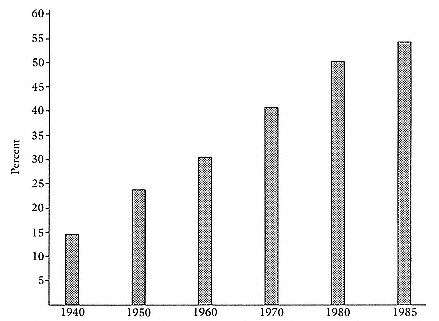
Figure 1.
Married Women (with Husband Present) in the Labor Force, United States, 1940–85
Source: U.S. Census Bureau, Statistical Abstract of the United States
(Washington, D.C.: Government Printing Office, 1985), p 398; (1987), p 383.
But they never worked, at least to this degree, by market principles. The primary form of women's work in nineteenth-century France and England was domestic service, that is, not in their own home but in someone else's home. Moreover, women did not take possession of their wage to dispose of as they wished until the twentieth century; before then they worked, as Louise Tilly and Joan Scott put it, "in the interest of the family economy" and, as a result, seemed "almost like an internal backwater of pre-industrial values within the working class family."[4] The post–World War II development, then, in which large numbers of women work in the market on a market basis, is "not a continuation, but a departure from, the earlier patterns."[5]
There are a myriad of reasons for the fact of working women. The most important, because it affects the most women, is that women have been forced to work. Increasing rates of divorce have combined with the structure of the welfare system to impose work discipline on poor women; the "feminization of poverty" is thus both cause and consequence of the inter-
vention of the labor market into women's lives.[6] Moreover, for those not quite poor but hardly rich, a second income has become an economic necessity. As Paul Blumberg has documented, in the postwar period median family income rose sharply, from (in 1978 dollars) $8,848 in 1947 to $17,640 in 1978, a trend that, not unexpectedly, almost exactly parallels the increasing number of women in the labor force. Yet that rise has slowed considerably in the years since 1978 (see figure 2). When the effect of being raised into a higher tax bracket is taken into account, the median family income in 1979 was less than in 1969, even though more women were working.[7] For families at the margin of the middle class, and increasingly for middle-class families as well, in short, women are working so that the family can, at best, remain in the same place.
Not all of the increase in female labor force participation, however, can be explained by women's being forced to work. In a study of the choices women make between work and family, Kathleen Gerson found that fragility of marriage and domestic isolation were as important in women's deciding to go to work as strictly economic reasons.[8] For many of the women she interviewed, work appeared more as a pull than a push up the economic ladder. Among middle-class women particularly, the desire to work reflects the heritage of the woman's movement and the drive toward equality of the 1960s and 1970s; no longer content to remain home, women work for self-esteem, for greater decision-making authority within their families, and for security in the event of divorce.
As Gerson's research makes clear, the weakening of the boundary between family and the market has real benefits, especially for women. These benefits are so important, moreover, that most people, including this author, believe that we should not, even if we could, "go back" to the family structure of the 1950s. (In the "traditional" family, an artificial division of labor in which fathers were responsible for income and mothers for nurturance—by absolving the father of responsibility for the children and the mother of responsibility for the family's finances—stunted almost everyone.) Yet one ought also to recognize that, along with the greater freedom of choice associated with market intervention into the family, it is more likely that considerations of self-interest associated with the economy will serve as moral codes within the family than that the family will serve as a moral world capable of influencing behavior in the economy. This moral logic of self-interested rational calculation is reflected in such areas as family size, arrangements for child care, patterns of marriage and divorce, and relations among grandparents, children, and grandchildren, all of which,
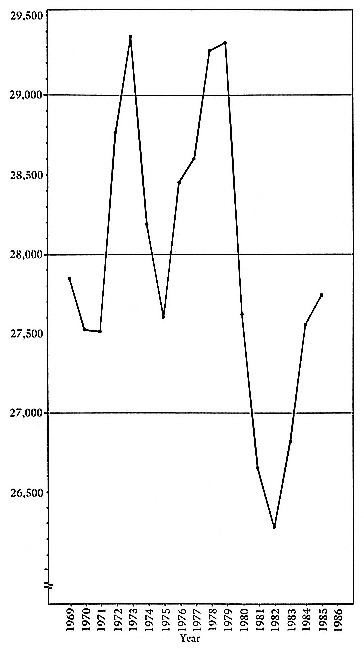
Figure 2.
Median Family Income, United States, 1969–85 (1985 dollars)
Source: U.S. Census Bureau, Current Population Reports. Consumer Income,
Series P=60. Money Income and Poverty Status of Families and Persons in U.S.
(Washington, D.C.: Government Printing Office, 1987).
when combined, do seem to indicate a far greater reliance on the market as a moral code in the intimate sphere of society than existed previously.
Family size is one of the first factors to be affected. The entry of women into the work force coincided with technological improvements in birth control, making it possible for a greater number of women to engage in rational calculation with respect to pregnancy.[9] For some women, especially those committed to a time-occupying career, postponement of pregnancy, even to the point of impossibility, was not uncommon.[10] For those who wanted both work and children, single-child families became the sound compromise position.[11] As a result, fertility rates tended to go down as female participation in the labor force went up.[12]
Any number of children, even one, needs full-time care. The ways in which children are brought up also tend to be increasingly affected by the logic of the market, especially among the middle class. In working-class families, where "the emphasis is on help, cooperation, and solidarity with a wide range of kin,"[13] there is greater reliance on relatives to watch children than among professional and managerial workers.[14] In black communities in particular, grandparents are still a much-relied-upon source of support for child care.[15] Among middle-class families, by contrast, which put "strong emphasis upon the self-sufficiency and solidarity of the nuclear family against all other kinship ties and groupings," child-care needs tend to be contracted out in the market.[16] As Gerson discovered in her research, "reluctant mothers" did not "seek help from relatives or friends unless it was voluntarily offered." Afraid of the obligations that such ties would entail, "paid child-care arrangements were overwhelmingly favored by the group."[17] The career mobility needed for success in the corporate world makes impractical any kind of child care except hired help. Rosanna Hertz puts it this way:
For many dual-career couples, the location of the worksite takes them away from close networks of extended kin; career demands may require leaving the neighborhood and often the city where their family resides. . . . Many couples believe that their income is or ought to be sufficient to enable them to arrange childcare without incurring financial or, more important, familial indebtedness.[18]
Marriage itself has, like childrearing, become oriented increasingly along marketlike principles of exchange. As Andrew Cherlin has pointed out, "the generation that came of age after World War II differed from generations before or since in its pattern of marrying, divorcing, and childbearing."[19] Those born around 1920, Cherlin discovered, married earlier, had more children, and stayed married longer than those born around
1950. For the 1920s couples, in contrast to the generation that followed, marriage ties were more binding than the kinds of self-interested relations found in markets. As with working women, couples who established the dominant social tone of the 1940s and 1950s were the statistical exception, not those who came later; late marriage, for example, is far more common historically than early marriage, and remarriage was as common in earlier times as it is now, if much more often because of the death of a spouse than divorce.
Searching for an explanation of why an earlier generation opted for more binding ties, Cherlin cites the work of Glen Elder, Jr., who investigated the experiences of the Great Depression on those who grew up in its aftermath.[20] Elder's research demonstrates the importance of economic conditions outside the family to the choices that take place within it. Male children who experienced the Great Depression, for example, achieved more later in life than those who were unaffected by it, perhaps because of the searing economic insecurity they suffered.[21] Women of the Great Depression developed strong attachments to the marriage bond.[22] Even though the depression caused enormous stress on marriages, those unions that already had strong bonds tended to be strengthened even more.[23] One possible conclusion from this research is that those who experience most directly economic vulnerability to the market are less likely to structure their moral choices around market notions of free entry, rational choice, and quick turnover. This concept may also help explain why working-class and minority families, who are also extremely vulnerable to the market economically, rely more on traditions of reciprocity and dependency on kin than middle-class families.[24]
For the generation whose formative years were spent not during depression but during historically unprecedented prosperity, inexperience with the downside of the market may help explain their greater willingness to leave marriages more quickly. Two-income families have clearly raised more people into prosperity, but at the same time pressures from the market make marriages more precarious. As Blumstein and Schwartz put it, "In today's world, work and home life are more separate than ever, with work demanding much or all of a person's energy. The relationship may too easily become a secondary aspect of the individual's life. Work-centered people may not really want the relationship to go under, but if no one is serving as its advocate, the things that made a couple's life together special may be lost."[25] Whether or not increasing divorce rates can be directly attributable to market pressures, it is not so much the extent of divorce but
rather how people get divorced in the United States that reveals how the decision-making logic of the market has penetrated the reality of family life.
As Lenore Weitzman has pointed out, ease of divorce has "shifted the focus of the legal process from moral questions of fault and responsibility to economic issues of ability to pay and financial need." Alimony may have been demeaning, but at least, in contrast to no-fault divorce, it was based on a theory of reciprocity, in which the wife's contribution to a husband's career was recognized. Equal division of property sounds fine in theory, but since men earn more money because they have a career (to which the wife often directly contributes), decisions to divide property equally "free men from the responsibilities they retained under the old system, [and] 'free' women primarily from the security that system provided."[26]
No-fault divorce, it would seem, is to marriage what laissez-faire is to economic policy, an effort by the state not to intervene in a matter of social significance. Also like laissez-faire, it is based on individualistic assumptions. New divorce laws, to continue with Weitzman's account, "alter the traditional legal view of marriage as a partnership by rewarding individual achievement rather than investment in the family partnership." While the laws are meant to apply to divorce cases at hand, they also affect behavior in marriage in the future, since they contain "incentives for investing in oneself, maintaining one's separate identity, and being self-sufficient."[27]
If husbands and wives loosen their ties, the effects will be felt by their children as well. Half of today's children will experience the breakup of their parents' marriage (or their own) during their lives.[28] One study of extremely affluent and mobile families north of San Francisco discovered that children still felt the pain of their parents' divorce five years later[29] Although most children of divorce may well recover within two years, as has been argued,[30] children of divorce nearly always lose contact with the nonresident parent over time (or continue a relationship at so superficial a level that it involves what has been called "a ritual form of childhood").[31] There seems little doubt that when marriage ties were stronger, so were ties to the generation that came after, and likewise that as marriage becomes more individualistic, so do questions of responsibility to children.
Since the income of divorced women will go down while men's will increase, where do these women turn for support, especially women with children? Many turn to the generation that came before: their own parents. How contemporary grandparents and grandchildren treat their responsibilities to each other is the theme of Arthur Kornhaber's recent
work. "A great many grandparents have given up emotional attachments to their grandchildren," he writes. "They have . . ., in effect, turned their backs on an entire generation." The result, he feels, is "a new social contract," the effects of which "have sheared apart the three-generational family and critically weakened the emotional underpinnings of the nuclear family."[32]
There is reason to believe that Kornhaber's conclusions are excessively dramatic. For one thing, ties along the female line across three generations remain strong in America.[33] Moreover, the whole thrust of Kornhaber's thesis has been challenged by Andrew Cherlin and Frank Furstenberg, who argue that because ties between grandparents and grandchildren are more subject to choice, they are more rooted in affection. Yet Cherlin and Furstenberg's informants do tend to confirm that Kornhaber is touching on important developments, for most of them wanted to experience the joys of casual interaction with (particularly young) grandchildren but also wished to avoid the responsibility of serious emotional ties. "Your children are your principal; your grandchildren are your interest," two members of Cherlin and Furstenberg's sample told them independently.[34] What is interesting about this comment is not so much the choice of an economic metaphor as it is that the accumulation of principal requires hard work and delayed gratification, as the early Protestants realized, while the accumulation of interest is passive and, from some points of view, even decadent.
Because so many American grandparents respect what Cherlin and Furstenberg call the "norm of noninterference"—laissez-faire rhetoric can be applied not only to families about to break apart but also to those staying together—ruptures have developed in the three-generational family unit as the market has come to serve as a metaphor for ties in the intimate realm. It is not surprising, therefore, that Cherlin and Furstenberg found that American grandparents "strive to be their grandchildren's pals rather than their bosses," "concentrate on those relationships that promise the greatest emotional return on their investments of time and effort," "do not play a major role in the rearing of their grandchildren," "do not directly transmit values to their grandchildren," and have, in short, "been swept up in the same social changes that have altered the other major family relationships—wife and husband, parent and child."[35]
Families in America have by no means disappeared, but they have, it would seem, been considerably changed. In a wide variety of family functions—ranging from the decision whether to enter the labor force to how many children to have to who should watch them to how relations within
the three-generational family should be structured—the market has become a more important guide to choices made in one realm of civil society, that of the family. Marriages are more frequent and do not last as long; romance gives way to the hard realities of two-income families; time is always too short, friends too busy, and relatives preoccupied with other things.[36] Few like to, but people find themselves having fewer children and turning to the market for help in raising them. These developments reveal a picture of what can be called the private family, a tie that binds, to be sure, but one that does not bind so tightly that it can override a tendency of its members to ask what their family can do for them, not what they can do for their family. Individualism—which in, say, Hegel's philosophy would be countered by the demands of family—has become an increasingly important part of the way the modern family functions.
It is by no means inappropriate, therefore, that family relations have become one of the major areas in which economic theorists of the Chicago school have applied their tools,[37] nor that some sociologists have been, at least to some degree, attracted to the resulting models.[38] Yet when calculations of self-interest do become more relevant to moral decision-making in the intimate sphere of society, we ought to recall the findings of three psychologists in a study of American values:
When, finally, individual happiness becomes the criterion by which all things are measured, when the ability to withstand, strength of character, position in a community, the good of the group, exemplary and responsible adult behavior, and/or the welfare of one's children are all subjugated to individual happiness and "self-realization," then social arrangements weaken. And the calculus assumes a market quality: all things are measured by hedonic coinage.[39]
The effects of a more privatized family, in short, can be felt not only in the family itself but also in the society around it. Thus when ties in the intimate realm weaken, ties in the somewhat more distant realm of community can be expected to weaken as well.
Community and the Market
Community, Kai Erikson has written, is "the most sociological of all topics."[40] It is the basis for the distinction between Gemeinschaft and Gesellschaft, the ingredient presumed to be missing in nearly all studies of the instrumental rationality of modern life and the empirical locus of the distinctive contribution of American sociology. Yet despite a near consen-
sus around the notion that modernity undermines community (including Marx, Weber, Tönnies, Durkheim, Simmel, Park, Wirth, Nisbet, and Parsons), contemporary sociologists and historians have found a surprising amount of community to have persisted in American life, not only in small towns[41] but even at the very center of the metropolis (particularly in working-class, minority, and ethnically homogenous areas).[42]
Although many have claimed that community need not necessarily decline as modernity advances, the concept of community is, at least to some degree, in tension with one of modernity's major instruments: the market.[43] "A community," Thomas Bender has written, "involves a limited number of people in a somewhat restricted social space or network held together by shared understandings and a sense of obligations"; thus, for community to exist there must preexist "a network of social relations marked by mutuality and emotional bonds." Community ties, consequently, are quite different than market ties. The former are intimate, reciprocal, and sympathetic, while the latter tend to be impersonal, rational, temporary, and instrumental. Americans have fought hard to hold on to community values because they understood that the growth of purely instrumental economic relationships would destroy the quality of their local societies. Their residence and their locality, in other words, would serve for them as a protection against a market over which they otherwise would have no control. "Market and community became alternative and competing patterns of order."[44]
In their effort to draw a distinction between community and the market, Americans possessed one overwhelming advantage. Land in the United States was so plentiful that not even the most ingenious capitalist could figure out a way to commodify it. By its very nature, land is difficult to organize by market principles, for markets are generally best at organizing mobile things, like commodities or human labor. As Peter Wolf has pointed out, "There is no central marketplace in real estate. The object of the transaction cannot be moved. Its value is so dependent on location that a distinct marketplace is irrelevant. Real estate is thus by nature more dependent on local people, local knowledge, and local deals than most other types of investment."[45] Precisely because real-estate organization was local rather than national, culturally and symbolically the notion that land should never be subject to the absolute logic of market priorities retained its power well into the second half of the twentieth century.
Even a generation as late as the one that came of age during the Great Depression and World War II—which, as we have seen, did not structure
internal family life according to market principles—was able to protect itself against the full effects of the market in its choice of residence as well. For many Americans of that generation, the G.I. bill offered home mortgages at below-market rates, enabling them to afford the new, and relatively inexpensive, housing that was being built in the 1950s. Income-tax policies were the single greatest subsidy in the postwar housing market.[46] Not only was land subsidized, but so were building costs, as government support for research into prefabrication helped develop aluminum clapboards, predecorated gypsum-board ceilings, plywood paneling, and other staples of postwar housing.[47] Finally, even the money that people borrowed to pay for their houses was not lent to them on market principles; fixed-rate mortgages, for example, absolved an entire generation from inflation for thirty years. Even working-class people, who are often the most exposed to the market, were, in their housing choices, protected to some degree against it. David Harvey has shown how in Baltimore "the white ethnic areas are dominated by homeownership which is financed mainly by small community-based savings and loan associations which operate without a strong profit orientation and really do offer a community service"[48] and has pointed out how such savings and loan associations once made "use of detailed local knowledge about both housing and people," before giving way to national banks more interested in straightforward considerations of profit and loss.[49]
Given this protection against the market, it is not surprising that even in urban areas community in America came to be defined in terms of social networks and subgroup ties. Claude Fischer's extensive research into urban networks indicates that modern people living in cities are not isolated, alone, and schizophrenic, as many critics of modernity alleged they would be. Fischer demonstrates that even in the largest of cities, Americans have extensive contacts with friends and workplace acquaintances. Cities exemplify what he calls "more voluntary and modern kinds of associations," founded not on kin and tradition, but instead on "political alliance, cultural tastes, sexual proclivity, common handicap, and so on."[50] It is even possible to argue, as Mark Granovetter has, that such "weak" ties actually contribute to "strong" societies, because they "are indispensable to individuals' opportunities and to their integration into communities."[51] An entire generation of urban sociologists in America has shown that the negative view of the modern city upheld by Louis Wirth is by no means accurate.
The problem is whether this positive American sense of community, like the American image of the family, can survive the penetration of mar-
ket logic into civil society. Granovetter's argument about the strength of weak ties, because it is based on new opportunities, assumes favorable economic and social conditions (mobility, for example, presupposes continued economic growth). Similarly, Fischer's research into the social life of American urban residents was undertaken under economic conditions that were unusually positive. Americans could protect community because, in many ways, the market had not yet penetrated it. Community, in other words, even when strongest, is still potentially vulnerable to economic transformations. As Fischer points out,
kinship has always been the essential interpersonal glue of society; friendships can be seen as luxuries people develop in times of security, affluence, and freedom. One wonders about how strong unexercised kin ties will be in times of social trauma. If economic collapse, war, mass migration, or some other catastrophe struck northern California, could these people, particularly the city-dwellers, rely on their otherwise inactive kinship relations for survival?[52]
In some ways, the crisis that Fischer discusses did happen, and northern California was one of the first places it occurred; but it was not an economic collapse that caused the crisis, but an economic boom. Liberated by national banking, instant communication, geographic mobility, increasing scarcity, and capitalist ingenuity from local roots, housing in America became a dynamic investment, one so profitable that it led, for the first time, to the introduction of market principles into real estate, thereby transforming the whole meaning of community in America.
Rapidly increasing housing prices (between 1976 and 1984, the median price for existing housing rose from $38,000 to $72,000, and for new housing from roughly $40,000 to $80,000)[53] have been the single most important economic reality facing Americans over the past decade. To purchase increasingly expensive homes, Americans assumed higher levels of debt. Despite a generation's experience that in any month one week's salary should go to housing, homeowning costs, which before 1980 rarely exceeded 15 percent of the owner's income, increased to 42 percent by 1982, before leveling off at 33 percent a few years later.[54] (When combined with consumer installment debt, total debt in 1986, as figure 3 indicates, had grown dramatically over a decade.) In order to afford high levels of debt, many Americans began to experiment with new financial techniques that tied them directly to money markets of various kinds: when introduced in 1981, variable-rate mortgages accounted for 28 percent of all mortgages, and increased to as high as 70 percent in the years thereafter;[55] likewise second mortgages increased from roughly $10 billion in 1987 to $55 billion
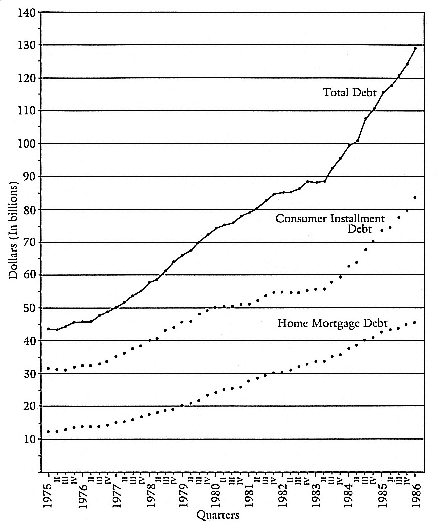
Figure 3.
Estimated Home Mortgage and Consumer Installment Debt Service Payments, United States, 1975–86
Source: Federal Reserve Bank of New York, Quarterly Review (Summer 1986), 16.
in 1985.[56] These years saw as well the introduction of an active secondary mortgage market, so that homeowners often did not know who actually possessed their mortgage note. Even the subsidy provided by federal tax policies changed, as a major tax reform in 1986 decreased the share of housing costs paid by the government. The only surprise in all this was how
long, in the development of this one capitalist society, it took before capitalism came to organize the real-estate market.
The results of the introduction of market principles into real estate—in which decisions about where and how to live are made under conditions of scarcity, both in land itself and in the money used to build on it—are predictable. Homeownership itself became more of an impossibility; although homeowners rose from 44 percent of American families in 1940 to 66 percent in 1980, this figure decreased to 63.8 percent in 1986, a decline that one government agency called "the first sustained drop in home ownership since the modern collection of data began in 1940."[57] The percentage of defaults on mortgages for one- to four-unit residential housing more than doubled between 1978 and 1983–84.[58] Moreover, the dollar amount of properties repossessed, as measured by the Federal Savings and Loan Insurance Corporation, increased from $797.4 million in December 1979 to $7.7 billion in 1985. A wall of protection between community and the market no longer seems to exist.
The changes brought about in people's relationship to the land on which they lived (and the built structures within which they lived) took place, and in no small measure were also due, to the exposure of American cities to a world-capitalist market from which they had once been more insulated. "The future of a city can never be deduced from its own internal potential trajectory," Harvey Molotch and John Logan have written, "but rather how it is institutionally integrated into the international system through which production and rent are organized."[59] While not a crisis in the sense of the Great Depression, the experience of full vulnerability to a national and international market, without support from strong ties of kin and neighborhood, creates for Americans a unique situation. Will Americans still form healthy networks, create vibrant subcommunities, join voluntary associations, help their neighbors when in trouble, support social services, and take pride in their place when place is defined by the market and no longer by community? Because the intervention of the market into the community is so recent, answers to these questions must necessarily be fragmentary. But some evidence exists that the nature of community life in America will change as market logic prevails.
As both national and international markets penetrate into urban life, some cities will become richer while others will become poorer. Interestingly enough, the moral consequences of both processes are similar. Wealthy cities like San Francisco experience a building boom, often called Manhattanization, that seems to their residents cold and unfeeling.[60] Poor
cities like Elizabeth, New Jersey, instead of bemoaning the loss of industry in favor of insurance, bemoan the loss of industry in favor of nothing. There too, however, distrust and a complete lack of community solidarity once more replaced tightly bounded social codes.[61] Cities in America seem either on the way up or on the way down; in either case, they no longer appear to their residents as places in which social ties between individuals remain strong.
A parallel situation has taken place in rural areas, which in the past decade have been subject to unusually sharp swings in economic fortune. Both "boomtowns" and "busttowns" are places where suspicion, divorce, alienation, and distrust tend to increase. The energy crisis of the 1970s, by driving up the price of imported oil, brought a boomtown mentality to such states as Colorado, Oklahoma, Texas, and Louisiana. While rapid economic growth had many positive consequences, there were negative ones as well. Young people were especially alienated from the economic boom; not only did rates of antisocial behavior increase, but "boomtown's youth" did not experience rapid growth as either liberating or beneficial.[62] Although crime itself did not increase, fear of crime and suspiciousness toward strangers did.[63] Economic growth brought about an increase in off-farm employment in rural areas, which, at least in the case of families without strong traditions in farming, caused strong marital tensions.[64] Even those sociologists who felt that the negative consequences of boomtown growth had been exaggerated still found social problems: "The boomtown phenomenon does not disrupt actual informal ties, but it does diminish the effectiveness of facilities that support informal ties such as friendliness and community spirit."[65]
Booms tend to be followed by busts. The group of Americans that in recent years faced the full force of an economic bust are the same Americans that have been most exempt from the dictates of the market: American farmers. Not only has the federal government subsidized crop prices, but in their communities farmers borrowed money from local bankers who could be flexible in terms of repayment, and they developed cooperative relations of trust with other farmers, pledging to help each other out when times were bad. As the effects of a real market hit American agriculture, the moral nature of rural life began to change. The economic stress associated with farm depression caused personal stress in marriages, as people blamed each other for the problems they faced.[66] As was the case with boomtowns, rural poverty increased homicide, suicide, and divorce.[67] Mortgage foreclosures and repossessions, as in urban and suburban areas,
increased measurably. The percentage of farmers in the Department of Agriculture's bank-lending area who went into bankruptcy rose from 0.75 percent in 1982 to 4.2 percent in 1986, while the rate of legal foreclosure increased from 18.1 percent of all farms that went out of business to 26.3 percent.[68] "Although anomie, implying a total breakdown of community, is far too strong a term," a leading expert on rural America wrote, "there appears to be widespread rural malaise and an unfilled potential for rural community development."[69]
These changes in the nature of the rural community have been exacerbated by the new social relations that have developed between bankers and farmers. Bank deregulation led to the closing of many local banks and their replacement by branches of national banks. Not unexpectedly, independent banks had been more likely to lend to smaller farmers and to be flexible in repayment schedules, while national banks insisted on making the farmer's decisions for him, including decisions about conservation and what to plant.[70] The consequences of such functionally rational decision-making on communities that had always operated otherwise have been vividly captured by journalists and novelists. Andrew Malcolm, who covered the farm crisis for the New York Times , wrote:
There was less trust in communities once held together by nods and handshakes. Now storeowners, longtime friends, asked for payment up front, or a letter from the bank guaranteeing payment come harvest. The bank . . . sent out computer-printed warnings to folks who'd never missed a payment, and were proud of it, just to be sure they wouldn't think of such a thing now. . . . The unprinted message in all of this was unmistakable: suspicion and fear were being unleashed.[71]
Rural areas have always had pride of place in the American moral imagination. Those who not only lived on the land but also worked on it for their livelihood would truly be moral. Their possession of land and their ability to apply to it their capacity to work anchored their existence in an otherwise unstable world. Only thus anchored could the farmer secure community, working together with like-minded others in ties of trust and local loyalty. When America became an urban and industrial nation, this link between morality and the land might have been permanently severed—except for the invention of the suburb.
In postwar America, the suburban home became the very definition of moral identity. Definitions of the self, as well as presentations to others, took place primarily through living arrangements.[72] As Constance Perin has emphasized, questions involving land use, no matter how economic,
are also moral in nature: they "name cultural and social categories and define what are believed to be the correct relationships among them."[73] Americans, Perin argues, possess an implicit notion of a "ladder of life," in which progress through a series of predetermined steps results in the reward of single-family homeownership. In this way, social time and social space are linked, for passage through time guarantees possession of desired space. When the system works properly—that is, when people obey rituals of deference in youth in order to be rewarded with transition to a higher status when older—all is well with the world. At the end of the process, American homeowners become home sellers, realizing the profit that has accumulated in their one major investment and therefore prepared to spend their retirement years in comfort. The suburb, as the theater in which this moral drama took place, became the alternative to the brutal world of the market. Not a place for self-interest and the war-of-all-against-all, the suburb embodied friendliness, voluntarism, and community spirit. As Herbert Gans has emphasized, class was once a dirty word in American suburbia.[74]
This entire moral life cycle, it turns out, was premised on a housing market that never really worked as a market. It assumed that housing prices would always increase, when in real markets prices go down as well as up. It assumed that one would hold on to a house long enough to pay off the mortgage, when in real markets commodities are frequently bought and sold. It assumed that one had solidaristic relations with one's neighbors, since all would be experiencing the same rites of passage simultaneously. None of these assumptions were able to survive the introduction of real markets into American beliefs about community. Far more young people will never be able to buy a house, no matter how dedicated they may be to the rules of the game. Those who do will live in them for even shorter periods than already mobile previous generations as "trading up" becomes more common and long-term financial planning more uncertain. When a seemingly "natural" life cycle is broken by realities of income and class, it is no wonder that the notion of the suburb as a refuge from the harsh realities of money declines; in contrast to the silence about class found by Gans a generation ago, Mark Baldassare in a more recent investigation found suburbanites who could hardly talk of anything else. Contemporary suburbanites, he discovered, tend to be pessimistic, distrustful, unwilling to tax themselves to pay for services, and hostile toward newcomers.[75]
As with the family, the weakening of the compartment between the market and civil society often means that the moral logic of self-interest
takes precedence over the moral logic of altruism and community service. Journalistic accounts covering the suburbs north of New York City discuss how rising housing prices and longer commuting times have made severe inroads into working-class enclaves and how as that takes place volunteer fire companies and other such nonmarket social practices no longer can recruit enough participants.[76] (In general, according to the only study available, volunteer firemen are white, married, small-town residents with generally a high school education, all of which suggests that they will, indeed, be unlikely to survive the entry of marketplace considerations into community.)[77] American suburbs were once thought of as strong cultures; indeed, a common story of American life in the 1950s was that in the suburbs conformity and group ties were so strong as to be stultifying. Now, under conditions of rising property values, the suburbs may be becoming so individualistic as to be anomic.
Although many of the transformations experienced by Americans as the market penetrates ideals about community are disruptive, the picture is obviously not entirely negative. The small community, which so emphasized moral life, was also stultifying and repressive. The bright lights of the city are difficult to shun, especially for people committed to cosmopolitan values. Mobility, for modern people, is as necessary as connectedness—and the market places a premium on mobility. Just as the entry of women into the labor market helped to destroy the inequities of the "traditional" family, the introduction of market rationality into community has had positive effects, such as the revitalization of older neighborhoods. Moreover, markets, at least in theory, like to remove "artificial" obstacles, and at least some of the progress made in America in breaking down racial and religious barriers is due to the triumph of the market, even if it substitutes income barriers in their place.
It is not the role of the market in decisions involving community that is really at issue, but its scope. From playing relatively little role in determining how Americans shall live, the market has come to play a very great role indeed. The somewhat abstract idea associated with urban economists inspired by the Chicago school—that space ought not to place emotional or traditional obstacles in the way of purely rational calculation—has begun to be more than a hypothetical possibility for many Americans. This development, moreover, has come simultaneously with the changes in family life discussed above. Because of this link between family and community, the introduction of market principles into both—at roughly the same time and applying to roughly the same generation—creates a double squeeze
on people's expectations. The community, like the family, may be able to overcome these tensions and remain intact. Yet whatever happens in the future, the penetration by the market into community indicates a weakening of civil society that will be difficult to counteract.
The Market and the Common Life
One reason why Americans put so much faith in the idea of community is that a society organized by the market does not place a premium on public things. For Americans in search of a common life to counterbalance the effects of individualism, no institution was more public than the school. If there were a trinity of American inspirational stories, education would take its place alongside family and community as a place where public morality and virtue could flourish. "Whereas the United States was late and unenthusiastic . . . about the creation of modern welfare state policies, it was early and enthusiastic about the creation of modern public schools," Ira Katznelson and Margaret Weir have written.[78] Given their attachment to the common school, Americans were quick to establish boundaries around schooling to prevent the market—always viewed as efficient, rarely as moral—from coming in.
Thanks to the efforts of a generation of "revisionist" historians, we now know that nineteenth-century economic elites viewed educational reform as a method of reinforcing capitalist class relations at a time of industrial transition.[79] The discovery of economic motives behind mass education in the United States helps correct a previous picture that emphasized moral and religious fervor as the main inspiration for those movements, but it would be a mistake to ignore moral motives entirely.[80] Early common-school advocates, as David Tyack and Elizabeth Hansot have pointed out, were motivated by their moralistic and redemptive commitment to Protestantism.[81] Agents of educational change "were actors whose authority was more moral than official. . . . What held such individuals together, in this 19th-century conception of the polity, was not the coercive or normative power of the state but their common consciousness of the laws of God and the demands of rational human order."[82] Even when, in the early years of the twentieth century, American schooling began to be organized along professional, scientific, and managerial lines, reformers still had something more in mind than a narrow fitting of unskilled workers to skilled work. For them professionalism was, however self-serving, also an ideology that emphasized service to the public good.
| |||||||||||||||||||||||||||||||||||||||||||||||||
As is the case with families and communities, the boundary between schooling as representative of community values and the market with its emphasis on self-interest has begun to break down. One indication of the declining commitment to public education is, of course, private education. Private schools have always existed in America alongside the public ones, and numerous signs indicate that their use is expanding. A dropoff in attendance at Catholic schools has been more than met by an increase in attendance at just about every other kind of private school. One researcher estimated the increase in non-Catholic private-school enrollment between 1965 and 1983 at 186 percent (see table 1).
It is not hard to find reasons for this change in Americans' commitment to public schools. Three sociologists have argued that private schooling provides greater future economic advantages than public schooling.[83] Although their data have been strongly criticized on methodological grounds,[84] the advantages of private over public schooling in America are indeed not only economic but also cultural, as an increasing number of parents know.[85] Private schools provide high school seniors with much better advice on college than do public schools, for example.[86] This may well be because public schools are characterized by legal/rational authority relationships, while private schools rely more on consensus.[87] If, in short, it is expected that people will make rational choices about schooling, it is clear which type of school, if they can afford it, they will choose. Cooper's conclusion that "parents may be treating both the private and public schools as a kind of 'educational marketplace'" seems the only realistic one.[88] (This increase in private-school attendance cannot, of course, be at-
tributed to marketplace calculation alone; fundamentalists, for example, show extremely high rates of private-school switching, but this is for religious and moral reasons, not economic.)[89]
Recognizing changes such as these, some economists and public policy advocates have urged that educational vouchers, which would enable people to purchase private schooling with public dollars, be formally adopted in the United States. This idea has never caught on, though; Americans remain leery of allowing the market to intervene directly in the one aspect of their common life they hold most dear.[90] Indirect market intervention, however, is another matter entirely. Americans who can afford to do so tend to "buy" their public school by buying their house. Suburbanization has perhaps done more to destroy the ideal of common schooling than any other factor in American life. As Katznelson and Weir point out, "the geography of the American urban system has changed in ways that have made the hegemony of the market over the public schools nearly complete."[91] If increasing attendance in private schools is combined with movement to the suburbs, in which higher school taxes become the purchase price of quasi-private education, then public schools, instead of countering the effects of the market, become the market choice for those priced out of other markets.
The market affects not only where one goes to school but also how. Just as women have been entering the labor market in ever greater numbers, so have students. It is not homework but paid work that shapes the moral consciousness of American students. "A Study of High Schools," a project cosponsored by the National Association of Secondary School Principals and the Commission on Educational Issues of the National Association of Independent Schools, emphasized the incredible demands on students' time, due in part to the fact that most high school students work while attending school.[92] A "High School and Beyond" survey taken in 1980 estimated that 75 percent of the boys and 68 percent of the girls between sixteen and eighteen years of age were in the work force.[93] Young people have always worked in America; what is new is that now students work. Two psychologists, Ellen Greenberger and Laurence Steinberg, have examined in detail the implications of teenage work on schooling. Interestingly enough, they found that many students do not work because they are driven by economic need; moreover, they do not turn their salary over to their parents (though minority students still do).[94] High school students work to have more to spend, a surprisingly large percentage of it on what would be considered "luxury" items.[95] As "A Study of High Schools" puts
the matter, "With so many opportunities competing for their attention, it is no wonder that many students—and their teachers, whose time is precious for similar reasons—regard school as just another part-time job."[96]
Working is often thought to be good for young people because it encourages independence and maturity. But this point of view, Greenberger and Steinberg argue, ignores the kinds of work available for most American teenagers.
Whereas work at one time served a valuable educational purpose for young people, performed an essential economic service to the family and community, and facilitated the development of relationships between young people and nonfamilial adults, during the past one hundred years early work experience has declined in its educational value, in its economic significance, and in the degree to which it fosters meaningful intergenerational contact.[97]
The decline of the educational value of teenage work, Greenberger and Steinberg continue, has intensified greatly in the past twenty-five years. During that time "old" styles of work, such as factory jobs or farm work, declined precipitously, while "new" styles of work, essentially service-sector jobs, increased just as dramatically. Indeed, only two jobs—in merchandising and food service—account for nearly half the jobs held by teenagers. Teenagers, especially including students, fill a particular niche in the national market: they work when other people eat dinner. Moreover, Greenberger and Steinberg found that such service-sector jobs do not prepare young people for adult work, do not contribute to intergenerational solidarity, and tend to harm performance in school. American teenagers reach adulthood knowing far more about how the market works than they do about history (or, for that matter, sociology).
Since marketplace considerations affect where and how children in America go to school, it should come as no surprise to discover that they have also become a metaphor for describing what takes place in the school. "A Study of High Schools" concluded that American high schools are best compared to shopping malls: students are buyers, and fickle ones at that, whereas teachers view themselves as sellers, often of commodities that the buyers would rather avoid. "The shopping mall high school cares more about consumption than about what is consumed." In contrast to an older image of the school, one rooted in compulsory-attendance laws, discipline-oriented teachers, and a standard curriculum, the contemporary American high school is committed to the notion of freedom of choice, which is often proudly seen as a "distinct virtue."[98]
The moral consequences of the shopping mall high school are not dissimilar from those of shopping malls themselves, for which moral sprawl is as good a term as any. "Our job is not to teach morality," one teacher told Arthur Powell and his colleagues, while another claimed, "I don't think it's good for me to impose my values on the class."[99] The stories the research team heard in a variety of American high schools confirmed the point. If lockers were vandalized, staff were quick to blame it on the lockers, not the vandalizers. Moral sanctions against improper behavior such as cheating were weak. Even when students did something blatantly wrong, staff tended to be divided on how to respond. That students might consider themselves responsible for their appearance seemed a foreign notion indeed. No moral value was attached to mastery of a subject. Faculty members were individualistic, having few meetings and few interests in common. A refusal to establish standards applied even to academic matters; teachers were quite often unprepared to draw the line between passing and failing performance. In the American high school, this study concluded, consumers have sovereignty, anything can be purchased, and, as in most laissez-faire situations, there are no coercive sanctions capable of saying no.
Many of these changes in the nature of American schooling were the result of movements to reform an older system that not only emphasized morality too much, but emphasized only one kind of morality. The early Protestant morality of American schools was anything but tolerant and enlightened; as late as 1939, a Pennsylvania teacher was fired because she worked after school in a tavern owned by her husband.[100] In a similar manner, professionalism, the ideology that replaced moral protestantism, was tied up with the interests of a class that viewed education as part of an instrumental design to rationalize a social order in which that class prospered. In contrast to the morality of a specific class or a specific religion, there is something to be said for a greater market role in individual choice in schooling, just as there is in families and communities. But it is also difficult to deny that privatization in a matter as socially important as schooling represents a step away from the notion of a republic as a group of people who share civic values in common, including the values that shape their growth and development.
Schooling is not the only common service being organized increasingly by market principles: one can see similar trends with regard to prisons, refuse collection, data processing, sewerage, bus system operations, vehicle towing, day care, child welfare services, hospitalization, ambulance services, fire protection, resource recovery, and cancer research.[101] Given the
power of the market—helped along by the ingenuity of economists who believe in its virtues—there is, theoretically speaking, no service that could not be privatized. Even national defense and road building, generally viewed as quintessential "public goods," are not immune: at least one thinker committed to the market has proposed the privatization of defense services,[102] and two other economists have argued that new technologies—such as sensors built into cars to record highway usage—can enable private companies to undertake road building on a for-profit basis.[103]
The question, evidently, is not whether common services can be turned over to private operators; they can. Rather, the question is whether they should be. Privatization is an important trend because it raises the implicit question of whether people have any common stake in the provision of the services that define their society. If they do not, then the term used to describe all this activity, deregulation, is an appropriate one, for regulation is at the heart of the social fabric. If deregulation is carried to its logical extreme, it is difficult to imagine exactly what aspects of civil society would remain.
In the Absence of Civil Society
It is possible, given the passions that moral debates can arouse, that my point in this chapter may be lost. I am not arguing that in the United States such intimate sectors as the family and the community have been completely colonized by the logic of self-interest; the notion of a "second bourgeois revolution" remains more of a wish associated with Chicago school theorists than a reality describing American life. There still exists in the United States strong support for social security, extensive medical help for the elderly, and communities that have neither gone bust nor exploded; many families are characterized by strong ties of love and caring; people still assume responsibility for aged parents; the idea of educational vouchers has never taken hold. Nor does it follow that the kinds of trends described in this chapter will continue; nearly all trends in America seem at some point to reverse themselves, and talk of a rekindling of altruism and community spirit in the United States can be heard.[104]
At the same time, while the United States does not resemble the picture the Chicago school of economics painted of a society with no compartments between the market and civil society, aspects of that picture are more of a reality today than, say, twenty years ago.[105] It is as if we can contrast distinct life courses associated with two different generations in
recent American experience. An older generation, fearful of the economic insecurity it felt when young, took refuge from the economy in civil society. Long marriages, whether satisfying or not, were combined with relatively stable communities and a commitment to the expansion of the public sector, all to create a system in which people could to some degree rely on one another for support. For a younger generation, by contrast, the market, rather than something against which individuals would be protected by civil society, has become more of a model by which relations in civil society can themselves be shaped. Marriage and childbearing are shaped increasingly by considerations of self-interest; communities are organized more by the logic of buying and selling than by principles of solidarity; and services, when no longer satisfactory publicly, are increasingly purchased privately. In a way unprecedented in the American experience, the market has become attractive in not only the economic sphere, but in the moral and social spheres as well. That trend may explain why, according to an intensive study of Americans' attitudes about themselves, a shift occurred between 1957 and 1976 "from normative concepts of morality to more individuated and morally neutral bases of self-conception."[106]
Perhaps the fairest way to conclude the discussion is to suggest that in the United States the market substitutes for a conception of civil society that no longer exists. Convinced—often correctly—that older forms of morality constrain them unjustifiably, Americans look for something better. An idealistic strain in American culture often leads reformers toward moral codes based on solidarity, reciprocity, and loyalty that seem compelling in comparison to the restrictions of the older morality and hold open a vision of future possibility. This has been the case in each of the areas discussed in this chapter, since challenges to the old morality have generally been launched by people who considered themselves to the left: in the women's movement, gentrification, and school reform, for example. Yet so weak has civil society become in the shadow of the market that when institutionalized change does take place, only the market remains to fall back on as a guide to moral obligations. That new moral obligations are created that are at least as problematic, if in a different way, than the old does not mean that Americans are rushing out and embracing the market because they are fundamentally selfish. It suggests instead that they face excruciating dilemmas. It is not easy to decide to continue with a career when your children would prefer you at home, to hire an illegal Peruvian immigrant to watch your children, to commit yourself to variable mortgage rates for thirty years, or to abandon public services for private.
Americans are not so much narcissistic as they are caught between competing moral codes, only one of which, they are convinced, will enable them to enjoy the irresistible benefits of modernity. The market, in other words, neither forces its will on unsuspecting dupes nor is eagerly embraced by selfish egoists. It is there. Not much else is. And it seems to offer the least problematic option for many good people.
The question, then, is not why the market is so strong in America, but why civil society has become so weak. An articulate notion of civil society never developed in the United States because in many ways America already was a civil society and so never needed to develop any theory about how it would work. The small town, the voluntary association, the spirit of the people—these aspects of how Americans viewed themselves contained such an emphasis on trust, friendship, and community that people simply assumed they would always be there. To the degree that these virtues were threatened at all, they seemed to be threatened by the state; to protect civil society, therefore, Americans often erected barricades in the wrong place. Suspicious of government, they did not realize until too late that the things they took for granted could be as easily destroyed by economic calculation as by political authority. Having in a sense been given the gift of society when young, Americans took it as a right rather than the remarkable present it was. If Americans now are to protect the remaining realms of intimacy and community against the market, they will have to create, through conscious deliberation, the kinds of ties of civil society that they once assumed God or nature would automatically provide.