
Chapter Nine—
Martini:
Association and Attribution
Two Masses in the first fascicles of SPB80 can be linked to Johannes Martini: the Missa Au chant de l'alouete that begins the manuscript and also the anonymous Sanctus and Agnus on folios 21-25. While the former can be attributed to Martini on stylistic grounds, the fragmentary Mass, recently recognized in Speciálník with an attribution to "Lanoy," distinctly shows Martini's influence. The attribution to Lanoy, doubtless Martini's friend Colinet (Karulo, Karolo, Karolus, and Carlo) de Lanoy, occurs in Speciálník both in the alphabetical index and over the Credo, a movement that does not appear in SPB80.[1]
Lanoy, Missa Fragment, SPB80, Folios 21-25
The Lanoy Sanctus and Agnus originally belonged to one of the most modem Masses in the manuscript. Truncated when two fascicles of SPB80 were removed, these movements are now sandwiched in between the partial copy of Du Fay's Missa Ave regina coelorum and his motet Ave regina coelorum . Along with the complete Kyrie, Gloria, and Credo, the excised folios also must have contained the missing superius of the Sanctus and Pleni. All three voices survive for the
[1] Speciálník has only the Credo and Sanctus movements (on fols. b7v-b11r; or pp. 48-55). The concordance of the anonymous Sanctus in SPB80 with the attribution in Speciálník was found by Bob Mitchell. I would like to thank Rob Wegman for this information and for graciously providing me with a transcription of the Credo.
Osanna, Benedictus, and entire Agnus. From these sections and those in Speciálník, it is clear that the Mass—with a g final and a two-flat signature in all voices[2] —was not based on a cantus firmus in the tenor, nor does it appear to have had a motto.
Certain stylistic traits of the Mass, as noticed by Rob Wegman, resemble another work copied in the 1470s, the Missa Quinti toni by Ockeghem.[3] The Missa Quinti toni also has no cantus firmus, although, unlike the SPB80 Missa , it does have a perfunctory motto in the bass, consisting of three triadic descending notes,


Wegman's valuable observations not withstanding, Martini exercised a much greater influence over Lanoy than did Ockeghem. To begin with a few random observations, neither of Ockeghem's three-voice Masses, and neither of his Masses in


[2] The tenor occasionally has only one flat.
[3] Rob Wegman, "An Anonymous Twin of Johannes Ockeghem's Missa Quinti toni in San Pietro B 80." This article includes a transcription of the surviving parts. The Missa Quinti toni was copied into Br5557 between 1476 and 1480 (Rob Wegman, "New Data concerning the Origins and Chronology of Brussels, Koninklijke Bibliotheek, Manuscript 5557," 14).
[4] On this basis Wegman argued not only that these Masses were paired as "twins" but also that Ockeghem is the most probable composer (Wegman, "An Anonymous Twin," 25-48).
Benedictus in coloration, nor with the dotted rhythmic pattern which in this Mass begins both the Benedictus and the Osanna. He prefers longas and breves. This opening rhythm is perhaps most typical of chansons by Hayne, but Martini was also familiar with it, using it both in chansons and Mass movements.
The Agnus II violates many stylistic norms for Ockeghem's settings of this text. In no Agnus II in


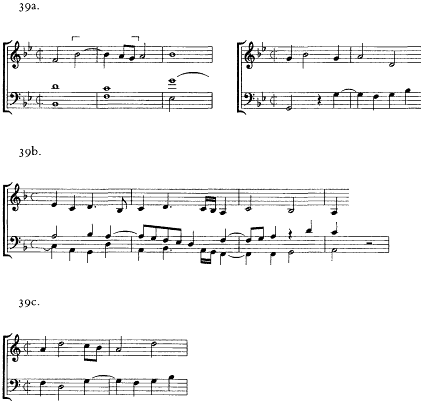
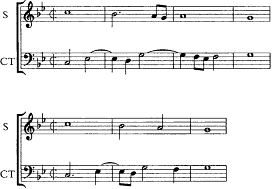
But the most striking differences with Ockeghem's style are in the cadences. The cadential patterns of the Missa differ from Ockeghem's in their counterpoint, their much greater frequency, and the regularity with which they occur on the final. Taking the last point first, the Missa clearly demonstrates the hand of another composer at the penultimate cadence of each section. They occur much closer to the final cadence than one finds in Ockeghem, and they are invariably on the final. Just as predictably Ockeghem will turn to another scale degree, often the fifth. The strong emphasis of the final in the Missa extends to the last three cadences of the Agnus I and III and the last four of the Benedictus. The greater tonal feel of the composer of this Missa marks him as a younger man than Ockeghem. Indeed, some of the unconventional cadential counterpoint indicates a youthful inexperience with a three-voiced texture. In the comparison of cadences in Example 39, the un-Ockeghemian leaps away from the final stand for the Missa , and the elegant, graceful, and unsurpassed ability to suggest closure without resorting to a suspension cadence represents the Missa Quinti toni . Martini was quite capable of the former, as a cadence from Il est tousjours (Ex. 39c) attests.
In the absence of a cantus firmus or a unifying motto, this Mass is
EXAMPLE 39. Comparison of cadences by Lanoy, Ockeghem, and Martini: (a) Lanoy, Missa (SPB80, fols. 21-25), Osanna, mm. 3-5, and Agnus III, mm. 21-22; (b) Ockeghem, Missa Quinti toni , Agnus I, mm. 42-45; and (c) Martini, Il est tousjours , mm. 27-28
unusually chansonlike in the details of its counterpoint. Several contrapuntal and melodic passages in the Mass can be found almost note for note in two chansons by Martini. Very much like both Hayne and Martini is one particular postcadential syncopated figure in the Agnus I. Hayne had used it in De tous bien plaine after the cadence marking the end of the first phrase. In the Agnus I it also comes after the first phrase, accompanied in parallel tenths (Ex. 40), which is exactly the
EXAMPLE 40. Comparison of postcadential phrases in (a) Lanoy, Missa , Agnus I, mm. 4-8; and (b) Martini, Tousjours bien , mm. 9-14 (transposed down a major second)
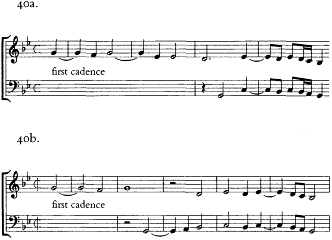
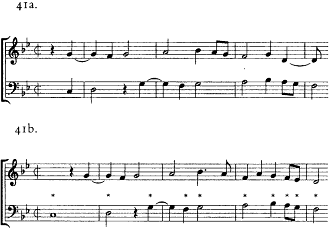
way we find it in Martini's Tousjours bien (here transposed down a major second).[5] This chanson and the Missa share another contrapuntal segment, a point of imitation that commences with a cadential suspension (Ex. 41). Once again I have transposed the chanson.[6] While the motivic and imitative use of suspensions exists in the works of most contemporaries of Busnois, it is only one hallmark of Martini's style present in this work.
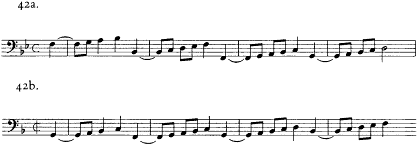
Hayne may ultimately be the stylistic inspiration for another phrase in the Agnus I, but this rising sequential figure also turns up in a Martini chanson, the (presumably) instrumental Fuge la morie (Ex. 42). Further, two of the recurring bass motives in Fuge la morie appear in the Missa . The head motive of the chanson and the beginning tenor motive of the triple meter section in the Agnus II are closely related (Ex. 43). Then, after three statements of this idea in Fuge la morie , the bass takes up a second motive (mm. 15-18), which begins the Agnus II
[5] This figure also appears in Martini's Se mai il cielo e fati fur benigni (Flor229, no. 5), mm. 34-37.
[6] See also Martini, Malheur me bat (Flor229, no. 11), mm. 38-42.
EXAMPLE 41. Comparison of counterpoint in (a) Lanoy, Missa , Agnus II, mm. 13-17; and (b) Martini, Tousjours bien , mm. 19-23
EXAMPLE 42. Comparison of sequential figures in (a) Lanoy, Missa , Agnus I, mm. 27-31; and (b) Martini, Fuge la morie , mm. 44-48 (rebarred)
EXAMPLE 43. Motivic comparison of (a) Lanoy, Missa , Agnus II, mm. 36-40; and (b) Martini, Fuge la morie , mm. 1-3
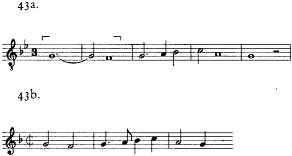
EXAMPLE 44. Motivic comparison of Lanoy, Missa, and Martini, Fuge la morie
EXAMPLE 44A . Lanoy, Agnus II, mm. 1-3

EXAMPLE 44B . Lanoy, Benedictus, mm. 31-34
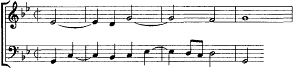
EXAMPLE 44C . Martini, Fuge la morie , mm. 15-18
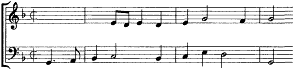
and also appears in the Benedictus (mm. 31-34) with a similar contrapuntal treatment (Ex. 44).[7]
In one imitative passage Lanoy quotes directly from his popular chanson, Cela sans plus , but here too the imprint of Martini is visible. In the Benedictus the second entrance of the superius is quickly answered by the tenor. These voices cite the second phrase of the chanson (Ex. 45a). Contrapuntal citations were not limited to the begin-
[7] The title Fuge la morie occurs in the Ferrarese source Rome 2586, while in the later Spanish source, Segovia (fol. 189v), it is called Scoen vint . Jacobus Barle, about whom nothing is known, wrote what appears to be a parody of Fuge la morie in his presumably instrumental work Moyses . It appears in Segovia with that title on fol. 191, two folios after Fuge la morie .
EXAMPLE 45. Motivic comparison of Lanoy, Missa ; Lanoy, Cela sans plus ; and Martini, contra for Cela sans plus
EXAMPLE 45A . (i) Lanoy, Missa , Benedictus, mm. 11-16 (superius and tenor); (ii) Lanoy, Cela sans plus , mm. 7-12 (superius and tenor)
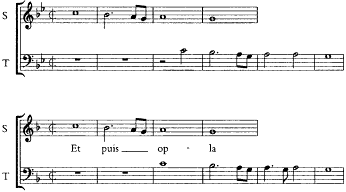
EXAMPLE 45B . (i) Lanoy, Missa , Benedictus, mm. 11-16 (superius and contra); (ii) Martini, contra for Cela sans plus , mm. 1-3 (transposed from G)
EXAMPLE 46. Motivic comparison of (a) Lanoy, Missa , Benedictus, mm. 1-5; (b) Martini, La martinella (Rome 2856, fol. 138v), mm. 1-5; and (c) Martini, La martinella (Rome 2856, fol. 55v), mm. 1-5
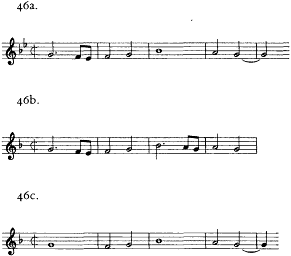
nings of chansons or to the start of the second parts any more than were tenor citations. Thus Richafort quoted in his Requiem both music and text from an interior phrase of Josquin's Faulte d'argent (at "c'est douleur non pareille"), and Du Fay in his Missa Ave regina coelorum quoted the end of his motet.[8] Interestingly, Martini made his own arrangements of Lanoy's chanson. In Rome 2856 Cela sans plus appears with a si placet bass part attributed to Martini. The opening bass counterpoint is also present in the Mass (Ex. 45b). Martini cared enough for this chanson—or its composer—to base an entire Mass on it (as did also Obrecht).
A final motivic detail: The Benedictus and Patrem begin with a melodic turn that resembles closely the opening motive of a few of Martini's Martinella compositions (Ex. 46). It is true that one can find this turn in works of Busnois, Josquin, and others. But given the com-
[8] On the former, see Alejandro E. Planchart, "Parts with Words and without Words: The Evidence for Multiple Texts in Fifteenth-Century Masses," 251; and Paul Kast, "Jean Richafort," cols. 439-43.
pelling similarities already noted and Martini's penchant for this motive, the prominent use of this particular figure as an opening motive further points to Martini as the composer whose style exerted a formative influence over this three-voice Missa . Indeed, were it not for the Speciálník attribution, the many passages related to Martini's chansons would suggest that these movements constitute the tail end of a Mass by Martini, perhaps another Missa La Martinella .[9]
Even if Martini was not the composer, he could not have been far away when it was composed. Just as Martini's influence on the creation of this Mass may be deduced from the many stylistic similarities, so too is his probable connection with it after its composition, indicated by the presence of the Mass in the first fascicles of SPB80, which contains the very repertoire that Martini is presumed to have brought to Rome from Ferrara in 1473.[10] In later years Martini and Lanoy evidently knew each other well. Lanoy was in Ferrara in March 1491. That is when illness delayed his trip from Ferrara to the Mantuan court of Isabella d'Este; by mid-October he had left Mantua without permission in the company of a singer named Alexander. Indeed, on 1 October both Lanoy and Alexander Agricola had joined the choir at the Annunziata in Florence, Karolus as a singer of the San Giovanni chapel. "Launoy" settled in Florence and married the Florentine sister-in-law of Heinrich Isaac. Earlier Martini and Lanoy may have met in Milan. "Launoy" is listed among those departing from Milan in February 1477. The length of his service in Milan cannot be determined because no other references to him there are known.[11] But these encounters are too late for Martini to have had possession of this work by early 1473. What little is known about the two musicians before this does not place them in close proximity: In 1472 Lanoy served as a
[9] There is a three-voice Mass by Martini in Ver759, the Missa In Feuers Hitz on fols. 15v-20 (J. Peter Burkholder, "Johannes Martini and the Imitation Mass of the Late Fifteenth Century," 485-86).
[10] See chapter 4, pp. 97-98.
[11] See Prizer, Courtly Pastimes: The Frottole of Marchetto Cara , 6-7, 10-11; Frank D'Accone, "The Singers of San Giovanni in Florence during the Fifteenth Century," 344; Lowinsky, "Ascanio Sforza's Life: A Key to Josquin's Biography and an Aid to the Chronology of His Works," 40-41; and the note and bibliography in Howard M. Brown, A Florentine Chansonnier from the Time of Lorenzo the Magnificent: Florence, Biblioteca Nazionale Centrale MS Banco Rari 229 , text vol., p. 50, nn. 54 and 55.
choirboy under Basiron at Bourges, and Martini is presumed to have worked in Constance by December 1471.[12]
Missa Au Chant De L'alouete, SPB80, Folios IV-9
The first Mass in SPB80 illustrates well the danger of basing an argument for any composer on criteria that do not include motivic and contrapuntal style. On a purely formal level this Mass shows the influence of Faugues.[13] Entire sections of the Mass return not once but several times. As in Faugues's SPB80 Missa and his Masses on L'homme armé, La basse danse , and Pour l'amour d'une , this Mass repeats the music of the second Kyrie for the Osanna (which itself repeats). And like Faugues's Missa L'homme armé this Mass derives another movement from the same music, in this case the Agnus III. Moreover, as in the Missa La basse danse , there is a link between the Confiteor and the Cum Sancto, the ending sections of the Credo and Gloria. While Faugues repeats all the music, the composer of the Missa Au chant has a nearly literal repeat of the first sixteen breves. Both of these sections are for four voices. In reduced scorings the same music also returns at the beginning of Pleni (three voices for six breves) and at the Credo text "Et unam sanctam" (two voices for twelve breves—the two voices, contra and superius, switch their usual parts).
But the counterpoint, the rhythmic treatment of motives, and the scoring have no relation to what can be expected of Faugues. Whereas Faugues, like Du Fay (and in a different way Busnois), commonly be-
[12] Paula Higgins, "Tracing the Careers of Late Medieval Composers: The Case of Philippe Basiron of Bourges," 15, shows that while still a choirboy (presumably an older one) Lanoy received two vicariates: at Notre-Dame of Montermoyen on 5 Sept. 1472, and at the monastery of S. Ambroise on 8 Jan. 1474; see also Lewis Lockwood, Music in Renaissance Ferrara, 1400-1505: The Creation of a Musical Center in the Fifteenth Century , 131-32.
[13] Rob Wegman, "Guillaume Faugues and the Anonymous Masses Au chant de l'alouete and Vinnus vina, " 38-42, attributes it to Faugues partly on this basis and partly on similarities of imitative texture; however, he also cautions that if not Faugues, then the most likely composer is Martini (p. 42, n. 46). Adelyn Peck Leverett concurs, concluding that "if the Missa Au chant de l'alouete is not Faugues's own, it is at the very least a close and deliberate emulation of his methods" ("A Paleographical and Repertorial Study of the Manuscript Trento, Castello del Buonconsiglio, 91 (1378)," 199).
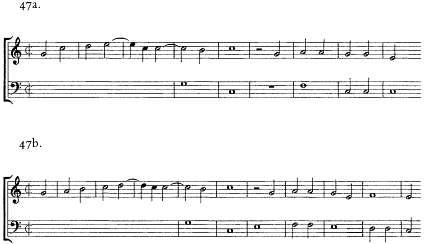
EXAMPLE 47. Comparison of counterpoint in (a) Missa Au chant de l'alouete , Et resurrexit, mm. 36-44; and (b) Martini, Missa Or sus , Crucifixus, mm. 7-17
gins the Gloria and Credo with a lengthy duet, the Missa Au chant has these movements start a tre voci , the tenor entering later. In this respect it resembles all Masses by Martini that begin these movements in tempus perfectum . With regard to other features, there are more revealing indications of Martini's authorship. Because there is so little difference between Martini's Mass counterpoint and that in his chansons, fruitful comparisons can be made to each.
Cadences in the Missa Au chant occur with Martini's customary frequency, and from a contrapuntal standpoint they fit into the same patterns that exist in the three of his Masses copied in Milan, the Coda pavon, Ma bouche rit , and Io ne tengo Masses. Of the many possible points of comparison I cite just one. Midway through the Et resurrexit of the Missa Au chant the tenorless trio concludes with the cadence shown in Example 47, a rhythmically square pattern very similar to one Martini used in the Crucifixus of the Missa Or sus .
The Et resurrexit resembles nothing so much as one of Martini's three-voice imitative chansons. At a distance of two breves the contra follows the bass, and the superius the contra, a bottom-to-top progres-
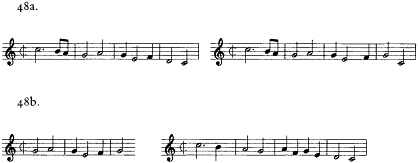
EXAMPLE 48. Motivic comparison of (a) Missa Au chant de l'alouete , Pleni, mm. 24-27; and Martini, Tres doulx regard , mm. 1-4; and (b) Missa Au chant de l'alouete , Pleni, mm. 32-34; and Martini, Tres doulx regard , mm. 9-12
sion that one finds in a half dozen of his chansons, L'espoir mieulx and Il est tel to name two.[14] In the Et resurrexit as in this group of chansons, Martini mixes imitation at the octave with that at the fifth, and he is most strict for the upper two voices. The bass joins at the beginning of a new phrase before going its own accompanimental way. In the Et resurrexit the imitation is strict to the point of being canonic for the first thirty-one breves, at which point there is one breve of free counterpoint as the contra and superius realign to replace imitation at the unison with imitation at the fifth above. In terms of its rhythm, this section, like much of the Mass, rarely departs from the tactus, certainly as compared to Faugues or Caron. There is much counterpoint in which all voices move together in semibreves or one voice asserts itself in brief syncopated figures that last for just two or three breves at a time.
Imitative passages in general in the Missa Au chant are identical to those of Martini, at times even to the motive. Example 48a juxtaposes a motive that comes midway through the Pleni with Martini's chanson Tres doulx regard . Variants of this motive are common during this time, occurring in Martini's L'espoir mieulx as well as in works by Du Fay,
[14] The others are Biaulx parle tousjours, De la bonne chiere, Il est tousjours , and Per faire tousjours .
[15] Du Fay, Missa Ave regina coelorum , Agnus II; Faugues, Missa , Agnus II; Touront, Missa Tertii toni , Agnus II; Naples Missa L'homme armé no. 1, Benedictus; Caron, Se doulx penser ; Cornago, Porque mas sin duda creas ; Anon., Puis fortuna m'avis en tal partit (MC, no. 11).
Faugues, Caron, Touront, and Cornago.[15] But of all the instances I have seen, the two in Example 48a are closest in the rhythmic and contrapuntal handling of the motive. In the Pleni and in Tres doulx regard , Martini presents the motive first in two voices, the superius and then the bass. After eight breves the tenor enters for a period of three-voice imitation on a related motive (shown in Ex. 48b).
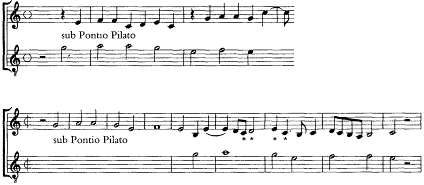
The Missa Au chant also features a motive that is ubiquitous in Martini's music, the "English" motive discussed earlier with regard to the anonymous Missa on folios 122-29. Sometimes it appears imitatively, as in Example 49a, sometimes not, as in Example 49b. And in compositions with two flats in the signature—as in the chanson Non per la (m. 40)—this motive is present in imitation a step lower. Curiously, Martini often turns to this motive when the superius dips below the contra or tenor voice; to put it the other way around, when a lower voice rises to the top of the contrapuntal texture, it often does so with this motive, as for instance, in each movement of the Missa Au chant . Example 49c compares Martini's setting of "sub Pontio Pilato" in the Missa Au chant and the Missa Or sus, or sus . Occurring either in the tenor or the contra, this motive crosses over the superius here as in the preceding examples.[16]
A notable aspect of Martini's style is his Italianate sensitivity to harmonic effects. In his Masses and many chansons based on C, Martini routinely has a phrase that juxtaposes a root-position


[16] Compare the three-voice imitative version in the Missa Au chant , Pleni, m. 32, the Missa Coda pavon , Pleni, m. 12, and the Missa Ma bouche rit , Et incarnatus, m. 31; and in his three-voice Missa in Ver759, among several instances, see the Patrem at "et propter nostram salutem" and the beginning of the Crucifixus. See also the Magnificat Secundi toni , Deposuit, m. 32; the Missa Io ne tengo , Et in terra, m. 30, and Qui tollis, m. 45; and O di prudenza fonte , m. 21. In the Missa Au chant this figure occurs also in the Et in terra, m. 22, Et resurrexit, m. 98, Sanctus, m. 16, Osanna, m. 5.
[17] This chanson exists uniquely in Paris 2973. See G. Thibault, ed., Chansonnier de Jean de Montchenu (Bibliothèque nationale, Rothschild 2973 [1.5.13] (Paris, 1991), 20, and the commentary by David Fallows on pp. lxxxviii-lxxxix.
EXAMPLE 49. Comparison of counterpoint in Missa Au chant de l'alouete and Masses by Martini
EXAMPLE 49A . (i) Missa Au chant de l'alouete , Patrem, mm. 6-8; (ii) Martini, Missa Io ne tengo , Patrem, mm. 24-27
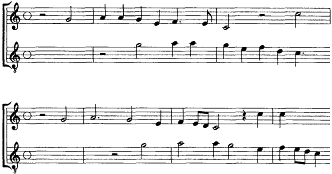
EXAMPLE 49B . (i) Missa Au chant de l'alouete , Sanctus, mm. 16-17; (ii) Martini, Missa Coda pavon , Sanctus, mm. 19-22
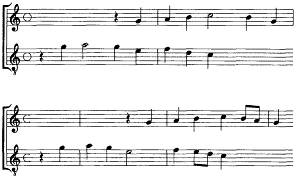
(continued )
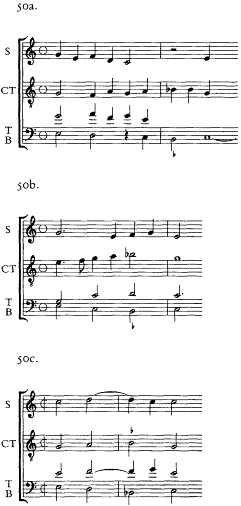
pitch and then ascending out of it while the contra moves in contrary motion. A passage from the Osanna of the Missa Au chant de l'alouete matches one from the Osanna of the Missa Coda pavon and the Crucifixus of the Missa Or sus, or sus (Ex. 50). The contra in each leaps back to G, and the bass has an unavoidable melodic tritone as it moves
EXAMPLE 49 (continued )
EXAMPLE 49C . (i) Missa Au chant de l'alouete , Patrem, mm. 37-40; (ii) Martini, Missa Or sus , Crucifixus, mm. 13-21
down from


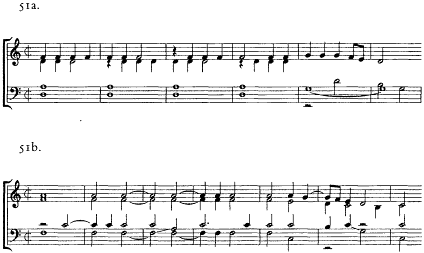
A passage of chordal recitation provides a contrast to counterpoint in the Missa Au chant as occasionally one finds also in Masses by Martini. Harmonic movement comes to a momentary standstill in the Et resurrexit of the Missa Au chant at the text "et vivificantem: qui ex patre filioque procedit" just as it does in the Qui tollis of Martini's Missa Ma bouche rit at "suscipe deprecationem nostram" (Ex. 51). For four breves the voices sustain a single triad, in the manner of falsobordone improvisations of a later period, or, more immediately, like the declamatory Psalm tone settings of Martini that were copied in the latter 1470s into the paired choirbooks ModC.
EXAMPLE 50. Comparison of harmonic movement in (a) Missa Au chant de l'alouete , Osanna, mm. 5-6; (b) Martini, Missa Coda pavon , Osanna, mm. 4-5; and (c) Martini, Missa Or sus , Crucifixus, mm. 9-10
Finally, the choice of chanson for the Mass points strongly to Martini as the composer. Martini (or one of his patrons?) evidently had an uncommon preoccupation with birds. The Missa Au chant de l'alouete would be the third Mass of his to employ a bird motif. He also wrote a Missa Cucu —based not on a chanson but on a repetitive bird call—
EXAMPLE 51. Comparison of harmonic movement in (a) Missa Au chant de l'alouete , Et resurrexit, mm. 49-54; and (b) Martini, Missa Ma bouche rit , Qui tollis, mm. 17-23
and the Missa Or sus, or sus , the text of which extols the special virtues of a cucu: "Par dessus tousles aultres / Begny soit le coqu!" and later, "Puis le jour de roes nopces / Oyseau suis devenu. / ... je suis un vray coqu."[19]
But what of the Faugues-like repetitions? If musicians at St. Peter's took an unexpected interest in the compositions of one of the most promising young northern composers to find recent employment in Italian courts, Martini shows another sign of being influenced by Faugues in the structural repetitions of the Missa Au chant . Like Faugues, Martini also wrote a Mass on a dance tune (the Missa Coda pavon ), and Faugues is the only composer other than Martini with more than one Mass in ModD, the Mass manuscript compiled in Ferrara in 1481, probably under Martini's supervision.
There is no repetition of the same magnitude in Martini's other Masses. In his Missa Io ne tengo Martini repeats the end of the Gloria at
[19] The chanson survives in Pav362. For the text see Henrietta Schavran, "The Manuscript Pavia, Biblioteca Universitaria, Codice Aldini 362: A Study of Song Tradition in Italy circa 1440-1480," vol. 2, 183-84.
the end of the Credo, but only the last eleven breves and concluding longa. Du Fay rather than Faugues is the potential model for this short repetition. He does the same at the end of the Missa Ave regina coelorum , where the endings of the Gloria and Credo coincide for the last eleven breves of counterpoint, followed by two breves with fermatas and the final longa. The possibility that Martini had a special connection to Du Fay's last Mass is also raised by an intriguing coincidence in the two Italian manuscripts that preserve it. In SPB80 and ModD the compositions that precede the Missa Ave regina coelorum are both Masses by Martini. In ModD it follows the Martini Missa de feria .[20]
SPB80 thus becomes one of a handful of manuscripts from this time that begin with works by Martini. It is no surprise that in Ferrara the manuscript ModD should begin with a Mass by Martini, but that manuscripts copied in Rome, Florence (Flor229), and Trent (Tr91) do as well suggests a broad popularity, a vogue, for the works of Ercole d'Este's composer-in-residence.
[20] On Martini's role in bringing Du Fay's Mass to Italy, and for a discussion of Martini as the prime candidate for the scribe that copied it into Tr91, see Leverett, "A Paleographical and Repertorial Study," 144-67 and 197-99.