
Chapter Two
Naths or Jogis in North India
The preceding chapter introduced Madhu Nath, the storyteller, as an individual and located him in the rural society of Rajasthan where he lives, sings, and explains his tales. Here I shall selectively explore some broader contexts of Madhu's knowledge, while continuing to touch base within the corpus of his performed texts. The tales of Gopi Chand and Bharthari as sung and told by Madhu Nath belong to a loosely bounded but nameable tradition whose roots reach back at least to the tenth or twelfth century. I shall speak of this as the Nath tradition, but its adherents or practitioners are often popularly designated Jogi , or in some areas Jugi —vernacular derivatives of yogi .
Throughout this book I use English "yogi" rather than jogi , unless referring to a specific caste in a specific region by its name of record. And I use the terms Nath and yogi interchangeably, except when focusing on the significance of their respective etymologies. Nath teachings and stories flow as one stream within popular Hinduism, contributing to and drawing from several others. The purpose of this chapter is to give readers of Gopi Chand's and Bharthari's tales a sense of these stories' roots, and of the bard's roots, within such broader cultural, historical, and religiohistorical patterns.[1]
One way of understanding the popular stories of the Naths, including Madhu's tales, is to consider them as didactically motivated representations of renunciation. In these representations both a high
[1] The progression of this chapter very deliberately leads to the tales that are our central focus. Others have written about Naths themselves as a focal topic; those seeking a fuller and more "disinterested" treatment are referred to them: Briggs 1973; Dvivedi 1981, n.d.; Mahapatra 1972, 75–96; Pandey 1980.
evaluation of world-renunciation and an appreciation of the sacrifices entailed by acting on that evaluation are transmitted for the edification and entertainment of householders.[2] The stories provide an interface between two distinguishable although intricately linked social and religious universes.
In thus formulating as separable but interwoven the lifestyles and worldviews of householders and yogi ascetics, I do not intend to address directly the big issues of "man-in-the-world" versus "world-renouncer" in pan-Indian thought. These issues have been elegantly if misleadingly formulated by Louis Dumont and worried over by many others including myself.[3] Although the following discussion may shed some light on those vexed matters, my focus is on a smaller-scale but still complex contrast. This is the contrast between householder or grihasthi Naths who form hereditary castes ( jatis ), and renunciatory or naga Naths—using naga here in its unmarked sense of celibate member of a Nath sect.[4] It seems no accident that it is frequently grihasthi Naths who purvey—not only to their own communities but to society at large—the stories of Gopi Chand and Bharthari, in which the central figures are, or become, naga Naths.
I begin by considering the term Nath as it is applied to renouncer members of a sampraday or religious sect.[5] In this context the category
[2] For an interpretive approach to these issues, see the afterword. See also Gold and Gold 1984.
[3] For Dumont's formulation see Dumont 1970; for some reflections on, reactions to, and conflicts with Dumont see, for example, Bradford 1985; Burghart 1983a, 1983b; Das 1977; Gold 1988, 3–4; Madan ed. 1981.
[4] Meaning four under the masculine noun nagau in the RSK is nath sampraday ka vah vyakti jo vivah nahin karta hai "a member of the Nath sect who does not marry." During interviews in the winter of 1987–88 I heard both Rajasthani renouncer and householder interviewees regularly employ naga in opposition to giihasthi . Used thus, naga does not refer to the particular sect of Shaivite renouncers who go naked (the primary adjectival meaning of naga ) or to the "fighting nagas "—famous battalions of these unclothed ascetics, whose participation in local military struggles is recorded in Rajasthan and elsewhere.
[5] Some scholars argue that "sect" may not appropriately translate Hindi/Sanskrit sampraday . Barz, following Wach, shows etymologically that sampraday refers positively to a "vehicle for transmission of doctrine" whereas "sect" has negative implications of a splinter group. However, sampraday also suggests a "refuge" from the ordinary world, as sect may; Barz continues to use it (Barz 1976, 39–40). More recently, van der Veer prefers "order" or "monastic order" to sect because the "church-sect dichotomy" is so alien to Hinduism (van der Veer 1988, 66–71). Like Barz, I find it convenient to use "sect" here; like van der Veer, I warn against a false jump to Christian parallels.
"Nath" is a rubric that may cover any number of loosely organized associations of Shaivite renouncers, sharing certain orientations and practices.[6] BeSides referring to a sectarian identity, the term Nath evokes a particular set of ideas concerning the merged physical and spiritual perfection possible for humans, and how to achieve it. And, not the least important in relation to our tales, Naths are strongly associated in popular thought with certain visible emblems, appurtenances, and behaviors.
I turn then to the phenomenon of householder Naths: castes whose group identity is rooted in renunciation. Such is Madhu Nath's birth group ( jati ), and it is not unique. Similar castes are present throughout India and Nepal.[7] The distinction between Nath as sect or path and Nath as caste is pronounced and critical in indigenous accounts. However, as will soon become apparent, it is also imprecise, plastic, and subject to collapse at several levels.
Nath Renunciatory Traditions in Story and History
Nath may be simply defined as "master" and the Naths as "'Masters' (of yogic powers)" (Vaudeville 1974, 85). Other sources report various complex etymologies deriving from possible syllabic deconstructions of the word nath , producing meanings such as "form of bliss established in three worlds" or "he who removes ignorance of Brahm and is absorbed in truth-consciousness-bliss" (Lalas 1962–78).[8] A yogi is an adept, a practitioner of yoga—deriving from a Sanskrit root meaning "yoke," carrying implications of self-discipline as well as union. Yoga
[6] Classifications and descriptions of various and variously organized groups of Nath renouncers are available elsewhere (Briggs 1973; Dvivedi 1981; Oman 1905, 168–86; Sinha and Saraswati 1978, 113–14; Tripathi 1978, 71–74); Nath traditions, rather than monastic organization, are my focus here.
[7] For two interesting examples see Bradford 1985, a discussion of how the South Indian Lingayat caste maintains its renouncer identity through historical and social changes; and Bouillier 1979, an ethnographic study of a renouncer caste in Nepal. On relatively recent fieldwork with other North Indian Jogi performers see Champion 1989; Henry 1988; Lapoint 1978. That a number of Jogi groups are nominally Muslim is a phenomenon well worth investigating, but I lack data and space to do it justice here.
[8] For other definitions and etymologies of Nath see also Dvivedi 1981, 3; Singh 1937, 1; Upadhyay 1976, 1–6.
is one of the six darsanas or major classical philosophical systems known in Indian thought.[9] But in relation to Nath traditions it refers particularly to various physical and meditative techniques for selfrealization. [10]
Most scholars treat the terms Nath and yogi as interchangeable when dealing with the sect and its teachings (for example Vaudeville 1974, 85–86).[11] Many, for the sake of clarity, settle upon one or the other to use when speaking of that tradition.[12] The terms Nath and yogi are far from exhausting the descriptive designations applied to Naths. Briggs discusses "Gorakhnathi," "Darsani," "Kanphata," and "Natha"—all categorizations with identical or overlapping references that at times designate members of the sect(s) with which he is concerned (Briggs 1973, 1 2). Whereas the first in the series refers to the founding guru, the second two highlight the most visible and distinctive emblem of the group—their large earrings (darsani ) worn in split ears—the descriptive meaning of kanphata .[13]
The origins of Nathism dissolve in the mists of a presumed selective merging of Buddhist and Hindu tantra, Shaivite asceticism, and yoga philosophy and practice that took place somewhere in the tenth or eleventh century (Briggs 1973; Ghurye 1964; Schomer 1987). A shadowy but imposing figure looming in those mists is Gorakh Nath—who probably lived but whose biography is totally overlaid with myth and magic.[14] Although some locate Gorakh's birthplace in northwestern India (Sen 1954,74; Singh 1937, 22) and his lore certainly flourished in Punjab, merging with indigenous tales much as it has done in Rajasthan, most cultural historians agree that the real Gorakh came from the east. Briggs, who mustered most of the sources available in his time in admirably systematic fashion, concludes that "Gorakhnath lived not later than A.D. 1200, probably early in the 11th
[9] Sources for yoga as philosophy include Dasgupta 1924, 1974; Woods 1972; Raju 1985, 336–76.
[10] See Eliade 1973; Varenne 1976; Sinh 1975.
[11] Yogi, of course, may and often does have myriad associations unconnected with Naths.
[12] Ghurye uses "jogi" (Ghurye 1964, 114–40) and Oman "yogi" (Oman 1905, 168); Dasgupta prefers Nath (Dasgupta 1969, 191–210).
[13] I follow Dvivedi 1981 and Sundardas 1965 in spelling the sect name; others use kaphata (Briggs 1973) or kanphata (Ghurye 1964).
[14] For a full hagiography of Gorakh Nath (also Gorakhnath; Goraksanath) in simple Hindi see Gautam 1986; see also Briggs 1973, 179–207; Dikshit n.d.; Pandey 1980; Sen 1960, 42–54.
century, and that he came originally from Eastern Bengal" (Briggs 1973, 250; see also Dvivedi 1981, 96–97).
Sukumar Sen characterizes the Nath cult as "an esoteric yoga cult based on austere self-negation and complete control over the vital, mental and emotional functions" (Sen 196O,42). But as Nath teachings spread within popular Hinduism, both their content and mode of transmission changed. From secret instructions imparted by guru adept to select disciple, Nath ideas passed into folklore. There, these teachings are strongly associated with the "perfection of the body" (kaya siddhi ) and the quest for immortality (Eliade 1973; Maheshwari 1980, 101).[15]
There exist numerous and conflicting stories of the origins and guru-disciple lineages of the early Nath gurus. One popular version with which Madhu Nath's tales coincide is that Gorakh was a disciple of Machhindar Nath who obtained his knowledge directly from Shiva (known as the Adi-Nath or original Nath), although he did it by trickery.[16] This association of the founding Nath guru with a wily coopting of divine power fits well with the general character of most Nath gurus in popular lore. In part 4 of Madhu Nath's Gopi Chand we see Gorakh playing all kinds of tricks on his own guru, Machhindar himself. Although he acts thus for the guru's good, such behavior nonetheless runs counter to ordinary Hindu piety that prescribes nothing but diligent obedience in the disciple role. Most striking of all in the Gopi Chand tale, Gopi Chand and Bharthari obtain immortality only through Gorakh's devious tricking of Gopi Chand's angry guru Jalindar.[17]
There exist texts, including technical manuals of esoteric yogic practice in Sanskrit and the vernaculars, whose authorship is attributed to Gorakh Nath himself, and to others closely associated with his teachings.[18] The connection between Gorakh the folk trickster
[15] Some expounders of Nathism as philosophy explicitly bar such vulgar physical aspirations (Singh 1937, 28).
[16] For summary versions of the story of Machhindar Nath (also Macchendranath, Minanath; Matsyendranath) see Bhattacharyya 1982, 285; Mahapatra 1972, 82–83; Sen 1960, 43–44.
[17] Jalandhar.
[18] For extensive catalogs and discussions of literary works attributed to Gorakh Nath and his disciples see Briggs 1973, 251–57; Singh 1937, 35–39; Upadhyay 1976, 134–79. An English translation of one important text is Sinh 1975. For the Goraksa Samhita in Sanskrit verse with a simple Hindi explanation see Gautam 1974.
hero and Gorakh the author of esoteric yoga manuals may seem slim but has relevance for an understanding of the folk traditions. The popular reputation of Nath yogis is of persons who have benefited, mysteriously but enormously, from their secret knowledge of just such techniques. If the epic texts presented in this volume make little or no reference to specific techniques, they nevertheless assume their results: magical powers and physical immortality.
Madhu's texts posit some crude but handy stereotypes for what a yogi is and does. These tales reveal two kinds of yogis: the powerful, well-known few and the powerless, nameless many. Thus, the yogis' world can seem as hierarchical as that of householders, with rank based not on birth or wealth but on ascetic prowess. Ordinary yogis, if they are described at all, are often portrayed in most unflattering ways (Gopi Chand parts 1 and 3). A polite way for a householder to greet a yogi is to tell him he doesn't look like just any old yogi.
What all yogis have in common is a lifestyle outside the domestic and social realms of marriage, work, and caste and a dedication to meditation or divine recitation. Thus all yogis sit by a campfire (dhuni )—understood as an ascetic act in a tropical climate—with lowered eyelids (palak lagaya ) and repeat divine names (samaran ). When ordered by the guru to do so, they go into villages, towns, or castles and beg for alms (bhiksa mangna ). The powerful among them—Jalindar, Machhindar, Gorakh, Kanni Pavji,[19] Charpat, and Hada, whose names and characters (except for Hada) are part of wider Nath traditions—possess the capacity to perform miracles. They can bring the dead to life and turn rocks to precious metals. Madhu's audience loves it when Charpat Nath whacks a stone with his tongs and it glitters as pure gold, or when Jalindar casually restores flesh and breath to a crumbling heap of bones.
An obvious cause-and-effect relation exists between the lifestyle and miraculous capacities of yogis. The primary conditions for, if not the sole sources of, yogis' miraculous powers are their ascetic practices or ardor (lapas ), often simply construed as unbroken meditation by the campfire. The ability to pursue such activity singlemindedly is in turn grounded in detachment from the worldly snares of women and wealth. If the hundreds of nameless, faceless, sheeplike disciples have not attained such powers, the tale suggests—if only obliquely—that
[19] Kanhupa, Krisnapad, or Kanpha.
it is because they have not fully overcome the physical and mental snares that bind mortals to an illusory world.
In physical appearance the yogis of Madhu Nath's tales look very much like members of the Nath sect described in earlier ethnological accounts (Ghurye 1964, 134; Risley 1891; Rose 1914). Their emblems of identity include a begging bowl (khappar ), a deer-horn instrument (singi nad ), a "sacred thread" made of black wool (seli ), iron tongs (chimta ), wooden sandals (pavari ), a body smeared with sacred ash (bhabhut ), and thick crystal earrings (darsani; mudra ). The earrings are especially important. For Naths, full initiation is marked by cutting the disciple's ears, and this cut is said to allow a yogi to bring his senses under control.[20]
Less frequently referred to in the tales is the one emblem that the present-day Nath caste in Rajasthan retains, although only in the token form of their turbans: the wearing of ochre-colored cloth, called bhagva . Reference to yogis as wearers of bhagva occurs only in part 4 of Gopi Chand, when Gorakh Nath is prohibited from entering Machhindar Nath's kingdom because the roads are closed to all those clothed in ochre. Unlike the deer-horn instrument, which figures in almost every mention of a yogi's appearance, ochre robes are of course worn by many non-Nath renouncers, which might account for their relative neglect in the texts.
None of the yogis in Madhu's tales, including the gurus, are particularly well spoken; indeed they curse more freely than any other characters in the epic. They never attempt to impart wisdom or enlightenment through reasoned or impassioned words; rather their language is blunt, direct, and action-oriented. They give abrupt commands, and recalcitrance is met with shocking demonstrations of miraculous power. Beyond miraculous power, yogis also assert and exercise brute physical strength. When Jalindar's superiority in hurling spells is challenged by the lady magicians of Bengal, he rouses his cowardly disciples by proclaiming, "Well, sister-fuckers, if you can't win with magic and spells, then use your tongs, give those sluts your tongs, beat them." And indeed, more than once in the tales an angry
[20] Not all Nath renouncers wear darsani . The term aughar —although it has a number of general meanings evoking such qualities as "lazy," and "carefree"—refers to a Nath yogi whose ears are not split. Briggs understands this as a "first stage" (1973, 27), but it can also refer to particular sects whose practices are less "restrained" and closer to Tantric.
yogi wields his tongs—worshiped symbol of ascetic practice by the campfire—as a club. Beyond that, all the yogis like to smoke hashish and eat sweets. And even the greatest of the gurus are not above quarrelling with, competing with, and deceiving one another.
Clearly, Madhu Nath's tales of Nath yogis do not teach their audiences any practical or spiritual disciplines. Nor do they focus on relationships between human beings and God. Although Madhu Nath invariably utters a fervent "Shiv! Gorakh!" or "Victory to Mahadev!" at the close of each sung portion of his performance, thus framing it in devotion, references to divine grace and religious emotions are scant within the stories. Yet like the framing prayers, presuppositions of spiritual discipline, human-divine relationships, devotional feelings, and grace form the backdrop before which audience members see and evaluate the yogis' actions. This evaluation is clearly based on moral standards different from those appropriate to householders—or perhaps more accurately, on a clearly defined but unresolved tension between householders' dharma and renouncers' paths.[21]
Teachings of yoga philosophy and techniques, attributed to Gorakh Nath and his followers, are not of immediate relevance in understanding Nath folk epics. On the level of allegory, popular Nath stories may indeed contain some mystic messages. For example, the unusual name of Bharthari's queen, Pingala, suggests an association with yogic physiology where the subtle channel called Pingala represents the right side, the sun, and violent action.[22] Such an association, however, never surfaces in Madhu's explanations or in any villagers' reception of the tales, to the extent that I have investigated these.[23]
The stream of Hindu thought most strongly and consciously associated with Nath teachings in rural Rajasthan is not esoteric yoga but nirgun bhakti or devotion to a God perceived as "without qualities." Nirgun bhakti is important to village religion, and one of the sects that promotes it is led by Naths (Gold 1988). The diffusion of Nath yogis and their lore antedates by several centuries the emergence of nirgun bhakti as preached and sung by medieval poet-saints called sants .
[21] I discuss this irresolution more fully in the afterword.
[22] David White (personal communication 1990) suggests that Gopi Chand's many women and his struggles to come to terms with them may have to do with the "awakening, taming and sublimation of the female energy within the yogic body."
[23] Members of Nath bhajan parties and their listeners will, by contrast, readily discuss esoteric, mystical, or subtle interpretations of the language of hymns.
Because of this chronology, the relation between Nath and Sant traditions is usually seen in terms of Nathism's influence on the iconoclastic teachings of the fourteenth- and fifteenth-century Sants.
The external trappings and postures of Naths were denigrated by Sant poets, who found them as false as any other exterior forms of religion.[24] Most scholars of medieval Hindi literature acknowledge, however, that early Sant poets such as Kabir were conversant with Nath teachings, and that Nath esoteric imagery is important in Sant poetry (Barthwal 1978; Gold 1987; Schomer 1987; Vaudeville 1974, 88–89). Barthwal cites a respectful reference to Gopi Chand and Bharthari in Kabir's verses (Barthwal 1978, 141).
In the village where I recorded Madhu's tale, the situation is curiously reversed. Rather than an active Sant tradition retaining traces of Nath influence, in Ghatiyali the Naths as caste, as leaders of a local sect, and as members of loosely organized hymn-singing groups, seem to have appropriated and become the purveyors of a somewhat altered Sant tradition. Their "bhajan parties" have an extensive repertoire of hymns including many with the signature of Kabir; others are stamped by Gorakh and Machhindar. Sometimes, the same bhajan will bear on different occasions either a Sant or a Nath signature, probably depending on the orientation of the lead singer. Madhu, living as he did in another village, was not often a participant in the nirgun bhajan sessions in Ghatiyali. However, several times during his Gopi Chand performance he presented interludes of nirgun bhajans . Clearly he felt his repertoire of Nath tales and Sant compositions to be unitary.
But Nath and Sant traditions can seem profoundly different. Sants teach surrender to divine grace; Naths, although they invoke Shiva as the original Nath and first guru, stress not devotional feeling but austere practice and a transformation of the physical being. The quest for bodily immortality with which popular Nathism is strongly associated would appear to be a very different enterprise from the spiritual development fostered by the Sants. Yet in village traditions Nath and
[24] See for example Kabir's poem translated by Hess and Singh, that begins "How will you cross, Nath, how will you cross, so full of crookedness?" (Hess and Singh 1983, 76). Centuries earlier than Kabir, the South Indian poet-saint Allama is said to have demonstrated to Gorakh Nath the superiority of his inner devotion to the yogi's "solid diamond-body" (Ramanujan 1973, 146–47; thanks to David White for reminding me of this example).
Sant teachings blend together, are referred to loosely as nirgun bhakti , and are taught by Nath gurus.
Several significant cosmological and practical elements common to the two traditions help explain their close merging in popular thought. Foremost among these would be the concept of divinity as formless and indescribable (niranjan; nirakar; alakh ), and the idea that only a guru can help human beings to realize their identity with that unknowable divinity. The reliance on a guru is greatly stressed in Nath nirgun hymns, where the "true guru within" may be invoked as in Sant poetry. Reliance on and submission to an external guru inform the plot structure of both of Madhu Nath's tales. The single element of practice stressed in the epic tales, that of samaran or divine recitation, is also an important part of the meditative practice that Sant poets taught and followed.
Madhu Nath and participants in his sect identify themselves simultaneously as worshipers of Shiva and followers of nirgun bhakti . They do not see these two persuasions as incompatible. And indeed, Naths' worship is iconographically and mythologically unelaborated, in keeping with nirgun ideas. Shiva does appear as a minor character in both Bharthari's and Gopi Chand's epics, but he appears as a yogi, or just another guru, a step higher up in the power hierarchy and chain of command from Gorakh or Jalindar Nath, and lower than an unnamed bhagvan —the Lord.[25]
Both Nath and Sant traditions disdain social norms and caste ranking, at least in relation to God.[26] Gorakh, like most of the early Sant poets, is said to have come from a low level of society.[27] However, teachings of human equality are notably absent from village Nath lore. Village society in the 1980s was still caste-ruled in many respects, and radical messages, publicly proclaimed, would probably not have been welcomed. Although Bengali traditions explicitly identify Gopi Chand's guru as a sweeper, Rajasthani versions give no indication
[25] The third long tale in Madhu's repertoire, "The Wedding Song of Lord Shiva," is almost solely concerned with deities in mythic time. This tale is not usually included in general Nath traditions, but many versions figure in Shaivite mythology (O'Flaherty 1973). When speaking of or invoking Shiva, Madhu Nath often calls him Lord Shankar; less frequently he says Mahadev or Bhola Nath.
[26] For examples see Gokhale-Turner 1981; Zelliot 1981.
[27] See Singh 1937, 23–24. The pervasive legend that Gorakh was born from a pile of cow dung testifies, some suggest, to humble origins.
that Jalindar is an untouchable. Yet a secret cult (of which I have no evidence beyond much gossip from many sources) with which Naths were often associated was said to feature as its central rite intercaste eating from a single pot. That this significant defiance of hierarchical codes should be elevated to powerful but hidden ritual speaks both for its importance to Nath belief and its untenability in the public domain of ordinary village life.
The influence of Nath sects on community life in Rajasthan has varied greatly over time and space. But it does not seem ever to have been a radical one, in the sense of undermining the socioeconomic status quo. However, the history of the Nath sect in Rajasthan is not divorced from political events. Indeed, in Rajasthan as elsewhere in India, historical research uncovers more and more political and economic roles played by supposedly otherworldly monks and yogis.28 Madhu Nath's texts propose that kings may be influenced by yogis, and such has certainly been the case at times.
Stemming from their reputed powers as religious adepts, miracle workers, and gurus but obviously supported also by a skillful command of statecraft and diplomacy, some members of the Nath sect have acquired considerable influence over ruling families and have been directly involved in affairs of state. The most notorious instance of Naths' political activities in Rajasthan unfolded during the rule of Raja Man Singh of Jodhpur.
Man Singh, the Maharaja of Marwar in western Rajasthan from 1803 to 1842, initially obtained the Jodhpur throne with the powerful aid of the yogi Ayas Dev Nath. Whether this aid was effected by prayer or by poison is unclear. Whatever the case may be, Man Singh's grateful resolve was to "rule Marwar strictly in accordance with the advice of the Naths" (Sharma 1972, 155). During Man Singh's reign, members of the Nath sect acquired unprecedented wealth and power in his kingdom, and their numbers swelled (1972, 177). That some at times abused their privileged position, indulging in luxury and sensuality, is history. The story of how the British attempted to diminish Nath influence in Jodhpur, even as the Maharaja's own behavior
[28] Historical studies discuss worldly parts played by many renouncer sects, including Naths; these include active participations in trade, politics, and diplomacy as well as military ventures (Bayly 1983, 183–85; Ghosh 1930; Sarkar n.d.; Singh 1937, 23–24).
became more yogi-like, is not the tale I have to tell here.[29] Yet Man Singh's case demonstrates that the gap between story and history is not so great as it may appear to Western readers of Madhu Nath's tales.
The last few lines of Madhu's performance of Gopi Chand include some auspicious predictions for the followers of Jalindar Nath (as opposed to those of Kanni Pavji who have been degraded to nomadic snake-charmers). One of these predictions is: "When armies die then we make the king a disciple and bring his army back to life. We bring it back to life, and make the king a disciple." The history of Man Singh's Jodhpur demonstrates that yogis have indeed at times swayed the beliefs and actions of kings, and when the tale-teller boasts of his sect's potential temporal influence he is not just spinning fantasies.
But let us beware of reading either story or history one-sidedly. Another lesson from Man Singh's reign is that yogis are susceptible to corruption, and this could serve as a cautionary tale about the alluring world of illusion to which yogis are not immune (the theme occurs too in Gopi Chand part 4). With the accumulation of wealth and property come worries over inheritance—increasing the temptation to abandon celibacy, beget a lineage, and return, even if only partially, to a householder's existence.[30]
Horace Rose complains in his discussion of Jogi divisions and subdivisions (in an ethnographic survey of Punjab and the northwestern provinces compiled at the end of the nineteenth century) that "Though professing Jogis are forbidden to marry, many of them do so, and it is impossible to disentangle the jogis who abandon celibacy from those who do not profess it at all and form a caste" (Rose 1914, 410). Rose, as a surveyor who must produce a neat alphabetically organized glossary of castes within his appointed region, is evidently peevish over these blurred categories. But his failure to "disentangle" yogis who form a caste from renouncers who have abandoned celibacy highlights one of the perpetually shifting boundaries between householding and renunciation.
[29] At one point a British officer, Ludlow, observed that "the Maharaja would have passed anywhere for a 'religious mendicant'" (Singh 1973, 82–83). See D. Gold 1992 for a full discussion of this revealing drama of cultural confrontations.
[30] For processes of "sedentarization" among Ramanandi monks of Ayodhya see van der Veer 1988, 126–30.
Nath Fatis
Naga Naths as renouncers are celibate ascetics whose traditions must be passed on through recruitment and guru-disciple transmission. Theoretically, such associations have nothing to do with jati , or birth-given caste status, but only with separate human beings' decisions to follow a particular path to divinity. In considering the distinction between householder and renouncer, however, it should also be kept in mind, as recent studies by Burghart and van der Veer have amply demonstrated, that there are many kinds of renouncers, many degrees of asceticism, and many transitions, both gross and subtle, between those degrees (Burghart 1983a, 1983b; van der Veer 1988). For example, it is not unusual for a renouncer to keep a mistress and subsequently appoint his natural child by her to be his chief disciple and successor.[31] How did castes of married yogis come to exist? "Abandonment of celibacy" is certainly one common explanation.[32]
Renouncer Naths, who may regard householder groups with a certain amount of disdain, tend to formulate the transformation explicitly as a process of degradation. Householder Naths are fallen ascetics whose ancestors could not resist the blandishments of women and domestic life. As one renouncer with whom we spoke expressed it, "Householder life is like honey, it attracts flies."
Risley provides several origin stories of Jugi castes in Bengal, all of which reinforce the proposition that these groups were engendered by a fall from ascetic perfection. In these stories the fall is attributed to seduction of the yogis by irresistible females. In one instance the caste is the product of the union of former ascetics with widows of the merchant caste; in another yoginis (female yogis) tempt siddhas (perfected male yogis) and their intercourse results in the ancestors of the caste (Risley 1891, 355–58).
Gorakh Nath is, according to Bengali legend, the only one of five original Naths to resist the attractiveness of women and all that they
[31] Komal Kothari reports groups of householder Naths in western Rajasthan who call their children chelas or "disciples" —a nice twist on the kinship metaphor that dominates the nongenetic guru-disciple relationship (personal communication 1988).
[32] See, however, Vaudeville who argues that "married"Jogis are not necessarily fallen ascetics because Nathism itself is "a kind of anti-Brahmanical, half-Buddhistic creed" (Vaudeville 1974, 87), by which she implies, as did many householder Naths, that asceticism is no prerequisite for the spiritual achievements to which Naths aspire.
represent and offer (Sen 1960, 45). As we have already noted, in Madhu's tales, Gorakh's own guru, Machhindar Nath, becomes a not-so-unwilling "victim" of Bengali queens—an episode appearing in most Nath traditions and popularized in theater and romantic literature. It is only with great difficulty that Gorakh is able to pry Machhindar away from his householder's life. Of course, mythological explanations that shift the blame from male weakness to female allure offer a rationalization that may appeal to the male bards who usually perform and transmit caste origin stories.
The ancient Hindu pilgrimage center of Pushkar, located in Ajmer district, Rajasthan, has thousands of temples, many of which are associated with a particular caste and provide guestrooms and priestly services for pilgrims of that caste. Here, the Nath sampraday and the Nath jati have separate accommodations. Renouncers do not patronize the householders' temple, nor do householders normally visit the renouncers' location. In January 1988, just following our extensive conversations with Naths from many villages who had assembled in Ghatiyali for the three-day funeral feast in December, Daniel Gold and I interviewed householders and renouncers, resident priests and wayfarers at both these Pushkar temples. We also visited a retreat of naga Naths on the outskirts of Pushkar.[33]
Despite the preliminary nature of this round of fieldwork, we were able to note certain consistent patterns in responses to our inquiries about the differences between grihasthi and naga Naths. Naga Naths often vehemently expressed a conviction that there existed a world of difference between them and grihasthi Naths. One of them formulated this distinction in a terse but illuminating fashion. He said that for him and his fellow renouncers everything is interior and "hidden" or "secret" (gupt ) whereas householders need external props. "Renouncers don't have to sing hymns or hold knowledge talks," he asserted. "They can just be mast (carefree, intoxicated): eat, drink, sleep." This is consistent with the impression given in Madhu Nath's tales that being an ordinary (non-miracle-working) yogi doesn't call for any particular aptitude.
Folklore and classical satire on renouncers often judge their exter-
[33] On this trip our time was limited. We considered these interviews preliminaries to a future depth study of Rajasthani Naths but learned a lot from the many persons who kindly agreed to talk with us.
nal trappings (ashes, beads, muttered prayers, and so forth) to be the hollow insignia of professional hypocrites. According to ascetics, however, householders are the ones whose religious postures belie their worldly concerns. Ascetics insisted that householders must perpetually, and by and large futilely, struggle to control their bodies and minds in order to draw their attention away from the ever-pressing and seductive concerns of the world of flux. Renouncers have none of these concerns and thus relax.
Householder Naths expressed their own strong convictions that living in the world offers no impediment to spiritual achievement. One of them, for example, told me that there is absolutely no difference between death rites for married members of the Nath caste and naga Naths.[34] He claimed that the use of "Gayatri mantras" at these rites—powerful spells known to sect gurus—ensures the highest Hindu aim of liberation (moksa ) and that one's worldly condition, whether householder or renouncer, is of no account.[35]
That this speaker took death rites as the critical conjunction of renouncers and householders is no accident. Their death rites are the most distinctive feature of the Nath caste, setting them apart from other Hindu villagers.[36] Naths bury their dead near their homes, rather than cremating them outside the village as is the custom for other Hindu castes. Moreover, the place of burial, although unmarked by more than a pile of stones, is referred to as a samadhi —a term usually reserved for monuments memorializing the final resting place of powerful world-renouncers.
Madhu's caste calls itself Nath, and all its members take the surname Nath, while other villagers use Nath as a term of reference for them. In the tales of Gopi Chand and Bharthari, however, although Nath occurs as a surname for renouncers, it is used less often as a general term of address or reference for people. Rather jogi and the inter-
[34] Sandra King Mulholland who has done extensive fieldwork among Nath ascetics in Uttar Pradesh comments that "not all ascetic Naths indulge" in spells and rituals (personal communication 1990).
[35] The Gayatri mantras spoken of by members of the Nath caste and sect are a set of powerful secret spells used particularly in death rituals. They should not be confused with the Sanskrit prayer recited each day by orthodox Brahmans. According to the householder Naths we interviewed in Ghatiyali, there are twenty-four Gayatri mantras and someone who knew them all could bring the dead to life; but no one today possesses that knowledge.
[36] See Gold 1988, 99–105, for more about Nath death ceremonies.
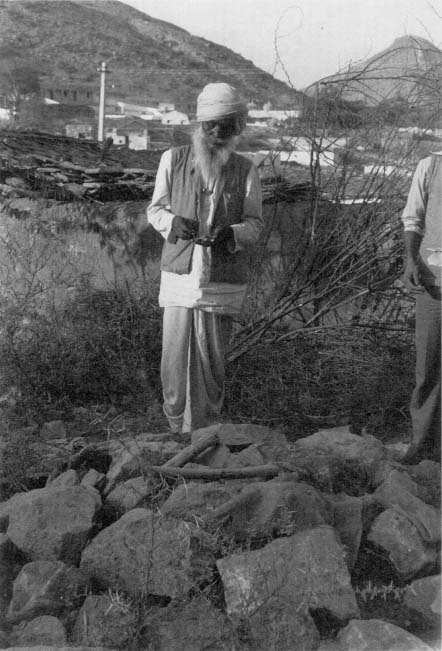
6. Ogar Nathji, a naga Nath and Madhu Nath's paternal cousin, at the grave site (samadhi )
of Nathu's mother during her funeral rites.
changeable jogi are constantly employed. When "Nath" is used to address an ordinary yogi it occurs significantly in situations of exaggerated politeness—those in which the addresser compliments the yogi as appearing "princely" and "established." Besides being used as a surname, Nath sometimes occurs in the texts in reference to Lord Shiva, the "true Nath."
Pre-independence census data and various ethnographic surveys usually do not present Nath as a caste name. Nineteenth-century British sources report castes called Jogi (or Jugi) in Bengal (Risley 1891), Rajputana (Census of India 1921), and the Punjab and NorthWest Frontier Province (Rose 1914). A Hindi census from Rajasthan, however, lists Naths as one of six subgroups under the broader heading of Jogis (Marwar Census n.d.). Commonplace throughout Indian history is the manipulation of status by castes through name changes, among other strategies. Several of the nineteenth-century sources attribute low rank and bad reputation to Jogis (Risley 1891; Rose 1914). In general, their image appears to be strongly associated with wandering minstrel-beggars, fallen ascetics, or low-status weavers. The term Nath clearly carries fewer of these pejorative associations. It is understandably preferred by the present-day Naths of Rajasthan, many of whom are prosperous farmers and serve as Brahman-like priests in temples patronized by clean castes. The current preference for Nath as a caste name in Rajasthan, then, represents a move toward greater respectability consonant with an improved economic condition.
If today's Rajasthani Naths are dissociating themselves from the negative images of begging jogis , they are in no way interested in unlinking their identity from the powerful yogi gurus whom they accept as founding ancestors. Madhu and all of his caste fellows with whom I spoke have a clear pride in this special identity, one explicitly emerging from the same roots as the Nath sect, although now distinct from it. Moreover, the traditional part Naths play in village society is based on their credentials as spell-wielding magicians—credentials rooted in their descent from yogis.
According to people with whom we talked (I cannot document this), several hundred years ago local thakurs or landlord-rulers invited families of Naths to live in their villages and gave them land grants in exchange for their magical services. Naths possess verbal spells to avert plagues of locusts and hailstones whenever they might threaten the village crops. As this power was explained to me, it consisted not in
making these plagues disappear but in sending them down the road a way. Therefore, it is not surprising that any village ruler who could afford the land grant might be interested in having a family or two of Naths settle within his dominion.
The text of Gopi Chand contains, as we shall see, the "mythic charter" for Naths' power over locusts and their right to eat well as a result of this power. Gorakh Nath commands seven species of locusts to obey yogis of both sexes: "Brothers, when yogis tell you go, then go. And maintain the honor of robe-wearers. Help them to earn their livings.... And keep their stomachs full of bread." By the 1980s when I first met them, Ghatiyali's Naths were lamenting the loss of their status as locust-removers owing to the government's successful use of pesticides to eradicate this perpetual agricultural hazard, Yet, some Naths still claim a power over hailstones and drought, and several Nath women whom I knew possessed effective spells to remove the pain and ill effects of scorpion stings.[37] Moreover, in Ghatiyali Naths are hereditary priests at two of the three shrines most closely associated with the physical well-being of the village and its livestock (Gold 1988, 44–58). It is still in their interests to maintain their special identity even though they now derive most of their income from agriculture. Many are educating at least one of their sons for white-collar professions, and whether the part of resident magicians will continue to appeal to them remains to be seen.
It should by now be evident that, although the Nath jati and the Nath sect have separate temples and their members may express strong opinions concerning their nonidentification with one another, in other ways they are closely associated, and at times they merge. Members of the Nath caste often become householder initiates into sects led by Nath renouncers, and participate in sect rituals, although these may be performed under the direction of a renouncer-guru. Such participation can be a powerful force in the lives of householders. One way the Nath sect recruits members is through the offering of children by devotees who have received favor, and householder Naths are perhaps more disposed than other castes to offer their children up in this fashion to become Nath renouncers. In Madhu's case (chapter 1)
[37] The efficacy of these spells is not simply in their words but must be cultivated by the person who wields them through an initial period of constant repetition accompanied by ascetic self-discipline.
we see another intersection: a young member of the Nath caste is given an initiation appropriate to a renouncer yet continues on a householder's life course.
Although caste origin myths and the comments of many living renouncers explicitly posit human frailty and moral debasement at the root of householder Naths' existence, the Nath jati 's lore that comprises this book sympathizes intensely with those attracted to worldly life.[38] Moreover, it perpetually vacillates in its evaluation of that attractiveness, which derives from much more than simple animal sexuality. Domestic love, and the ever powerful Hindu ideal of continuity in the male line, are values that the Nath caste's lore treats with respect. Pingala's lament, acknowledged as one of the most powerful scenes in King Bharthari's tale, has a moral force not easily refuted.
The teachings of the Nath sect are best known not through religious texts but through their stories. And purveyors of those stories, all over India, are often members of Nath or yogi castes. What makes this lore distinctive is that it is about renouncers but plays largely to householders. Thus the continuities established in the preceding discussion of sect and caste will continue to inform our investigation of Nath oral traditions.
[38] Who first told the stories of Nath yogis to whom is a tantalizing but unanswerable question. A cross-referencing of householders' and renouncers' values is, I believe, at the core of these traditions.