
Chapter 9—
Improving Irrigation Systems[*]
by Marvin E. Jensen
Abstract
The volumes of water diverted and consumed by irrigation are summarized. The effects of changes in conveyance and on-farm distribution systems on water supplies made available to the primary water users are easy to estimate. The net effects of system changes on water supplies are more difficult to ascertain. Two hypothetical projects and various system changes are used to illustrate the net effects of these changes on water availability to agriculture within a river basin. Suggested changes in irrigation efficiency terminology are provided to minimize misuse of irrigation data and misconceptions about the effects of system changes.
In an upstream project, major changes in the conveyance and on-farm systems may have little effect on net water available to agriculture if a high proportion of the excess water returns to the river system. If more land is irrigated with increased water supplies, water consumption is essentially transferred upstream from downstream areas.
In a downstream project, near the ocean or a salt sink, large increases in water supply for agriculture can be obtained if return flow systems are made part of the on-farm surface irrigation systems and the irrigated area is enlarged or diversions are reduced.
Estimates of increased water supplies for agriculture for the western states indicate that less than four percent more water may be available to agriculture as a result of massive changes in the systems.
[*] Developed cooperatively with Agricultural Research Service employees: A.R. Dedrick, D.F. Heermann, T.A. Howell, E.G. Kruse, J.T. Musick and J.A. Replogle.
Water consumption by row crops is not significantly affected by the irrigation method. Simulations of evaporation and transpiration by cotton under various irrigation systems are used to illustrate system effects.
All water diverted from a natural source such as a river or a groundwater aquifer is either consumed (evaporated), stored in a nonrecoverable strata, or returned to the river or groundwater system. Water consumption includes water evaporated from reservoirs, conveyance and return flow channels, during application, and consumptive use by irrigated crops, riparian and phreatophyte vegetation (evapotranspiration). The source of water consumed by phreatophyte vegetation in arid areas may be from distribution system seepage, surface runoff and deep percolation from irrigated lands, and periodic flooding of flood plains. Water retained below the maximum crop rooting depth in previously dry sedimentary materials is not consumed, but is essentially permanently nonrecoverable for later reuse and can be considered as water consumed.
An assessment of future water supplies for irrigated agriculture and the ultimate effects on U.S. agricultural production must consider water supplies now being consumed by agriculture. In 1975, the U.S. Water Resources Council estimated total U.S. water withdrawals to be 463 km3 , of which 76 percent came from surface supplies and 24 percent came from groundwater sources.[1] About 217 km3 were withdrawn for irrigation and 118 km3 (54 percent) were consumed.[*] About 93 percent of the water consumed was by irrigation in the western water resources regions.
Wolman estimated that 1,250 km3 of water are consumed by farm crops and pasture, 870 km3 by forest lands and browse vegetation, and 1680 km3 by noneconomic vegetation.[2] I estimated that about 840 km3 of water are consumed on nonirrigated cropland and fallow. Briefly, water consumption by nonirrigated U.S. agriculture is about 10 times that on irrigated land. Assessment of water supplies to sustain or increase U.S. agricultural production must include the effects of potential improvements in water use efficiency on nonirrigated croplands.
[*] One cubic kilometer (km ) = 10 m = 810,710 acre-feet.
Improving water conveyance and on-farm water distribution systems can increase our ability to irrigate efficiently and to avoid adverse plant water stresses. Improvements can assure maximum delivery of the water supply available to users, reduce or eliminate consumptive waste along canals and on farms, and reduce energy costs for pumping. Improving farm irrigation systems to provide better and more timely water control can result in direct benefits to individual water users, such as reduced energy costs, higher or better quality crop yields with improved water management, and often less labor.
Changes in water conveyance and on-farm distribution may increase the proportion of water diverted or pumped that is made available to the primary users in a project, but these increases may reduce by a like amount the potential amount of water available to downstream users from return flow. Similarly, changes in farm irrigation systems that minimize surface runoff and deep percolation may reduce the potential return flow or storage in nonrecoverable sites. Changes that increase the water supply available to primary users will reduce the water supply available as return flow if the increased water supply is used to irrigate more land within the project. If the seepage or deep percolation water is accumulating in nonrecoverable sites, changes that reduce these losses represent a true net water savings.
Irrigation Efficiency Terminology
There are three major common misconceptions about U.S. irrigated agriculture that relate to the engineering aspects of water use: (1) irrigated agriculture wastes 50 percent of the water it uses; (2) by increasing "irrigation efficiency," proportionally more water will be available for agriculture and other users; and (3) the irrigation method can greatly influence the amount of water consumed in crop production. The first two of these can be clarified by the following two definitions, and a schematic illustration that summarizes the average irrigated agriculture water budget.[3]
Irrigation Efficiency
Irrigation efficiency is the ratio of the volume of irrigation water required for beneficial use in the specified irrigated area to the volume of water delivered to this area.
Net Irrigation Efficiency
Net farm or project irrigation efficiency is the ratio of irrigation water consumed by crops on a farm or project to the net depletion of usable water in a river basin or groundwater system. Net depletion is diversion minus return flow.
Use of Irrigation Efficiency Terminology
Irrigation efficiency is a term that has a specific meaning to engineers, but it alone cannot be used to evaluate the impacts of changes in irrigation systems and practices on agricultural water supplies. Irrigation efficiency considers only part of the water budget, i.e., crop water consumption as compared with farm delivery or gross diversions. Return flow is not part of this term.
Net irrigation efficiency compares crop water consumption with net water depletion. An increase in efficiency means either greater crop water consumption with the same depletion, or a reduction in net depletion, or both.
The following efficiency values are obtained when using the data in Figure 9.1:
|
In this example, the return flow is 78 percent of the excess diversion (100/(81 + 48) = 0.78). If the project irrigation efficiency was increased from 41 to 82 percent and the same crops were grown, the gross diversion could be reduced to 110.5 km3 . If the return flow percentage remained the same (78 percent), the net depletion would be 90.6 + (1 – 0.78) (19.9) = 95 instead of 119 km3 . Doubling the irrigation efficiency in this example would decrease net depletion by only 20 percent.
The major ways to increase "net irrigation efficiency" and available water supplies are: (1) to reduce evaporation from soil and surface reservoirs; (2) to reduce evapotranspiration by lowor nonbeneficial vegetation of farms and flood plains; and (3) to reduce all system losses and reduce waste of usable drainage and operationally spilled water. Greater production per unit of water consumed can be achieved by increasing water use efficiency.
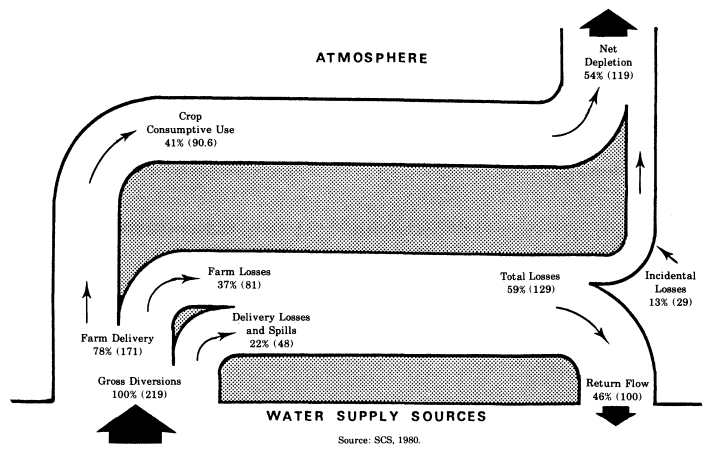
Figure 9.1
U.S. Irrigation Water Budget in Percent and in km3 /year
Source: SCS, 1980.
Other Effects of System Changes
Direct and Indirect Costs and Benefits
Major changes in conveyance or on-farm irrigation systems to conserve water will require large capital investments and probably increased annual operating costs. In some cases, lower operation and maintenance costs will offset part of the increased annual capital costs. If the primary water users cannot expand the irrigated land area as a result of system changes, their benefits from improvements may be limited to indirect benefits resulting from better water control. If the purpose of major conveyance and on-farm system changes is to reduce net depletion or salt loading, the primary beneficiaries will be the downstream or secondary water users. Improvements may result in a loss of wet wildlife habitat and benefits, if any, attributable to excess water diversions.
Water Quality
All water consumption increases the concentration of salts in the remaining downstream flow. In addition, mineralization occurs as excess water percolates through the soil, and there may be salt loading from saline subsoils. The reduction in salinity damages to downstream water users by upstream system improvements often is used to justify expenditures of public funds.
Increasing Water Supplies to Primary Users
Use of on-farm irrigation systems like sprinkler and trickle systems reduces the opportunity for excess water application, or mismanagement. Project-wide conversion to these systems can increase the potential water supply to irrigated agriculture in those cases where the fraction of surface runoff and deep percolation that returns to a reusable supply is small.
Potential Increases in Water Supplies for Agriculture
Water flow to and through irrigation projects is a complex process involving many interacting variables. The effect of changes in the water conveyance system on the water supply that can be delivered to the primary water users is easy to measure or
predict. The overall effect of system changes on water available to agriculture is more difficult to determine or predict.
Two hypothetical case examples are presented to illustrate the complexity of irrigation projects and systems, and the difficulty of estimating the probable impacts of proposed system changes on available water to agriculture. These cases involve: (1) an upstream project along a major river; and (2) a project near the downstream end of a river basin. Several examples of on-farm system changes and their effects on water use are presented in the next section.
Case A—Upstream Irrigation Project
Data for a hypothetical upstream project before and after changes in the system are presented in Table 9.1. The recommended metric volume unit for large volumes of irrigation water is 1000 cubic meters (1000 m3 ) which is one cubic decameter (dam3 ). However, the megaliter unit (ML) is more convenient for frequent use.[*] The effects of various changes in the system described under cases A1 to A4 are presented in columns 2-5 of Table 9.1.
Case A1
Line the main conveyance canal and install improved water control and delivery structures. ET is assumed to increase five percent per unit area as a result of more timely and uniform irrigations. Water diversion remains constant and the land area irrigated is increased with the additional water delivered to the water users. Surface runoff is reduced from 25 to 20 percent due to better water control.
Case A2
Same as Case A1, except the volume of water diverted is decreased because of reduced conveyance losses and the land area irrigated is held constant. ET is assumed to be five percent greater per unit area as in Case A1.
Case A3
Pump-back return flow (tailwater) systems are installed on each farm. Return flows do not re-enter the distribution system,
[*] 1000 cubic meters = 1 dam = 1 ML = 0.8107 acre-foot.
| ||||||||||||||||||||||||||||||||||||||||||||||||||||||||||||||||||||||||||||||||||||||||||||||||||||||||||||||||||
| ||||||||||||||||||||||||||||||||||||||||||||||||||||||||||||||||||||||||||||||||||||||||||||||||||||||||||||||||||||||||||||||||||||
reducing farm surface runoff to five percent. ET is increased five percent as in Case A1, the land area irrigated is held constant as in Case A2, and the diversion is reduced as needed, but the canal is not lined.
Case A4
Case A2 and A3 combined.
Assumptions
Assumptions required are that the project-wide return flow fractions for canal seepage, surface runoff, and deep percolation are 0.9, 0.8, and 0.95, respectively. If smaller values were used, the net effects would be different, but the general results would be similar.
Results
The calculated relative changes in water available for agriculture were based on the following ratio expressed in percent.

In the above ratio, Enet in the numerator is the value for case Ax, while in the denominator, it is the value for Case A. For Case A1, six percent more water would be available for ET mainly because ET was increased five percent. The upstream net water depletion would be 25 percent greater. Thus, lining the canal to reduce seepage, and expanding the irrigated area using the increased water supply, would essentially shift agricultural production from downstream areas to upstream areas. In Case A2, net depletion of water would remain about the same as in Case A, and water available to agriculture would be six percent greater than in Case A. In Case A4, water available to agriculture in this project would be 11 percent greater than in Case A, and net depletion in the upstream project would decrease five percent. Basically, major changes would have little effect on water supplies for agriculture, but could shift the area of water use.
If the return flow fractions were much smaller, i.e., 0.8, 0.6, and 0.8, for canal seepage, surface runoff, and deep percolation, respectively, then the increases in water available to agriculture by system improvements would be larger. Net depletion for Case A would be 78,000 ML instead of 68,250 ML, and water available to agriculture would be 96,200 instead of 109,940 ML. For Case A4 (lining the canal and decreasing surface runoff), net depletion would decrease to 67,800 ML from 96,200 ML, and the water available to agriculture would be 117,300 ML or 22 percent greater than for Case A.
Case B—Downstream Irrigation Project
Data for a hypothetical irrigation project near the mouth of a river or inland sink are presented to illustrate important differences in options available to increase available water to agriculture between upstream and downstream projects (Table 9.2). Basically, it is more difficult and may be more expensive to capture and reuse return flow from a downstream project, i.e., surface return flow from the project enters the ocean or a salt sink instead of the river system or groundwater. Return flow must be reduced by expanding the irrigated area, or reducing diversions to increase upstream water supplies to agriculture, or both. Data from a recent study of the Imperial Irrigation District in California were used to approximate the current status and the effects of various changes in the conveyance and irrigation system.[4]
Case B1
Line more lateral canals and expand seepage recovery lines under the main canal. Estimated recovery is about 38 percent of 96,000 ML seepage from main canals and a 90 percent reduction in the 151,000 ML of seepage from lateral canals. The resulting seepage loss is 74,000 ML instead of 247,000 ML. Farm deliveries remain constant. Water salvaged from main canal seepage and lining was assumed to be used to irrigate more land in the district at the same unit efficiency.
Case B2
Tailwater recovery systems installed on farms where surface runoff cannot be recovered in the lateral systems, to reduce project surface runoff from 22 to 5 percent. Farm deliveries are reduced to offset reduction in surface runoff. Water salvaged is used to irrigate more land in the district at the new unit efficiency.
Case B3
Changes in B1 and B2 combined. Water salvaged is used to irrigate more land in the district at the new unit farm efficiency.
Case B4
Case B2 and B3 combined and diversion reduced. Reclaimed seepage returned to the canal-lateral system. Reduction in diversion would be available to irrigate more new land outside the district.
| ||||||||||||||||||||||||||||||||||||||||||||||||||||||||||||||||||||||||||||||||||||||||||||||||||||||||||||||||||||||||||||||||||||||||||||||||||||||||||||
| ||||||||||||||||||||||||||||||||||||||||||||||||||||||||||||||||||||||||||||||||||||||||||||||||||||||||||||||||||||||||||||||||||||||||||||||||||||||||||||||||||
Assumptions
Deep percolation was kept at approximately 15 percent of ET to control salinity (leaching fraction). As the surface runoff fraction was reduced, new land was assumed to be irrigated at the same new unit efficiency without increasing total main canal seepage. If the diversion was reduced, new land was assumed to be available elsewhere in the region for agriculture to use the water.
Results
If more laterals were lined and seepage under main canals was recovered, then six percent more land could be irrigated, increasing the net irrigation efficiency from 61 to 64 percent. The present cost (July 1981) of water delivered to the farmer is $6.08/ML ($7.50/acre-foot). The estimated cost of lining the canals was $25/ML of reduced seepage ($31/acre-foot). The estimated cost of the seepage recovery system was $11/ML of water recovered ($14/acre-foot).
The largest increase in water that could be made available to agriculture would be by installing on-farm tailwater recovery systems to reduce surface runoff from about 22 to 5 percent. The cost of tailwater recovery systems was estimated to range from $6.50 to $20/ML of water recovered ($8 to $25/acre-foot).
The above example shows that if water supplies are limited, about 600,000 ML (490,000 acre-feet) of water could be made available for expanded irrigated agriculture in the region. The California Department of Water Resources estimated 541,000 ML could be saved.[5] I did not attempt to include reductions in water spills. The estimated cost of project reservoirs to accomplish reductions in water spills was $28/ML ($34/acre-foot) of water saved. The important difference between a downstream project like this and an upstream project is that additional land must be irrigated within the project or upstream from the diversion to use additional water that would become available to agriculture as a result of changes in the project system.
Potential Increases in Water Available to Agriculture
Estimates of potential reduced diversions and the resulting increases in water supplies in the 17 western states made by an Interagency Task Force showed that if all of the measures identified in a USDA Soil Conservation Service study were implemented under a 25-year accelerated program, average conveyance efficiency could be increased 10 percent and average on-farm efficiency 13 percent.[6] With no increase in irrigated area and
providing water to water-short areas, return flows could be reduced by 43.5 km3 (35.3 million acre-feet) and net depletion reduced by 4.1 km3 (3.3 million acre-feet). Diversions would be reduced by 47.6 km3 (38.6 million acre-feet), but only the 4.1 km3 (3.3 million acre-feet) would be available for additional agricultural or other consumptive uses. The estimated one-time capital cost of the entire program in 1977 dollars was $14.6 billion or $3.56/m3 of additional water made available. The cost of parts of the program would be less per unit of water than the total cost for all projects.
Effects of Changes in On-Farm Irrigation Systems
Basically, the irrigation system has little effect on water consumption by most farm crops that are fully irrigated. An exception is the use of trickle irrigation systems to establish orchards, citrus groves, and vineyards, because of reduced evaporation when the trees or vines are small. The major water conserving benefits from system changes occur when most or all of the surface runoff or deep percolation does not return to the river or groundwater aquifer.
Changes in irrigation systems can reduce surface runoff and deep percolation (Table 9.3). In the Texas High Plains, an evaluation of the volume of water pumped from the groundwater and from return flow systems on several farms showed that 14 to 23 percent of the water pumped from the aquifer was repumped with the return flow system.[7] This water would have been lost by evaporation without the return flow system.
There essentially is no deep percolation on the Pullman soil. Runoff from furrow irrigation on this soil ranges from 25 to 35 percent.
About 20 percent of the water applied on the Olton soil was estimated to be deep percolation that probably would not reach the groundwater because subsoils are dry. When farmers convert from furrow irrigation to center pivot irrigation, they generally pump about 20 percent less water with little difference in yields. However, during a dry year like 1980, sprinkler-irrigated crop yields were lower because well yields were limited.
In 1981, surface runoff averaged 32 percent and deep percolation averaged 13.5 percent, resulting in a water application efficiency of 54.5 percent on a surface-irrigated demonstration farm near Greeley, Colorado.[8] The recently leveled fields were 425 to 540 m in length and had a slope of 0.6 percent. The soils were in a SCS intake family of 7.6 to 13 mm/h (0.3 to 0.5 in/h). In 1974, prior to leveling and with 185-m long furrows, the average
| |||||||||||||||||||||||||||||||||||||||
application efficiency was 46 percent with surface runoff being 40 percent.
With level basin surface irrigation, there is no runoff and the amount of deep percolation is dependent on the control of the volume of water applied and on the timing of irrigations. Dedrick[9] observed the data in Table 9.4 in a level basin study in Arizona.
With most irrigation systems, management can have a major effect on water application or irrigation efficiencies. For example, Heermann[10] showed that the average depth of water applied on a 405-hectare nonscheduled, farmer-managed area was one-third more than on an adjacent 648-hectare area of corn on which irrigations were scheduled with a computer program. Both areas were on sandy soils and irrigated with center pivot sprinkler systems. One of the scheduled center pivot fields had the highest corn yield for the state. In this case, because of the sandy soil near the South Platte River, most of the excess water applied returns to the river system.
T.A. Howell[11] evaluated water consumption by simulating cotton water use when irrigated with trickle, sprinkler, and furrow irrigation methods near Fresno, California. Using experimental data, he used a calibrated water balance model and 1981 weather data to evaluate the potential reduction in ET by simulating the use of different irrigation methods. All cases were assumed to be
| ||||||||||||||||||||||||||||||||||||||||||||||||
irrigated and would produce about the same yields of cotton on a clay loam soil. The six cases simulated were: (A) sprinkler irrigated, 100 mm applied at 10-day intervals; (B) furrow irrigated, 150 mm at 20-day intervals; (C) trickle irrigated, 30 mm at 3-day intervals and medium soil evaporation; (D) trickle irrigated, 10 mm daily applications and medium soil evaporation; (E) trickle irrigated, 10 mm daily applications and low soil evaporation (buried lines or irrigating alternate rows); and (F) trickle irrigated, 10 mm daily application and high soil evaporation (closely spaced lines). The water application efficiency was 80 percent for sprinkler irrigation, 85 percent for furrow irrigation, and 92 percent for trickle irrigation. Irrigations began when 150 mm had been depleted on all treatments. Irrigations were terminated 125 days after starting to irrigate in all cases except for the furrow case in which irrigation was terminated 110 days after starting. All simulations ended 150 days after starting to irrigate. The soil was assumed to hold 450 mm of available water. All treatments received a 300-mm preplant irrigation.
The simulation results, expressed in mm, and the relative total ET compared with Case A are shown in Table 9.5. The average ET for the sprinkler and furrow cases is 772 mm (30.4 inches). The ET for the trickle irrigated cases ranged from 2 to 9 percent
| |||||||||||||||||||||||||||||||||||||||||||||||||||||||||||||||
less, except for the low evaporation case (E) which was 16 percent less than the ET for the sprinkler case. The reductions ranged from 6 to 13 percent when compared with the furrow irrigated case. Howell indicated that lysimeter measurements of total ET by tomatoes which were trickle irrigated (daily) and furrow irrigated (each 10 days) made at Davis, California, by W.O. Pruitt were nearly the same (560 mm), which supports these simulated values. These results clearly show that water consumption by trickle irrigated row crops is not much different from row crops irrigated with furrow or sprinkler methods.
A five-year study of trickle irrigated cotton in New Mexico using water of medium salinity (1200 ppm) showed that trickle irrigated plots yielded six percent more lint cotton of comparable lint quality with 25 percent less water applied than that applied on the surface irrigated plots. However, the soil salinity increased from 25 to 100 percent in the 30- to 130-cm depth on the trickle irrigated plots.[12]
Discussion of Chapters 8 and 9:
Marshall J. English
The technological possibilities for maintaining agriculture with less water have been summarized well in these two chapters. It is left to me to provide emphasis and additional perspective where I can, and to raise one additional topic.
As Dr. Jensen has pointed out, irrigation diversions could be reduced substantially in some areas by increasing conveyance and application efficiencies, but most of the water wasted by inefficiencies would eventually be returned to a river or aquifer anyway as percolation or runoff. So the ultimate water savings associated with improved irrigation practices would be the result of:
· reduced transpiration by wild plants, such as vegetation along canals and drainage ditches, and evaporation from ponded water;
· reduced evaporation from soil surfaces during the early stages of crop development by improved management or drip irrigation;
· prevention of runoff or percolation into the ocean, saline sinks, or other bodies of water where the water is rendered unusable.
Dr. Jensen indicated that these savings could amount to a modest fraction of total diversions in the western states. The capital costs to accomplish these savings might be high for the amount of water saved, but these costs could be offset to some extent by reduced energy costs, reduced capital costs for pumps and wells, and by the opportunity costs associated with the water saved.
I would like to add additional perspective concerning the third item of the list. The third item, in its broadest sense, may include return flows that are partially degraded by salts leached from soils or subsoils. These saline return flows can adversely affect downstream crop production. Structural or irrigation system improvements which reduce percolation may reduce downstream salinity. While this may not increase the water supply per se it can enhance the productivity of the water, which amounts to the same thing. Reducing percolation is a significant conservation technique in a few locales where the salinity derived from percolating water, leaking canals, etc., is substantial. Examples include the Roaring Fork and Grand Valleys of Colorado where project irrigation efficiencies are low and the subsoils are highly soluble marine evaporites.
I would also like to add one item to the list of possibilities for saving water. This fourth item would be reduced transpiration by crops. Most of the water consumed by irrigated agriculture is lost to the atmosphere through transpiration. Unfortunately, if crop transpiration is reduced, yields will also be reduced; the two are inextricably linked. Nevertheless, a reduction in transpiration might be economically feasible under some circumstances. This idea is based on the relationships shown in Figure 9.2. The dashed line represents the relationship between transpiration and yield. The solid line shows the relationship between total water use and yield. The horizontal distance between the two curves is the water wasted as runoff, percolation, or unproductive evapotranspiration. A combination of high irrigation uniformity and careful irrigation management can narrow the gap between the two curves, though some gap will always remain.
The highest levels of transpiration (and crop yields) are achieved when soil moisture levels are kept uniformly high throughout the field. But maintaining uniformly high soil moisture levels requires frequent irrigation. It also requires that excess water be applied to compensate for the nonuniformity of applications and the inhomogeneity of the soil. Excess applications insure that those parts of the field receiving the least water
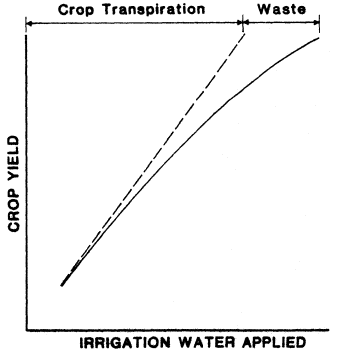
Figure 9.2
Relationship between Water Use and Crop Yield
will be fully irrigated. Because of these practices, irrigation tends to become less efficient as higher levels of transpiration are reached, which is why the water-use line diverges from the transpiration line. As efficiency decreases, irrigation becomes more costly and more energy intensive, and so the marginal costs of production tend to increase as we approach maximum yield.
Now consider the consequences of under-irrigating the crop by a small amount. If we arbitrarily decide to reduce transpiration by, say 10 percent, we will sacrifice perhaps 10% of potential yields. But it then becomes possible to irrigate less frequently and to reduce the excess applications. The consequent reductions in energy, capital, labor, maintenance, and other production costs may be greater than the reduction in gross income, in which case net income will increase. This is a straightforward application of a fundamental principle of economics; we want to reduce the
level of production until the marginal cost of production just equals the value of the marginal product. Profit is maximized at that point. English and Nuss (1982) did a hypothetical case study of this concept by designing an irrigation system explicitly to under-irrigate a wheat field in eastern Oregon.[1] For the particular circumstances which they considered, a 24 percent reduction in evapotranspiration was possible without any reduction in net income.
The yield reduction associated with deficit irrigation would be offset by increased production if the water saved were used to irrigate additional land. Furthermore, if the newly irrigated land includes land that is not already being farmed, more natural precipitation will be captured, which will increase the effective water supply.
This approach to irrigation offers a way to compensate for reduced water supplies, but it involves theoretical and practical questions that have not yet been fully explored. Researchers have been actively examining these questions, and Rosenberg was referring to one aspect of that research when he talked about irrigating at critical stages of growth. However, it should be noted that deficit irrigation is not fundamentally a radical departure from normal irrigation practice. In fact most fields are under-irrigated to some extent. SCS guidelines are commonly used in specifying irrigation system performance. These guidelines are based on an 87.5 percent adequacy, meaning that 87.5 percent of the field will be fully irrigated. Thus ordinary irrigation practices following SCS guidelines allow a degree of deficit irrigation already.
To my knowledge, the possible economic benefits of this approach to irrigation have not been systematically analyzed for working farms, although various theoretical analyses have been carried out. It is difficult therefore to estimate the returns that might be realized by this approach. My impressions at this point are:
· Where irrigation costs are moderate, irrigation systems are already in place, and water supplies are not limiting, this approach to irrigation offers only slight economic advantage.
· Where total irrigation operations costs are high or where a new irrigation system is to be built, profits may be moderately increased by this approach.
· Where water supplies are limiting and the water saved by this technique can be used to put additional land into production, profits may be increased significantly. Note that this situation may also result in an actual increase in water supply, as discussed earlier.
The discussion up to this point has introduced an economic perspective. We have been asked to discuss the technical aspects of maintaining agricultural productivity with less water, but we are implicitly concerned with maintaining the profitability of the agricultural industry. The techniques that have been described in this volume can add to the usable water supply. But some of them will also reduce production costs and by doing so will further compensate for limited water supplies. For example, water harvesting and snow management were discussed in terms of their potential for conserving water, but these techniques can also reduce irrigation costs, and thereby increase profitability.
Finally, there are one or two points that I would like to raise concerning Rosenberg's discussion of water harvesting and snow management. We should keep in mind that when water is trapped on an upstream farm by these techniques, it may mean less water available for downstream users. It makes economic sense to trap the water where it falls rather than to pump it for use somewhere else. Nevertheless, this technique may only shift a portion of the water supply from one region to another, rather than increase the supply.
It should also be kept in mind that water harvesting will not be effective unless the soil is sufficiently deep to store the water. There are areas where precipitation exceeds the storage capacity of the soil, and erosion is continuing to reduce soil depths in much of the country; the Palouse region of the Northwest is a good example. In the long run, this continuing soil loss may limit the effectiveness of water harvesting and force us to use irrigation as a substitute for dryland agriculture. Erosion control is therefore relevant to the problem of dealing with reduced water supplies. Water harvesting can contribute significantly to erosion control by reducing surface runoff.
Discussion of Chapters 8 and 9:
Wilford R. Gardner
In their respective chapters, Rosenberg and Jensen have given excellent reviews of the prospects for maintaining present crop yields with less water through improved engineering practices and through crop adaptation. What I should like to consider in these brief comments are a few factors which will determine which agronomic and engineering practices will actually be adopted, and the information that must yet be developed if dramatic water savings are to be realized.
First, it must be accepted that plant transpiration is a mandatory cost which the plant must pay as a consequence of the physical pathway which permits CO2 to be taken up for photosynthesis. Rosenberg described a number of approaches to reduction of water loss during CO2 uptake, but thus far most of these are only interesting concepts which have not resulted in encouraging reductions in water use. Except for very modest differences between plant species, the amount of dry matter produced per unit water transpired depends upon the saturation deficit of the atmosphere and the metabolic pathway (C3 , C4 or CAM). Improvements in water use efficiency in the near term will come mainly from increasing the harvest index, i.e., increasing the fraction of the plant that is of economic value to the farmer. This will be achieved through a combination of plant breeding and better management of plant population. Plants which are less sensitive to brief periods of water stress can be more readily managed under water-limiting conditions than sensitive plants, even though their inherent water use efficiencies may be virtually identical. Plant breeders have already made tremendous progress in developing plants that produce more grain with less vegetation, though the limit to this process does not yet seem to have been reached. However, producing more dry matter with the same amount of transpired water, or the same dry matter with less water, does not offer immediate prospects for large savings in water. Even the so-called low-water-using plants must transpire, and offer advantages over sensitive plants mainly in that they are more forgiving of water stress, whether planned or inadvertent.
The major gains in water use efficiency will come through reduction in evaporation from the soil surface and from reduction in runoff and percolation losses. Reduction of losses from the delivery system itself is a matter of straightforward engineering and economics. Jensen gives a good discussion of this aspect.
Tailwater recovery systems are also quite straightforward and readily evaluated. Reduction of percolation and evaporation losses is more difficult.
Only two approaches give any real promise for reducing evaporation losses. If the fraction of the soil surface wetted can be reduced, or the number of times that it is wetted reduced, savings can be affected. Drip irrigation and alternate furrow irrigation both achieve some reduction in evaporation, though these measures are of value only under irrigated conditions and are of no assistance under rainfall conditions. A second solution is a surface mulch of some sort. Dust mulches and mulches of crop residue have proven to be of very limited value in reducing surface evaporation. An impervious mulch, such as a plastic covering, offers significant savings. Only in a very limited number of cases has this proved economically attractive. The cost/benefit ratio must change significantly before this measure will be adopted for other than very high value crops. Narrower row spacing, resulting in earlier closure of the crop canopy, tends to reduce surface evaporation, though this practice must be considered in the context of the other consequences of high plant population.
The greatest opportunity for reduction in crop water use on the farm is in the reduction of deep percolation. This will be achieved simply by applying less water during an irrigation. How much reduction in yield will accompany that reduction in water application is a matter of how uniformly the water is applied. Existing techniques for water application often result in very nonuniform distribution of water, with parts of many fields getting as much as twice the needed water. This is especially true of furrow irrigation. Even when the land is laser-leveled, it is virtually impossible to achieve a uniform distribution of water from one end of the field to the other. Variable soil properties combine with the variations inherent in the irrigation technique to ensure this result. Greater uniformity can be achieved by a number of techniques. Space does not permit a review of them here, but the most dramatic results are achieved through drip irrigation systems, which, when designed properly, assure almost negligible variability.
The problem facing the farmer in achieving uniformly efficient irrigation is not so much a technical problem as an economic problem. We know that sprinkler irrigation, laser-leveling, drip irrigation, and other engineering measures increase water application efficiency. We know the value of any water saved by these
practices. What we lack, unfortunately, is adequate information on the potential reductions in water use and potential increases in yields for a particular situation. Because of the variability of soils and other site-specific factors, it is very difficult to make a cost/benefit analysis for any given farm. The cost of laser-leveling is sufficiently modest that a farmer can undertake it on speculation. Sprinkler irrigation systems are costly, and drip irrigation systems even more so, and the benefits are difficult to quantify. Small scale irrigation experiments on research farms are of some help, but the results cannot be reliably scaled up to field-size operations, nor can the results from one soil necessarily be transferred to another soil. It has been estimated that it takes at least 1800 individual measurements to obtain a good quantitative assessment of the permeability of a field. Few farmers have even a single permeability measurement upon which to base a design, let alone an understanding of the variability of each field.
Future improvements in water use efficiency on the farm will come largely from irrigation management practices more closely tailored to the local situation. No longer will maximum yield per unit of land be the major criterion of merit. The yield per unit of water will also be important. This means that instead of managing a farm or a field according to its average properties, smaller units will have to be irrigated according to their properties. While we have measuring techniques which permit us to obtain the necessary information in the field, they are not now sufficiently simple and inexpensive that they lend themselves to routine application. There is a serious gap between what is known about irrigation efficiency and common irrigation practices.
A final point seems worth making. Much present irrigation practice is predicated upon the assumption that "beneficial use" of water justifies the amount applied. If using more water results in more yield, more water is used. As water becomes limited, the law of diminishing returns should be reinstated and optimum water use rather than maximum yields should become the goal. While there are many who now espouse this philosophy, it has not been so widely adopted as economic and social forces will come to dictate.