
The Democratization of the Presses
The Paris bookseller François Momoro was thirty-three years old when the Revolution began. He had arrived in Paris from his native Besançon in 1780. In 1787 he was admitted as a bookseller by the Paris Book Guild.[1] His bookshop stocked a mere eleven titles, which he estimated in 1790 to have a total value of 19,720 livres . Momoro was one of the myriad of small Parisian book dealers with little hope of advancement within the Old Regime book guild. But with the declaration of the freedom of the press in August 1789 Momoro's career prospects suddenly opened up before him. Embracing the revolutionary movement wholeheartedly, he quickly opened a printing shop at 171 rue de la Harpe and boldly declared himself the "First Printer of National Liberty" (plate 7). Within a year he had added four presses, ten cases of type, and a small foundry for making type characters; his business assets now totaled 30,108 livres .[2] In the publishing and printing world Momoro was still a very small fry. But he was soon to make a big name for himself in ultrarevolutionary politics.
Momoro understood the power of the press, and he believed in unleashing its revolutionary potential. Further, he knew the business from the bottom up. In 1793, he composed and published a little treatise on
[1] Lottin, Catalogue chronologique des libraires, 126.
[2] AP, Fond Faillite, ser. D4B6, carton 110, doss. 7811, Faillite de François Momoro, [June 8, 1790].
printing, the Traité élémentaire de l'imprimerie, which was intended to put the practical knowledge of printing within the reach of a wide audience.[3] It remains the single best source of eighteenth-century printing shop slang. He also used his press to launch a career in radical revolutionary politics, soon becoming the official "Printer for the Cordeliers Club." His printing business evolved along with the revolutionary politics of the Parisian sections, serving as a propaganda machine, first for the Cordeliers Club and then, by the winter of 1794, for the Hébertists. He produced pamphlets, minutes of meetings of the Cordeliers, and handbills and posters for several of the Parisian sections, and he also did a significant business by sending the publications of the Paris Cordeliers out into the provinces to be read before the tribunals of provincial clubs.[4]
When he was arrested in February 1794, the police inventoried his commercial stock. With the exception of a few sheets of a Manuel du républicain —found literally under the presses—Momoro's entire stock consisted of pamphlets, handbills, and, most important, sectional posters.[5] His business was devoted exclusively to, and depended almost entirely on, the printed ephemera that sustained the revolutionary political life of the Paris sections.
Not surprisingly, Momoro worshipped Jean-Paul Marat as a political and cultural idol and modeled his revolutionary career after him. After Marat's death, Momoro aspired to succeed him as the cultural champion of the little people. He convinced the Cordeliers Club to produce a continuation of the Ami du peuple under his editorship. His first issue received the number 243, to establish a direct lineage from Marat's last issue, number 242. Its rhetorical style resonated deeply with that of the martyred Marat:
The Cordeliers Club, justly alarmed by the new dangers that menace the Republic, and convinced of the necessity of enlightening the people to the odious and perfidious plots of new conspirators, has resolved to repair . . . the loss of Marat, that ardent defender of the rights of the people, through
[3] François Momoro, Traité élémentaire de l'imprimerie (Paris: Momoro, 1793).
[4] For examples of provincial dissemination, see AN, ser. W, carton 78, plaque 1, nos. 61, 69, Momoro's correspondence with Richard and Lulier of February 19 and March 7, 1794.
[5] For the Manuel du républicain, see AN, ser. W, carton 76, plaque 2, no. 106, Minutes of a search chez Momoro, 29 ventôse, an II (March 19, 1794). For the inventory of Momoro's stock, see AN, ser. W, carton 78, plaque 1, no. 68, 10–20 ventôse, an II (February 28–March 10, 1794).
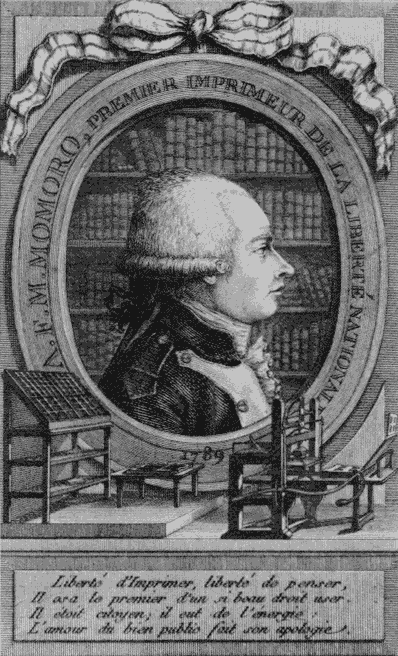
Plate 7.
Portrait of François Momoro, "First Printer of National Liberty" (n.d.).
Momoro was one of the most militant new printers in revolutionary Paris.
He was guillotined by the revolutionary government as an agitator in March
1794. Musée de la Révolution française, Vizille, France.
a journal that will be edited in the name of the Club and in the spirit of its principles. Like Marat, the Club will publicize terrible truths; like him, it will stand up to the daggers of assassins; it will denounce all traitors without exception, and tear the masks from the enemies of the fatherland.[6]
Momoro also entered into negotiations with Marat's widow to convince her to collaborate with him in publishing an edition of Marat's Oeuvres . Like numerous other Parisian publishers, in 1794 he began soliciting the Commission on Public Instruction in the hope of receiving one of the government's newly authorized publishing subsidies for the project.[7]
Between 1789 and 1794 Momoro had built his entire business around agitational ephemera designed to expose counterrevolutionaries and their perfidious plots. The careers of sectional politicians and municipal bureaucrats were made and broken through his neighborhood terrorist media campaigns. At a moment's notice a flood of handbills and posters could pour forth from his presses, turning public opinion almost instantaneously. These political tactics, however ruthless and demagogic, proved effective—at least in the short run. By 1794 he had become president of the Cordeliers Club and served on the directorate of the department of Paris.
There is also significant evidence to suggest that Momoro did quite well in his business of revolutionary ephemera. The Revolutionary Tribunal heard repeated depictions of Momoro as a greedy opportunist and ambitious parvenu, a man notorious for shady business dealings who had declared bankruptey twice.[8] They also testified that he had gotten rich—too rich—in recent times: his wife lived in "scandalous luxury," with "sumptuous furniture," a "superb wardrobe," and even a carriage. But it was not just his enemies who remarked on his financial success: his uncle, the local barber, stood up in his defense, describing Momoro as an upstanding and sober businessman who, despite his bankruptcies, was worth, by 1794, 80,000 livres .[9] In the first four years of the
[6] AN, ser. W, carton 77, plaque 5, no. 334, L'Ami du peuple, no. 243 [1793–1794], 1–2.
[7] Guillaume (ed.), Procès-verbaux du Comité d'Instruction Publique 3:485, 499, 530, 559; 4:789; 5:169.
[8] For testimony against Momoro concerning his business dealings and his wealth, see AN, ser. W, carton 78, plaque 1, no. 6; plaque 2, no. 120; plaque 3, no. 191; and AN, ser. W, carton 339, doss. 617, for Fouquier-Tinville's "acte d'accusation," which includes the charge of fiscal opportunism, March 24, 1794.
[9] AN, ser. W, carton 78, plaque 3, no. 1919, Testimony of François Legendre, 29 ventôse, an II (March 19, 1794).
Revolution Momoro's business in printing revolutionary propaganda appears to have expanded, perhaps as much as twofold.
Momoro's career, however dramatic, was not untypical. In 1789 Parisian printing exploded. In the first few years of the Revolution the industry was swept by a new generation of little printers, most of them former printing-shop workers or small book dealers who seized the cultural space opened by the declaration of freedom of the press and commerce, bought a few presses, and entered into the fast-paced world of revolutionary cultural agitation through the production of political ephemera.
Trade journals, commercial almanacs, and government surveys from the revolutionary and Napoleonic periods offer striking testimony to the numbers of these businessmen. In 1789, Lottin's Catalogue chronologique listed the 195 libraires (publishers and book dealers) and 47 imprimeurs (printers who might be publishers and retail book dealers as well) who were legally authorized in Paris. Only a year later, in a memorandum to the National Assembly, the Paris publisher Jean-Augustin Grangé claimed that the number of printing shops in Paris had climbed to 200.[10] Although this was perhaps an exaggeration, ten years later, in 1798–1799, a more neutral source, M. Duverneuil's Almanach du commerce de Paris , advertised the names of 337 publishers/book dealers and 223 printers in the capital. And after another decade, an official government survey of 1810–1811 recorded 508 publishers/book dealers and 157 printers.[11] Thus, over the course of the revolutionary decade 1789–1799, the number of active printers had at least quadrupled, while the number of publishers increased by at least one-half as a consequence of the deregulation of these industries. Even after the Napoleonic decrees
[10] [Grangé], Mémoire présenté à l'Assemblée Nationale, 4.
[11] For Lottin's totals for 1789, see Delalain, Imprimerie et la librairie, li–lx; and for Delalain's original source, see Lottin, Catalogue chronologique des libraires . The three available sources for numbers of publishers and printers in Paris in 1798–1799 are M. Duverneuil, ed., Almanach du commerce de Paris (Paris: Vve Valade, an VII [1798–1799]); Henri Tardieu-Denesle, ed., Almanach typographique (Paris; an VIII [1799–1800]); and Pierre Roux, ed., Journal typographique et bibliographique (Paris, 1797–1810). Finally, for the years 1810–1811, the best sources are the government surveys found in AN, ser. F18, carton 10a, plaque 2, and carton 25. For the figures offered by the government after the reregulation, see the Journal général de l'imprimerie et de la librairie (Paris: Pillet, 1810–1811).
of 1810 limited the number of printers to eighty, the printing world had nearly doubled in size. The Revolution thus marked a moment of unprecedented expansion in both productive power and the sites of distribution of the printed word in the capital.
The available statistical evidence, moreover, suggests that the greatest share of this expansion occurred during the revolutionary decade 1789–1799. In 1900, the publisher and bibliographer Paul Delalain compiled a masterful registry of every printer, publisher, and bookseller he could identify in Paris for the years 1789–1813.[12] Using this register as a base, it is possible to establish the number of active printing and publishing businesses, date their founding, and trace the longevity of their enterprises with some accuracy.[13] It is further possible to distinguish the multitude of ephemeral enterprises that appeared and disappeared in response to the heightened demand for printed debate at critical political conjunctures, on the one hand, from the longer-term printing and publishing businesses that succeeded in installing themselves permanently within the cultural infrastructure of the capital, on the other. The result is a near-complete picture of the new printing and publishing enterprises established during the two decades spanning the Revolution and the Napoleonic period (figure 7).
Over the twenty-six-year period 1788–1813, approximately 1,224
[12] Delalain, Imprimerie et la librairie .
[13] Delalain was a meticulous and conservative bibliophile. As a consequence, he excluded 181 names of individuals or establishments that he determined to be fictive, redundant, or ephemeral, dating principally from the period 1789–1795, and he excluded 75 individuals because he found them in only one source. To avoid redundancies, he lists as a separate index 61 descriptive names, such as the Imprimerie de l'Ami de l'Ordre, de l'Egalité, or des Révolutions de Paris, that printers gave to their establishments. Proper names posed certain problems. Simple questions of spelling variations could be resolved by cross-checking addresses. Less easy to clarify were establishments employing fictive or anagrammatic names, addresses, and dates. Although TEYGAT for Gattey or ROUGYFF for Guffroy were fairly unproblematic, what about "Clairvoyant imprimeur-libraire de leurs Altesses sérénissimes, Nosseigneurs les princes fugitifs, à l'enseigne de la Lanterne," or "Au pays de la liberté, de l'Imprimerie de la Résurrection, l'an de la vraie lumière 5590"? Delalain found at least forty-five titles of this kind in the first five years of the Revolution; he excluded them from his main registry because they did not represent separate establishments; see Delalain, Imprimerie et la librairie, xxiv–xxv. Delalain's totals from his index of individuals by profession are 438 printers and 1,177 booksellers/publishers, totaling 1,615 (1790–1813). My calculation of the total number of actual establishments, as opposed to individuals, is 337 printers and 887 booksellers/publishers, totaling 1,224 (1788–1813). In both cases printers are counted only as printers, even if they also performed the services of publishers and booksellers.
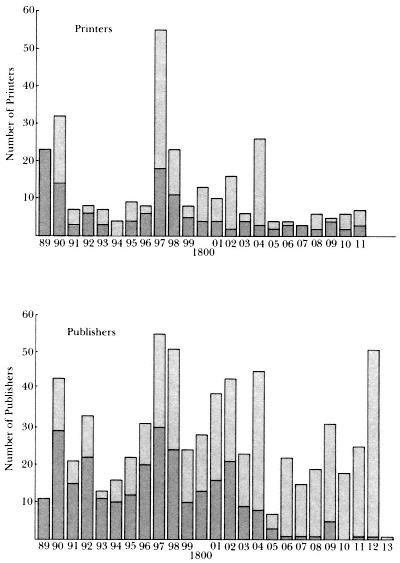
Figure 7.
New Printers and Publishers in Paris, 1789–1810
Note: Darker area represents printers and publishers in business for eight or
more years; lighter area represents those in business for less than eight years.
Sources: Paul Delalain, L'Imprimerie et la librairie à Paris de 1789 à 1813
(Paris: Delalain, [1900]) and AN, ser. F18, cartons 10a and 25.
printing, publishing, and bookselling establishments were active in Paris: 337 printing houses and 887 booksellers/publishers. A little fewer than half of these businesses (166 printers and 403 booksellers/publishers) were active for at least one-third of the period. Major changes of regimes (1789–1791, 1795–1796, and 1804) ushered in new generations of printers and publishers.[14] It is not surprising that these political upheavals would be accompanied by spasmodic increases in the production and consumption of printed matter. Interestingly, however, if we consider only the longer-term establishments—those in business for over eight years, or one-third of the period in question—the upsurge of new businesses that otherwise appears to accompany the declaration of the first Empire in 1804 disappears entirely. The new world of printing and publishing, then, was forged during the two great liberal moments of the revolutionary decade: in the wake of the freeing of the press (1789–1791) and in the period of renewed liberalization of press laws during the Directory (1796–1799).
Did this sudden expansion of the power to print and publish transform the cultural topography of the capital? Apparently not. In 1807, the Paris guidebook Le Pariséum described a literary landscape much like that found at the end of the Old Regime: "The majority of the publishers have their warehouses and shops on the Quai des Grands-Augustin. Nouveautés are sold in the Palais Royal, in the wooden galleries."[15] As Bernard Vouillot has shown, printing and publishing enterprises remained concentrated around the university, where they had formerly been restricted by royal regulation: that is, in the area roughly circumscribed today by the rue St-Jacques, the rue Soufflot, the rue Vaugirard, the rue de Rennes to the place St-Germain des Prés, the rue Bonaparte to Pont Neuf, and the quais of the Left Bank back up to St-Jacques. The
[14] A quick glance at Delalain's list reveals that because he based his list on published sources alone, his information is weak for the period before 1797. Similarly, his dating of enterprises is strongly biased toward the years of his sources: 1797–1798, 1804, and 1811–1813. Fortunately, the manuscript surveys of Paris booksellers, publishers, and printers, compiled by Napoleonic inspectors between 1810 and 1811 and currently found in the F18 series at the Archives Nationales (cartons 10a and 25), allows the bias in the published sources to be corrected against, because these surveys provide actual dates of entry into the profession attested to by some form of written proof, most frequently a privilege or patente . Consequently, the dates of the founding for approximately half of the establishments listed in Delalain have been redated.
[15] J.-F.-C. Blanvillain, Le Pariséum, ou tableau actuel de Paris (Paris: Piranesi, 1807), 205.
largest expansion of printers was eastward up the Left Bank, remaining as close by the old neighborhood as possible. The greatest expansion of book dealers, in contrast, was outward from the Palais Royal into the new wealthy neighborhoods on the Right Bank.[16]
Just as printers remained closely tied to their prerevolutionary neighborhoods, so too, as Philippe Minard has recently shown, did they remain wedded to their old craft mode of production.[17] With the two exceptions of the national printing house and Charles-Joseph Panckoucke's enormous shop with twenty-seven presses, the printing shops of the revolutionary period increased in number but not in scale, containing on average between four and ten presses.[18] Indeed, the most distinctive feature of the revolutionary world of print was the proliferation of many small shops like Momoro's, rather than an expansion of the more established shops.
Furthermore, apart from minor improvements in typesetting and the introduction of night work to produce daily newspapers, the technology of printing (the two-strike wooden handpress) and the basic division of labor between pressmen and compositors remained essentially unchanged from the Old Regime into the nineteenth century. To Philippe Minard, Roger Chartier, and Daniel Roche, in fact, the most striking feature of the world of print during the Revolution is the very persistence of "the old typographical regime":[19] the printing community was enlarged as a consequence of the freedom of the press, but its character was not fundamentally changed.
The crucial transformation in the world of revolutionary print cannot be found in the development of new technologies, or in the reorganization of the relations of production within the printing shop. Rather, it must be sought more broadly in the impact of the transformations of the political and legal institutions within which those technologies and relations of production were embedded, that is, in the collapse of the closed
[16] Bernard Vouillot, "La Révolution et l'empire. Une Nouvelle Réglementation," in Chartier and Martin (eds.), Histoire de l'édition française 2:533.
[17] See Philippe Minard, "Agitation on the Work Force," in Darnton and Roche (eds.), Revolution in Print, 107–123.
[18] Ibid. See also Robert Darnton, "L'Imprimerie de Panckoucke en l'an II," Revue française d'histoire du livre, n.s., no. 23 (1979): 359–369; Duprat, Histoire de l'Imprimerie Impériale .
[19] The phrase is Roger Chartier's; see his "Ancien Régime typographique," Annales E.S.C., no. 36 (March 1981): 191–209. See also Minard, "Agitation in the Work Force"; Minard, Typographes des lumières; Roger Chartier and Daniel Roche, "Les Livres ont-ils fait la Révolution," in Chartier and Roche (eds.), Livre et Révolution, 9–20.
corporate printing world of the Old Regime, the introduction of laissez-faire cultural policies, the consequent redistribution of the cultural power to print, and the freeing up of the possible ends toward which that cultural power could be deployed.
Who ran the presses of the Revolution, and to what purposes? A look beyond the raw numbers reveals that three-quarters of the printers and almost two-thirds of the booksellers/publishers of the old Paris Book Guild, though suffering badly, managed to survive at least through the Directory (until 1799). One-third of the guild families still had active members in the professions in 1811, and a full one-quarter of the eighty printers selected by the Napoleonic administration were from families of the eighteenth-century guild.[20] These figures indicate that despite their serious financial difficulties immediately following the freeing of the press and the collapse of the guild, a significant sector of the old eighteenth-century publishing elite maintained a critical presence in the industry.
But they also sustained two large infusions of new blood in the periods of the constitutional monarchy (1789–1792) and the Directory (1795–1799). Old families, such as the Delalains, the LeClercs, and the Barbous, scrupulously restricted their business and marital relations to other families of the old guild.[21] Far more common, however, were those businessmen who followed the instinct not only to band together, but also to draw in new blood and capital. With a few notable exceptions, the new empires of the Revolution thus look more like those of Charles-Joseph Panckoucke, Pierre Didot l'aîné , François-Jean Baudouin, and François Belin, who strategically built bridges between the old elites and the new. The Panckoucke family, for example, drew in weaker members of the old guild, like Nicolas Ruault and Pierre Plassan, as managers and directors of their expanding establishments; at the same time, they brought in, through marriage and business, new associates like Henri Agasse and Pierre-Claude-Victor Boiste.[22] The Didot-Maginel-Léger nexus and the Baudouin-Imbert-Mame-Hacquart-Rondonneau-Prault conglomerate; the associations of Belin-Leprieur-Rozet-Delance
[20] For the persistence of the families of the Paris Book Guild, see Delalain, Imprimerie et la librairie . For the selection of the eighty printers of Paris in 1811, see AN, ser. F18, carton 25, "Notes sur les imprimeurs après désignés" (1810–1811).
[21] See Delalain, Imprimerie et la librairie, 52.
[22] Ibid.; and AN, ser. F18, carton 25, "Notes sur les imprimeurs."
and Duprat-Letellier; and Crapart, Caille, and Ravier Company all disclose similar patterns.[23] New publishers grafted themselves onto the old elites, forming associations, and fusing new capital to old. However exaggerated, there was an element of truth in what the director of the national printing house had said: the printers and publishers of the Old Regime were not driven under by new speculators who appeared after the freedom of the press; rather, they were engulfed by them.
But what were the characteristics of these new empires? Between 1789 and 1799 the number of printing shops in Paris better than quadrupled, from 47 to 223. When the Napoleonic administration undertook a door-to-door survey of Parisian printers in 1810, the number stood at 157. Of these, the 80 that best met the qualifications established by the administration were allowed to remain in business, provided they swore political allegiance to the new regime and they had the requisite scale—at least four presses and enough type to run them full time—and financial security as printing establishments.[24] These eighty shops constituted a core of the largest and more successful printing establishments to emerge from the revolutionary period.
The majority of the new printing shops of the revolutionary period arose to meet the explosive demand for political news and debate that accompanied the declaration of the freedom of the press in 1789.[25] Of the 196 new newspapers (the publishing of which required many more presses than did book publishing, since extensive press runs and continuous production were necessary)[26] that appeared in Paris in 1789, fewer than half (90) can be attributed to the old printers of the book guild.[27] It is thus not surprising that great numbers of new printing shops emerged in the early years of the Revolution—at least fifty-five in Paris between 1789 and 1790 alone.
But the Terror, and then the dismantling of sectional politics after
[23] Ibid.
[24] AN, ser. F18, carton 1, "Décret impérial contenant le règlement sur l'imprimerie et la librairie . . . 5 février 1810," title 2.
[25] Bellanger (ed.), Histoire générale de la presse française 1:436. The number of journals produced in Paris went from 4 in 1788 to 184 in 1789, 335 in 1790, and 236 in 1791. In contrast, from the year II (1793–1794) to the year III (1794–1795) the numbers jumped only from 106 to 137, fell in the year IV to 105, climbed in the year V to 190, and finally settled in the year VI at 115.
[26] Ibid., 435.
[27] My calculations are based on the information provided in Pierre Rétat, Les Journaux de 1789. Bibliographie critique (Paris: CNRS, 1989).
Thermidor, spelled the end to popular political activity and debate, and hence to quick profits in political journals and ephemera. After 1793, political repression cut down the desperate and unprotected along with the militant and outspoken. Thus, formerly wealthy and respected members of the old Paris Book Guild, such as Philippe-Denis Pierres, François Froullé, and Gaspar-Joseph Cuchet, having suffered the abolition of their privileges and witnessed the collapse of their businesses, soon found themselves driven into the production of illicit ephemera in order to survive.[28]
Cuchet, who had specialized in publishing scholarly scientific and agricultural works, was one of the wealthiest members of the book guild in 1789.[29] In July 1794, Cuchet presented the following account of his career since the beginning of the Revolution to the Committee on General Security:
[A] zealous partisan of the Revolution, I embraced it with the enthusiasm of a free man. An elector in 1789, I was one of the first to take up arms. The morning of July 14 I was in town, and in the afternoon I marched among the brave French Guards to take the Bastille. . . . On October 5 I marched with the Parisian army . . . to Versailles. I have proof of all of these facts. . . . After these great events, I was overcome by the darkest misfortunes; I went bankrupt. Heartbroken, pursued by creditors, menaced by captivity . . . I lost my spirit, I lost my reason, and weakened by torment I clung to any branch that could save me from the storm. . . . Citizens, I am not guilty of treason; I succumbed to the excesses of woe. I printed three of four works on the monarchy.[30]
Whatever his actual political beliefs, Cuchet was driven by the collapse of the book trade after 1789 from his business in grande édition into the
[28] See AN, ser. BB3, carton 81a, fols. 361–364, Pierres, printer, 25 nivôse, an II (January 14, 1794). For Froullé, see AN, ser. F17, carton 1005a, doss. 743bis, Letter from Froullé to the Committee on Public Instruction, July 27, 1793; and AN, ser. W, carton 332, no. 566, 8 ventôse, an II (February 26, 1794). Finally, for Cuchet, see AN, ser. F7, carton 4658, doss. 4, 24 messidor, an II (July 12, 1794); and AN, ser. W, carton 53, doss. 3401, 8 thermidor, an II (July 26, 1794). For the corporate status and wealth of Cuchet, Pierres, and Froullé on the eve of the Revolution, see table 2.
[29] See AN, ser. F7, carton 4658, doss. 4, 24 messidor, an II (July 12, 1794); this dossiet gives a list of some of Cuchet's stock. See also AN, ser. ADVIII, carton 7, "Consultation pour le citoyen A. J. Dugour, propriétaire du Cours d'agriculture par Rozier." A.-J. Dugour bought Cuchet's business, including this work, in 1796.
[30] AN, ser. F7, carton 4658, doss. 4, Cuchet, publisher, 24 messidor, an II (July 12, 1794). For more of Cuchet's business troubles in the early years of the Revolution, see Gaspar-Joseph Cuchet, Avis (N.p., [January 11, 1789]).
shady world of counterrevolutionary ephemera, only to stand trial before the Revolutionary Tribunal.
Yet it was not simply the last relics of the old cultural regime who found themselves in danger. The Terror struck to the left as well as the right, at young as well as old, in its effort to impose political unity on the warring nation. Momoro, too, found himself denounced before the Revolutionary Tribunal in March 1794 as a counterrevolutionary conspirator because of his association with the ultrarevolutionary Hébertist movement.[31] A death sentence on March 24 thus brought to an abrupt end one of the most prominent new printing establishments of the revolutionary period.[32] Momoro instructed his wife in his last letter: "You will not be able to maintain the printing shop. Dismiss the workers. . . . I leave you my memory and my virtues. Marat taught me how to suffer."[33] Momoro's presses were soon confiscated by the government.[34]
Behind ideological hot-heads like Momoro stood numerous new printers of nouveautés and peddlers of printed matter who found themselves suddenly at risk of losing their lives for a journal or pamphlet they had simply printed "in consequence of the freedom of the press, and to make a living."[35] By the end of 1794, the honeymoon between youthful revolutionaries and the printing press was definitively over.
Despite the unhappy fate of individuals like Momoro, on the whole it was the new printing shops founded early in the Revolution that survived into the Empire. Twenty-one of the eighty shops selected for retention in 1810 were owned by members of the old guild; thirty-five
[31] The entire dossier concerning Momoro's arrest and conviction is conserved in AN, ser. W, cartons 76, 77, 78, and 339.
[32] AN, ser. W, carton 339, doss. 617, "Acte de condamnation contre François Momoro, et al.," 4 germinal, an II (March 24, 1794).
[33] AN, ser. W, carton 77, plaque 1, no. 47, "Billet de Momoro à sa femme," [February-April 1794].
[34] Duprat, Histoire de l'Imprimerie Impériale, 166.
[35] AN, ser. W, carton 339, doss. 8, Jean-Pascal Sétier, printer in Paris, September 4, 1793. For other, similar, cases, see AN, ser. W, carton 21, doss. 1160, Gallier, printer, 9 pluviôse, an II (January 28, 1794); AN, ser. F7, carton 4722, doss. 3, Gérard, printer, 10 prairial, an II (May 29, 1794); AN, ser. F7, carton 4645, doss. 2, Chemin fils, 8 messidor, an II (June 26, 1794); and, for a printer named Senneville (Rioux-Maillon), see AN, ser. F7, carton 4775, doss. 17, doc. 4, 21 messidor, an II (July 9, 1794), and AN, ser. F7, carton 4774, doss. 93, doc. 3, 13 thermidor, an II (July 31, 1794).
were founded in the period 1789–1793, nine in the period 1795–1799, and fifteen in the period 1800–1810—that is, almost half of the printers of 1811 came from the time of the constitutional monarchy.[36] The printers of 1811, furthermore, break down by specialization (possible for sixty-four of the eighty) as follows: newspapers and periodicals, 19; administration, 12; literature, belles lettres, and nouveautés , 11; classical works, 4; theater, 3; religion, 3; foreign languages, 3; sciences, medicine, and agriculture, 2; arts, 2; almanacs, 2; ephemera, 2; law, 1.[37] Clearly, periodical publications were the single most important source of employment in the new printing world.
It was not just old fortunes like those of Charles-Joseph Panckoucke, Pierre-Robert-Christophe Ballard, François Colas, or Antoine Demonville that followed the winds of revolutionary literary culture and shifted toward newspaper and ephemeral publishing.[38] New fortunes were made from the periodical press as well. Thus, the Napoleonic inspector who wrote up "notes" on the eighty largest printing establishments in Paris recorded a whole new generation of wealthy printers as well: François Chaignieau l'aîné , "rich from his Courrier universel "; Henri Agasse, "printer of the Moniteur , . . . stockholder and editor at 3,000 livres a year"; Jean-Baptiste-Etienne-Elie Lenormand, "former worker, a parvenu who can always be reproached for having printed pamphlets. But the presses of the Journal de l'Empire have cured him of that"; or Louis Prudhomme, "rich, Révolutions de Paris , a hot-head."[39] The association of the freedom of the press with both "the presses" and la presse is not a phonetic coincidence or a mere play on words: it is a historical reality.
The freeing of the press and the consequent deregulation of printing and publishing after 1789 led to an unprecedented democratization of the printed word. The number of printing and publishing establishments in Paris more than tripled during the revolutionary period, allowing much broader social initiative and participation in the production of the printed word than ever before and, consequently, in the public exchange of ideas. Not surprisingly, the literary forms created by the freed presses were more democratic as well. Ephemeral publishing was less capital-intensive than book production, and its success depended on
[36] See Delalain, Imprimerie et la librairie; and AN, ser. F18, carton 25, "Notes sur les imprimeurs après désignés" (1810–1811).
[37] Ibid.
[38] Ibid.
[39] Ibid.
extensive, as opposed to intensive, markets. These literary forms were made for (and often by) people who inhabited the world of Momoro rather than that of Condorcet and Sieyès, with little money to spend and little leisure time to read. This is not to suggest that there was no popular literary culture prior to the French Revolution. But with the declaration of press freedom and the collapse of the literary institutions of the Old Regime, the center of gravity in commercial printing shifted perceptibly from the elite civilization of the book to the democratic culture of the pamphlet, the broadside, and the periodical press.