
2
The States of Holland and the Habsburg Government
Like the provincial parliaments of other Netherlandish-speaking provinces in the Habsburg Netherlands, especially Brabant and Flanders, the States of Holland represented the interests of the towns to an unusual extent, and enjoyed a degree of political influence that was arguably without parallel elsewhere in Europe during the sixteenth century. The other side of the coin was that the central government of the Netherlands was relatively weak, since it depended on the good will of the towns for money to fend off invasion, and thus had little opportunity for implementing some of the more exalted notions of princely authority that were current at the time. The power of the purse, however, did not necessarily give the States the upper hand since they were themselves divided and inconsistent. The States of Holland could be a motley collection of ambassadors from mutually suspicious towns, each bargaining for its own narrow interests, or a parliament truly representing, as the deputies claimed, "the common body of the land."
The States of Holland among Europe's Parliaments
In the history of other civilizations there is no analogue to the parliamentary institutions that appeared all over Latin Christian Europe, from the British Isles to the Crusader states, and from Iberia to Poland, roughly between 1100 and 1400.[1] The classical tradition of English constitutional history presents a clear line of development from the feudal magnum consilium,
which advised the king on important matters, to parliament in a proper sense, which began only when the king's need for revenue induced him to summon representatives of the commons, including the towns—for no prince could introduce the then novel principle of taxation without the consent of the realm. For bodies that reached this latter stage, Otto Hintze distinguishes between two "ideal types" of parliamentary structure, a "two-chamber" institution found in England, Scandinavia, and eastern Europe, and a "three curia" (or three estates) system to be seen in France, Germany, parts of Italy, and Iberia.[2] But in the Low Countries (not discussed by Hintze) leagues among the towns of a given principality may be as old as the Anglo-Norman magnum consilium . Hence scholars here are less likely to reserve the term "representative institutions" to assemblies that have the power to consent to taxation.[3]
Still another difference worth noting is that members of the English Parliament "represented" their constituencies in a different way than the deputies to many continental parliaments. Once elected, members of Parliament had a general mandate to vote as they saw fit on whatever issues might arise. In England the granting of full powers to deputies can be documented as early as Edward I's writ of summons for the "model parliament" of 1295. Over 200 years later, direct pressure from Charles V induced the towns of Castile to grant "full powers" to their deputies to the Cortes, but only after the revolt of the Comuneros had been put down.[4] In the Low Countries, by contrast, no question could be put to a vote unless it had been raised either in the writ of summons or at a previous meeting, and deputies had an explicit charge (last ) instructing them how to vote on each issue. In the estates of Piedmont-Savoy, which worked in the same way, deputies were called "ambassadors" and indeed functioned like ambassadors, rather than "representatives."[5] Likewise, deputies to the States General of the Netherlands operated under instructions from their provincial states—which were sometimes so strict that a sharp-tongued minister of Duke Charles the Bold was prompted to ask if the deputies were also told how many times they could drink during the course of a journey.[6]
These differences raise a more general question about the precise way in which any medieval or early modern parliament
can be said to "represent" the whole territory for which it speaks. At least on the continent, it was common to say that deputies represented "the land," that is, a territory understood by its inhabitants to be a communis patria . The fundamental work on this point was done by Otto Brünner, who argued (from Austrian and south German evidence) that a land was a community of landholders, living under a common law, who may or may not have been ruled by a single prince. Thus the territorial estates (landstände ) should be understood as the land acting as a corporate body.[7] Brünner's argument does not work everywhere, even for the German-speaking territories—for example, in East-Elbian Germany, land meant a territory ruled by a single lord, not a territory with a common law. But Peter Blickle's impressive study of the smaller territories of south Germany confirms the broad applicability of Brünner's argument for a link between representation (landschaft ) and the existence of a self-conscious community; for Blickle, landschaft means "the subjects of a given lordship, organized as a community and acting as a corporate body."[8]
These important questions of terminology have yet to be fully explored by Low Countries historians, but preliminary indications do seem to bear out Brünner's contention that there was no representation unless there was first a land to be represented. To be more precise, the term land was often used for small dependencies of a single feudal lord, such as the land van Stein in Holland, near Gouda, whereas gemeen land or communis patria referred to the whole of a territory. During the fourteenth century there were regular meetings of the "Four Members of Flanders," that is, the cities of Ghent, Bruges, Ypres, and the federation of small towns and rural communes known as the Franc of Bruges. At these meetings, gemeen land or communis patria referred to the rest of Flanders, that is, all the other towns and rural communities. By the fifteenth century the Four Members had appropriated these terms for their own use; they now claimed to represent or speak for the gemeen land of Flanders.[9] Just as the pace of urbanization and political development in medieval Holland was slower than in Flanders, the term gemeen land seems to have appeared quite a bit later here, but it was certainly in use by the late fifteenth century, when the
States of Holland sold what were called gemeen lands renten to finance the Utrecht War.[10]
The States of Holland sources clearly did speak for the province as a whole in the creation of renten debt (see chapter 5); by action of the States, renten were sold "on the common body" (lichaem, or corpus ) of the land. Gemeen lands renten created a corporate liability in the sense that merchants from any Holland town could have their goods seized for non-payment of interest in towns outside Holland, like Bruges or Antwerp.[11] But just as the issuance of renten by the States was relatively new in Holland, dating only from the Utrecht War, so too was the idea that Holland was a lichaem, capable of acting (through the States) in a corporate way. As late as 1514 a Dordrecht jurist, Meester Floris Oem van Wijngaerden, argued that Dordrecht and neighboring South Holland formed a lichaem that had nothing in common with the rest of Holland; even if Holland too was a lichaem, as Dordrecht's opponents contended, "the members are so diverse that one cannot be outvoted by the others."[12] Even in the towns, where magistrates had long been accustomed to pledge the faith and credit of the community through the issuance of renten, the basic metaphor of the body politic had not yet found a universal language. Thus Amsterdam's vroedschap resolutions of the 1490s speak of loans being contracted "on the belly (buyck ) of this city," rather than "on the body of the city," the usage which was even at this time spreading from the towns to the villages.[13] One has the impression that the pressures of war-time finance were inducing local authorities at various levels—from village elders to the States of Holland—to presume to act in behalf of their constituencies in new ways, and to find a new, corporate[14] language to express the powers they claimed. For if Holland was indeed a lichaem, there could be no question of the States' right to act in ways by which all Hollanders would be bound.[15]
In effect, the States were a meeting ground for contrary pressures. On the one hand, Habsburg officials (and, no doubt, many creditors) wanted to deal with a small number of deputies who could speak authoritatively for the entire province. On the other hand, the deputies had a natural desire to share as widely as possible the responsibility for decisions to which either the
government or fellow Hollanders might object. Thus even though the government recognized only the six "great cities" as having voting rights, the States sometimes requested postponement of a particular issue until deputies from the smaller cities could be summoned, so as to have a "broader mandate" (breeder last ) for the final decision.[16] Also, although the town governments to which deputies were answerable were clearly oligarchical in character, magistrates had an uneasy awareness of their accountability to fellow townsmen, and it was not unusual for deputies to vote against a subsidy proposal on the grounds that "the common man" would not tolerate it.[17]
For students of Low Countries history, the parliamentary typology that makes the most sense is the one proposed by W.P. Blockmans. Most assemblies, including the English Parliament and many of the French and German estates, were dominated by their noble or clerical deputies; these bodies met infrequently, and were primarily concerned with fiscal and political issues. A second category includes mainly the Low Countries parliaments, plus a few others; these assemblies met frequently, and were often concerned with economic issues, as befits a fundamentally urban constituency. Differences in the frequency of meetings are indeed striking. The Four Members of Flanders met 4,055 times between 1386 and 1506, for an average of 34 times per year, and the States of Brabant met 1,601 times between 1356 and 1430, for an average of 21 times per year. In Holland, the States convened 21 times per year between 1525 and 1529, and 13.5 times per year between 1542 and 1563. By contrast, the English Parliament was in session 73 times between 1384 and 1510, and the Cortes of Castile met 93 times between 1390 and 1520. The number of meetings is not a guide to how many days per year a parliamentary body was in session—for example, sessions of the English Parliament averaged seven months (1450–1520), whereas meetings of the provincial states of the Netherlands on their home ground usually lasted only a few days (delegations sent to court for negotiations with the Regent and her officials might have to remain in Brussels for a month or two). But frequent meetings are a good indicator of the degree to which parliamentary deputies were subject to the control of their principals.[18]
For present purposes, one might broaden Blockmans's "urban parliaments" category by looking at a few other parliamentary bodies that resemble those of the Netherlands in some respects, even if they may not meet the criteria Blockmans suggests. Piedmont's estates have certain structural affinities with those of the Netherlands, while Württemberg in Germany and Aragón in Iberia each enjoyed a certain historical reputation as a bulwark of parliamentary "liberties."[19] In Piedmont, the Cisalpine portion of the Duke of Savoy's lands, the estates convened frequently; and town deputies—controlled, as in the Netherlands, by a strict mandate—played an especially prominent role.[20] In Württemberg, nearly fifty small towns with voting rights made the urban chamber of the Landtag or territorial estates more influential than it was in most other German principalities.[21] In Spain under the crown of Aragón (including the kingdoms of Aragón and Valencia and the county of Barcelona), towns had a strong position in the Corts . During the sixteenth century the Corts convened infrequently, once every five or six years, and thus was quite unlike the Netherlandish parliaments. Nonetheless, economic concerns figure prominently in the long list of furs or statutes of the Corts which the crown customarily approved at the end of each session.[22] For Aragón and Piedmont there is a further point of comparison with the Netherlands: in both realms the estates of various territories convened as a "states general," while preserving their separate identities. In Aragón the estates of the three principalities mentioned above usually convened together as the Corts General, but they deliberated and voted separately; in Cisalpine Savoy, the estates of Piedmont, Val d'Aosta, and the marquisate of Saluzzo could meet either separately or jointly as the Stati Generali of Piedmont. Like the Habsburg Netherlands, these polities were, in Otto Hintze's phrase, "monarchical unions of corporate states," in which the natural centrifugal tendencies of each province were anchored in a separate representative assembly.[23]
During the first half of the sixteenth century, a hypothetical omniscient observer of European political institutions might have singled out the parliamentary bodies of Aragón, England, the Low Countries, Piedmont, and Württemberg as having the most authority in their respective commonwealths. Yet by the
end of the century the stati of Piedmont had disappeared, and the authority of the corts of Aragón and the estates of Württemberg had considerably diminished. In Piedmont, Duke Emmanuel Philibert lost his lands in a French invasion in 1536, and recovered them again only in 1558, after having served as Philip II's Governor-General in the Low Countries. Possibly because he had seen enough of parliaments while in the Low Countries, he declared that the estats of Savoy and the stati of Piedmont were now abolished, and proceeded within a few years to raise the level of the subsidy by 500 percent.[24] Meanwhile, both the corts of Aragón and the estates of Württemberg transferred much of their power to standing committees. In Württemberg, standing committees that (among other responsibilities) collected and disbursed revenue were created during the Habsburg period (1519–1534), and revived in 1554 when the Duke had to call upon the Landtag for help with his debts.[25] In Aragón, the separate principalities of Catalonia and Aragón each had a tradition of naming powerful committees to handle business between sessions, and in the sixteenth century the Corts General did the same, electing a permanent committee that, during the long intervals between sessions, had considerable authority in the collection and disbursement of funds and in the appointment of government officials.[26] Blockmans argues persuasively that committees of this type tend to escape the control of their parliamentary principals, becoming more like organs of the territorial government.[27]
In part, the contrast between Aragón or Württemberg and the provincial states of the Netherlands was dictated by geography, for it was much easier for town deputies to shuttle back and forth to a central meeting place in tiny Holland (roughly 2,000 square miles) than it was in Aragón or Württemberg. In any case the Netherlandish parliaments never permitted their rulers the luxury of dealing with smaller and more malleable permanent committees. The States of Holland had no standing committees prior to the Revolt, and even the development of ad hoc committees was fairly rudimentary.[28] Since none of the cities with voting rights was more than a day's travel from The Hague,[29] where the States traditionally convened, there was no real pressure to create a substitute for frequent meetings. Gov-
ernment commissioners seldom gained approval of what they wanted at the first or even the second session and often had to make a circuit of the towns for direct discussions with the magistrates. One cannot imagine a structure of representation more calculated to keep power in the hands of the deputies, or rather, in the hands of the patrician colleges of burgomasters and town councils to whom they reported for instructions.
Yet the survival of parliamentary institutions did not depend only on their structure. This was, after all, the age in which princes were shaking off the constraints imposed on them by representative assemblies during the late Middle Ages, the heyday of parliamentary authority. Already in 1439 the Estates General of France had voted the usual taxes without attaching to them the usual time limit, so that the French king henceforth enjoyed a unique freedom to tax his subjects without first obtaining the consent of their representatives.[30] In Castile, the Cortes held monarchs of the early fifteenth century accountable for how they spent war subsidies, but by the time of the Catholic kings, growing royal influence in the election of urban deputies gradually eroded the prerogatives of the Cortes. To be sure, Charles V and his Flamengo entourage did manage to provoke a celebrated uprising by demanding a subsidy for his coronation at Aachen (as King of the Romans, 1520), but once the revolt of the Comuneros was put down, Charles found the Cortes pliant, and free of awkward questions about how the king spent his subsidy income or where he fought his wars.[31] Meanwhile, political thinkers in France and elsewhere were at work on a theory of princely "absolutism," aided by conceptions of sovereign power found in Roman law and possibly by a practical sense that representative assemblies stood for a self-serving and outmoded parochialism.[32]
In such an era, parliamentary bodies continued to flourish only where they offered the prince something he could not do without and could not otherwise obtain. For example, at the time of the Reformation prince and parliament had to act in concert to abolish the traditional rights of the Church, both in England and in a number of Germany's secular principalities; in both cases scholars believe that parliamentary bodies, by giving sanction to these great religious changes, enhanced their
own authority.[33] The help of parliamentary bodies was equally indispensable to princes attempting to cope with the novel phenomenon of government debt. In many of the secular principalities in the Holy Roman Empire (including Württemberg), creditors demanded better assurance of repayment than the prince himself was able to supply. The only remedy was for the Landtag to assume responsibility for his debts, which also meant taking over the collection and disbursement of his revenues.[34] The provincial states of the Netherlands performed a similar role for their Habsburg rulers, except that the debt in question exceeded that for a number of the major German principalities put together. Moreover, the Netherlands parliaments took a uniquely[35] active role in managing the debt, by issuing low-interest renten in their own name, so that the capital raised could be used by the government to pay off high-interest bankers' loans (see chapter 5). In other words, the Netherlands provincial states, already distinguished by a structure that gave urban magistrates an unusual degree of influence in affairs of state, had fiscal responsibilities that made them even more indispensable to their ruler than similar bodies were in other territories.
For a variety of reasons, then, Netherlands town magistrates were in a peculiarly strong position to wield the power of the purse. Thus the custom by which such bodies attached formal conditions to their consent to a subsidy was consistently observed in the Netherlands during the sixteenth century, after it had gone out of fashion in Castile and before it became common in England. Under Henry VIII, Charles V's contemporary, English Parliaments passed the king's subsidy requests without delay, "for Commons did not yet realize what great leverage their control over supply gave them."[36] By contrast, the States of Holland routinely wrote conditions of various kinds into the accord by which they agreed to a bede ; this act, known as the acceptatie after it was signed by the Regent, provided at the very least a basis for complaint if the States felt their stipulations were not being met. To be sure, Charles V in person flatly refused to "bargain" with his subjects in the States of Holland.[37] Yet Charles was usually absent from the Netherlands (this may have been the real key to the success of the states), and no one who spoke in the Emperor's name com-
manded the same respect he did. Thus Margaret of Austria, as Regent of the Netherlands, recommended postponing the redress of grievances until after taxes were voted, but was not able herself to put the idea into practice.[38]
The conditions attached to a bede accord often had to do with matters of war and diplomacy. In the late Middle Ages it was not uncommon for parliaments to set limits to the prince's ability to conduct foreign policy, often in the form of a requirement that he not make war without consent of the estates. But such restrictions were largely swept away by about 1500; in the Netherlands, for example, clauses to this effect in the 1477 Great Privilege were among those abolished in 1494.[39] The new emphasis on princely power had become a received doctrine by the early seventeenth century, when James I's Lord Treasurer tersely informed Parliament that declaring war was part of the king's prerogative.[40] Such claims would probably not have been formally disputed in the Netherlands. Nonetheless, by setting conditions and restrictions, the states repeatedly hedged in the ruler's war-making power. Like the Württemberg Landtag, the states of Holland were able to negotiate military unions with other Habsburg lands in time of war.[41] Like the Corts of Aragón, they mandated certain allocations from subsidy income for defense of the sea lanes.[42] Like the Stati Generali of Piedmont, they made stipulations as to where troops paid by a subsidy would be stationed.[43] They were also able to insist on the removal of an infantry commander whom they distrusted and to extract promises that the troops they paid for would be used to invade enemy territory instead of merely defending the frontier (see chapter 3). There are as yet no comparative studies of parliamentary involvement in military policy, but one suspects that the Netherlands provincial states intervened in military affairs more extensively than similar bodies did elsewhere.
Finally, the Dutch-speaking parliaments of this era are distinguished by a rich documentation, as befits bodies that played important roles in their respective territories. Sources are of five basic types. Official summaries of the acts or "resolutions" of the States of Brabant and Holland and of the Four Members of Flanders are extant from the sixteenth century. The best known record of this kind is the Resolutiën van de Staten van Holland,
which begins in 1525; the first six volumes (through 1560) were published in 1751, and the whole series (289 volumes, through 1795) was in print by the end of the eighteenth century.[44] A second class of sources owes its existence to the fact that the annual accounts of town and local treasurers include a section that scrupulously records travel expenses, including monies paid to deputies attending meetings of the provincial states. Even the briefest entries of this kind will usually list dates and places of the meeting, and some towns or other jurisdictions had a tradition of including capsule summaries of the purpose or results of the meeting as well. For the Four Members and the States of Flanders, there are now seven imposing volumes, covering the period from 1384 to 1506, in which materials of this kind are collected and edited by Blockmans, Prevenier, and Zoete.[45] This basic work remains to be done for the States of Brabant and Holland, although the first volume of a new series of documents for the States of Holland to 1433 has just recently appeared.[46] Minutes of the town councils or vroedschappen in several Holland towns provide a third kind of source for what was decided or proposed at dagvaarten or meetings of the States. Vroedschap resolutions for Gouda (relating to the States) and Amsterdam (to 1550) have been published, but those of Haarlem give the fullest description of the dagvaarten .[47]
The rarest but perhaps most interesting kind of source is the Memoriaalboek or travel diary of the town secretary, or (a more grandiose title) town pensionary, a paid official who was often empowered to speak for the town. When the States of Holland sent a delegation to Brussels for discussions with the central government, it usually included the pensionaries of two or three towns (see chapter 5).[48] Travel diaries for four such officials have survived: Andries Jacobszoon (1523–1538) and Aert Sandelijn (1548–1564) of Amsterdam, and Willem Pieterszoon uyten Aggar and Jacob de Milde (1531–1558) of Leiden. These documents give a running account of the dagvaarten, slanted ever so slightly in the interests of a single town. Andries Jacobszoon's Memoriaalboek, spiced by the author's personal opinions, also provides rare glimpses of private conversations between government officials and Amsterdam's deputies.[49] Finally, the views of government commissioners who negotiated
with the States can be gathered from the correspondence of leading court figures closely involved with Holland and of the Council of Holland in The Hague, which represented the government at the local level. Two names merit special mention here: Antoine de Lalaing, Count of Hoogstraten, who served as Stadtholder or governor of Holland from 1522 to 1540, and Lord Gerrit, Lord of Assendelft, First Councillor of the Council of Holland from 1527 until his death in 1555.[50] It will now be helpful to look more closely at the government which these men served.
The Habsburg Govrnment in Action
For the complex of territories that Charles V inherited from his Burgundian ancestors (minus the Duchy of Burgundy itself, reabsorbed by France in 1477) there was neither a commonly agreed-on name nor a unifying princely title. Each province had a traditional compact between rulers and subjects, like the famous Blijde Inkomst or Joyeuse Entrée in Brabant, which every new ruler had to swear to uphold.[51] When Prince Charles came of age at fourteen (1514), he too had to be recognized separately in each province—as Count of Artois, Duke of Brabant, Count of Flanders, Count of Hainaut, Count of Holland and Zeeland, Count of Luxemburg, and Count of Namur. Charles made his tour of Holland in June and July 1515, passing through five of the six great cities, plus The Hague (the administrative capital) and Rotterdam.[52]
Two years later (September 1517) Charles took ship for the kingdoms of his maternal grandparents, Ferdinand and Isabella, where he spent most of his adult life. In the years that followed, Charles spent a total of fifty-five months in the Netherlands on five different sojourns, the longest being from June 1520 through May 1522, from January 1531 through January 1532, and from September 1548 through May 1550.[53] In the long intervals of his absence, Charles entrusted the Netherlands to the women of his family.
Margaret of Austria, his aunt, named Regent by Maximilian I in 1506 when Charles's father died, continued in office until 1514 when Charles came of age. On his departure for Spain in
1517, Charles called on Margaret to resume her former position, and the widowed Duchess of Savoy served loyally until her death in 1530. (For her residence Margaret preferred Mechelen to Brussels the traditional capital; thus, Mechelen was the seat of government during these years.) Charles then turned to his widowed sister, Mary Queen of Hungary, who had lived in relative seclusion after her husband was killed in the battle of Mohacs (1526). Though Mary lacked Margaret's political experience and self-confidence, once in office, she grew in stature and presided over what must be seen in restrospect as the high point of Habsburg authority in the Netherlands, the period just prior to the disastrous Habsburg-Valois War of 1552–1559. When her brother abdicated (1555), she too submitted her resignation as Regent.[54]
Like the Dukes of Burgundy, the Habsburg Regents of the Netherlands were advised by a Privy Council and a separate Council of Finance. The great nobles who served on these councils (along with legists, or "men of the long robe") often held simultaneously positions as governor or stadtholder of one of the provinces; the great families were slowly fusing into a national aristocracy, and their support was the sine qua non for a strong regency. The French-speaking provinces produced a disproportionate number of these families, including such names as Croy, Lalaing, and Montmorency. The Dutch-speaking provinces were represented by the Nassaus (lords of Breda in northern Brabant), the Bergens (lords of the market town of Bergen-op-Zoom in northern Brabant), the Marquis of Vere (Zeeland), scion of an illegitimate branch of the house of Burgundy, and the Egmonts of Holland, who had been leaders of the pro-Burgundian Kabeljauw faction. (The Brederodes, though they were reckoned to control as much as one twelfth of the land in Holland, were never accorded the same political recognition, perhaps because of their role as leaders of the anti-Burgundian Hoek faction.)[55] The Grand Council of Mechelen, established by Charles the Bold and then, after the political debacle of 1477, reestablished in 1504, served as the high court of the Netherlands, hearing some cases in the first instance, but usually on appeal from lower courts.[56]
The Emperor maintained a voluminous correspondence with
the Netherlands, especially with Mary of Hungary, most of which remains unpublished.[57] But the only time that Charles V was principally occupied with the internal affairs of the Netherlands was in 1531, during the transition from Margaret of Austria to Mary of Hungary. The Emperor insisted that Mary must not bring with her the humanist advisers, prominent in her entourage in Budapest, whose orthodoxy he suspected. Since Margaret's latter years had been troubled by quarrels among the great nobles, Charles instructed his sister on how to keep these important men at peace with each other, and he bade her not to act without their advice.[58] To improve the process of deliberation, Charles also divided the former Privy Council into two bodies: a Council of State in which the great lords provided counsel on war and diplomacy, and a Secret Council in which "men of the long robe" dealt with internal affairs of the realm (1531). Jean Carondolet, Archbishop of Palermo, served as President of both Councils until his death in 1540, and Lodewijk van Schore, a doctor utriusque juris from the University of Leuven, was particularly effective in this dual capacity (1540–1548).[59] Thereafter the two functions were split, possibly because of a growing work load. Under Schore, and particularly under his successor as President of the Secret Council, Viglius Zuichemius van Aytta (1549–1573), this body assumed an ever larger role, both judicial and administrative.[60]
In each province the Regent and her Councils relied on a local apparatus of government that also dated from the Burgundian era. The Raad van Holland in The Hague was given a new administrative statute by Charles V in 1531. As before, the Council was to have eight salaried members or "councillors ordinary" (including a presiding officer), chosen from among Hollanders or Zeelanders who were of noble birth or had law degrees. Since the Council invariably included men from some of Holland's most prominent families, like the lords of Assendelft or the Duvenvoirdes of Warmond, it was respected for its ability to represent the interests of the province; these were men whose family honor rested on a tradition of service to the prince, but they were never a faceless panel of bureaucrats slavishly devoted to his wishes.[61] Besides the councillors ordinary, there were (unsalaried) councillors extraordinary. The
larger Hof van Holland also included secretaries ordinary and extraordinary, process-servers (deurwaarders ), and messengers. There was also the Rekenkamer van Holland, whose auditors supervised a separate fiscal bureaucracy. All told, there were some 200 Habsburg officials, high and low, resident in The Hague. In addition, there were over 100 judicial officers scattered throughout the province, usually sheriffs in the towns and bailiffs in rural districts, most of whom employed subordinates. Counting all who were directly appointed by Charles V as Count of Holland, the province had about 1.5 government officials per 1,000 inhabitants.[62]
Since the fourteenth century, two very different conceptions of princely power had coexisted in the Netherlands. One view, most clearly expressed in contractual agreements like the Blijde Inkomst of Brabant, regarded the prince as the protector of the rights and privileges traditionally enjoyed by his subjects, whether in an individual or a corporate capacity. In the late Middle Ages, when parliamentary bodies throughout Europe were successfully asserting their claims to share in the authority of the prince, this was the most widespread understanding of the idea of the state. As Maurice Powicke has said of England in the period before the Reformation, it was "a theory of the state . . . as a self-directed organism held together by a common regard for customary rights and obligations." Koenigsberger finds a similar understanding of the state in Piedmont-Savoy, where "communes and nobles relied on rights which were anterior to those of the crown." In this framework, according to Otto Hintze, "even the power of the ruler appears as a privilege, a 'prerogative'."[63]
The other concept of the state stems from the revival of Roman law with its notion of a sovereign power on which all other rights depend. In fourteenth-century Holland, this view found expression in the De Cura Reipublicae of Philip of Leiden and in the writings of his mentor, Geraard Aelwijnszoon, both of whom provided legal justification for revocation of privileges by the counts of the Avesnes or Wittelsbach lines. Sixteenth-century Habsburg officials were certainly aware of the Roman law discussion of princely authority, and some of them knew Philip of Leiden's work; the first edition of De Cura Reipublicae,
published in 1516, was dedicated to Meester Vincent Corneliszoon van Mierop, a Hollander who was to become an important member of the Council of Finance under Mary of Hungary.[64] Similarly, one finds among the papers of Lodewijk van Schore an autograph memorandum supplying legal citations to support the proposition that "In time of need, secular princes may impose taxes on churches and ecclesiastical persons, who may not excuse themselves from this exaction by any privilege." H. G. Koenigsberger describes an occasion when Schore's predecessor, Jean Carondolet, put emissaries from Holland to the test by asking if the Emperor did not have a right to abolish the privilege they had come to defend; wisely, the Hollanders said they hoped to offer practical arguments for their position, not to dispute "about the powers of princes."[65] In 1543, when Mary of Hungary tired of resistance by the States of Holland to a new tax on exports, she imposed it "by the Emperor's absolute power," and no one was bold enough to claim the Regent had no right to act as she did.[66]
But the fact that Charles V's officials were aware of such doctrines, and could sometimes put them into practice, does not imply any settled policy of making the Emperor "absolute" in the Netherlands by abolishing the privileges of his subjects. For example, during Charles V's reign there were only three cases in which the government imposed a bede on a province without the consent of the states, and in each case the same or comparable beden had already been approved by other provinces. Writing in the nineteenth century, when the patriotic school of Dutch historiography tended to project the tyranny of the Duke of Alba back into earlier decades of Habsburg rule, Robert Fruin asserted that Viglius and Granvelle (Philip II's most trusted adviser) were "disciples of Philip of Leiden." But Viglius the statesman still awaits a proper study, and Granvelle's biographer concludes that although he was a "zealous champion of the absolutist and state-church ambitions of the crown" under Philip II, he was "careful and gradual" in his approach to the curtailment of privileges.[67]
The roots of a certain ambivalence among Habsburg jurists about the powers of the prince can be seen in the legal opinions of Niklaas Everaerts (1462–1532), then a law professor at the University of Leuven, and later President of the Council of Hol-
land (1509–1528) and then of the Grand Council of Mechelen (1528–1532):
It would be wicked to say that [the opponent of Everaerts' client] was unjustly deprived of his rights by Duke Charles [the Bold], the fount of justice . . . .Presumption is always in favor of the justice of the prince himself, to such an extent that if the prince command something contrary to divine law, such as the hanging or murder of someone whose trial is still under way, or similar things, he must be obeyed.
[The prince is bound by the terms of a compact made with his subjects] not least because God, who is King of kings and Lord of lords, is bound by His compacts.[68]
If Everaerts were a political theorist, he would have to reconcile the apparent conflict between these two texts. But as a practicing lawyer he was free to choose whichever concept of princely authority suited the circumstances of his clients. Similarly, government officials trained as lawyers could also employ different concepts of the state, depending on the needs of the moment, or on the particular traditions of the offices they held. For example, when the States of Holland had an important privilege to defend, deputies expected a favorable hearing from the Grand Council of Mechelen, but not from the Secret Council; the former body had a record of upholding privileges granted by past rulers, but the Secret Council, which met regularly with the Regent, was necessarily attuned to her wishes.[69] In The Hague, there are occasional indications that the Chamber of Accounts, sworn to watch over the prince's revenues, was not so well disposed toward existing privileges as the Council of Holland, whose members were in the habit of remonstrating with Brussels if they felt the needs of the province were being overlooked.[70] All of these officials served the prince, but they were not bound by any single notion of what his majesty's service required.
At a more personal level, there may be some doubt about the degree to which members of the official hierarchy really did serve the interests of the prince. Great nobles feuded among themselves for influence at court,[71] and could on occasion flatly
refuse to obey a direct order from the Regent.[72] Stadtholders struggled with the Regent for effective control of the machinery of government in their respective provinces.[73] Moreover, the loyalty of most government officials was at least intermittently compromised by the widespread practice of influence-buying. To put things in perspective, Koenigsberger points out that money collected in this fashion might be regarded as compensation for the financial risks that officials were expected to incur as part of their service to the prince. Alain Derville describes the practice by which towns curried favor with powerful men at court as a form of patronage, a practice to be distinguished from those seen as unambiguously disreputable, such as bribing a judge in a criminal case or extorting money from a town by threatening to attack its privileges.[74] Nonetheless there are indirect indications that influence-buying was in bad odor, at least among those who had to pay the bill. Payments were usually made not in cash, but in valued commodities, such as wainscoting (wagenschot ) or barrels of French wine.[75] Gifts were sometimes refused by particular individuals, [76] yet by means of gifts, wealthy persons could obtain cancellation of a fine imposed by their town court, or prevent the Council of Holland from passing sentence of death on a kinsman convicted of treason.[77] Towns and corporate bodies like the States of Holland could expedite their requests in the same way.[78] Men who were themselves members of the inner circle described this process as "making friends at court," but plain-spoken burghers in the States referred to it as "corrupting the great lords."[79]
In the end, the policy of the Habsburg government was given shape and coherence not because its officials shared a common conception of princely authority or because they served their prince with a saintly selflessness, but because of imperatives dictated by the geopolitical situation of the Habsburg Netherlands. Lacking any defensible frontier against France in the south or against Guelders in the northeast, and dependent on commercial intercourse with all parts of Europe, the ten (eventually seventeen)[80] provinces were a realm made for peace. In the larger scheme of dynastic politics, however, decisions that led to war were made in Paris or Valladolid or even in smaller capitals allied with the great powers. The Netherlands were but
a pawn or at most a rook in the struggle for hegemony between Habsburg and Valois, which erupted into full-scale war six times between 1515 and 1552. Much against the will of the Regents, who hoped the Netherlands might remain neutral in Franco-Spanish wars,[81] it became the overwhelming priority of this government to maintain field armies in time of war and especially to find money to pay the troops so they would not prey on the Emperor's own subjects.
The government's financial problems and the resulting fiscal negotiations with the States of Holland will be the subject of chapter 5. Here it will suffice to note that while revenues roughly quadrupled during the reign of Charles V,[82] government indebtedness on the Antwerp exchange increased by a factor of about sixty to one.[83] Thus fiscal officials like Holland's Receiver for the beden sent their receipts directly to the counting house of one or more great firms in Antwerp,[84] and the bankers themselves took an active interest in the revenues by which their loans were secured. In compensation for important loans, bankers might acquire the administration of important domain revenues like the Antwerp tolls[85] or the import license for alum, a mineral vital to the woolen cloth industry.[86] Provincial merchants—and their spokesmen in the states—complained, with reason, that the government was violating its own strictures against monopoly by entering into some of these arrangements.[87] But the "great purses" were a source of life's blood, and the government could ill afford to be scrupulous about how it obtained the ready cash that kept mercenary armies from ravaging the lands they were meant to defend. In the end, the government could escape the clutches of the bankers only by becoming still more dependent on the states, through the creation of a funded debt (see chapter 5).
Financial difficulties do not seem to have diminished the government's ability to dispense effective justice. As measured by case load, there was (until the 1550s) a steady increase in the number of suits brought before the Grand Council of Mechelen, especially on the part of plaintiffs in more distant regions.[88] But the regulation of economic activity in the perceived interest of justice, considered a normal function of government, was hobbled by the need for striking bargains either with the great bank-
ers of Antwerp or with the provincial states. In the traditional view, widely shared among ordinary folk, "monopolies" were held responsible for a whole range of economic ills, including exorbitant prices for consumers and the business failures of honest tradesmen.[89] Fiscal officials cast covetous eyes on "the great and excessive monopolies that merchants practice."[90] Yet for practical reasons one had to make exceptions for the "great purses" that supplied the government with credit, just as Charles V in Germany had to shield the Fuggers from the effects of anti-monopoly initiatives in the imperial Diet.[91] In Holland, the government seems to have had success in legislating more against grain dealers who bought up commodities in advance of the harvest than against manufacturers employing new techniques that drove smaller operators out of business. The reason is that grain dealers (who feared competition from larger firms in Antwerp and elsewhere) were represented in the States, whereas small manufacturers threatened by what they saw as predatory business methods were not.[92] A sensible government could neither permit the Hollanders to ship grain to France or other lands at war with the Netherlands merely to obtain a higher price,[93] nor allow the shippers of this one province to pare their costs by evading regulations concerning armaments that had to be carried while sailing routes endangered by privateers.[94] Yet because of the importance of the shipping interest in Holland, it was almost impossible to force compliance on such matters. Government officials were right in believing that they alone could speak for the interests of the Low Countries as a whole, as distinct from the interests of one or another province. But in a state with the peculiar history and political structure of the Habsburg Netherlands, the real question was whether the government, however well-intentioned, was strong enough to prevail against a determined assertion of provincial interests.
Economic Rivalries among the Towns
In the early years of Charles V's reign, it was far from clear that towns voting in the States had a common conception of what Holland's interests were, much less a willingness to subordinate local concerns to any larger objective. On one point there was
no doubt: the States of Holland did not necessarily have the same interests as the central government. Since 1480 the States had had an Advocate of the Common Land, whose function was the same as that of a town pensionary; that is, he was empowered to speak on behalf of the States in discussions with agents of the central government. The Advocate also kept a private record of the acts of the States, although no such records are extant prior to the tenure of Aert van der Goes (1525–1543).[95] The States voted in 1525 to remove Van der Goes's predecessor, Meester Albrecht van Loo, because he had accepted a post from Charles V as Count of Holland and because, it was argued, no man could serve two masters. It was also in 1480 that the Receiver for the Beden, an official of the prince, was authorized to collect smaller sums that would be employed by the States for purposes of their own. Such levies were collected according to the schiltal, but were called omslagen, perhaps to distinguish them from the beden . Monies from the omslagen were used to pay for travel expenses of non-noble deputies or for incidental political expenses such as influence-buying at court. Beginning in 1509, omslagen were collected by a separate Receiver for the Common Land; this official remained for some time a princely appointee, but gradually came to take his orders from the States (see chapter 5).[96] The distinction between officers of the prince and officials of the States was still somewhat uncertain; for example, the nobles who took part in the States' deliberations were, until the 1550s, men who also served the prince in the Council of Holland or some other important office.[97] Nonetheless, the tendency towards greater autonomy of the States as an institution seems clear enough.
The Advocate's task was to speak for the gemeen land, but in fact any consensus the deputies might achieve was in constant danger of being undermined by private discussions between government officials and individual town magistracies. Many of the objectives that town governments pursued could be obtained only by face-to-face negotiations of this kind. For example, every city wanted to keep its bede payments as low as possible, and deputies willingly traded their consent to new taxes for an increase in the gratiëen or rebates for their town. By the 1520s, Leiden, Gouda, and Delft were aware that Dordrecht
and Haarlem enjoyed gratiën of sixty-six percent on the ordinaris bede, and were demanding the same for themselves. For extraordinaris beden, in which both the amount of the bede and the level of gratie were less fixed by custom, government commissioners had notable success in collecting affirmative votes by making generous offers of gratie . It was nothing more or less than the classic strategy of divide et impera .[98] The travel diaries of town pensionaries offer unique glimpses into these behind-the-scene deals. In impoverished Leiden, a gratie that reduced the city's interest payment on States of Holland renten by as little as twenty-eight pounds was duly noted by the pensionary. But wealthy Amsterdam had more important fish to fry than reducing its ordinaris bede liability by a mere two or three thousand pounds.[99] Amsterdam's Andries Jacobszoon comments bitterly on the "auricular confession" in which deputies from individual towns were summoned to meet "apart" with the Regent's commissioners: charmed by the "holy water" of rebate promises, "every city looks out for itself, without thinking about the welfare of the land ."[100]
In addition to the divisive issue of rebates, there were deep-rooted economic conflicts which pitted town against town and caused one or both parties to seek intervention by the government. Examples of such rivalries are legion,[101] but there are two conflicts, or rather series of conflicts, that stand out from the rest. The first and more obvious was the Dordrecht staple, a tenacious legacy of the fourteenth century. In 1505 Gorinchem brought suit against the Dordrecht staple before the Grand Council of Mechelen, joined by thirteen cities and three seafaring villages. As the legal action dragged on for years, Dordrecht expanded its claims to cover newly developing branches of the river trade. Skippers from Brill had prospered in recent years by picking up sea salt in Zeeland for delivery in centers of the herring fishery like Rotterdam and Schiedam, without first proceeding upstream to call at Dordrecht. In 1520 Dordrecht seized two salt ships from Brill and, just to make the point clear, had its warships draw up in hostile array before the harbor of Brill. To add insult to injury, in a case separate from the one before the Grand Council, the Council of Holland found that Dordrecht had acted within its rights against Brill.[102]
In 1527 Dordrecht's gunboats seized a grain ship bound for Schoonhoven on the Lek and stationed four warships at the mouth of the Lek to prevent further evasions of its staple rights. When the Council of Holland summoned both parties to The Hague, Dordrecht evidently did not appear, but Schoonhoven was joined by supporting delegations from many cities, including Amsterdam. On the recommendation of the Stadtholder, Hoogstraten, the plaintiffs sought out Niklaas Everaerts, President of the Council of Holland, who was then in Mechelen. Everaerts urged the plaintiffs to appeal to the Emperor through the Grand Council of Mechelen, for the staple privileges were indeed "contrary to all natural right, and therefore null" (contra omnem equitatem naturalem, ergo nul ). In effect, Everaerts was suggesting that the Emperor's potestas absoluta could be invoked to provide a remedy where positive law worked an injustice. But the President of the Grand Council told the Hollanders nothing could be done unless an action were brought—notwithstanding the fact that the action brought by Gorinchem in 1505 was still pending. It continued in that state even during Everaerts's tenure as President of the Grand Council (1528–1532). Tribunals like the Grand Council, which were instructed to settle disputes amicably if at all possible, had a deep aversion to rendering a verdict that could seriously damage vital interests of one party or another.[103]
Meanwhile, new occasions for dispute continued to arise. In 1539 tensions between Dordrecht and Rotterdam reached the point that grain ships from Amsterdam, passing down the Hollandse IJssel towards Rotterdam, were armed and manned with troops, to defy Dordrecht's "outlyers." Rotterdam's claims, like those of Gorinchem and Brill, were backed by many towns and villages throughout Holland. But when the Grand Council finally did pronounce judgment (October 1540), it was favorable to Dordrecht on all points, except that goods coming down the IJssel were declared to be free of the staple. This decision did not settle every question—for example, Dordrecht complained of evasion by Amsterdammers importing Rhine wine by way of the Zuider Zee—but the staple henceforth had to be accepted by all as a basic fact of Holland's legal and economic life.[104] On this important issue, potestas absoluta had proven to be a weak reed.
The other major issue that divided Holland's towns had to do with the flow of goods north and south along the inland waterways. As indicated in the last chapter, much of the traffic between the Maas-Scheldt estuary and the Baltic passed through Holland, and the binnenvaart was also a highway for local commerce: "wool ships" and "eel ships" and "salt ships" served the needs of consumers and industries within Holland, as did water barges (for breweries) and others loaded with turf dug for fuel.[105] The volume of traffic is suggested by an account that survives for the period from May 1542 through April 1543, according to which 6,126 toll-paying ships or barges passed through the Gouda lock; over the whole year, excluding winter days when the channel was frozen solid, an average of nineteen vessels per day passed through, not counting those with goods for which no toll was collected. At the Sparendam sluice, the northern point of entry for the binnenvaart, officials reported in the 1550s that as many as sixty to eighty ships and barges might be waiting to enter the lock at one time, a volume of traffic that made it necessary to begin issuing numbered lots to skippers to avoid disputes. Cities that maintained large fleets for the inland waterways included Amsterdam, Dordrecht, Gouda, and Haarlem; for example, according to the 1514 Informacie, Amsterdam had eighty-three binnenvaarders; Dordrecht, one hundred and forty.[106]
Since the fourteenth century, the official route for such traffic had been marked out by stations of the Holland Toll—notably at Sparendam, Gouda, and Dordrecht. The lock at Sparendam, cut into the dike along the IJ, was rebuilt in 1518 after being destroyed by a Guelders army. Twenty-two feet across, the new lock could accommodate thirty vessels between its doors. To help protect the vulnerable IJ dike, the outer doors were set in a foursquare frame; thus, cog ships (including some coming directly from the Baltic) had to ship their masts before passing through. Haarlem had offered to build, at its own expense, a wider lock with doors open at the top, but the Hoogheemraadschap of Rijnland, representing the interests of landowners threatened by flooding, insisted on a sturdier and safer construction. From Sparendam the route went up the Spaarne to Haarlem, thence across the Haarlemmermeer either to Leiden or to a point farther up the Oude Rijn, along the Gouwe and through the lock at
Gouda into the IJssel, which flowed into the Merwede not far below Dordrecht.[107] But if this axis of traffic ran roughly north–northwest by south-southeast, the axis of commercial vitality in the Low Countries lay along a line running north-northeast by south-southwest, from Amsterdam (east of Haarlem) to Antwerp and its out-ports or to Bruges, both of which were reached by crossing the Maas estuary downstream from Dordrecht. Towns like Delft and Rotterdam lying at some remove from the legally privileged route had good reason for seeking a more direct connection with Amsterdam.
The stage was thus set for a series of conflicts in which towns along the established binnenvaart fought tenaciously to hold back route changes apparently dictated by the commercial development of the region. Each side found allies readily enough. Defenders of the old binnenvaart enlisted the cooperation of farmers of the Holland Toll who in turn called upon the Emperor's revenue officials to enforce a long-standing ban on the use of alternate water routes. Gouda and Haarlem repeatedly cited the provisions of this ordinance, reissued several times during Charles V's reign, which guaranteed them the privilege of controlling the binnenvaart, much as traffic along the great rivers was regulated by the Dordrecht staple.[108] Proponents of innovation relied on the aid of men who held rights of low justice in Holland's rural judicial districts or ambachten; a willing ambachtsheer could find or allege justification for making improvements in the inland waterways that were not prohibited by the Emperor's ordinances.[109] The Hoogheemraadschap of Rijnland was also involved because any change in the flow of water had implications for drainage and flood control; for example, land farther downstream might be endangered if a local ambachtsheer replaced a "fan sluice" door, which rotated on a water-level horizontal axis to let water out, with a "wind-up" sluice door that permitted passage of barges.[110] Basically, however, it was a battle between towns—Gouda, Haarlem, and Dordrecht—dependent on the traditional route, and others—Amsterdam, Delft, and Rotterdam—that could profit from new connections. Leiden, lying just off the traditional route, could support either side, depending on the circumstances.
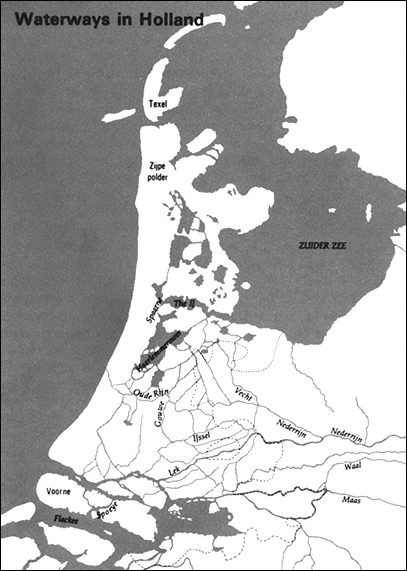
Map 2.
Waterways in Holland
Between 1492 and 1565, disputes of this kind are recorded for at least eight places around the "ring of Rijnland," from Sparendam on the IJ dike to the Zijdewijnd dike that divided the hoogheemraadschappen of Rijnland and Delfland. At several of these points dams or sluices were rebuilt and torn apart frequently over the course of the decades, often after a band of armed men appeared on the dike to smash to pieces whatever in their view infringed on the privileges of their town.[111] Despite the "bearing of arms" sometimes accompanying such demonstrations, there were never any actual battles. Hence these little-known disputes lack the whiff of gunpowder that lends drama to the long battle over Dordrecht's staple rights. Yet they are no less indicative of deep fissures in the urban economy of Holland. In both cases, commercial innovations was pitted against a dogged defense of entrenched privilege. Invoking the power of the prince to right the wrongs of the past, legal briefs on one side appealed to the "common law" freedom of trade,[112] whereas those on the other side were content to rest on the positive law created by the actions of former princes. In both cases, the defenders of free trade and productive innovation repeatedly suffered a double indignity, defeated first by the force majeure of their opponents (the gunboats of Dordrecht or lock-smashing sorties by the men of towns like Haarlem and Gouda), and then in verdicts rendered by the courts. Finally, the losers represented in both cases Holland's dynamic seafaring trades (the Baltic commerce of Amsterdam, the herring fisheries of the Maas ports), whereas the victors represented more retrograde sectors of the provincial economy. Dordrecht had no role in the Baltic trade; by the end of Charles V's reign, Rotterdam was beginning to challenge its traditional supremacy on the north bank of the Maas.[113] Haarlem and Gouda were, with Leiden, heavily involved in the industries that had flourished until the mid-fifteenth century, but had steadily declined ever since. The fact that the defenders of traditional privilege won the legal battles does not mean they won the war; in fact, the frequent reissue of the ban on non-traditional inland waterways suggests that innovators and entrepreneurs were still busy devising ways to evade the rules. But both the nature of the conflict and its apparent outcome do raise a question as to how
towns with such differing interests could ever form a common front.
The Interests of Holland
The answer to this question lies in the fact that there were outside the province forces and powers which could do more harm to Holland's towns than they could ever do to each other. First, the Duke of Guelders could throttle Holland's commerce by choking off the great rivers in the south, while his free-booters watched the Zuider Zee channels by which ocean-going ships passed to and from Amsterdam. Since the government persistently viewed the Guelders wars as a minor part of the larger struggle with France, Holland's towns had to stick together if they were to use the power of the purse to focus attention on their problems (see chapter 3). Second, despite the differences among the towns, Holland's economy was integrated in two important ways: almost every town and village had at least an indirect stake in the Baltic trade, and the province as a whole formed one of several regional satellites around the great commercial and financial hub of Antwerp. Holland by itself, even if united, was not strong enough to withstand a direct challenge from its rivals in the Baltic, and there was also a danger that fiscal policies at home could undercut its competitive position. A threat in either of these two spheres required persuading the Habsburg government to take the right sort of action, and Hollanders had no leverage for moving Brussels to their will unless they could speak with one voice (see chapter 4). Further, the war taxation of Charles V's reign set in high relief urban grievances against the traditional exemptions of the clergy and the nobility, especially the feudal enclaves (seven towns and some thirty-seven villages) that were "outside the schiltal " and thus did not contribute to the beden . Since the towns were pitted in this case against families like the Egmonts and (later) the Nassaus, here too they had no hope of prevailing unless they pooled their strength (see chapter 5). Finally, the draconian provisions of Charles V's heresy laws posed a direct challenge to some of the most cherished privileges of the towns and threatened at times to provoke riots among the
burghers; here too, magistrates learned that they could protect the privileges of their town only by trying to protect the privileges of all (see chapter 6). All of these themes become tangled up together in the first ten years of Philip II's reign, when a government seriously weakened by war finance (and by a devolution of credit-worthiness to the provincial states) attempted once more to stoke the fires of persecution (see chapter 7).
Some of these conflicts may create the impression that Holland's towns stood for a "modern" conception of social and economic life, in which everyone might trade freely and no one would enjoy special privileges. To see how misleading such an impression is, one need only take note of how the twenty-five "walled cities" of Holland joined together to obtain a ban on rural industry (buitennering ). In Henri Pirenne's classic presentation of pre-industrial economic development in the Low Countries, government and entrepreneurs were allies in knocking down the barriers to cheaper and more efficient production posed by the manifold regulations of urban guilds. In many respects Pirenne was correct: the new cloth industries of the sixteenth century flourished in smaller towns that had no guilds, and high government officials were certainly familiar with the argument that "trade must be free."[114] But in Holland, unlike the Flanders that Pirenne was more familiar with, towns large and small pooled their political influence to seek relief from rural competition, especially in brewing and cloth-weaving. In 1529, the six great cities voting in the States made a ban on rural industry a condition for their consent to an extraordinaris bede . But nobles voting in the States, who stood to profit from economic growth in the villages, resisted the proposal, and the promised ordinance was not issued. Hoogstraten offered to help, but expressed doubt as to whether feudal enclaves (areas not subject to the jurisdiction of the Council of Holland) could be comprehended within the proposed ban. Finally the cities decided to "make friends" with the influential Lodewijk van Vlaanderen, lord of Praet, who was at this time one of the small circle of councillors travelling with the Emperor. On 11 October 1531 the cities got what they wanted—a prohibition against the practice of brewing, weaving, leather-working, masonry, or any
other industry (nering ) outside the walled towns. A few months later, the States voted a special omslag of 30,000 pounds, presumably to be paid by the towns only, as the cost of this cherished privilege; since the Council of Holland supported the position of the nobles on this question, no member of the Council would sign the authorization for this omslag, and the Advocate of the Common Land had to do it himself. The ban did not mean that rural industry in fact came to an end. Apart from the feudal enclaves, which were indeed not covered by the ban, the ambachtsheren also had to be contented one way or another, either by buying out their claims to operate or license rural industries, or by having the city itself acquire title to the ambachtsheerlijkheid of adjacent districts.[115] But it would certainly not be right to represent Holland's urban economy in this period as the springboard for a modern form of commercial capitalism. Pirenne saw urban protectionism as a function of the political influence of artisan guilds in the great cities of the southern Netherlands. Holland's magistrates may have had patrician pedigrees, but in their determination to suppress competition from the countryside, they were blood brothers to the weavers and fullers of Ghent.[116]
There is a unifying thread in the arguments made by urban deputies to the States, but it lies in the medieval principle of privilege (insofar as the towns benefited from it), and not in the modern idea of' free trade. Given Amsterdam's long battle against the Dordrecht staple, it might seem that the merchant communities of these two cities present a textbook between a medieval regulated trade and a modern spirit of enterprise. As will be seen in chapter 4, however, the real defense of Amsterdam's precious freedom of trade in Baltic grain lay not in legal or pragmatic arguments, but rather in a privilege that was granted in 1495 by the cash-starved Maximilian I, exempting Amsterdam from duties on foreign grain. However much Amsterdammers might wish to appeal to the power of the prince to overturn "unjust" privileges (like the Dordrecht staple), they surely realized that the same power could be turned against their vital interests."[117] In the early years of Charles V's reign, no one could have predicted whether the government might succeed in playing on the divisions among Holland's towns to make
itself stronger, or whether the towns might develop a cohesion among themselves that might effectively limit the government's influence within the province.
In fact, no body politic ever achieves a perfect union. Even in the most stable commonwealth, there are faults and fissures which wisdom of hindsight can always point to in "explaining" whatever schism or bifurcation that the confluence of events may bring about. In the case of the Habsburg Netherlands, Pieter Geyl has pointed out that to observers in Charles V's reign, the most important line dividing the Dutch-speaking provinces would have been between the urbanized areas in the west (Flanders, Brabant, Holland, and Zeeland) and the more rural eastern provinces, some of which had only recently come under the rule of the Netherlands government. But since the division that occurred after 1572 between north and south, patriotic Dutch writers found reasons for believing that even under Habsburg rule Hollanders were different, more independent of spirit than Flemings or Brabanders.[118]
To speak of Holland's towns as developing, already under Charles V, a spirit of resistance to Habsburg rule would be to fall into the trap Geyl so well describes. But one can speak of habits of action that tend to be repeated simply because people find it easier to do so. A major argument of this book is that Charles V's reign in Holland witnessed the development of important habits of cooperation among the towns and nobles represented in the States. The point is not that the members of Holland's political elite reached, by ripe deliberation, the sage conclusion that there was strength in union. Rather, pressure from external foes, combined with energetic action by the Habsburg government, induced the towns to begin collaborating in new ways. The end result of this process was a States of Holland more capable of speaking for the province as a whole and more confident in dealing with the problems that governments had to face, backed by an administrative machinery of their own and a strong credit rating. The fact that such provinces had come to exist by the time of Philip II's reign did not mean that the Revolt was necessary or inevitable. Had there not been such provinces, however, it is hard to imagine how the Revolt could have succeeded.