
Bhisi(n) (Bhima)
Bhisi(n), or Bhisi(n) Dya:, "Bhisi(n) God (see fig. 15)," as he is usually referred to, is related tenuously to the Mahabharata's epic hero, Bhima or Bhimasena, one of the five Pandava brothers. He is included in most households' sets of gods (discussed below), but he is in Bhaktapur the special divinity of shopkeepers.[50] He has three major city shrines, two of which are significantly located along that portion of the city festival route that follows the bazaar. The third one is just to the south of the
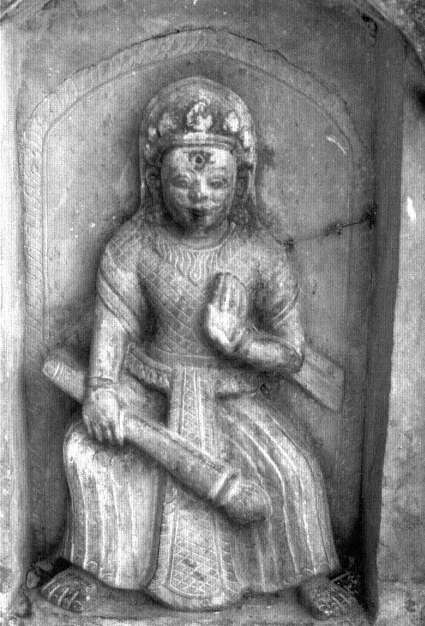
Figure 15.
The merchants' special deity, the Bhisi(n) God.
city. Shopkeepers worship him at home and in his temples for good fortune in their commercial affairs. He is also the focus of one annual festival, centering on the temple of Suku Bhisi(n) Dya: in Dattatreya Square in the northeastern part of the city. Representations of Bhisi(n) show him as a powerful man with a full moustache, usually subduing a kneeling vanquished figure, said to be the epic's Kaurava King, Dussasana.
Slusser notes D. R. Regmi's claim (1965-1966, part II, p. 612) that the earliest reference to Bhisi(n) in the Kathmandu Valley is 1540 A.D. , and remarks that all of his images are works of the late Malla period, suggesting a relatively recent (in terms of Newar history), introduction of the figure as a separate god, independent of his position as one of the five Pandava brothers. How he became a god of commerce is unclear. Slusser surmises that he may have been "first associated with the fields as a heroic guardian figure, and later, by extension, guardian of the granary and of trade" (1982, 258f.). It is not clear whether any of the special characteristics of Bhima as portrayed in the Mahabharata, where he is a kind of marginally socialized figure of great strength, facilitate his semantic appropriateness for the merchants. One may, perhaps not entirely frivolously, note the following. When Bhima fought and killed the Kaurava King Duryodhana "the two were well matched, but when Bhima was losing he struck an unfair blow with his mace, thus disregarding an ancient rule that a blow should never be dealt below the navel. This blow broke his adversary's thigh, and hence his epithet Jihmayodhin, the 'unfair fighter'" (Stutley and Stutley 1977, 45). Whatever his specific appropriateness to commerce may be, there are considerations that make a dangerous god more appropriate to the sphere of commerce than an ordinary god, as we shall argue in the summary section of this chapter.