
PART 1—
SETTING THE SCENE
Chapter 1—
The Southern Californian Technopolis in Context
Introduction
Southern California is today one of the world's largest and most dynamic manufacturing regions. Over much of this century, and especially since the end of the World War II, the region has grown at an extraordinary pace, and it now comprises an enormous sprawling conurbation in which some 17 million people make their home.
Southern California began to grow in earnest at the beginning of the twentieth century as irrigated agriculture developed and as rich local petroleum resources were brought into production (Starr 1990). The motion picture industry also contributed to early expansion, and it remains today, along with a constellation of television, recording, and video production activities, one of the mainstays of the region's economy. In the interwar years, a small aircraft industry took root in Los Angeles and to a lesser extent in San Diego, and it soon came to be an important focus of employment. After World War II, the aircraft industry blossomed into a great aerospace-electronics manufacturing complex whose growth was fueled by large-scale federal defense spending over the postwar decades. By the early 1960s the complex had become the dominant element of the entire local production system. In addition, since the 1970s, the region has emerged as a major center of low-technology labor-intensive forms of manufacturing such as clothing, furniture, jewelry, and printing, just as it has also grown to be one of the major financial and commercial centers of the Pacific Rim.
This saga of regional growth and development poses innumerable puzzles to the theorist and the historian alike. On the one hand, the available conceptual frameworks of urban and regional analysis seem quite inadequate when faced with the sheer breadth, intensity, and durability of Southern California's rise to industrial preeminence. On the other hand, the narrative sorting out of the detailed empirical events that collectively define the region's trajectory over space and time is a task of daunting complexity. In particular, the circumstances surrounding the birth and subsequent expansion of the many individual industries in the region are frequently quite obscure, as are the ways in which different industries evolved in relationship to one another. I cannot hope, in this book, to achieve much more than a preliminary sketch of some approaches to these questions. Moreover, the focus of the book is on just one ensemble of industrial activities, namely, the high-technology manufacturing complex, and most of the other forms of economic production in the region will be considered only in passing. That said, the great advantage of this concentrated focus is that it allows us to pursue one or two major theoretical and substantive themes with some degree of detail.
In the present chapter, I shall briefly sketch out some of the empirical background to these themes. The chapter that follows enlarges on a few general ideas about problems of industrial organization and regional development, and on this basis I hope to be able to pinpoint a number of important aspects of industrial complex formation. These ideas have been more fully adumbrated elsewhere, and I shall therefore not attempt to argue them out at length in this book. They depend in essence on an effort to capture the logic of the production system as a dynamic complex of interconnected producers articulated with a series of local labor-market activities. This logic, I shall argue, leads under specifiable conditions to geographically agglomerated economic growth and hence to the formation of densely industrialized and urbanized regions.
In the light of this conceptual apparatus I shall in subsequent chapters lay out an extended series of empirical studies of high-technology industry in Southern California. Special attention will be paid here to the genesis and growth of the region's aerospace-electronics complex, its changing technological foundations, its structure and organization, its labor force, its extraregional connections, and its evolving geographical pattern within the region. These empirical studies are important in their own right as stories about the development of high-
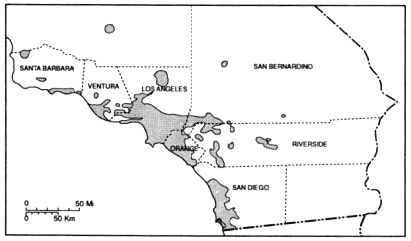
Figure 1.1
The seven principal counties of Southern California. The primary built-up area
is shaded.
technology industry in Southern California. But they are also intended to be read as attempts to operationalize a specific theoretical perspective, and the entire book—despite its profusion of empirical references to Southern California—is meant in the last analysis to stand (or fall) as a series of wider claims about regional development processes in general.
Southern California:
A Brief Overview of Its Geography and Population
Southern California can be roughly defined as consisting of the seven counties of Los Angeles, Orange, Riverside, San Bernardino, San Diego, Santa Barbara, and Ventura. These seven counties are shown cartographically in figure 1.1. The actual built-up area of the region is also indicated in figure 1.1; it forms a virtually continuous tract of urbanized land sweeping some 230 miles in an irregular band around the Pacific coastline from Santa Barbara in the north, through the central pivot of Los Angeles, to San Diego and the Mexican border in the south.
The whole seven-county area is further subdivided into 188 different independent municipalities so that despite its continuous pattern of land uses it is marked by severe fragmentation of local government and urban-planning activities. These municipalities are connected
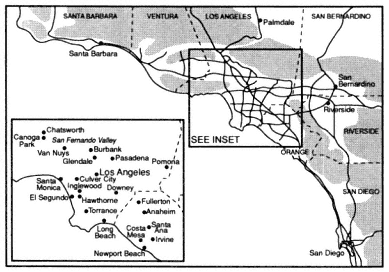
Figure 1.2
Southern California: Freeway system and primary place-names used in
the text. Mountainous areas are shaded.
together into a regional system by an extensive network of freeways (fig. 1.2). Over the decades, this network has induced concentrated growth at the core of the region while simultaneously facilitating an enormous shift of both population and industry to peripheral suburban areas. Southern California's growth can in significant degree be traced out as a series of ever-widening ripples of lateral urban expansion and outer-city formation.
Population trends in the seven counties are presented in table 1.1, which provides data on each individual county at ten-year intervals since 1970. In terms of total population, Los Angeles County clearly dominates the whole region, with San Diego and Orange counties trailing far behind in second and third places, respectively. The most striking feature of the data presented in table 1.1 is the enormous and steady growth of population in the region in recent decades. The second striking feature is the vigorous population surges of peripheral areas as manifested in the explosion of Riverside and San Bernardino counties in the 1970s and 1980s, and now most recently of all in the incipient expansion of the population of Santa Barbara and Ventura counties. All of this growth has been fueled by the region's extraordinary economic vitality, and by its ever-enlarging pool of jobs and economic opportunities.
| ||||||||||||||||||||||||||||||||||||||||||||||||
The growth in population has been accompanied by a number of important changes in the racial and ethnic complexion of Southern California (see table 1.2). The African-American population of the region currently stands at close to 1.4 million, and it has increased steadily in absolute terms in recent decades. Over the 1980s, however, it actually showed a slight proportional decrease, and it now constitutes 7.7 percent of the total (as opposed to 8.6 percent in 1980). By contrast, the immigrant population has grown enormously since the 1960s, and Southern California has recently become a region of great ethnic and cultural diversity. Two main ethnic groups constitute the major part of this population. First, there is a rapidly growing Asian group consisting variously of Koreans, Vietnamese, Chinese, Japanese, Thais, Filipinos, and Cambodians. Second, there is an exceptionally large Hispanic population originating principally in Central America (Mexico, El Salvador, and Guatemala in particular), with a further admixture of people from South America and the Caribbean. Asians and Pacific Islanders (to use the official census designation) now account for 8.9 percent of the total population, and Hispanics account for 31.0 percent. Los Angeles is today the major port of entry for immigrants into the United States, a position formerly held for most of this century by New York. A large but unspecified proportion of the
| ||||||||||||||||||||||||||||||||
immigrant population consists of undocumented workers, especially in the case of Hispanics, many of whom enter the country by illegally crossing over the land boundary between Mexico and the United States.
These immigrant populations play a vital part in the economy of Southern California, and they have been absorbed on a massive scale into unskilled low-wage jobs throughout the region. They play an especially important role as a source of cheap and pliable labor in the underbelly of sweatshops that forms an integral part of the region's economy, both in low- and in high-technology manufacturing sectors. African-Americans, by contrast, have not been incorporated to the same extent into either of these sectors (Scott and Paul 1990), and this no doubt helps to account in part for the contrasts in growth between the African-American population and the Asian and Hispanic populations. Several commentators have remarked that with the huge influx of Third World immigrants into the region, social structures and labor markets have tended more and more to become dichotomized between an upper- and a lower-income group. The former group is composed of managers, professionals, scientists, engineers, and other highly qualified workers; the latter is made up to a large degree of unskilled, immigrant workers, a high proportion of whom are women. Between these two strata, there is a middle group comprising the traditional skilled and semiskilled blue-collar working class, but now so small and
shrinking with such rapidity that it is commonly referred to as the "disappearing middle" (Ong 1989; Soja 1989).
A Sketch of the Regional Economy of Southern California
Since the end of the 1960s, economic development in the United States has shifted to a significant extent away from the old Manufacturing Belt in the northeast of the country and toward the Sunbelt, where many new forms of industrialization and urbanization have made their historical appearance. Southern California is in many ways paradigmatic of this change, so the study presented here is not just an isolated investigation of a unique region, but is also in several respects representative of a wider pattern of geographic and economic transformation. Southern California is particularly important as an advanced case of postfordist flexible economic growth.
Over the decade from 1980 to 1990, total nonagricultural employment in Southern California grew by a robust 31.2 percent, as compared to 21.8 percent for the United States as a whole. From the data laid out in table 1.3, it is apparent that most of this growth was concentrated in various service and white-collar sectors. Manufacturing employment in Southern California grew by a modest 3.1 percent during the decade, but this contrasts with a decline of 6.1 percent for the entire country, and several manufacturing sectors in the region grew at a very rapid pace indeed. At the present time, the nearly 1.4 million workers in manufacturing in the region account for 18.2 percent of total nonagricultural employment—a percentage that is just slightly more than the 17.3 percent for the United States as a whole.
The aggregate manufacturing data for Southern California mask a number of important internal differences in this category of employment. We need to note first of all that at the end of the 1960s, once-thriving elements of the region's economy like car assembly, rubber tire manufacture, and steel entered a period of severe crisis. These traditional smokestack and mass-production industries in the region (as in the country as a whole) were subject to an epidemic of plant closures and job losses in the 1970s and 1980s, and they have now virtually disappeared from Southern California. By contrast, two other major industrial ensembles have held their own to a significant degree. These are represented by a group of low-technology labor-intensive craft in-
| |||||||||||||||||||||||||||||||||||||||||||||||||||||||||||||||||||||||||||||||||||||||||||
dustries on the one hand, and high-technology industries on the other. Both ensembles of industrial activity employ large numbers of workers, and both have expanded at a fast pace over the postwar decades. Let us look briefly at each.
Employment in low-technology labor-intensive craft industries in Southern California in 1988 is shown in table 1.4. This table is based on data provided by County Business Patterns , in contrast to table 1.3, which is based on data in Annual Planning Information . The two sets of data are not strictly comparable because of the different ways in which they are collected. In particular, County Business Patterns does not ensure a 100 percent enumeration of all business activity. However, County Business Patterns gives more complete sectoral breakdowns of employment than does Annual Planning Information , and is
| ||||||||||||||||||||||||||||||||||||||||||||
thus used here (as well as in subsequent chapters) as a source of data for detailed intersectoral comparisons. Table 1.4 is based on a mix of two- and three-digit SIC categories defined in terms of the 1987 Standard Industrial Classification. Note that SIC 781 (motion picture production and services) is listed in the Standard Industrial Classification as a service, but given its mode of organization it is probably more appropriately viewed as a low-technology labor-intensive industry (cf. Storper and Christopherson 1987), and hence is included in table 1.4. The major sectors in table 1.4 are apparel, furniture, printing and publishing, and motion pictures, with leather, jewelry, and toys at a much lower level of development (but poised for major expansion). Southern California has now actually edged ahead of New York as the nation's major center of the garment industry. All of these low-technology labor-intensive sectors tend to form specialized industrial districts scattered around the central area of Los Angeles (Scott 1988a). In these districts, they are organized into networks of many interconnected producers and subcontractors, and except for the motion picture industry (much of which is dominated by craft labor unions and subject to closed-shop rules) they also employ large numbers of immigrant workers. The data on number of establishments given in
| ||||||||||||||||||||||||||||||||||||||||||||||||
table 1.4 also indicate that these low-technology labor-intensive sectors are dominated by small production units, averaging 34.1 employees each.
The high-technology manufacturing ensemble in Southern California is made up for the most part of aerospace-electronics industries together with sectors producing various kinds of instruments including medical instruments and supplies (table 1.5). There is also a flourishing biotechnology industry in the region (concentrated in San Diego), but employment data are not readily available for this sector. The high-technology ensemble, defined in table 1.5, accounts for very roughly a third of all manufacturing employment in Southern California. Indeed, Southern California is unquestionably the largest high-technology industrial region in the United States, if not the entire world. The industry is organized in the form of a stratified network of establishments consisting of (a) large systems houses (i.e., small-batch assemblers of extremely complex technology- and design-intensive artifacts such as aircraft or communication satellites), (b) medium-sized producers of components and subassemblers, and (c) many small manufacturers and subcontractors offering specialized services such as
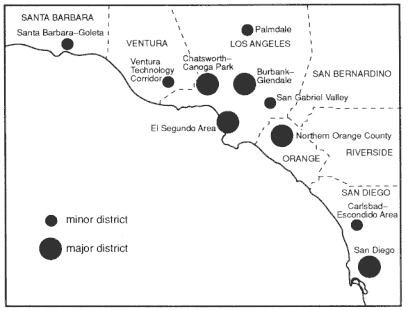
Figure 1.3
The primary high-technology industrial districts of Southern California.
printed-circuit board fabrication, electronics assembly, plastics molding, aluminum foundry work, tool-and-die making, and so on. These establishments, like their low-technology counterparts, also tend to cluster together within specialized industrial districts (see fig. 1.3). The original high-technology industrial districts of the region date from the 1930s and are located in Burbank and the El Segundo area (both of them on the periphery of Los Angeles as it was at that time), and in San Diego. These three districts developed as the region's aircraft industry and associated parts-producing sectors grew. In the postwar decades, new and more diverse high-technology industrial districts have emerged at a series of increasingly peripheralized locations. The collective set of these districts in the region constitutes the Southern Californian technopolis, which is the main object of investigation in this book.
The robust growth of high-technology industry in Southern California since the 1950s has been largely driven forward by the copious spending of the federal Department of Defense over the entire Cold War period. Table 1.6 traces out defense prime contract awards in
| |||||||||||||||||||||||||||||||||||||||||||||||||||||||||||||||||||||||||||||||||||||||||||||||||||||||||||||||||||||||||||||||||||||||||||||||||||||
both the United States and in California between 1970 and 1990. Unfortunately, information on prime contract awards for Southern California as such is not readily available over extended time periods, but since Southern California receives from 70 percent to 80 percent of all awards made to the state, the data for California as a whole laid out in table 1.6 can be taken to be reasonably representative of overall trends
| ||||||||||||||||||||||||||||||||||||||||||||||||||||||||||||||||||
in the region. For both the United States and the state, prime contract awards, in constant dollar terms, grew erratically but continually over most of the period from the 1950s to the 1980s. They reached a peak in 1987, and have declined steadily since then. In view of the prospect of a durable international détente throughout the 1990s, this pattern of decline seems likely to persist. Moreover, while Southern California still takes a much greater share than any other state of total money expended on prime contract awards, the share, too, has tended to decline over the late 1980s from a maximum of 23.0 percent in 1984 to 16.6 percent in 1989.
If we look at aggregate annual employment in the core aerospace-electronics complex of the region (i.e., high-technology industry as defined above less medical instruments and supplies), we see that it runs more or less parallel to the course of defense spending. Here, the complex is identified (not entirely satisfactorily) in the terms established by the Employment Development Department of the state of California
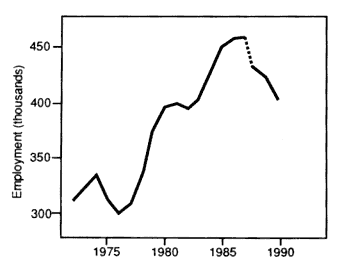
Figure 1.4
Total employment in the aerospace industry of Los Angeles,
Orange, and San Diego counties. Note change of definition of
industry after 1987. (Data from State of California, Employment
Development Department, Annual Planning Information .)
(see table 1.7). After 1987, SIC 365 was dropped from this definition, and SIC 381 was added. Fortunately-, the discrepancies in the aggregate data series before and after 1987 are probably slight. Figure 1.4 shows absolute levels of employment in the complex from 1972 to 1990 for the three leading counties of Los Angeles, Orange, and San Diego. Over the years of the Reagan presidency, employment in the complex expanded with particular intensity, and this was a boom period for the region as a whole. Since 1987, however, in response to the declines in Department of Defense prime contract awards, significant losses of employment have been experienced. Southern California assuredly remains the world's premier high-technology manufacturing region, though it is now experiencing many difficulties, and serious questions remain as to its future course of development. We shall return to these questions—and the major policy issues that they pose—in the final chapter of this book.
Chapter 2—
Patterns of Industrialization and Regional Development
Basic Dimensions of the Problem
Industrialization—the transformation of materials and semifinished outputs into marketable commodities—is in both physical and social terms an enormously complex undertaking. In capitalist society it is particularly problematical because in addition to the technical and organizational problems involved, the social relations and accumulation strategies intrinsic to the whole process lead to constant turbulence and crisis, just as they also provoke continual readjustment of the geographical bases of production (Storper and Walker 1989).
As I shall contend later in this chapter, it is useful to think of industrialization processes as embedded within technological-institutional structures of production that constitute physical and social settings within which economic activity as a whole is accomplished. These structures are in turn subject to evolutionary trajectories of development , meaning that they change over time at varying velocities. Moreover, the dynamic of change can be represented as a branching structure in which the accumulated weight of many small events may lock a particular pathway of development into place over long periods (Arthur 1988; David 1975). In addition, industrialization is, by its very nature, spatially extensive, and therefore it is subject to various locational logics and leitmotifs , as expressed in the enormous diversity that we commonly find in patterns of industrial development from place to place. Each of these broad dimensions of the problem is of the
first importance in understanding industrial development, and in charting out the rise and fall of regional economic systems. Together, they provide a way of organizing in analytical terms the many detailed inner workings of the production system qua sets of technologies, labor processes, input-output relations, locational decisions, managerial viewpoints and ideologies, and so on. In particular, the notion of production as an organized technological and institutional structure differentially unfolding over time and space represents a sort of conceptual road map as we start to examine the complex interrelations between industrialization and regional development.
The investigation now begins with an inquiry into the logic of some of the central building blocks of industrialization processes as they impinge on patterns of regional development (i.e., the division of labor, the organization of production, and the location of industry). This is followed by an account of some of the main temporal and spatial tendencies of production systems in contemporary capitalism, and in which an attempt is made to situate the Southern Californian technopolis both historically and geographically.
From the Division of Labor to Spatial Agglomeration
Patterns of Industrial Organization
In every kind of society there are always productivity gains to be made by specialization and trade. For example, an individual can do all of the work of making a hammer, from cutting down a tree, smelting the necessary iron ore, making a handle and a head, and then assembling the parts into a final product. Obviously, however, in any organized society, it will usually be more economical to carry out this work if there is a division of labor such that individuals concentrate on particular tasks, and exchange what they make against what others make. There are limits to how far such a division of labor can efficiently go, but as it proceeds we say—along with Böhm-Bawerk (1891)—that the "roundaboutness" of the economy is increasing. This is equivalent to the proposition that there is an increasing number of stages or steps between the production of the raw materials on which the economy is based on the one hand, and the production of final outputs on the other. One of the immediate effects of increasing roundaboutness is
that it makes possible an evermore finely grained geographical differentiation of economic activity.
Roundaboutness may be expressed in terms of either a technical division of labor or a social division of labor . The former involves the separation of tasks and the specialization of workers within a particular firm. In this case, workers interact with one another via a network of purely intrafirm transactions representing a hierarchy that is coordinated by means of managerial fiat. By contrast, a social division of labor involves the parceling out of different tasks between individual production units (firms or establishments as the case may be) in a pattern of vertical disintegration. In this instance, producers specialize in a particular sector or subsector, and they buy and sell among themselves in networks of externalized transactions that are in part governed by market relations and hence subject to price signals (Coase 1937; Williamson 1975). In practice, there is a third organizational modality that is neither purely hierarchical nor purely subject to market forces, but involves various combinations of these two principles, in the form, for example, of joint ventures, strategic alliances, or other kinds of contractual obligation. One of the problems that we face is to determine where these different structural forms begin and end in different sectoral and historical contexts. We may approach this problem by way of a discussion of the relations between technologies, organization, and average costs.
Industrial processes are invariably subject to internal and external economies. Internal economies, as the name implies, come from cost-reducing relationships that are contained within the individual production unit; external economies come from cost-reducing relationships that lie outside the boundaries of the individual unit. Internal and external economies can be further categorized as being due to the effects of either scale or scope . Figure 2.1 shows how internal and external economies articulate with scale and scope effects and how each particular articulation is rooted in the broad conditions of production. Figure 2.1 informs us that economies of scale are engendered by simple quantitative increases in levels of economic activity (i.e., internally in terms of the amount of product manufactured, especially where large units of machinery and equipment with high fixed costs are present; or externally in terms of the number of individual producers). Economies of scope are based on levels of productive variety (e.g., internally in terms of the number of different tasks undertaken such as spinning,
|
Figure 2.1
The genesis of internal and external scale and scope effects.
weaving, or dyeing; and externally in terms of the range of different producers in a given industrial complex or economic system). Note that dis economies of scale and scope occur when expansion over the same respective dimensions brings about increasing average costs.
The empirical circumstances underlying the formation of internal and external economies of scale and scope are many and varied (Gaffard 1990; Tirole 1988; Williamson, 1975), and I shall make no attempt to provide a systematic catalog of them all here. Two major remarks are germane, however. In the first place, where producers face intensified levels of uncertainty (e.g., as a result of increased market contestability, insistent product differentiation, or frequent cyclical ups and downs of the economy) their internal scale and scope economies will be under considerable pressure and will have some tendency to break down. This is a result directly of the circumstance that uncertainty will create inefficiencies in the use of large units of fixed capital, and the problem will be compounded where such units are slaved together in a vertically integrated system so that the inefficiencies will be passed backwards through the vertical structure of the firm (Carlton 1979; Scott 1988a). Conversely, predictability and stability will tend to encourage the quest for scale and scope. In the second place, when vertically related production processes have strong synergetic interactions (as is observable in the case, for example, of manufacturers of military and space hardware, which is commonly subject to rigorous design specifications covering all subcomponents and their interconnections) internal economies of scope are likely to be highly developed. Thus, in this instance, considerable vertical integration is apt to occur and production units may attain great size, even though scale
in the strict sense of number of units of output produced per time period may be quite small.
The configuration of any industrial system will be intimately shaped by these different forces. Two extreme cases may be cited to illustrate this point. One is where massive internal economies of scale and scope are present leading to large vertically integrated production units (i.e., hierarchical organization). The other is where internal scale and scope economies dissolve away and where external economies abound. In this second case, we would expect to find the production system fragmented into many small establishments linked together through dense networks of externalized transactions (i.e., vertical and horizontal disintegration). A wide assortment of intermediate cases can be envisaged between these two extremes, as for example, in the Southern Californian technopolis where a number of large, integrated aerospace producers (i.e., systems houses) are caught up in dense networks of small and disintegrated firms.
Transactional Networks
When vertical and horizontal disintegration of the production system takes place, the system typically evolves toward the form of a transactions-intensive complex of producers. In brief, more and more of the system is externalized, and interestablishment networks of linkages become ever more profuse and intricate. These linkages or transactions are usually many faceted, and they are often quite problematical in that certain kinds of failures to achieve full transactional efficiency frequently occur.
In the simplest case (which is also probably relatively rare) interindustrial linkages are reducible to spot dealings in which a given quantity of product changes hands at a given price in one finite transaction. In more complex cases, linkages may be based on considerable prior negotiation and discussion, and they may also entail contractual agreements over extended periods of time. Sometimes, the parties involved in any transaction may find it to their advantage actually to form complementary institutional frameworks as a way of ensuring smoother and more reliable flows of information and products. Probably the most advanced case of this latter phenomenon in modern capitalism is to be found in Japanese subcontracting systems where parent firms and dependent subcontractors form durable alliances with
one another to guarantee systemwide efficiency and survivability. Joint ventures and strategic alliances represent another means of institutionalizing transactional relations between firms over lengthy periods of time. We may refer to all such phenomena as forms of "quasi-integration" for they represent agreements between otherwise independent firms to renounce a limited portion of their operational autonomy for the sake of superior transactional efficiency. Institutionalist economists of the markets-and-hierarchies school are often accused of evacuating such intermediate forms of organization and transactional interaction from the purview of economic theory (cf. Gordon 1991; Sayer 1990), but as the work of Williamson (1975, 1985) indicates, these forms are actually entirely consistent with the main ideas of this school of thought, and are indeed predictable out of its basic premises about structures of contractual interaction.
One especially important aspect of interindustrial transactions is that they occur over geographic space . They thus invariably generate space-dependent costs that increase positively with distance. Often enough, such transactions represent so small a fraction of the total costs of production that they play scarcely any role in the locational decisions of manufacturers. In other cases, they have major impacts on the ways in which productive activity is distributed over geographic space. To sharpen these remarks, we need to distinguish between different kinds of transactions on the basis of their size, formal attributes, and spatiotemporal characteristics.
Thus, transactions that occur in large volumes typically have low costs per unit of quantity and distance because there are almost always significant economies of scale to be obtained in transport processes. Conversely, small transactions tend to incur relatively high costs per unit. Transactions that are in some way difficult to effectuate because of their physical characteristics—in such matters as shape, fragility, packageability, perishability, and so on—also face high unit costs. A special, but enormously important variant on this matter of the formal attributes of transactions is where they necessitate the movement of people who must deal face-to-face with one another for any transaction to be accomplished. This will often be the case where transacting involves the communication of information or advice; or it may occur in relation to a physical flow of materials where a process of mutual education and negotiation is crucial to effective intermediation,—a circumstance that is commonly encountered when work is subcontracted out. The costs of face-to-face contact involve not just ordinary ex-
penditures on transport but also the wages of the person or persons engaged in the contact; and when high-level employees (managers, supervisors, legal counsel, and so on) are engaged, these costs can escalate rapidly. Lastly, the costs of transacting are usually sensitive to the regularity and predictability of transmission and delivery of goods and information. Where transactions are routinized in space and time their costs are likely to fall; and where they are irregular and unpredictable, their costs will rise. The latter state of affairs is reinforced where firms face much randomness in their external transactions (e.g., because of a need for occasional customized components, special kinds of services, machinery repair, and so on) and must, as a consequence, continually find and build new linkage partnerships.
In the light of this discussion we would expect to observe relatively low aggregate transactions costs where groups of producers are linked to one another via large, stable, standardized transactions (especially if these involve little personal contact). But we would also expect to detect much more burdensome transactions costs in disintegrated industrial complexes with many small producers tied together in idiosyncratic and variable linkage networks. If, in the latter case, transactions are problematical so that they must also be executed by means of personal contact (or even, in the extreme, supported by complex institutional infrastructures) then they will be that much more onerous. Indeed, transactions costs may be elevated to the point where they cancel out the advantages that would otherwise accrue from vertical disintegration.
This state of affairs is represented schematically in figure 2.2, which shows two average cost curves for a particular kind of production process—let us say electronics assembly. One of the curves [I(q)] represents average costs of the electronics assembly function under conditions where it is vertically integrated with downstream functions, and where q represents quantity of output; the other curve, [D(q)], represents average costs under conditions where electronics assembly becomes vertically disintegrated from downstream functions. It is assumed that the cost curves in these two contrasting situations have quite different shapes, because the specific conditions of production may vary greatly depending on whether assembly is integrated or disintegrated. Figure 2.2 coincidentally suggests how vertical integration/disintegration may occur in relation to both scale and scope effects. In panel A of the figure there are no distance-dependent transactions costs and vertical disintegration is clearly the optimal solution for this
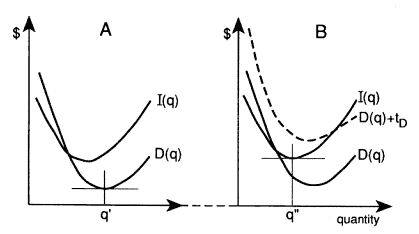
Figure 2.2
Average cost curves I(q) and D(q) as a function of quantity produced (q) under
conditions of vertical integration and vertical disintegration, respectively; tD is
the distance-dependent transactions cost involved where vertical disintegration
prevails. In panel A (without transactions costs) the optimal solution is
production of q' in vertically disintegrated form; in panel B (with transactions
costs) the optimal solution is production of q" in vertically integrated form.
particular example. In panel B distance-dependent transactions costs are assumed to be so high that vertical integration becomes the preferred solution, and the greater the distance over which transacting must occur, the greater this tendency will be. Notice that we could add yet another dimension to this discussion by introducing distance-dependent intrafirm transactions costs and thus broadening our analytical range to include the possibility of vertical integration and spatial separation, i.e., the multiestablishment firm (see Scott 1988a for a more extended exposition of this problem). For the moment, the important point to recognize is that if the distance-dependent costs of external transacting are sharply curtailed by locational convergence of the parties involved, then the advantages of vertical disintegration can often continue to be reaped.
The generalization of the latter remark is immediate. In any transactions-intensive complex of producers there are likely to be benefits for all or for a subset of producers if they locate in close proximity to one another so as to bring transactions costs under control. In brief, depending on the specifics of interindustrial transactions, there will be cases where external economies engendered by fragmentation
of the production system can best be secured if they are transformed into agglomeration economies by the locational strategies of producers.
Agglomeration
It is this connection between the social division of labor, external economies, and locational agglomeration that, in part, calls forth the phenomenon of the Marshallian industrial district , i.e., a specialized geographical cluster of production activities. The sobriquet "Marshallian" is intended as a reminder of the contribution of Alfred Marshall (1919) who first systematically commented on the disposition of certain kinds of industries to concentrate locationally in specialized areas (see also Becattini 1987). Such districts were extremely common throughout Europe and North America in the nineteenth century, and many of them became celebrated centers of craft industry. Some of these are cataloged by Piore and Sabel (1984, p. 28) in the following terms:
Silks in Lyon; ribbons, hardware, and specialty steel in neighboring St. Etienne; edge tools, cutlery, and specialty steel in Solingen, Remscheid, and Sheffield; calicoes in Alsace; woolen and cotton goods in Roubaix; cotton goods in Philadelphia and Pawtucket.
Analogous phenomena are still observable today, and as postfordist, flexible production organization has made increasing headway in modern capitalism, many new industrial districts are beginning to materialize. One of the most conspicuous examples of this process is represented by the high-technology industrial districts of the U.S. Sunbelt, and of Southern California in particular.
All such industrial districts are characterized by a proliferation of many different producers, all locked together in mutual interdependence through their transactional relations. Because of the geographical proximity of producers to one another, the velocity of circulating capital through the system is accelerated and this increases the advantages of agglomeration. At the same time, producers have added insurance against rare contingencies that might severely disrupt production. Thus, in the absence of immediate access to suitable suppliers of unpredictable needs (e.g., machine shops or engineering consulting services) production may be severely disrupted over extended periods of time. Industrial districts also represent important centers of employ-
ment and local labor market activity. They are invariably surrounded by dense residential districts housing their main work force. Because of the spatial juxtaposition of large numbers of jobs and workers, job-search and job-matching activities are facilitated, and this is often expressed in terms of increased rates of labor turnover in large industrial centers (Jayet 1983). The specialization of workers in local trades and their habituation to place-specific norms of production and work ease the tasks of filling job vacancies and labor-force training. These labor market conditions further underpin the agglomeration economies secured in the first instance by the transactional-cum-locational interrelations between producers, and they reinforce the competitiveness of the entire complex of industries. Agglomeration economies are yet further amplified where there is active collective provision of infrastructural services and public goods (e.g., roads, utilities, airports, and the like), and where useful immaterial infrastructures emerge such as business associations, information-providing services, educational and research institutions attuned to local production needs, and so on.
Industrial agglomerations thus come to embody significant productivity advantages, and these in turn endow producers with a strong competitive edge. This edge is continually being sharpened by the innovative activity that seems to occur endemically within industrial agglomerations—both because they are the sites of innumerable windows of innovative opportunity, and because they are also places in which the specific individuals best positioned to perceive and take advantage of the same opportunities are located (Russo 1985). These circumstances are manifest in the emergence of Verdoorn effects in densely developed regional economies, in that such regions tend to experience rising levels of productivity with rising levels of gross output (Kaldor 1970). The same essential point is to be found in the work of Porter (1990). The same essential point is to be found in the work of Porter (1990), who has recently argued that one of the major factors behind competitive performance in export markets is the existence of densely developed industrial districts, with their intrinsic productivity and innovation advantages.
Here, an important point of qualification is in order. In modern capitalism, industrial agglomerations are never hermetically sealed off from the outside world. On the contrary, and notwithstanding their strongly centripetal tendencies, they are always connected to a wider economic system through elaborate networks of extraregional transactions. Today, these networks are typically global in extent. Indeed, much of the contemporary world economy can be seen as a mosaic of
regional agglomerations (marked by localized transactional networks) embedded in far-flung systems of national and international transacting (Scott and Storper 1992). An important corollary of this observation is that the governance of industrial systems involves important tasks of coordination not just at the national level, but evermore insistently at the international and regional levels too. We shall return to this issue.
Industrial Systems and the Historical Geography of Industrialization
Types of Industrial Systems
Industrial systems can thus be seen in part as units of production (i.e., constellations of technologies, labor processes, managerial apparatuses, and so on) caught up in transactional networks and local labor markets. A wide variety of geographical outcomes for such systems is possible depending on the specific locational forces at work in any given case. This manner of formulating the problem, however, remains extremely abstract, and we need to inquire into the concrete forms and locational configurations that different types of industrial systems may assume. We must also broach the important issue of the evolutionary dynamics of industrial complexes and agglomerations through time.
We can begin to approach these questions by means of a simple and preliminary classification of industrial systems according to the degree to which they are subject to the sway of internal and external economies (Scott and Storper 1992). In figure 2.3 four major types of system are distinguished. First, a category with low internal and external economies (of both scale and scope) is identified under the designation the isolated specialized workshop . Second, a category labelled process industries is defined, with low external economies but strong internal economies based on highly capitalized flow-through production technologies, as in food processing or petroleum refining. Third, we can identify disintegrated transactions-intensive complexes wherever we find that producers are characterized by low internal economies of scale and scope while simultaneously reaping significant external economies through networks of interfirm transactions. Typical examples of this third category are the craft industries of the Third Italy, or some kinds of high-technology complexes like Silicon Valley. Fourth,
| |||||||||||||
Figure 2.3
Types of industrial systems arrayed by internal and external economies.
(Based on Scott and Storper 1992.)
complexes based on large-scale assembly industries contain production units that have potent internal and external economies of scale and scope. This last category comprises both classical mass-production sectors (like the car industry) and aggregations of systems houses together with their large cohorts of dependent subcontractors. It is the third and fourth types of industrial systems that are of particular interest in this book, because they are the ones that are most closely implicated in the formation of industrial districts.
To be sure, the four main types of industrial systems classified above by no means exhaust the total range of possibilities. Moreover, hybrid forms are conceivable in theory and observable in practice. We can easily imagine, for example, a disintegrated transactions-intensive complex that embodies within itself certain kinds of process industries. The evolutionary transformation of any given complex is also always an open prospect. Allen (1929) shows how the gun industry in Birmingham, England, changed after the 1850s from an intensely fragmented network system to a large mass-production assembly industry based on imported American technology. Over much of the nineteenth century, in both Britain and the United States, the shoe industry was largely organized in disintegrated transactions-intensive complex form, and then with the invention of new shoemaking machinery in the early part of the twentieth century it became something more like a process industry (Hall 1962). The motion-picture industry in Los Angeles, as Storper and Christopherson (1987) have shown, was transformed after the late 1940s from a sector made up of large-scale studios (essentially systems houses) to a network of much smaller disintegrated pro-
ducers. Changes like these are often, though by no means always, associated with marked locational shifts.
Technological-institutional Structures of Production and the Historical Periodization of Capitalism
It is common to find that the sorts of transformations of production systems described above proceed in an extremely wayward fashion. At some times in history one particular sector may be evolving in one direction, while another sector is evolving in an altogether different direction. We might even observe different segments of the same industry changing in diametrically opposed ways, as in the case, for example, of the fragmentation and agglomeration of specialized semiconductor firms in Silicon Valley, in contrast to the emergence of large mass-production semiconductor facilities at dispersed sites across the United States (Saxenian 1990; Scott and Angel 1987). It is therefore a hazardous undertaking to attempt to make any sort of historical generalizations about these processes.
That said, it is sometimes possible to discern certain ordered patterns in the ways in which economic systems are organized at different historical moments. In this regard, it is useful to break any system down into four or five basic tiers of activity, each of which is susceptible to analysis on its own terms, though each of which is also part of an articulated total economic reality. These different tiers involve the following main elements:
(a) an evolving technological system;
(b) a framework of industrial organization;
(c) a regime of labor relations and managerial norms;
(d) forms of competition and market demand; and
(e) institutions of collective economic order and regulation at sectoral, regional, national, and international levels.
We may refer to any composite structure of this nature as a technological-institutional structure of production , with any given structure representing a sort of model of political-economic order. The notion has many affinities to regulationist theory as developed by scholars like Aglietta (1979), Boyer (1986), and Lipietz (1986), though at this stage it is my intention to sidestep many of the theoretical
issues and debates associated with the regulationist position(s), and simply to concentrate on the descriptive meaning of the notion of a technological-institutional structure and on its use as a heuristic device for periodizing moments of historical geography.
It should be stressed at once that there are probably few, if any, periods in the history of capitalism when anything like a fully coherent, homogeneous, and all-embracing technological-institutional structure of production could be said to be present. However, there are certainly times when we can say that the leading edges of the economy evinced a kind of uniformity and consistency, and when the very success of these leading edges resulted in their identification as models or norms as to how other segments of the economy should and probably would evolve. We can accordingly identify a technological-institutional structure of production as a comparatively stable configuration of economic activities focused above all on the leading edges of the economy as both empirical reality and idealized norm. Different structures may be separated from one another in historical time by abrupt ruptures, or they may fade gradually into one another so that strong continuities are in evidence (Hyman 1991).
Fordist mass production, whose heyday coincided with the period from the 1920s to the 1960s, may be cited as a case of a technological-institutional structure with a strongly identifiable core group of sectors. As the name implies, fordist mass production was focused on large-scale assembly and process industries such as cars, steel, machinery, and domestic appliances. These industries were characterized by highly capitalized lead plants, with large and usually unionized labor forces. Around these lead plants there developed stratified hierarchies of input and service suppliers. The whole system of production and employment gave rise to overgrown industrial cities in the U.S. Manufacturing Belt like Detroit, Pittsburgh, and Chicago. And even though there were many other sectors throughout the period from the 1920s to the 1960s that were organized along completely different lines (cf. Pollert 1991), the fordist mass-production industries functioned as the central motor of the economic system, and as a definite paradigm of technological and managerial order.
During the 1970s, fordist mass production entered a period of crisis and massive restructuring in both North America and Western Europe. As deindustrialization of older fordist centers of production occurred, a number of other industrial sectors—many of which had
coexisted with mass production in earlier years—now began to move to center stage. Three major ensembles of industries can be identified as constituting most of this shift. They are (a) various sorts of high-technology industrial sectors, (b) low-technology, labor-intensive industries such as clothing, furniture, jewelry, motion picture and television production, and (c) business and commercial services. These industries are often characterized as being "post-fordist" or "flexible," both of which terms are unsatisfactory in several respects—their very unsatisfactoriness reflecting the circumstance that we still have not achieved a really focused conceptual fix on the technological-institutional structures that sustain them and that have brought them into prominence. For better or for worse, both terms are now widely used, and our task is to continue to try to imbue them with theoretical and substantive meaning reflecting the dramatic changes that have been taking place in all the major capitalist economies since about the late 1960s.
What we can say about these industries is that they often tend to disintegrate into transactions-intensive complexes of many small producers forming dense and multifaceted production agglomerations. In this regard, they seem to represent a throwback to nineteenth-century craft industries, though in fact they are characterized by many features (in terms of technologies, products, labor markets, and so on) that distinguish them from nineteenth-century precursors. The high-technology ensemble, in particular, is interpenetrated by large systems houses producing complex outputs for defense and space exploration purposes. This ensemble is thus commonly constituted as an interdependent blend of (a) large-scale assembly industries focused on internal economies of scope, and (b) disintegrated transactions-intensive industries marked by many small producers. Flexible production ensembles of all three major types are also often associated with two-tier occupational structures and labor markets, and in contrast to much fordist mass-production industry, they are subject to systems of labor relations that tend to facilitate the deployment and redeployment of labor, both in terms of absolute employment levels and in terms of the assignment of workers to different tasks within the firm (Atkinson 1985; Storper and Scott 1990). The economic geography of flexible production is also, on the whole, quite different from that of fordist mass production. Despite the existence of a number of areas where there is some spatial overlap between the two, much flexible manufacturing occurs in parts of Western Europe and North America (such as
the Third Italy or the Sunbelt) where traditions of large-scale fordist-style industrialization are at best weakly developed.
The emerging economic hegemony of flexible production sectors has been accompanied and in part stimulated by a series of important changes in structures of governance and social coordination. In fordist mass production, there was a broad tendency for national governments to engage in macroeconomic steering and to provide extensive social-welfare systems whose net effect was to maintain high and generally expanding levels of social consumption. There were many variations on this modus operandi from country to country, but its general lineaments followed a fairly identifiable pattern, which is now commonly subsumed under the general label of Keynesian welfare-statism . During the 1970s, this political order of things fell under increasing attack from conservative critics, and the attacks became all the more successful as fordist mass production itself fell into crisis. Reaganism, Thatcherism, and analogous conservative political movements in continental Europe can in some degree be interpreted as the instruments by which the decisive breakup of the old order and the ushering in of the new were secured. The new order is one in which a variety of flexible production sectors have moved to the leading edges of capitalist development, and in which privatization, a fresh spirit of entrepreneurial capitalism, and an intensification of the winds of competition have come strongly to the fore.
The emergence of this putative new technological-organizational structure of production has been attended by a resurgence of spatially agglomerated production in many new industrial spaces combined with the increased globalization of economic relations mediated in large degree by the multinational corporation. This twofold developmental process has given rise to the international mosaic of regional economic systems referred to above, and many novel experiments in social and economic coordination at both the local and the global levels are now proceeding forward. On the one hand, these experiments (like the Ben Franklin Partnership in Pennsylvania, or the marketing associations of the Third Italy) seek to build new institutional frameworks around the idiosyncratic needs, cultures, and prospects of individual industrial districts. On the other hand (like the U.S.-Canada-Mexico free trade agreement, or the European Economic Community) they are also a response to the potential anarchy of a system of international economic relations that is always tending to elude the scrutiny and regulatory power of sovereign states.
Reprise
Southern California has been swept up in these different economic and political trends, though in its own extremely distinctive manner. Its particular pathway to high-technology industrialization and regional development was initiated some time between the two world wars with the growth of the aircraft industry, and on this basis, after the late 1940s, it steadily developed as a major center of the aerospace-electronics industry in general. Throughout the era of fordist mass production it was seen as an exception, as an anomalous complex of regional and urban activity in comparison with what were then considered to be the paradigmatic cases of successful industrial development, i.e., the large manufacturing cities of the Northeast. Nowadays, with the steady ascent of flexible production organization, Southern California is often taken to be something like a new paradigm of local economic development, and its institutional bases, its evolutionary trajectory, and its internal locational dynamics have come to be seen as providing important general insights and clues about the unfolding of flexible production systems and about some of the political tasks that this brings forward (Marchand and Scott 1991; Soja 1989). At the same time, it must always be kept in mind that Southern California's manufacturing base has also been decisively shaped by its special role as the dominant provider of high-technology weaponry to the federal government of the United States during the last few decades, and by its many particularities of local history and culture. There are hence a multitude of unique features inscribed on the economic landscape of the region.
The chapters that follow seek to play upon the analytical tensions created by this forceful combination of the general and the particular in the history and geography of high-technology industrial growth in Southern California.