
The Weaver as Artisan
The first thing that defines a weaver is his work. The technological dimensions of the work consist of the difficulty of operating the pit loom, of weaving jacquard designs, and of maintaining unfaltering originality in every piece woven (see fig. 12). The stories and legends about the incomparability of the Banarsi sari and its attractiveness for all people in all times are part of the weaver's way of conceptualizing himself. The first reaction of the weaver to a question about his place in society is to bring down the three-by-one-foot cardboard boxes that house the Banarsi sari, if he is a prosperous or master weaver, or to open up the weaving side of the loom to reveal the precious product being created there, if he is too poor to have anything in store.
The weaving technology of Banarsi silk has not undergone major changes over the last century; in fact, in contrast to the fate of many other craftsmen and domestic industries, the lack of mechanization has been a powerful aid in its survival. The two simplifications introduced were the use of the jacquard machine in place of the intricate cotton-thread designs strung over the loom, and the adoption of the Hattersley domestic loom, both in about 1928 (for the technology, see DuBois 1986). While traders consider these changes to indicate a decline in traditional skill, weavers themselves consider them only labor-saving devices that leave the skill untouched.
Ironically, the corollary to their skill and excellence is poverty and insecurity. All artisans are poor, their lives characterized by the seemingly essential features of cottage industries: low capital investment, the control of the market by middlemen, the uncertain supply of raw materials, and the impossibility of achieving economies of scale beyond a point. All artisans are accustomed to insecurity as well, insecurity at the daily and weekly level attendant on earning by the piece, implying earning exactly as much as health and "mood" permits; and to largerscale periodic slumps dictated by the market, any of which may signal long-term decline. Their products are culturally valued ones, dependent on the vagaries of "fashion," and alternative products may outmatch them in dazzle at any time.
There have been two major periods of decline in the silk industry over the last hundred years, in the 1880s and the 1950s. In 1884 ten to twelve thousand Muslims of Banaras were reported to have gathered for special prayers, as their work was at a standstill (Bharat Jiwan , 15 Dec. 1884, 3). In December 1891 one thousand to twelve thousand weavers went to the house of the District Magistrate, Banaras, with a petition asking for lower grain prices and complaining of no work. The industry was so depressed that the government considered diverting all
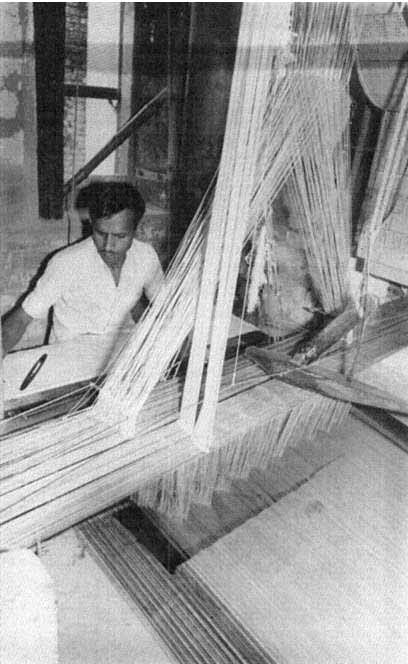
Fig. 12
Brocade weaver in Banaras working at pit loom with jala[*] and jacquard attachments.
Photograph by Carley Fonville; thanks to Emily DuBois.
the weavers to a new industry of weaving carpets (GAD 155B 1891, Ind 110 1910, Ind 253 1911). Weavers in this period were supposed to be full of discontent: "The Julahas are a disaffected class of people as the weaving industry has given place to the piece-goods of British manufacture" (GAD 255B 1891 no. 30). In April 1891 they successfully persuaded Hindus not to hold their "river carnival," the Burhwa Mangal, in sympathy with their problems. Later in the year they were suspects in the riots related to the destruction of the Rama temple: they were supposed to have joined the Hindu "rascals" to create trouble for the government (GAD 255B 1891 no. 30 and see chapter 7). At this time, too, the leading weekly of the city and province made its only passing allusion to the decline in exports of silk from the U.P. (Bharat Jiwan , 26 Dec. 1892, 5). By 1900 there is no more mention of any trouble in the silk industry (Ali 1900). Banaras weavers were preparing to demonstrate their techniques and display their brocades at the Delhi Exhibition, and were referred to as "a prosperous community" (Bharat Jiwan , 5 May 1902, 7; Adampura TR 8-IV).
These periodic slumps are part of a cyclical process and do not detract from the overall expansion experienced by the silk industry in the last century. They do contribute to a feeling of insecurity, however, that is characteristic of all artisans. The consciousness of the weavers is colored moreover by smaller, more frequent ups and downs, and every weaving family uses an idiom of flux and change to describe its fate (see Bismillah 1986). Yet the weaver's world is an expanding one, and the overall progress in the industry—in the number of workers (see table 5.1), the volume of sales, the variety of markets (N. Kumar 1984)—does affect the weaver positively. As contrasted with the metalworker, the woodworker, the potter, and the painter, the weaver continues on top of the swift currents of change and has a positive outlook on the world, based on the recent history of his industry.
A small part of this is also composed of positive expectations from the government. A weaving school was opened in 1915, and agencies such as the All India Handloom Board were set up to tide over the crisis in the 1950s (UP Admin Rpt 1916, Ind 820 1922). Although most of the schemes for rationing of silk yarn, registration of looms, and loans to weavers have remained confined to paper, there is a sense of optimism about the government's role, which contrasts with the sense of other artisans, particularly metalworkers and woodworkers.
The positive outlook of weavers is further compounded by the progressive possibility of mobility in the industry. In about 1900 there were three main silk products in Banaras: kamkhwab[*] (brocade), material for specific apparel purposes, and plain silk yardage. Corresponding to
| |||||||||||||||||||||||||||||||||||||||||||||||||||||||||||||||||||||||||||
these were three levels of production: the dependent laborer working for the karkhanedar[*] , or firm owner, the dependent laborer working for himself at home, and the independent weaver or master weaver (Ali 1900; UP Admin Rpt 1882). Today there is relative homogenization of products, and almost every weaver is a weaver of Banarsi saris. The three levels of production continue to exist, constituting a hierarchy in relative well-being for the weavers: from the bottom up, laborer working under another's roof, weaver working at home for others, weaver working at home for himself. The difference between the earlier hierarchy and the present one is that now there is more mobility among the different levels, and today a laborer can conceivably move up the ladder in a decade or two to an independent weaver's status.
Poverty is one corollary of the nature of handicraft industry; control over space and time is the other. The home is the workshop, and work time is always time set by the artisan himself. Even when men work in another's place as laborers, the location still remains a domestic one. Even in the largest workplaces the total number of workers is never more than ten or twelve; there is direct interaction between them and the employer, and time remains the worker's, for payment is always by the piece. These conditions have not changed over the last century in that there has been no tendency for larger production units or a new ethic of production relations to emerge. When the Royal Commission on Labour gathered oral evidence on working hours, it found that in the Banaras silk and brocade industry hours were normally seven per day but could be as many as fourteen per day in the wedding season. But there were important features of the work which alleviated this problem. "A good deal of the work is done in the open—in the courtyard of the worker's house or even in the public street or lane . . . there is no discipline to observe. Rest and recreation is taken whenever the need is felt. Contact with the home and familiar surroundings is seldom interrupted. The usual amenities of social life are not disturbed" (Royal Commission of Labour 1931:154). This familiarity with "freedom" has become an integral part of the weaver's identity, as discussed further below.
On all these counts—the perceived level of skill needed for their unique work, the liberties with space and time possible within the dimensions of domestic handicrafts production, and the near guarantee of poverty—the world of the weaver is no different from that of the other artisans of Banaras, including the metalworker, wooden-toy maker, goldsmith, potter, painter, copper-wire drawer, embroiderer, and garland maker. Where he is at all different is in being the best off of the lot, a factor that contributes substantially to his construction of identity.