
38—
Yüan Hung-tao (1568–1610)
Together with his brothers Tsung-tao (1560–1600) and Chung-tao (1570–1624), Yüan Hung-tao formed the vanguard of the Individualist movement in Ming literature, a group opposed to the orthodoxy of Wang Shih-chen and the poetic canon of the "Early and Later Seven Masters." Born in Kung-an in present-day Hu-pei, their poetry, prose, and criticism defined the core of the "Kung-an school" of letters and represented one of the important trends of late Ming culture. Yüan Hung-tao, the most influential of the brothers, showed youthful promise, organizing a literary society at the age of fifteen. He became a Provincial Graduate in 1588 but failed his first attempt at the Metropolitan Graduate exam the following year. He then visited the iconoclastic thinker Li Chih (1527–1602) and became his disciple. Li's courageous advancement of the concept of the individual self, his revisionism of Confucianism and of official history, and his appreciation of unorthodox literary genres such as fiction and drama became key elements in Yüan Hung-tao's own thought. After becoming a Metropolitan Graduate in 1952, Yüan maintained a lifelong ambivalence toward government service, rarely holding any office for long and retiring frequently. In 1595, he served as magistrate in Wu District (Su-chou) and was later commemorated as an outstanding official even though he resigned after a year or so to travel. He then visited West Lake and other areas in what is today Che-chiang, while further refining his literary views. In 1598, he joined his brothers in Peking in forming the Grape Society (P'u-t'ao-she) to further their literary views. Yüan Hung-tao briefly returned to the government as a secretary in the Ministry of Rites but retired after a few months and returned home. The shock of his elder brother's early death in 1600 led
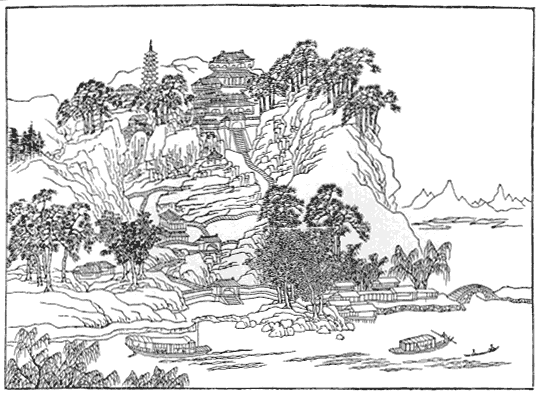
Fig. 46.
Tiger Hill . From T'ien-hsia ming-shan sheng-kai chi (Hong Kong, n.d.; rpt. of Ch'ung-chen era
[1628–1644] ed.). The canal in the foreground is the one ordered dug by Po Chü-i. The plateau m the
center is Thousand Men Rock, with Sword Spring to the upper left of it beneath the covered bridge.
him to embrace Buddhism more deeply. He retired to a religious community in his native city and continued to travel and write. In 1606, he again returned to office and held a series of positions in the Ministry of Personnel; he also served as chief examiner of the provincial examinations in Shaan-hsi in 1609. Yüan died the following year at the age of forty-two.
The fundamental program of Yüan Hung-tao and the Kung-an school was based on developing authentic (chen ), individual styles of
poetry and prose to convey the writer's "personal sensibility" (hsingling ) and on recognizing the inevitability of historical change in literary styles. The school opposed the archaist position of orthodox writers, considering such practices as imitation and stylistic revival irrelevant to the present. Yüan was a master of the "prose miniature," particularly in his influential travel writing. Indebted to the miniatures of Su Shih, he represented the traveler as an autonomous consumer of sensual scenes who has liberated himself from court politics and Confucian moralism. In Tiger Hill , Yüan appears as an observant tourist and as a connoisseur of elegant, aesthetic scenes. Unlike Ou-yang Hsiu, whose enjoyment of a place among the common people signified the achievement of moral order, Yüan noted with some irony that his status as magistrate had been a barrier to his participation in the lyric scene. Yüan Hung-tao also wrote a historical novel, edited dramas, and experimented with new forms of poetry. Yet he was also strongly criticized by his opponents. Some of his works were later proscribed under the Ch'ienlung Emperor (r. 1735–1795) and rejected by orthodox bibliographers, such as the editors of the officially sponsored Complete Edition of the Four Libraries (Szu-k'u ch'üan-shu , 1772–1782).
Tiger Hill  (1597)
The city of Su-chou had long been a favored destination of the sophisticated traveler and was celebrated along with Hang-thou as an earthly paradise. Tiger Hill, a scenic park dominated by a hill only ninety-eight feet high, is one of its most famous spots, located about two miles outside the city walls to the northwest. The ingenious placement of ponds, paths, and pavilions gives the park the appearance of spaciousness once one is within the grounds. According to legend, it is the burial place of King Ho-lü of Wu (r. 514–496 B. C.) and three thousand of his swords; a white tiger was observed crouching on his gravemound three days after the internment, hence the name. Another theory bases the name on the shape of the hill, said to resemble a crouching tiger. Originally, during the Six: Dynasties period, it was a private estate; later it was converted into a Buddhist temple. Through the centuries, the buildings were destroyed and rebuilt some seven times. Its most outstanding edifice is the pagoda finished in 961, which dominates the flat countryside. Tiger Hill is said to have been visited by the First Emperor of Ch'in, who unsuccessfully tried to find the
entrance to Ho-lü's tomb. It was a favorite retreat for Po Chü-i when he was magistrate; in fact, he ordered the canal constructed in front of its entrance. Its famous sites noted here by Yüan earned it the name "Number One Scenic Attraction in Wu."
Tiger Hill is only about two and a half miles from the city. The hill lacks tall cliffs or deep valleys, but because it is near the city not a day passes without flutes and drums sounding and pleasure boats gathering. On moonlit nights, on blossom-filled mornings, on snowy evenings, visitors come and go, crisscrossing like the weave of a tapestry. It is especially crowded on the Mid-Autumn Festival.[1]
Whenever this day arrives, so does every family in the city, shoulder to shoulder. From fine ladies and elegant gentlemen down to shanty dwellers, all put on their finery, and the women don makeup. They spread out layers of mats and drink wine by the roadside. From Thousand Men Rock to the Temple Gate,[2] they crowd together like teeth on a comb, like scales on a fish. A hill could be formed from all the sandalwood clappers; the wine drains from goblets like rain from clouds. Observed from a distance, it looks like geese flocking along sandy banks, like mist blanketing the Long River, like thunder rumbling or lightning crackling—I could not fully describe it.
At first, just after the mats have been spread out, there are as many as a thousand singers. Their sounds are like a swarm of mosquitoes: it is impossible to distinguish any one of them. They divide into groups and compete against one another with their loud singing. As both refined and crude voices are displayed, the beautiful singers distinguish themselves from the ugly ones. Before long, there are only several tens or so whose heads are swaying and feet are tapping. By then the bright moon has floated up in the sky and the rocks glisten like satin. All the "clamoring of earthen crocks"[3] falls into silence. A group of only three or four gathers and harmonizes: a vertical hsiao flute, a short horizontal flute, and someone slowly beating the clappers while singing. Bamboo instruments and voice perform together, the purity of the sound penetrates so that listeners feel their souls melting. As the night deepens, the moon shadows elongate, plants and flowers appear to blend in confusion. By then, flutes and clappers are put aside. Someone takes the stage as the audience holds its breath. The sound of his voice is like a delicate strand of hair, yet its resonance reaches the clouds. Every word seems to last for fifteen minutes. Flying birds circle about him, brave men listen and weep.
Sword Spring is so deep it is unfathomable.[4] The soaring cliffs seem like they were sliced. Thousands of Acres of Clouds serves as a table for Celestial Pond and other mountains whose peaks and valleys vie with one another for beauty,[5] It is a perfect spot for inviting guests for wine drinking. But past noon the sun's rays beat down, and it becomes unbearable to sit for long. The Pavilion of the God of Literature[6] is also fine, for the evening trees are especially worth viewing. Opposite it to the north is the old site of the Hall of Unbroken Distance—an empty, vast, endless view—only the speck of Mount Yü is visible.[7] The hall has long since been demolished, and I discussed with Chiang Chin-chih how it might be rebuilt.[8] I wanted to enshrine Wei Ying-wu, Po Chü-i, and others in it,[9] but illness forced me to abandon the project. I retired from office and fear that Chin-chih's enthusiasm has also waned. Indeed, the flourishing and decline of a scenic place can only occur at its proper time.
I served as an official in Su-chou for two years and climbed Tiger Hill six times. The last occasion was with Chiang Chin-chih and Fang Tzu-kung. We awaited the moon at Tao-sheng's Rock.[10] When the singers there heard that the magistrate had come, they all fled. So I said to Chin-chih, "How awful! This is due to the brutality of officials and the crudeness of their clerks. Someday when I leave office, I swear by the moon above that I will hear the songs sung at this rock!" Now, fortunately, I have been granted release from official life and can call myself just a traveler in Su-chou. I wonder if the moon at Tiger Hill still remembers my oath?[11]
Heaven's Eyes Mountain  (1597)
Heaven's Eyes Mountain (T'ien-mu-shan) is located in modern Lin-an District in northwest Che-chiang. It is composed of two ranges, eastern and western, which culminate m two majestic peaks. According to one legend, lakes on the summit of each peak appear to be gazing at each other, hence the name "Heaven's Eyes." Its highest point stands at about 5,080 feet. Known for its waterfalls, which Yüan Hung-tao also celebrated in a poem, the mountain was regarded by the Taoist religion as the Thirty-fourth Celestial Cave. The following is one of two accounts Yüan wrote about the mountain. It is primarily an expository piece that uses the occasion of a journey to define aesthetic criteria for appreciating scenery, thus demonstrating his approach to traveling as that of a connoisseur.
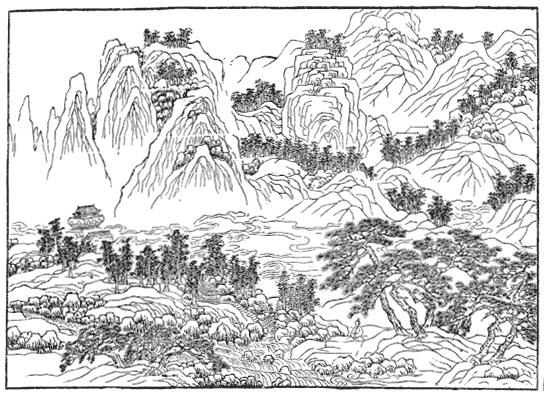
Fig. 47.
Heaven's Eyes Mountain . From T'ien-hsia mine-shan sheng-kai chi
(Hong Kong, n.d.; rpt. of Ch'ung-chen era [1628–644] ed.).
I can hardly describe the secluded, remote, extraordinary, and ancient character of Heaven's Eyes. It is only a little less than seven miles from the village[1] to the summit. Most mountains that are deep and out of the way are desolate and overgrown; those that are sheer and precipitous lack curiously winding and twisting forms; when they are ancient, then there is an insufficiency of fresh beauty; and when their structure is massive, they are absolutely devoid of delicate intricacy. Moreover, mountains that are too high and lack streams, and rock that is outsized so that the greenery is parched—all these constitute defects in mountains.
Heaven's Eyes is filled with valleys where cascading streams sound "ts'ung-ts'ung ," appearing like a myriad bolts, of white satin: these are its first perfection. The color of the rock is a lustrous blue-green, its structure is inscrutably ingenious, with winding stone paths and sheer cliffs standing erect: these are its second perfection. The architecture of every temple is exquisite, though they are located in secluded valleys or by overhanging cliffs: these are its third perfection. I don't like to listen to lightning, but the sound of lightning on Heaven's Eyes is quite muted, like the cry of a baby: this is its fourth perfection. At dawn, I arose to view the clouds, which were at the bottom of a deep valley. They were white and pure as silk, rising up like waves until the whole land had become a glass sea. The sharp tips of the mountain pierced through the clouds like blades of floating sea-grass: these are its fifth perfection. However, the changing shapes of the clouds were most unusual, and the sight of them was extraordinary to the extreme. Unless one dwells for a long time on the mountain, one cannot possibly come to know all their forms. The large trees on the mountain are practically forty handspans around. The pine trees are shaped like parasols. A single tree, though no more than a few feet in height, would be worth more than ten thousand cash: these are its sixth perfection. The flavor of the firstpick tea leaves is far superior to the tea from Dragon Well.[2] The flavor of its bamboo shoots resembles that of the shoots from Broken Pond in Shao-hsing[3] but far surpasses them in lightness: these are its seventh perfection. I maintain that south of the Long River no place surpasses this for spiritual cultivation and dwelling in retirement, for it makes one long to escape the bondage of mental turmoil and become a monk. After spending the night at the Temple Where Illusions Abide, I arose in the morning to view the clouds and then, after a while, climbed to the summit, where I spent the night at the Gateway to Death on Tall Peak. The next day I descended by the same path from the Temple of the Living Entombment. It had been very clear for several days following a rain. The monks on the mountain took this for an auspicious sign, and as I descended the mountain they all came to greet me. The more than four hundred monks on the mountain were extremely courteous and competed to offer me food. As I was about to depart, the monks said, "This rustic mountain is isolated and small, unworthy of your exalted gaze. But what can we do about it?" I said, "I feel like I am but a child of Heaven's Eyes Mountain. If you do not speak so humbly about it, then I will not flatter it before you." Thus we parted, laughing heartily.[4]
An Evening Stroll to the Six Bridges to Await the Moon  (1597)
West Lake in Hang-chou, the scenic focus of the former Southern Sung capital, increasingly became a mecca for literati, who immortalized its famous scenes and helped create a demand for literature, paintings, prints, and guidebooks representing its well-known spots. The Six Bridges (Liu-ch'iao) were located along Su's Embankment (Su-ti), the causeway on the west side of the lake built by Su Shan when he was magistrate. They were named "Reflecting Ripples" (Ying-po), "Locking the Waves" (So-lan), "Gazing at the Mountain" (Wang-shan), "Supporting the Embankment" (Ya-ti), "Controlling the Shore" (Shup'u), and "Archang Rainbow" (K'ua-hung). Yüan's piece is a typical example of a prose miniature and resembles a souvenir album-leaf in its brevity. Here, he further presents traveling as a mode of aesthetic cultivation. The literatus reveals his authentic sensibility by inscribing lyrical landscapes and participating in elegant social scenes, in contrast to the implicit vulgarity of the common tourist.
The finest scenes at West Lake are in springtime and in the moonlight. And within a single day, the best are the morning mist and the twilight haze around the mountains. This year, the snow at the beginning of spring was especially plentiful. The plum blossoms, prodded by the cold, flowered along with the apricot and the peach, one after the other, making an especially wonderful sight. T'ao Shih-k'uei[1] said to me several times, "In Chamberlain Fu's garden, the plum blossoms are the ones that belonged to Chang Kung-fu's concubine, Glistening Jade.[2] Let's go quickly and view them." But at that time I was so captivated by the peach blossoms that I couldn't bear to leave them.
Across the lake from Broken Bridge to Su's Embankment[3] is green mist and red haze spreading for almost seven miles. Songs to the sounds of flutes form a breeze; powdered drops of perspiration fall like rain. There are numerous people clad in gauze and silk, many of them on the grass lining the embankments. They are the epitome of seductive beauty. Yet the people of Hang-chou make outings on the lake only during the hours of wu, wei , and shen [11:00 A.M. to 5:00 P.M.]. Actually, the most perfect reflection of the greenery on the lake's surface and the most marvelous colors of the haze on the mountains occur when the sun first rises and just before it sets. This is when they reach
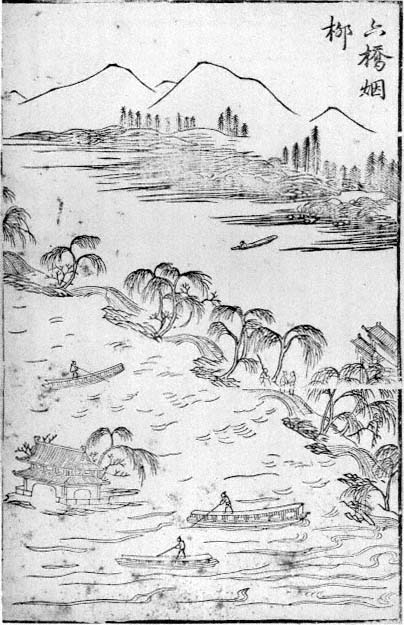
Fig. 48.
Misty Willows by the Six Bridges (detail) from Hai-nei
ch'i-kuan (1610), Deutsche Staatsbibliothek, Berlin.
the epitome of richness and attractiveness. The moonlit scene is particularly indescribable. The gestures of the blossoming flowers, the feelings of the swaying willows, the face of the mountains, and the sentiments of the water hold a special kind of charm. These pleasures are meant for the mountain-dwelling monk and for the traveler. How could one explain it to ordinary people?[4]