
3
Lowland Fields
To build up and never to pull down is a maxim that ought always to be kept steadily in view.
John Watson, land agent, 1845
At a time when massed bomber formations were shaking apart the cities of continental Europe and when shells and the treads of advancing tanks were ripping up hedges and fields, T. Bedford Franklin, a British agricultural historian, published a little book called Good Pastures . It recorded another battle, "noiseless" but "none the less deadly," that had taken place early in the twentieth century on his father's farm at Shutlanger Grove, several miles east of Towcester in Northamptonshire. The permanent pasture Farmer Franklin had labored over the years to create was a peaceful, fruitful, attractive, law-abiding, mutually supportive colony of clovers, cocksfoot, timothy, foxtail, and nutritious meadow grasses. It sustained in good health the sheep and cattle who gently grazed. But as they grazed, they tended to select the tastiest plant varieties, thereby disturbing, little by little, the harmonious environmental relationships. A few signs of declining fertility would begin to appear, intently watched for from the surrounding edges by a ragged army of predators: sorrel, reed, bent grass, bramble, and other weeds—an undisciplined band but fitter than their tame adversaries to survive a Darwinian struggle of attrition. Farmer Franklin's task was to intervene, not in order to make the established pasture system work but to protect it from deterioration and the subsequent invasion.[1]
Franklin described in loving detail the strategies his father developed to rescue from earlier neglect some old pastures that had surrendered to
weeds and been colonized by rabbits, the soil of the meadows soured, ditches blocked, hedges fouled. By hand, farmer and laborers cleaned out the hedges and filled the rabbit burrows. Next they unplugged and deepened the foul-smelling ditches, mixing into the resulting dirt heaps any manure-rich ant hills they could find. That done, they applied a dressing of lime to the surface of the ground and waited for the snows and rainstorms of winter to work through and loosen the mats and sweeten the soil.
Farmer Franklin used a sharp-toothed harrow to drag out the mat when the spring thaw arrived. By harrowing up, down, and across the field, he accumulated a large heap of vegetable matter mixed with ditch and anthill dirt. To this heap he added lime and animal manure. While all this was rotting, he gave the field a treatment of acid-neutralizing blast furnace slag, and then he chain harrowed and rolled it in. During the summer he penned sheep where they could feed on what turned up and removed them in the autumn when it was time to spread the ripened compost.
With the next spring came a wonderful transformation. As if by magic, dormant red and white clover, trefoil, and rye grass seeds germinated and found the way cleared to grow freely and robustly. By the third year, the old system was back in working order. Franklin's father called this phenomenon, "lifting the face." His care had begun the process that retrieved the countenance of the land from disfiguring blemishes. Nature had been assisted, not mastered. Skill and respect for the land had done what even the most advanced technology could not do: It had increased the soil's fertility and given the local countryside a smiling face. The moral was clear: "Striving after abundance," wrote Bedford Franklin, "by forcing an unwilling crop to grow in an antagonistic soil or an unsuitable climate is almost certain to be a failure."[2]
In Good Pastures , Franklin concentrates on the place of permanent pasture in one farm's operation and says little about the other factors in its economy. Therefore his account, if taken as an example of an older lowland agriculture, may give the reader an exaggerated sense of continuity. One notices the reliance on traditional methods, on the use of human and animal energy, on the readiness to recycle the locally available minerals, fertilizers, and biomass. Even at this late phase of the era of steam technology, it would seem, the tools and skills of earlier generations were still at work in the fields. One might be tempted to conclude that farms like Shutlanger Grove had hardly been touched by change, as though the radical improvements since the 1830s in steam-power deliv-
ery, machinery and machine tools, metallurgy, soil science, and communications technology had passed them by.
But a closer look at such farms would suggest otherwise. The lime that helped to neutralize the acid soil could have come from a local pit, but the basic slag that intensified the lime's effect obviously did not. It had been processed and then hauled by rail from distant smelters. We may also confidently assume that the manure from livestock (Bedford Franklin called the bullock a "travelling manure cart") did not consist entirely of reprocessed grasses from the farm pastures: it would have been enriched by imported winter feed supplements. Sailing and steam vessels and railways began to import oil cake made from linseed, cottonseed, sunflower, palm, and rapeseed in increasing quantity from the 1840s until the 1880s.[3] Since grazing animals did not completely restore from the rear what they took in at the front, the use of this artificial feed—rich in phosphates and ammonia—more than made up for this deficit—of course, at the expense of the exporter's soil fertility. In A History of Agriculture Bedford Franklin gave this summary of the effects of enhancing farm-grown animal food: "more cattle cakes meant more meat, more manure, more corn and straw, mangolds and swedes, and so again more food for still more cattle."[4]
In turn, more cattle meant bigger barns and covered yards to protect the manure (and especially the urine, which contained most of the potash and much of the nitrogen) from rain and leeching. These buildings as well as the new farm houses had to be located inside the farm enclosure rather than in a village. Thus "high farming," in the sense of high investment in more productive techniques, was not simply a reaction to the challenge of low prices and international competition but a response to opportunities created by an expanding domestic market and the construction, in a remarkably short space of time, of a national railway system, a system linked first by sail and gradually by steam to expanding rail networks around the world. In early Victorian years, commercial suppliers of processed fertilizers began to advertise wares drawn from almost everywhere.
Therefore farms like the one at Shutlanger Grove had long ago ceased to extract locally all or even most of the ingredients that went into their productive activities: building stone and wood, roofing straw or slates, lime, marl, fertilizers, implements, and seed. F. M. L. Thompson contends that the traditional, self-contained, "closed-circuit system" broke down during the middle decades of the nineteenth century. From that point, farming turned into a "manufacturing industry" where "pur-
chased raw materials are processed in order to produce a saleable finished product."[5] But the smaller farms of Northamptonshire and most lowland places would have responded to this fundamental change without surrendering all of the aspects of the old regime. Traditional and new farming tools and practices found ways of co-existing.
Coincident with this structural change came significant advances in soil chemistry, and these advances contributed to the trend toward use of imported artificial products. Farmers could purchase packaged bonemeal, either in natural form or, as tended to happen in the third quarter of the century, turned into a superphosphate by the application of sulfuric acid.[6] Many of these innovations were the product of researches carried out from the 1830s on John Bennet Lawes's Rothamstead estate in Hertfordshire. Progress made there in the understanding of how plants convert minerals and chemicals into forms they can assimilate led directly to the development of artificial fertilizers. Improved understanding of soil chemistry allowed farmers to apply specific nutrients to suit different soil conditions. Those few who were willing and able to profit from the advice of scientists learned that soil was not simply a nutritive medium but a complex of processes where the capacity of lower organisms to react to minerals was affected by the amounts of air, heat, and water. "Fine tuning" meant adjusting those processes rather than merely adding to the soil's inherent resources.[7]
Just before the middle of the century, novel forms of nutrients kept appearing, increasing the effectiveness of this technological breakthrough and augmenting the fertilizer supply available to conventional agriculture. Quantities of sea-bird guano, shipped from Peru, became available as did the even richer coprolite—a mineral phosphate, containing the remains of marine animals, dug from shallow mines in Cambridgeshire, Hertfordshire, and Suffolk.[8] These products were supplemented in the 1860s with Prussian potash and Chilean "cubic nitre," along with all kinds of refuse from cities and factories, once thrown away but now packaged and marketed by rail: wool scrap, leather shreds, steel slag, rags, street refuse, coal gas residue, brewery dregs, sulfate of ammonia, dried blood, horns, hoofs, offal, feathers, ashes, and soot from the cities and factories.[9] Human excrement was also utilized, although rarely. Experiments with spraying town sewage on fields showed that the cost of laying pipes and installing pumps usually exceeded the value of the increase in crop yield.[10] The considerable lime-burning industry declined as lighter (thus cheaper to transport) products came on the market.[11] Although quality could not be relied upon until after midcentury,[12]
these additions to the farmyard manure pile and to the locally available supplies of salt, sand, marl, chalk, and lime encouraged improving landlords and tenants to experiment with flexible regimes of rotation and pay attention to reports on innovative programs. The resulting spurt in productivity made it possible for large-scale cereal growers to withstand competition from abroad during early and mid-Victorian times and respond effectively to an constantly rising demand, particularly noticeable from the 1850s, for meat and dairy products.[13]
The economy of the Franklin farm would have been directly linked to world markets for food and fibers, and farmers would have reacted like practitioners of any industry to price changes by looking for ways to cut costs and increase productivity. Mechanization was one possibility. Although an impressive amount of hard physical labor had gone into the maintenance of the farm's meadows, that work had been greatly assisted by horse-drawn harrows. Like the other mechanical implements that would have been used on the farm, harrows became common about the time when processed fertilizers and feed supplements were reaching farmers. From the middle of the nineteenth century, mechanical farm implements, whether purchased or rented, were sufficiently cheap and reliable to be good investments, especially since increasing inputs of capital gave landlords, land agents, and tenants an incentive to innovate and consider ways to make factors of production more efficient.
The contemporary expert Lord Ernle pointed out the connection between the cheapness and portability of artificial fertilizers and the decision to acquire mechanical implements: having paid good money for guano or mineral phosphates, the farmer could see the advantage of buying machines to spread them evenly and to make sure that weeds did not profit from this investment.[14] On the other hand, few farms were ideally suited to use, without expensive preparations, the potentially profitable machine harvesters. Where field enclosures were small, horsemen frequently needed to dismantle parts of their reaping machines in order to move them through narrow, muddy, hedge gates to the next field. Because of the rotation system, often the adjacent field would be planted with a different crop. Where the soil was heavy and wet, surface drainage might have been carried out by means of ditches or deep furrows and high ridges—a considerable obstacle to machines made of wood, leather, and iron and pulled by teams of heavy horses. On undulating ground, workmen did not always lay underdraining pipes at the same depth. Consequently farmers either had to put up with the difficulties of using steam cultivators on uneven surfaces or undertake an expensive over-
haul of the drainage system before attempting to level fields. Thus it is correct to say that agriculture entered the machine age at about the same time that the railway builders were establishing a rail system. But a modern expert, Paul David, is also correct in stating that the farming landscape of early and mid-Victorian times "was not congenial to the introduction of agricultural machinery."[15]
It was H. V. Massingham's insight that the beauty of the "traditional" landscape was the unconscious product of skilled craftsmen intent on maximizing utilities.[16] Adult male specialized workers took over such tasks as horse-training, machinery operation and maintenance, hedging, and caring for sheep.[17] With skill of all sorts in abundant supply, it was often a rational decision to choose to employ that skill rather than invest in machinery and methods designed to make it redundant. C. K. Harley has put forward a theory that, given the storehouse of skills at their disposal, Edwardian entrepreneurs could reject the American assembly line and still compete successfully on world markets in a number of industrial sectors.[18] Agriculture may have suffered the economic consequences of having such an embarrassment of human riches even earlier than the manufacturing sector, but the land and the landscape were undoubtedly the gainers.
Therefore the contention that "the real mechanical revolution in British farming came in Victoria's reign" is open to question.[19] It is true that ever more sophisticated horse-drawn machinery became cheaper, lighter, and more durable from the 1850s onward and that machinery was widely employed on farms of over fifty acres. Manufacturers of horse-drawn harvesters, rollers, drills, rakes, and hoes (many of them adopted for relatively small farm operations) multiplied after midcentury and found eager buyers.[20] But for this transition to have been a revolution, hand labor, sufficiently plentiful and mobile for most farm tasks until the 1880s, would need to have been displaced more quickly and completely than it was. E. J. Collins has estimated that the 300-acre farm of 1910 had £140 worth of machinery and the average farm of 100 to 150 acres, only £80. He concludes that, while far more was spent on tools and equipment at the end of Victoria's reign than at the beginning, the proportion of farm capital so invested remained much the same.[21]
It follows that the mingling of old hand skills and new technology we noticed at Shutlanger Grove was the norm elsewhere. A farmer might employ a horse-pulled mechanical reaper to harvest wheat standing on sloping ground but then send men and boys with fagging hooks to take in densely packed grain on bottom land. Or he might send them to finish
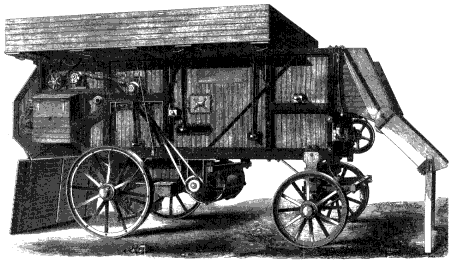
Figure 3.
Combined thresher and finisher (1876). Powered by a separate steam engine, this combine
delivered straw in front, discharged chaff behind, and filled sacks with grain. When it
appeared, hand cutting and threshing became adjuncts to the machine. (Engineering 22, 1876)
off, with scythes and sickles, the "headlands," the corners or edges of fields untouched by the reaper blades. Wind- and rain-flattened grain might need to be hand cut. Heavily ridged and furrowed fields might be machine reaped up and down their lengths and then again cut across by hand mowers. A temperate assessment is that from midcentury to the late 1860s, the machine was an important adjunct to hand cutting; and after that date, to the end of the Victorian era, hand cutting was an important adjunct to the machine.[22] Thus on all but the smallest farms by the end of the century, laborers planted, cultivated, and harvested grain, using horses to convey the crop (in wagons made, as they always had been made, by local craftsmen) to a rented steam thresher. (See Figure 3.)
Few farmers could afford to substitute steam for horsepower even when engineers made steam planting, cultivating, and harvesting cheaper and easier. The agricultural steam engine became more fuel-efficient and portable as time went on, but compared to the petrol-driven tractor of the next century, it remained heavy, clumsy, inflexible, and expensive to operate. If a large farm happened to have flat, rectangular fields about twenty acres in size, if it was situated on heavy soils and grew quantities of wheat, there might be large economies in using steam to get a crop in
early and quickly. According to Hugh Prince, steam plowed 200,000 acres of the roughly 50,000,000 acres of arable land in Great Britain and Ireland in the golden days of the late 1860s.[23] Most of that work would have been done by professional contractors who would send engines and tackle, a foreman, two engine drivers, and a plowman. The farmer supplied two carts, one for hauling coal to engine fire-boxes and the other to carry water for the boilers, with two or three men to serve them. Grain prices would need to be steady to afford the advantage such a large expenditure entailed, the reason why so many plowing contractors went out of business when wheat prices collapsed in the 1880s.[24] As Lord Ernie noted, "few farmers can afford to own both horse-power and steam power, and without horses they cannot do."[25]
For these reasons steam farming remained a rarity. By the turn of the century fixed steam engines were the main power source for threshing and barn work (chopping and pulping turnips, crushing cake, grinding corn, lifting hay and straw, pumping and boiling water) on most farms of 100 acres or more—with some exceptions in the west of England, the north of Wales, and the Highlands of Scotland.[26] The experimental "California" engines and chain-driven plow platforms developed by Thomas Gooch at midcentury rapidly improved in efficiency.[27] But steam never threatened to make the horse redundant in rural or urban Britain.[28]
In fact the need for horse-supplied power steadily increased even through the years of agricultural hardship after the mid-1870s. Under-draining made plows easier to pull through wet, heavy clays. Thus one-or two-horse plows were substituted for the large teams formerly needed to lug cumbersome implements through heavy soils. Fewer horses in front of the plow meant fewer trampling hooves to compact the ground.
While the technology of intensive farming saved horsepower, it also created new uses for it. Where, for example, farmers had been reluctant to expend much energy in removing weeds from growing crops only several decades earlier, they now were motivated to keep fields cleaner and tidier than before and to use horse-drawn implements to do the work.[29] Thus between 1811 and 1880 the general horse population doubled. Since railways could seldom deliver goods door-to-door, the number of horse-drawn wagons and carts on the roads kept increasing.[30] Demand exceeded the capacity of domestic horse breeders. By the 1870s, Britain had become a net importer.[31] There were about 800,000 horses at work in agriculture in 1811, 940,000 in 1871, and 1,116,505 in 1901, the peak year.[32]
Had he lived to see this evidence of failure to create a thoroughly
mechanized nineteenth century agro-industry, George Mechi, perhaps the century's most energetic agricultural modernizer, would have been deeply depressed, although perhaps not surprised. He was emphatically not a conservative, nor was he an Arcadian romantic. He believed, and preached to all who would listen, that paternalism and sentimentality were outmoded and dangerously irrational mental states, given what he took to be the commonsense realities of the time. A successful London businessman (Mechi's Magic Razor Straps, improved gas lamps, high finance), he purchased a 170-acre farm, Tiptree-Hall, in 1843 on heavy, wet Essex clays, "in a state between bird lime and putty." He thought it an ideal place to show what could be done with even the most intractable environments, given up-to-date methods and close attention to advances in soil science.[33] Success at Tiptree-Hall would demonstrate, he hoped, that the "existing predilection for land as an honorable qualification " had become "absurd and inconsistent with our great commercial and manufacturing dignity."[34]
Determined to act on that conviction, he proceeded to build a "substantial and genteel residence," lay out eighty to ninety miles of drains, cut every tree, grub out hedges and level boundary banks, line enlarged fields with roads, and erect cattle sheds with slotted floors so that "every pint and pound of manure" could drop through and be piped from a collecting tank (as large as a chapel) to be sprayed on the fields. At the center of all these operations he placed a large fixed steam engine, the main "instrument of progress." He added, "It facilitates intercourse, economizes time, multiplies labour, and cheapens production." In a characteristic burst of enthusiasm, he declared that "mighty steam," possesses a "marvellous and almost invisible power which has no opposition, which never tires. Scouring the plains, piercing the hills, threading the valleys, and ploughing the wide ocean; mastering with indolent ease time and space, wind, water, and season."[35] Now that "the feudal, wooden, and pastoral age" had passed, giving way "to that of coal, iron, steam, commerce and manufacture," the time had come, he urged any audience he could persuade to listen, "to rescue land from its feudal swaddling clothes and give it a modern suit, adopted to modern requirements."[36]
He said this in 1875 after his fortune was lost in the financial crash of 1866 and his farm was nearing its eventual bankruptcy. In an address entitled, ironically, How I Make Farming Pay he admitted to a gathering of the Midlands Farmers' Club that "there appears to be a total want of commerciality in the dealing with land" despite the obvious fact that food-producing had become a highly competitive business, "almost a
manufacture." He pointed out that decades of research and experiment by Liebig, Playfair, Hodge, Johnston, Lawes, and others had turned an empirical art into a "more dependable" craft.[37]
Thirty years earlier, he had discovered that his "desire to apply common sense principles . . . stumbled against the old antiquated castle of prejudice. Instantaneously there descended from its turrets on my poor devoted head such a storm of missiles, indignation, imprecation, ridicule, censure, disbelief, that had I not been clothed with the strong armour of truth, I must have succumbed."[38] But, experience, he conceded, had taught him how obstinately determined were the castle's defenders to fend off even the best-armored of truths. He had not fully appreciated the depth of conservatism in the mentality of his neighbors, not one of whom, he noted ruefully, had "followed my example." Nevertheless he clung to this vision, expressed as follows in the early, more hopeful days of his farming experiment:
I see, in perspective, a railway activity pervading agriculture. The time is coming when farms will be squared, trees removed, and game moderated— when tramways will intersect estates, and one horse will draw to market the load of four—when the sewage of our towns will ebb back to its original source—when the waters of our rivers and drains will be applied to the irrigation of our fields—when our millers will use caloric engines instead of water—when our farmers and their children will be better educated and rank higher in the social scale—when our labourers will be better housed, taught, and fed.
After those things had come to pass, he continued, "then will antiquated territorial loyalties be superseded by personal responsibility, identity, and possession." He thought it only a matter of time before people would grow used to seeing "mighty engines on railwayed open fields, tearing up furrows a yard deep, making the land look like a sea."[39]
Mechi was able to recognize and perhaps even to feel a twinge of regret that the visual beauty of the landscape would be swept away in this tide, but he asked his readers and audiences to reflect on the Malthusian dilemma. As population increases, Mechi wrote three years after his experiment started, "stern necessity" will compel the farmer "to sweep from the land those pleasing, green fences, trees, and pastures, whose agreeableness blinds us to their cruel unprofitableness. . . . Let us, then, take time by the forelock, and do that willingly and profitably, which otherwise we must submit to grudgingly by stern compulsion."[40]
Probably Mechi was more pleased to sacrifice agreeableness to stern necessity and stern compulsion than he allowed himself to admit. To
him, an outsider to landed society, the flowering hedgerow and green, patchwork fields dotted with cattle and sheep signified feudalism. A perceptive Frenchman, Léonce de Lavergne, included a visit to Tiptree-Hall in his 1851 inspection tour of British agriculture. He noted in a subsequent article for Revue des Deux Mondes that his host, a bourgeois bent on displacing the aristocratic improver, was "one of those energetic individuals who anticipate the future while seeking by every means to escape from the difficulties of the present." Lavergne recognized that what he had seen on this model farm—the central steam engine, the stall-fed animals, "shut up in melancholy cloisters," and treated as manure machines—was not typical of British farming, being more an exercise in wounded, middle-class pride than in profit-seeking.[41] Equally interesting was Lavergne's observation that the economic realities of the time, forces Mechi so often evoked, were the very factors he tended to ignore in his role as seer. Like so many enthusiasts, Mechi concentrated on increasing productivity rather than adjusting each operation to market forces.
More professional, although not more typical, in his attempt to apply what he considered to be the logic of steam energy and the new soil science technology to food production was John Prout of Blount's Farm in Hertfordshire. Like Mechi, he recognized that the first step required of a progressive farmer was to convert his cold, undrained clay (so stiff and heavy "it would starve a donkey")[42] into productive cornland. Again, like Mechi, his solution was to rely on steam and on the advice of soil scientists, in this case Augustus Voelcker, an expert employed by the Royal Agricultural Society of England, who examined the soil samples and worked out a mix of artificial supplements, designed to allow for continuous corn growing.
Before starting this regime in 1861, Prout invested heavily in drainage for his 450 acres. In this he had an advantage in being able to use a steam mole to lay his pipe drains, having started his experiment twenty years later than Mechi. As at Tiptree-Hall, out went the ancient hedgerows, six and a half miles of them, and down went the trees, 920 falling to the ax. Along the much-enlarged fields Prout stretched ring fences and built roads strong enough to hold portable steam engines. To supply their boilers, he dug reservoirs equipped with pumps, it being his intention to use steam wherever possible. Essential to his strategy was deep plowing to break up the hardpan and make the soil more friable, a task horses would have found impossible. Where he went beyond Mechi was in his decision to eliminate all animals, except for a few horses to sow
oats and barley in the wet spring season, and to rely exclusively on imported guano and artificial fertilizers: superphosphates, soot, and nitrate of soda.
Between 1861 and 1880, according to Voelcker, who monitored the effect of this specialization on the soil's fertility, productivity rose by a hundred percent.[43] Were it only possible, Prout wrote in 1881, for tenants to be freed from the drag of indifferent landlords, they might be able to follow his example and thus withstand the barrage of cheap imported grains. As it was, he deplored, as Mechi had done, the fact that so few of his admirers had decided to imitate his methods. Lack of publicity could not be the explanation: thousands of agriculturalists had visited his farm, he said, and chemists had analyzed his soil and published their highly positive findings. In any other business, he mused, successes such as his would have produced a flood of improvers.[44]
Mechi and Prout were among the first to realize and put into action the potentiality of steam agriculture, but their calculations did not take all of the costs into account.[45] Thus they assumed, wrongly, that indolence or stubborn resistance to change caused their neighbors to prefer these compromises: horse-powered machinery, supplemented, mainly at harvest time by steam engines, and continued reliance on a gradually diminishing quantity, but growing quality, of hand labor.[46]
The success of another innovator illustrates the point. Beginning in 1875, when cereal prices began their long fall, George Baylis, son of a Berkshire tenant farmer, built a corn-growing empire. By 1917 he owned or rented 12,140 arable acres. Unlike Mechi and Prout, he looked at new technologies not for how much they would increase production but for how much profit they would bring in. When others were laying aside the plow and turning fields into pastures, Baylis grew rich by turning to wheat monoculture, using ammonia and phosphates from artificial fertilizers almost exclusively to replenish the soil. Where his fields were large, fiat, and easily worked, he plowed with steam; on most of his operations, however, he found that, until the 1920s, horse-drawn machinery brought in a higher return, despite rising labor costs. Until tractors and trucks made steam hauling and cultivation technologically obsolete, this consummate rationalizer relied on some 250 workhorses.[47] Only a handful of innovators followed his example and restructured their farm holdings on factory principles. His interest in cost accounting, however, was part of a trend. As he demonstrated during a time when the use of steam energy reached its highest point, reliance on animal power could still be sound business strategy.
Because Victorian and Edwardian landscape was fashioned by horses, pulling machinery designed to make efficient use of animal skill and muscle, field patterns retained, despite all the technical advances of the period, a pleasing variety and a feeling of comfortable intimacy. Field enclosures on the best arable land tended to be larger than they had been in the eighteenth century. In the third quarter of the nineteenth century large farms gained at the expense of small.[48] On the other hand, a constantly accelerating expansion of market gardening along railway links with major urban markets during the latter part of the century led to a division of some properties into small holdings, intensively cultivated by hand. Where machines did the tilling and harvesting, hedges were sometimes grubbed out;[49] but so long as horses were vital and crop routines depended on manure from large stocks of cattle and sheep and so long as estate owners were concerned with providing cover for game, most of those hedges, walls, and ditches survived. They sheltered insects and wildlife while giving definition to the countryside. At the same time, they were essential to the system. Some form of containment was required when sheep were folded on fields during or just before a turnip course and when it was the turn of a field to be put to grasses or clover and grazed by cattle.
Farmer Franklin and his predecessors produced a landscape that reflected their ways of working as well as their attitudes and aspirations. Mixed farming and diverse crop rotations, for example, painted the countryside with a kaleidoscope of colors and patterns: in the spring the rich dark brown of plowed earth, turning smooth and lighter as the sharp teeth of the harrow cut through the clods, the emerald green of young wheat next to the paler green of early grass pasture; in the late summer and autumn, the whitish spread of the barley field, side by side with the blond and copper of ripe grain and the blue-gray leaves of the mature turnips. This harmonious blending of so many patterns, textures, and colors, marked off by lines of darker hedgerow or gray stone, came to be thought of, even at the time, as the "traditional" landscape.
Thus the lowland landscape of mid- and late Victorian times was, in a most literal way, a "synthesis of man and nature."[50] The countryside managed to be both dynamic and stable, partly mechanized yet still organic in so many of its processes, rationalized by earlier standards but still preserving regional variations and traditions, not preindustrial and not fully industrialized. Where high farming was practiced, there was some increase in farm size; elsewhere the scale of farming did not change radically. On most "progressive" estates the work was done by a com-
bination of energies: hand, horse, and steam working together. Because the visible features of much of the land reflected those balances, it could comfort and reassure an age that was well aware of the damage industry and urban growth were inflicting on the environment. This goes far to explain why George Perkins Marsh's warnings tended to be dismissed as exaggerations—when they were received at all. Because the agriculture of high farming returned to the soil what it took out, often improving the soil's texture and fertility in the process, the robbery of the earth's resources by mining, quarrying, tree cutting, polluting, trampling, and house building provoked alarm and indignation but not despair.
It is possible, of course, to overstate this ecological and aesthetic success. The French visitor Lavergne claimed in the early 1850s that "English agriculture, taken as a whole, is at this day the first in the world."[51] This, some thought, was perhaps being excessively enthusiastic. Professor Scott Watson of Edinburgh University was undoubtedly right when he recommended James Caird's 1851 reports on agricultural conditions to the Times as a far more balanced appraisal.[52]
The increase in productivity on the high-farming estates in light soil regions of the English Midlands and Southeast and in the Scottish Lowlands was, everyone agreed, one of the wonders of the world. Tenants on high-farming estates managed to survive competition from foreign grain imports between 1846 and the mid-1870s by efficiently responding to the brisk demand for wheat and, increasingly, meat. Their fertilization and rotation regimes built up the soil, and their determination to get as much as possible out of each field fashioned a trim, clean, attractive countryside.
Elsewhere, especially on the heavy clays and areas of marginal fertility, progress was slower and considerably less impressive. By no means did every English estate carry on high farming, and the few Welsh landowners and farmers who did so were concentrated in the Vale of Glamorgan, the southern part of Monmouthshire, and South Gower.[53] At the end of the nineteenth century the agriculture of South Cardiganshire was still a study in "Medieval simplicity."[54] Five- to seven-course rotation systems relying on turnip breaks, heavy dunging, and careful weeding to keep soils clean and fertile were firmly and widely established only in the Scottish Lowlands.[55] In other places the investigator would hardly have noticed that many small-scale farmers were suspicious of new methods and fertilizers and that many land restorers prepared the ground only to exploit it for short-term profit. Nevertheless, the generalization still holds that, until wheat prices collapsed in the last quarter
of the century, mixed farming in Britain created an "elegant" balance, although, as it turned out, a precarious one.[56]
Admirers of high-farming methods also need to remember that, with exceptions, the heavy investment never brought a particularly high return and contributed to the sluggishness with which many grain-growing regions responded to the changes in the late Victorian food market.[57] As wheat prices plummeted during the decade after the mid-1870s, "the edifice of high farming," which rested on heavy capital investment in the land's productivity, came tumbling with it.[58] Until 1900 rents and land prices dropped steadily. Owners of large consolidated holdings were not inclined to take advantage of falling prices for chemical fertilizers and oil cake under these circumstances. Spending even more to increase productivity and economize on land use had little appeal. Nor were producers much interested in laying out capital for more machinery to reduce their large and increasing wage bills so long as the heavy and clumsy steam engine was still the main alternative to the motive power of horses and handworkers.[59]
The Great Depression was real for those who, partly for structural reasons, could not or would not convert their operations to produce high-grade beef, or dairy products, or, as on the Cambridgeshire fens, fruit and vegetables for the urban market. Twelve percent of the arable land of Britain in 1872 was in wheat, and in 1913, five percent. The percentage of barley and oats dropped less precipitously from twelve to nine. Estimated farm income fell some forty percent between the mid-1870s and the late 1890s. In the breadbasket of Essex, where heavy clays had always been costly to cultivate, farmers calculated costs of keeping hedges trim and maintaining ditches and drains and decided to retrench. In all parts of eastern and southern England and on sandy soils made productive before by lavish fertilization, fields "tumbled down to grass" or, in particularly depressed areas, to thistles, brambles, and bracken. Water meadows, once maintained by experts, all but disappeared. Between 1871 and 1901 the number of laborers employed on the land shrank by a third; those who remained had to be used by hard-pressed employers in the most immediately productive ways. Man-, woman-, and child-power could not be expended on trimming and tidying up. Therefore in many grain-producing areas the polish did go out of cultivation. Hard times showed in overgrown hedges, dilapidated walls, unweeded crops.
Governments responded to these ominous signs by appointing committees of inquiry. The duke of Richmond's Royal Commission on Ag-
riculture sat from 1879 to 1882 and heard tales of woe from tenant farmers. Lord Ernle summed up the question so many of them, in one way or another, were asking: how could they be expected to "hold their own in a treacherous climate on highly rented land, whose fertility required constant renewal, against produce raised under more genial skies on cheaply rented soils, whose virgin richness needed no fertilisers?"
The subsequent report confirmed that the distress was real, but, believing the trend to be cyclical rather than secular, suggested legislation to lower taxes, adjust rents, and ease burdens. No legislation to expedite transformation to a new economic world was forthcoming. Until 1896, when conditions tended to stabilize, food import figures continued to rise, wheat prices continued to fall, the cost of labor remained high, and rents kept on sliding, although not fast enough to rescue some hard-pressed tenants on grain-producing estates. "Scarcely one bright feature," recalled Lord Ernle, "relieved the gloom of the outlook."[60]
Beginning in the 1960s, economic historians began questioning this melancholy account. One of the first to suggest that "depression" was too sweeping a description was T. W. Fletcher, who noted that bad times for grain farmers in the south and east of England meant that livestock feeders and dairy farmers could fatten animals on cheaper oil cake and coarse grains. He gave, as an example, the cheese, milk, butter, beef, and mutton producers of eastern Lancashire who met the challenges offered by high demand for protein in a highly competitive market by taking advantage of lower feed prices, down by a third during the "depression" years. Dairies, so abundant in the region, had difficulty competing with ever-cheapening foreign cheese and butter. Liquid milk was a more attractive option. Because it was so perishable, it had protection from foreign competition. Demand from city dwellers kept rising.[61] Gradually the Danes and Dutch took over much of the responsibility for providing the English breakfast, but the British hen still provided the egg and the British cow continued to whiten the national cup of tea.[62]
Where crop and farming conditions were roughly similar to eastern Lancashire, farmers developed similar strategies. Central to the Scottish arable system was a regime of rotation based on oats, barley, grass, with a turnip or potato break to recuperate the soil. Meat, not bread, was what delivered the profits. For that reason, the collapse of wheat prices was seldom devastating. Prices for other grains fell as well but less dramatically. Farmers recognized that they could cover some of their losses by increasing their emphasis on animal production, since the market for
premium domestic beef stood up reasonably well to foreign competition.[63] In northeastern regions, there were still significant numbers of small farms, worked mainly by family labor. Therefore savings could be made through more intensive exploitation of household members, rigorous belt-tightening, and lower feed bills. There was a tendency to include more grass leas in rotations but not to let the land go to permanent pasture. Few farms remained unoccupied for long. The soil continued to be well dunged and weeded. The number of fat cattle going out from Aberdeen for southern markets rose from 39,000 in the 1870s to 60,000 in 1900.[64] Scottish arable farmers in general struggled and sacrificed to adjust to change and did so with considerable success. There were no complaints in the last quarter of the nineteenth century that these tillers of the soil had ceased to be careful husbandmen.
Lowland Wales, like lowland Scotland, was cushioned against the shock of falling prices by the fact that the climate favored livestock farming and discouraged the growing of wheat. There were some large, high-farming estates in the Vale of Glamorgan, South Pembrokeshire, Denbighshire, and Flintshire, and these suffered from the difficulty of converting away from cereals to other activities; but a large majority of smaller farmers were still semisubsistent producers when the time of troubles began in the later 1870s. The typical small holding would have a few sheep and some store cattle. These they would feed oats and hay from their own hillside fields. A cow or two allowed them to make butter on the farmstead. Thus there would be no need for drastic restructuring. When livestock prices dropped in the mid 1880s, those who produced for distant markets experienced hardship; but it was this class of farmer who benefited most from the improvement in the 1870s of railway communications and the consequent availability of inexpensive imported feedstuffs.
Because Wales as a whole had come slowly, hesitantly, and unevenly into the era of capital-intensive, market-oriented agriculture, its response to the new incentives seemed particularly impressive. Railways, having penetrated so late in the century into formerly isolated regions, brought about striking increases in crop yields. Consequently, growth rates were higher than in England, where the economic benefits of a mature transport system had been felt for decades.[65] Thus observers of the Welsh landscape would have needed to look closely to detect the visual effects of these adjustments to changed agricultural conditions.
By contrast, changes would have been easily noticeable wherever the soil, climate, location, and size of farm units made it practical to grow
fruit, flowers, and vegetables. As in the case of milk production, access to rail transport was crucial to success. Orchard acreage nearly doubled in England and Wales in the last quarter of the century. New canning and jam-manufacturing industries created opportunities for Kentish soft fruit growers and market gardeners in the Lea Valley and the Vale of Evesham. Some Norfolk farmers survived by growing mustard for the Coleman's factory. A special train carried produce from glass hothouses in Sussex each morning to Covent Garden, and another brought in celery from the Lincolnshire coast.[66] By the end of the century railways and steamships were filling market stalls with fresh produce from everywhere in Britain and every corner of the world: out-of-season onions from Egypt, apples from New Zealand, potatoes from the Canary Islands. The cultivation of flowers, seeds, and bulbs for suburban homes and gardens added splashes of vivid color to local landscapes in the Fenlands, the Scilly Isles, and almost every place where climate, soil, and, above all, rail transport combined to make specialization profitable.[67] While the gross output of wheat in the United Kingdom, measured by weight in millions of pounds, fell from 27.56 in 1870-76 to 7.72 in 1894-1903, the output of hay, straw, fruit, and vegetables rose over the same period from 19.40 to 21.75.[68]
Mention of exceptions, notice of regional variations, presentation of selected statistics, complicate but do not refute the claim that the long process of taming wildness and reclaiming rough or sodden environments did tend to slow down and, in some places, cease or go into reverse during the last quarter of the nineteenth century and the first third of the twentieth. It is also true that formerly outlawed plant species, birds, small mammals, insects—wildlife in general—benefited wherever brakes were applied, marginal soils abandoned, reclamation projects canceled, coppices and infrastructure neglected, and weeds allowed to invade once well-tended crop and meadowlands. Collins makes the valuable observation that many of the soft, romantic landscape features and ecologically rich environments that preservationists are now especially eager to retain were saved from the plow or allowed to revert to a more natural state when the "biological exploitation of the countryside" lost some of its energy in the 1880s and thereafter. "When agriculturalists despaired, aesthetes rejoiced," is Hugh Prince's version of that idea.[69]
Some late Victorian and Edwardian agriculturalists despaired, a few rejoiced, most struggled and carried on. We should not exaggerate the extent of deceleration and dereliction or fall into the old error of assuming that what happened in places like Essex was symptomatic of all
agriculture and all rural landscapes in so richly diverse an environment as the British Isles. During the later years of the steam era, the face of the lowland countryside did change; some luster faded, blotches appeared, but the bone structure remained much the same.
That generalization could not be so confidently made in 1944, when Bedford Franklin wrote about his father's skill as a builder and restorer of permanent pastures. By that time the transformation Mechi had so ardently wished for had become clearly apparent. After 1918, the shift of energy source from coal to liquid carbons accelerated. Between the wars, modern agribusiness, specialization, concentration on reducing labor costs by applying sophisticated machinery, the virtual elimination of animal labor, the massive use of chemical fertilizers, pesticides, and herbicides had advanced far enough to alarm Franklin and make him want to remind his countrymen of what was being lost.
What happened in 1929 in the Cambridgeshire fens to the south and west of the Isle of Ely was an early demonstration of this transformation's ecological consequences. In the late winter of that year, the region experienced the worst dust storm in living memory. As Muriel Arbor noted, local farmers at first blamed a heavy frost for having broken up the fine black peaty soil; but they had to look for other explanations when, in subsequent years, the same thing kept happening during the violent winds of February through May. Swirling dust obscured the sun; seeds and young shoots blew away along with the top layers of soil. Dykes seven feet across could fill in a few hours.[70] Reluctantly, Fenland farmers came to accept that the cause was their decision to convert from mixed farming to the growing of sugar beets, a new crop introduced from Belgium and northern France in 1905.
The difficulty was that this particular agro-industry disturbed a delicate balance that had been constructed and reconstructed. During the first quarter of the nineteenth century, most of the Fenland had been, according to H. C. Darby, "drained in theory but not in fact."[71] By this he meant that existing wind and water mills, dredging equipment, watercourse engineering, and administrative arrangements had made the land dry enough to farm but could not prevent large-scale inundations. New channels and outfalls straightened the sinuous rivers and greatly improved the general drainage system. But it was the steam-driven pump that, above all, gave Fenland farmers reasonable expectations of stability. Experimental steam pumps appeared in 1817 and became well established during the 1830s. By 1852 sixty steam engines had drained 222,000 acres of land in the Bedford Levels and Lincolnshire.[72]
Not unexpectedly, technological solutions to the problem of how to keep reclaimed marshland dry created other problems. One reason windmills were gradually replaced was that they caused subsidence. This meant that pumps would need to raise water from ditches to higher levels in order to discharge it into major channels and rivers. Steam power overcame that difficulty but greatly accelerated the rate of subsidence. When drained and cultivated, the peat contracted as a wet sponge does when gradually squeezed. Darby illustrated this effect with a photograph of an iron column at Holme Fen in Huntingtonshire. In 1851 it had been pounded into solid clay, the top at ground level. In 1860 four feet, nine inches of the column stood above the surface; fifteen years later, the exposed part measured eight feet, two inches. When the picture was taken in 1933, almost twelve feet of post were showing.[73] A recent estimate is that the fens have lost well over half of their volume of peat. Ditches and rivers stand as high as fourteen feet above the fields they pass through.[74] Thus it would be difficult to imagine a physical environment more dependent on human ingenuity for its appearance and its continuance.
To the engineer's ingenuity was added the farmer's. The soil was inherently unstable since its organic particles, when dry, lost much of their capacity to cohere. Therefore, as the peat areas of the Fenlands shrank, they also began to lose some topsoil to wind erosion. There was, however, a compensation: as the clay floor "rose" it became easier to mix marl (lime-rich clay) from that lower layer into the light, organic material on top.[75] J. A. Clarke, writing in 1852, spoke of how, over the past thirty years, the "powdery peat" had been "exchanged for the richly cropped arable of the new corn-bearing mould," giving "solidity and tenacity to the soil." The result, said Clarke, was "the most fertile and productive of soils."[76] In such soil, rotation regimes of roots, grasses, and grains (fertilized by manure from stock) produced, on a sustainable basis, some of the best crops in Europe. Peaty humus absorbed and held moisture and allowed entry for air; the clay supplied potash; animals ingested nitrogen from plants and returned it in the form of dung and urine; the clay, manure, and deep roots of the grain and grasses bound the soil and checked the effect of wind and water erosion. The calcium in the clay reduced or neutralized the acidity of the peat soil, allowing bacteria to convert the nitrogen in the fertilizer into a soluble form, making it available to plants.[77] Victorian farming had disturbed a natural harmony only to create a new one, one that had far more heart than it had possessed in the state of nature.
This flat world, tamed and maintained by human ingenuity, did, over the years, change some of its colors and textures. The fortunes of mixed (a variety of crops and grasses with livestock), high (capital-intensive) farming suffered in Cambridgeshire as it did in most regions during the difficult time of adjustment for agriculture in the last quarter of the century. The more enterprising scaled down their corn growing and converted to intensified production of fruits, vegetables (especially new potatoes), and flowers for the urban market.[78] In the southern peat zone of the Cambridgeshire fens, the growing of sugar beets proved to be, in the long run, one of the keys to survival and prosperity.
For all its merits, the sugar beet, it is generally conceded, is a dull and demanding vegetable. It is a "gross feeder" in that it robs the soil of nutrients and consequently requires heavy doses of fertilizer. Monoculture assured that most of this nourishment would come, not from the stockyard, but in a bag purchased from a retailer. It was much cheaper to use the lighter manufactured lime when it became readily available than to pay expensive labor to dig and spread clay or to bring it in by cart or rail.[79] Powdered lime kept the soil sweet but did not thicken it. Furthermore, before the beet could be planted, the ground had to be plowed deeply. This allowed frost to penetrate to a greater depth than it would have done had the ground been prepared for grain. The effect was to pulverize the soil. The leaves of the growing crop provided less cover than did grain; therefore weeds grew readily and had to be removed, disturbing the surface of the ground. Grain and grass courses of the rotation system had left roots in the ground after mowing; in the case of beets, the root was the product. The old system had acted to fix the surface during part of the windy season; the beet harvest left behind no such protection. Furthermore investment in machinery led in many cases to the grubbing out of hedges and trees.[80] The consequence of this radical change of crops and methods became apparent whenever the cold, dry winds of spring began to blow, seemingly direct from the Steppes, across the level plain.
Franklin had case histories like this one in mind when he predicted that a time would come when farmers and the general public would need to confront the fact that scientifically induced high yields were taking the heart out of the soil. Land was in "good heart," he explained, when it produced abundantly and free of disease the crops and meat suited to its character.[81] An earlier generation of farmers had been obliged by the surrounding culture and the limitations of the available technology to pay close attention to nature's ways and respect her wishes. Should some
future generation learn that degree of humility, perhaps then, Franklin hoped, farmers might again see relevance in his father's example of good husbandry: the mixed farming rotations, the utilization of natural fertilizers, the desire to preserve ecological interrelationships, the concern for sustainability, the attention to energy conservation, the loving care of land and landscape.