
Volcanism, Structural Deformation, and Sedimentation Following Caldera Collapse
Immediately after caldera-forming eruptions, the craters become closed sedimentary basins. Crater lakes may form and the process of fluvial and lacustrine sedimentation begins. If it is adjacent to the sea, the crater is flooded and may eventually be filled with marine sediments. If a caldera wall is breached, the lake drains and a new drainage system is established. Well-bedded lacustrine mudstones and siltstones may eventually fill smaller calderas, but structural resurgence within larger calderas will limit the crater lakes to an annulus between the central structural dome and the caldera wall, like that of the Creede caldera of Colorado, depicted in Fig. 4.9 (Smith and Bailey, 1968; Heiken and Krier, 1987).
Interbedded with the laminated lacustrine mudstones are reversely graded breccias (turbidites from caldera walls), coarse sandstones (fluviatile rocks and small deltas), volcanic ash beds (both ash-fall and pyroclastic-flow deposits), and lavas from postcaldera eruptions.
Mapping and age-dating of caldera-lake sedimentary rocks can provide information
| ||||||||||||||||||
to be used in determining the time and rate of structural resurgence. By employing lake beds as markers, it is possible to measure the amount of deformation during resurgence; for example, Mahood (1980) measured the degree of resurgence of La Primavera caldera in Jalisco, Mexico, by mapping the elevation of caldera lake sedimentary rocks and interbedded tuffs (Fig. 4.10).
The buoyant rise of magma or injection of new magma following a caldera's collapse can be inferred from structural deformation of the caldera floor and postcollapse volcanic activity. Structural resurgence is common in calderas with diameters of 10 km or greater (Smith and Bailey, 1968). Deformation may result in a simple symmetrical dome within the caldera fill, and radial dips within these deposits may
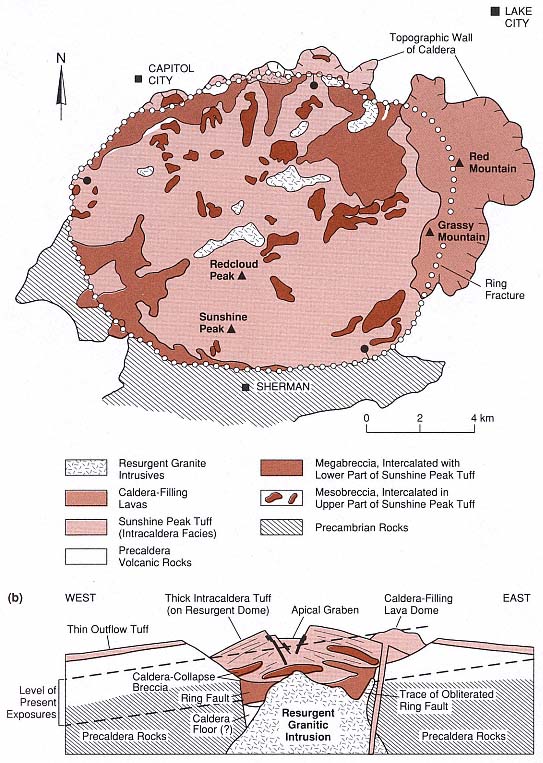
Fig. 4.7
Geologic map and schematic cross-section of the Lake City Caldera of Colorado, showing the
distribution of meso-and megabreccias that are intercalated within thick caldera-fill tuff deposits.
(Adapted from Lipman, 1976.)
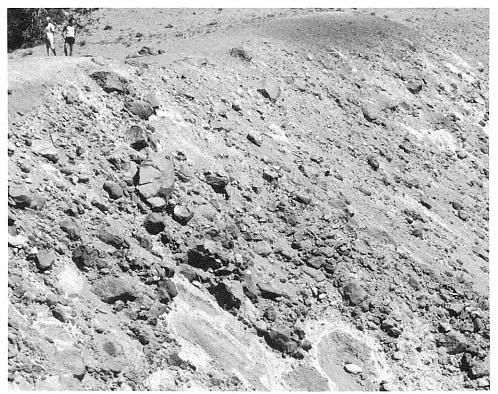
Fig. 4.8
The concentration of boulders and cobbles in the cliff shown here are lava lithic clasts that
make up a lag breccia interbedded with ignimbrites surrounding the Crater Lake caldera in
Oregon. These breccias may have been formed by gravity segregation of the dense lithic
clasts near the crater rim during the caldera-forming eruption of rhyolitic ash. Lag breccias
may be used as markers that indicate periods of caldera collapse during the eruption.
range from a few tens of degrees to 45°, as is shown in Fig. 4.7 (b). However, many resurgent domes are more complex and reflect the precaldera structural control of the caldera's shape. For example, within an asymmetric "trapdoor" caldera (hinged on one side with substantial collapse on the other side), resurgence that takes place adjacent to the bounding faults forms an oval dome parallel to those faults (Nielson and Hulen, 1984). The dome heights relative to the original crater floor range from a few hundred meters to more than a kilometer. Summits of most resurgent domes are broken by "keystone" grabens. The fault orientations of these grabens may be influenced by older structures; for example, they may follow the trend of precaldera faults in rocks underlying the volcanic field, as Nielson and Hulen (1984) noted for the Valles caldera of New Mexico (Fig. 4.11).
The probable resurgent intrusions identified in the deeply eroded calderas of Questa, New Mexico; Turkey Creek, Arizona; and Mt. Aetna, Colorado, rise above the basement rocks and intrude intracaldera tuff deposits (Hon and Fridrich, 1989). Areas of maximum uplift within these calderas are directly above the resurgent plutons. The interface between the fractured caldera floor and the block of densely welded intracaldera tuff allows rising magma to spread out. Hon and Fridrich (1989) inferred
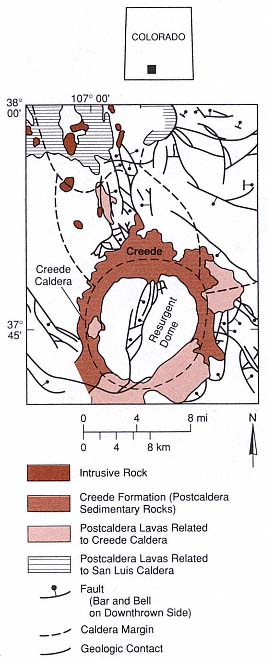
Fig. 4.9
Simplified geologic map of the Creede caldera in
Colorado, showing distribution of the Creede
Formation—tuffaceous sedimentary rocks that
partly filled the annulus (moat) between the
resurgent dome and caldera walls. The same
zone is partly filled by lava domes and flows
erupted after caldera collapse. The Creede
Formation consists of several facies from the
fanglomerate breccias of the caldera walls and
slopes of the resurgent dome, intermediate fluvial
sandstones and gravels, and lacustrine siltstones
of the annulus between caldera walls
and a resurgent dome.
(Adapted from Steven and Eaton, 1975.)
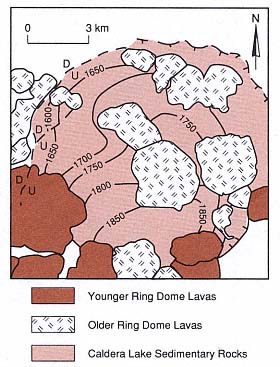
Fig. 4.10
Structural contour map of tuff deposits (known
as the "gaint pumice horizon") interbedded with
caldera lake sediments of the La Primavera
caldera in Jalisco, Mexico; elevation in meters
(from Mahood, 1980). Resurgence was
asymmetrical, with maximum uplift in the
southeastern corner of the caldera.
that initially the resurgent plutons had a laccolithic form but that this form was eventually modified when stoping during subsequent phases produced more or less cylindrical intrusions similar to the central plutons of ring complexes. Those authors also proposed that the resurgence here was more likely related to continued magmatic input (10-2 to 10-3 km3 /year rather than to renewed magmatic pressure caused by vesiculation, as was suggested by Marsh (1984).
Structural resurgence can be a rapid process. At Long Valley caldera of California, Rabaul caldera in Papua-New Guinea, and the Phlegrean Fields of Italy, active deformation of centimeters or meters have occurred over only decades (Newhall and Dzurisin, 1988).
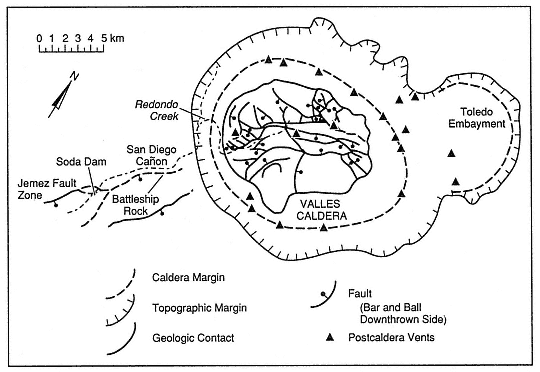
Fig. 4.11
Map of the Valles caldera in New Mexico, showing faults that cross
the caldera complex and faults within the 1-km-high resurgent dome.
(Adapted from Nielson and Hulen, 1984.)
Resurgence can also be an intermittent process in which uplift is followed by alternating subsidence and uplift. Bailey et al . (1976) stated that inferred times for resurgence of older calderas range from <10,000 to ~100,000 years. Although the time required for resurgence obviously varies greatly, for the best-documented modern example, at the largely submarine Iwo-Jima caldera of Japan, the average rate of uplift has been 15 to 20 cm/year since the caldera floor rose above sea level 500 to 700 years ago (Kaizuka et al ., 1989).
Such structural resurgence has a significant effect on the thermal history of a caldera. Thermal gradients within resurgent calderas are higher than in calderas with no resurgence (Zyvoloski, 1987). In addition, hydrothermal systems can develop along faults associated with the keystone grabens that are typical of resurgent domes because fracture permeability is necessary for the meteoric water circulation within densely welded caldera-fill tuffs.
After caldera collapse, small, less explosive eruptions may begin along ring faults or along faults that bisect the caldera. The lavas and pyroclastic rocks erupted are less volatile-rich than the pyroclastic materials of caldera-forming eruptions (Hildreth et al ., 1984). Within most calderas, dacitic or rhyodacitic dome lavas are erupted along the ring faults over periods ranging from a few decades to >1 myr after the initial caldera-forming eruption (Fig. 4.12). Heiken and Wohletz (1987) reported that a variety of pyroclastic rocks are associated with these domes, including hyaloclastic deposits of tuff rings, ash fall beds, and small pyroclastic flow deposits. Postcaldera volcanic activity ranges from eruptions of a few isolated vents to eruptions of postcaldera domes,
cones, and flows that can fill the caldera. Calderas located along volcanic arcs at the plate margins may be partly buried by composite cones that consist of lavas and pyroclastic rocks of intermediate composition; such cones are well-documented throughout Central and South America, in the volcanic fields of Kamchatka in the Kurile islands, and along the Japanese island chain. The magmas supplying postcaldera volcanoes are far less voluminous than the caldera magma body, but they form shallow magma bodies and cause magma-induced fractures that are needed for hydrothermal systems.