
One
Theoretical and Historical Background to the Study of the Bureaucratic-Authoritarian State
Argentina between 1966 and 1973 serves in this book as a case study of the implantation, social impact, and collapse of a type of state I have termed bureaucratic-authoritarian (BA). The first section of this chapter introduces some of the basic concepts to be used and elaborated upon as we examine the Argentine BA and compare it with similar cases. The remainder of the chapter outlines the decisive antecedents to the BAs implanted in Argentina and other Latin American countries during the 1960s and 1970s, beginning with the emergence of the popular sector as an important actor during the period that followed the collapse of oligarchic domination. Both the ambiguous relationship of this process to the issues of citizenship and political democracy (section 2) and the largely concomitant process of the transnationalization of Latin American economies and societies (section 3) are analyzed.
The processes of popular activation and social and economic transnationalization gave rise to crises that formed the more immediate antecedent to the BAs. The fourth section contains a general discussion of crises. The fifth section distinguishes among various types of crisis in order to lay the groundwork for analyzing the ones that, at varying levels of intensity, preceded the implantation of the BAs. The sixth section summarizes attributes that define the BA and distinguish it from other forms of authoritarian rule. The seventh consists of a brief excursus
To facilitate the reading, notes have been separated into two categories. Those at the bottom of the page elaborate the arguments and information presented in the text, while those at the end of the chapter refer exclusively to sources.
defining the social and political actors whose conflicts and alliances constitute a central theme in this study.
1. On the Capitalist State and Related Themes[1]
The BA is a type of capitalist state, and should therefore be understood in the light of the distinctive attributes of capitalist states in general. The most important characteristics of such states, and of other concepts to be used throughout this book, are delineated in this section.
A. State and State Apparatus
The basic (though not the only) network of social relations in a capitalist society, and the one that characterizes it as capitalist, is the one formed by its relations of production. These relations are established in one of society's basic cells: the workplace and work process. Ordinary consciousness views these relations as exclusively economic, but closer inspection reveals that they are constituted by other aspects as well. One such aspect is the coercive guarantee they contain for their effectiveness and reproduction. The state, according to the view set forth here, is a part, or more precisely an aspect, of these relations: the one that supplies its coercive guarantee. The state, as the guarantor of the capitalist relations of production, is (no less than their economic aspects) a necessary and primordial part of these relations. In addition to guaranteeing their effectiveness and reproduction, the state also organizes the capitalist relations of production by articulating and buffering the relationships among classes and by providing elements necessary to their "normal," unchallenged reproduction.
It is crucial to underscore that the state is the guarantor not of the immediate interests of the bourgeoisie, but of the ensemble of social relations that establish the bourgeoisie as the dominant class. It is a capitalist state, not a state of the bourgeoisie. Insofar as it guarantees and organizes capitalist social relations, the capitalist state guarantees and organizes the social classes inherent in them—including the dominated classes, although what the state guarantees in respect to them is their reproduction as such, i.e., as dominated classes.
Some important consequences stem from the fact that the state is the guarantor and organizer of the capitalist relations of production, and not of the immediate interests of the bourgeoisie. It is particularly important
to recognize that the state, even in opposition to the concrete demands of the bourgeoisie, may assume a custodial role with respect to the dominated classes. The general interest of the bourgeoisie as a whole—the effectiveness and reproduction of the social relations that ensure its condition as a dominant class—entails the placing of constraints on the microeconomic rationalities of its members. The processes set in motion by such rationalities, if left unchecked, could culminate either in the physical extinction of the working class or in its recognition of the exploitative character of its relationship with the bourgeoisie. The demystification of capitalist exploitation would undermine a fundamental support of ideological domination: the commonsense perception of the relations of production as freely agreed upon, purely economic, and nonexploitative. In turn, the disappearance of this perception would lead to a generalized challenge to these relations and the domination inherent in them.
Up to this point I have discussed the capitalist state on an analytical level upon which one might also situate, for example, the concept of class or of capitalist social relations. Just as one cannot see "the bourgeoisie," one cannot see "the state." But at a concrete (that is, nonanalytical) level, these categories are objectified in social actors, among which are the institutions or apparatuses of the state. I have argued that the capitalist state is primarily and constitutively, one aspect (which must be comprehended analytically) of capitalist social relations. The state, in this fundamental sense, is a part of society; society is the more basic and inclusive category. But in terms of the concrete social actors who are the bearers of these (and other) social relations, the state is also an apparatus, or a set of institutions. Just as the commodity is an objectified moment in the global process of the production and circulation of capital, the institutions of the state are an objectified moment in the global process of the production and circulation of power. Like the commodity, these institutions are of great importance and have crucial effects of their own. But it is wrong to confuse them with the whole state and thereby lose sight of the state's foundations at the very heart of society.
Ordinary consciousness reduces the capitalist state to its institutions, just as it isolates the commodity from its origins in the production and circulation of capital. The limitation of commonsense perceptions to the concrete—fetishized—appearance of the state and capital is the principal cloak behind which class domination (and with it the domination of the state) is concealed and protected. More precisely, the fetishized
appearance of the state apparatus as the "whole" state underlies the illusion that this apparatus constitutes a "third" social actor, unbiased and external to the relations that link the capitalist to the worker. Actually the state, as we have seen, is a constitutive part of those relations. This appearance of externality is what allows the state to operate as the organizer of capitalist society: because the state seems to stand apart from society, it can proclaim itself, and will usually be perceived, as the unbiased guardian and agent of a general interest. But the state is the agent of an interest that is general but partialized: that of the effectiveness and reproduction of certain—intrinsically unequal—social relations. It is by no means, however, the agent of a general interest that is impartial with respect to the structural positions of the social classes.
B. Nation
The state serves a general interest, which is the general interest of the effectiveness and reproduction of the social relations that constitute both the dominant and the dominated classes. The discourse emitted by the state apparatus claims, however, that it serves an undifferentiated general interest: that of the nation. The nation is the arc of solidarities that postulates a homogeneous "we" that is distinct from the "they" of other nations. The effectiveness of the state's coercive guarantee is based on its control of the means of coercion in a territory whose boundaries mark the limits of the nation's arc of solidarities. It is for these reasons that the state is, or tends to become, a national state: its territorial boundaries delimit the scope of its coercive supremacy, and it is the undifferentiated interest of social actors qua members-of-the-nation that the state apparatus claims to serve.
C. Pueblo
The custodial role of the state with respect to the dominated classes can lead to recognition of the pueblo, i.e., the least favored members of the nation. Pueblo is an inherently ambiguous category.[2] certain conjunctures the poor and weak who constitute the pueblo may channel explosive demands for substantive justice that conflict with the state and the basic social relations, or pact of domination,[3] that it guarantees and organizes. By articulating such demands, these actors may come to identify themselves not just as pueblo but as dominated classes who self-consciously
consciously challenge the system of social domination. But in other circumstances the identification pueblo may inhibit the formation of class identities, serving instead to define its members as subordinate actors in processes whose main protagonists are dominant class fractions struggling among themselves.[*]
D. Citizenship
Just as each social actor appears abstractly free and equal before the market, commodities and money, citizenship embodies another moment of abstract equality. In a political democracy, the state institutions ground their claim to the right to command and coerce on the basis of the free wills of the members of the nation as citizens. The image of a society made up of equal citizens abstracted from their actual positions in society is in various senses false, but, just as the concepts of state, nation and pueblo harbor ambiguities, this image of citizenship contains a side of truth as well as one of falsity. On the one hand, the image of a society composed of free and equal citizens usually provides optimal cover for the social domination embodied in the capitalist relations of production. On the other hand, citizens in a political democracy enjoy, on the basis of their abstract equality, the right to organize around goals they are (in principle) free to define, as well as the right to be protected from and compensated for arbitrary acts by the state institutions or other social actors. Moreover, citizenship and political democracy entail mechanisms and entitlements that often permit the dominated classes to carve out social and political spaces from which to articulate demands and realize interests that are both objectively and subjectively important to them. Furthermore, as we shall see, the mechanisms and opportunities associated with political democracy may at certain conjunctures provide the dominated classes institutional channels and resources through which
[*] In order not to overcomplicate this introductory theoretical sketch, I have limited myself to the ideal case of a social formation where capitalist social relations are strongly predominant. Moreover, I have restricted myself to relations of production, with no discussion of other relations of domination—those not directly based on the work process—that the state usually also guarantees and organizes. In the study of social formations where capitalist relations have become predominant over other types of relations of production, it makes sense to start (for reasons of conceptual parsimony) with the ideal type of those relations—which, as we have seen, are not only economic—that articulate and subordinate the rest. As we shall see, this is only a preparatory step for historically specific analysis, which must also introduce those other relations and try to present them in their dynamic interplay with the former.
the foundations of social domination may be shaken and, eventually, destroyed. Thus, as with the other categories already analyzed, the specific implications of citizenship and political democracy cannot be determined a priori; they depend on circumstances that must be recognized and assessed through detailed historical analysis.
E. Regime and Government
Two other categories need to be defined: regime and government . The regime is the set of effectively prevailing patterns (not necessarily legally formalized) that establish the modalities of recruitment and access to government roles and the criteria for representation and the permissible resources that form the basis for expectations of access to such roles.[4] These criteria may be derived from classical democratic theory (citizenship, parties and party membership), from articulations of interests in society (as in the case of corporatist representation), and/or from membership in certain state institutions (such as in highly militarized regimes).[*] The government is the set of persons who occupy the top positions in the state apparatus in accordance with the rules of a given regime, and who are formally entitled to mobilize the resources controlled by the state apparatus (including those on which the coercive supremacy of that apparatus is based) in support of their directives or prohibitions. In other words, the government is the apex of the state apparatus, and the regime is the network of routes that lead to it.
The concepts outlined in this section will serve to structure and orient the remaining portion of the chapter, in which we shall examine some processes that made a decisive contribution to the implantation of bureaucratic-authoritarian states in Argentina (1966 and 1976), Brazil (1964), Chile (1973), and Uruguay (1973).[5]
[*] Type of regime and type of state usually correspond closely but not exactly. A regime that is democratic or competitive, or, in the terminology of Robert Dahl, "polyarchic" (cf. esp. Modern Political Analysis [New York: Prentice-Hall, 1966]), implies universalistic criteria of representation (citizenship) and of patterns of social representation—i.e., patterns that are not determined unilaterally by incumbents of the state institutions. Such a regime is incompatible, for example, with a bureaucratic-authoritarian state (as defined below). On the other hand, an authoritarian state can coexist with a regime made up of a single party, a dominant party (Mexico), two formally authorized parties (Brazil prior to 1979), or no party at all (Chile today), and can impose more or less rigid constraints on corporative representation, with differing biases with respect to the various social classes.
2. Pueblo in Latin America
A. Pueblo
Most populations in Latin America forged their national identities much more as a pueblo than as a citizenry. At various times—and not only through the so-called populisms[*]—sectors that previously were excluded from all forms of political participation (except as subordinated members of clientelistic systems) burst forth as a pueblo . They were recognized as members-of-the-nation through demands for substantive justice, which they posed not as dominated, exploited classes but as victims of poverty and governmental indifference. The disadvantaged sectors (los pobres ) who constituted the pueblo saw themselves (and were proclaimed by the political leaders who sought their support) as embodying what was most authentically national, and they contrasted these national orientations and aspirations to the "foreignness" of the ruling oligarchies and their international allies.
Los pobres were not the main protagonists in the process by which they themselves became members-of-the-nation. From Getúlio Vargas's image as the "father of the poor" to the more mobilizing discourse of Eva Perón, the pueblo emerged as both a part and a consequence of a broad alliance. This alliance, dominated by the urban middle sectors and that part of the urban bourgeoisie that seemed capable of playing a dynamic role in development, sought the liquidate the oligarchic states. The supposedly archaic character of the oligarchy and the conspicously foreign character of transnational capital linked to the export of primary products were set in contrast to the newly defined national-popular identity.
[*] I shall address the issue of populism here only in every general terms, partly because of space limitations and partly because there exist few comparative studies that examine in detail the political transformations that took place in Latin America following the rupture of the oligarchic state. A work that clarifies various aspects of the periods preceding the implantation, of the BAs is Marcelo Cavarozzi, " Populismos y 'partidos de clase media' (Notas comparativas)," Documento CEDES/G.E. CLACSO 3, Centro de Estudios de Estado y Sociedad (Buenos Aires, 1976). The main contributions to the analysis of Latin American populisms are those of Francisco Weffort; cf. esp. his collected essays in O populismo na política brasileira (Rio de Janeiro: Editora Paz e Terra, 1980). For important contributions to the comparative study of the populist periods and the BAs that succeeded them, see David Collier, "The Bureaucratic-Authoritarian Model: Synthesis and Priorities for Future Research," and Robert Kaufman, "Industrial Change and Authoritarian Rule in Latin America: A Concrete Review of the Bureaucratic-Authoritarian Model," both in The New Authoritarianism in Latin America, ed. Collier; and Ruth Berins Collier, "Popular Sector Incorporation and Regime Evolution in Brazil and Mexico," in Brazil and Mexico: Patterns in Late Development, ed. Sylvia Ann Hewlett and Richard Weinert (Philadelphia: Institute for the Study of Human Issues, 1982).
Why did the previously excluded sectors in most Latin American countries form their collective identities more as pueblo than as a citizenry? First, in such countries the abstract ideas equality upon which citizenship is based were not well developed, basically owing to the incomplete diffusion of capitalist relations at the time when the national-popular identities began to crystallize.[*] Even in relatively homogeneous countries like Argentina and Uruguay, the previously excluded became members-of-the-nation at the same time as a great wave of urbanization and industrialization was taking place. The clustering of these great social transformations in most Latin American countries contrasts with the longer, more sequential historical rhythms of the core capitalist countries, where capitalist relations expanded more gradually and came to predominate throughout society prior to the expansion of citizenship by the electoral enfranchisement of the whole (male) population. A second reason why the pueblo became the main locus of new national identities in Latin America is that in many cases these identities were formed at the same time as the urban economy was undergoing rapid expansion. This economic growth furnished resources that enabled governments to project an image of concern for, and to some extent to promote, the interests of the popular sectors.[†] During such periods governments, together with key parties and movements, tended to orient their discourses in support of those whom incumbents of the state apparatus and members of the dominant classes had formerly viewed as nothing more than silent masses subject to occasional upheavals. To a degree and for a duration that varied according to the country, it seemed that the state really was a national-popular state. More than a few of those who had come to consider themselves members of the pueblo not only experienced improvements in their material conditions, but also took part in the nationalist rituals in which the populist governments
[*] During the oligarchic and populist periods, Latin American societies were not as fully articulated by capitalist relations as were the societies of the center countries when mass citizenship came upon the scene. Some consequences of these contrasting experiences are discussed by Marcelo Cavarozzi in "Elementos para una caracterización del capitalismo oligárquico," Documento CEDES/G.E. CLACSO 12, Centro de Estudios de Estado y Sociedad (Buenos Aires, 1979). I have borrowed from this work the concept of "cellular domination."
[†] The appeal to lo popular was characteristic of governments established during the interval between the rupture of the oligarchic state and the implantation of the BA, regardless of whether these governments owed their existence to movements that actively promoted such appeals. During this era the discourse of the state apparatus was "popularized," even if on some occasions its popular content had a rather hollow ring.
celebrated their "victories" over the oligarchy and transnational capital.[*]
B. Citizenship and Political Democracy
In the countries of Latin America, with the partial exception of Chile and Uruguay, citizenship never assumed a preponderant role in the forging of political identities. As noted above, the limited scope of ideas of citizenship in Latin America was due partly to the absence of fully and extensively capitalist societies that foster, and are nurtured by, other levels of abstract equality. Another reason for the secondary role of citizenship is that the periods in which the popular sector burst into the national political arenas were fraught with conflict over restricted and fraudulent forms of oligarchic democracy. Such "democracy" often was—and was perceived as—a sham concocted by conservative forces to stifle popular advances. During the popular irruptions, however, diverse factions of the oligarchy would frequently come out in support of a "democracy" they had seldom practiced in the past. Such democratic posturing was notoriously ambivalent. With the emerging populist alliances convinced that "democracy" was little more than a hoax designed to fetter the advance of the pueblo , and with conservatives and oligarchs fearful of the enormous electoral support upon which those who appealed to the pueblo could rely, democracy, and the ideas and institutions of citizenship with which it is associated, through the period appealed to very few political actors. With their shallow roots, citizenship and democracy proved unable to withstand the crises out of which the bureaucratic-authoritarian states emerged.
The initial political activation of the popular sector cannot be considered properly a class movement in any of the countries we are studying, since the previously excluded sectors did not recognize themselves as dominated classes and were unable to set their own goals or to determine the general direction of the process. The popular activation was channeled not into overt class struggle, but rather toward a recomposition of the dominant classes. This recomposition consisted on the one hand of the displacement of the agrarian-based oligarchies from their previously
[*] Such nationalist rituals were of immense symbolic importance. They ranged from expropriations to more moderate decisions, such as the purchase of British-owned railroads by the first Peronist government in Argentina, which was attended by an elaborate ceremony in which it was implied that with this act the state, identified with its pueblo, fully constituted the nation.
central position within the dominant classes, and on the other of the emergence as key social and economic actors of the newest and most dynamic appendages of the world capitalist center. In some cases (such as Mexico and Argentina, each in its own way and at its own time) the national-popular emergence had largely subsided when, by the late 1950s and early 1960s, the great surge toward the transnationalization of the urban productive structure took place. Elsewhere (as in Brazil and Chile, again each in its own way) the processes of popular activation and transnationalization largely overlapped. But in all of the cases with which we are here concerned, the popular activation, the displacement of the agrarian-based oligarchies, and the intense transnationalization of the economy and society led to a rapid expansion of capitalist relations. The advance of all of these processes was, however, subject to a key limitation. The democratic (in Chile and Uruguay) or populist (in Brazil and Argentina) "state of compromise"[6] remained viable only so long as the pueblo 's demands for substantive justice did not collide with the constraints imposed by the way in which the economy was expanding and becoming extensively transnationalized.
As a result of this clash between popular sector demands and the requirements of the new mode of economic expansion, many actors, including some who had initially supported the popular activation, began to search for ways to drive a wedge between the pueblo and the nation and to ground the latter in an alternative referent. Such initiatives, which began well before the adoption of explicitly authoritarian solutions, were put forth in a situation where democracy and citizenship remained weakly rooted and where the pueblo had overcome, if only partially and in a subordinate fashion, its earlier political marginalization. The resulting presence and demands of the popular sector, even though they were not expressed in class terms and therefore posed no direct challenge to social domination, were perceived nonetheless as increasingly dangerous. For the dominant classes, new and old alike, this became the Gordian knot that had to be cut.[*]
[*] My previous research has centered on the processes alluded to in this paragraph, especially on their elective affinities with the emergence of the BAs and—contrapuntally—with the tortuous ways in which Latin American societies have grappled with the problem of political democracy. No discussion of such themes can fail to recognize the contributions made by the analyses of Fernando Henrique Cardoso; cf. (with Enzo Faletto) Dependencia y Desarrollo en América Latina (Mexico City: Siglo XXI, 1969), and the postscript in the English edition, Dependency and Development in Latin America (Berkeley and Los Angeles: University of California Press, 1979); and his essays collected in Estado y Sociedad en América Latina (Buenos Aires: Nueva Visión, 1973), and Autoritarismo e Democratiza ção (Rio de Janeiro: Editora Paz e Terra, 1975).
3. Dependency and the Transnationalization of Society
Existing theories of the state have not adequately considered whether the state's "boundaries" coincide with those of the nation and of society. In the centers of world capitalism, where the state may be viewed on the one hand as the link between the domestic capitalist relations of production and the system of social domination, and on the other as an arc embracing the entire nation, it is taken for granted that state, society, and nation are coterminous. This view has been challenged on the periphery, above all in studies of dependency, which argue that society is not coterminous with the nation.[7] However, this argument is seldom extended to the state—society—nation triad.[8]
Following the Second World War, the mode of linkage between the Latin American countries we are studying and the world market changed considerably. Primary-product export ties to the world capitalist center did not disappear, but they became increasingly subordinated—in terms of the dynamics of capital accumulation and the relative weight of the classes associated with each activity—to the operations of transnational corporations (TNCs). These corporations adapted to the protectionist policies enacted in these countries during the 1930s and 1940s by vaulting over customs and exchange barriers to become direct producers in and for the domestic market.[9] TNC subsidiaries increasingly displaced firms engaged in the production and export of primary goods as the dynamic motor of the transnationalization of capital, and in so doing they accentuated the oligopolistic characteristics of each domestic market. Not only the activities of the TNCs themselves but also the changes their activities stimulated in the world financial and commercial systems promoted this transnationalization. Especially in the countries with the largest domestic markets, TNC subsidiaries, together with some state institutions, predominated in the economic sectors (primarily industry and nontraditional services) that became the new dynamic axis of economic growth. The TNCs remained the major vehicles of the transnationalization of these Latin American economies and societies until the world crisis that began in the mid-1970s gave financial capital a preponderant role.
These processes gave rise to capitalist societies whose attributes define them as historically original. They are dependent capitalisms because in their normal functioning[*] they assign a decisive role to transnational
[*] The idea of "normality" in the functioning of a capitalist economy is discussed in section 4 of this chapter.
capital and their circuits of capital accumulation are completed not within the domestic market but in the centers of world capitalism. They are also extensively industrialized societies, owing as much to the relative weight of industry in the economy as to the significance of industry in class formation and articulation. Because of this coexistence of dependency and extensive industrialization, the capitalisms of Latin America are marked by acute imbalances.[10] It is enough to note that (1) they produce few of the capital goods and little of the technology they utilize; (2) they generate locally only a small fraction of the services involving the production, transmission and processing of information; (3) their balance of payments tends to be negative even if their balance of trade is positive; (4) their domestic capital markets are at best embryonic; (5) a large proportion of their largest and fastest-growing private economic entities are TNC subsidiaries; and (6) their distribution of all kinds of resources (not just economic ones) are significantly more unequal than in the center capitalisms, in spite of which (7) available goods and services tend to mirror those found in the core capitalist countries.
To summarize, the productive structures of these societies are complex and differentiated, but at the same time they are unbalanced and incomplete in that their vertical integration is limited by the dearth of internal production of complex capital goods and of technology. The imbalances just described suggest that these economies and some of the problems they confront are not the same as those of the center capitalist countries. On the other hand, the Latin American economies that concern us here differ in important ways from those that conform to the archetypal image of "underdevelopment," in which the domestic productive structure is less complex and industry less extensive.
But transnationalization involves more that the presence of TNC subsidiaries as the most dynamic private economic entities in these societies. The insertion of transnational capital as a direct producer within economy and society. Once it had undermined the earlier supremacy of enterprises and classes engaged in the export of primary products, the entry of TNCs into domestic markets led to a profound recomposition of the bourgeoisie. What occurred was less the capture of an already existing productive structure (although this too resulted from the most parasitical forms of transnational expansion) than the creation of new industrial, commercial and service sectors and activities. As a result of these changes, one part of the preexisting urban bourgeoisie, overwhelmingly
national in terms of the location of its decision-making centers and the origins of its capital, found itself relegated to the traditional, slowest-growing, least technology- and capital-intensive, and most competitive sectors of the economy. On the other hand, other national firms, most of them newly created, associated themselves with the TNC subsidiaries, either by providing them with inputs or services or by acquiring their products for last-stage processing or for sale.[11] Entrenched as they are in a larger matrix of economic relationships built by and around the TNCs, such firms can be considered national only in a formal sense. Located in power networks (both economic and non-economic) controlled by the TNC subsidiaries, their modalities of capital accumulation tend to remain subordinate to those of the TNCs,[*] and in no sense are such firms in the hands of an independent bourgeoisie in control of its own accumulation, the technology it utilizes, and the social relations it begets. Even local firms that have expanded outside the network of direct linkages to the TNC subsidiaries are profoundly transnationalized. To succeed, they have had to "modernize" in a dual sense: by imitating the type of product, services, advertising, and marketing characteristic of the TNCs, and by importing equipment, trademarks, technologies, and services that convert them into replicas of those subsidiaries.[†]
Finally, what is socially deemed a "need" on the periphery is in large measure a function of this very transnationalization, whose dynamic agents foster a pattern of expensive consumption epitomized by an insatiable thirst for new products. This is socially absurd in societies marked by inequalities much more profound than those of the central capitalist countries, and the tensions that result from such patterns of consumption have important political consequences. Some of the demands for substantive justice associated with the self-affirmation of the pueblo reflect "needs" induced by this pattern of "development," but such demands, even as they ratify the imitative and transnationalized cast of the productive structure, also strain the limits of this structure by highlighting its relative and absolute inequalities.
[*] "Contrary to what is assumed in simplistic conceptualizations of dependency, this subordination does not preclude serious conflicts between the TNCs and the national firms to which they are linked. These conflicts, however, tend to be defined and resolved within the limits imposed by the subordination of the latter to the former. I have developed this theme and related ones—to which we shall return later in this book—in "Notas para el estudio de la burguesía local," CEDES Estudios Sociales 12 (Buenos Aires, 1978).
[†] Or, more precisely, into partial replicas of these subsidiaries. The more limited range of products offered by these firms, coupled with their restricted capacity to introduce innovations, makes it more difficult for them to adapt to domestic economic conditions and to international competition.
Let us return to a crucial point raised in the first paragraph of this section. In the era of primary product exports, the real frontiers of dependent societies were already more blurred than those of the center capitalisms. But once transnational capital began to push its way into the urban productive structure, it became even more evident that these frontiers stretched well beyond the boundaries supposedly demarcated by their respective states. The uppermost ranks of the bourgeoisie in the countries we are studying now contain a number of strategic decision-making centers that lie beyond the territorial limits claimed by the state. Society, or more specifically its most dynamic and economically powerful elements, has overflowed the nation-state. The state institutions can negotiate some of the terms under which the TNC subsidiaries penetrate the domestic economy, but they are powerless to challenge the role of these subsidiaries as crucial agents of transnationalization. The conspicuous presence of these extranational centers of decision-making in territories controlled by a state that cannot cease to proclaim itself a national state bears important consequences. In the first section of this chapter, attention was called to the systematic bias of the state (as an aspect of a social relation and as an apparatus) toward the reproduction of society as, fundamentally, an ensemble of social relations that gives rise to a system of class domination. This bias tends to be hidden when the state appears as a state-for-the-nation, but it may become visible when society is recast to incorporate within the upper ranks of its bourgeoisie the above-mentioned segments of transnational capital. With this recasting, the state and the nation encompass neither a substantial part of society's most dynamic actors nor the social relations that make them socially and economically dominant.[12] Accordingly, the state tends to lose credibility as the active synthesis of the nation.
The political activation of the popular sector and the transnationalization of society were fundamental antecedents to the BAs. The state that fostered and some extent embodied the national-popular movements was, at the same time, subject to the expansive tendencies of world capitalism that paved the way for the insertion of new segments of transnational capital into the domestic economy and society. With tempos and sequences specific to each case,[*] the period following the
[*] In certain cases, notably Brazil and Mexico, the dynamic economic expansion of the state apparatus permitted an escape from the dilemmas posed by the combined presence of a highly transnationalized upper bourgeoisie and a weak local bourgeoisie. But as has recently become clear in both countries, this escape was limited and temporary and did not improve the social distribution of resources.
rupture of the oligarchic state saw the growth of the contradiction between, on the one hand, the rise of the pueblo as the principal constituent of the nation and, on the other, the limitations imposed by a productive structure that accentuated existing social and economic inequalities while overflowing the boundaries upon which the state founds its claim to be the agent of the national interest.
4. On Economic Crises
The preceding discussion has called attention to some of the ways in which the societies where the BAs have emerged differ from those of the central capitalisms. Nonetheless, both types of societies are supposed to function normally. But what is meant by "normal"? The answer is given on the basis of criteria used to evaluate the functioning of the central capitalisms. The application of such criteria to the societies that concern us here has important political consequences.
A modern capitalist economy is considered to be functioning normally when its dynamic reproduction, or expansion, takes place without major disruptions to capital accumulation, and in particular to the accumulation of its large economic entities. Such "normality" is the perpetual but opaque crisis of an uneven and unequalizing growth whose chief beneficiaries are these large entities and whose capital accumulation subordinates the behavior of other economic actors and the overall distribution of resources in the rest of society. "Normal" economic functioning is measured in terms of indicators that define a "satisfactory" economic situation as one in which there are few impediments to the existing pattern of capital accumulation. Moreover, those who judge whether the economy is functioning normally are usually the ones whose actions and abstentions are most capable of influencing those indicators. A different assessment might well result if indicators usually overlooked were taken into account, or if actors holding other criteria conducted the evaluation. As Alice in Wonderland learned, the degree to which things are going "well" or "poorly" depends on the power wielded by those who evaluate them.
When is a capitalist economy operating in a "satisfactory" manner? Such a judgment seems to be based on the following conditions: (1a) capitalists—particularly those who control large-scale enterprises—enjoy rates of profit they consider satisfactory for their own activities and for the overall performance of the economy; (2a) profits are reinvested in sufficient proportion to stimulate what these actors consider
to be a reasonably high and sustained rate of economic growth; and (3a) those same actors expect that the above conditions will be maintained (or improved) in the relevant future, i.e., as far ahead as their time horizons extend.[*] These conditions can be stated in the negative: the economic situation is abnormal or unsatisfactory when any of the following circumstances exist: (1b) capitalists—particularly those who control large-scale enterprises—receive rates of profit they do not consider satisfactory; or (2b) profits accrue at a satisfactory rate but are not channeled into investments in sufficient amount to generate what they consider a reasonably high and sustained rate of growth; or (3b) conditions (1a) and (2a) are met, but those actors feel that the outlook for the future is unfavorable or unpredictable. Given any of these conditions, the economic situation will be judged unsatisfactory, and actors will adjust their behavior accordingly.
It should be noted that each capitalist, in judging whether the economic situation is satisfactory, assesses the existing situation but also makes a prediction about the future that he or she considers relevant. If the prediction is that in this future the "relevant" variables will behave in a negative or unpredictable fashion, the capitalist will evaluate the situation as unsatisfactory. The most pessimistic prediction, however, is not that these variables will assume still more negative values or that they will become even harder to predict. For the capitalists, the most pessimistic prediction is rather that existing social arrangements will be replaced by others in which they themselves have no place, and in which judgments as to whether the economy is performing in a satisfactory manner are made by other actors, using alternative criteria. For capitalists the most pessimistic prediction is the elimination of capitalism.
The normal functioning of an economy depends in large measure on whether its more influential actors evaluate its situation as satisfactory. However trivial this point may seem, it has a number of implications. First, this appraisal is codified. A code is a partial map of reality that draws attention toward some of its aspects and away from others. A code filters information by distinguishing "relevant" from "irrelevant" data, and by ordering the data considered relevant in hierarchical fashion such that some pieces of information are classified as important, others as secondary, and still others as those, important or not, about
[*] Some assumptions underlying "normality" are of course historically specific: at t1 they can differ from those at tn , and in country A they can differ from those in country B. Nonetheless, it seems to this author that in capitalist countries of medium or high complexity they would have to satisfy the general conditions stated in the text.
which nothing can be done. Usually implicit in the ordering process is a putative system of causal connections in which certain consequences are believed to follow regularly from certain situations. Codes, as partial visions of reality, obscure those aspects of a situation that go badly when, or because, those on which they focus are going well. Like ideology, of which it is an explicit and articulated segment, a code may represent with a fair degree of accuracy one aspect of reality even as it neglects or profoundly distorts other aspects, or as it confuses the single aspect with the whole reality.
Whose evaluation of a complex capitalist economy really matters? "Everyone's" matters to some degree, but in a highly oligopolized structure the evaluations of the monopolistic or oligopolistic actors matter the most. These actors have the power to influence greatly, by their actions and abstentions, the current and future condition of many economic and social relations. It happens that the criteria encoded for evaluating the overall economic situation are homologous with those used by the actors who control the largest economic units to evaluate their own situation. On the whole, things are "going well" for the economy when, and because, things are going well for its large mono/oligopolistic units. Whether things are going well for the latter depends in turn largely on whether those who control such units consider the situation on their own plane of activity to be satisfactory. But what is the meaning of "going well" at the level of these large, complex, and bureaucratized organizations? To answer this question it is sufficient to summarize some themes set forth in the extensive literature on the topic.[13] organizations (1) use highly routinized guidelines to conduct and evaluate their activities; (2) use similarly routinized criteria to determine what constitutes the "satisfactory" attainment of the goals they have set for themselves (typically, a certain ratio of profit to capital and/or sales, and a certain share of the market); (3) try to absorb and control the areas of uncertainty that they have learned may have a negative impact on their performance; and (4) contain internal coalitions with specialized activities and entrenched routines that make it difficult to change the behavior they have learned. Furthermore, in comparison to other actors these organizations have a long-term outlook, owing to their internal complexity, the nature of their investments, and the scope of their activities, which are typically specialized and not easily learned or unlearned. The short- and medium-term bases on which most small commercial and industrial firms operate—rational for entrepreneurs whose limited resource base restricts
| ||||||||||||||||||||||||||||||||||||||||||||||||||||||||||||||||||||||||||||||||
their capacity to process information—is unsuitable for those large organizations.
The Argentine case, as the data in Table 1 indicate, provides evidence that large industrial firms have significantly longer planning horizons than smaller ones.[*] Every firm's evaluation of its situation contains a prediction of the future as well as an assessment of current conditions, but the future dimension is especially important for larger enterprises. Suppose that the actual state of the world is that depicted in Figure 1, where t1 is the current year and t2 … t7 are the following years. Suppose also that a value (of, say, expected profits) within the 70–80 range on the vertical axis allows for the judgment that the economic situation is satisfactory and that a value in the 30 range or below produces the opposite assessment. Given a predicted value of 90 for year t2 , actor A, whose time horizon is one year, will judge the situation to be very
[*] These figures are still more significant if we take into account that the firms surveyed are stock corporations (sociedades anónimas ). This means that the sample excludes the numerous small and medium-sized firms that are individually owned or that adopt other forms of association.
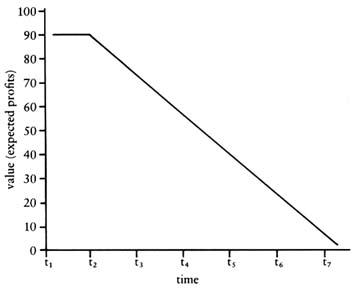
Figure 1.
Long-term Outlook: Steady Decline
satisfactory. But for actor B, an oligopolist whose time horizon extends for several years, the situation will be considered far from satisfactory, since the predicted values decline steadily after t2 . Actor B will therefore begin immediately to act in such a way as to minimize the risks apparent in this negative long-term forecast.
Now let us suppose that the situation is as depicted in Figure 2, which registers the same values as Figure 1 for the first and last years. Actor A's evaluation, which remains limited to a one-year horizon, is even more optimistic (note the predicted improvement during the first year). But actor B's assessment not only terminates, as in Figure 1, at an unsatisfactory point; it also forecasts, in contrast to Figure 1, considerable fluctuation, which will make it more difficult to plan ahead and to adjust decisions accordingly. Hence actor B's evaluation will be even more pessimistic.
These examples suggest that when the medium- and long-term outlook approaches either of the situations discussed, the rational response is to maximize gains in the short term and minimize the losses and risks predicted for the future. The tendency to respond in this way is accentuated when fluctuations are predicted, as in Figure 2.
In the Latin American countries where BAs were eventually implanted, the codified indicators by which the overall situation was evaluated
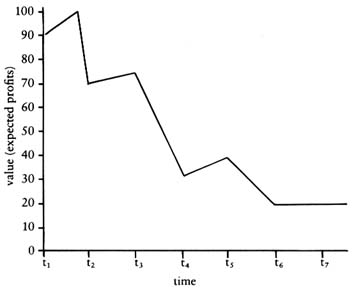
Figure 2.
Long-term Outlook: Fluctuating Decline
were both deteriorating and performing erratically. These trends generated evaluations that were even more negative than those of actor B in Figure 2. The real actors could foresee further deterioration and fluctuations, but (unlike the omniscient forecaster in the example) they could not predict, except in the very short run, the timing and intensity of the fluctuations.
A situation in which economic conditions are deteriorating and in which it is almost impossible to predict medium-term fluctuations (except to say that they will occur along a negative trend) creates an especially perverse type of economy. The only rational behavior in such an economy is to engage in plunder, i.e., to restrict the actor's operations to activities with satisfactory short-term outlooks while leaving as little as possible at stake for the time when the situation is predicted to deteriorate further. It is especially irrational to risk capital in investments that will mature in the medium or long term. The aggregate result of this micro-rational behavior is widespread financial speculation and capital flight, the effects of which are worsened by the suspension, also owing to predictions of deterioration and uncertainty, of capital inflow from abroad. Still, the situation does not lead to complete disinvestment because, apart from the various institutional rigidities that make this difficult, it makes sense to maintain a minimum of capital on hand to
participate in successive rounds of plunder. As the process continues, financial speculation intensifies and tends more and more to eclipse other activities, further dislocating the productive structure and subverting the normal patterns of capital accumulation.
It is worth analyzing some consequences of this kind of situation. First, the circumstances just outlined do not prevent firms from realizing high profits—the fruit of their maximization of short-term gains. But high profits do not give rise to optimism; on the contrary, they reinforce the very pessimism that inspired the strategy whereby the high profits were generated. Thus an apparently paradoxical situation emerges in which most of them may be reaping inordinately high profits. Second, plunder is rational for everyone. As capitalists disinvest and speculate, it makes no sense for workers to heed injunctions to "moderate their demands" to aid an economy that, in any case, will continue to deteriorate. For everyone the only meaningful gains are those that can be realized immediately. Third, the plunderers know that they live in a world of pillage. This awareness results in the relaxation of institutional and ideological controls, which become increasingly irrelevant with the evaporation of the predictability and stability that they support and presuppose. Each ego assumes that every alter will maximize short-term gains, resulting in a situation where everyone contributes to a world of high uncertainty. Ultimately, the situation approaches what David Apter has called the "randomization" of behavior.[14]
In understanding how this micro-rational behavior contributed to the economic crises that precipitated the BAs, the following elements are crucial. First, as judgments about current and future economic conditions prompt decisions that make such evaluations self-fulfilling prophecies, a point is reached at which the aggregate effect of rational micro-level decisions becomes profoundly irrational in terms of the capitalist code to which the most powerful economic actors (among others) subscribe. Second, while an economy of plunder can yield high profits, its incompatibility with medium- and long-range planning undercuts the advantages that the largest economic units enjoy over other actors. This ensures that the largest enterprises will remain intensely dissatisfied, even if they profit from speculative plunder. Finally, as a result of this process, the economy becomes progressively incapable of reproducing the conditions for its own functioning, normal or not.
Since it is the contextually rational behavior of individual units that drives a process so at odds with the logic of the prevailing capitalist code,
it is evident that this process can be halted only by someone outside these actors' microeconomic and short-term rationality. Such intervention could come from actors who subscribe to a different code—i.e., from a revolution. But another possibility is that someone who adheres to the same capitalist code, but is not similarly subject to microeconomic rationality, could step in to restore conditions under which the aggregate outcome of the behaviors of individual capitalists might once again be perceived as normal and satisfactory.
This discussion has remained at a relatively high level of abstraction and has included a minimum of factors. Even so, the state institutions have entered the picture as that "someone" who can transcend the microeconomic rationality on the basis of which even the largest economic units act, and who may be capable of restoring the general conditions for the normal functioning of society qua capitalist. Implicit throughout our discussion was a state that was failing to guarantee such conditions. Moreover, in a crisis triggered by an economy of plunder that has gone "too far," the foundations of the class structure and the domination implicit within it are unavoidably shaken. At this point the crisis engulfs the whole state, which, far from being the foundation of order, is caught up in, and aggravates, the crisis. This gives rise to efforts to restore the state to its role of effective guarantor and organizer of social domination and "normal" patterns of capital accumulation.
We can now turn our attention to more concrete matters.
5. Political and Economic Crises: Convergences
Prior to the emergence of their respective BAs, Argentina, Brazil, Chile, and Uruguay did not meet the general conditions for the normal functioning of a capitalist economy. Rather, to varying degrees their economies were characterized by (1) pronounced fluctuations in the growth of the economy and its principal sectors; (2) large intersectoral transfers of income; (3) a high and rising rate of inflation, also subject to strong fluctuations; (4) recurrent balance-of-payments crises; (5) suspension of direct investment and long-term credit from abroad, exacerbated by captial outflows; (6) declining private investment; and (7) sizeable fiscal deficits. From the standpoint of the codified criteria discussed in the previous section, these economies were seen as performing very unsatisfactorily and doomed to continue deteriorating toward the point at which the very survival of capitalism would be at stake.
These troubles were alarming enough, but they were made worse because they did not occur in a political vacuum: the economic crisis was interlaced with a no less profound political crisis. The emergence of the pueblo involved the expansion of an urban-based popular sector,[*] one component of which was a working class that had grown rapidly and had become geographically concentrated as a result of the rate and type of industrialization taking place at the time. This urban popular sector intervened, with a growing voice and weight of its own, in a political arena in which conflicts over the allocation of resources had become increasingly acute. These conflicts strengthened the political activation[†] of the popular sector at the same time that they amplified the fluctuations of the economy. The resulting political turmoil is well described by the concept of "mass praetorianism,"[15] which describes a situation in which a growing number of political actors are embroiled in conflicts barely, and decreasingly, regulated by institutional and normative controls. This situation tends to correspond on the one hand to an increasing randomization of social relations and, on the other, to a worsening of the economic crisis.
From the standpoint of the dominant classes, both domestic and external, the economic and social crisis in the countries in which the BAs emerged involved more than the absence of the general conditions for normal economic functioning. It also raised the possibility (more or less imminently, depending on the case) that capitalism itself would be eliminated. This perceived danger—the most pessimistic of predictions—was a key factor in the decisions that led to the implantation of the BAs. Praetorianism, the randomization of social behavior, uncertainty, and negative expectations combined to narrow even further the limits imposed by the economic crisis and the transnationalization of society. These troubles were compounded by the demands of an increasingly activated popular sector and its leadership, which became more difficult to satisfy as the economic crisis worsened and which eroded the vertical—corporatizing[16] —controls previously imposed on the popular sector's organizations. The state apparatus, for its part, displaying an
[*] By urban popular sector I mean the ensemble formed by the working class and the unionized segments of the middle sectors.
[†] By the political activation of the popular sector I mean its ongoing presence in national political conflicts and alliances, a presence that obliges other actors (including state institutions) to respond to the interests and demands voiced by this sector (one such response may be repression). The political activation of the popular sector entails its control of organizational and informational resources that allow it to maintain a fairly continuous presence in the political arena.
extremely low level of autonomy with respect to all sectors and classes, had become a battleground for social forces whose micro-rationalities it could not reconcile with the normal functioning of the economy. Moreover, with its enormous deficits and seldom-implemented policies, the state apparatus made its own contribution to the uncertainties, fluctuations, and conflicts of the time. Democratic or not, the praetorian state was representative—too representative—of classes, sectors, and groups that viewed its resources and institutions as part of the booty in each round of plunder and conflict.
6. On Crises
The term crisis is too general. Since the social and/or political dimensions of a crisis can attain very different levels of intensity, it is useful to distinguish among several kinds of crises.
(1) Crisis of Government . The first type of crisis is characterized by political instability, and calls to mind a parade of high officials, including presidents, prematurely forced from office. This type of crisis has important consequences, since it is usually accompanied by erratic changes in public policies and by a widespread feeling that no public power can possibly establish itself. The state apparatus under these conditions tends to appear before society bereft of its majestic façade of authority, revealing itself to be little more than a site of struggles among rival groups.
(2) Crisis of Regime . In the second type of crisis, groups not only expel each other from the government, but also seek to establish new channels of access to governmental roles and new criteria for political representation. This type of crisis is also significant in that it reveals potentially explosive disagreements among competing groups. But unaccompanied by yet more severe levels of crisis, crises of regime and government float upon the surface of society. Latin America abounds with examples of "political instability" and regime transformation that have had little or no effect on economic performance or on social domination.
(3) Expansion of the Political Arena . During such a crisis groups, parties, movements, or government personnel appeal to classes or social sectors on the basis of collective identities that conflict with those of the established participants in the political arena. Successful[*] appeals to lo
[*] By successful I mean that such appeals evoke responses that lead to the emergence of new collective actors in the political arena. See Landi, "Sobre lenguajes, identidades y ciudadanías políticas," Laclau, Politics and Ideology in Marxist Theory, and Norbert Lechner, "Postfacio," in La crisis del estado en América Latina, ed. Lechner.
popular, or to wage-earners as a class, introduce political forces and collective identities that the existing regime cannot absorb without undergoing important transformations. But even if they are successful, such appeals do not necessarily produce parallel transformations at the level of social domination, nor do they necessarily entail the collapse of the existing regime or government. Nonetheless, this crisis is always a matter of grave concern for the dominant classes, who would prefer that the political arena remain confined to discourses and appeals under their own control.
(4) Crisis of Accumulation . A fourth type of crisis is produced when subordinate classes take actions that recurrently impede what the dominant classes view as the normal functioning of the economy. As we shall see in examining the Argentine situation prior to 1966, a crisis of accumulation does not necessarily imply a challenge to social domination: the popular sector and those who represent it in the political arena may have no intention of attacking the fundamental (capitalist) parameters of society. But such a crisis may touch interests perceived as more crucial than those affected by the crises we have sketched thus far. A diagnosis of persistent impediments to capital accumulation suggests to the dominant classes that the demands of the popular sector are dangerously exceeding the limits of the economy and society. These classes tend therefore to define the situation as one in which the capitalist parameters of society will sooner or later be threatened, regardless of whether the popular sector or their political representatives seek to pose such a threat. The situation so defined, the dominant classes conclude that in some way—ranging from cooptation to coercion—the dominated classes must be put "in their place." Often perceived as a necessary condition for achieving this goal is the severance of the bonds that link the popular sector to political personnel who are judged to be making "excessive" or "irresponsible" demands on its behalf. Thus, although a crisis of accumulation initially manifests itself as an economic problem, its diagnosis and the remedies prescribed for it tend to make it a central political conflict.
(5) Social (or Cellular ) Domination . This principal and most profound crisis affects the very foundation of capitalist society: the social relations that constitute and articulate its social classes. This crisis is marked by the appearance among the dominated classes of behaviors and abstentions that are not consistent with the reproduction of the social relations central to a capitalist society. "Rebelliousness," "subversion," "disorder," and "lack of discipline" are labels affixed to situations
that threaten the continuity of what previously were assumed to be the natural attitudes and practices of the dominated classes. Such situations manifest themselves in daily life in "improper" attitudes toward social "superiors," in unusual forms of interpersonal relations among socially "unequal" persons, in the questioning of traditional patterns of authority in such settings as the family, the school, and even the street, and—specifically characterizing this crisis—in the challenging of the bourgeoisie's claim[*] to the right to organize the work process and to appropriate and allocate the capital it generates. Such a challenge may involve anything from "excessive" demands concerning the organization and operation of the work process, to the seizure of productive units, to open challenges to the social role of the capitalist as owner and to the entrepreneur as possessor of the means of production.
Crises of social domination pose a crucial threat to the existing order. They reveal that ideological controls have deteriorated sharply and that coercion is failing to eliminate "disorder"—i.e., that the state is failing to guarantee the reproduction of basic social relations and, with them, of the system of social domination. Such a crisis is therefore at the same time the supreme political crisis: a crisis of the state not only, nor so much, as an apparatus, but in its primary aspect as guarantor and organizer of social domination. A crisis of social domination is a crisis of the state in society. Of course, this crisis has deep repercussions within the state institutions, but it can be fully understood only from a perspective that recognizes the state first and foremost as an indispensable support of domination within society.
None of the other crises examined is as directly and radically threatening as a crisis of social domination, in which the actions and intentions of (at least) the most active and vocal segments of the dominated classes point toward what is most worrisome to the bourgeoisie and to the capitalist state: the abolition of the bourgeoisie as a class, and therefore of the existing system of social domination. By itself, however, a crisis of social domination is limited to the cellular, micro levels of society. But it is usually combined with crises of government, regime, and expansion of the political arena, and obviously also with a crisis of accumulation. The two situations we turn to now are variants that may accompany, and intensify, a crisis of social domination.
(6) In the first variant, political parties and/or government personnel,
[*] Or, in the case of bureaucratic socialism, of similar claims on the part of state officials.
echoing and accentuating the tremors raised by the crisis of social domination, attempt to found a new social order.
(7) The second variant, which may or may not arise jointly with the preceding one, is brought on by armed attempts to divest the state apparatus of coercive supremacy over its territory. Such attempts may take place in the absence of any or all of the crises discussed earlier, but their chances of success increase when they coexist with other crises, especially with a crisis of social domination.
Each kind of crisis may be combined in various ways with others. The crisis of government (type 1) has constituted the "normal" history of Latin America. Crises of regime (type 2) and of expansion of the political arena (type 3) together marked the liquidation of the oligarchic state and the recomposition of a social order based on bourgeois domination. Type 2 and type 3 crises have appeared profoundly subversive (and as such have been harshly repressed) when they have involved the peasantry, since such involvement could not but subvert the prevailing (noncapitalist or barely capitalist) patterns of social domination in the rural areas. A type 3 crisis characterized the Chilean political democracy during the 1960s; it was not until the period just prior to the implantation of the bureaucratic-authoritarian state in 1973 that the system of social domination was challenged. A crisis of accumulation (type 4), together with crises of government and regime, existed in Argentina just before the inauguration of the 1966 BA. A crisis of social domination was barely visible in pre-1966 Argentina, and only slightly more so in pre-1964 Brazil, where the implantation of the BA was precipitated by crises of government, regime, and expansion of the political arena. By contrast to the preceding cases, a crisis of social domination was the decisive element in the implantation of BAs in Argentina, Chile, and Uruguay during the 1970s. The Chilean situation prior to 1973 approximated a type 6 crisis, while circumstances in Argentina and Uruguay during the 1970s (where armed organizations disputing the state's coercive supremacy over the national territory, not political parties or government personnel seeking a fundamental change in the social order, were decisive in precipitating the countries' respective BAs) conformed closely to a type 7 crisis.
The dominant classes may perceive type 1, type 2, and even type 3 crises as abnormalities it would be advisable—but not essential—to correct. Type 4 crises, in which the dominant classes confront what they view as "excessive" demands by the popular sector for economic benefits
or organizational autonomy, likewise fall short of challenging the capitalist parameters of society. But type 5, type 6, and type 7 crises, by contrast, are always seen by the dominant classes as fundamental threats to their social position.[*] Argentina experienced prior to 1966 the convergence of an accumulation crisis with crises of regime and government. But at that time no political party attempted to alter the capitalist parameters of society (as in pre-1973 Chile); no armed organizations disputed the coercive supremacy of the state (as in Argentina and Uruguay during the 1970s); and no government personnel sought either to expand the political arena to incorporate previously marginalized classes and sectors (as in pre-1964 Brazil) or to challenge cellular domination (as in pre-1973 Chile). By comparison, then, the crisis that preceded the 1966 Argentine BA was quite mild, even if, as we shall see, it was by no means insignificant.
Each type of crisis, in addition to combining with other types, can vary in intensity. Comparative analysis of these combinations and degrees of intensity helps us account for the varied reactions of the dominant classes (as well as of the armed forces and of more than a few middle sectors) that lead to the implantation of BAs, and for variations in the repression that is subsequently applied. The period preceding the 1964 coup in Brazil combined elements of crisis that by comparison also seem rather mild. However, the rapid pace of political activation of segments of the popular sector (including parts of the peasantry) at the time seemed to many to pose a serious threat. This perception was reinforced by the fact that it was largely government personnel, including President Goulart, who seemed responsible for the crisis of expansion of the political arena and for incipient signals of a crisis of social domination. But even as the participation of government personnel heightened the perception of a threat, it underscored the weakness of a challenge that had only shallow roots in the dominated classes. The Brazilian case thus suggests that another pertinent factor is the location of the dynamic axis of each crisis. If, as in Brazil, the axis runs through the state apparatus, the process, though it tends to appear very threatening, may be extirpated with relative ease. From this standpoint, the case of pre-1966 Argentina is at the opposite pole, since there it was neither
[*] For an initial discussion of threat as a crucial factor in the implantation of the BA, see Guillermo O'Donnell, "Reflections on the Patterns of Change in the Bureaucratic-Authoritarian State," Latin American Research Review 12, no. 1 (Winter 1978): 3–38. In the present context I am trying to disaggregate this concept and to refine it for comparative use.
political parties nor the government, but forces that arose within society, that fostered the crisis of accumulation and first hints of a crisis of domination. But in view of the comparative mildness of the crises preceding their respective coups, the Argentine and Brazilian cases resemble one another more than their counterparts of the seventies, which emerged out of crises of social domination.
In Chile prior to 1973, the impetus for the crisis of social domination came from government personnel and political parties proclaiming socialist goals, as well as from direct challenges to capitalism at the cellular level. Both the perception and the reality of the threat during this period in Chile were much more profound and imminent than in pre-1964 Brazil or pre-1966 Argentina. The other cases of the 1970s—Uruguay and pre-1976 Argentina—also approached this situation of grave and imminent threat. Each of these countries also experienced a crisis of social domination, but one propelled, to a far greater degree than in Chile, by armed organizations that disputed the coercive supremacy of the state. The challenges posed by these armed organization were of sufficient gravity to produce a perception of a threat perhaps less imminent, but probably no less intense, than in Chile. The greater magnitude of the perceived threat prior to the implantation of each of the three 1970s BAs generated subsequent levels of repression far in excess of anything experienced in Argentina between 1966 and 1973 or in Brazil after 1964. It was also decisive in accelerating the respective economic crises toward extremes unmatched during the sixties;[*] the key factor promoting the full fruition of a plunder economy prior to each of the 1970s BAs was the fear and uncertainty that the crises of social domination generated among the bourgeoisie and many middle sectors.
The foregoing allows us to clarify the concept of hegemonic crisis. Crises of types 1, 2, and 3 are best viewed as involving tensions that prevent the state from functioning, on certain institutional levels, in a manner consistent with the majestic and stable appearance that helps make it the guarantor and organizer of existing social relations. But these types of crisis do not threaten the basic supports of social domination; they are compatible with a high degree of ideological control and with the continued effectiveness of the coercive guarantee that the state supplies to the capitalist relations of production. Similarly, a crisis of
[*] It should suffice to say that the annual rates of inflation in Chile in September 1973, and in Argentina during March 1976, easily surpassed 500 percent, far in excess of the rates registered before the 1964 Brazilian coup or the Argentine coup of 1966.
accumulation (type 4) falls short of challenging the capitalist parameters of society.
Since crises of types 1, 2, 3, and 4 do not involve a direct challenge to the fundamental parameters of society qua capitalist, they do not in themselves expose the constitutive and fundamental reality of the state. By contrast, a crisis of social domination (type 5), whether or not it merges with a crisis of type 6 or 7, is properly considered a crisis of hegemony. A crisis of social domination involves more than the widespread malfunctioning of the patterns by which society is reproduced from day to day. It also involves—and this is what defines it as a crisis of hegemony—the emergence of widespread denials that the existing relations of domination are, as they once seemed, natural or equitable. A crisis of hegemony also involves, consequently, the calling into question of the right of capitalists to appropriate the economic surplus and to direct the work process.
A crisis of hegemony shakes class relations so severely that the bourgeoisie realize that their existence as a class is in more or less immediate jeopardy. Class struggles thus emerge, both objectively and subjectively, as a crucial component of the situation. It cannot be too strongly emphasized that a crisis of hegemony is also a crisis of the state, but not solely or primarily as a set of institutions. Rather, it is a crisis of the state in its original and fundamental aspect: a crisis of the state in society. A crisis of hegemony involves the abandonment by the state of its role as guarantor and organizer of the fundamental social relations of a capitalist society. A crisis of social domination, of cellular domination, of hegemony, hegemony, and of the state in society are thus equivalent terms. This equivalence underscores the links between the state, society, and the social relations that constitute the capitalist character of each.[*]
Despite the absence of a crisis of hegemony in pre-1966 Argentina, the situation preceding the implantation of the BA had crossed a threshold at which the dominant classes felt endangered enough to adopt or
[*] This discussion stops short of resolving the specific question of when, and under what actual circumstances, a society can be said to be undergoing a hegemonic crisis. It is obviously unnecessary for the entire popular sector or working class to pose a challenge to hegemony; on the other hand, it is not sufficient to identify isolated pockets of society in which the fundamental social relations of capitalism are being questioned. The crucial point would seem to be where the crisis of hegemony has extended beyond these isolated and probably ephemeral pockets. At this point the crisis may not involve the entire range of dominated classes, but it becomes a political problem of the first order and captures the attention of all political actors. Perhaps the best barometer would be the fears experienced by the bourgeoisie. The impact of these fears is as great in the political sphere as it is in the economic realm, where they generate a rush by the members of this class to salvage their immediate interests in the face of what they believe is an imminent social catastrophe.
support drastic measures to eliminate the perceived sources of the threat. But the effects of the crisis are not limited to the bourgeoisie. High and erratic inflation, sudden transfers of income, widespread unpredictability, feelings of increasing social and economic disorder, and the eventual emergence of radical discourses deeply disturb a broad spectrum of middle sectors and institutional groups. The response of these actors is to follow their most defensive proclivities: they call for the restoration of "order," issue moral condemnations of the plunder economy, and long for the appearance of leaders endowed with sufficient "authority" to restore the state apparatus to the role of a stable and benevolent tutor. When the defensive reactions of these middle sectors converge with the fears of the bourgeoisie, an alliance is forged around a common desire for "order" and "authority."
The specificity of the BA in relation to other, past and present, authoritarian states in Latin America lies in this defensive reaction by the dominant classes and their allies to crises involving a popular sector that has been politically activated and is increasingly autonomous with respect to the dominant classes and the state apparatus. This reaction includes an agreement among those who implant and support the BA that its main tasks should be the subordination and strict control of the popular sector, a sharp reversal of the tendency toward autonomy of its class organizations, and the elimination of its capacity to express itself in the political arena.
Now we can proceed to delineate the characteristics of the bureaucratic-authoritarian state.
7. The Bureaucratic-Authoritarian State
The BA is a type of authoritarian state whose principal characteristics are:
(1) It is, primarily and fundamentally, the aspect of global society that guarantees and organizes the domination exercised through a class structure subordinated to the upper fractions of a highly oligopolized and transnationalized bourgeoisie. In other words, the principal social base of the BA is this upper bourgeoisie.
(2) On the institutional level, it is a set of organizations in which specialists in coercion have decisive weight, as do those who seek to "normalize" the economy. The crucial role played by these actors is the institutional expression of the main tasks that the BA undertakes: the
restoration of "order" by means of the political deactivation of the popular sector, on the one hand, and the "normalization" of the economy, on the other.
(3) It is a system of political exclusion of a previously activated popular sector, which is subjected to strict controls designed to eliminate its earlier presence in the political arena. This is achieved by coercion, as well as by the destruction or strict governmental control of the resources (especially those embodied in class organizations and political parties or movements) that sustained this activation. Such exclusion is guided by the determination to impose "order" on society and to ensure its future viability.
(4) This exclusion brings with it the suppression of citizenship and political democracy. It also involves prohibiting (and enforcing this prohibition with coercion) any appeals to the population as pueblo and, of course, as class. The suppression of the institutional roles and channels of access to the government characteristic of political democracy is aimed at the elimination of the roles and organizations (political parties among them) that once served as channels for appeals for substantive justice. These channels are considered incompatible with the reimposition of order and with the normalization of the economy. The BA is thus based on the suppression of two fundamental mediations between state and society: citizenship and pueblo .
(5) It is also a system of economic exclusion of the popular sector, inasmuch as it promotes a pattern of capital accumulation strongly biased in favor of large, oligopolistic units of private capital and some state institutions. Preexisting inequalities are thus increased.
(6) Through its institutions it endeavors to "depoliticize" the handling of social issues, which are entrusted to those who deal with them according to the supposedly neutral and objective criteria of technical rationality. This is the obverse side of the prohibition against raising issues linked to pueblo or class.
(7) Its regime—which, while usually not formalized, is clearly identifiable—involves closing the democratic channels of access to the government. More generally, it involves closing the channels for the representation of popular and working-class interests. Access is limited to those who stand at the apex of large organizations (both state and private), especially the armed forces, large enterprises, and certain segments of the state's civil bureaucracy.
The features just enumerated permit us to distinguish the BA from other authoritarian states. This is not just any authoritarianism, but one
marked by characteristics that signal the historical specificity I have sketched in the preceding pages.[*]
8. A Conceptual and Methodological Excursus
It seems advisable at this point to anticipate the empirical referents of some terms that will be used frequently throughout this book.
(1) The upper bourgeoisie is composed of the larger and more powerful (monopolistic or oligopolistic) fractions of urban private capital, both national and transnational.
(2) Transnational capital refers to the TNC subsidiaries established in the domestic market (which usually are the most dynamic component of the upper bourgeoisie) and/or, depending on the context, to large enterprises based abroad, including the headquarters of those subsidiaries and private financial institutions.
(3) The local bourgeoisie includes the small and medium-sized fractions of national capital, not the monopolized or oligopolized segments of national capital, which form part of the upper bourgeoisie.
(4) The Pampean bourgeoisie consists of the fraction of the agrarian bourgeoisie that exploits Argentina's pampean region.
(5) The bourgeoisie is the ensemble formed by the preceding four categories. On the other hand,
(6)organizations of the upper bourgeoisie are those organizations that, during the period studied here, expressed the interests of various fractions of the upper bourgeoisie: the Unión Industrial Argentina (UIA), the Cámara Argentina de Comercio (CAC), and the Bolsa de Comercio de Buenos Aires (Buenos Aires Stock Exchange), as well as
[*] The BA can hardly be confused with any variant of political democracy. But it is worthwhile to specify certain features that set it apart from other authoritarianisms. It is possible to distinguish the BA from (1) Latin America's traditional forms of authoritarian rule, in which an oligarchy and segments of transnational capital engaged in the export of primary products dominate subordinate classes that have undergone little or no political activation and whose working-class component is small; (2) the more or less authoritarian variants of populism, in which expansionist economic policies promote the formation of a coalition consisting of nationalist and anti-oligarchic groups involved in new industries, fractions of transnational capital producing for the domestic market, various middle sectors, and a recently activated and politically incorporated popular sector; and (3) fascism, which is based on a more genuinely national bourgeoisie and led by a party, or movement, and leadership with characteristics that differ markedly from those of the political actor that brings about the implantation of the BA and occupies its highest governmental posts: the armed forces. For a comparison of the BA and fascism, see Atilio Borón, "El fascismo como categoría histórica: en torno al problema de las dictaduras en América Latina," Revista Mexicana de Sociología 2 (1977).
the principal organizations of the Pampean bourgeoisie, the Sociedad Rural Argentina (SRA) and the Coordinadora de Asociaciones Rurales de Buenos Aires y la Pampa (CARBAP). The same term applies to the association that claimed to represent all of those organizations, the Asociación Coordinadora de Instituciones Empresaries Libres (ACIEL). Where appropriate, these organizations will be referred to individually.
(7)Associations of the local bourgeoisie include the Confederación General Económica (CGE) and the Confederación General de la Industria (CGI). Henceforth, these organizations will be identified by their acronyms.
Finally, (8) the leading periodicals consist of certain daily newspapers (La Prensa, La Nación, La Razón, Economic Survey ) that regularly express the viewpoints of the upper bourgeoisie and/or the Pampean bourgeoisie. I have also utilized other periodicals (particularly the dailies Clarín and, after 1971, La Opinión , as well as the weeklies Análisis, Primera Plana, Panorama , and Confirmado ) whose viewpoints are more ambiguous, and more variable over the course of the period to be examined. The periodicals in this latter group will be identified by name. I use the term media to refer to the ensemble formed by all the publications mentioned above and the television and radio stations.
Let us now tackle a methodological point. It is assumed throughout the book that it is reasonably correct to attribute authentic representation to the various organizations of the bourgeoisie, i.e., that the views and demands such organizations presented basically corresponded to those of the actors for whom they claimed to speak. The problematic character of this assumption derives from the question of whether, and to what degree, it is valid to say that the views expressed by leaders, ranging from those of a small group to those of a nation, basically correspond to the opinions and attitudes of those whom they claim to represent. The degree and character of this correspondence is, of course, an empirical question. The following discussion is an attempt to show that this assumption is not too problematic for the organizations of the bourgeoisie during the period of Argentine history studied in this book.
The CGE was founded in 1953, during Perón's second presidency, as part of a corporatist scheme to "complement" the Confederación General de Trabajo (CGT). The CGE was designed to absorb the obstinately anti-Peronist organizations of the upper bourgeoisie, subsuming under a single entity the representative associations of agrarian, commercial, financial, and industrial capital. This attempt was partially successful only with respect to industrialists. Industrial capital was represented
through the CGI, which dominated the CGE to such an extent that in the vernacular of politics and journalism it was usually confused with the latter. Despite its claim to be "the" representative of Argentine industry, the CGE-CGI after Perón's ouster in 1955 basically represented small and medium-sized firms, mostly owned by Argentine nationals and located in the interior of the country. In 1960 the organizations of the upper bourgeoisie formed a superordinate body, ACIEL, at the same level as was originally projected for the CGE. ACIEL included the UIA, the CAC and the SRA (among others) and like its constituents expressed active hostility toward the CGE-CGI. Since industrial firms predominated in the CGE-CGI, many of the resulting conflicts pitted the CGE against the UIA. There emerged from these conflicts a widespread perception that the UIA expressed the interests of the oligopolistic and transnationalized sectors of industry (or, according to the term I have proposed, the upper bourgeoisie), while the CGE-CGI bore a similar relationship to the small and medium fractions of national industrial capital (or, in my terminology, the local bourgeoisie). This perception emerged in spite of the fact that each institution claimed to represent industry as a whole. The UIA supported its claim to overall representativeness by pointing out that its affiliated enterprises generated a substantial part of industrial value added, while the CGE-CGI backed its similar claim by arguing that its affiliated enterprises greatly exceeded in number those of the UIA. These claims, both of which are accurate, together constitute an interesting synopsis of the structure of Argentine industry. But perhaps the most important indication that the split between the ACIEL-UIA on the one hand and the CGE-CGI on the other expressed a fundamental cleavage within the industrial sector is that the leaders of those associations, as well as political actors and observers of the time, believed that it expressed such a cleavage and the divergent interests that stemmed from it.
The cleavage between the ACIEL-UIA and the CGE-CGI had important political correlates. From the standpoint of the UIA and, in general, of the leading periodicals and the organizations of the upper bourgeoisie, the CGE-CGI was a remnant of Peronism's "totalitarian" leanings. Its leaders (including José B. Gelbard, who headed the organization from its inception until 1973) were viewed as suspiciously close to those origins and as supportive of the demagogic policies associated with Peronism. The leaders of the CGE-CGI, for their part, viewed the UIA and in general the ACIEL and its associates as expressions of monopolistic and foreign-oriented interests that blocked off the expansion of the domestic
market and militated against economic development led by the "national entrepreneurs." Although there exist no studies that would allow us to determine conclusively that owners and managers of enterprises affiliated with the UIA and the CGE-CGI shared the perceptions of their respective leaderships regarding the other organization's social bases and political orientation, there was clearly a consensus among practically all actors and observers that such perceptions were close to the mark.* On the other hand, it is important to note that many of the top leaders of the CGE-CGI came not from the type of firm most characteristic of that organization but from enterprises that, although generally medium-sized, had been created relatively recently, used modern technology, and were linked to TNC subsidiaries and/or to the state apparatus. However, the issue of the social origins of the CGE leaders (to which I shall return) is not the same as that of whether the public stands taken by those leaders really represented the opinions of the CGE membership.