
Eruption Processes That Lead to Caldera Collapse
Caldera-forming eruptions begin when pressure within the volatile-rich cap of the magma chamber can no longer be contained by the overlying rock. Conduits to the surface may follow faults and fracture systems [see (a) of Fig. 4.5]. In some instances, the main eruption is preceded by phreatic (steam) explosions and by relatively mild explosive eruptions and lava flows. Bacon (1983) described such precursor activity at Crater Lake, Oregon, where a still partly molten lava flow was erupted before the collapse and flowed back into the new crater. Phreatic and phreatomagmatic activity (explained in Chapter 2) may also have been precursors to the main Minoan eruption at Thira, Greece (Heiken and McCoy, 1984), and at Krakatau in Indonesia (Simkin and Fiske, 1983), where there were small ash eruptions for days before the main eruption.
From observation and inferences from field relations, it appears that caldera-forming eruptions last only a few hours or days (for example, at Krakatau in 1883; Simkin and Fiske, 1983), if one does not include smaller ash eruptions or the lava flows that may follow caldera formation. The first and most explosive phase begins with an eruption of volatile-rich magma as pumice and ash, which forms a high eruption column. This phase generally produces fallout or a Plinian pumice-fall deposit (see definitions in Appendix G). Massive or graded pumice beds (with coarser fragments at the base of the bed) drape the countryside. This first phase may erupt from a single conduit or closely spaced conduits, as depicted in part (c) of Fig. 4.5. Plinian eruption phases from a single conduit have been widely documented in isopach and isopleth maps as well as maps of lithic clast distributions (for instance, Hildreth and Mahood, 1986; Heiken and McCoy, 1984; Self et al ., 1986). Volumes of pumice fallout deposits depend upon the overall size of the magma body,
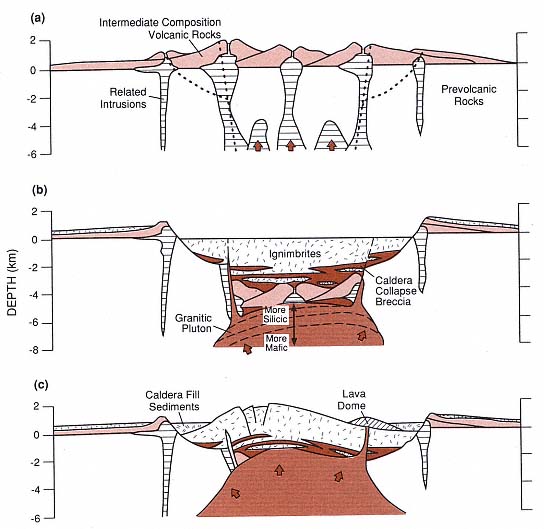
Fig. 4.4
The evolution of a large silicic caldera. (a) Volcanism before caldera collapse. Clusters of composite
cones develop over isolated, small plutons that eventually coalesce to form a large silicic magma
body or heat the shallow crust sufficiently to allow the buoyant rise of a large pluton. The site of
subsequent caldera collapse is marked by dotted lines. (b) Caldera structure immediately after
the eruption of ignimbrites and concurrent caldera collapse. Calderas contain thick tuff deposits
that are interbedded with megabreccias. Dashed lines approximate the compositional zones
developed within the pluton. (c) Caldera resurgence. Welded tuffs and other caldera deposits are
uplifted as a structural dome over the magma body. Postcaldera collapse volcanism and
sedimentation occur mostly along an annulus between the resurgent dome and caldera walls.
Hydrothermal systems develop within the caldera deposits and floor rocks, as well as along
extensional faults that cross the resurgent dome.
(Adapted from Lipman, 1984.)
but when ~20% of the total eruptive volume has been ejected, caldera collapse may be initiated (Smith, 1979). Druitt and Sparks (1984) proposed that when a small fraction of material has been erupted, the pressure within the magma chamber decreases rapidly to values less than that of the lithostatic pressure and the chamber roof begins to collapse catastrophically [parts (c) and (d) of Fig. 4.5].
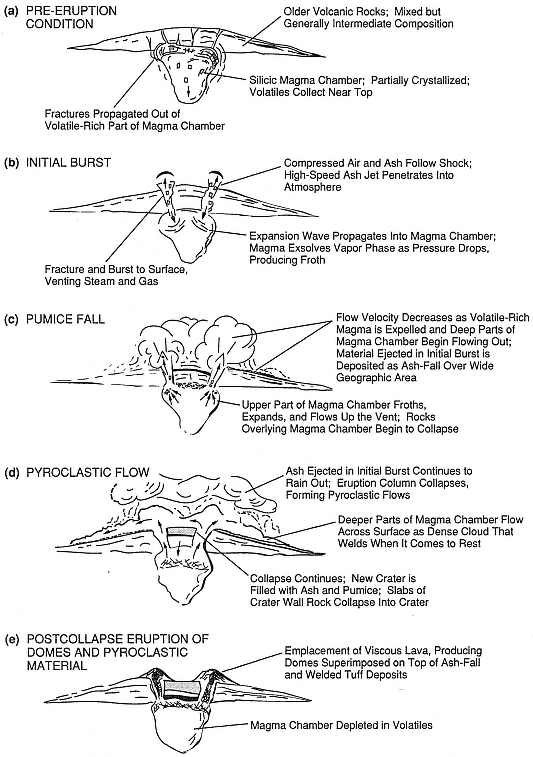
Fig. 4.5
Inferred stages of eruption and collapse of a large silicic magma chamber and caldera.
(After a drawing by T. McGetchin, 1976)
The rocks overlying a magma chamber roof collapse into the partly evacuated chamber and form new fracture systems, which approximately outline the magma body. Complete or piecemeal subsidence may occur along the fractures, creating ring faults with a concentric pattern. During this stage, eruptions may occur continuously or intermittently along the newly formed ring faults [(Fig. 4.5 (d)]. As blocks that make up the caldera roof begin to collapse, the ring faults may open widely and allow large quantities of pyroclastic material to erupt; these same roof blocks can rotate back into place, closing off the fractures and opening other fracture vents. Roof subsidence not only allows eruptions to occur over long sections of ring faults, but also may displace magma and drive it to the surface (Druitt and Sparks, 1984). It is usually during this stage of the eruption that the hotter but more volatile-poor ash and pumice are deposited around the caldera as pyroclastic flow deposits or ignimbrites, as shown in Fig. 4.6 (Self et al ., 1986; Hildreth and Mahood, 1986). Ignimbrite deposits, located around the periphery of a caldera, form plateaus that slope away from the source. These tuff deposits are usually thickest within and along the edges of the caldera, thinnest at the distal plateau margins, and generally absent on steep slopes. Details of facies changes within ignimbrites are discussed in Chapter 2 and by Fisher and Schmincke (1984).
Caldera collapse occurs during and not after an eruption—an important concept to keep in mind when examining caldera structure and seeking caldera-hosted geothermal resources. Perhaps as much as 50% of the erupted pyroclastic material collects within the caldera crater, especially in the largest calderas where many of the pyroclastic flows never surmount the crater wall; these tuff deposits are usually 1 to 3 km thick and can be as much as 5 km thick (Lipman, 1984, and personal communication). Because their depositional temperatures are 500 to 600°C, the rapidly deposited pumice and ash may be compacted, welded, and altered by remnant gases and heated groundwater. For every ignimbrite exposed around caldera margins, there is a texturally different (welded, devitrified, and perhaps hydrothermally altered)—but correlative—thick tuff sequence within the caldera. Table 4.1 presents the lithologic sequences commonly found in such caldera-fill deposits and correlative outflow deposits.
Figure 4.7 provides an example of intra-caldera ignimbrite deposits interbedded with breccias that formed when unstable caldera walls avalanched into the collapsing Lake City caldera (Lipman, 1975; 1984). Mesobreccias consist of concentrations of small lithic clasts interlayered with the middle and upper parts of the caldera-filling tuffs. Megabreccias are made up of clasts that are generally larger than an individual outcrop; they actually are intact slump blocks located near the bottom of the caldera filling (Lipman, 1975). The slumping that forms megabreccias may leave scalloped topographic caldera walls that extend outward from the ring faults for hundreds of meters or several kilometers. Megabreccia blocks occur at different stratigraphic horizons in a caldera fill, which suggests a piecemeal failure of steep caldera walls during collapse (Meyer, 1989). The slumping of large megabreccia blocks may make it difficult to map the actual caldera wall, as defined by ring faults; in many cases, the topographic caldera wall is located well outside the actual structural caldera. The lenslike deposits of caldera-collapse breccia act as heat sinks within the caldera-filling tuffs: they rapidly cool the adjacent hot ash deposits and locally limit the compaction and welding of glassy pyroclasts.
Near the caldera rim, outflow ignimbrites contain concentrations of lithic clasts called lag breccias (Druitt and Sparks, 1982; Druitt and Bacon, 1986). These lithic clast concentrations (shown in Fig. 4.8) may indicate episodes of caldera-wall collapse or vent widening during explosive eruptions. The ability to recognize caldera-collapse breccias and associated nonwelded tuffs within
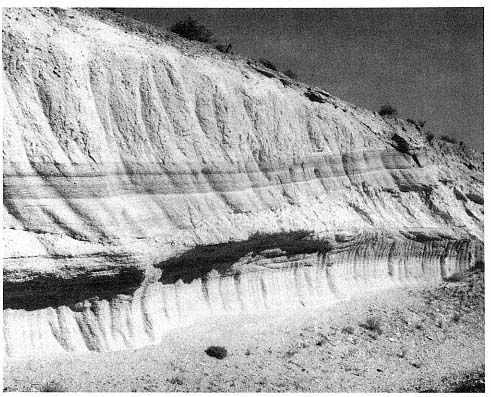
Fig. 4.6
Photograph of a pumice fall and ignimbrite deposit in the Bishop Tuff, Long Valley Caldera,
California. Interstratified surge and pumice fallout deposits are
overlain by a massive ignimbrite.
drillholes and in surface outcrops is important for identifying hydrothermal reservoirs within the calderas because these deposits may be more permeable than the densely welded tuffs that enclose them.