
Focal Mechanisms
As has been discussed in several papers (for example, Stauder, 1973; Malgrange and Madariaga, 1983; Astiz and Kanamori, 1986), focal mechanisms developed for large earthquakes in Chile with worldwide data show the main features of the Nazca–South American plates convergence process. These are: the occurrence of low-angle thrust faulting at the interplate boundary, tensional normal faulting for intermediate depth earthquakes with occasional compressional thrust faulting after an event at this depth, and compressional reverse faulting for deep events. The data observed for the 1985 central Chile earthquake are consistent with this characterization (see fig. 4).
It will now be shown, however, that focal mechanisms for many small earthquakes in this same area show quite a different and more complex behavior, which may indicate discontinuities in the lithosphere. Using the central Chile seismograph network, Acevedo (1985) obtained 103 focal mechanism solutions for 1981 earthquakes. The results of this work are summerized in figure 7. Many conclusions have been drawn from these data, but only two are discussed here.
The first conclusion is that, on the average, the slip direction during earthquakes north of 33°S latitude is east-west, while south of this latitude it is S70°E. It has been noted before (Eisenberg et al., 1972; Isacks and Barazangi, 1977; Comet et al., 1986; Pardo et al., 1986) that 33°S marks a latitude of discontinuity in Chilean tectonics as demonstrated by three related features: the absence of Quaternary volcanism between 33ºS and 26.5°S latitutes, the beginning of Chile's central valley at 33°S, and the bending of the subducted Nazca plate between latitudes 26°S and 33ºS. Recent work now indicates that south of 33°S the lithosphere seems to be moving in a different direction, which is also shown in the bending of the trench at that latitude. Again, both the east-west and the S70°E slip directions are different from the direction of Nazca–South American plate convergence (N70°E as shown in fig. 7) im-
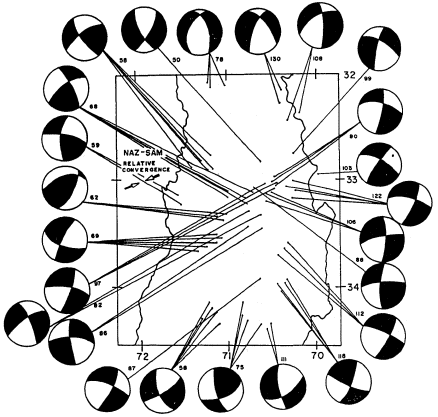
Figure 7
Composite focal mechanisms for events of 1981 with depths between 45 and
130 km located with the central Chile local network. Depth of focus is indicated
for each set of earthquakes used in the composite solution. Direction of relative
convergence of the Nazca and South American plates (N70°E) is obtained
from the fossil magnetic reversals observed over the ocean floor.
plied by the pattern of paleomagnetic pole reversals observed over the ocean floor.
The second conclusion that can be drawn from the focal-mechanism data of figure 7 is that many of these small earthquakes (whose depths turn out to be in the 45–130 km range) show a strike-slip character. The preferred fault plane for these events can be assumed to be in the east-west direction. If these strike-slip mechanisms have been accurately determined, it means that the subducted Nazca plate is not only moving in a different direction south of 33°S but is also suffering internal breakage or flexure in a way implied by the rotation of the subduction trench at that latitude.