
Five—
The Paradigm Applied:
On Motion , Problems 1, 2, and 3
Theorem 3 in Newton's tract On Motion provides the basic paradigm for solutions to direct problems: Given the orbit and the location of the force center, find the force. As Newton put it, "specifically the solid SP 2 × QT2 / QR must be computed." He concluded Theorem 3 with the statement, "We shall give examples of this point in the following problems." In this tract, he elected to solve three examples of direct problems. The most important example was Problem 3, the Kepler problem: find the centripetal force required to maintain planetary elliptical motion about a center of force located at the focus of the ellipse. Kepler had demonstrated that a planet P moves in an elliptical orbit about the sun S located at a focal point of the ellipse, and in Theorem 3 Newton demonstrated that the nature of the force required to maintain that motion is inversely proportional to the square of the distance SP , which is the mathematical statement of the law of universal gravitation. Problem 3 clearly has important physical significance. Preliminary to the solution of that very important problem, however, Newton presented the solutions to two other direct problems: find the force that generates (1) circular motion with a center of force on the circumference of the circle and (2) elliptical motion with a center of force at the center of the ellipse (see fig. 5.1). Problems 1 and 2, however, have no clear physical significance, that is, they have no direct application to physical phenomena such as Problem 3 does to the motion of planets.[1] They appear as relatively simple preliminary mathematical exercises in the application of Theorem 3, and they serve only to prepare the reader for the more complex solution that follows them in Problem 3. In an attempt to make clear the general method employed by Newton in applying Theorem 3 to these specific examples, I repeat the suggestion I
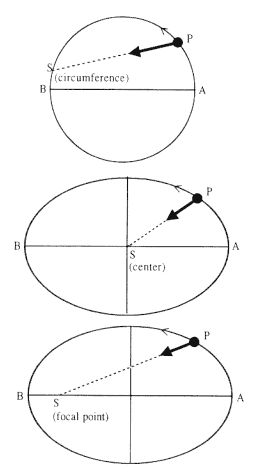
Figure 5.1
In the three direct problems analyzed in On Motion ,
a body P moves on a given path APB about a
given center of force S : (1) circular
path/circumference, (2) elliptical path/center, and
(3) elliptical path/focus.
made in chapter 2 that Newton's exemplar solutions for direct problems be distilled into the following general pattern of analysis:
Step 1. The Diagram . A drawing is provided that identifies the specific orbit corresponding to the general orbit QPA in Theorem 3. The immediate position P of the body is located, and the line of force SP is constructed that connects the body P with the force center S . Then the future position Q of the body is located, and the two lines QR and QT are constructed. Thus, all three elements of the linear dynamics ratio QR / QT2 × SP2 are identified in the diagram.
Step 2. The Analysis . Given the full diagram, Newton begins the search for the geometric relationships that will reduce the discriminate ratio QR / QT2 to a form in which it is expressed as a function of the distance SP alone. It is in this search that Newton displays his command of geometry, conic sections, and mathematical insight; and it is here that the reader must be careful not to lose sight of the general structure of the dynamics in the flurry of mathematical details.
Step 3. The Limit . The general theorem holds only in the limit as the future point Q approaches the immediate point P . Thus, Newton need not search for exact geometric relationships, but only for those that will reduce to the desired functional form in that limit as the point Q approaches the point P . Such relationships will eventually be sought out by others employing the methods of the calculus, but here Newton employed his unique geometric/limiting technique that serves in its stead.
I divide the following detailed discussion of each of the three problems into the three steps just outlined. No such explicit formal division exists in Newton's tract, but I offer it here as a guide for the first-time reader.
Problem 1—
A Circular Orbit with the Center of Force on the Circumference of the Circle
As the first example of the application of the paradigm of Theorem 3 to the solution of direct problems, Newton determined the nature of the force required to maintain a circular orbit with the center of force on the circumference of the circle. This problem had no obvious physical application, but it is the simplest of the three examples he presented and thus serves the reader in understanding the more difficult examples to follow.
Problem 1. A body orbits on the circumference of a circle; there is required the law of centripetal force being directed to some point on the circumference .
Step 1—
The Diagram
Figure 5.2 is based on the diagram that accompanies this problem in Newton's manuscript. The dynamic elements of Theorem 3 are evident in this figure: the projected tangential displacement PR , the actual circular arc PQ , and the deviation QR . The center of force S is located on the circumference of the circular arc SQPA . The chord QL and the normal QT are also elements in the analysis of the force.
[1-A] Let SQPA be the circumference of a circle , S the center of centripetal force , P a body carried on the circumference, and Q a nearby position into which it will be moved .
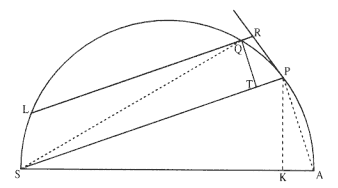
Figure 5.2
Based on Newton's diagram for Problem 1. A body P moves
in a circular orbit APQLS about a center of force S located
on the circumference of the circle.
The general curve QPA from Theorem 3 appears here as a portion of the specific circular path SQPA of Problem 1.
[1-B] To the diameter SA and to SP drop the perpendiculars PK and QT,
The line QT , which is constructed perpendicular to the line SP , is one of the two elements in the discriminate ratio QR / QT2 from Theorem 3, which is needed to express the force law in terms of the radius SP .
[1-C] and through Q draw LR parallel to SP, reaching the circle at L and the tangent PR at R.
The second element of the determinate ratio QR and the chord of the circle QL are defined.
Step 2—
The Analysis
In what follows, Newton expressed the discriminate ratio QR / QT2 in terms of the radius SP and the given constant diameter of the circle SA .
1. He first demonstrated from similar triangles that SA2 / SP2 = RP 2 / QT2 .
2. Then he called upon a proposition from Euclid to show that RP2 = QR × LR .
3. Finally, he argued that the line LR can be replaced by the line SP in the limit as point Q approaches point P .
Thus, SA2 / SP2 = RP2 / QT 2 = (QR × LR ) / QT2 = (QR × SP ) / QT2 , which can be solved for the discriminate ratio (i.e., QR / QT2 = SA 2 / SP3 ). When that is done, the linear dynamics ratio QR / (QT2 × SP2 ), and hence the force F , can be expressed in terms of SP .
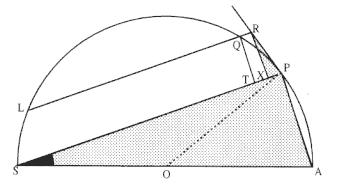
Figure 5.3A
A revised diagram for Problem 1. The perpendicular RX and
the radius OP are added.
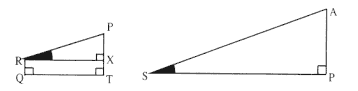
Figure 5.3B
The triangle RPX is similar to the triangle SAP .
1. From Theorem 3, FµQR / (QT2 × SP2 ) = (QR / QT2 ) (1 / SP2 ).
2. Substituting for QR / QT2 from above, Fµ (SA 2 / SP3 ) (1 / SP2 ) = SA2 / SP 5 .
3. Because SA is the given constant diameter of the circle, the force is inversely proportional to the fifth power of the radius, that is, Fµ 1/SP5 .
Thus, the proportional dependence of the force F on SP is known and so the solution to Problem 1 is given (i.e., Fµ 1/SP5 ). What follows is Newton's detailed analysis for this problem.
[2-D] There will be RP2 (that is , QR × LR) to QT2as SA2to SP2 .
First, one must demonstrate that RP2 / QT 2 = SA2 / SP2 . See figure 5.3A for a revised diagram[2] that defines another perpendicular to SP at a point X . From the similar triangles RXP and SPA (see above) one has RP / RX = SA /SP , and from the parallelogram RPXQ one has RX = QT . Thus, RP /QT = SA / SP . Newton expresses the ratio RP2 / QT2 = SA 2 / SP2 as squares because QT2 is needed in the discriminate ratio, QR / QT2 .
Similarity: (1) Angle OPR = 90° because OP is a radius of the circle and PR is the tangent to the circle. Angle PXR = 90° by construction. Thus,
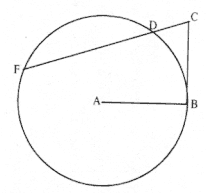
Figure 5.4A
From Proposition 36 of Book 3 of
Euclid's Elements : CF / CB = /CB / CD .
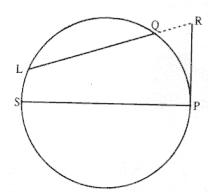
Figure 5.4B
Thus, RL / RP = RP / QR or
RP2 = QR × RL as required in Problem 1.
angle SPR is the complement of both angles OPS and PRX and thus angles OPS and PRX are equal.
(2) Angle PSO = angle OPS because OS and OP are both radii of the circle. Thus, angle PSO = angle PRX .
(3) Angle APS = 90° because PS and PA are chords of the circle terminating on the diameter SA . Thus, triangles RXP and SPA have all angles equal and are thus similar. Note in figure 5.3B that line RX equals line QT and thus the ratio RP /RX = RP /QT = SA /SP as required above.
Second, one must demonstrate that RP2 = QR × LR , a relationship that introduces the deviation QR into the analysis. Newton obtained this result from Proposition 36 of Book 3 of Euclid's Elements to relate the following lines (see fig. 5.4A): CB (the tangent), CD (the deviation), and CF (the chord plus the deviation). Euclid's basic relationship is given as CF /CB = CB /CD , or BC2 = CD × CF . Figure 5.4B extends Euclid's relationship to the diagram for Problem 1, where CB = RP , CD = QR , and CF = LR . Thus, QR / RP = RP / LR , or RP 2 = QR × LR , as required above.
[2-E] Therefore (QR × LR) × (SP2 / SA2 ) = QT2 .
The first result from [2-D] gives RP2 / QT 2 = SA2 / SP2 or QT2 = (SP2 / SA 2 ) RP2 . The second result from [2-D] gives RP 2 = (QR × LR ). Substituting the second value for RP2 into the first expression gives the desired result (i.e., QT2 = (QR × LR ) (SP2 / SA2 )). Thus, Newton has obtained an expression relating the two elements QT2 and QR of the discriminate ratio QR /QT2 , which is required in the linear dynamics ratio QR /(QT2 × SP2 ) to measure the force.
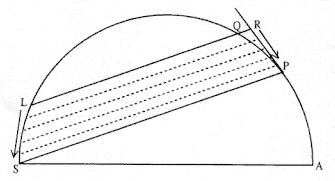
Figure 5.5
As the point Q approaches the point P , the line segment LR
approaches the line segment SP .
Step 3—
The Limit
[3-F] Multiply these equals by SP2 / QR, and, with the points P and Q coalescing, let SP be written in place of LR. Thus , SP5 / SA2 = QT2 × SP2 / QR.
From [2-E], QT2 = (QR × LR ) (SP2 / SA 2 ). The linear dynamics ratio can be obtained if both sides of the expression above are multiplied by SP2 / QR (i.e., QT2 × SP2 / QR = (QR × LR ) (SP2 / SA2 ) (SP2 / QR )) which, upon canceling QR and combining powers of SP , reduces to QT2 × SP2 / QR = LR × SP4 / SA2 . In the limit, "with the points P and Q coalescing," Q ®P , then LR ®SP (see fig. 5.5). When SP is substituted for LR , the expression above reduces to QT2 × SP2 / QR = LR × SP4 / SA2® SP5 / SA2 , or SP5 / SA 2 = QT2 × SP2 / QR as required above.
Conclusion
[3-G] Therefore the centripetal force is reciprocally as SP5 / SA2 , that is (because SA2is given ), as the fifth power of the distance SP. Which was to be proven .
Or, Fµ 1/SP5 . The centripetal force F is given by the linear dynamics ratio QR / (SP2 × QT2 ), which from [3-F] is equal to (SA2 / SP5 ). Since SA is the given constant diameter of the circle, the force F is inversely proportional to the fifth power of the distance SP and the solution to Problem 1 is given (i.e., F µ 1/SP5 ).
Scholium
In this case and in other similar cases, it must be understood that after the body reaches the center S, it will no longer return to its orbit, but it will depart along the tangent.
Recall that the force center was located on the circumference of the circle and therefore the body will eventually pass through the force center. In such a singular situation both the force and speed would increase without limit and, as Newton states, the body would shoot off along the tangent. The statement is not carried through to the 1687 edition of the Principia .
In a spiral which cuts all the radii at a given angle, the centripetal force being directed to the beginning of the spiral is reciprocally in the tripled ratio of the distance, but at that beginning no straight line in a fixed position touches the spiral.
A full solution to the problem of the equiangular spiral appears as Proposition 9 in the 1687 edition of the Principia with the force center at the pole (or "beginning") of the spiral. At the pole, no tangent can be defined, but elsewhere the force is proportional to the inverse cube of the distance SP .
Newton has thus demonstrated that the centripetal force required to maintain a circular orbit with a center of force located on the circumference of that circle is inversely proportional to the fifth power of the distance SP . As has been previously noted, such an orbit with such a center of force does not serve any particular physical situation. The example is intended purely as a demonstration of how the general paradigm in Theorem 3 can be applied to a very simple problem. The analysis requires only one set of similar triangles and a single reference to a proposition from Euclid. (In contrast, the analysis for the Kepler problem in Problem 3 has some sixteen sub-steps.) The particular example of Problem 1 is carried forward to the 1687 edition of the Principia in much the same form as given in the tract On Motion .
Problem 2—
An Elliptical Orbit with the Center of Force at the Center of the Ellipse
As the second example of the application of the paradigm of Theorem 3 to direct problems, Newton determined the nature of the centripetal force required to maintain an elliptical orbit with the force center located at the center of the ellipse. Figure 5.6 is based on the diagram that Newton provided for this problem. As in the previous problem, the dynamic elements of Theorem 3 can be identified: the projected tangential path PR , the elliptical arc PQ , and the deviation QR , here constructed correctly as being parallel to the line of force PC . I break Newton's statement of the problem and its solution down into three steps as outlined earlier and provide a line-by-line commentary. I have not given a discussion of Problem 2 as detailed as that in the preceding problem or as detailed as that I shall give in the distinguished Kepler problem (Problem 3). Readers may
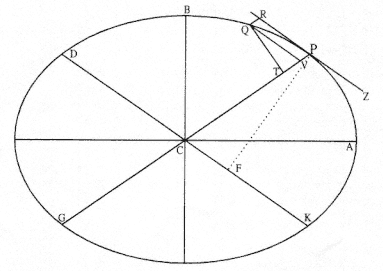
Figure 5.6
Based on Newton's diagram for Problem 2. A body P moves on an
elliptical orbit APQB about a center of force C located at the center of the
ellipse.
want simply to follow the flow of the solution to Problem 2 and reserve their energy for the solution to Problem 3.
Problem 2. A body orbits on a classical ellipse; there is required the law of centripetal force being directed to the center of the ellipse .
Step 1—
The Diagram
[Problem 2] Let CA and CB be the semi-axes of the ellipse; GP and DK conjugate diameters; PF and QT perpendiculars to these diameters; QV ordinate to the diameter GP; and QVPR a parallelogram .
[1-A] Let CA and CB be the semi-axes of the ellipse;
The semi-major axis CA and the semi-minor axis CB are constructed perpendicular to each other (see fig. 5.6). Note also that the conjugate diameters GP and DK (defined next) are not, in general, mutually perpendicular.
[1-B] GP and DK conjugate diameters;
The transverse diameter GP is constructed from the point P through the center C of the ellipse to the point G opposite point P (see fig. 5.6). The conjugate diameter DK is constructed parallel to the tangent PR , and it passes through the center C . The diameters GP and DK are said to be a
conjugal (united) pair. Many properties of the ellipse can be expressed in terms of these conjugate diameters.
[1-C] PF and QT perpendiculars to these diameters;
PF is normal to DK and will be used in the calculation of the circumscribed area to the ellipse given in Lemma 1. The line QT is constructed perpendicular to the diameter GP and will be used in the discriminate ratio QR / QT2 (see fig. 5.7).
[1-D] QV ordinate to the diameter GP;
QV is constructed parallel to the tangent PR and hence is parallel to the conjugate diameter DK and furthermore is said to be ordinate to the transverse diameter GP (see fig. 5.7).
[1-E] and QVPR a parallelogram .
The deviation QR must be constructed parallel to the line of force PC , and is thus parallel to the conjugate diameter PV . The line segment QV is parallel to the tangent RP from [1-D]. Thus, QVPR is a parallelogram (see fig. 5.7).
Step 2—
The Analysis
In the analysis to follow, Newton expresses the discriminate ratio QR / QT2 in terms of the given constant circumscribed area of the ellipse (BC × AC ) and the radius PC . Note that the particular radius PC from Problem 2 is equal to the general radius SP from Theorem 3. When the discriminate ratio was determined in terms of PC , then the linear dynamics ratio was also expressed in terms of PC . Thus, the proportional dependence of the force F on PC was known, and so the direct problem was solved (F µQR / (QT 2 × PC2 )).
[2-A] After these have been constructed, there will be [from the Conics] PV × VG to QV2as PC2to CD2andQV2 / QT 2 = PC2 / PF2 , and on combining these proportions PV × VG / QT2 = PC2 / (CD2 × PF2 )/PC2 .
Find QT2 : An expression for the line QT is obtained from the similarity of triangles QTV and PFC (i.e., QT / QV = PF / PC or QT2 = QV2 (PF2 / PC 2 )). Then, a relationship from Apollonius (i.e., PV × VG / QV2 = PC2 / CD2 or QV2 = (PV × VG ) (CD2 / PC2 )) is used to eliminate QV2 from the expression for QT2 (i.e., QT2 = (PV × VG ) (PC2 / CD2 ) (PC2 / PF 2 )).
[2-B] Write QR in place of PV and BC × CA in place of CD × PF,
Find QR : The relationship PV = QR (from the parallelogram QRPV ) is used to introduce the deviation QR into the expression for QT 2 and to obtain
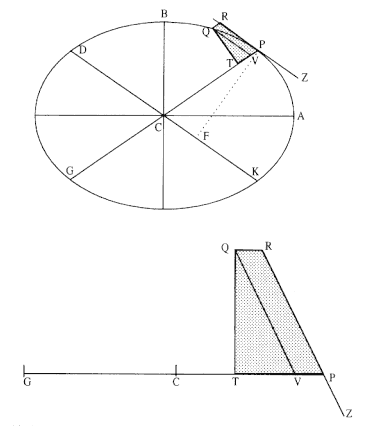
Figure 5.7
The bottom figure is abstracted from the full figure above. The line QT
is constructed perpendicular to the conjugate diameter GP , and the line
QV is constructed parallel to the tangent ZPR .
the following expression: QR / QT2 = PC 4 / (VG ) (CD × PF )2 , where (CD × PF ) is a constant equal to area (CA × CB ).
Step 3—
The Limit
[3-A] and in addition (with the points P and Q coalescing ) 2PC in place of VG, and, when the ends and middles are multiplied into each other, there will result QT2 × PC2 / QR = 2BC2 × CA2 / PC.
Find QR /(QT2 × PC2 ): Finally, when the point Q approached the point P , then the line VG approached the value 2PC , and the expression for the discriminate ratio becomes QR / QT2 = PC 3 / 2(CA × CB )2 .
[3-B] The centripetal force is therefore reciprocally as 2BC2 × CA2 / PC, that is (because 2BC2 × CA2is given ), as 1/PC, that is, directly as the distance PC. Which was to be found .
Dividing both sides by PC 2 gives the linear dynamics ratio QR / (QT2 × PC2 ) = PC / 2(CA × CB )2 , which, because the area (CA × CB ) is a constant, gives the ratio as directly proportional to PC .
Conclusion
From Theorem 3, Fµ QR / (QT2 × PC2 ) µPC , or the centripetal force F required to maintain elliptical motion about a center of force located at the center C of the ellipse is directly proportional to the distance PC , which is the solution for Problem 2. Newton has thus demonstrated that the centripetal force required to maintain an elliptical orbit about a center of force located at the center of the ellipse is directly proportional to the first power of the distance PC . As noted earlier, such an orbit with such a center of force did not represent any particular physical situation. Newton intended this example purely as a demonstration of how the general paradigm in Theorem 3 was to be applied to yet another direct problem. The analysis for Problem 2 is more complicated than that for Problem 1, but it is relatively simpler than that for Problem 3. The particular example of Problem 2 is carried forward to the 1687 edition of the Principia in much the same form as given above for the tract On Motion .
Problem 3—
An Elliptical Orbit with the Center of Force at a Focus of the Ellipse
The challenge set forth in Problem 3 is a distinguished one: find the solution to the "Problem of the Planets." Kepler had demonstrated in 1609 that Mars moved in an elliptical orbit with the sun at a focus. The question that remained to be answered, however, was the mathematical nature of the force required to maintain that motion. In On Motion , the solution follows the two preliminary examples without any fanfare. In the Principia , however, Newton called attention to "the dignity of the problem and its use in what follows" by separating Problem 3 from the preceding direct problems and giving it a place of honor at the beginning of a new section. It is the keystone of both works in terms of the dignity of the problem and in the degree of mathematical difficulty.
As in all the previous problems, Newton's diagram identifies the dynamic elements to be employed in the demonstration (see fig. 5.8 in the following statement of the problem): the projected tangential path PR , the elliptical arc PQ , and the deviation QR from the point R on the tangential path to the point Q on the elliptical arc. Note in this diagram that
the deviation QR is constructed parallel to the line of force SP , which is directed toward the focus S , and that the line segment QT is constructed perpendicular to SP . The challenge for this problem is, as it was for the two previous problems, to express the discriminate ratio of the force QR / QT2 in terms of the radius SP and / or constants of the orbit. The final expression of the solution appears deceptively simple: the discriminate ratio QR / QT 2 is found to be proportional to the reciprocal of the constant latus rectum L of the ellipse (where L = 2BC / AC ), and therefore the force is proportional to the inverse square of the distance, 1/SP2 .

where L is a constant of the ellipse. Thus, once it is demonstrated that the discriminate ratio QR / QT2 is a constant for the elliptical/focal motion, then the problem is solved. That initial demonstration, however, requires a number of steps, and the reader must remember that the goal is to demonstrate that the discriminate ratio QR / QT2 is a constant. Once that goal has been achieved, it is a simple matter to determine from Theorem 3 that the force is inversely proportional to the inverse square of the distance SP .
I have divided Step 2, the analysis, into some sixteen sub-steps between line [2-B] and line [2-Q]. The journey is not for the faint of heart; but then if it had not been challenging there would have been no reward for Newton. In honor of the dignity of the problem, I give the statement of the entire proposition and follow it with a line-by-line analysis. I suggest reading the full statement to get an overview of the problem without attempting to justify each point and then following the details of the proof in the line-by-line analysis.
Problem 3. A body orbits on an ellipse; there is required the law of centripetal force directed to a focus of the ellipse .
Let S be a focus of the ellipse above. Draw SP cutting the diameter of the ellipse DK at E. It is clear that EP is equal to the semi-major axis AC, seeing that, when from the other focus H of the ellipse the line HI is drawn parallel to CE, because CS and CH are equal , ES and EI are equal, and hence EP becomes half the sum of PS and PI, that is, of PS and PH which are conjointly equal to the total axis 2AC. [See fig. 5.8.]
Let drop the perpendicular QT to SP, and, after calling the principal latus rectum (or 2BC2 / AC) of the ellipse L, there will be
L × QR to L × PV as QR to PV, that is, as PE (or AC) to PC;
and L × PV to GV × VP as L to GV;
and GV × VP to QV2as CP2to CD2 ;
and QV2to QX2as, say , M to N;
and QX2is to QT2as EP2to PF2 , that is, as CA2to PF2 , or as CD2to CB2 .
And when all these ratios are combined ,
L × QR / QT2will be equal to (AC / PC) × (L / GV) × (CP2 / CD2 ) × (CD2 / CB2 ),
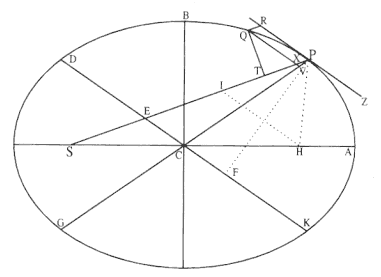
Figure 5.8
Based on Newton's diagram for Problem 3. A body P moves in an
elliptical orbit APQB about a center of force S located at a focus of the
ellipse.
that is, as AC × L (or 2BC2 ) / (PC × GV) × (CP2 / CB2 ) × (M / N) or as (2PC / GV) × (M / N).
But with the points P and Q coalescing, the ratios 2PC / GV and M / N become equal [and approach unity ], and therefore the combined ratio of these L × QR / QT2 [equals unity (i.e., L = QT2 / QR)]. Multiply each part by SP2 / QR and there will result L × SP2 = SP2 × QT2 / QR.
Therefore the centripetal force is reciprocally as L × SP2 , that is , [reciprocally ] in the doubled ratio of the distance. Which was to be proven .
The concluding statement of Problem 3 sets forth the mathematical nature of the gravitational force; that is, it is reciprocally as the square of the distance SP between the sun and the planet. It is this result that provided the answer to the problem of the planets. I now give a detailed analysis of each portion of Newton's demonstration.
Step 1—
The Diagram
[1-A] Let S be a focus of the ellipse above. Draw SP cutting the diameter of the ellipse DK at E.
The body is located at a general point P , and the center of force is located at a specific point S , the focus of the ellipse (see fig. 5.8). The diameter DK is one of the conjugate diameters to the point P , and it is drawn parallel to the tangent PR and through point C , the center of the ellipse. The
intersection of the diameter DK with the line of force SP defines the point E . Note that the diameter PG is not perpendicular to the diameter DK but that the line segment PF is constructed perpendicular to the diameter DK .[3]
Step 2—
The Analysis ([2-B] to [2-Q])
In Problem 3, as in the solutions to the two previous direct problems, Newton expressed the discriminate ratio QR / QT2 in terms of the radius SP and / or constants of the figure. When the discriminate ratio was determined in terms of SP , then the linear dynamics ratio QR / QT2 × SP2 was also expressed in terms of SP . So, the proportional dependence of the force F , given by the linear dynamics ratio, was also known, and the direct Kepler problem was solved.
As an overview for the reader, I summarize Newton's determination of the discriminate ratio QR / QT2 here in an effort to provide a general guide to the multiple details in the analysis.
Find QR : A relationship for the deviation QR is obtained from the similarity of triangles PXV and PEC , where QR = PX by construction (i.e., PE / PC = PX / PV = QR / PV or QR = PV (PE / PC )). Newton also demonstrated that the line PE (defined in fig. 5.8) is equal to the semi-major axis AC (a useful relationship for an ellipse that was not found in the standard works on conics). Thus, QR can be written as PV (AC / PC ). From the same proposition of Apollonius's used in the solution of Problem 2, Newton obtained an expression for PV (i.e., PV × VG / QV2 = PC 2 / DC2 or PV = (QV2 / GV) (PC2 / DC2 )), and he used it to eliminate PV from the expression for QR (i.e., QR = (QV2 / GV ) (PC2 / DC2 ) (AC / PC )).
Find QT 2 : From the similarity of triangles EPF and XQT , he obtained an expression for the second element of the discriminate ratio QT2 (i.e., QT / QX = PF / PE or QT2 = QX 2 (PF2 / AC2 ), where as above PE = AC ). From Euclid's relationship for circumscribed areas (also used in the solution of Problem 2) one has PF / AC = BC / DC , and thus QT2 = QX2 (BC 2 / DC2 ).
Find QR / QT2 : The discriminate ratio QR / QT2 can then be written from QR = (QV2 / GV ) (PC2 / DC2 ) (AC / PC ) and QT2 = QX2 (BC 2 / DC2 ) or QR / QT2 = (QV2 / QX 2 ) (PC / GV ) (AC / BC2 ). Given the definition of the constant latus rectum L = 2BC2 / AC , the discriminate ratio becomes (QV2 / QX2 ) (PC / GV ) (2 / L ).
In the limit as the point Q approaches the point P , the line QV approaches the line QX , and the line GV approaches a value of 2PC . Thus, the discriminate ratio QR / QT2 approaches 1/L , and the linear dynamics ratio QR /
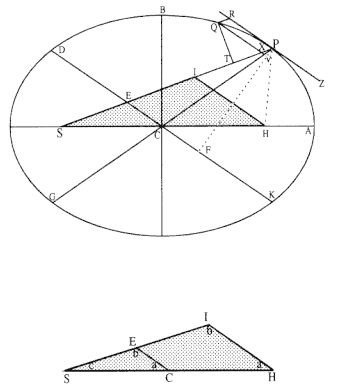
Figure 5.9
The triangle SIH below is abstracted from the shaded area of the
ellipse above. Line EC is parallel to line IH and thus triangles SEC
and SIH are similar.
QT2 × SP2 approaches 1 / (L × SP2 ). The force, therefore, is inversely proportional to the square of the distance SP , as was to be demonstrated. What follows is a detailed analysis of Newton's demonstration of the solution.
[2-B] It is clear that EP is equal to the semi-major axis AC,
At least it will be "clear" that EP = AC after Newton's demonstration in the next three steps ([2-C] to [2-E]). This particular relationship for an ellipse, EP = AC , is not found in the standard works on conic sections and appears to be original with Newton.[4]
[2-C] seeing that, when from the other focus H of the ellipse the line HI is drawn parallel to CE, because CS and CH are equal , ES and EI are equal .
Or, ES = EI . The lines CS and CH are equal because they both locate a focus (S or H ) relative to the center C . The equality of ES and EI follows from the similarity of triangles SEC and SIH and the equality of line segments CS and CH (see fig. 5.9).
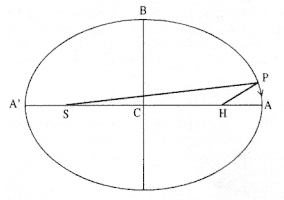
Figure 5.10
The sum (SP + PH ) is a constant for any given ellipse,
and when the point P goes to A that sum is equal to
2AC .
Similarity: HI was constructed parallel to CE , and these two parallel lines are cut by the two transversals SCH and SEI , as demonstrated in figure 5.9 by the small diagram abstracted from the full diagram. Hence, all the angles a, b , and c in triangles SEC and SIH are equal and thus the triangles are similar.
Because the triangles are similar, C bisects SH , then E bisects SI , and thus ES = EI , as was to be demonstrated.
[2-D] and hence EP becomes half the sum of PS and PI,
Or, EP = 1/2(PS + PI ). From figure 5.9, PS = EP + ES = EP + EI (because ES = EI from [2-C]). Moreover, PS + PI = (EP + EI ) + PI = EP + (EI + PI ) = 2EP . Thus, EP = 1/2(PS + PI ).
[2-E] that is, of PS and PH which are conjointly equal to the total axis 2AC.
Or, 2EP = (PS + PI ) = (PS + PH ) = 2AC . From the properties of conics (Apollonius, Proposition 48, Book 3)[5] the angles made by the tangent and focal lines (i.e., angles RPS and APH ) are equal, and since the line IH is constructed parallel to the tangent RPZ , the line PI = PH . An ellipse is a curve such that the sum of the distances from two fixed points (the foci) to a general point is given (i.e., the sum (PS + PH ) is a constant). When the general point P is on the major axis A (see fig. 5.10) then the sum (PS + PH ) equals the sum (AS + AH ) equals (2AC ) because AH = A' S . Thus, (PS + PH ) = 2AC . Therefore, from [2-D] 2EP = (PS + PI ) = (PS + PH ) = 2AC , or "clearly" EP = AC , as was to be demonstrated in [2-B].
[2-F] Let drop the perpendicular QT to SP, and, after calling the principal latus rectum (or 2BC2 / AC) of the ellipse L,
In [2-F], Newton calls upon the Apollonian definition of the latus rectum L , which states that the latus rectum L is in the same ratio to the minor diameter 2BC as the minor diameter 2BC is to the major diameter 2AC (i.e., L : 2BC :: 2BC : 2AC or L / 2BC = 2BC / 2AC ) or L = 2BC2 / AC as given above.
[2-G] there will be L × QR to L × PV as QR to PV,
The deviation QR is introduced in the format (L × QR ) / (L × PV ) = (QR ) / (PV ), which will be extended next. Given (QR ) / (PV ), then simply multiply by (L / L ), which can be written as (L / L ) (QR / PV ) = (L × QR ) / (L × PV ) = (QR ) / (PV ).
[2-H] that is, as PE (or AC) to PC;
Or, L (QR ) / L (PV ) = AC / PC . The expression for the deviation QR is extended. Triangles PEC and PXV are similar because XV and EC are parallel lines (see fig. 5.11). Thus, from the ratio of sides of the similar triangles, PX /PV = PE / PC . Moreover, PX = QR because QRPX is a parallelogram, and PE = AC , as demonstrated in [2-E]. Therefore, the ratio of sides can be written as QR / PV = AC / PC . Thus, from this result and [2-H], one obtains L (QR ) / L (PV ) = AC / PC , as required.
[2-I] and L × PV to GV × VP as L to GV
The element PV is introduced in a similar format to that employed to introduce QR in [2-G]. Given L / GV , simply multiply by PV / PV , which can be written as (PV / PV ) (L / GV ) = (L × PV ) / (GV × VP ) = L / GV .
[2-J] and GV × VP to QV2as CP2to CD2 ;
Or, GV × VP / QV2 = PC 2 / DC2 . This property of an ellipse will be used to eliminate PV from the expression for QR . The particular reference is to Proposition 15 of Book 1 of Apollonius's Conics , in which it is demonstrated that any chord parallel to a diameter of an ellipse is bisected by the conjugate diameter and, moreover, its square is equal to the product of the portions of the conjugate diameter. In figure 5.12, if the chord is given by QVQ ' and the conjugate diameter by PVG , then (PV × VG ) = (QV × VQ '), where QV = VQ '. The same relationship holds for the chord DK, that is (DC × CK ) = (BC × CG ), where DC = CK and BC = CG . Thus, the ratio PV × VG / QV2 about point V is equal to the ratio PC2 / CD2 about point C , as required above.
[2-K] and QV2to QX2as, say , M to N;
The ratio M / N is simply a definition of the ratio of QV / QX , a step that Newton eliminates in the 1687 edition of the Principia .
[2-L] and QX2is to QT2as EP2to PF2 ,
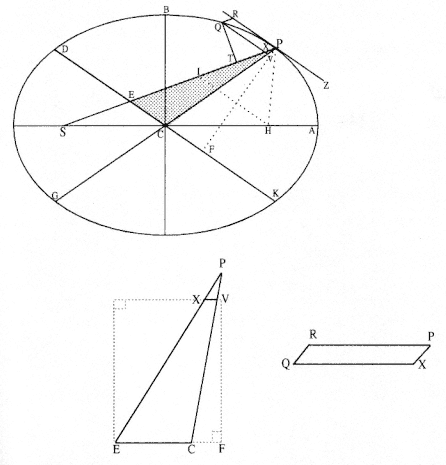
Figure 5.11
The shaded area CEP from the ellipse above is abstracted as the similar triangles
PXV and BEC below. The parallelogram QRPX from the ellipse is shown enlarged
below.
The second element of the discriminate ratio QT2 is now introduced. Because triangle EPF is similar to triangle XQT (see fig. 5.13), the ratio of similar sides gives the ratio QX / QT = EP / PF .
Similarity: Lines QX and EF are parallel lines cut by the transversal EP , as demonstrated in the small drawing abstracted from the full drawing in figure 5.13. Thus, angles PEF and QXT are equal, as are the right angles EFP and XQT . Thus, all the angles of triangles EPF and XQT are equal and the triangles are similar.
Thus, QX / QT = EP / PF and as given above, QX2 / QT2 = EP2 / PF 2 .
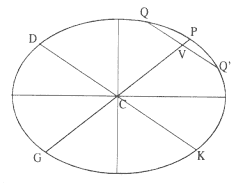
Figure 5.12
The diameter PG bisects the chords QQ ' and
DK . From Proposition 15 of Book 1 of
Apollonius's Conics , the ratio of PV × VG / QV2
is equal to the ratio PC2 / DC2 .
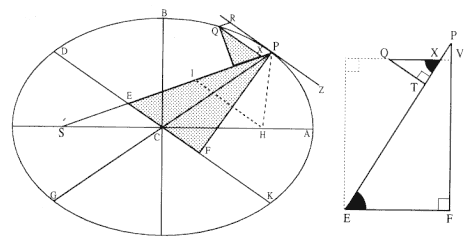
Figure 5.13
The shaded area in the ellipse is abstracted as the triangles EPF and XQT . Since the lines
QX and EF are parallel, the triangles are similar.
[2-M] that is, as CA2to PF2 , or as CD2to CB2 . [Finally, that is , QX2to QT2as CD2to CB2 .]
From [2-B] or [2-E], EP = CA , thus EP / PF = CA / PF . Also, from Lemma 1, area 4(CA ) (CB ) = area 4(CD ) (PF ) (see fig. 5.14), or CA / PF = CD / CB . Thus, from [2-L] QX / QT = EP / PF = CA / PF = CD /CB , which can be written in the square as in line [2-L] (i.e., QX2 / QT 2 = CD2 / CB2 ).
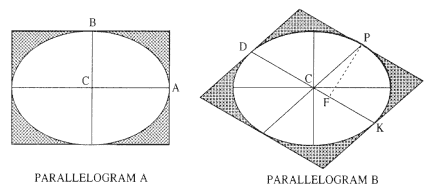
Figure 5.14
The area of parallelogram A (= 4BC × CA ) is equal to the area of parallelogram B
(= 4CD × PF ).
[2-N] And when all these ratios are combined , L × QR / QT2
Multiply together the five preceding relationships (i.e., lines [2-H] to [2-L]) and consider the products of the left- and right-hand sides separately. The product of the left-hand side of [H] [I] [J] [K] [L] is equal to the product (L × QR ) (L × PV ) (GV × PV ) (QV2 ) (QX2 ) divided by the product (L × PV ) (GV × PV ) (QV2 ) (QX2 ) (QT2 ). By simple cancellation of equals, this ratio of products reduces to (L × QR ) / QT2 .
[2-O] will be equal to (AC / PC) × (L / GV) × (CP2 / CD2 ) × (M / N) × (CD2 / CB2 ),
The product of the right-hand side of [H] [I] [J] [K] [L] equals the product (AC ) (L ) (PC2 ) (M ) (CD2 ) divided by the product (PC ) (GV ) (CD2 ) (N ) (CB2 ), which is equal to (AC /PC ) × (L /GV ) × (CP2 / CD2 ) × (M /N ) × (CD2 / CB2 ).
[2-P] that is, as AC × L (or 2BC2 ) / (PC × GV) × (CP2 / CB2 ) × (M / N)
That is, by simple cancellation of CD2 in the ratio given in [2-O], one has (AC ) (L ) (PC 2 ) (M ) divided by (PC ) (GV ) (N ) (CB2 ). Also, from the definition of the latus rectum L (see [2-F]), AC × L = 2BC 2 . Substituting 2BC 2 for AC × L , the ratio can be further reduced to (2BC2 ) (CP2 ) (M ) divided by (PC ) (GV ) (N ) (CB2 ). This ratio can be rearranged into the ratio given above (i.e., [(2BC2 ) / (PC × GV )] × [(CP2 / CB2 ) × (M /N )]).
[2-Q] or as (2PC / GV) × (M / N) or [(L × QR) to QT2 ]
Upon canceling BC2 and PC , [2-P] reduces to (2PC / GV ) (M /N ), as in [2-Q]. Thus, the left-hand side [2-N] equals the right-hand side [2-Q], or (L × QR ) / QT2 = (2PC / GV ) (M / N ).
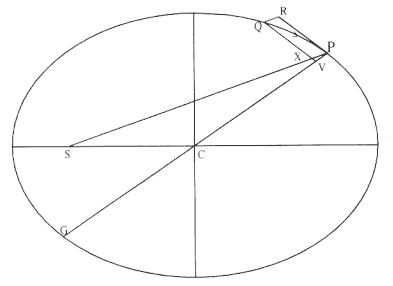
Figure 5.15
As the point Q approaches the point P , the line QV approaches the line QX
and the line GV approaches the line GP , which is equal to 2PC .
Step 3—
The Limit
[3-R] But with the points P and Q coalescing, the ratios 2PC / GV and M / N become equal [and approach unity] ,
In the limit as the point Q approaches the point P , then the line GV approaches the line PG = 2PC (see fig. 5.15), and thus the ratio 2PC / GV approaches unity. Also in the limit, the line QV approaches the line QX and from [2-K], (QV / QX )2 = M / N , thus the ratio M / N , also approaches unity.
[3-S] and therefore the combined ratio of these L × QR / QT2 [equals unity (i.e ., L = QT2 / QR)]
At long last, QR /QT 2 = 1/L ! Thus, from [2-Q], one has (L × QR ) / QT2 = (2PC / GV ) (M / N ) ® 1, or L = QT2 / QR . Recall that Newton concluded Theorem 3 by stating that the force was to be computed from the ratio QR /QT 2 × SP2 . Everything in this proof has been directed toward showing that the discriminate ratio QR /QT 2 is a constant equal to the reciprocal of the constant latus rectum L . The long journey is over.
[3-T] Multiply each part by SP2 / QR and there will result L × SP2 = SP2 × QT2 / QR.
To obtain the reciprocal of the linear dynamics ratio (QR / SP2 × QT2 ), simply multiply the expression for the discriminate ratio in [3-S] by SP2 . Thus, SP2 (L ) = SP2 (QT 2 / QR ) = 1 / linear dynamics ratio.
Conclusion
[U] Therefore the centripetal force is reciprocally as L × SP2 , that is, [reciprocally ] in the doubled ratio of the distance. Which was to be proved .
From Theorem 3, the force is proportional to the linear dynamics ratio QR / SP2 × QT2 , or reciprocally as L (SP 2 ), where the latus rectum L is a constant of the ellipse. Thus, the force is proportional to the inverse square of the distance SP .
Scholium
[V] Therefore the major planets orbit in ellipses having a focus at the center of the sun, and with their radii having been constructed to the sun describe areas proportional to the times, exactly as Kepler supposed .
By 1609, Kepler had obtained both the area law and the general ellipticity of solar planetary orbits by analyzing Tycho's observations of the motion of the planet Mars. In 1664, Newton demonstrated that both relationships can represent motion in the absence of any resistance. Note, however, that Newton demonstrated only that if the planet moves in an ellipse, and if the force center is at a focus, then the force is as the inverse square of the distance (a solution to the direct problem). He has not here demonstrated that if the force is as the inverse square of the distant, then it necessarily follows that the orbit is an ellipse with the force center at a focus of the ellipse (a solution to the inverse problem). In the solution to Problem 4 (to follow) he demonstrates that if the body is initially moving in an arbitrary ellipse under the action of an inverse square force, and if the speed and angle of inclination are changed to take on all possible values, then the resulting motion will be an ellipse, a hyperbola, or a parabola. Newton did not formally address the question of the uniqueness of the solution of the direct problem in the 1678 edition of the Principia ; however, he did speak to that question in the 1713 edition (to be discussed in chapter 10).
[W] Moreover, the latera recta of these ellipses are QT2 / QR, where the distance between the points P and Q is the least possible and, as it were, infinitely small .
For infinitely small displacements the discriminate ratio QT2 / QR is equal to the constant latus rectum L . Newton considers this property of elliptical motion (derived in [3-S]) to be so important that it is elevated to the position of a scholium for easy future reference. Given the detailed analysis required to provide the demonstration, it is a result worthy of the elevation.
Conclusion
Thus, Newton demonstrated that the centripetal force required to maintain a body P in elliptical motion about a focal point was inversely proportional to the square of the distance SP . From this solution he developed the concept of a force of universal gravitation that controlled the motion of the planets as they sweep around the sun. All the mathematical astronomers to follow used and extended the solution and, from its beginning here in Newton's reply to Halley's request of 1684, it has developed into the sophisticated gravitational astronomy of the eighteenth, nineteenth, and twentieth centuries. Of all the contributions that Newton made to mathematics, to optics, to astronomy, and to areas other than science, no other received as much public recognition as this solution of the Kepler problem. It elevated both Newton and mathematical astronomy to new heights. One wonders, however, when (if ever) Newton would have made his results public had not Halley happened to visit Cambridge after his discussion with Robert Hooke and Christopher Wren concerning such a proof. As one historian has put it (no pun intended, I am sure), "by 1684, the general question of gravitation was in the air."[6] It is reasonable to assume, therefore, that Newton would eventually have become aware of the general interest in his demonstration. Nevertheless, Halley asked his question at the right time and of the right person, and Newton's answer caught the attention of the academic world.