
Four
Household Systems and the Lives of the Old in Eighteenth- and Nineteenth-Century Hungary
Rudolf Andorka
Where did the elderly find a place to live in past centuries in Hungary? Or, more specifically, in what type of households did they live? This question is not of historical interest only; it is relevant for present-day social policies. Like other advanced societies, Hungary is facing the problems caused by the aging of the population. But these problems are somewhat different in Hungary. As the decline of fertility below the level of simple replacement occurred more or less a decade earlier (at the end of the 1950s) in Hungary than in western European societies, these problems became acute about a decade earlier in Hungary. And, as the welfare state is much less developed in Hungary than in most western European societies, the elderly must necessarily rely much more on help from family, kin, and other personal contacts than is the case in the West. It is therefore interesting to know how the elderly were cared for in past centuries in Hungary.
The conditions of the elderly in Hungary are also important from an international comparative perspective. Earlier historical sociological research, most notably by Peter Laslett (1977, 1983), has shown that western Europe was unique in past centuries in many demographic and social indicators and institutions, including those relating to the conditions of the old population. The famous Trieste-St. Petersburg line of John Hajnal (1965), with the "late marriage, low celibacy" eastern European pattern lying to the east, passes along the western frontier of Hungary. Hungarian historians have long focused on the question of whether Hungary belongs to western or to eastern Europe, a question given new prominence by recent political events. Neglecting here the political implications of the answer to this question, I would like to point to what is probably the most serious work on this subject, by Ernö Tárkány-Szücs (1981). Tárkány-Szücs argues that after belonging to western Europe from 1000 to 1500, Hungary slid after its defeat
in the battle of Mohacs by the Ottoman Turkish army to a special "intermediate" eastern-central European region, together with other parts of the Habsburg empire and Poland.
It ought to be added that more recent research has shown that the demographic and social patterns in Europe were more complicated than a simple east-west division suggests. There were variations within western Europe; most notably, southern Europe seems to have been different from the West in many respects, while in the east the Balkans were different from Russia and the Ukraine, and there were "western" islands in eastern Europe and "eastern" islands in western Europe, most of all in central Europe (Laslett 1983; Viazzo 1989). There are signs that Hungary itself was rather differentiated, some regions or ethnic or denominational groups being more western European and others more eastern European.
A Short Outline of the Demographic, Economic, and Social History of Hungary in the Eighteenth and Nineteenth Centuries
The nearly two centuries of Turkish wars and occupation of the majority of the present territory of Hungary (from 1526, the date of the battle of Mohacs, to 1711, when the Habsburg army defeated the Hungarian army of Rákoczí fighting for independence) caused great population loss, most of all in the central part of Hungary, which was dominated by the Ottoman Empire. Estimations of population size based on tax lists in 1715 and 1720 vary from 2.6 to 4 million in the territory of the Hungarian Kingdom and Transylvania; less than one-third of that number lived in the present territory of Hungary. In the following decades of the eighteenth century, the relatively peaceful conditions and the gradual ending of the plague (the last great epidemic was in 1738-1741) favored rapid population growth. The first census in Hungary in 1784-1787, performed under the reign of Joseph II, found a population of 8.1 to 8.2 million in Hungary and Transylvania, of whom 2.7 million lived in the present territory of Hungary. Thus, the population more than doubled in about seventy years.
A civil servant made and published a calculation of the birth- and death rates in 1777. Although these are estimations, the very high birthrate— 55.2—and the much lower death rate—40.4—support the conclusion drawn from the census population numbers that the second half of the eighteenth century was indeed a period of very rapid population growth.
The population of the present territory of Hungary was 5 million at the time of the next reliable census, 1870. Thus in more than ninety years, the population had almost doubled again. The growth rate was clearly lower than in the eighteenth century. The birthrate was 45.4 and the death rate 40.2 in 1870-1879, when regular official vital statistics began to be kept.
Thus the birthrate seems already to have begun to decline in the first half of the nineteenth century, much before the onset of industrialization, but the death rate did not improve until the 1870s.
For the decades before the 1870s, only sample studies can be used to calculate vital rates. Estimations of life tables on the basis of the data from a sample of parish registers demonstrate a life expectancy at birth of about 30 years (table 4.1). Life expectancies at the age of 30 for married males and females, who figured on the completed family sheets, could be calculated from family reconstitution studies (table 4.2). Infant mortality rates were established from parish registers used for family reconstituting (table 4.3).
TABLE 4.1 | ||||||
Life Expectancy at Age 30 (e30 ) | Number of Survivors per 1,000 Births (160 ) | |||||
Category of Settlement | Male | Female | Male | Female | ||
Villages | ||||||
Population < 2,000 | 31.3 | 28.8 | 251 | 226 | ||
Population > 2,000 | 32.6 | 30.9 | 258 | 253 | ||
Agricultural towns | ||||||
Population < 2,000 | 31.5 | 29.5 | 265 | 219 | ||
Population > 2,000 | 32.6 | 31.4 | 255 | 253 | ||
Towns having "royal right" | 28.6 | 30.5 | 172 | 214 | ||
Total | 31.6 | 30.8 | 238 | 242 | ||
TABLE 4.2 | |||
Life Expectancy at Age 30 (Years) | |||
Village | Marriage Cohort | Male | Female |
Vajszló and Besence | 1791-1820 | 36 | 31 |
1821-1850 | 35 | 33 | |
1851-1880 | 40 | 41 | |
Alsonyek[*] | 1760-1790 | 34 | 28 |
1791-1820 | 32 | 31 | |
Sárpilis | 1752-1790 | 37 | 28 |
1791-1820 | 34 | 29 | |
Átány | 1730-1789 | 33 | 29 |
1790-1819 | 29 | 28 | |
Pocemegyer | 1759-1790 | 29 | 29 |
1791-1820 | 25 | 28 | |
TABLE4.3 | ||||||||||
Religious Denomination | Age at First Marriage of Women 1850-1895 | Illegitimate | Infant Mortality | Total marital Fertility, 20-49, Marriage Cohorts of | ||||||
Village | Region | Ethnicity | 1790-1820 | 1850-1895 | 1790-1820 | 1850-1895 | 1790-1820 | 1850-1895 | ||
Vajszló and Besence | Southern Transdanubia | Hungarian | Calvinist | 19.9 | 1.0 | 4.4 | 282 | 130 | 4,760 | 2,760 |
Alsonyek[*] and Sárrpilis | Southern Transdanubia | Hungarian | Calvinist | 17.5 | 0.4 | 4.5 | 188 | 215 | 3,725 | 2,725 |
Kerkáskápolna | Southern Transdanubia | Hungarian | Calvinist | 19.1 | 5.9 | 7.8 | 168 | 182 | 4,415 | 2,500 |
Bakonya | Southern Transdanubia | Hungarian | Roman Catholic | 20.5 | 3,595 | |||||
Töttös | Southern Transdanubia | Hungarian | Roman Catholic | 19.9 | 4,705 | |||||
Velem | West | Hungarian | Roman Catholic | 22.1 | 6,635 | |||||
Rábakecöl | West | Hungarian | Roman Catholic | 1.4 | 290 | 7,395 | ||||
Bük | West | Hungarian | Roman Catholic | 25.0 | 4.6 | 7.0 | 128 | 207 | ||
Bük | West | Hungarian | Lutheran | 23.2 | 0.9 | 4.9 | 189 | 207 | ||
Bárna | North | Slovakian | Roman Catholic | 19.5 | 0.2 | 2.3 | 225 | 7,795 | 7,375 | |
Felsovadasz[*] | Northeast | Ruthenian | Greek Catholic | 20.1 | 1.9 | 3.6 | 243 | 108 | 6,249 | 8,665 |
Átány | Great Plain | Hungarian | Calvinist | 22.8 | 1.5 | 2.4 | 173 | 232 | 6,230 | 6,775 |
From these data the following tentative conclusions can be drawn: (1) mortality was relatively low around 1800 but did not decline in the subsequent decades; (2) regional differences seem to have been very important; and (3) female mortality was worse than male mortality, the disadvantage of females being higher in smaller settlements and in the earlier decades. Infant and child mortality of girls was also somewhat worse than that of boys, so it might be hypothesized that some form of discrimination against females prevailed.
Total marital fertility rates (i.e., the number of children ever born to 1,000 married women) calculated from a national sample of parish registers are available for two marriage cohorts, 1830-1839 and 1850-1859; the rates are 6,015 and 5,400, respectively (Dányi 1965). Results from family reconstitution studies of individual parish registers (Andorka 1978, 1988, 1990) provide data on earlier decades and permit us to evaluate the differences by regions and by ethnic and denominational groups. These data seem to suggest that while birth control was nonexistent or very rare in the marriage cohorts of the pre-1790 decades, it began to spread in some southern Transdanubian parishes in the marriage cohorts of 1790-1820, while in others marital fertility remained at an unchanged high level until the end of the nineteenth century (table 4.3).
Age at first marriage was relatively young in Hungary. The female average age at marriage was 20.3 years in the marriage cohort of 1830-1839 and 19.4 in the marriage cohort of 1850-1859 (Dányi 1965). The family reconstitution studies show considerable regional variations, the southern Transdanubian parishes having the lowest and the western Transdanubian parishes the highest age at first marriage (table 4.3). It is tempting to hypothesize that western Hungary, never occupied by the Ottoman Empire and having always had the closest contact with western Europe, was influenced by the western European marriage pattern.
From the family reconstitution studies, it is difficult to find reliable data on lifelong celibacy. If the family status of women is given in the death register, the percentage of never married above the age of 50 can be estimated. In no study was this found to be higher than 5 percent. One explanation might be the frequent remarriage of widowers. Almost all of them remarried, often much younger brides. In this way remarriage of widowers cleared the market supply of single women who had not found a single bridegroom.
Thus the elderly in Hungary in the eighteenth and nineteenth centuries faced somewhat different demographic conditions than in western Europe: marriage was earlier and almost universal; marital fertility began to decline at least in parts of Hungary earlier than in many parts of western Europe (certainly in an earlier phase of the modernization of the economy than in western Europe); mortality was not conspicuously worse at the end of the eighteenth century but did not improve until the last decades of the nineteenth century (Flinn 1981).
Household structure, investigated by the method and typology proposed by Laslett (1972), displays a pattern that is somewhere between the two extremes of England and Russia. The percentage of extended and multiple family households is higher than in American colonial Bristol, English Ealing, French Longueness, Serbian Belgrade (Laslett 1972), Flandrian Lampernisse (Danhieux 1983), and German Grossenmeer (Laslett 1983) but similar to Estonian Karuse (Palli 1983), Italian Alagna (Viazzo 1989), and Fagagna (Laslett 1983) and lower than in Italian Casalecchio (Kertzer 1989) and Russian Mishina (Czap 1983) (table 4.4). In terms of the characteristics of household structure, Hungary seems to be in an intermediate position between the central European, the Mediterranean, and the eastern European regions proposed by Laslett (1983).
Regional and ethnic variation were important in Hungary: German and Slovakian villages near to the center and to the largest town, Buolo, of Hungary were more similar to the central European type than the Hungarian villages of southern Transdanubia. However, household structure seems to have changed over time. In both cases, where two population listings—the German Nagykovácsi and the Hungarian Sárpilis—could be analyzed by the Laslett typology, the proportion of complex households increased (Andorka and Faragó 1983). The analysis of macrodata from the census of 1784-1787 and from the nonnoble enumerations of 1804, 1819, and 1828 demonstrates similarly that the size of households and the number of adult males per household increased (Andorka and Faragó 1983; Faragó 1977).[1]
By matching the households and the persons in the two listings of Sár-pilis in 1792 and 1804 and adding the data from the parish register, it was possible to find out what happened to the households and to the persons living in Sárpilis (Andorka and Balázs-Kovács 1986). During these twelve years the population increased from 458 to 555, but the number of households only increased from 85 to 100. In consequence, the average household size increased from 5.39 to 5.55. This tendency was more marked if we consider only the Calvinist serf peasants, that is, the autochthonous and relatively well-to-do population. Their population increased from 431 to 515, the number of their households only from 74 to 77; consequently, their average household size increased from 5.83 to 6.69. Three types of household changes can be identified: (1) in a few cases a complex household became a simple family household; (2) most often a simple family household became a multiple family household or an extended household; (3) some households fissioned into two and in one case into three parts.
In addition, a clear "household life cycle" can be demonstrated by classifying the population of Kölked by age in 1816 into the household types in which they lived (Andorka and Faragó 1983). The percentage living in extended and multiple family households was high around the age of marriage, that is, in the 20 to 29 age group, declined in the 30 to 49 age group, when some of the married couples having young children separated from
TABLE 4.4 | |||||||||||
Percentage of Households by Types | Mean | ||||||||||
Village | Year | Region | Ethnicity | Religious Denomination | Solitary | Non- | Simple | Extended | Multiple | Not Classifiable | |
Perbál | 1747 | Central | German- | Roman Catholic | 1 | 1 | 85 | 6 | 5 | 2 | 4.67 |
Pilisszáintó | 1747 | Central | Slovakian | Roman Catholic | 3 | 1 | 71 | 8 | 17 | — | 4.61 |
Nagykovácsi | 1747 | Central | German | Roman Catholic | 6 | — | 79 | 7 | 7 | 1 | 4.82 |
1769 | 3 | — | 77 | 6 | 14 | — | 5.28 | ||||
Fajsz | 1762 | Southern Great Plain | Hungarian | Roman Catholic | 1 | 1 | 56 | 10 | 32 | — | 5.91 |
Sárpilis | 1792 | Southern Transdanubia | Hungarian | Calvinist | 2 | — | 72 | 5 | 21 | — | 5.53 |
1804 | 1 | — | 54 | 9 | 36 | — | 5.77 | ||||
Alsonyek[*] | 1792 | Southern Transdanubia | Hungarian | Calvinist | 2 | — | 44 | 15 | 39 | — | 5.80 |
Kölked | 1816 | Southern Transdanubia | Hungarian | Calvinist | — | — | 47 | 13 | 36 | 4 | 5.75 |
Mezocsoknya[*] | 1800 | Southern Transdanubia | Hungarian | Calvinist | — | — | 47 | 15 | 38 | — | 6.01 |
the parental households (and thus fewer of the children lived in extended and multiple family households), and increased again after the age of 50, when the children of the old persons married and at least one of them tended to remain in the parental household.
Thus the complex household was not "perennial" in Hungary, neither on the macrolevel of historical time nor on the microlevel of individual persons and families. It seems that families tended to react to the changing demographic and economic conditions by changing their household structure.
One important economic factor, influencing household structure and probably also demographic behavior, was the growing density of the population, caused by the high growth rate of the population in the eighteenth century. This caused scarcity of land, at least in the more densely populated regions of Hungary, which was aggravated by the existence of manorial estates of landlords. Peasants were mostly serfs and were allotted a "serf parcel" of land by the landlords.[2] Families had serious difficulties increasing the land that they could cultivate, as landlords usually wished to increase or at least maintain the land cultivated by their manors. Peasant families having several heirs thus usually had to subdivide their farm. This obviously meant pauperization, as, given the lack of markets and transportation, intensification of production and sale of the agricultural products at more distant markets were almost impossible. Allowing the households to become larger and more complex was essentially a strategy, to avoid the fragmentation of the peasant farms and/or the pauperization of part of the family.
The fragmentation of serf land was favored by existing inheritance practices. The inheritance customs in the eighteenth and nineteenth centuries seem to have been rather varied in Hungary (Tárkány-Szücs 1981). For example, impartible inheritance and primogeniture predominated in the villages of German ethnicity.[3] Hungarian peasants in the backward but densely populated regions usually divided the familial property equally among the sons, and daughters received a substantial dowry at their marriage. It seems that inheritance inter vivos and retirement contracts described for northern and western-central Europe by David Gaunt (1983) and for Austria by Lutz Berkner (1972) were exceptional in Hungary. Therefore it is understandable that many married sons tended to remain—at last temporarily—in the households of their parents and farm together.
Another important institutional characteristic of eighteenth- and nineteenth-century Hungary, especially the villages, was the lack of any transfers from charitable institutions, the municipalities, or the state for poor persons not having family members or other kin to support them. Therefore, in the case of "nuclear hardship," Hungarians had to rely on families and kin groups. This fact necessarily had a strong influence on
household structure and kin relations and caused important differences as compared to Western societies, where support for poor individuals from the collectivity was available (Laslett 1988; McIntosh 1988; Pullan 1988).
At the same time, there was a vague but deep feeling in the Hungarian peasantry until at least the first half of the twentieth century that it was appropriate for married children to help their parents in farming and to stay at least for some years with their parents in the same household. Even when the young couple built their own house, the mutual helping relationship between parents and children and between married brothers and sisters was maintained (Fél and Hofer 1969). It might be concluded that the Hungarian peasant culture favored—but did not necessarily prescribe—mutual help and common or nearby residence of parents and adult children. Thus the elderly in Hungary in the eighteenth and nineteenth centuries could usually rely on their descendants and their families, in most cases by living together with them in the same households.
Sources of Data on the Household Conditions of the Old
To study the household contexts of older people, listings of households and populations that provide ages are needed, similar to those used by Laslett (1977) for the investigation of the history of aging and the aged. Such listings are relatively rare in Hungary in the precensus decades and centuries. Only a few listings of the first census of 1784-1787 are available in different local archives (Dányi 1965). The census forms of the regular decennial censuses beginning in 1870 were largely destroyed. Therefore, to study the household context in which old people lived, we have to search for population and household listings in the local archives and in the individual parishes. Four such listings, all found in local parish archives, are used here: (1) the status animarum of the Roman Catholic village of Fajsz in 1762, prepared for the administration of the bishopric of Kalocsa (Barth 1975); (2) the listing of the Calvinist village of Mezocsoknya[*] in 1800, prepared by the local pastor to replace the parish register, which was burned together with the local church building two years earlier, giving the year of birth and marriage of each inhabitant; (3) the listing of the Calvinist village of Sárpilis in 1804, prepared by the local pastor for the administration of the department (megye ) of Tolna in the framework of a conscription of the population of the department;[4] and (4) the listing of the Calvinist village of Kölked in 1816, prepared by the honorary principals of the local congregation, giving the age of each inhabitant (Mándoki 1971).
These listings are of varying quality. For example, Sárpilis's does not give the age of all women, so ages were determined by trying to find them in the parish register of burials. The problem of completeness, that is, of the eventual omissions, causes more serious concern. The possibility of
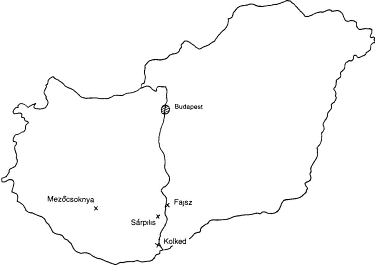
Fig. 4.1.
Location of the four Hungarian villages investigated.
TABLE 4.5 | |||||||
Number Aged 60+ | |||||||
Village | Population Size | Male | Female | Total | Percentage Aged 60+ | Sex Ratio 60+ | |
Fajsz | 1,022 | 43 | 18 | 61 | 6.0 | 239 | |
Mezocsoknya[*] | 547 | 9 | 11 | 20 | 3.7 | 82 | |
Sárpilis | 525 | 19 | 10 | 29 | 5.5 | 190 | |
Kölked | 643 | 17 | 15 | 32 | 5.0 | 113 | |
Total | 2,737 | 88 | 52 | 142 | 5.2 | 163 | |
omissions is suggested by the very high sex ratio of the populations over age 60 investigated here (table 4.5). One reason for the higher number of males over age 60 might be the shorter life expectancy of females (tables 4.1 and 4.2). The very high sex ratio in Fajsz and Sárpilis, however, cannot be explained simply by mortality differences of men and women. In the case of Sárpilis, it was possible to compare the parish registers and the listings and to verify in this way that no old women are missing from the listing of 1804. The surplus of men might be caused partly by the migration balance by sexes of the previous years. From 1792 to 1804, 45 men out-migrated and 33 immigrated, while 58 women out-migrated and 40 immigrated. Thus the loss of migration was 12 men and 18 women (not detailed
by age). If the migration balance was similar in previous decades, then in addition to the higher mortality of women, the greater loss of women by out-migration might explain the very high sex ratio. No similar data are available to explain the even higher sex ratio found in Fajsz. It might be assumed that—as the listing dates from an earlier period than that of Sár-pilis—the surplus mortality of women was higher.
All four listings present the names of the inhabitants and their ages ordered by households. Households are divided by serial numbers. It is, however, not absolutely clear what the serial numbers mean, namely, whether one household or one house is given under one serial number. It might be assumed, however, that the enumerators used the definition of the census of 1784-1787, according to which all those belong to one "familia" that cooks and eats together.
Usually the oldest male family head is given as the first person in the household and might be defined in consequence as the household head. In some exceptional cases, the male head of the younger family is first mentioned. Widowers seem to be treated similarly, that is, they are usually listed as household heads if they are the oldest in the household. Widows are sometimes mentioned first and are therefore defined as household heads; in other cases, they are mentioned as a family member of the household head, who is usually their son. The household position of the other members is defined in relation to the first-mentioned person of the household (e.g., spouse, child, mother of the household head).
Cotters (landless peasants) and servants are mentioned explicitly in the listings of Fajsz and Sárpilis. Two types of them were distinguished in the analysis of the data and were treated differently: (1) solitary servants and cotters, who are always assigned in the listings to households, are treated as members of these households; (2) cotters and servants having a family were treated here as separate households, even if they were assigned in the listing to another household. Ethnographic evidence suggests that these cotter and servant families cooked and ate separately. As, however, the number of cotters and servants assigned to other households was relatively small (much lower than in contemporary England), their treatment in the analysis does not influence the results very much.
As is visible from the data presented earlier in this chapter, in the case of Sárpilis, additional sources were used. A listing of the population in 1792, not containing complete age data, was used to study household structure. The comparison of the listings of 1792 and 1804 and of the parish register could be used to investigate migration and the changes of household structure. A listing of the economic resources of the households from 1793 made it possible to investigate the characteristics of households and families by social strata (Andorka and Balázs-Kovács 1986). The family reconstitution
based on the Calvinist parish register made it possible to investigate the demographic characteristics and changes from 1752 to the end of the nineteenth century (Andorka 1978).
Some Data on the Economic, Social, and Demographic Characteristics of the Four Villages
The four villages are situated near one another in a well-defined geographic and ethnographic region of Hungary, namely, southeastern Transdanubia and the opposite bank of the Danube (Fajsz). This region was not poor, the soil being fertile, but land became scarce in the second half of the eighteenth century, and the area was far from any markets and from centers of protoindustrialization. The geographic conditions—marshy areas around the Danube, lack of roads—also contributed to the isolation of the region from European and even national influences. It might be concluded that these populations lived at that time in archaic conditions.
Relatively little is known about the family economy of these four villages. A monograph on the villages of the western bank of the Danube gives more information on Sárpilis and Kölked (Andrásfalvy 1975). The economic conditions were probably similar in Fajsz on the eastern bank. The economy of these villages was dominated by the fact that, being on the floodplain of the Danube, they had relatively little arable land. In consequence they had to combine cultivation of arable lands with animal husbandry (for which purpose the meadows that were periodically inundated were very suitable), fishing, hunting in the forests and at the riverside, and long-distance transportation with horse-drawn carts. The economic register of Sárpilis in 1793, which was matched to the population listings of 1792 and 1804, as well as two similar economic registers demonstrate that these peasants had little arable land. Most households had less than one unit of land held in villenage but a relative abundance of animals (horses, oxen, cows). These fragmentary data suggest that the peasants of these villages had to employ a very flexible family economy, continuously adapting their labor supply to the sources of income open to them and expanding and reducing their productive activities according to the number of adults in the household. For example, plowing of arable land could be done either by oxen or by horses. Oxen were stronger and therefore could plow the soil deeper, but plowing with one or two pair of oxen required two adult men, because in addition to the man directing the plow, one man was needed to guide the oxen. Therefore either the number of adult males had to be adjusted to the oxen or, if only one adult male lived in the household, horses had to be used instead of oxen for plowing. It might be hypothesized that peasants sought to employ a certain household structure to utilize efficiently the possibilities of production.
The peasants of these villages were socially rather differentiated. The data from Sárpilis in 1793 illustrate the social differences: of the 85 house-
holds, 32 comprised rich peasants, having 2 or 4 oxen or 2 to 6 horses; 31 comprised middle-level peasants, having 0 to 2 horses and some cows; 11 comprised poor peasants, having no large animals; and another 11 comprised very poor peasants, not included in the listing of resources. Richer peasants tended to have larger and more complicated households.
As compared to other villages in Hungary, all four villages investigated here had larger and more complicated households (table 4.4). It is doubtful that the demographic indices of Sárpilis, calculated on the basis of family reconstitution, can be assumed to represent the historical demography of the other three villages as well.
Mortality conditions in Sárpilis can be characterized by the indicators of infant and child mortality.[5] In the period from 1792 to 1820, 382 deaths of children age 0 to 9 per thousand births occurred. The rate was somewhat higher for girls (410) than for boys (350), the opposite of the usual pattern. Similarly, the mortality of adult males was more favorable than that of adult females (table 4.6).
In the period 1752-1790, the average age at first marriage for women was 19 years, and in the period 1791-1820, it was 18.4 years. The average age of men at marriage was 24.4 and 19.9, respectively, in these periods. It is difficult to estimate the frequency of remarriage in Sárpilis, as until 1805 the marital status of bridegrooms is not given. Of the 100 marriages celebrated between 1792 and 1804, 13 involved brides who were widowed and 2 involved brides who were divorced. In the case of the 66 marriages over the next ten years, between 1805 and 1814, 18 bridegrooms were widowers, 9 brides were widows, and 1 bride was divorced. From these data, it might be guessed that remarriage of widowers was more frequent than remarriage of widows.
Sárpilis is one of the villages where signs of early birth control were observed in the marriage cohort of 1752-1790. However, marital fertility was still very high, amounting to a total fertility rate of 7,180 from the ages of 20 to 49.[6] Illegitimacy rates were low (table 4.3).
The high level of fertility and the moderate rate of mortality resulted in a high rate of natural increase. In the period from 1779 to 1803, 630 bap-
TABLE 4.6 | ||
Percentage Attaining the Given Age | ||
Age | Male | Female |
30 | 100 | 100 |
40 | 100 | 89 |
50 | 91 | 71 |
60 | 74 | 50 |
70 | 46 | 34 |
tisms and 414 burials are mentioned in the parish register of Sárpilis, and the population (458 in 1792 and 555 in 1804) increased by 216 as a result of the surplus of births over deaths.
Data on migration were obtained by matching the listings of 1792 and 1804 and the parish register of Sárpilis. From a population of 458 in 1792, 103 persons out-migrated in the following twelve years. From a population of 555 in 1804, 73 persons had in-migrated during the previous twelve years. Thus part of the natural increase of 216 over those years was "discharged" from Sárpilis through a negative migration balance. This fact itself points to the difficulties caused by the high rate of natural increase for the society of Sárpilis.
The out-migration of 22 percent from Sárpilis in 1792-1804 is lower than the migration intensity from Clayworth and Cohenhoe in seventeenth-century England and Hallines in eighteenth-century France and more or less similar to the population turnover in Longuenesse in eighteenth-century France (Laslett 1977). It is, however, higher than out-migration in Pinkenhof, Latvia (Plakans and Wetherell, this volume), and Krasnoe Sobakino (Czap 1983) in nineteenth-century Russia.[7]
An important factor in both out-migration and in-migration was marriage with residents of neighboring villages. The residence of the new couple was mostly determined by the principle of living in the household or at least the village of the father of the bridegroom. A few cases were found in which the new couple resided with the father of the bride.
Another important factor in the turnover of population was the out-migration and in-migration of complete households. These households belonged to three types: (1) most were landless cotter families who frequently migrated from one place to another; (2) the households of the local Calvinist pastor, notary, and schoolteacher from time to time changed their place of work from one Calvinist village to another; and (3) two economically strong farmer households and a nuclear family component of an economically strong multiple family household out-migrated from 1792 to 1804, demonstrating that there was pressure, probably caused by land scarcity, to find new "farm niches" in less densely populated parts of Hungary.
In addition, there were some "individual" migrants. Five were found in the listing of 1804. Their demographic and social characteristics illustrate the causes of these movements. These in-migrants were the following: a 35-year-old discharged soldier who returned to the household of his father and brother; a widowed father who came to live with his married son; a widowed woman who came to live with her married sister; a 77-year-old widower (the only one who was above 60 among these individual migrants) who came with his son, who had married the daughter of a local peasant; and a widowed mother who joined the household of her married son. Thus it seems that in
exceptional cases of hardship, the "reincorporation strategy" (Hammel, this volume) was utilized. Nevertheless, Plakans's hypothesis that old age or "post-labor force" migration might have been rare in preindustrial rural places in Europe seems to be confirmed by the data from Sárpilis.
All these data point to the fact that these were most probably not average Hungarian villages but villages living in archaic conditions. The findings on the conditions of the elderly should not be generalized, therefore, to the whole of Hungary, where demographic and social conditions, including the conditions of the elderly, might have been rather varied. These data nevertheless give some insight into the question of the type of household conditions in which the elderly lived in archaic Hungarian villages.
Household Composition and Household Position of the Population Over Age 60 in the Four Villages
On the basis of the four listings containing age data, the indicators and tables used by Laslett (1977) were calculated and compiled. The data are compared to Laslett's.
The percentage of the population over age 60 is lower than in the English, French, German, Italian, Icelandic, and Japanese localities given by Laslett but is near those found in Austria, Estonia, and Serbia. The sex ratio is among the highest in all these places (table 4.5). The problems of the elderly, which in present-day Western societies are predominantly the problems of old women, were in these four villages about two hundred years ago predominantly the problems of old men.
The most conspicuous difference in terms of marital status between the Hungarian villages and the places presented by Laslett is the absence of single persons in the former.[8] The percentage of married men is somewhat higher in the Hungarian villages than in most places given by Laslett, while the percentage of married women is similar or somewhat lower in Hungary than in England and France but much higher than in Serbia and Japan (table 4.7). In consequence, the percentage of widows among the women is higher in Hungary than in all the English and French locals but much lower than in Serbia and in Japan.
The high sex ratio and the much higher percentage of married persons among the men than among the women over age 60 suggest that the age difference between spouses might have been important. The comparison of the ages of married men with the ages of their wives demonstrates that, indeed, more than half of the wives were ten or more years younger than their husbands (table 4.8).[9] Husbands' second marriages were distinguished only in the listing of Mezocsoknya[*] . Here both husbands over age 60 who had wives who were younger by more than ten years were in a second marriage.[10] It might be assumed that in the other villages, marriages involving husbands
TABLE 4.7 | |||
Village | Men (%) | Women (%) | |
Fajsz | 81 | 61 | |
Mezocsoknya[*] | 89 | 9 | |
Sárpilis | 79 | 60 | |
Kölked | 53 | 27 | |
Total | 76 | 41 | |
TABLE 4.8 | |||||||||||
Age of Husband | Age of Wife | ||||||||||
< 39 | 40-49 | 50-54 | 55-59 | 60-64 | 65-69 | 70-74 | 75-79 | 80+ | Total | ||
60-64 | 1 | 12 | 9 | 3 | 4 | — | — | — | — | 29 | |
65-69 | 1 | 1 | 1 | — | 1 | 1 | — | — | — | 5 | |
70-74 | — | 2 | 1 | 1 | 2 | 3 | 2 | — | — | 11 | |
75-79 | 2 | — | 1 | — | — | 1 | 1 | — | — | 4 | |
80+ | 1 | 1 | 1 | 1 | — | 1 | 2 | 1 | 2 | 11 | |
Total | 5 | 16 | 13 | 5 | 7 | 6 | 5 | 1 | 2 | 58 | |
who were much older than their wives were second marriages as well. Therefore, it might be hypothesized that the relatively low proportion of widowers among the old men was due to a large extent to the fact that widowed men usually remarried, sometimes marrying much younger women.
As in the English communities presented by Laslett, most married men and women over age 60 were household heads and spouses of heads (table 4.9). The majority of widowed men were also household heads, but only about half of the widows were heads of households. Altogether, 93 percent of the men and 70 percent of the women over age 60 were household heads (table 4.10).
A closer look at the persons who were not household heads helps explain the high headship rates. Only two married men were found who were not heads of households. One of them was 93 years old and lived with his 88-year-old wife in the household of a married son. The other was an 85-year-old servant-lodger who lived with his 38-year-old wife in the household of an unrelated farmer. The two widowed men who were not heads and lived with married children were 77 and 76 years old. The two who lived in a household of nonkin were a 76-year-old lodger and a 60-year-old servant. One of the widows who was not a head lived as a servant in a nonkin-related household.
TABLE 4.9 | |||||
Male | Female | ||||
Village | Married (%) | Unmarried (%) | Married (%) | Unmarried (%) | |
Fajsz | 94 | 75 | 91 | 100 | |
Mezocsoknya[*] | 100 | 100 | 100 | 30 | |
Sárpilis | 100 | 100 | 100 | 0 | |
Kölked | 100 | 100 | 100 | 60 | |
Total | 97 | 81 | 96 | 52 | |
No systematic difference could be found between the widows who were heads of the households in which their married and/or unmarried children lived and the widows who lived in households headed by their married children. Men over age 60 were not heads only in exceptional cases of old age or poverty. No clear rule is evident for women remaining heads after widowhood or giving over the headship to one of their children.
The most conspicuous difference as compared to the English communities analyzed by Laslett is that in these Hungarian villages, no person over age 60 lived in an institution, only two unmarried men and one unmarried woman lived as a servant and/or lodger in a nonkin household, and no person lived alone. It is clear that no institutions for the care of old and poor persons existed in these villages, and apparently no children were willing to let their widowed parents live by themselves. Old widowed parents either continued to live in their households together with their unmarried and married children or entered the households of married children after widowhood. Not only the parents of the household head but in some cases also the widowed mother of the head's spouse lived in the household. Comparison of the listing of 1804 and Sárpilis with the listing of 1792 indicates that widowed parents in some cases were accepted into the households of their married children, that is, the hardship reincorporation household scenario (Hammel, this volume).
Both married and unmarried old people lived much more frequently with their married children than was the case in England (table 4.10). Seventy-six percent of the men and 82 percent of the women over age 60 lived together with married children and in most cases with grandchildren. In consequence, the generational depth of the households in which old people lived was great: in 73 percent of these households, members of three generations lived together (table 4.11). Most old persons thus had everyday contact with their grandchildren, and many children had everyday contact with their grandparents.[11]
TABLE 4.10 | ||||||||||||
Fajsz 1762 | Mezocsoknya[*] 1800 | Sárpilis 1804 | Kölked 1816 | Total | ||||||||
Marital Status and Household Position | Male | Female | Male | Female | Male | Female | Male | Female | Male | Female | ||
Married, household head, | ||||||||||||
Unmarried children | 7 | — | 3 | — | — | — | — | 3 | 10 | 3 | ||
Married children | 6 | 3 | 1 | — | 9 | 3 | 6 | 1 | 22 | 7 | ||
Unmarried and married children | 17 | 6 | 2 | — | 6 | 3 | 3 | — | 28 | 9 | ||
Others | 3 | 1 | — | — | — | — | — | — | 3 | 1 | ||
Only spouse | — | — | 2 | 1 | — | — | — | — | 2 | 1 | ||
Married, not household head, | ||||||||||||
Unmarried children | — | — | — | — | — | — | — | — | — | — | ||
Married children | 1 | 1 | — | — | — | — | — | — | 1 | 1 | ||
Unmarried and married children | — | — | — | — | — | — | — | — | — | — | ||
Others | 1 | — | — | — | — | — | — | — | 1 | — | ||
Not married, household head, | ||||||||||||
Unmarried children | 2 | 1 | — | — | — | — | 1 | — | 3 | 1 | ||
Married children | 2 | 5 | 1 | 2 | 1 | — | 7 | 5 | 11 | 12 | ||
Unmarried and married children | 2 | 1 | — | 1 | 1 | — | — | 1 | 3 | 3 | ||
Others | — | — | — | — | — | — | — | 1 | — | 1 | ||
Not married, not household head, | ||||||||||||
Unmarried children | — | — | — | — | — | — | — | — | — | — | ||
Married children | 1 | — | — | 7 | 1 | 2 | — | 3 | 2 | 12 | ||
Unmarried and married children | — | — | — | - | — | 1 | — | 1 | — | 2 | ||
Others | l | — | — | — | 1 | 1 | — | — | 2 | 1 | ||
Total | 43 | 18 | 9 | 11 | 19 | 10 | 17 | 15 | 88 | 54 | ||
TABLE 4.11 | ||||||
Number of Generations in Household | Fajsz | Mezosoknya[*] | Sárpilis | Kölhed | Total | |
1 | 1 | 1 | — | — | 2 | |
2 | 16 | 4 | 3 | 4 | 27 | |
3 | 31 | 14 | 18 | 24 | 87 | |
Solitary servants | 2 | — | 2 | — | 4 | |
Total | 50 | 19 | 23 | 28 | 120 | |
NOTE: In Fajsz, 2 persons aged 60+ lived in two-generation households and 9 persons in three-generation households; in Mezocsoknya[*] , 2 persons lived in 1 one-generation household; in Sárpilis, 2 persons lived in 6 three-generation households; in Kölked, 2 persons lived in 4 three-generation households. | ||||||
The other aspect of the same phenomenon is that most of the households in which old people lived were of complex structure: following the typology proposed by Laslett (1972), only 13 percent belonged to the simple family household type, 26 percent to the extended family household type, and 57 percent to the multiple family household type (4 percent were not classifiable). Of the 57 percent who lived in multiple family households, 26 percent belonged to the "stem" type, 18 percent to the "joint" type, and 13 percent to the "frérèche" type.[12] Thus the joint-and frérèche-type households, which were infrequent in Hungary and very rare in western Europe, were relatively frequent among the households of the elderly in these villages (table 4.12).
It seems that older people lived largely in extended and multiple family households. It would be premature, however, to draw the conclusion that a stem and/or joint family system was the general rule in these four villages. To understand the formation of these complicated households, the changes of household contexts of the elderly have to be analyzed.
The comparison of the listings of 1792 and 1804 gives some insight into the changes of the household context of the persons over age 60 in 1804 in Sárpilis. Five of these older persons were not found in the listing of 1792; they probably immigrated in the meantime. Two of them were widowed mothers of household heads. It might be assumed that they lived in a neighboring village before the death of their husbands and came to live after widowhood with their married sons in Sárpilis. The three others were old men who immigrated with their families.
For those found in both listings, we can distinguish the following transitions: (1) becoming a cotter or a servant; (2) living in the same simple household; (3) the household changing from a simple to a more complex pattern, in consequence of the marriage of an unmarried child; and (4) splitting of the household, the elderly parent living in 1804 in a "successor"
TABLE 4.12 | |||||||
Household Type | Fajsz 1762 | Mezocsoknya[*] 1800 | Sárpilis | Kölked 1816 | Total | ||
3. Simple family household | |||||||
3.a. Married couple alone | 1 | 1 | — | — | 2 | ||
3.b. Married couple with child(ren) | 8 | 3 | — | 1 | 12 | ||
3.c. Widower with child(ren) | — | — | — | 1 | 1 | ||
3.d. Widow with child(ren) | 1 | — | — | — | 1 | ||
4. Extended family household | |||||||
4.a. Extended upward | 8 | 6 | 3 | 11 | 28 | ||
4.b. Extended downward | 2 | — | — | — | 2 | ||
4.c. Extended laterally | 1 | — | — | — | 1 | ||
5. Multiple family household | |||||||
5.a. Secondary unit(s) up | — | — | — | — | — | ||
5.b.1. Secondary unit(s) down "stem" | 16 | 4 | 6 | 5 | 31 | ||
5.b.2. Secondary, unit(s) down "joint" | 6 | — | 10 | 6 | 22 | ||
5.c.d. Units on one level | 4 | 5 | 2 | 4 | 15 | ||
5.e. Other multiplea | 1 | — | — | — | 1 | ||
6. Not classifiable (solitary servants in household of nonkin)a | 2 | — | 2 | — | 4 | ||
Total | 50 | 19 | 23 | 28 | 120 | ||
a The conjugal families of two married brothers and of one married son of one of the brothers living in one household. | |||||||
household. There is no case of an elderly person who lived in 1792 in a complex household living in 1804 in a simple household.
One person, who was head of a simple family household in 1792, was widowed; his son married into another household, and he himself lived as a cotter in a nonkin household. A widower who lived in the stem household of his son in 1792 lived after the death of this son as a servant in a nonkin household in 1804.
One person lived as the head of the same simple family household in both years with his wife and his unmarried young children. One person lived as the head of the same stem household with his wife and the family of his married son. Two persons, an old couple, lived as heads of the same stem household with the family of their eldest son, the two younger daughters having departed to a neighboring village when they married.
Seven people—three couples and a male household head—lived in simple family households in 1792 which became stem households in 1804 as a result of the marriage of one of their sons. One male household head
lived in a simple family household in 1792 which became a joint household in 1804 due to the marriage of two sons. One male household head lived in a simple family household in 1792 which became a multiple household (type 5.c.d.) after the death of his spouse and the marriage of two sons.
The remaining nine people over age 60 in 1804 lived in households in 1792 which had split by 1804 into several households. One woman had lived with her husband in a simple family household. Her husband died, one of her sons married, and she then lived with her younger son in the stem household of this married son, who was the head of the household. Meanwhile, a daughter married and entered another simple family household.
One old man lived with his wife, his younger unmarried son, and his older married son in a stem household in 1792. The married son separated and lived in his own simple family household. The younger son also married and lived with his parents, who remained household heads, in a stem household.
Two people lived in a stem household with one married son and three unmarried children. Two of the unmarried sons married between 1792 and 1804; one of them established a separate simple family household, the other remained in the household of the parents together with the oldest married son, so that the household was of a joint type (5.b) in 1804.
One male household head lived in a joint household in 1792 with two married sons. One of the married sons established a separate 3.b household, so that the original household of the head became a stem household.
One male household head lived in 1792 in a frérèche-type (5.c.d) household with the family of his younger married brother. The two families split, and the older brother lived in a simple family household, while one of the sons of his younger brother married, so that they ended up living in a stem household.
One male household head lived with his family and two younger married brothers in a frérèche household. The three families split and established separate households, the younger brothers forming simple family households, the oldest brother a stem household in which a married son lived with his parents.
Finally, a couple lived in 1792 with two married sons and the widowed sister of one of their daughters-in-law and her child in a joint household. The widowed sister died, and her son married into another household, where his father-in-law was the head. The older married son established his own separate simple family household, while the parents lived with their younger married son in a stem household.
Thus the household context of the old people changed in various ways between 1792 and 1804 under the influence of demographic events. One type of change, however, never happened: no elderly person who lived in a complex household with his or her children later lived in a simple family household, if married children were present in the villages. No clear corre-
TABLE 4.13 | |||
Percentage Living in Extended and | |||
Age | Male | Female | |
0-9 | 55 | 62 | |
10-19 | 51 | 63 | |
20-29 | 85 | 88 | |
30-39 | 71 | 57 | |
40-49 | 49 | 59 | |
50-59 | 68 | 83 | |
60+ | 89 | 100 | |
All | 64 | 67 | |
lation could be found between the changes of these households and their economic resources (measured by the number of oxen, horses, and cows in their possession in 1793). The two households that disappeared were, however, poor.
It seems that the life of the older population was organized in a rather different way in these four Hungarian villages from that in western Europe and even in western-central Europe (e.g., Austria). Most of the old people lived in households with their married children or at least with one married child (table 4.13). They shared with them not only housing but also the costs of living. In case of need, adult children were able to care for their old parents. This resulted from a household system characterized by a large proportion of extended and multiple family households. This household system was well adapted to the economic circumstances of these villages and was supported by cultural values and norms. Nevertheless, this did not re-suit in "perennial" multiple family households. The household structure adapted continuously—both on the micro- and macrolevel—to the changing demographic and economic conditions of the individual families and of the village community.
Implications for the Handling of Current Social Problems in Hungary
The conditions of the elderly population (18.7 percent of the total population was over age 60 in 1989) are problematic in several respects. As pensions are not indexed, only the lowest pensions are increased so that they do not fall below the official minimum. The older pensioners, more or less those above the age of 70, often face serious financial problems. The health conditions of the elderly are very bad; many suffer from
chronic illnesses. Many old persons, especially widows, are isolated. As long as the old people continue to work after retirement in a part-time job or in the second economy, their daily life is dominated by these income-supplementing activities. When they cannot find such work, they, especially the old men, do not find rewarding and meaningful leisure activities for themselves (Andorka 1990).
The Hungarian state is not able to solve the problems of the elderly. It does not seem to be possible to assure the indexing of pensions in the framework of the present social security system. The health care system, particularly the care provided for the elderly, is considered to be of rather low quality, so that those in the medical service and the old patients themselves are very dissatisfied. The institutional homes for the elderly provide housing and care for only a small segment of the elderly population and are considered to give very poor services, so that older people and their younger family members tend to take advantage of them only in case of extreme need.
In these circumstances, families, especially children, aid their older relatives as much as possible in Hungary today. The simplest way to provide financial support, daily health care, and human contacts to the elderly is for elderly parents and their married or unmarried adult children to live together in the same household. Although the share of complex households has declined, it has remained relatively high in Hungary: in 1980, 13.5 percent of the population lived in households that might be defined as "extended," and 8.3 percent lived in "multiple family" households, following Laslett's typology (table 4.14). A survey in 1969 showed that 40 percent of the men of pensionable age (60+) and 49 percent of the women of pensionable age (55+) lived together with at least one child (Andorka et al. 1972). A comparison of the households of the elderly in the United States and in Budapest in the 1980s demonstrates that a much higher percentage of Hungarian elderly lived with adult children in the same households (Farber et al. 1990).
TABLE 4.14 | |||
Household Type | Persons (%) | Households (%) | |
Solitary | 7.1 | 19.6 | |
Nonfamily household | 2.6 | 3.4 | |
Simple family household | 68.5 | 63.5 | |
Extended family household | 13.5 | 9.2 | |
Two-family, in vertical relation | 7.4 | 3.8 | |
Two-family, in lateral relation | 0.1 | 0.1 | |
Two-family, nonkin | 0.4 | 0.2 | |
Three-family | 0.4 | 0.2 | |
Total | 100 | 100 | |
All available survey data suggest that the old people living with or at least in the proximity of younger family members, usually children, have fewer income problems, are better cared for in case of illness, and are more satisfied with their human relationships and with life in general than those who do not have frequent contact with their children. The decline of the average number of children per family, the growth of the divorce rate, the decline of the rate of remarriage of divorced persons, urbanization, the high level of migration, and the small size of new dwellings in urban apartment houses all tend to diminish the cohabitation of parents and adult children, increasing the loneliness of old couples and unmarried old persons.
These are tendencies of modern life; nevertheless, it might be hypothesized that long-standing national characteristics, cultural values, beliefs, and norms continue to condition the living conditions of the older population even in advanced societies (Altergott 1988). From the data presented here, it seems that the cohabitation of elderly parents with their adult married children and the intensive help provided to elderly parents by their children are long-standing norms in Hungarian culture. It might be hoped that at least as long as the present hardships of an important part of the old population continue, their children will be willing to provide the financial help and the personal care that the underdeveloped welfare state is unable to provide.
References
Altergott, Karen. 1988. "Daily life in later life: Concepts and methods of inquiry." In Daily life in later life , ed. Karen Altergott, 11-22. Newbury Park, Calif.: Sage.
Andorka, Rudolf. 1978. Determinants of fertility in advanced societies . London: Methuen.
———. 1988. A családrekonstituciós vizsgálat módszerei [The methods of family re-constitution]. KSH Népességtudományi Kutató Intézet Történeti Demográfiai Füzetek, no. 4.
———. 1990. "The role of the family in the care of the elderly in Hungary." In Aiding and aging: The coming crisis in support for the elderly by kin and state , ed. John Mogey, 35-48. New York: Greenwood Press.
Andorka, Rudolf, Laszlóné Babarczy, László Cseh-Szombathy, Béla Ghyczy, and András Laktos. 1972. Az öregek helyzete és problemai [The conditions and problems of the aged]. Budapest: Central Statistical Office.
Andorka, Rudolf, and Sándor Balázs-Kovács. 1986. "The social demography of Hungarian villages in the eighteenth and nineteenth centuries, with special attention to Sárpilis, 1792-1804. "Journal of Family History 11: 169-192.
Andorka, Rudolf, and Tamás Faragó. 1983. "Pre-industrial household structure in Hungary." In Family forms in historic Europe , ed. Richard Wall, with Jean Robin and Peter Laslett, 281-307. Cambridge: Cambridge University Press.
Andrásfalvy, Bertalan. 1975. Duna menta népének ártéri gazdálkodása Tolna es Baranya vármegyében az ármentesités befejezéséig [The economy in the inundated area of the population living at the riverside of the Danube in counties Tolna and Baranya until the completion of the anti-inundation works]. Szekszard: Tolna megyei Tanacs Leveltara.
Barth, Janos. 1975. "Fajsz népessége a 18. század közepén" [The population of Fajsz in the middle of the eighteenth century]. Bacs-Kiskun megve multjabol 1: 81-131.
Berkner, Lutz K. 1972. "The stem family and the development cycle of the peasant household." American Historical Review 77 (2): 398-418.
Czap, Peter. 1983. "'A large family, the peasant's greatest wealth': Serf households in Mishino, Russia, 1815-1858." In Family forms in historic Europe , ed. Richard Wall, with Jean Robin and Peter Laslett, 105-151. Cambridge: Cambridge University Press.
Danhieux, Luc. 1983. "The evolving household: The case of Lampernisse, West Flanders." In Family forms in historic Europe , ed. Richard Wall, with Jean Robin and Peter Laslett, 409-420. Cambridge: Cambridge University Press.
Dányi, Dezsö. 1965. "Városi háztartások és családok a 18. század végén, Györ, 1787" [Urban households and families at the end of the eighteenth century]. Történeti Statisztikai Évkönyv 1963-1964 3: 5-204.
Faragó, Tamás. 1977. "Háztartásszerkezet és falusi társadalom-fejlödés Magyarorszá-gon 1787-1828" [Structure of households and development of rural society in Hungary, 1787-1828]. Történeti Statisztikai Tanulmányok 3: 105-214.
Farber, Bernard, John Mogey, lone DeOllos, and Robert A. Lewis. 1990. "Household composition among the elderly in the United States and Hungary: A comparison." In Aiding and aging: The coming crisis in support for the elderly by kin and state , ed. John Mogey, 11-33. New York: Greenwood Press.
Fél, Edit, and Tamás Hofer. 1969. Proper peasants . Chicago: Wenner-Gren Foundation.
Flinn, Michael W. 1981. The European demographic system 1500-1820 . Brighton: Harvester Press.
Gaunt, David. 1983. "The property and kin relationships of retired farmers in northern and central Europe." In Family forms in historic Europe , ed. Richard Wall, with Jean Robin and Peter Laslett, 249-279. Cambridge: Cambridge University Press.
Hajnal, John. 1965. "European marriage patterns in perspective." In Population in history , ed. D. V. Glass and D. E. C. Eversley, 101-143. London: Edward Arnold.
———. 1983. "Two kinds of pre-industrial household formation systems." In Family forms in historic Europe , ed. Richard Wall, with Jean Robin and Peter Laslett, 65-104. Cambridge: Cambridge University Press.
Kertzer, David I. 1989. "The joint family household revisited: Demographic constraints and household complexity in the European past." Journal of Family History 14(1): 1-15.
Laslett, Peter. 1972. "Introduction: The history of the family." In Household and family in past time , ed. Peter Laslett, with Richard Wall, 1-89. Cambridge: Cambridge University Press.
———. 1977. Family life and illicit love in earlier generations . Cambridge: Cambridge University Press.
———. 1983. Family and household as work group and kin group: Areas of traditional Europe compared. In Family forms in historic Europe , ed. Richard Wall, with Jean Robin and Peter Laslett, 513-563. Cambridge: Cambridge University Press.
———. 1988. "Family, kinship and collectivity as systems of support in pre-industrial Europe." Continuity and Change 3: 153-176.
Mándoki, Lászlo. 1971. "A kölkedi népszámlálás" [The conscription of Kölked in 1816]. Janus Pannonius Muzeum Evkonyve 13:215-224.
McIntosh, Marjorie K. 1988. "Local responses to the poor in late medieval and Tudor England." Continuity and Change 3: 209-246.
Palli, Haldur. 1983. "Estonian households in the seventeenth and eighteenth centuries." In Family forms in historic Europe , ed. Richard Wall, with Jean Robin and Peter Laslett, 207-216. Cambridge: Cambridge University Press.
Pullan, Brian. 1988. "Support and redeem: Charity and poor relief in Italian cities from the fourteenth to the seventeenth century." Continuity and Change 3: 177-208.
Tárkány-Szücs, Ernö. 1981. Magyar jogi népszokások [Hungarian legal folk customs]. Budapest: Gondolat.
Vásáry, Ildiko. 1989." 'The sin of Transdanubia': The one-child system in rural Hungary." Continuity and Change 4: 429-468.
Viazzo, Pier Paolo. 1989. Upland communities: Environment, population, and social structure in the Alps since the sixteenth century . Cambridge: Cambridge University Press.