
Intrusion
Silicic calderas are associated with crustal magma bodies, the tops of which are at inferred depths of 4 to 10 km. Geothermal resource evaluation requires information about the depth, shape, size, and age of such bodies that supply heat to geothermal systems. Although most thermal models of these magma bodies are based on cube-, slab-, and cylinder shapes, geological and geophysical evidence indicates that silicic plutons have inverted, tear-drop shapes and are no more than 10 km thick (Bott and Smithson, 1967; Cobbing and Pitcher, 1972). Smith and Shaw (1975) proposed that the pluton diameter is equal to or somewhat greater than that of the caldera ring faults.
Excellent examples of plutonic-volcanic associations, particularly plutonic complexes believed to have underlain calderas, are visible within the Peruvian batholith (Cobbing and Pitcher, 1972; Myers, 1975); these are steep-sided plutons with domical roofs that have intruded into caldera fill and sub-caldera rocks. Collectively, the many various types of plutons emplaced over millions of years make up what is termed a batholith . Thermal metamorphic effects suggest that plutons of the Peruvian batholith were once within 3 km of the surface (Meyers, 1975).
The Uyaijah ring structure of Saudi Arabia consists of a 15- by 20-km oval ring dike, 2 km thick, which surrounds a granite stock and is believed to have underlain a caldera (Dodge, 1979). The pluton appears to have an inverted tear-drop shape similar to those of the Peruvian batholith (Fig. 4.2).
Of the 40 high-level plutons that make up the granitic ring-dike complexes of the Jos Plateau of northern Nigeria, many are believed to have underlain calderas (Jacobson et al ., 1958). Figure 4.3 provides a comparison between this complex and those of the Valles/Toledo complex of New Mexico and the Lake City complex in Colorado. Various periods of pre- and post-collapse intrusion and volcanism that are characteristic of caldera clusters created the Nigerian plutonic complexes. The polygonal shapes of many of these plutons and associated dike systems were controlled by fault and fracture patterns that existed before the plutons were emplaced and before caldera-forming eruptions occurred. Associated with these plutons are glassy, brecciated rhyolitic dikes and uniform rhyolitic rocks that have been interpreted as caldera-fill deposits.
There is increasing evidence, based on geological research and thermal models, that most—or even all—large silicic plutons are underlain, surrounded by, or mixed with basaltic intrusions. Without the heat supplied by hotter mafic magmas, the large, silicic magma bodies cannot rise as crustal diapirs (Lachenbruch et al ., 1976;
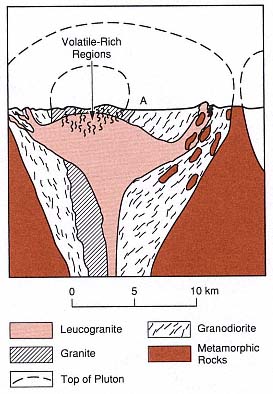
Fig. 4.2
Schematic cross-section of the composite,
subcaldera pluton that makes up the Uyaijah
ring structure in Saudi Arabia. "A" marks the
present-day ground surface. Dodge (1979)
postulated that this pluton once lay
beneath a caldera complex.
(Adapted from Dodge, 1979)
Eichelberger and Gooley, 1977; Hildreth, 1981). The viscosity of a cooling magma body can increase to the point where it stops rising and never reaches the shallow crust to erupt. Many caldera complexes are located in volcanic fields that exhibit bimodal volcanism: the more silicic rocks are in the center of the field overlying a silicic magma body and the basaltic lava fields are located around the flanks. Basaltic magmas trapped beneath a silicic pluton cannot pass through it because they are more dense and thus buoyant rise is suppressed; however, these magmas can rise to the surface along fractures in the brittle crust adjacent to a silicic pluton.
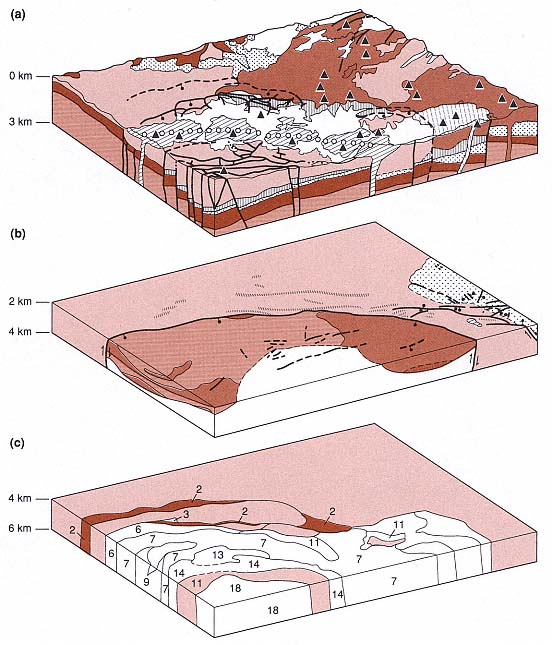
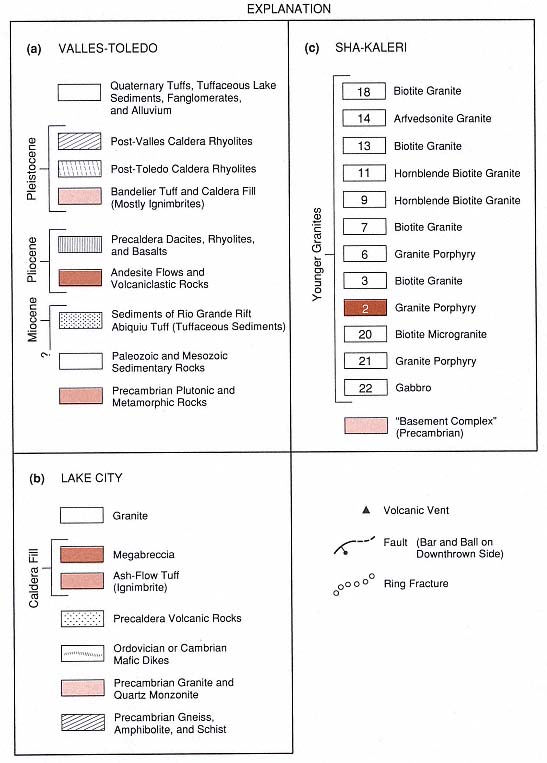
Fig. 4.3
These composite block diagrams schematically represent different levels below a caldera complex and
illustrate an igneous system within the upper 6 km of crust. These examples are from three different areas
where rocks are exposed or have been sampled by drilling. (a) Geologic map and cross-sections of the
north-northeast quarter of the Valles and Toledo calderas of the Jemez Mountains in New Mexico.
The geology is based on data and maps from Smith et al . (1970), Dondanville (1971;1978),
Slodowski (1977) and Hartz (1976).
(Adapted from Heiken and Goff, 1983.)
(b) The Lake City caldera in Colorado is similar to the Valles/Toledo calderas in size
and composition, and its interior has been well exposed by erosion. The upper
surface of the diagram is at a level that was originally ~2 km below the ground
surface present at the time of eruption, 22.5 million years ago.
Tuffs and interbedded breccias of the caldera fill are intruded by a silicic pluton.
(Adapted from Lipman, 1976.)
(c) This diagram is based upon maps of the Sha-Kaleri intrusive complex in northern Nigeria
by Jacobson et al . (1958). Interpreted as a cluster of plutons that were emplaced below a large caldera,
it may be analogous to the plutonic complex that underlies the Jemez volcanic field. The diagram
illustrates the potential complexity of a composite plutonic body below a caldera.
Mount Mazama Volcano, which erupted ~50 km3 of magma 7000 years ago, is a well-documented example of the basalt/rhyolite association required for the rise of a large silicic magma body. Rhyodacitic pumice was erupted first, followed by a mixture of the rhyodacite, crystal-rich andesitic pumice, and mafic-cumulate scoria (Bacon, 1989). When the caldera collapsed during the eruption, Crater Lake caldera was formed. Preeruptive magma temperatures ranged from 880°C for the rhyodacite and early andesite phase to >940°C for the late-erupted scoria phase. Analysis of H2 O in melt inclusions suggests that depth to the magma chamber was 6 km. Using 87 Sr/86 Sr ratios for the eruption products as evidence, Bacon suggested that the magma chamber grew during injection of multiple parent liquids, forming a hot lens between plagioclase-rich cumulates and the overlying rhyodacitic magma. A buoyant, differentiated melt mixed into the overlying rhyodacite and crystal mush to form a new cumulate layer. Basaltic fluids then penetrated the base of the cumulate pile. Had the caldera-forming eruption not occurred, crystallization would have formed a granodiorite pluton overlying a dioritic to gabbroic cumulate.
Large-volume, caldera-forming eruptions usually occur late in the history of a volcanic field. Most of these eruptions have been preceded by smaller scale eruptions of mafic to intermediate magmas—sometimes over periods of millions of years, as was described by Lipman (1984) and depicted in Fig. 4.4. This type of volcanic field may consist of dozens of vents, including those of composite cones, scoria cones, lava domes, and small calderas. Rarely, if ever, has a large, single composite cone collapsed to form a caldera. There are many examples of a complex volcanic field being developed before a caldera is formed, including Crater Lake in Oregon, where Howel Williams developed his caldera models (Bacon, 1983; Druitt and Bacon, 1986), Thira (Santorini) in Greece (Fouqué, 1879; Heiken and McCoy, 1984), and the Valles caldera in New Mexico (Smith et al ., 1970; Gardner et al ., 1986).