
Temples and Charitable Endowments
Nakarattar house construction in Chettinad shares much in common with house construction in other parts of South India (see, e.g., Daniel 1984, Moore 1990) and indeed with other architectural forms—most notably, temples. All such forms are influenced in varying degrees by a complex set of iconic architectural principles based on Hindu religious ideas about cosmic creation, sacrifice, and regeneration (cf. Beck 1976b; Daniel 1984; Kramrisch 1946; Meister 1983, 1986; Michell 1988; Moore 1990; Varahamihira 1869–74: Chs. 53, 56). The central idea is that properly designed buildings (kattitam: literally, "bounded spaces") represent an image of the personified Hindu universe in microcosm: creation spreading outward toward the eight cardinal directions from a central point where formless divinity is manifest, worshiped, and celebrated in ritual. The center/periphery contrast already noted for Nakarattar houses constitutes only a specific version of this core theme, which is expressed most dramatically in the relationship between the sanctum of the temple (Sk: garbagrihya , Tm: karpakkirikam: literally, "womb room") and its outer walls (cf. Meister 1986).
The floor plan for Ilayathakudi Temple (Plate 16) illustrates the relationship between central sanctum and peripheral shrines. In addition, it also reflects an architectural concern for locational significance defined along both a front-back axis and a right-left axis. The front-back orientation, already remarked in the case of houses, is reflected in Ilayathakudi Temple by the outward and easterly gaze of the temple's principal deity, Kailasanatasvami (Siva) and the inward, westerly, devotional gaze of devotees as they enter the temple through the pillared hall (muna mantapam ) and towered gateway (koparam ). The right-left orientation, expressed in Nakarattar houses by the placement of the kitchen (samayalarai ) and of the room for the seclusion of women, is expressed in temples by the location of the kitchen (matappalli ) and of a shrine for demon devotees (yakasalai ). In both the house and the temple, relatively pure entities and activities are positioned on the right-hand side of the divine center, and relatively impure entities and activities on the left-hand side.
The multiplicity of shrines to secondary deities in Ilayathakudi Temple is obvious (their names are given a Tamil transcription in the floor plan, Plate 16). Invisible is the division of honors (maryatai ) in the yearly round of rituals among different "shareholders" in the temple (kovil pankalis ). Also invisible is the rotation of rights (murai ) to sit on the temple board of trustees and the political interplay among trustees and other prominent members of the temple clan concerning any allocation of temple resources or conduct of ritual practices. See Chapter 7 for discussion.
Their apparent architectural invisibility notwithstanding, many of these political properties of the temple influence the construction of secondary shrines and the performance of rituals at all shrines—including, for example, the allocation of separate shrines to Ganesh (Tm: Kanapati —the elephant-headed son of Siva) to temple members from Peramaratur, Perasantur, and Sirusettur. A local historical reading of Ilayathakudi Temple is beyond the scope of the present study, but evidence suggests that temple architecture should be seen not only as reflecting general cosmo-logical principles, but also as reflecting and constituting locally specific political processes. Photographs of Iraniyur Temple (Plates 17 and 18) provide a glimpse of the material consequences of Chettinad ritual politics. A parallel secular manifestation is illustrated by the Raja Annamalai Mandram (music academy) in Madras (Plate 19; again, see Chapter 7 for discussion).
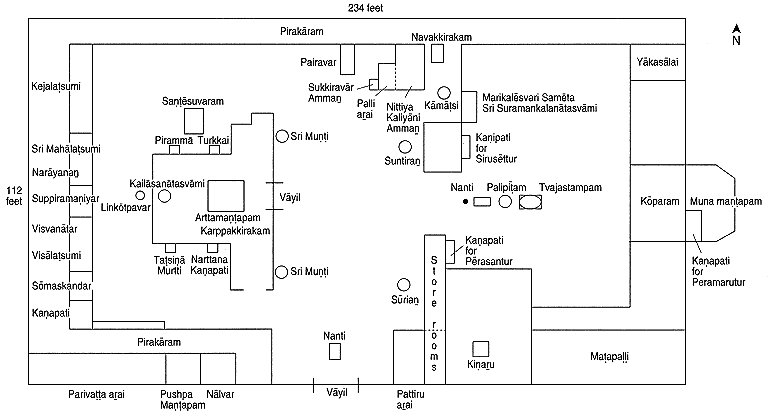
Plate 16.
Floor plan of Ilayathakudi Temple. Based on a drawing by V. Thennappan, Devakottai, July 5, 1981.
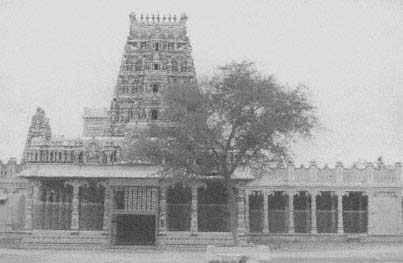
Plate 17.
Iraniyur Temple (exterior). Photo by Peter Nabokov.
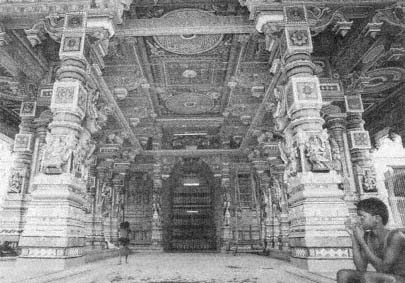
Plate 18.
Iraniyur Temple (interior of mandapam). Photo by Peter Nabokov.
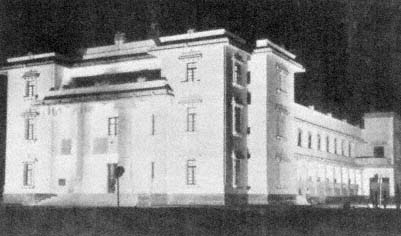
Plate 19.
Raja Annamalai Mandram (music academy and auditorium).
Reprinted from Annamalai University (1965).