
Sibsize and Aptitude/Achievement
Does the inverse relation of educational attainment and sibsize reflect, in part, a similar relation of intellectual ability or achievement and sibsize? In attempting to answer this question, we obviously want to avoid, as much as possible, interpreting relationships that have been confounded by the association of parental background characteristics and fertility, or by selection of various kinds. For this reason we will employ similar, in most cases identical, controls for parental background characteristics in each of the studies, as well as controls for whether the family is intact, region of the country, and, where possible, size of community. We use mul-
tiple classification analysis throughout so that exceptions to a regularly decreasing relationship with increasing sibsize will be visible. Additionally, in a final section of this chapter, we will deal with some "special effects" on the relation of sibsize and ability/achievement tests.
The controls used in this chapter markedly influence the shape of the relationship of sibsize and ability/achievement tests, as will be seen by comparing adjusted and unadjusted means in those cases where we present both. This analysis thus underscores the importance of such controls—controls that capitalize on our knowledge of the relation of parents' characteristics and their fertility.
For Cycles II and III of the Health Examination Surveys, figures 4.3 and 4.4 show both the unadjusted and the adjusted means by sibsize for the components of the WISC, Vocabulary and Block Design; the supporting data are in appendix C, table C.1.
Beginning with Cycle II, among the unadjusted means we see that Vocabulary is clearly the most important component for the relation with sibsize among this sample of children age 6 to 11. The difference between sibsize one (score of 53) and sibsize seven-plus (score of 43) is a standard deviation. In effect, 74 percent of the children taking the test had a score better than the average score obtained by children from sibsizes seven-plus. For Block Design there is only four-tenths of a standard deviation difference between sibsizes one and seven-plus. Adjustment for major background variables reduces the Vocabulary relation with sibsize somewhat, but it remains very strong. Even in the adjusted data it amounts to seven-tenths of a standard deviation. Controls substantially reduce the effects of sibsize on Block Design. There is clearly no only-child deficit.
In Cycle III, figure 4.4, the findings are essentially the same as for Cycle II except that the effects of sibsize are slightly less. It is notable in Cycle III that the only child clearly does the best on Vocabulary in both the unadjusted and adjusted data.
It should be noted, with regard to both Cycle II and Cycle III, that controls were introduced for the mother's labor force activity—whether she was working full-time, part-time, or had no job. No significant effect on the WISC, or either of its components, was evident. This result is not surprising since, as will be discussed in a later chapter, the literature on the effects on children's achievement of mother's labor-force participation rarely suggests much impact.
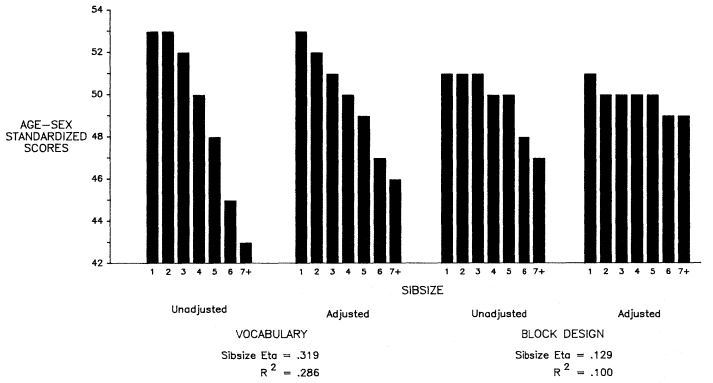
Figure 4.3.
Age–Sex Standardized Scores on Vocabulary and Block Design Components of the Weschler Intelligence Scale
for Children (WISC), Adjusted and Unadjusted for Parental Characteristics, White Boys and Girls, HES, Cycle II.
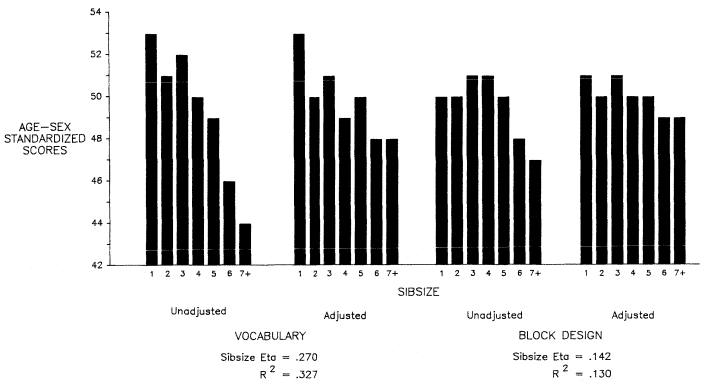
Figure 4.4.
Age–Sex Standardized Scores on Vocabulary and Block Design Components of the Weschler Intelligence Scale
for Children (WISC), Adjusted and Unadjusted for Parental Characteristics, White Boys and Girls, HES, Cycle III.
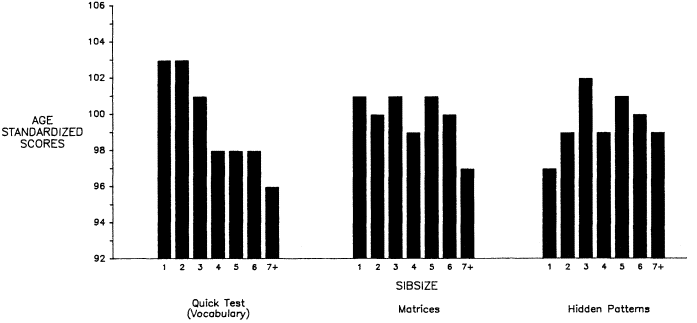
Figure 4.5.
Age Standardized Achievement Test Scores by Sibsize, White Boys,
YIT, High School Sophomores, Adjusted Means.
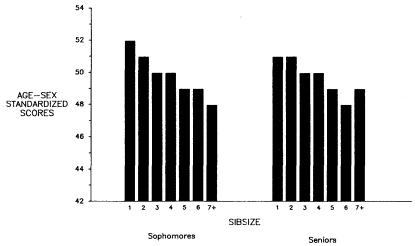
Figure 4.6.
Age–Sex Standardized Vocabulary Test Scores by Sibsize, White
Boys and Girls, HSB, Sophomores and Seniors, Adjusted Means.
One reason for the lack of effect appears to be that mothers who work spend almost as much time with their children as mothers who do not, and other relatives (including fathers) act as alternative child-care suppliers.
When we turn to the Youth in Transition high school sophomores, figure 4.5 (and appendix C, table C.2), and the High School and Beyond sophomores and seniors, figure 4.6 (and appendix C, table C.2), the relationship of verbal ability and sibsize is less than in the younger samples, quite probably because the high school samples have already been selected by sibsize (as we have seen in our analysis of the experience of adults). The relationship with sibsize for the other tests either disappears (figure 4.5 for Youth in Transition and table C.2 for High School and Beyond) or suggests that those from large families do slightly better. The persistence of verbal differences is noteworthy, however.
In sum, it seems clear that the most important aptitude/achievement influence of sibsize is on the vocabulary component of tests even after controls for parental background. These findings thus help to validate the earlier research we have discussed (by Nisbet, and by Davie et al.) and assist in explaining the strong association of sibsize ard educational attainment. The findings are also impor-
| |||||||||||||||||||||||||||||||||||||||||||||||||||||||||||||||||||||||||||||||||||||||||||||||||||||||||||||||||||||||||||||||||||||||||||
tant in suggesting that not all components of aptitude/achievement are much affected by sibsize, something about which we have had little information. This finding casts some doubt on claims that the sibsize–IQ relation is based on the possibility that parents of smaller families are genotypically more intelligent. Quite clearly, children from large families only suffer certain kinds of ability deficits—those that are known to be particularly associated with low levels of parent–child interaction. Unfortunately, since verbal ability is the principal cognitive predictor of educational success, this particular deficit has significant educational consequences for youngsters from large families.
It is worth mentioning that the diminution of vocabulary effects as students advance in school classes can be seen within the Cycle II and III samples (table 4.1) when these youngsters are tabulated by grade level. For high school students in Cycle III, we see a marked diminution of sibsize effects on Vocabulary compared with youngsters in lower grades. The discontinuity between the sixth- and seventh-grade scores in Cycle II and the sixth- through eighth-grade scores in Cycle III is due to the fact that each sample is standardized within itself. It is particularly clear from these data that as the grade levels increase, the scores of youngsters from large families improve proportionately much more than the scores for students from small families. We believe that these results are a consequence of school leaving (or being held back) by the less able students.
Although we know that school leaving (and being held back) among students from large sibsizes greatly changes the relation between sibsize and ability as youngsters go up the educational grade levels, a critic could argue that the diminution of sibsize effects is due simply to the fact that these effects are ironed out in the schooling process. Youngsters from large families make up the verbal deficit in school, and gain from school what youngsters in small families gained at home. Logically, this is a compelling point, and it would be more compelling if we did not already know that, in fact, there is a large differential drop-out rate by sibsize. Nonetheless, it is possible that both mechanisms are operating—selective drop-out and improvement.
One way of casting some light on the issue of a persistence of verbal deficiency by sibsize is to consider the results of a vocabulary
| ||||||||||||||||||||||||||||||||||||||||||||||||||||||||||||||||||||||||||||||||||||
test that adult respondents in the General Social Surveys take at the end of the interview session. In table 4.2, we have tabulated these test scores for individual sibsize groups by respondents' mothers' education (as an indicator of family environment) and by respondents' own education. From this table, it is evident that at each level of education for respondents and for mothers, there is a significant verbal deficit for respondents from large families compared to those from small ones. Even when respondents have gone to college, the deficit between small and large sibsizes remains, and it remains at each level of the mother's education among the college-educated.
To sum up our findings so far, it is clear that verbal ability (especially vocabulary) stands out in its relation with sibsize among all of the studies. Only-children excel in verbal ability—there is no only-child deficit. Moreover, there are important relationships with
sibsize even after adjusting for major family background characteristics. On other tests, the relationship with sibsize is much more modest, suggesting that a genetic interpretation of the relationship is unlikely. Finally, as we move from young children to high schoolers, the sibsize relation diminishes suggesting strong effects of selection by sibsize such as we have seen among our adult respondents. Although children from large families, if they stay in school, may gain some of the verbal ability that they did not get from parent–child interaction, a vocabulary test of adults in the General Social Surveys suggests a persistence of verbal deficits among those from large families.