
Chapter One
Ambiance, Rhetoric, and the Meaning of Things
Nun machen wit die phantastische Annahme, Rom sei nicht eine menschliche Wohnstätte, sondern ein psychisches Wesen von ähnlich langer und reichhaltiger Vergangenheit, in dem also nichts, was einmal zustande gekommen war, untergegangen ist, in dem neben der letzten Entwicklungsphase auch alle früheren noch fortbestehen.
Now let us consider a fantastic hypothesis: let us say that Rome is not a human habitation, but rather a psychic entity of similarly long and fruitful past, in which, however, nothing that existed has passed away and in which all earlier phases of development still persist along with the last phase.
Freud, Das Unbehagen in der Kultur
Ambiance and Rhetorical Theory
In the sixth book of the Ab urbe condita Livy tells of the trial for sedition of Manlius Capitolinus. Livy begins the narrative with the curious statement that Manlius was at first saved from conviction because of "the site" rather than because of his defense against the charges (6.20.5: damnandi mora plebi non in causa sed in loco fuerit ).[1] The trial took place in the Campus Martius, and the historian states that here the defendant delivered a magnificent speech: after rehearsing his great deeds and baring his breast to reveal the wounds he had suffered, he looked up to the Capitoline and called on the gods to inspire the Roman people
[1] Unless noted, all Latin and Greek quotes are drawn from Oxford Classical Text editions. For the De finibus, J. N. Madvig's 1876 edition (reprint, Hildesheim, 1963) was used; for the De legibus, that of K. Ziegler (2d ed., Heidelberg, 1963).
with the same spirit they had given to him when he had defended that place from the Gauls (6.20.8–9).
Livy had earlier prepared his readers for this appeal by noting that when Manlius had first been thrown into prison, the people asked one another whether they did not recall that night that had almost been Rome's last; whether they could not see again the Gauls scaling the Tarpeian Rock and Manlius, dripping with sweat and blood, as he had been when he had saved (so it seemed) Jupiter himself from their enemies (6.17.4). Manlius's speech had such force that, in spite of strong evidence of his guilt, the trial had to be adjourned by the prosecutors. Livy explains that the tribunes realized that it would be hopeless to attempt to secure a conviction in a place where people could be visually reminded of Manlius's glorious deeds (6.20.10: nisi oculos quoque hominum liberassent tanti memoria decoris, nunquam fore in praeoccupatis beneficio animis vero crimini locum ). The trial was later reconvened in the Peteline Woods near the Flumentane Gate, from which point the Capitol was said no longer to be visible, and there a guilty verdict was wrung from the reluctant jurors.[2]
What does the story imply about the use of ambiance as an element of persuasion? First, it seems clear that the effectiveness of Manlius's appeal in the initial trial was not due simply to the sight of a place (in this case, the Capitoline Hill) but depended as well on the gestures and words that manipulated the audience's feelings about that sight. The defendant, looking up from the place of the trial in the Campus Martius, reminded his listeners of what he had done and begged them to train their eyes on the Capitolium (the Temple of Jupiter and its precinct) and the Citadel as they judged him (6.20.9: orasse singulos universosque ut Capitolium atque arcem intuentes ). Second, mere verbal references to the associations of place do not function in the same way, at least according to the story, since Manlius's appeals proved insufficient to secure an acquittal once the venue of the trial had been changed to the Forum Boarium. What is suggested by the tale of Manlius, then, is a creative interaction of ambiance and actio by which an orator might incorporate allusions to the visible environment into his speech in order to manipulate the response of his audience to the speech.
[2] The topographical information in the story is analyzed by Wiseman, "Topography and Rhetoric."
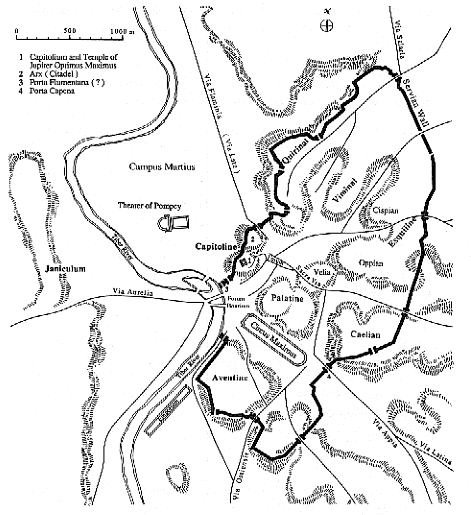
Fig. 1.
Republican Rome
This is not the only instance Livy gives us of a defendant exploiting the ambiance of a trial to his advantage. At the trial of Publius Horatius, who had killed his sister for mourning the death of one of the enemy Curiatii he had slain, the boy's father delivers a moving appeal within sight of the "Horatian Spears," the monument of Horatius's victory. Horatius's father, gesturing to the weapons his son had taken
from the enemy, asks whether his audience could bear to see the young victor "beaten, tortured, and bound to the yoke" (1.26.10). He continues:
Go ahead, lictor, bind the hands that, when armed but a little while ago, won dominion for Rome! Go ahead and veil the head of the liberator of this city; hang him from the barren tree! Beat him within the city walls—only let it be among the spears and armor of the enemy! Or flog him outside the walls—but let it be among the graves of the Curiatii! For where can you lead this young man in which the signs of his glorious achievements (sua decora ) will not save him from so horrible a punishment?
(1.26.10–11)
Livy states that the audience could not uphold Publius's conviction in the face of the "tears of his father" and the young man's extraordinary courage. Horatius was thus acquitted despite his legal culpability (1.26.12).[3]
Such striking illustrations would lead us to believe that this technique of persuasion might well have been a facet of Latin oratory as practiced both in Livy's time and earlier. This belief is strengthened by the fact that one of the most quoted passages in pre-Ciceronian oratory depends, at least in part, on an appeal to the visible. It is recorded that in a speech made a short time before his death Gaius Gracchus had asked: "Wretched as I am, where can I go? Where can I turn? To the Capitol? But it is soaked with my brother's blood. To my home? That I might see my mother—miserable, cast down, and in mourning?" That Cicero, Quintilian, and Julius Victor all quote the lines in connection with the
[3] The story of the Horatii and Curiatii contains aetiologies for several landmarks of Augustan Rome: the graves of the fallen warriors, the trophy of spears, and the tigillum sororium ("Sister's Beam"). See Ogilvie, Livy, 113 (ad 1.25.14), 116 (ad 1.26.10), 117 (ad 1.26.13). On the process by which stories connected with such monuments were created, Wiseman, "Monuments and the Roman Annalists," 89, comments: "We cannot simply assume that accurate knowledge of the true nature of such monuments survived till the beginning of the Roman historiographical tradition—and the same may be said of such other 'documents' of early history as the tombs of the Horatii, the tigillum sororium, the statues of Horatius Codes and Cloelia (or Valeria), the column of Minucius and the busta Gallica . The stories that accounted for them were part of the 'expansion of the past' (to borrow Badian's expressive phrase)—the elaboration into satisfying detailed 'history' of the meagre record of Rome's early past that was available to Fabius Pictor and Cincius Alimentus at the end of the third century."
discussion of effective gestures suggests that Gracchus must have raised his arms towards the Capitol when he spoke of it and that the passage preserves a memorable example of the effective combination of reference to ambiance and dramatic delivery.[4] The famous dilemma of Gracchus suggests as well that appeal to the visible environment was a facet of rhetorical training and practice long before Cicero's day. This thesis, however, receives little corroboration from the pages of the Latin rhetorical handbooks; explicit discussions of how an orator might exploit visible topography and monuments as a means of persuasion are nowhere to be found.[5] A number of references in such works to places that were not visible to the speaker's audience—a subject I shall examine in more detail in chapter 3—have at least an indirect bearing on the subject.
The description of places, for instance, is one aspect of "vivid description" (in Greek, usually termed enargeia, in Latin, often illustratio
[4] Cic. De or. 3.214: "Quo me miser conferam? Quo vertam? In Capitoliumne? At fratris sanguine madet. An domum? Matremne ut miseram lamentantem videam et abiectam?" Quae sic ab illo esse acta constabat oculis, voce, gestu, inimici ut lacrimas tenere non possent . Cf. Quint. 11.3.115; Julius Victor in Halm, Rhetores Latini minores, 443; and "G. Gracchus" (XXIII: Oratio extremis vitae diebus habita ) in Malcovati, Fragmenta, 1:196. On the form and the numerous examples of imitation of the passage in ancient times, see Bonnet, "Le dilemme de C. Gracchus."
[5] In discussing the concept of decorum, Cicero notes that the style of a speaker must be adapted to the type of case at issue, the size and composition of the audience, the character and status of each speaker, and the occasion of and time allotted for the speech (De or. 3.210–11; Or. 123). In his discussion of the same concept (11.1.8: quid deceat ) within an overall treatment of elements of style, Quintilian notes that the orator must consider the place where a speech is to take place (11.1.47): "It matters a great deal whether you are speaking in a public or private place, in one that is crowded or removed, in a foreign state or in your own, finally, in a military camp or in a forum: each place requires its own form and peculiar type of oratory (suam quidque formam et proprium quendam modum eloquentiae ), since even in other realms of life it would not be suitable to do the same thing in the Forum, the Senate house, the Campus Martius, the theater, or at home; and many things that are not naturally blameworthy and sometimes are even absolutely required would be considered disgraceful if done in a place other than allowed by custom." None of this can be said to deal explicitly with the exploitation of ambiance as an aspect of inventio, although the implications are there, since, in the practice—if not the theory—of forensic and deliberative oratory, style (elocutio ) can never be divorced from inventio (i.e., the strategy of persuasion employed in the speech). On this issue, see Neumeister, Grundsätze der forensischen Rhetorik, 33–34, 61–62 n. 7.
or evidentia ), which was generally treated by the rhetorical handbooks under the heading of Style. Vivid description refers to a technique by which an orator created the illusion of sight through the use of concrete details of description. His aim was to induce his listener to envision a person, a thing, a scene, or an event in the mind's eye, thereby rendering it immediate and affecting. Subsumed under this technique was the description of places (sometimes termed topographia or topothesia ).[6] The device seems in general to have been an important part of the orator's effort to arouse a strong emotional response in his audience, and the scenes given as examples of it are often those of high pathos, such as the depiction of the outrages to be expected when a city fell to a hostile army.[7] It might at first be supposed that this connection of detailed description with a pathetic appeal to an audience would have provided ancient rhetoricians with a basis for discussing the specific kinds of symbolic meanings attached to places and monuments, as well as ways in which these associations could most effectively be exploited. Such discussions would also, in turn, have revealed how an orator might draw on similar associations connected to aspects of the setting in which he delivered his speech. Unfortunately, no such discussions appear in the rhetorical handbooks of Cicero's day.[8]
Rhetorical treatises do note that description of places plays a role in two of the traditional divisions of a judicial speech, the narratio and the argumentatio . In sections dealing with the narratio, the orator is advised to consider carefully the place where an event occurred when describing that event. He is urged to review the physical characteristics of a place and its surroundings, as well as to consider such matters as "whether the place [was] sacred or profane, public or private, belonging to another or the property of him about whom one is speaking" (Cic. Inv.
[6] See Quint. 4.2.63–65 (evidentia, enargeia ), 123 (rerum imago ); 6.2.32 (enargeia ); 8.3.61–71 (enargeia, evidentia, repraesentatio ); 9.2.40–44 (hypotuposis, topographia ); Her. 4.51 (descriptio ), 63 (effictio ), 68 (demonstratio ). Zanker, "Enargeia," 298, states: "The rhetors, in their discussions of ekphrasis, see in enargeia the arete of pictorial description." He notes that the Greek terms ekphrasis and enargeia are used by some authors "almost interchangeably." See evidentia in Lausberg, Handbuch, 1:399–407 (§810–19), and further discussion below, pp. 89–102, 90 n. 3, 90–91 n. 4, 91 n. 5, 94 n. 11, 103 n. 26.
[7] E.g., Her. 4.51; Quint. 8.3.67–70.
[8] See below, esp. pp. 89–102, for further consideration of vivid description and its possible applications in rhetoric.
1.38) in devising an account that would appear credible to his audience.[9]
Before dealing with the importance of place to the argumentatio, or proof, a word of explanation is in order. Ancient rhetorical theory recognized different systems for classifying the kinds of arguments that would be of use to an orator faced with a variety of individual circumstances. Generally, the topoi, or sources of argument, were divided into those dealing with persons (a persona ) and those dealing with matters, usually actions (a re ). Among the topoi in the latter category were considerations of motive, place, time, means, and instrument. The arguments drawn from place were further broken down into those that concerned questions of fact, those that concerned questions of definition, and those that contributed to characterizing an action. It is obvious that these categories were derived from the method, primarily associated with the Hellenistic rhetorician Hermagoras, of determining the chief grounds of contention between two opponents, called status (or stasis ) theory. Generally speaking, this theory posited three strategies of defense: that derived from the fact alleged ("He didn't kill the man"), that derived from the definition of what was done ("He killed him, but it was self-defense, not murder"), and that derived from the character of the action ("He had to murder him in order to save the Republic"). Here the same questions (est? quid est? quale est? ) form the basis for determining the subcategories of arguments connected to place.[10]
The first of these categories (est? ), which dealt with those arguments concerning place that would aid an orator in proving the facts, involved
[9] Lausberg, Handbuch, 1:182–83 (§328), 210–11 (§§382–83). The grammarian Fortunatianus summarized the questions to be asked concerning the characteristics of place in the following way (Ars rhet. 2.3 = Halm, Rhetores Latini minores, 104):
1) aut naturalis, ut in mari, in monte, in campo;
2) aut positivus, ut in civitate; positivum quot modis consideramus? octo: a) publico, ut theatro, studio; b) privato, ut domo, villa; c) sacro, ut templo, adyto; d) religioso, ut mausoleo, sepulchro; e) infami, ut lupanari; f) intervallo, ut prope, longe; g) qualitate, ut contra, post, ante; h) quantitate, ut angusto, spatioso loco.
[10] See Cic. Inv. 1.38; Quint. 5.10.37–41; Lausberg, Handbuch, 1:210–11 (§§382–83) for arguments involving place. For status, see Quint. 3.6.1–104; Kennedy, Art of Persuasion, 306–14; Lausberg, Handbuch, 1:64–129 (§§79–238); Wisse, Ethos and Pathos, 93–95. A fourth status involved a defense based on procedural matters, taking up such questions as whether the prosecutor had the right to prosecute the case or whether the proper court was hearing it.
the same aspects of locus that the rhetorical handbooks also specified as elements to be considered in creating a believable account in the narratio . In the narratio, however, the orator took pains simply to insure that the objective and subjective characteristics of a place did not contradict his description of what had occurred there. In the argumentatio, on the other hand, similar characteristics of place were to be considered with a view to supporting the contention that an event must have occurred in the way the orator had represented it. As an example of this mode of argumentation, the rhetorician Quintilian, writing in the first century A.D. , refers to the Pro Milone . Here Cicero had argued that since the struggle between Clodius and Milo had occurred in the neighborhood of Clodius's estate and in a place in which Clodius and his retainers held the high ground, logic demanded that the audience conclude that it was Clodius who had ambushed Milo rather than vice versa.[11]
Considerations of place were sometimes relevant in questions of legal definition (quid est? ), for the law could view the same action as criminal in one place and innocuous in another or could term an act one sort of crime when done in one place and a different crime when done elsewhere. An example that can be cited from Greek law concerned the rights of a husband whose wife committed adultery. If the husband came upon the offending couple in flagrante delicto, the law allowed him to kill the lover; if, however, he planned his revenge and carried it out later, he could be legally charged with murder. The fact that a husband's murder of a lover took place in the husband's own bedroom would therefore be the basis for the argument that his action had been unpremeditated and therefore could not be described as murder.[12] Again, the prosecutor of a man accused of robbery might argue that since a theft had taken place within a temple, the accused was guilty not merely of theft but of sacrilege.[13]
Under the final category mentioned above (quale est? ) were subsumed those arguments connected to place that concerned the quality
[11] Quintilian (5.10.37) is clearly referring to this passage (Mil. 53) when he states that Cicero carefully analyzed the characteristics of place in devising his argument in the Pro Milone .
[12] The example is drawn from the situation described in Lysias's On the Murder of Eratosthenes . The prosecution in the case claimed that Eratosthenes had been killed at the hearth begging for mercy, which the defendant denied.
[13] See Quint. 5.10.39. Cf. Arist. Rhet. 1.14.6 (1375a11–13), in which he notes that wrongdoing can be greater if done in a particular place; for instance, lying in a court of law.
of an action. Here the orator went beyond the mere legal definition of an act and attempted to use the place where an action occurred to characterize it, not only in terms of legality or illegality but according to extralegal standards of propriety (decorum ) and justice. Thus a defendant might argue that an act was rightly (if not legally) done simply because it occurred in a particular place, while an accuser would hope to demonstrate that because of the place where it occurred, a particular action was especially blameworthy. After alluding briefly to arguments of this sort, Quintilian comments that arguments connected to place "are also effective in securing praise and blame" (5.10.41: ad commendationem quoque et invidiam valet ). To illustrate this sort of appeal he cites two examples (5.10.41). The first, drawn from Ovid's Metamorphoses, reminds the reader both of Livy's description of Manlius's appeal before the Capitoline Hill and of his account of the appeal of Horatius's father before the "Horatian Spears." In the passage cited by Quintilian, Ajax argues his claim to the arms of Achilles by directing the gaze of his audience to the Greek ships that he had saved from burning and before which the dispute was being decided (Met. 13.1–6).
Quintilian's second example refers to the charge of Milo's prosecutors that the defendant had killed Clodius before the monuments of his ancestors (Mil. 17). Before looking more closely at this citation, it is worth noting that Quintilian might well have pointed to several other kinds of exploitation of the associations of place to be found in the Pro Milone . In sections 83 and 84 of the speech Cicero speaks of the death of Clodius as the result of the fortuna of the Roman people and the will of the gods. He appeals to "the very hills and groves" of ancient Alba, which had been defiled when Clodius cleared large tracts of forested land; to Alba's "ruined altars," buried by Clodius's building projects; and to Jupiter of Mount Latiaris, whose lakes, forests, and enclosures had witnessed Clodius's crimes (85). This sacred landscape both ordained and witnessed Clodius's death. Cicero then declares that it was not by chance that Clodius had been killed near the shrine of the Bona Dea, whose rites he had earlier polluted; this goddess, too, had taken part in the divine retribution meted out to Clodius (86). It has already been noted that Cicero used the place where Clodius's death occurred to claim that Milo's act was self-defense rather than murder. In this passage the orator argues that even if Milo's act were to be described legally as murder, the very location where the incident took place showed that Milo had acted justly and as an instrument of divine vengeance in ridding the state of Clodius.
The Pro Milone not only provides this striking example of the use of place to characterize an action but includes as well an attempt to attack the validity of this same strategy of persuasion. Quintilian states (5.10.41) that Milo's accusers had charged that the defendant had killed Clodius on the Appian Way, among the monuments of his forebears. The topic must have furnished one of the chief sources of pathos for the prosecution, as it would have allowed the accusers to expatiate on the tragic irony of Clodius's demise on the road built by Appius Claudius Caecus and amidst the tombs of the Claudii that stood along that road. Its success with the audience and judges can be gathered from Cicero's need to refer to it three times in the speech he later published. In the exordium of the speech Cicero derides the notion that parricide is a greater crime when the victim is an ex-consul rather than an ordinary man, or that the death of Clodius was more cruel simply because it occurred among the monuments of his famous forebears (17). Again, a few lines later, he exclaims against the "great melodramas" (quantas tragoedias ) called forth by the name of the Appian Way (18); and at the end of the argument (91) he once more speaks of "those who complain about the Appian Way," reproving them for their lack of concern for Rome itself. Although Quintilian finds it necessary to posit this strategy of "praise and blame" as a fourth category of arguments drawn from place, he seems actually to be referring to the emotional impact that could be derived from expanding on arguments of quality. Whether the technique should be classed under a separate heading or simply as an aspect of arguments of quality, it is clear that careful consideration of the physical aspects and psychological associations of a particular place was understood to provide the orator with opportunities for manipulating the feelings of his audience about actions that had occurred there.
It seems clear that a Roman orator was trained (a ) to observe and describe concrete details of a place in order to provide his listeners with a vivid and moving description of a particular scene and the actions that occurred there, (b ) to consider the objective and subjective characteristics of particular places in creating a convincing narration, (c ) to draw on these same characteristics in claiming the inevitability of his version of events in the argumentatio, and (d ) to use associations of specific places to manipulate the feelings of his audience. An orator trained and practiced in using these techniques to exploit the associations of places and monuments not visible to his audience would obviously be well equipped to draw on the characteristics of the place where he gave his speech as well, in order to amuse, convince, or arouse his listeners. It
remains to be determined, however, whether the aims and effect of references to visible topography and monuments might have differed from the use made of verbal representations of places that were not visible to an audience. This question will be explored in more detail in chapter 3 through the analysis of the role played by Cicero's description of certain works of art, monuments, and topography in the fourth part of the Second Action against Verres.
It is worth noting that the use in persuasion of aspects of visible (as well as unseen) environments might well have been treated within a number of other rhetorical categories in addition to those mentioned above. For instance, the appeal to topography, statues, monuments, and the like could have been subsumed under the topic of "inartificial proof." Inartificial or nonartistic proof (atekhnoi pisteis ) was that provided by direct evidence, such as documents, laws, and the testimony of witnesses, including that of slaves who had been examined under torture.[14] Although a variety of commonplaces existed to deal with such evidence, ancient rhetorical theory held that these kinds of proofs were "discovered" rather than "invented" by an orator. There are hints that Cicero might have seen the appeal to monuments and places as a form of inartificial proof. In the Verrines, the Temple of Castor—which would have been visible to the (hypothetical) audience—did not actually constitute direct evidence, since absolutely nothing could be deduced in support of Cicero's allegations against Verres simply by looking at it: in the first references to the temple (11.1.129–54) the monument functions merely as the visible focus of what is actually proved through argument, the testimony of witnesses, and the introduction of pertinent documents. And yet Cicero speaks of the temple as if it were, in fact, an inartificial proof, for it is not the gods Castor and Pollux but the building itself that is called a testis of the crime (11.1.154: aedem Castoris testem tuorum furtorum ). This section of the speech ends with a statement that the eyes of the judges would be trained on the temple as they pronounced their verdict. A similar sort of conceit is also found in the De imperio Cn. Pompei (30—31). Here Cicero calls the entire Mediterranean world—Italy, Sicily, Africa, Gaul, Spain, "all shores and foreign lands and peoples, finally, all the sea, both in its whole expanse as well as in all its individual inlets and harbors"—to be "witnesses" (testes ) to the virtue of Pompey.
[14] Arist. Rhet. 1.2.2 (1355b35–39); 1.15.1–33 (1375a22–1377b12); Kennedy, Aristotle, 108–18.
Quintilian's allusion to the "praise and blame" that might be connected to specific places and things suggests that the topic could also have been dealt with as an aspect of epideictic or demonstrative oratory (and epideictic passages incorporated in deliberative and forensic speeches). In a section of the Institutio oratoria devoted to the genus demonstrativum, Quintilian states that an orator might on occasion be called on to praise cities, public works (such as temples and walls), and localities (3.7.26–27). And, turning to more general praise of places, we also find that among the "externals" that the Ad Herennium lists as a source of laudation and its opposite is "citizenship" (3.10: civitas ).[15] This idea of praising or censuring an individual by alluding to the positive or negative aspects of a place with which that person is connected appears to be closely related to a crucial source of persuasion in forensic oratory: the probabile ex vita argument, whereby an orator makes an action attributed to an individual seem credible by placing it within a general description of the mode of life of that person and the milieu in which that life was lived.[16]
It must be acknowledged, however, that even if ancient rhetoricians had explored all of these avenues in attempting to classify the role of ambiance in persuasion, the Greek-derived structure of Latin rhetorical treatises would have made it difficult to provide an adequate theoretical description of the technique. Appeal to the visible milieu seems to have played practically no role in ancient Greek rhetorical practice; it is hardly surprising, therefore, that Greek rhetorical theory was ill suited to its description.[17]
The Spirit of Place
While the material on ambiance gleaned from the rhetorical handbooks is limited, certain passages from Cicero's later philosophical and rhetorical works shed additional light on the subject. Although the De oratore does not refer explicitly to the use of the setting of a speech as a source of persuasion, it is significant that the setting of the dialogue itself is
[15] For further citations, see Lausberg, Handbuch, 1:133–35 (§§245.I; 247.1, 2) and 204–5 (§376.2, 3, 6, 7, 11).
[16] Cic. Inv. 2.32–37; Her. 2.3–5.
[17] See Pöschl, "Zur Einbeziehung anwesender Personen," 213–16, for the negligible role played in Greek oratory by persons and objects present during a speech.
made to play an important role in inspiring the conversation about oratory that takes place among Crassus, Antonius, and the others. At the beginning of the first book of the work (1.24–29), Cicero recounts how Q. Mucius Scaevola, Marcus Antonius, Gaius Cotta, and Publius Sulpicius assembled at Crassus's villa at Tusculum. On the second morning of the visit, the group is enjoying a pleasant walk when Scaevola suggests to Crassus that they "imitate Socrates as he appeared in the Phaedrus, " for a spreading plane tree on Crassus's estate had reminded him of the plane tree of Plato's dialogue. It was this dialogue, says Scaevola, that had caused the tree to become famous, rather than the "little rill" that flowed beside the tree. He then declares that the rest Socrates had enjoyed "with his tough feet" ought even more readily be allowed to his own feet. Crassus agrees to the proposition, whereupon the entire group reclines under the plane tree.
Cicero had several reasons for beginning the De oratore in this way. On a purely artistic level, the vivid description of the scene introduces the characters and engages the interest of the reader in what they will say. The image of the plane tree with its cool shade and spreading branches and the realistic representation of the elegant conversation suggest the scene strongly to the reader's mind. Secondly, by his allusion to the scene of the Platonic dialogue, Cicero clearly hoped to signal that his own work, like the Phaedrus, would be of a philosophical character, far removed from the sterile prescriptions of the rhetorical textbooks.[18]
But one can go farther. The scene suggests as well that the experience of a locus can call to mind specific associations and that these associations, in turn, can move and inspire. The reader of the passage inevitably recalls the potent effect of the landscape on Socrates in the Phaedrus: how the fragrant plane tree, the clear, cold water, the breezes, the
[18] See Cic. Att. 13.19.4 and Fam. 1.9.23 on the philosophic character of De oratore . While the connections between the De oratore and the Phaedrus are not limited to superficial allusions (Cicero, like Plato, wished to connect rhetoric with a kind of knowledge), there is much that is un-Platonic, even anti-Platonic, in Cicero's description of the ideal orator. For general background to Greek philosophic sources of the work, see Michel, Rhétorique, 80–149; Leeman and Pinkster, De oratore, 65–67 (for Cicero's allusions to Plato and their meaning); Guthrie, Greek Philosophy, 4:412–17; Solmsen, "Aristotle and Cicero on the Orator's Playing upon the Feelings" (for the Platonic vs. the Ciceronian view of the ideal orator). See Wisse, Ethos and Pathos, 151–52, for the Aristotelian mise-en-scène at the beginning of book 2, complementing Platonic parallels at the beginning of book 1.
music of the cicadas, and the lush grass provoke Socrates to stop and rest; how he warns Phaedrus, after calling the spot a "divine place" (238d: theios . . . topos ), that he must not be surprised at the sort of speech he might deliver there; and how, after delivering a speech that he considers blasphemous, he feels himself prevented from leaving the place until he can substitute another, truer discourse. Plato had described Socrates, then, as drawing inspiration from the locus where he made his speech, reacting creatively and uncharacteristically—even mystically—to what he felt to be a sacred landscape.[19] Cicero not only alludes to this scene but depicts the characters in his own dialogue reacting to the associations of a similar setting. Crassus, as well as Scaevola, is affected by this atmosphere, for he is persuaded by the younger members of the group to do what he had never been known to do previously—deliver an extended disquisition on the nature and practice of oratory.
We should note, however, the degree to which Cicero has civilized and rationalized his topographical model. The characters in the De oratore do not, like Socrates and Phaedrus, wander in the countryside; they stroll around the manicured walks of Crassus's estate. When they are inspired to recline on the grass under the shady tree, they immediately send their slaves for cushions to sit on. Most important, Scaevola is depicted as drawing inspiration from the intellectual associations of the place rather than from the natural setting itself: the plane tree that he sees reminds him of the plane tree described by Plato, and the thought of that Greek plane tree is moving not simply because the tree was beautiful but because the dialogue that occurred under it was "divine."[20]
Cicero's emphasis here, at the beginning of his magnum opus con-
[19] See Parry, "Landscape," 17: "The ambiance [of the Phaedrus ] is one to suggest and reinforce that vision of natural truth with which Socrates wishes to counter Lysian rhetoric. Here the gods still live, who have no place in the sophistic milieu of the town"; and Walter, Placeways, 146–50.
[20] In general, the urbane setting of the De oratore seems to guarantee the civility and predictability of the locus, while the Greek setting in nature contains hints of violence (the Orithyia legend) and unpredictability (the mystic power ascribed to the place). On the Ciceronian plane tree as a symbol of rhetoric itself, see Piderit and Harnecker, De oratore 38–39 (§19). See also the discussion of the "Marian oak" in Leg. 1.1–4. Cicero evidently hoped that his epic poem on Marius would give the Arpinate oak the same sort of eternal symbolic existence as the Phaedrus had given the plane tree of the dialogue.
cerning the nature of oratory, on the emotional response to the associations of setting suggests his consciousness of its importance in persuasion. In addition to this passage, statements that testify strongly—if indirectly—to the importance of this source of persuasion can be found in two of Cicero's philosophical works, the De finibus and the De legibus . The former, a discussion of the ethical philosophy of Antiochus, is set in the Athens of 79 B.C. Cicero depicts himself and his friends on an afternoon stroll from the house of Marcus Piso to the Academy. When they reach the walls of the Academy, Piso remarks:
Naturane nobis hoc, inquit, datum dicam an errore quodam, ut, cum ea loca videamus, in quibus memoria dignos viros acceperimus multum esse versatos, magis moveamur, quam si quando eorum ipsorum aut facta audiamus aut scriptum aliquod legamus? . . . tanta vis admonitionis inest in locis; ut non sine causa ex iis memoriae ducta sit disciplina.
(5.2)
Is it inborn in us or produced by some trick that when we see the places in which we have heard that famous men performed great deeds, we are more moved than by hearing or reading of their exploits? . . . So great a power of suggestion resides in places that it is no wonder the Art of Memory is based on it.
The passage turns on the response each of the characters makes to various loci . When Piso looks on the grounds of the Academy he recalls Plato and his disciples, comparing the experience with the feelings he had when looking on the old Curia in Rome, a building that had always brought to his mind the great Romans of an earlier generation; Quintus's eye turns to the village of Colonos, recalling Sophocles and his depiction of Oedipus arriving at that place; Atticus predictably speaks of the many hours he has spent in the gardens of Epicurus; while Cicero tells of the impression left on him by his visit to the house of Pythagoras in Metapontum and refers to the hall in Athens in which Carneades used to sit. The youngest member of the group, Lucius Cicero, admits to walking along the beach where Demosthenes had practiced his speeches and to visiting the tomb of Pericles. Lucius ends by exclaiming that wherever they walked they encountered some reminder of the past (5.5: quacumque enim ingredimur, in aliqua historia vestigium ponimus ).[21]
[21] The phrase is especially difficult to translate, as the meaning of historia not only included all the kinds of associations mentioned by the characters in the dialogue (literary, philosophical, historical), but the Roman concept of the past was quasi-religious as well. See Pöschl, "Die römische Auffassung der Geschichte." Note also that here vestigium refers to the marks of the present. In the passage from De legibus discussed below (pp. 31–33), it refers to the traces of the historical past; while in In Verrem II.4.107 the term refers to the signs of the ancient inhabitation of the gods of the Sicilian landscape.
This introductory scene ultimately abandons Piso's original question concerning the mysterious power of place and ends with Cicero's neat but unsatisfying statement that historical loci were useful in stirring young men like Lucius to emulate the great men of the past. We, however, may read another lesson in the text. The passage demonstrates the way in which places can stimulate the imagination, the memory, and the intellect. This power is not limited to Athens, for both the Curia Hostilia and the scenes of Pythagoras's activity in Italy are brought into the discussion. Clearly, both the places that possess this power and the particular associations called to mind by the places are as various as the temperaments and preoccupations of the individuals depicted.
In attempting to explain their response to particular milieux, however, several of the characters make use of the same verb: movere . Piso begins with the question of why people are more "moved" (moveamur ) by seeing a place associated with famous men than by merely hearing or reading of their deeds. He goes on to declare that he himself is "moved" (ego nunc moveor ). A few lines later, Quintus Cicero states that he is "greatly moved" (5.3: commovit ), and his brother Marcus uses the word as well (5.4: ego illa moveor exhedra ). The characters thus emphasize the emotional nature of their response to places. This, in turn, strongly suggests the importance of the phenomenon for Latin oratory, for in numerous passages from the rhetorical works Cicero asserts that the ability "to move" an audience was one of the three chief goals of rhetoric and that it was the possession of this ability that was the distinctive quality of the true orator.[22]
The De legibus provides a parallel to the passage discussed above.
[22] On the pathetic appeal, see Solmsen, "Aristotle and Cicero on the Orator's Playing upon the Feelings," esp. 225–26; Schick, "Cicero and the Pathetic Appeal," 17–18; Michel, Rhétorique, 235–70; Wisse, Ethos and Pathos, 250–300; and De or. 1.17, 53, 60; 2.178, 215; Brut. 276, 279, 322; Or. 69, 128. For the three goals of oratory (delectare, docere, movere ) see De or. 2.115, 128, 310; 3.104; Or. 69; Brut. 185, 276; Opt. gen. or. 3. Piso's comment concerning the "Art of Memory" will be explored further below (pp. 100–102).
Here Cicero, his brother Quintus, and Atticus take a walk in the Arpinate countryside, admiring its beauties.[23] At first it seems that Cicero's attachment to the place stems only from the natural charm of the landscape, but he soon reveals (almost confessionally) that he is especially moved by the associations called up by the place with his own family history.[24] Atticus, in turn, declares that he would thenceforth be particularly attached to the villa and to the very earth of the place, for it was here Cicero had been born. He continues:
For we are in some strange way affected by the very places that carry the imprints (vestigia ) of those whom we love or admire. My beloved Athens delights me not so much by the stunning monuments or the exquisite works of antiquity found there, but rather by recalling to my mind great men—where each one lived, where he used to sit and carry on disputations; why, I even enjoy looking on their graves.
(2.4)
In depicting his own feelings about the scene of the dialogue, Cicero here testifies to the potent symbolism that had endowed, we might even say "inspirited," a locus with special meaning for him. In the case of Atticus, on the other hand, the passage demonstrates a process. At first, while admitting to the charms of the landscape (2.2: ad requietem animi delectationemque . . . natura dominatur ), Atticus experiences no profound feelings about it. Only when the same place becomes connected in his mind to thoughts of his friend does it become a source of strong emotional attachment "from then on" (2.4: posthac ). Further, he relates this process to his feelings about Athens, a city filled with constant reminders for him of the great men who once lived there.
Here again, as in the passages quoted from the De oratore and the De finibus, it is not chiefly "nature" that moves the participants in the dialogue but the association of particular landscapes with human history. There is a contrast implied between places that bear the spiritual imprint of the past, the "erlebte Welt" in Ernst Römisch's expressive
[23] Römisch, "Mensch und Raum," draws on this passage in his discussion of the Roman sense of place. On differences between a modern appreciation of nature and Cicero's, see Davies, "Was Cicero Aware of Natural Beauty?"
[24] 2.3: si verum dicimus, haec est mea et huius fratris mei germana patria. Hinc enim orti stirpe antiquissima sumus, hic sacra, hic genus, hic maiorum multa vestigia. . . . Qua re inest nescio quid et latet in animo ac sensu meo, quo me plus hic locus fortasse delectet.
phrase, and those that are devoid of human association, such as the wilderness.[25] No philosophical distinction, then, is to be drawn between city and country in this respect, for both are milieux pregnant with meaning. Further, Atticus's remarks about Athens (as well as the passage from the De finibus ) make clear that a place outside the imperium Romanum was as likely as Arpinum to provoke emotional responses in the Romans depicted in the dialogues.[26]
Cicero does, however, make an important distinction between the strength of feeling generated by his place of birth and that felt for Rome, the patria iuris .[27] In section 2.5, after a rather dry explanation of the concept of dual citizenship, Cicero suddenly declares that the Republic must overshadow the land of one's birth in caritas; that to it we must consecrate our lives and for it we must even be willing to die. The orator concludes the passage with the statement that his native land was scarcely less pleasant to him (dulcis . . . non multo secus ) than that other, greater homeland.
In spite of this passionate language, Cicero makes the basis for his connection to Rome a good deal less comprehensible than the basis for his weaker attachment to Arpinum;[28] but because he has used the same
[25] For the phrase, see Römisch, "Umwelt und Atmosphäre," 128. Note that when Atticus thought that the landscape was actually wild, he could not understand Cicero's attachment to it (2.2: nihil enim his in locis nisi saxa et montis cogitabam ). Cf. Lucas, Greatest Problem, 176–77: "The first time I saw the cloud-topped mountain ridges of Acroceraunia from the Adriatic, or the Leucadian Promontory white with sun and storm, or Hymettus, purpled with sunset, from the Saronic Sea, was something intenser even than poetry. But the same shapes and colours would not have seemed the same in New Zealand or the Rockies. Half their transfigured splendour came from the poetry of two thousand years before, or the memory of that other sunset on Hymettus when the hemlock was brought to Socrates." See also comments by Tuan, Topophilia, 93–95, 99–100.
[26] As in the passage from the De oratore quoted above (pp. 26–28), Cicero here wishes to call to mind the scene of the Phaedrus while at the same time suggesting symbolically the differences between the two: Socrates had waded in the cool waters of the Ilissus; Atticus alludes to this scene but pronounces the water of the Fibrenus too cold to test—reminiscent of the reluctance of characters in the De oratore to recline directly on the grass.
[27] See Salmon, "Cicero Romanus an Italicus anceps."
[28] The text is, unfortunately, corrupt at the point at which Cicero indicates the fundamental difference between the two patriae (2.5: Sed necesse est caritate eam praestare <e > qua rei publicae nomen universae civitati est . . .). See, however, the similar passage in De or. 1.196: Ac si nos, id quod maxime debet, nostra patria delectat, cuius rei tanta est vis ac tanta natura, ut Ithacam illam in asperrimis saxulis tamquam nidulam adfixam sapientissimus vir immortalitati anteponeret, quo amore tandem inflammati esse debemus in eius modi patriam, quae una in omnibus terris domus est virtutis, imperi, dignitatis? ("And if our own native land delights us, which it certainly should—a thought that contains such power and natural force that Odysseus in all his wisdom preferred to immortality that Ithaca of his, affixed like a small nest amidst the most precipitous crags—with what passionate love, then, ought we to be fired towards a fatherland of this sort, one that is the sole terrestrial abode of virtue, dominion, and respect?"). Römisch, "Mensch und Raum," 227, comparing the vocabulary of the text with other Ciceronian passages, defines caritas as "die von Natur gegebene, gefühlsbetonte Verbundenheit, es ist die Liebe der Verwandten untereinander, die zugleich Verpflichtung umfasst."
terms of his feelings for Arpinum and of those he cherished for the Republic (caritas/dulcis ), the distinction drawn is one of degree (maior ) rather than of kind. The reader, therefore, may deduce the grounds for the greater from the lesser, and Cicero's attachment to Rome—the physical embodiment of the res publica —may be understood by examining the reasons for his attachment to his place of birth. Of the latter he had said to Atticus: "For in this place we [i.e., Cicero and his brother Quintus] sprang from a most ancient line; here are our holy rites, here our kindred, here the many reminders of our ancestors" (2.3: Hinc enim orti stirpe antiquissima sumus, hic sacra, hic genus, hic maiorum multa vestigia ). These same concepts can be readily transferred from a familial to a communal context. The Romans, who traced their origin to the Latin founder Romulus and the Trojan Aeneas, also claimed to have sprung from ancient roots.[29] As Arpinum was the site of the sacra privata of Cicero's family, Rome held the sacra publica of the Roman people. And as the places of his native land moved in Cicero memories of his forebears, in Rome there were countless reminders of the semidivine ancestors who had changed Rome from a small and struggling state into a great one. The description in the De legibus of Cicero's emotional attachment to the places that spoke to him of his own history and identity thus reflects the deeper connection of the Romans to places in Rome of communal symbolic significance—places that spoke to them of their history as a people and of the meaning of the Republic.[30]
[29] E.g., Verg. Aen. 12.166: Aeneas, Romanae stirpis origo .
[30] The feeling of this passage is so close to that found in the speech of Camillus on the meaning of the site of Rome in Livy 5.51–54 that direct Ciceronian influence on Livy seems probable. For stylistic parallels between Camillus's speech and Cicero, see Ogilvie, Livy, 743.
In one of the last speeches he delivered, the Pro rege Deiotaro, Cicero spoke of the oratorical inspiration he drew from such places of shared symbolic meaning. The oration was delivered in camera in 44 B.C. before Caesar, who had arrogated to himself as dictator all judicial power. In the speech Cicero complains of the difficulty of speaking within a private house, isolated from the people and scenes that had inspired him in the past (5). He then imagines the oration he would be capable of if he were allowed to speak in the Forum: "If only, Gaius Caesar, I were defending this case in the Forum, with you looking on and judging, what excitement I would draw from the assembled throng of the Roman people! . . . I would look on the Senate house; I would gaze upon the Forum; finally, I would call on heaven itself" (6).
The passage is strangely moving. In rhetorical terms it can be classed as a predictable ingredient in the successful prooemium: the plea for goodwill and sympathy based on the persona of the orator himself.[31] And yet it reads not so much as an appeal as a reminiscence. Cicero reminds Caesar—the other great public speaker of the age—of the oratorical power he had wielded in the past and complains that the changes the dictator has wrought have denied him two important sources of rhetorical effectiveness: first, the interaction between the orator and a vast popular audience, and, second, the setting in which that interaction took place. The passage illustrates Cicero's realization that great oratory, like great drama, demands both an audience and a stage.[32]
Ambiance appears to have played a key role in Ciceronian rhetoric.[33]
[31] For appeal from the persona of the orator, see, for example, Cic. Inv. 1.22; Her. 1.8; Quint. 4.1.6–10.
[32] Cf. the complaint of Secundus in Tacitus's Dialogus de oratoribus that contemporary oratory was vitiated by the fact that, unlike in an earlier generation, it had no great public stage on which it was practiced (39: "For the orator needs noise and applause, just like in a kind of theater. This was always the case for the ancient orators, when at the same time so many and such noble individuals crowded the Forum; when clients, as well, and fellow tribesmen and embassies sent from the towns and Italian representatives appeared in support of those on trial; and when in many trials the Roman people believed that their own interests were at stake").
[33] In fact, a passage from the Pro Plancio suggests that Cicero was well known for his recourse to this strategy, for in the speech he refers to the prosecutor's fear that if the trial of Plancius were to coincide with the ludi Romani, Cicero would make a pathetic appeal for the defendant based on the sight of the sacred couches of the gods carried in procession through the Forum, just as he had on previous occasions (Planc. 83). Cf. Crassus's use of a Gallic shield hanging in front of a shop to ridicule his opponent (in De or. 2.266) and analysis of this passage in Perl, "Der Redner Helvius Mancia."
The subject has received slight attention from modern commentators, although two scholars have at least pointed the way to further study. Victor Pöschl has examined Cicero's references to individuals present during his speeches. His work reveals a striking contrast between Cicero's practice and that of ancient Greek oratory, a contrast he attributes both to the emotional and flexible temperament of the Romans and to the idea that "consensus," or the perceptually expressed will of the majority, was understood by the Romans to be a barometer of truth.[34] Complementing Pöschl's analysis is a series of articles by Römisch that explore various aspects of the meaning of Cicero's references to place. In the first of these, the passage from the De legibus referred to above (2.1–8) provides a starting point for a meditation on the unique political-emotional-spiritual connection that bound the Romans to their environment. In later articles Römisch has cited a variety of passages from the speeches, the letters, and the philosophical and rhetorical essays as part of his examination of Ciceronian thought concerning places of symbolic (i.e., political, social, religious, or historical) significance.[35] The most recent of these articles has shown how Cicero's description of the scene outside the Temple of Concord in the fourth Catilinarian was transformed into a demonstration of the consensus omnium supporting the boni .[36]
While Pöschl and Römisch have thus identified a previously ignored aspect of Ciceronian persuasion, much concerning the orator's use of this technique remains unexplored. Even a brief survey demonstrates, first of all, that references to the visual milieu are of varying complexity. Certain passages are clearly of limited impact on the overall strategy of the speeches in which they occur. Allusions to familiar places, for instance, sometimes function as a kind of shorthand of characterization. The technique is familiar from a much-quoted passage in Plautus's Curculio (461–86) in which the choragus instructs the audience regarding the places where they may find a variety of individuals: perjurers can be
[34] For comments and bibliography on the idea of Roman "collective morality," see Pöschl, "Zur Einbeziehung anwesender Personen," 216–18, 218 n. 21; Oehler, "Der consensus omnium."
[35] See Römisch, "Umwelt und Atmosphäre"; "Mensch und Raum"; "Cicero."
[36] Römisch, "Satis Praesidii."
found in the Comitium, liars and braggarts at the shrine of Venus Cloacina, rich spendthrifts and prostitutes sub basilica . The list goes on, mentioning many of the landmarks of the Republican Forum.[37] Cicero uses a similar technique in calling a certain Aebutius in the Pro Caecina "a fellow who hangs around the Regia" (14); or in the Divinatio in Caecilium in asking why Caecilius does not seek a defendant of his own class "near the Maenian column" (50); or in speaking of Naevius and his associates in the Pro Quinctio as individuals who can be found in "the Licinian [auction] halls" and at the entrance to the market (12; 25).
Other allusions to the visible milieu were intended simply to add vividness to abstract formulations. In the Pro Roscio Amerino, for instance, Cicero's claim that an unjust decision by the judges will unleash violence and anarchy is supported by his declaration that it is now up to the judges to prevent murders from being committed "here in the Forum, before the tribunal, . . . before your feet, judges, among the very benches of the court" (12). In the Pro Quinctio the orator attempts to impress his audience with the idea that the future of Roman justice hangs on the acquittal of Quinctius by declaring that either Truth will prevail or, driven from "this place," it will never again find anywhere to rest (5). Again, in the Pro Sestio, describing the destitution of public life after he had been forced into exile, Cicero asks: "Whom has the Curia missed more? Whom has the Forum more lamented? Whom have the very tribunals longed for as much? At my departure all became deserted, bitter, silent, full of tears and grief" (128). Through the use of this quasi-poetic anthropomorphism (a comparison with Daphnis's absence from the woodland comes inevitably to mind), Cicero no doubt hoped to heighten the pathos attached to the memory of his departure.
In many speeches, we find that Cicero makes powerful but relatively straightforward appeals to the religious and patriotic associations of the chief monuments visible from the Forum. Thus the fourth Catilinarian refers to the Curia, termed "the greatest haven of refuge for all peoples" (2: summum auxilium omnium gentium ); the De lege agraria 1 speaks of the Arx, the "citadel of all peoples" (18: arcem omnium gentium ); and, again in the fourth Catilinarian, Cicero declares that the Republic commends to the protection of the assembled senators "herself, the lives of all the citizens, the Arx and the Capitolium, the altars of the Penates,
[37] Cf. subbasilicanos (Plaut. Capt. 815); subrostrani (Cic. Fam. 8.1.4); canalicolae (Fest. 40 L.); forenses (Livy 9.46.13).
that eternal fire of Vesta," and the temples and shrines of the gods, the walls and buildings of the city (18). Such passages are of great value in revealing to us the chief intellectual and emotional associations of the major monuments of the Capitoline and the Forum, and they can stand beside the great speech of Camillus in the fifth book of Livy's history or the depiction of Aeneas on the site of Rome in the eighth book of the Aeneid as evocations of the symbolic meanings attached to such places in the first century B.C.
Of greater interest in this work, however, is the process by which Cicero not only drew on the more accessible preexisting associations of monuments and topography but attempted to emphasize certain less obvious associations at the expense of others, as well as to create new meanings that would interact with preexisting associations to further his rhetorical aims.[38] The Pro Scauro provides a particularly clear example of this technique. In the speech, Cicero states that wherever he looked he found material for his defense of Scaurus (46: quocumque non modo mens verum etiam oculi inciderunt ). He then connects each of a series of the most prominent monuments of the Forum with an event or idea redounding to the credit of the Scauri. The Curia calls to
[38] The study I propose responds to the need to understand literature in the context of its historical reception. As Jauss argues, the effect of a new work of literature is felt by a reader "not only within the narrow horizons of his literary expectations but also within the wider horizon of his experience of life" ("Literary History as a Challenge to Literary Theory," 18). Of this interaction between the experience of literature and that of real life, Jauss writes: "The orientation of our experience by the creative capability of literature rests not only on its artistic character, which by virtue of a new form helps us surmount the mechanical process of everyday perception. . . . But the new form . . . can also make possible a new perception of things by forming the content of an experience which first appears in the form of literature. The relationship of literature and reader can be realized in the sensuous realm as stimulus to aesthetic perception as well as in the ethical realm as a stimulation to moral reflection" (37–38). (Cf. Jauss's Towards an Aesthetic of Reception, 41: "The horizon of expectations of literature distinguishes itself before the horizon of expectations of historical lived praxis in that it not only preserves actual experiences but also anticipates unrealized possibility, broadens the limited space of social behavior for new desires, claims, and goals, and thereby opens patterns of future experience.") Jauss speaks of two separate experiences: the experience of literature changes the subsequent perception of reality. In respect to the manipulation of visual stimuli, however, rhetoric is able to create a simultaneous process: the orator alters his listeners' sensual and moral perception while they are in the very act of perceiving.
mind the illustrious senatorial career of Scaurus's father (46); by his restoration of the Temple of Castor and Pollux, Scaurus's grandfather seemed to have "established" (46: constituisse ) the gods in the sight of the jurors so that these deities might be able to intercede with them to win the acquittal of his grandson; the Capitoline temple of Jupiter Optimus Maximus, Juno Regina, and Minerva called to mind the generosity of Scaurus's father and of Scaurus himself, who had made generous gifts for its adornment (47); and the shrine of Vesta reminded the jurors of the heroism of Lucius Caecilius Metellus, an ancestor of Scaurus's mother, Caecilia Metella. As Pontifex Maximus, he had rescued the Palladium—symbol of the well-being of the state—from the flames that had threatened to destroy it when the shrine had caught fire in 241 B.C. (48).
In this section of the Pro Scauro, the manner in which Cicero uses the visual milieu to manipulate the feelings of the audience towards his client is relatively unambiguous.[39] In the case of two of Cicero's most celebrated orations, the first and third Catilinarians, however, his use of the associations of place is not so obvious; my analysis of the exploitation of setting in these works will therefore be the subject of the next chapter.[40] This analysis must, of course, rely upon the received texts of the speeches, and, as scholars have pointed out for generations, these texts are not transcriptions but reflections—sometimes clear, sometimes muddied—of the words actually spoken when the speeches were delivered.[41] It has often been argued that the Catilinarians in particular show evidence of Cicero's desire in 60 B.C. to turn the speeches into apologiae for his actions at the time of the conspiracy.[42] While it is probably cor-
[39] For further discussion of this passage, see below, pp. 102–3 n. 25.
[40] In spite of the existence of an extensive bibliography responding to the manifold literary and rhetorical aspects of these speeches, no work has hitherto attempted a systematic study of how appeal to ambiance actually functioned in the overall strategy of each oration.
[41] The speeches that we know to have been delivered form a continuum between the Oratio post reditum in senatu, which was said to have been taken down word for word, and the Pro Milone, which differed markedly from the speech Cicero actually made in defense of Milo. On the relationship between the received texts and the original orations, see Humbert, Les plaidoyers écrits; Laurand, Etudes, 1:1–23; Stroh, Taxis und Taktik, 31–54; and above, pp. 8–9.
[42] See, among others, Draheim, "Die ursprüngliche Form der katilinarischen Reden Ciceros"; Bornecque, Les Catilinaires, 145; Fuchs, "Eine Doppel-fassung in Ciceros catilinarischen Reden"; Kennedy, Art of Rhetoric, 176–81.
rect to assume that certain lines might well have been added in redaction, those who have claimed to be able to identify numerous specific passages in each of the speeches that were not part of the originals have tended to ignore the importance of the excised portions to the thematic development of the whole. Nevertheless, I must here reiterate that any analysis of actio –that is, the speech as delivered–is to some extent theoretical. Thus the question that will be answered in the next chapter is, How do the transmitted texts of the first and third Catilinarians demonstrate the ways in which Cicero might have made use of the setting of the speeches to achieve his ends?