
2—
Urban Design Practice, Euro-American Style
Just as architectural languages were brought to America by immigrants from Europe, so too recent urban design theory has been a European import. And like architectural styles that came before, European ideas about guiding urban building have been adopted and employed largely without scrutiny. Does this heritage of European urban design theory and practice in fact provide a satisfactory basis for revitalizing and sustaining American towns and cities? The answer is a qualified no. This chapter characterizes the ways in which the four directions in European urban design theory discussed in the preceding chapter have been transposed to American cities and have failed.
First, however, an explanation is needed. Why do the ideas of people like Lewis Mumford, Clarence Stein, Edmund Bacon, Victor Gruen, Jonathan Barnett, Paul Spreiregen, Kevin Lynch, Christopher Alexander, and Frank Lloyd Wright not constitute a distinctive, appropriate, and American urban design theory? In his criticism of planning practice and his praise of particular urban qualities, Mumford has evidenced urban values but has not offered what can be called a theory of urban design. Stein's values and practice were closely related to functionalist thinking in Europe, though with greater attention to small-scale humanist concerns than many functionalist European schemes. But Stein did not formulate a comprehensive theory of urban design related to the development or rejuvenation of urban centers in America. His focus was on new towns with a suburban cast: "The sane policy is first to direct our energy toward building new and complete communities from the ground up: that is to say on open land outside developed urban areas." The "obsolete patterns" of existing cities should be replaced comprehensively, following the model for new towns.[1] In his schemes for Philadelphia, Bacon offers not a unique American vision but a reflection of the systemic and formalist concern for efficient movement and for the aesthetics of urban design.
Victor Gruen's impact on American cities is perhaps greater than that of any other individual, and his model of an urban core circumscribed by trafficways, handy parking lots, and a pedestrian mall is a feature of many urban plans. But Gruen proposes not a theory of urban design so much as a stock solution to the problems of cities choked with cars. The roots of
his proposals are European; and although his willingness to admit the importance of the automobile gives his schemes a recognizably American cast, he constructs no theory about the nature of the urban setting or about broad goals and the methods to achieve them. Furthermore, his underlying assumption that the foci of the urban core are shopping and parking is too limited.
Barnett's work, which has spurred and supported urban design in America, is devoted principally to methods of implementing goals rather than to defining them for the urban setting. Hamid Shirvani's book The Urban Design Process is more comprehensive.[2] But even though it identifies certain values, design processes, and implementation tools, it offers no theoretical construct to link them. Urban Design: The Architecture of Towns and Cities , by Paul Spreiregen, offers historical and recent examples of urban form, techniques, and programs but no theory to guide the process. Kevin Lynch's Theory of Good City Form would seem promising, but even he admits that his theory is only "partial."[3] His book considers form but not process, and it strives for a universal theory of urban form, not one keyed to places (for example, American cities). In Lynch's work, like that of the others, we find value but not sufficiency.
Christopher Alexander's "new theory of urban design" seems in sympathy with our view that actions taken in the city need to recognize what already exists and that the process of interaction is what counts. But by his own admission his theory does not acknowledge the economic, ownership, and political realities of American cities. Moreover, it does not draw its lessons from American cities as they are but rather from an academic exercise. The quality on which his theory focuses—wholeness—is good; but like other theorists, he cites mostly non-American towns to exemplify the quality. It is our contention that the foreign settings that have the quality of wholeness probably were not the products of theories but of processes very much like those we describe below.[4]
If any American can be credited with an urban vision distinguishable from European precedents, it is Wright. His Broadacres idea assumes that land is readily available and affordable, that everyone needs personal transportation, and that people prefer suburban settings to living in cities. These assumptions and values are integral to his conception of democracy and contrast sharply with what he calls the monarchical European tendency toward centralization of government, services, and housing: "As centralization was the natural 'monarchy,' . . . men were compelled to centralize and revolve as closely as possible around an exalted common center, for any desirable exploitation of the man-unit. The idea of democracy is contrary. Decentralization—reintegrated—is the reflex: many free units developing strength as they learn to function and grow together in adequate space, mutual freedom a reality."[5] But the focus of our analysis is the possibilities and potential for existing urban centers, not alternatives to urbanization like Broadacre City.
To explore the impact of European urban design theory in America and to see how it falls short, we examine a typical American situation, an industrial city of nineteenth-century origin whose urban center declined
economically and deteriorated physically as a result of suburban development and normal aging. Our method, reflected in the following lists, is to identify the problems and their causes and then to see how developments based on European models have fared in the revitalizing of this American city.
Typical Causes of Center City Decline
1. Loss of housing and employment from the city center
2. Exodus of retail activities from the center
3. Increased use of automobiles because of inadequate public transportation
4. Congestion, inconvenience, and reduced environmental quality because of automobile traffic and parking
5. Abandonment of outdated and inadequate buildings and facilities in the older city center in favor of newer facilities elsewhere
6. The association of downtown with environmental deterioration and undesirable social groups—derelicts, the poor, those who are different from most middle-class Americans
7. Cost and difficulty in assembling land for development
8. Deteriorating and costly infrastructure
Typical Motivations for City Center Improvement
1. Damaged civic pride because an economically, physically, and socially weak city center makes a poor impression
2. A persistent image of what a city center should be
3. Declining sales tax revenues
4. Declining property and income tax revenues as businesses and wealthy residents leave the center city
5. The loss of jobs to competing suburban employment centers
6. Loss of residents
7. Deterioration of buildings, infrastructure, and environmental quality
8. Increasing crime
With these problems to solve and these motivations for solving them, Americans in the last three or four decades have initiated projects to reverse the decline of city centers. Because there was nothing like a corpus of American urban design theory on which to draw, urban reclamation efforts in America have relied either on expediency (what can be done easily and cheaply that will solve problems for the time being) or on planning ideals drawn from European theories. Some of the American applications of European ideas are striking and well known. For example, New York's Stuyvesant Town closely resembles Le Corbusier's functionalist schemes for Paris and elsewhere. Pruitt-Igoe in St. Louis and Robert Taylor "homes" in Chicago similarly grew from Corbusian or post-Bauhaus images and reasoning. Like other American versions of Eu-
ropean ideals, these are watered down or, perhaps, to be fairer, beaten back with laments about cost and government intervention and waste of money. Most often American versions of European ideas fail for lack of capital or conviction and inadequate analysis of context and need.
As a case study we examine Milwaukee, Wisconsin, and its efforts to build foreign ideals in an American city. Established in the late eighteenth century, Milwaukee a century later was a thriving export center for grain and an industrial center that for a time outshone and then rivaled Chicago. As in many American cities of the period, immigrants formed a substantial part of the population, so it is not surprising that ideals for the city's development often had a foreign cast. One early instance is particularly noteworthy. A development called Garden Homes was probably the earliest example of publicly supported housing in the United States. The city and county of Milwaukee invested in the Garden Homes cooperative development, which drew inspiration from British model towns like Port Sunlight, Letchworth, Bourneville, and Hampstead Garden Suburb (all of which were commemorated as street names in the Garden Homes development). The concept of a cooperative ownership program seems to have been drawn from Germany. The dream of affordable owner-occupied housing for the working class was short-lived, however. Only 105 housing units were built between 1923 and 1927, when the project was liquidated. This European ideal was only the first to fail in Milwaukee's increasingly Americanized soil.[6]
It is to more recent efforts at urban development and revitalization that we address ourselves, however, in particular, the reaction to suburbanization. Like many other cities, Milwaukee suffered from the exodus to the suburbs following World War II. Remote shopping centers competed with and then outdistanced the downtown retail center. The federal bulldozer and riots in the 1960s sped the decline. By the early 1970s the city's downtown was fourteenth in sales among the region's fourteen shopping centers. Milwaukee has a relatively stable population of 750,000 in a growing metropolitan region of roughly 1,500,000.
In considering Milwaukee's efforts to reconstitute and revitalize its central city using European theories of urban design, two features should be noted: how the European vision was modified or compromised, for whatever reasons, and how individual schemes failed to have the larger impact promised, that is, how they failed to catalyze further revitalization.
The ineffective efforts at solving Milwaukee's center city problems suggest that the guiding ideas borrowed from Europe were inadequate to the American context and circumstances and that insufficient attention was paid to other, more dynamic, mechanisms of revitalization. Although this chapter characterizes Milwaukee's early efforts as failure after failure, false start after false start, chapter 3 describes subsequent urban design efforts in Milwaukee in quite another way. In the mid-1970s something happened to end the course of failures and initiate a chain reaction of successes. From our point of view, Milwaukee in the 1970s forgot about European models and found another way to revitalize itself, a distinctively American way. But first, the application of European theory.
Functionalism
Functionalist theory offers no specific model for counteracting the problem of suburbanization. We must infer from European practice an approach to keeping residential, retail, and employment concentrations in the center city. The functionalist answer would probably be to make the center city more like suburban developments, with palatable shopping complexes that segregate pedestrian and vehicular traffic and housing that blends urban and suburban amenities. Because land costs in the central city necessitate a high density of population and a concentration of uses, country living is brought into the city in the form of towers in a park or, in the case of employment centers, towers above parking podiums that are made plazalike.
One benefit of recasting the center city in this way is the concomitant renewal that must accompany such extensive restructuring. (In Europe this kind of development was necessitated by war damage; it has only recently been a voluntary reaction to perceived decline and deterioration.) As light, air, and greenery are increased, new structures built, and parking facilitated, outdated, nonfunctional buildings can be replaced. Middle-class occupants can move in to replace the "undesirables" who typically occupy declining urban centers. Functionalist theory does not make clear how large parcels of land are assembled for large-scale restructurings other than through the power of central governments to claim land on behalf of the public good. When that is the method, its high costs are subsidized by those beyond the scope of any given redevelopment project.
The Vision of Towers in a Park
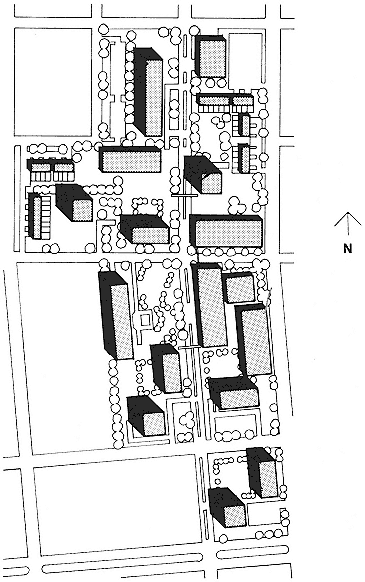
The ideal of functionalist theory, Euro-American style, may be seen in Milwaukee's Juneau Village development, which, once constructed, demonstrated the theory's failure. The development followed in the wake of the federal bulldozers that leveled poor and working-class neighborhoods near downtown so they could be replaced with middle- and upper-income enclaves. To entice the new population group downtown, the functionalist ideal of highrise towers in a parklike setting was chosen, with an adjacent pedestrian-oriented shopping center to offer the amenities of a village and to minimize trips beyond the safety of the enclave.
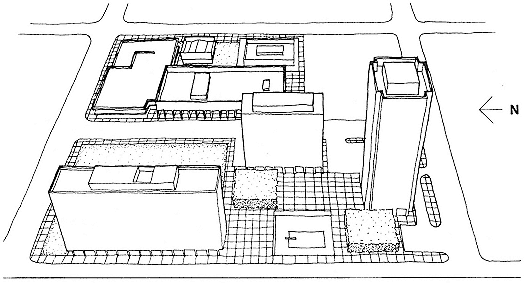
Functionalist theory argues that because automobiles interfere with human activities, vehicles should be separated from pedestrian areas. In extreme cases this separation means peripheral highways and peripheral parking. In the case of Juneau Village, it meant closing two streets and placing automobiles in underground or structured lots largely masked from public view yet connected to both housing and shopping precincts. The development is located within walking distance of downtown offices. The initial phase included three towers and a shopping center.
Juneau Village was envisioned as a step toward a functionalist revitalization of Milwaukee's downtown. It was not potent enough, how-
16.
Original scheme for Juneau Village, designed by Solomon,
Cordwell and Associates, Chicago, 1965–1967.
ever, to sustain even its own completion, let alone to lead or give impetus. No one seems to have had the necessary conviction to will the remainder of the development into being. And, a point we shall stress throughout the chapters that follow, the architecture itself offered no clues to the relation of the development to existing neighborhoods or to the ways succeeding developments should respond to it. The architectural vocabulary was alien to the past and too narrow to guide the future.
As built, the initial stage of Juneau Village was not large enough to restructure its context. Then too, the design was not appealing enough to stimulate a new market of renters or buyers. Although its failure to be realized is most easily blamed on economic conditions and middle-class
17.
Bird's-eye view of the part of Juneau Village that was actually built.
18.
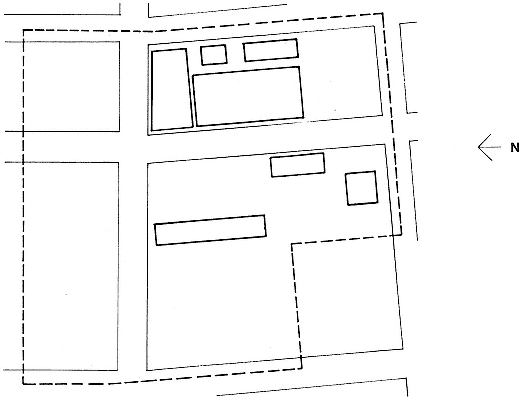
Juneau Village, plan of the section actually built, showing adjacent areas thatwere cleared as
part of the urban renewal effort.
19.
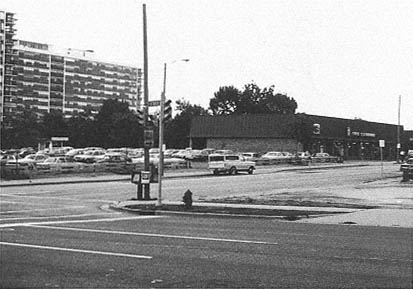
Part of Juneau Village, with shops seen to the right, and part of the site that
was used for twenty years for incidental parking.
prejudices, there is another explanation: Juneau Village failed both to recognize its context and to accept a role as catalyst in shaping the character and future of its American neighborhood. In short, it was inert, a seed on foreign soil. The transplanted European functionalist vision was not quite right for this American context, nor did it have sufficient conviction to motivate and shape a following.
For years the bulldozed areas around this early stage of Juneau Village lay empty. When it became clear that the village offered no model for subsequent development, pragmatic, visionless alternatives were approved and built in the form of suburban-style garden apartments. That Juneau Village usually is fully occupied testifies not to its actual or conceptual appropriateness or to its potency but to the raw need for housing.
Such transplants of European ideals need not inevitably fail. Our message, which we shall repeat, is that the implanted foreign idea will not succeed on its own merits but must be customized for its American context and must have the power to shape a subsequent context. These processes are discussed in chapter 3.
The Vision of Superblocks
Consolidating elements of the traditional urban plan into superblocks is another feature of functionalist theory. Smaller blocks are joined to form larger ones, and traffic is guided around these. In downtown Milwaukee this treatment was confined to institutions like Marquette University and, in a small way, the Milwaukee School of Engineering, which now spread
across former city streets. Such consolidations of institutions across city rights-of-way may be less a product of functionalist thinking than of American campus archetypes, rural groves of academe and academic fortresses walled off from their urban surroundings. But whatever the rationale for creating them, the superblocks in Milwaukee remained isolated instances. They had no significant impact on the shape, character, and fortunes of downtown Milwaukee.
Although superblock strategy was implemented at Juneau Village, where two streets were closed, the area was not restructured in any significant way. Planners of the development specified that pedestrian bridges were to be built to avoid traffic, thus working toward a similar goal of consolidation, but the bridges were not built. Like every other vision imported to restructure downtown Milwaukee, this one was tentative and incomplete and lacked conviction.
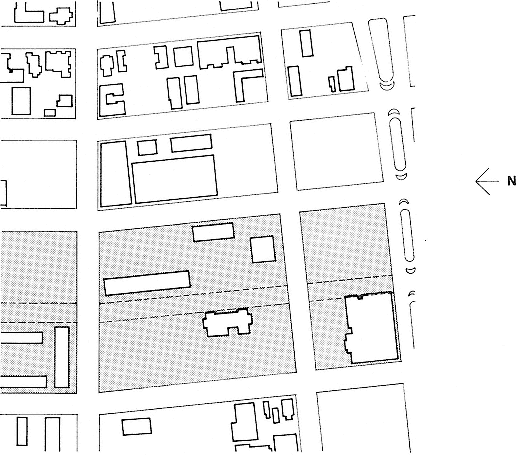
20.
Juneau Village (center and left) and the Milwaukee School of Engineering (right) "superblocks."
Humanism
Humanist thinking appears in isolated and limited instances in American city centers, usually where a single governmental jurisdiction or private developer has had the will and the power to introduce a design in which the quality and pleasure of the immediate human experience are primary concerns. Humanist efforts take three forms, implementing visions of what we call townscape, participation, and heterogeneity.
The Vision of Townscape
Pedestrianized shopping malls that are achieved through street closures have been introduced to make center cities more attractive to pedestrians by wedding the informality of medieval town plazas to the convenience and safety of enclosed suburban shopping complexes. Shopping malls in city centers have been designed to eliminate or restrict vehicular traffic because, it is argued, vehicles compromise the pedestrian experience of the city. The pedestrianized street, like the functionalist urban precinct, was also a European import that in most cases was implemented on American soil without conviction and with little sense of the urban context beyond the individual mall. The early, highly touted, mall on the main street of Fresno, California, failed to have the anticipated impact. It saved the downtown from utter desertion; but it did not revitalize major retail activity in central Fresno. Pedestrian malls in Battle Creek, Michigan, and scores of other cities had even less effect. Nicollet Mall in Minneapolis and Kalamazoo Mall in Kalamazoo, Michigan, by contrast, have been more successful. The difference between Kalamazoo's mall and others, what makes for success, is discussed in chapter 4.
Perhaps the central error of well-meaning public officials and the business community in the many cities where pedestrian malls have failed has been to assume that people want from downtown only convenient parking and a decorated path or, in harsher climates, a sheltered and decorated path. It takes more than basic shelter, low-budget fountains, and "sculpture," however, to transform a dying retail area into an urban place that actually attracts people. Unfortunately, many badly conceived, badly designed, and ineffective Main Street malls litter America. Face-lifting paint-up programs have been similarly unsuccessful in transforming moribund town centers and in radically modifying perceptions and the behavior patterns of consumers. Urbanism does not spring from cosmetics.
Milwaukee's most notable effort toward humanist revitalization has been the reclamation of North Third Street, a collection of turn-of-the-century commercial and industrial structures at the edge of downtown. A two-block area has been both renovated and dressed up. Furniture, like the wooden bench in Figure 22, has been added to make the street seem more hospitable. The result is an area of businesses and offices with an identifiable, visually rich character. Unlike pedestrianized street schemes, Third Street remained open to traffic. Although the area was intended as an initial, catalytic, phase of a reclamation process that would work its
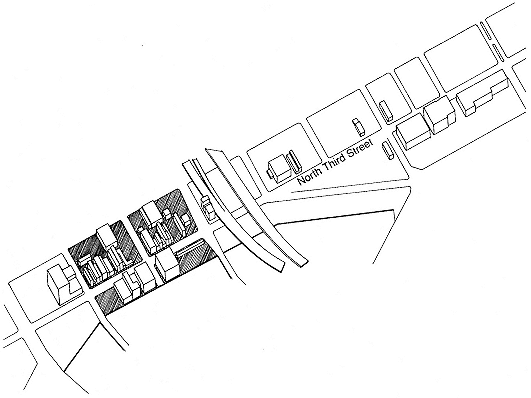
21.
North Third Street. The area actually rehabilitated is darkened.
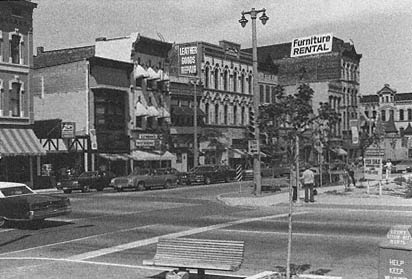
22.
The part of North Third Street that was refurbished.
Photograph by Paul Pagel.
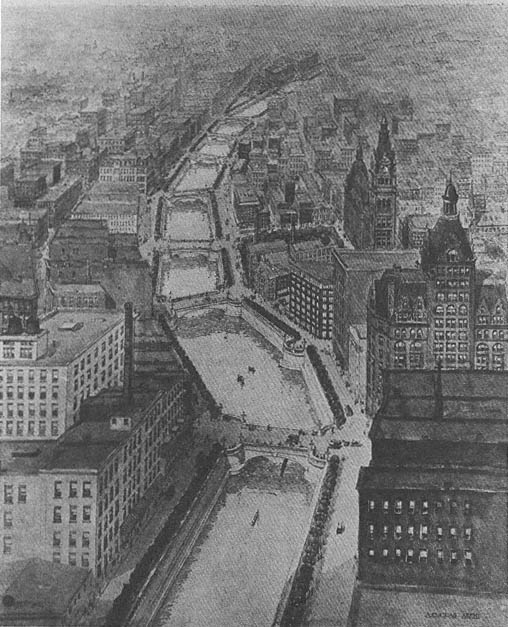
23.
Alfred C. Clas's scheme for developing the edges of the Milwaukee River for public use.
The view is to the north. City Hall is to the right of center.
way the entire length of deteriorated Third Street, this was not its effect. Instead, the renovated area stands out as an isolated decorative feature in the cityscape, not as an integral and potent part of the city's life and business.
There is too often, as with Milwaukee's Third Street, an erroneous sense that just doing something is enough. But it takes more. Despite the efforts of both the owners and the occupants of the area's buildings, new development did not follow the directions set. A crucial corner lot that should have provided a vivid gateway to the Third Street area is now occupied by a parking lot and an anonymous undersized box of a building. There is no declaration of the area, nothing that marks it as distinct from downtown. The vision for Third Street was not sufficiently compelling; its economics were not impelling; its politics were unwise.
The quality of pedestrians' experience is a persistent concern in humanist thinking. The townscape should be visually satisfying to persons on foot or cycling; pedestrians should "feel at home," feel that they have a place in the city, that they are not alien to it. They should be able to encounter the richness of life as it is actually lived, not single, sanitized, swatches of life.
Milwaukee, like most American cities, did not come to terms with the issue of the pedestrian's experience. This is especially curious since the city and the county have expended considerable resources on parks that enhance pedestrian (and recreational) experiences of nature beyond downtown. But with few exceptions, this commitment does not take the form of a rich and satisfying urban, man-made Milwaukee in the city's core.
Milwaukee's lengthy effort to create riverwalks is a case in point. When the Milwaukee River declined as a focus of commerce and industry, proposals were made to turn it into a European-style amenity with extensive promenades. One of these came from a prominent local architect, Alfred C. Clas. Clas's scheme was not built, however, and instead of a comprehensive, forward-looking program of riverwalk development, only isolated and independent sections appeared, without reference to one another or to an overall vision of riverside pedestrian ways as a humanizing feature.
Following Clas's lead, other architects attempted to revive the idea, but nothing substantial happened. At best, one or two isolated stretches were erected, but without conviction, for they established no link to anything else. In short, they did not acknowledge their context, nor did they realistically anticipate or mold a future.
The Vision of Participation
What we call townscape schemes to rejuvenate Main Street and historic commercial centers are but one aspect of humanist concern. Another, in which the United States, in some ways, is further ahead than Europe, is to involve people in the molding of their own environments. Home owner-
ship is more usual in America than in Europe; do-it-yourself modifications are a concomitant pleasure. Americans seem to have a greater choice of places to live and ways to live. In this sense, "nesting" and "making places" are quite widespread in America.
Yet as construction and financing costs have risen, the choices have become narrower, those able to make them fewer. And more to our point, personal involvement in shaping environments is restricted to home turf. The character of the center city is usually the province of public bureaucracies, developers, and financing institutions. Although citizens can try to take charge of center city areas through neighborhood action groups, these groups typically have little power.
The preservation of historic areas and neighborhoods, another European idea imported to America, is possibly the most successful of the imports. But only what already exists can be preserved; preservation allows no shaping of new neighborhoods and new city centers.
Milwaukee's other efforts to mold areas near downtown have been well-meaning but far from noteworthy. For years reclamation of the old warehouse district south of downtown was discussed, and a few individuals risked time and money in renovating and adapting a few buildings for new uses. These efforts did not turn the tide, however, nor did they precipitate widespread action by others. Efforts by merchants east of the river in downtown Milwaukee were similarly ineffective. Fearful of declining sales, the merchants formed an association that erected plaques to identify East Town as a distinctive part of downtown. The plaques, however, could not save East Town's one department store, which was closed and was razed.
With few exceptions the humanist ideals of making the city visually pleasing and physically congenial and of encouraging people to mold their environments according to their own visions have not blossomed in American center cities. San Francisco offers one of the few exceptions. The Embarcadero Center and Golden Gateway development there inter-twine office, retail, and housing uses with satisfying pedestrian areas that are offered not grudgingly but with determination. Nearby, residents of Telegraph Hill have banded together to protect their neighborhood from exploitation and defilement. But San Francisco's experience is atypical. In Milwaukee such efforts had little effect.
The Vision of Heterogeneity
A third element of humanist theory, beyond townscape aesthetics and citizen participation, is the conviction that heterogeneity is a positive feature of urbanism, that homogeneity dulls and stultifies. American urban designers and planners typically adopt this view but usually fail to implement it. For example, the functionalist predilection to separate land uses compromises the humanist vision of a visually rich and socially diverse city center. Even though a variety of uses may be outlined for downtown, too often office buildings are carefully removed from housing, institutions from commercial use. In recent years this error has been corrected
in some cities, where mixed use is not only allowed but encouraged within buildings and complexes. More than a mixture, however, mixing is needed, truly integrated zones of transition where land uses and activities actually overlap. This notion is not original; it is a feature of most rewarding urban centers. Yet it is too seldom a conscious objective in revitalization plans.
Although Milwaukee is showing signs of moving toward a greater mix in the city center, a recent zoning scheme for downtown insists on separating commercial, office, and other uses. While the downtown itself will be heterogeneous, no one part of it will be. Granted, the absence of zoning could be damaging. But transitional zoning between designated land use areas would encourage the mixings that are so important to satisfying urbanism.
The dearth of humanist urban design in an American city born of nineteenth-century circumstances is perhaps not surprising. Culturally and socially, cities like Milwaukee have been mixing (not melting) pots in which the fear of others and a perceived need to protect what one has have been primary motivations in personal, corporate, and civic decision making. Then, too, the people who immigrated to work in America's emerging industrial cities brought with them little in the way of positive urban experience. Perhaps only after several generations could these immigrant Americans overcome anti-urban prejudices and evolve to a point where a thoughtful design of the urban place was not a luxury but a reflex action.
Milwaukee does have some design achievements: City Hall, the old Federal Building, Lake Park, and numerous churches testify to taste and commitment in design. But these isolated achievements do not add up to the humanist vision of a rewarding townscape, broad involvement in decision making, and a social and cultural mix.
Systemic Design
Whereas European theorists proposed that both movement through the city and building production be systematized, and even coordinated, American systemic thinking has been focused almost exclusively on expressways and rapid transit. Efforts like Operation Breakthrough, a federal program of the 1970s that sought to encourage mass-production methods for housing, had no noticeable impact on the character of the city. The hope of the Dutch structuralists that people might fashion their own homes within a broadly supportive communal structure was not answered; the penchant for do-it-yourself projects around the house is hardly equivalent. Thus to speak of urban systems in America means, for the most part, to speak of traffic plans.
Edmund Bacon's recommendations for Philadelphia demonstrate how the systemic approach can be applied to an American city. Bacon asserts that to influence future development, urban designers "must have a clear concept of the underlying design structure that must be produced to
set in motion the involved processes of city-building." He recommends an "underlying order" of "simultaneous movement systems" conceived three-dimensionally. Movement systems become "a dominant organizing force in architectural design." Distinctions between speeds and modes of movement need to be acknowledged and, in fact, capitalized upon.[7] In short, the movement system is conceived as "an abstract design, from which the design structure of the city begins to emerge." The places where different movement modes connect should be marked by "special emphasis and design enrichment."[8]
Land and movement in Milwaukee, as in so many American cities, are organized by a uniform street grid. The two exceptions to the overall scheme are the radial streets that remain as vestiges of intercity travel before the construction of freeways (Chicago Avenue, Fond du Lac Avenue, Green Bay Avenue, and so forth) and a grid of arterials at one-mile intervals that have been widened to concentrate and facilitate vehicular movement at higher speeds.
The Vision of Express Traffic
The most obvious evidence of systemic thinking in Milwaukee, as in most American cities, is the expressway system. It was designed to circumscribe downtown and, superficially, to follow a Gruen-like vision of a central core surrounded by parking lots that intervene between high-speed roads and a pedestrianized city center. A closer look reveals that neither element of the design was realized in Milwaukee. For one thing, the circumferential expressway was not completed. (In the course of construction it ran into humanist values in the form of neighborhood opposition.) Further, with two exceptions, parking structures were not built adjacent
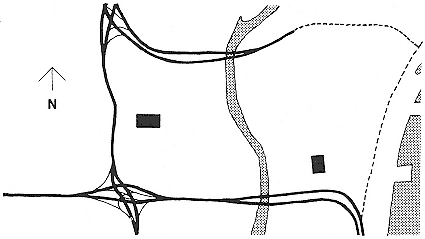
24.
The intended expressway system loop and two somewhat related parking structures
(darkened). Broken lines indicate sections left unconstructed.
to the high-speed trafficways but appeared on scattered sites throughout downtown, thus assuring rather than eliminating confrontations between vehicles and pedestrians. Although systemic thinking appears to have been the most successful of the four orientations in urban design theory employed in restructuring downtown Milwaukee, the scope of its application (part of an expressway loop with two associated parking structures) was limited. This vision touched only one of several urban systems, and that one incompletely. Other American cities had parallel experiences in pursuing a narrow systemic vision of rationalized vehicular access and similarly ran into opposition from citizens with a broader range of concerns and values. Expressway construction in San Francisco and New Orleans also was stopped.
The Vision of Efficient Transit
Systemic theorists try to rationalize public transit in city centers by integrating various traffic modes (rapid transit systems in Chicago, Washington, D.C., and San Francisco align at times with expressways) and (as in Toronto) by concentrating the development of new buildings near points of access to public transportation systems. In the multi-nucleated cities of the American Southwest new office/commercial centers are being built at the intersection of freeways (in Houston and Dallas, for example). Elsewhere, railroad rights-of-way are being reclaimed for public transport use. Streetcars, buses, and rapid transit trains intersect along San Francisco's Market Street. Although these transportation systems can restructure a city, in most cities where they are constructed they represent limited solutions and have no broad impact. Systemic theory demands a more comprehensive approach. It proposes a restructuring of the city that improves not only mass transit but housing and other urban functions too by having a coherent, flexible, and extensive armature that responds to a wide range of needs and uses. Although Milwaukee periodically talked about such programs, it did nothing.
Formalism
Formalism, whether Beaux-Arts or neo-rationalist, assumes that there are archetypal patterns and configurations with universal significance from which urban design should be drawn. Although the emphases and the socio-economic effects of the two approaches differ dramatically—proponents of Beaux-Arts formalism stressed axial organization and static spaces and, more recently, proponents of neo-rationalist formalism have focused on a finer and more circumstantial urban grain—both points of view assume that urban form is best drawn from timeless patterns. Neo-rationalism is now stronger than Beaux-Arts formalism as an intellectual current, but it has had little impact in America to date because the important Italian treatises of the 1960s that formulated it were not translated for a decade. Further, neo-rationalist theory is strongly related to histori-
cal European urban patterns and therefore is difficult to transpose to American contexts.
Aldo Rossi, a key advocate of neo-rationalism, speaks approvingly of the typical American grid, though he does not indicate what one could do with it or how it might guide and give impetus to contemporary urban form. Rossi speaks approvingly, too, of American towns with what might be called a late-medieval character, towns like Boston and Nantucket. But again, Rossi does not indicate how these models could inform new urban patterns. The scale of building in Manhattan impressed Rossi, but should other American cities seek to achieve the character of Manhattan? Because neo-rationalism has had little impact to date, the study of formalist efforts in American cities must focus on Beaux-Arts City Beautiful schemes. But we are convinced that the points we make here about earlier Beaux-Arts formalism will apply when neo-rationalist formalism appears in American streets: it will fail to blossom because it too is narrow and alien.
The Vision of Civic Axis
The grandest plan to put Beaux-Arts formalism into practice in Milwaukee envisioned a civic axis rising at a domed county courthouse. A broad avenue would unfold between flanking gardens and then pause at a rond point braced by four buildings of civic significance. Finally the axis
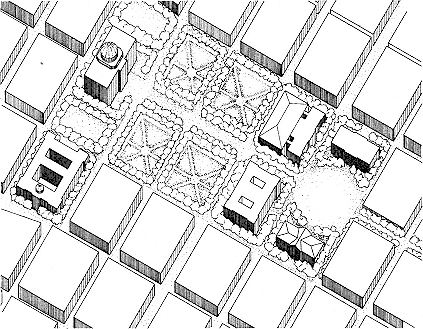
25.
A drawing suggesting Alfred C. Clas's scheme for a Milwaukee Civic Center.
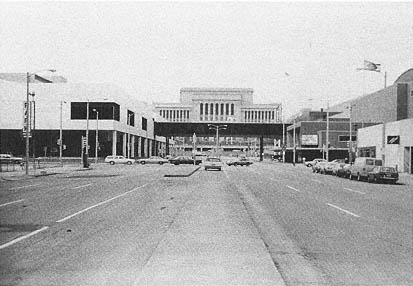
26.
Milwaukee County Courthouse seen down the "civic axis" of Kilbourn Avenue.
Buildings along the axis have not been sympathetic to the concept. The bridge
connecting the convention center and auditorium indicates how little the idea of
a civic axis meant to a subsequent generation.
would cross the Milwaukee River and terminate at the portals of the pre-existing muscular City Hall. Of this grand but feasible vision (after all, San Francisco had managed to build the beginnings of such a dream), only a courthouse (and then not a domed one) was built.
Milwaukee made a second effort to achieve a monumental civic axis, with the County Courthouse as an anchor for Kilbourn Avenue, which extended toward City Hall but angled off to miss that monument and passed on to terminate at the bluff above Lake Michigan. Civic buildings and other edifices of substance were to line this grand avenue. This second effort, however, akin to Edmund Bacon's idea for a "shaft of space" (outlined in The Design of Cities ), either was too grand for the city's civic and financial resources or, perhaps, was begun too late. The Beaux-Arts inspired City Beautiful movement, which sought to link American cities to the archetypal grandeur of European capitals, was losing potency in America at the time the construction of the Milwaukee County Courthouse was completed. Few of the structures built along Kilbourn Avenue fulfilled the original magnificent idea, and what has been built for the most part does not reinforce the sense of a civic axis. The Performing Arts Center, for example, although it was built on Kilbourn Avenue, does not front that axis but rather a minor, competing axis, the Milwaukee River. Kilbourn Avenue was simply too long; Milwaukee did not have enough civic energy to realize the conception. This was another case where the imported vision did not suit the realities.
The Vision of Public Realm
The shared, public, realm of a city often takes the shape of public squares or patches of nature in the city. Neither archetype seems to have inspired design decisions in Milwaukee when in recent years a new riverside park was created downtown. At best Pere Marquette Park is an amenity offering places to sit and stroll, but it is a compromise. It is neither an urban square nor an area given over to another, un-urban, world of nature. It does not pull parts of the city together; instead it does little more than occupy a landscaped area between other, unrelated, areas. Suburban lawns seem to have inspired it. Like so many other efforts to do something in downtown Milwaukee, this one lacked both conviction and a vivid guiding vision.
Elsewhere downtown the redevelopment of formal green squares, like Cathedral Square and Zeidler Park, has accentuated neither their urban nor their natural character. They have none of the suggestiveness of an eighteenth-century London square, for example, or a lush Victorian urban garden. These efforts failed not for having roots in European theory but for having no roots at all.
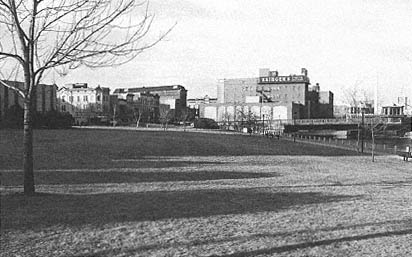
27.
Pere Marquette Park, situated downtown on the Milwaukee River, which was
once used for commerce, commemorates the landing of the missionary-explorer
Father Marquette. The site is prime in every way. It marks the important historical
process of exploration. It faces the Performing Arts Center across the river and
has frontage along the Kilbourn Avenue civic axis. It offers diagonal views of
downtown and of Milwaukee's striking City Hall. It is a crossroads for civic,
commercial, industrial, and sporting Milwaukee as well as a gateway to North
Third Street, with its Victorian buildings. The rich, strategic, and meaningful nature
of the site was ignored or suppressed, however, in a design that features a
suburban lawn, a curving walk, and some standard benches.
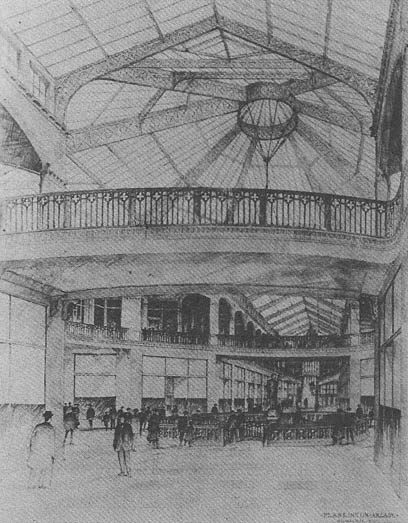
28.
Interior, Plankinton Arcade. Holabird and Roche, architects, Chicago, 1916.
Bridges and dome highlight the intersection of the building's axes.
The longer one parallels Wisconsin Avenue.
The Vision of Galleria
The Plankinton Arcade was Milwaukee's version of a classic urban element, the spacious skylighted semipublic commercial interior whose precedents range from Milan's Galleria and London's Burlington Arcade to more modest manifestations in Cleveland and Providence. Once a lively place, the Plankinton Arcade was allowed to age and decline. For more than sixty years it remained an isolated good idea, with no influence on its context. No one seems to have been inspired enough by it to
copy or improve upon it or to link up with it—not, that is, until the mid-1970s.
Pragmatism
Although one finds in a city like Milwaukee evidence of each urban design theory originating in Europe, none of the theories seems to have worked powerfully. None has proven strong enough to exert a substantial influence. The failures of European theory in Milwaukee can be attributed to (1) the inappropriateness of specific models in the American context, (2) a lack of conviction, (3) a concern with too few factors affecting urban development, and (4) the attitude that each new development effort is independent of its context. Urban design in Milwaukee does seem to have been guided by a collection of loosely held imported ideas and a decision-making process that boils down to pragmatism. Even in Milwaukee's heyday of socialist idealism, what was sought was not a vital, shared urbanism but better sewers.
Whereas theories about new possibilities for center cities often play a central role in European efforts toward revitalization, in America they typically do not. At best, American efforts include gestures toward ideas halfheartedly borrowed. In Europe one finds classic experiments with humanist, functionalist, systemic and formalist urban design; in America one usually finds only clouded versions of those ideas.
This is not to say that theory is entirely absent from American urban design projects but only that it seldom impels them. For every scheme like Bacon's plan for reconstituting Philadelphia, or Baltimore's renaissance, or Rockefeller Center, there are twenty that rise not from a vision but from conventions, or hopes of making a quick killing, or external pressures. Typically, American schemes respond not to the ideological questions What should be done? and What is right? but to the practical questions What has to be done? (politically, economically, socially), What can be done? (economically and politically), and Who benefits? (economically, politically, socially).
American urban revitalization is characterized by pragmatism, a concern with practical and feasible consequences. Perhaps nothing makes this point better than Jonathan Barnett's textbook An Introduction to Urban Design , a virtual bible of urban design in America. He calls it a "methodology" for dealing with the accelerated pace of change that characterizes our times.[9] Chapters identify three key forces to be contended with (ecological concerns, community participation, and historic preservation) and the leverage that can be applied to direct design and development. But he carefully avoids prescribing goals toward which the leverage and the forces might be applied. He does not propose what should be but does tell how to achieve particular ends. He subscribes to the view that people should decide for themselves, that there is no one best ideal for urban design.
We are sympathetic and probably more like Barnett than unlike him in
avoiding prescription, a preference for certain solutions toward which all urban design schemes should be aimed. We are sympathetic in particular with his recommendation that urban designers offer not specific designs or abstract policies but rules to guide choices.[10] But surely someone needs to take the lead in precipitating hopes and communicating visions for the urban place in America, hopes and visions that are more than merely workable.
There are several obvious reasons for the tendency of American urban design to be pragmatic rather than idealist, pedestrian rather than inspiring. First, most Americans have little experience with potent, positive, personally rewarding urbanism. (One urban designer confides that "if the City Council or Redevelopment Agency members haven't been to London or Rome, we as designers know we have an uphill battle!") Second, many American towns and cities were mapped out strictly as money-making enterprises. The goals in their settlement were ease in legally describing parcels and the greatest possible profit from real estate sales and investments. (Whereas the nineteenth century envisioned urban development as selling off parcels of land, the mid-twentieth century has seen it as an investment that one can write off or that will pay off.) As a consequence, the typical American urban pattern is a grid that from its inception did not respond to the physical setting but facilitated surveying, easy sales, and access to transportation. The understanding of land as a commodity the individual can own and exploit pervades American culture; it does not, unfortunately, create a dependable basis for good urban design.
Third, most American towns do not have the long history that imbues cities with richness and depth; few have had the chance European cities have had to be overlaid, modified, and amended. Aldo Rossi claims that American cities are as evocative as European ones, but those he likes—Nantucket, Providence, Boston—are not typically American in their formulation but are more typical of Europe, the products of late medieval life, thought, and economy. Few American cities are as obviously cities of distinguishable parts as these.[11]
Finally, Americans have tended to idealize nature and the experience of nature rather than to idealize the city and the experience of urbanism and civitas. In this prejudice we have a considerable tradition—in the writings of Thomas Jefferson, Henry David Thoreau, Ralph Waldo Emerson, and, more recently, Frank Lloyd Wright. Even now, though a few advocates of urbanism sing the virtues of the city, Americans move to the suburbs. This anti-urban bias is declining, especially in cities where gentrification has been possible and has been promoted and made profitable. Time gradually will lend the American town a sense of history, of one era overlaid on another and another. Because this has not happened yet, however, Americans, unless they live on the Eastern Seaboard or in isolated cities like San Francisco and New Orleans, expect little of their cities and find little there beyond economic reward. No wonder they tend to be pragmatic in deciding the future of their towns and cities. Nor is it any wonder that the task of urban designers in America is as much to educate and to raise aspirations as it is to design and plan strategies.
Although it would be handy to characterize American pragmatism as something like European functionalism, they are not alike. American pragmatism evidences none of the idealism of European functionalism. Furthermore, pragmatic Americans pick and choose as though theories could be selected à la carte. Whereas a European functionalist scheme would eschew sentimental historicizing references to the past that characterize humanism and a formalist scheme would not tolerate an overriding and extensive, systemic, pattern for everything, pragmatic Americans willingly mix ideas, not because they are convinced of the worth of the related theories but because those ingredients appear to be called for. Although eclectic mixes can be rich, they are not necessarily so. The key to a satisfying eclecticism is a knowledgeable and sensitive chef d'oeuvre and a good recipe book.
American pragmatism has drawbacks, but its virtue may well be its low regard for narrow theories. Existing theories are exclusionist; that is, they ignore some factors to build a strong, singleminded case for others. A humanist scheme, for example, neglects economic issues; functionalist schemes typically ignore the importance of cultural traditions; systemic schemes are overbearing and too optimistic about technology; formalist schemes assume that Europe had all the right and sufficient answers by the nineteenth century.
The disadvantage of American pragmatism, apart from the uncertainty about what will emerge from any given mix, is that it leads to urban design that envisions no better world. Even if such schemes work, they arouse no enthusiasm; or if they do, the arousal is temporary. Of most concern, pragmatic, happenstance approaches to urban design fail to provide a direction for subsequent development efforts.
A respected urban designer practicing in an American city asks the reasonable question, "Is a theory of urban design for America necessary? Isn't it enough to work intuitively from one's experience of good and bad urban design?" Our answer is that working from theory provides both a discipline and a basis for evaluation. It provides a reference point to which one can return in making decisions. And it provides a standard against which decisions can be measured. Without this external discipline and standard, there are two serious dangers. First, decisions may be made not with reference to goals but in response to local or momentary pressures. A design becomes the product of miscellaneous demands (economize, satisfy that alderman, don't antagonize the newspapers, maximize off-street parking, make snow removal easy, and so forth) rather than larger goals. Second, miscellaneous decisions can cancel out each other and leave little of significance as an end product. We can imagine Milwaukee's Pere Marquette Park resulting from a collection of decisions, each of which is justifiable but which collectively add up to neither an urban park nor an urban place: plant grass, minimize low shrubs, offer benches, discourage loitering, make it natural, permit surveillance, orient toward the Performing Arts Center, make a front yard for the County Historical Center, curve the paths, facilitate maintenance, provide street lights, and so on. At the larger scale, decisions made for one district cancel out decisions made in another; the parts of a city do not reinforce one an-
other. Although theory can be misused, without it, little will be achieved that is significant and memorable.
Although we feel too distant from European needs and circumstances to evaluate the relation between theory and practice in that context, we do feel qualified to examine and prescribe for American circumstances. American cities and towns can be revitalized only if the following premises apply to the native predilection for pragmatism:
1. The time scale of revitalization must be longer than the five or ten years of a financial balance sheet. Renewal must have within it the ingredients of its own subsequent regeneration.
2. A good urban center is more than an efficient machine for producing wealth. It has a civic dimension as well. Civic pride and personal identification with the city can have a deep long-range impact that does not appear readily in an economic forecast or in tallies of vehicles satisfactorily channeled and stored.
3. A vital urban center is not a suburban shopping center inserted downtown. It is more complex and less time-bound. (We like the concept of sedimentation,[12] the idea that the good city center is layered by time.)
4. Architecture is not the process of merely decorating cities. That the world's great cities are also the seats of the world's great architecture is not accidental. Architecture and urbanism are part of the same attitude.
5. Specific visions are needed to guide urban design, and these will vary from locale to locale.
American pragmatism is attractive as a method of urban design insofar as it is not exclusive and doctrinaire or limited and narrow as a result of being dialectically opposed to something else. An absence of aspirations other than profit, however, and the use of stock, borrowed approaches and ingredients restrict the achievement of American urban design.
Even though no one factor will correct the shortcomings of existing urban design methods and models, new ideas and theories can turn the process in more promising directions. For example, the involvement of citizens in decision making promises to increase the concern for quality as well as for economic feasibility. But because most Americans have so little experience of positive urbanism, they are hard-pressed to direct the process well.
Another new direction is to pay attention to the chemistry of urban design, the way elements act upon and interact with one another. The chemistry of investment and dividends is well known and relatively dependable, but the chemistry of social and architectural elements in urban design needs greater attention and understanding. In this interaction we see a specifically American approach, a chain reaction that links private and public initiative not in pursuit of a singular master plan but in an ongoing process of action and reaction that is always moderated but never completely controlled. Just such a chemistry of urban revitalization is the subject of chapter 3.