
Exchange and Redistribution
Just as the exchange system operated to pull wealth onto the island from outside, so it operated to assure that wealth was fairly equally distributed among island residents. Even though some families received significantly more money from migrants than others, disparities of wealth on Ponam were relatively small. Inequalities of income were neutralized in large part by the exchange system.
In very simple terms, the process by which exchange equalized the distribution of wealth was this: the size of a helping gift that any individual gave to a relative ideally should have been determined by his or her kin relationship to that relative. That is, referring again to diagram 1, A would receive a number of gifts from those relatives labeled B, but the size of those gifts would vary. Close relatives such as siblings would give larger gifts than more distant relatives such as cousins. Similarly, the various B s would receive larger gifts from their close kin than from more distant ones. We are, of course, presenting something of an ideal, as personal animosities could and did affect the way gifts were given on the donor's side and distributed on the recipient's side. However, this ideal was one that Ponams espoused and was the basis of their judgment of people's behavior in exchange. Moreover, behavior conformed to the ideal more often than not.
The logic behind the varying sizes of gifts was that the focal donor in an exchange should receive help from members of the ken si , the cognatic stocks, descended from the siblings of his agnatic stem: the siblings of himself, his F, FF, FFF, and so on, back to the last remembered ancestor, usually the founder of ego's kamal . As well,
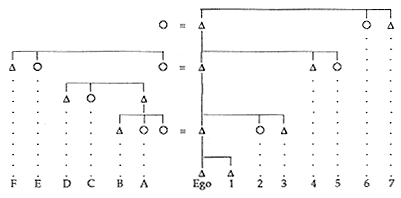
Diagram 2.
A Stylized Representation of Cognatic Stocks in Ego's Kindred
gifts should have been received from the natal cognatic stock of ego's M and to a lesser extent FM. It is important to note, however, that contributions to ego were group rather than individual gifts. Thus, the stock descended from ego's FFZ give a collective gift in the name of that FFZ. They do not give separate gifts in their own personal names. Diagram 2 illustrates this in simplified form.
In the diagram, the numbers 1–7 and the letters A–E are the cognatic stocks who contribute to ego's affinal exchange payment. (Note that in fact stock 1 is ego's B , and the matrilateral stocks usually were not as differentiated in exchange as they are in the diagram.) The size of the gift given by the stocks should decrease the more distantly they are related to ego, and of course the more distantly they are related the more likely they will be to have a large number of living members. Thus, the size of the gift a person gives should drop off sharply the more distantly related he or she is to ego, the focal donor in the exchange.
The contribution of each of the cognatic stocks in diagram 2 would be assembled at the house of the leader of the stock. The members of the stock were structured in the same way that the focal donor's relatives were structured, shown in diagram 2, which is an agnatic stem when read upward from ego, but a cognatic stock when read down from the top.
Furthermore, it is worth noting that those who are in the cognatic stocks that contribute to ego's payment themselves recruit assistance in the same way ego does in diagram 2: they too call on the stocks of the siblings of their agnatic stems, their M and their FM, though unlike the focal donor, who was making a payment to his affines, members of these subsidiary stocks received assistance from their
own affines as well as their cognates, affines who could recruit assistance from their own cognatic stocks in turn.
In fact, in large exchanges this sort of recruitment of assistance could ripple outward in as many as four or five stages. This indicates two things. First, the model given in diagram 1 is grossly simplified, though it does give a hint of the operation of exchanges. Second, a point we have mentioned already, this pattern of recruitment and distribution quite quickly leaps agnatic descent lines and involves large numbers of participants.
We said that the sizes of the gifts should have been determined by the kin relationship between the donor and the recipient. This rule was followed with the gifts made by the various cognatic stocks to the focal donor, and it was not uncommon for stock leaders to add to or take away from their stocks' gifts after they had been displayed in order to put them in the proper size relationship with the gifts from other stocks as they were put out on display. In the case of individual contributions to stock gifts, however, gift size was influenced also by the wealth of the donor; some individuals simply had less to give than others.
Ponams recognized that this was inevitable, and they stressed that wholehearted participation in exchange was more important than the size of the gift given. They said that a poor man who gave generously of what he had, even if it was only his time or a few sticks of tobacco, would be recognized as participating fully. While this was to some extent an idealized statement, our observation was that contributions from those recognized to be poor were judged accordingly. Thus, in some sense individual participation was reckoned in terms of the degree of sacrifice a gift entailed, rather than its absolute size. This parallels the point we made in chapter 3 in our discussion of the ownership of fishing rights: social credit was generated by the degree of generosity involved, rather than just the total amount of wealth passed.
The significance of all this for understanding the redistributive nature of Ponam exchange becomes apparent when we look at the rules by which return gifts were distributed.
Distribution was not simply the inverse of accumulation. A would give a larger return to his close relatives than to his more distant ones, but once goods moved beyond the focal parties the rules of distribution changed. When B distributed the goods he got
from A , he was expected to give equal shares to all those who helped him, regardless of the size of the gifts they gave. Similarly, when a C distributed what he got from a B he was supposed to give equal shares. Of course, it would have been possible for a B or a C to accumulate goods by refusing to redistribute a payment, or by redistributing only a part of it. However, islanders expected that any gift of any size would be redistributed, and they were not disappointed. Indeed, the focal recipient in an exchange and those to whom he or she distributed the gift often decided to forego their own share of the gift in order to forestall or still the complaints of those who might have felt that their share of the return gift was too small, behavior resembling that of the net right leaders we described in chapter 3.
The consequence of the way that gifts were distributed and redistributed was that those who gave large gifts (those who were closer to the recipient and those who were relatively wealthy) received a disproportionately small amount of the return gift, while those who gave smaller gifts (those who were more distant from the recipient and those who were relatively poor) received disproportionately larger shares. In other words, in any exchange wealth tended to be distributed from those who were close to the donor and from the wealthy to those who were more distant and to those who were poor. Thus, the rules of exchange worked to insure the relatively even distribution of wealth on the island, to insure that wealth flowed from those who had it to those who did not.
Ceremonial exchange, then, served a number of important purposes that broadly can be considered economic, both for the island as a whole and for individuals. For the island it was an important mechanism that encouraged migrants to send or bring their wealth back to Ponam, and thus helped keep the society reasonably well off. For individuals, exchange did two things. First, it was the way that residents could share in the wealth that migrants sent back to the island. Second, it was the field in which people could establish social credit and cancel social debts and so induce the cooperation necessary for life on Ponam. For migrants the cooperation meant that they could maintain their social identity and their claim on lineage property, while for residents the cooperation meant that they could call upon their kin to provide assistance, especially labor, when it was needed.