
La Nación Huanca
[In the Inca period] tribute played a double role: it linked the community to a much greater unit, but at the same time it isolated it in its local setting and consolidated its traditional structures .
—Wachtel (1977:73)
The Huasicanchinos, like most people living in and around the Mantaro Valley, regard themselves as the descendants of the nation of Huanca peoples subjugated by the Incas. Far from being conquered by the Spanish, the Huancas were their allies in the fight with the Incas. The Huasicanchinos argue that this fact provided the historical basis for resistance to hacienda penetration of the area, for Spanish claims to land were never as clearcut as in the areas of imperial Quechua where crown grants were made as part of the booty of war.
The Inca empire of Tahuantinsuyu in 1532, far from being well integrated, was composed of a number of ethnic groups or nations whose degree of subordination depended upon their remoteness from the centers of Inca power. They differed considerably in size and in degree of complexity (Moore 1958; Murra 1958; Espinosa 1972) but were governed by a political regime whose economy was based upon the social organization of these subordinated nations. Despite differences in the degree of Inca control, it seems doubtful that the empire ever radically altered the agricultural structure of any but those groups closest to Cuzco: "In 1500 the State could not afford to interfere with the peasant's ability to feed himself and his kinsfolk when in need; he continued to do so in the Andes by growing without irrigation the locally domes-
ticated tuber crops within a system of traditional lineage and ethnic tenures" (Murra 1958:341). To explore the interplay between the Incas and these subordinated groups we must first turn to a description of the ayllus that made up a nation or ethnic group.
The ethnic group was a unit of varying size, wider than the simple lineage but having an ideology of kinship, though not necessarily a traceable set of linkages. It was composed of a number of ayllus (Rowe 1946). La Nacion Huanca , for example, which was united by belief in a common ancestor, Huasihuillca, was divided into three maximal ayllus. These were Jatun Sausa, Lurin Huanca,and Anan Huanca, each being roughly equivalent to the present-day provinces of Jauja, Concepcion, and Huancayo that make up the Department of Junin. The present site of Huasicancha would have been on the extreme southern, highland periphery of this nation (Espinosa 1972).
Each maximal ayllu was made up of smaller ones, there being sixty of these in all (Espinosa 1972:35). The ayllu is described by Rowe (1946:255) as "a kin group with theoretical endogamy, with descent in the male line, [which] owned a definite territory." In practice, however, Spalding's more general description of the ayllu is more apt: "The traditional ayllu can be defined as any group whose members regard themselves as 'brothers' owing one another aid and support, in contrast to others outside the boundaries of the group" (1973:583). The ayllu provided members with plots for their households in return for labor on the ayllu common land. This household land consisted of both pasture and arable land. A couple were considered "married" from the time they organized a work team of their neighbors and kin and built a house. Once married, the couple were regarded as mature members of the ayllu. As members, they were expected to contribute to all community work, and in return the household was provided with arable land in proportion to its size. Arable land was reallotted each year to keep up with demographic changes both at the level of the ayllu and at the level of each individual household within it (Wachtel 1977:66).
It is important to emphasize the role of the household rather than the individual. Tasks were allotted to households, not to individuals (Murra 1958), and autonomy was as much a goal for the households as it was for the ayllu as a whole. Work might be extended beyond the household but not a single good was released to individuals. "Nobody, not my curaca (head man), nor later the Inca, has rights over my fields or my llamas" (Wachtel 1973:67). For the purposes of distribution among the households, the ayllu land was divided into sectors on the basis of a) where it stood in the system of crop rotation, and b) where it was located in the mountains. In view of the extreme variations in altitude within short distances in the Andes, this latter dimension was largely a function of "verticality": from high pasture, to intermediate tuber-growing lands, to lowland maize. Wachtel writes: "By virtue of the autarchic ideal which ruled the economic life of the Andean societies,
each domestic unit could lay claim to a parcel in each of the various sectors (even though this ideal was not always realised)" (1973:63). These sectors were referred to as mañay meaning literally "to request" or "to beg." The household requested land from neighbors and kin as a group, represented by its head or heads, the curacas. Neighbors and kin, in turn, requested that the household adults shows themselves to be socially responsible community members. This social responsibility or obligation was expressed through their reciprocal offering of labor in exchange for land. The offering of extrahousehold labor was seen as a social obligation be it the offering of labor to the community as a whole, or the offering of labor to individual neighbors and kin. Neither a household's request for land nor, conversely, requests to them for labor could be refused.
The reciprocal character of this exchange of household land for labor given to the community meant, of course, that larger households with more labor units could "rent" more land than those with fewer. The tupu (the allotting of land according to household size), within the principles of balanced reciprocity, reflected the labor potential of the household but not its consumption needs. Such reciprocity did not in itself serve a "welfare" function (cf., Louis Baudin 1928). In this kind of community the household head who could mobilize a large number of people through generalized reciprocity was in an advantageous position vis-à-vis the community as a whole. Thus a person with a large household could create both a greater debt from neighbors with respect to reciprocal exchanges of labor and also a greater debt from the community with respect to the allotment of land. Where generalized reciprocity begins in the household and moves out to proximate kin, a large household strategically positioned within a larger kin grouping would have offered favorable conditions for making a man "rich." A Spanish chronicler referring to contributions of labor to the communal work force notes: "He who has most assistants and finishes his share of the suyu [labour on community land] most quickly was considered a rich man he who had nobody to assist him and hence worked longer, a poor man" (Wachtel 1973:64).
Such a man was well placed to become the curaca or head man of the local ayllu. No doubt, with the advent of the Inca domination, curacas acquired special privileges. But the conflicting reports of their special privileges and their ownership of tracts of land far beyond the needs of their immediate household probably arose not simply from the specific ideas of property held by the Spanish chroniclers who provided us with this evidence, but also from the way curacas manipulated this system of reciprocity. Chroniclers suggested, for example, that curacas held large tracts of private land and large flocks of llamas and that they claimed the services of community labor on their property. Supposedly ayllu members first worked the community land and then the land of the senior curacas, on down to the curaca of their most immediate locality. Curacas also used the labor of yanas (owned servants).
The evidence implies that curacas had privileges quite distinct from other ayllu members. Yet, chroniclers were always impressed when curacas were seen at work in the fields with other ayllu members and were required to beg (rogar; mañay ) for labor services (Murra 1958; Wachtel 1977:65, Spalding 1973:585, Godelier 1977:64).
Distinctive privileges and the ability to secure private land were probably restricted to high ranking curacas, local ayllu heads having very little of either. But important is the way in which a curaca combined an ideology of reciprocity with kinship links. The curaca was essentially the head of the ayllu-family and as such commanded resources that allowed him access to a wide network of reciprocal rights from kin. Thus when Cobo wrote that "No one nobleman or commoner owned more land than was necessary to support his family" (1956 [1653]:XCII, 121) this need not have meant that the curaca was thereby limited in his control of large amounts of land since, in this context, the word "family" could cover a whole ayllu. This confusion, however, between the curaca's possession of land as household head and his possession as representative of the ayllu is significant in understanding the subsequent developments in territorial control in the Andes.
Similarly, curacas, unlike other ayllu members, owned yanas—people taken into the household for life who worked as servants in house and field. The origin of this institution of yanaconage is not clear (cf., Murra 1964:93), but any institution that allowed one household to expand its own internal labor pool by drawing in new members would give such a household a dominant position vis-à-vis other households in a system of balanced reciprocity of labor. Yanas would therefore have provided the means by which curacas could overcome the dictates of the demographic cycles and thus solidify their position within the ayllu.
Despite the advantages that the curaca might have derived from the system of reciprocity, the existence of community land and the obligation to give labor to cultivate land had the effect of maintaining the ayllu as a community of people with shared identity. This land was broken down into three categories:
1. communal land administered by the curacas;
2. land farmed to support the worship of the local deities;
3. land allotted to households.
In view of what has been said about the role of kinship in relations of production within the ayllu it is possible to see what would happen to those unable to provide extra-household labor to exchange in return for other labor or goods. The opposite of the "rich" household able to call upon large numbers of kin for labor would be the person unable to call upon any kin. Such a person is typically an orphan, a huaccha, referring also to a poorer person
in a relationship. These parentless children, together with childless parents and physically handicapped people, drew upon the resources produced on the communal land administered by the curaca.
Community land worked with labor extracted from each household thus resolved the problem of the debt that would have emerged between deficient households and those well endowed with labor. Resources provided by the community land substituted an overall debt to the community as a whole for what would otherwise have been an ever-increasing debt to any one household (see figure 1). Where curacas used control of this land for the specific advantage of their own households, of course, the communal solution to interpersonal debt was undercut.
An analogous situation existed for livestock husbandry. The person who inherited no livestock gave him or herself as a huacchero to a household seeking labor. In this way such a person could gain access to a number of the newborn animals of the flock each year. This was usually expressed by the adoption of the "orphan" into the household of the flock owner. In principle at least, huaccheros could, once having accumulated stock of their own, strike out and set up house for themselves. In the case of livestock husbandry, pasture might often be at some distance removed from the seat of the ayllu itself. And just as we have seen that an ideal of autonomy was pursued by households (each household attempting to control some land at differing altitudes in the Andean ecology), the same was true for the ayllu as a whole. The seat of the ayllu located at about 3,000 meters above sea level strove to control as many microclimates as possible above and below this level. Moreover, since ecological zones at the extremes of the Andean vertical ecology did not have to be geographically coterminus with the intermediate zones, they could form "archipelagos" whose "islands" achieved unity through reference to the ayllu lineage (Murra 1967:381–406).
The long distances involved meant that colonies of shepherd households arose who maintained their ties to the ayllu and continued to have rights in ayllu land in the other zones. When a household head died or was widowed, the household returned to the seat of the ayllu to be replaced by another (Wachtel 1972:72). Despite these arrangements, the sheer distances involved must have given to the pastoral colonies a certain distinctiveness that would have been increased because many of these distant shepherds shared in common their experience of being huaccheros for better-off households resident at the intermediate Andean level.
At least by the time the Spanish chroniclers were writing, curacas even of a fairly low level maintained their own yanas, which the Spanish translated as "slaves" (Murra 1964; Wachtel 1977; Lumbreras 1980). It is likely that yanas too were found in these colonies. In principle huaccheros were still members of the ayllu, and over a generation, families could dissolve the huacchilla relationship. By the time of the chroniclers in the 17th century it seems
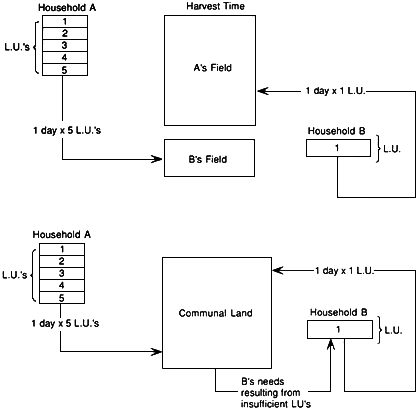
Figure 1.
Direct interhousehold reciprocity and communal reciprocity.
that this was not so for yanas, at least one of whose offspring appears to have remained the property of the wealthier household. It seems likely, however, that for huacchero and yana shepherds the social distinctions between them would have become less than the distinction that divided them, by distance, from the seat of the ayllu. The point is that even prior to domination by the Incas and the introduction of mitmaq colonies of "outsiders" within the various subordinated nations, there already existed, within the ayllus themselves, a group of pastoralists whose interests and daily concerns may have given them an identity distinct from the rest of the ayllu members, who spent the greater part of the year at the lower geographical levels. This at any rate is the interpretation of contemporary Huasicanchinos, who stress that their independence from lower level ayllu seats goes back to the earliest times. Contrasting themselves with the similar pastoral community of Yanacancha, they point to the distinction in their names: the one a cancha or collection of yanas,
the other a collection of huasis or houses. They argue that this suggests that there was a more permanent settlement in their own area, and they point as well to Yanacancha's uninterrupted accessibility, lying as it does, directly up the slopes from the old ayllu seat of Chupaca.[7]