
4—
Calmallí:
The Mining Circuit and Early Network Development, 1880–1910
The social relations that developed on the trek north and along the border have their roots in the early history of the families that migrated north. These histories include the migration experience and the geographic locales that came to be the social settings for the first meetings and friendships of the families of the network. Most of the early mining families traveled to the placer mines of Calmallí, the town that became particularly important as the key site of interconnection for the families of this study. Family experiences in Calmallí illustrate both the primary sociocultural characteristics that formed the basis of network development and the nature of family life in the mines.
The actual migration experience of Baja Californios can be reconstructed by detailing the mining circuit experiences of three important families: los Marquez, los Mesa—Smith, and los Castellanos. Such historical reconstructions become more than migration histories. They are the histories of pioneer families that experienced foreign involvement in the peninsula, successive moves, and the hardships associated with migration in Baja California. I trace each of these families from its place of origin in order to point out their reasons for migration and the nature of life in the hometown region. The interrelations of these families in Calmallí as well as during the migration north to the border are especially pertinent. Moreover, these histories illustrate the variety of individual circumstances and responses along with the principal socioeconomic conditions of the time which led these early immigrants to the border and into the United States. The interpersonal relationships of individuals in their daily lives, in their neighborhoods, and in their
work of the mines reveal the close friendships and sentiment that led to kin relations in the north.
Calmallí:
The Geographic Nexus
Migrant families traveled through a variety of small towns along the Baja mining circuit, but Calmallí represents the geographic and social nexus of the relationships that led to a formal kin network on the border. Some families had met in Las Flores (the Castellanos and the Sotelos) or Santa Rosalía before arriving in Calmallí; others became friends later in El Alamo, Punta Prieta, or other sites. But Calmallí was the geographic point at which migrant families began to establish social relations. Compared to other desert mines on the peninsula, the placers of Calmallí had a long production period requiring a stable working population. Here the families of this study had their longest continual contact, a major factor in establishing social relations. Social relations in Calmallí were based primarily on the mutual experience of family migration and the sharing of community life-styles. Friendships, supported by job experiences, regional backgrounds, migration, and the birth of offspring and their socialization, created the social bonds that led to close ties and relationships.
Calmallí is a desert mining town. It lies deep in the central desert almost midway between gulf and Pacific and between the cape and the U.S. border (some 450 miles north). There is no lush tropical growth here and no abundant source of water, but it is a region of rich cactus flora. Framed by the Sierra de San Borja on the east, it is within geologically new and rugged terrain. Today only ruins and bits of fragmented mining machinery remain scattered around the empty mining shafts that were opened and worked throughout the various boom days. In 1905 E. W. Nelson passed through Calmallí and described the rugged surrounding area and the southerly approach t the town.[1]
On September 29, we made an early start and a mile beyond camp (Cerro Perdido) came to another abrupt escarpment about 50 feet high, capped by a plateau extending away eastward into the interior. Before us to our left a range of hills approached . . . from the northwest, while far away to the east low mountains, some rising to an altitude of from 3,000 to
4,000 ft., stood out boldly. About 10 miles east of this last escarpment, the road led us through a range of low detached mountains of hills about a mile wide and 5 miles long. The hills rise abruptly and island-like from the level plain . . . About 4 miles beyond the road led through another group of hills, turned to the south, and at an altitude of 1,200 ft. carne to the mining town of Calmallí. This is located on the foot of a group of low bare hills and contained 25 to 30 small houses, two to three stores, and the reduction works for the mines. (Nelson 1922:31)
Calmallí was discovered by Don Emiliano Ibarra, who arrived in Baja California from the Alta California gold fields around 1870 (Goldbaum 1971:29). During the late 1880s an American firm bought Ibarra out and transformed the crude diggings into a company operation that produced over $3 million in gold during the most productive periods of the eighties (ibid .).
The stories of Loreto Marquez, a principal figure in this study, illustrate how Ibarra's role in Calmallí was kept alive by Baja mining migrants. "When we first arrived to Calmallí there was an old man Ibarra there, Don Emilio Ibarra. He worked some small ore mines, but since he had no money he didn't have the power to do anything. Then Ibarra received twenty-five thousand gold dollars for those prospects. It was a few Americans from that company in San Francisco [who gave him the money]. He had a few small holes in the ground there, and he sold" (Marquez 2/18/76:5). By the turn of the century Ibarra had sold out. The new owners, a group of Americans, were based in San Francisco, but they kept the Ibarra name for the company. The Ibarra Gold Mining Company operated into the first quarter of the twentieth century (Goldbaum 1971:29). Shipments from San Diego and San Francisco to Calmallí provided the latest in mining technology and kept the town alive.
The company saw that the mine was very rich and spent thousands and thousands of dollars to send the ships from San Francisco to the port of Santo Domingo. There in Santo Domingo [the Mexican government] sent guards and everything needed to take care of the port and the arrival of ships . . . ships that arrived to unload cargo were taken care of there.
From here [in San Diego] they carried a great deal of
machinery. They put a twenty-stamp mill in Calmallí. Oh, it was grand activity! But what nonsense! It was very costly. From Santo Domingo, where the ships unloaded, everything including market goods, food, and hay for the mules was transported in; because in Calmallí there wasn't a thing.
It's about fifty miles from the port to the location of the mill. I don't know how in the world they did it. I worked in the stamp mill, but everything had already been moved there [laughing]. I don't know how they took the materials up there. Lumber, food, horseshoes, so many animals. There were about four or five wagons with six, eight mules on each wagon, dust imagine. It's the truth. Well, the mine was surely very rich; the company took out a lot of gold.
One road entered Calmallí from the Pacific landing of Santo Domingo; a rougher trail led to the gulf landing of El Barril where some materials, foodstuffs, and individuals arrived from Santa Rosalía (especially before Ibarra sold out). A series of other smaller foot trails led to Calmallí from other small mining camps, and the original El Camino Real to the north went through the town, providing a main artery into the northern terrain (Nelson 1922).
Calmallí was a company town. The population consisted primarily of company laborers and gold seekers and fluctuated with the production boom cycles of the mines. When there was no production, the town was abandoned. But during the booms the town was a center of activity. In the 1880s, during Calmallí's heyday, Goldbaum states that "there were hundreds or possibly thousands of miners living in the vicinity" (Goldbaum 1971:29). The families of this study began arriving in Calmallí in the late 1880s and 1890s and left during the down cycle after the turn of the century. During their stay there, Calmallí experienced the largest population booms and busts. By the turn of the century there were only two to three hundred miners (ibid. ), and in 1905 Nelson reported that the area was deserted. A report of 1912 indicates that the mines were not being worked, the only population being that of cattle raisers in the surrounding area. The Mexican census of 1921 reported 44 inhabitants for Calmallí.
When in production Calmallí was a self-contained community. It was surrounded by a natural boundary of open desert and was distant from other towns and population centers. Hand-dug wells provided the only source of water and the surrounding country was no less arid. All
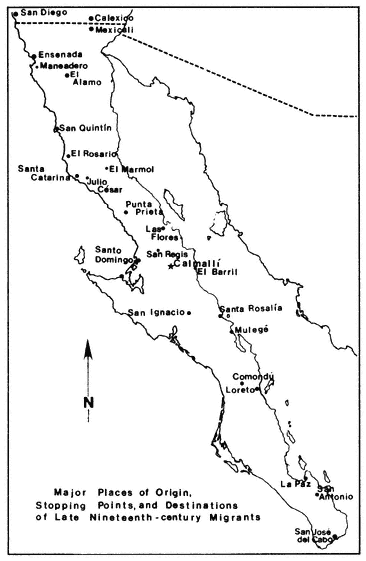
Map 4.
social relations took place within the immediate community, for the town's isolation limited other possibilities for social interaction. As a result, individuals and families saw each other daily, worked together, and socialized after working hours. Families arriving from other mining towns and those coming from cape pueblos joined this geographically confined neighborhood. Calmallí was typical of most desert mining towns.
The Characteristics of the Baja Network
The case studies of the Castellanos, Smith, and Marquez families, along with geographic descriptions of particular peninsular settings, are central to understanding the development of a network of social relations between the individuals as well as between the other families that participated and came to share in their mutual experiences. The importance of the towns in which these families lived seems obvious, but specific geographic influences in both migration and network development have received little attention from social scientists. The towns of Las Flores, Calmallí, Mulegé, Comondú, and other primary points where migrants lived are crucial to understanding migrant movement in the peninsula. These locales were paramount in the establishment of interfamily relations that survived any single individual. This phenomenon of long-lasting social interrelations is the basis of this study.
J. Clyde Mitchell compares the broad metaphorical interpretation sometimes given networks of social relations with more specific understandings.
The image of "network of social relations" to represent a complex set of inter-relations in a social system has had a long history. This use of "network," however, is purely metaphorical and is very different from the notion of a social network as a specific set of linkages among a defined set of persons, with the additional property that the characteristics of these linkages as a whole may be used to interpret the social behavior of the persons involved. (Mitchell 1969:1)
I am describing a social network in a specific context. The network of Baja California consists of individuals, families, and groups of individuals. More than simple acquaintances developed over their years of migration. Strong friendships based on reciprocity, child rearing, and regional ties led to the extension of godparenthood, then marriage alliances and the birth of offspring, all of which are prime examples of the strength of these ties.
Not all the cape families that participated in this labor migration became part of the specific network I am describing. Many of these labor circuit families and individuals never continued their migration north but returned to the towns of the cape region. How long these and other families remained in specific towns is not known, and their final destinations have likewise been unidentifiable. It is probable that most turned to larger gulf towns that offered some economic opportunities, but it is also likely that some individuals returned to their hometowns.[2]
Core Individuals and Families
As in all social networks some participants are more active than others and therefore more central to the creation and maintenance of a particular social field. Such core individuals in specific social networks have not been given much attention in social science research, and the role of historical, genealogical, and qualitative social characteristics of these individuals in early development phases of social fields is usually neglected in network studies. In Calmallí such a central group of individuals became the core not only for the immediate tenure in Calmallí but also for the evolution of a larger, more complex social field many generations later. This core generated intrafamily marriages, the incorporation of other families into the social field, and compadrazgos, all of which became the basis of a geographically defined social community in the United States.
In this case core families and individuals are those who had similar experiences in the mines and small towns of the southern cape. The families shared close ties based on a particular regional history that placed specific towns and families in close sociocultural association. Core families kept alive the memories of those living and of migration experiences on the peninsula. The core was in this way a foundation for intrafamily cohesiveness and for the initial cross-ties of kinship that
formed the basis for further family extensions of Baja Californios in the border region of the United States.
The Calmallí phase represents the initial coalescing of the core, which became the binding force of social relations despite the dispersal of families when Calmallí could no longer support a labor population. The core in this study includes eight principal families. This is a conservative number, for surviving migrants and early migrant offspring have identified over eighteen families associated with the main social field at this time. I have, however, positively identified the presence and social interaction of the eight families in Calmallí.[3] Relations of the social field, however, extended to other families and individuals in the mining community. I cannot enumerate the actual number of families and individuals participating in this specific field, but there must have been a great deal of social interaction extending beyond the core.
Along with los Castellanos, los Marquez, and los Smith, the identifiable social core also includes los Becerra, originally from El Triunfo, an early mining town south of La Paz, los Gonzales from the southern cape, los Alvarez from San José del Cabo, los Villavicencio from the Loreto area who settled and remained in Pozo Alemán just outside of Calmallí, los Bolume from the cape, los Simpson from San Antonio, and los Vasquez. Two families, los Blackwell and los Moore, from Alta California, were also part of the social field. These "families" are represented in Calmallí by groups of relatives (e.g., two parallel cousins of the same generation), extended families, nuclear families, and lone individuals.
The social interaction of these individuals derived from labor in the mines and from the interaction of households. This activity was not isolated or segmented; rather, it involved significant life-cycle experiences, including births, child rearing, adolescent development, friendship, extension of kin, and death. The sharing of these important life experiences along with participation in purely social, informal gatherings provided the basis of interaction and trust (confianza ) (Lomnitz 1977) fundamental to network maintenance.
Confianza:
The Basis of Relationships
Confianza means the general trust that develops between individuals. It is often characterized and identified by dyadic interrelations but includes a myriad of relationships. Dyadic relations are encompassed
within a greater base of interrelations that stem from multiple relations between groups of individuals. Confianza as fundamental trust forms the basis of multiple relations among individuals within specific socio-historic settings. It is the underlying base of reciprocity of all types in both dyadic and multiple social relationships of specific social networks. This perspective differs from recent definitions that view confianza solely as an extension (or variable) of reciprocal exchange, in which the exchange of favors, goods and services, and information between two individuals is the prime factor (Lomnitz 1977:193). From a maximizing/optimizing (both social and economic) point of view, this is generally true. But when viewed from the historical development of particular social relations, confianza goes beyond any two individuals and is characterized by the interaction of individuals in a myriad of interrelations. Any single dyad or reciprocal relationship of trust can be understood better when viewed in relation to the larger complex of relationships of which it is a part. The separation of individuals into dyads permits a focus on the types of reciprocity involved, but it also leads to the exclusion of the natural relations between the dyad and others and it ignores the influence of multiple relations/myriads on any single dyadic relationship. In this study reciprocal exchange is vastly important because it is one of the identifying factors of the Baja California family network. But for this network of relations it is inaccurate to label reciprocal relations confianza, for the converse is the case. Confianza is the trust that forms the basis for the types of interrelations of which reciprocity between dyads is but one example. Confianza is the underlying factor in specific social contexts which produces a density of relations and aids in the stabilization, further development, and expansion of immediate social fields. In Calmallí (and the mining circuit) confianza was a major factor in the continuing development of social relations in the specific group of individuals that became the core to this network.
I base interactions in the core on the reconstructed histories of particular families taken from interviews with original Calmallí migrant offspring. Only one individual interviewed was an adult when in Calmallí, and he possessed specific knowledge of interaction and mutual trust among the families that made up the social core at this time. This was Don Loreto Marquez. But a number of pioneer offspring born during the mining circuit migration recalled specifics about other families and their social interactions during this phase. This direct participant knowledge, along with archival records, placed individuals and families in
specific geographic locales and helped lead to the identification of family interaction. Another important source indicating family interaction was the relationships of marriage and compadrazgo between families and the interpretation of these formal patterns by migrant families themselves. Marriages between pioneer migrant families in San Diego after the turn of the century resulted directly from families' knowing one another in the mining circuit. Compadrazgos between family friends from the mining regions became common, and compadres often reminisced about the Calmallí days. Family ties are among the significant recollections of Calmallí. These relations stand out because they were prominent in the lives of these individuals. The experience in Calmallí was defined by these early pioneers and explained to their offspring in terms of social relations with specific families. To illustrate these relations let me return to the southern peninsula and recount the migration of Don Loreto Marquez and the familias Castellanos and Smith north toward Calmallí.
North to Calmallí
The migrant experience was paramount in the lives of these individuals. Each family history traced from the hometown area presents a full representation of the regional, economic, and kin factors that influenced migration. This social history helps to illustrate how these and other families provided support to one another and created the culturally relevant relations that produced social equilibrium rather than social breakdown throughout the process.
The families described here have a number of common attributes (although before they arrived in Calmallí they were unknown to one another). They all had experience in the peninsula mines where they often met mutual friends. They all shared a regional culture and history and identified closely with many of the family names that made up that history. Each family had knowledge of other families, where they were from, and often knew individuals from these families. In Calmallí they shared their daily lives, worked side by side, and shared the important life events that brought them together as close friends and later as kin. Each of the following histories presents a rich, interwoven pattern of the particular sentiments and perspectives on working the mines, life in the towns, and relations with other families, all of which made up the migration experience.
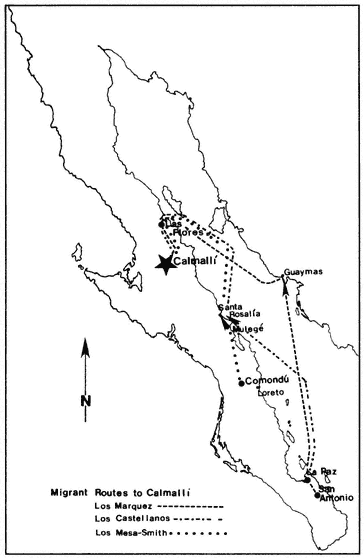
Map 5.
Los Marquez:
A Mining Family
I have reconstructed the history of los Marquez from the life of Don Loreto Marquez, who followed the mining circuit and vividly recalls the days and experiences of the mines. He spent his first thirty years in the mining communities of the peninsula which form a large part of his life story.
Don Loreto Marquez was a miner by birth. He was born in 1880, the eldest of three, in the mining community of San Antonio, where his parents also had been born. San Antonio was also the birthplace of the first commercially worked mines in the peninsula[4] (Aschmann 1967:25). Don Loreto's father was a miner and the boy was initiated into mining before his tenth birthday.
We do not know when the Marquez family came to San Antonio, but it is likely that they were among the early settlers there. The Marquez line is traceable to the first successful settlers on the peninsula, and the family is said to have been one of the first Creole families. In 1679 Nicolas Marquez, a Sicilian soldier, was among the five volunteers who accompanied Father Juan Salvatierra to Loreto.
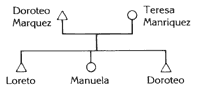
Diagram 1.
Los Marquez
In San Antonio los Marquez, like other miners, were poor, and Don Loreto worked initially to help his father support the family.
Life was very hard. Well, in those years there wasn't a thing like today. Uuuh! Today the difference is like heaven. And it was not difficult for just me but for my family and many others who lived then.
Well, we were there in El Triunfo, at that time, and to work I went. We were raised in the little town of San Antonio. The road that leads to San José del Cabo is very close to El Triunfo. The road begins at La Paz then goes to San José. Today that
is a very good road. In those times there was nothing more than . . . nothing. People traveled only by foot (a puro pie ). We walked to the top of the hills, everywhere, to work in the morning at all hours, and it rained. A person was obligated to go.
At the age of eight or nine Don Loreto was already working. He and other children were used to break up the crude ore outside the main shafts of the Triunfo mines. He vividly recalls this work and describes the technology of the period.
They kept me busy outside the mine. A young person was not allowed to enter inside. There were only grown men inside. There was plenty of machinery to carry the crude metal from the mines. Here [illustrating for me], for example, from the curb [about 25 feet] was the plain. And over there was the machinery. And here they came with a dump car. They dumped everything on the edge [making gestures to show the location and the movement of cars dumping raw ore]. With the small cart the grown men dumped the ore there. And over here they kept the younger boys like us. They had about fifteen or twenty boys there, along with an old man who watched us and told us what to do. Our job was to separate the good ore from the bad. The worthless metal we piled up [gesturing with his hands, showing how they picked up the raw metal and piled it up into two piles], you see? And the good metal we split. We always carried a hammer to break the metal into a certain size. The metal had to be small because in those times there were only a few types of machinery. The metal was taken to the smelter ready for processing because there was no rock crusher. We were the rock crusher [laughing]!
In the next twenty years Don Loreto became a permanent part of a mining labor circuit that took him to every major mine of the period. The family's migration began in the late 1890s. His father left San Antonio to work in the more northerly mines of the peninsula, then returned to get the family. They left San Antonio accompanied by another family and headed to La Paz on the Gulf Coast. The families were going to Las Flores, where Loreto's father had secured a job in the mines of San Juan. They went by steamer first to Guaymas across
the gulf, then to Las Flores. Don Loreto's description of the trip tells us about company shipping, travel at the time, and the northerly San Francisco route.
We boarded a ship in La Paz and went to Guaymas. That steamer . . . went along the San Francisco line and all these ports between here and there. It made a trip each month. Well, it left us in Guaymas.
From Guaymas we boarded a boat from the mining company of Las Flores. The company was referred to as Las Flores, the actual mines were called San Juan. We stayed in Guaymas about four or five days . . . then we crossed the gulf.
The Las Flores Company had a boat . . . they sent to all those little pueblos. It went to Mazatlán, Manzanillo, and Guaymas to pick up and send goods here to the company and material and whatever was needed in Las Flores. The owner of the boat was a Mexican . . . Pancho Fierro who lived in Mulegé. And he was a . . . he drank mezcal like water. (3/8/76:12)
Las Flores and the mines of San Juan are some five miles inland from Bahia de los Angeles on the gulf. The town is clustered in a valley forested with large cardon cacti, cholla, desert bush, and occasional ironwood trees (once abundant but now depleted because of use as fuel). Flanking both sides of the valley about ten miles apart are the steep mountains of the Sierra San Juan on the north and the Sierra San Ignacio to the south. The steep inclines of granite mountains in the distance above the flat valley floor give the valley a canyonlike appearance. Today adobe ruins, track outlines, and huge metal tumblers once used in breaking ore stand out conspicuously as one approaches the foundry site. When Don Loreto arrived, it was a bustling mine. "We got to Las Flores where the foundry was located and there was activity there. From Las Flores they sent my father to the mine at San Juan. They sent him on mules. He took us and all the baggage on the mules."
On the granite slopes of San Juan, Don Loreto, still a boy, worked outside the mine. He talks of the mines and the workings in a manner that reveals the prominent role of mining in his own experience and his knowledge of the technology of the time.
Well, we got to San Juan. My father had a job there with the company. A mine high on top of the mountain. It was very cold and, ay! it snowed a lot there. Well, he was a miner and they sent him into the mine. And us, we stayed outside to clean and break the ore.
The ore was lowered from the mountain. Well, such a mountain that I still don't understand how they finished that job. The company had put up cables with braces. [Illustrating with his hands] Here is the canyon, right? And here is mountain and over here is mountain [describing a ravine in the mountain that enters the valley floor at a right angle]. From the two sides of the mountain they placed wooden braces with a cable. It's about two or three miles long. Right in the mountain, in the actual rock! And down below . . . the ore arrived to the valley. There the ore was taken to a deposit.
The ore was lowered from the mountain in small "baskets," as they were called, small iron boxes. On the top of the mountain [still gesturing with his hands] the cable was rolled up on some huge wheels. And with only a lever here, at the base, it was controlled, so that it wouldn't go too fast, because the baskets that were loaded went very rapidly because they were very heavy. With these full baskets they pulled the empties up.
Very slowly, I'm telling you, they made the ascent, turning, turning, and turning. In that way the full ones pulled the empties. They went up and made the return.
The hacienda, as it was called, was in the valley where the foundry was located. Because this was foundry ore. Well, the work lasted. I believe we stayed . . . about three years there in the job. It ended and everything stopped. (2/18/76:3)
San Juan, like many of the peninsula mines, had a brief life. After three years, around 1895, the Marquez family packed up their belongings and headed south, beckoned by word of work in the placers of Calmallí. But their stay there was short, for, as was common in the exploitation of Baja California mines, San Juan was reopened. Don Loreto remembers the early move to Calmallí. He notes how laborers were dispersed throughout the peninsular region when company towns died: "Well, then the people began to leave to wherever they could. Some left for Mazatlán, for Guaymas, to El Palmar. At that time we headed directly through the mountains with burros . . . You should have
seen those tragedies. A person walked to arrive at a water spot. We came from San Juan to Calmallí."
The Marquez entrance into Calmallí seems to have taken place before other families of this study arrived there. It is likely that some of the other families arrived while the Marquez family was there during their first stay, but the exact dates of their meetings are unknown. When los Marquez left Calmallí, they first returned to Las Flores, then went south to Santa Rosalía, only to return again to Las Flores and to Calmallí. These peregrinations occurred in a period of about six years. The round trip (Calmallí–Santa Rosalía–Caimallí), a mining labor migration, illustrates the hardships of peninsular travel. But more important, it demonstrates how families adapted to migration as part of a way of life.
From Las Flores we went to Calmallí. And from Calmallí we returned to Las Flores because everything ended there too. But then we had already come by land, battling with the mule loads. Two or three clays of travel to arrive in Las Flores, to work once again. We stayed in Las Flores on our return, living there once again. The work had stopped above in the mines [San Juan] and I don't know how much time we stayed. We worked there in Las Flores doing odd jobs.
We came to Santa Rosalía and from Santa Rosalía back again. We stayed in Santa Rosalía a long time, until the work finally ended. Then we came to Las Flores. From Las Flores we went back to Calmallí again, with another company that began working for a short time until the work ended.
I was twenty or twenty-one years old at that time [laughing]. I think I turned twenty in Santa Rosalía [in 1900].
Don Loreto's father left Santa Rosalía first, for work in the Las Flores mines and soon sent for Loreto and the family. Don Loreto was working at El Boleo, the French concession in Santa Rosalía when he and his family learned that their father had found work again in Calmallí. Loreto had a secure job at El Boleo, but when his father sent for them, he left. Family unification was the important factor in the move.
At any rate, when we found out about my father, I had a very good job in Santa Rosalía. I earned two pesos a day [laughing], two silver pesos. It was a lot of money.
Yes, we had been told and we knew that my father was in Calmallí. One day as we were remembering, a man arrived with ten mules [sent by his father to pick them up]. My father had gotten a good job and was made captain of the mines, because that was his trade, the mines.
Well, I was there in Santa Rosalía, working at my job. I earned enough money to take care of the family there. My mother and my sister and "Tey" [his brother] was the whole family. Well, then, here comes this man with that army of animals. I already knew the man. His name was Antonio Espinoza.
"Well," he says, "I've come here because Doroteo sent me for all of you, to take you all to Calmallí."
Don Loreto arranged to feed the mule team that afternoon, and the following day he went to his French boss (jefe ) to arrange for leaving and collecting his pay. "The following day we left Santa Rosalía for Calmallí. Well, that next day in the afternoon we packed everything up . . . some friends went to the house and they were really complaining about our leaving. It was a mess! 'Victor: they didn't want you to leave.' 'Yes, so many friends.'" In Calmallí the Marquez family met and became part of a social field of families that formed the basis of mutual relationships throughout the next seventy-five years of Don Loreto's life. Among these individuals and families were los Smith and los Castellanos, whose migration to Calmallí was similar to that of los Marquez. The Smiths went first to San Juan and then to Calmallí to work in the mines, but both their place of origin and their reasons for migrating were quite different.
Los Mesa-Smith:
Comondú Migrants
Smith family lore is full of stories of origins that include pirates and whalers, but the Smiths of this study began with a Yankee sailor from New York City who arrived at San José del Cabo in December 1808. When Thomas Smith decided to stay on the peninsula, he became the first citizen of the United States to permanently settle in the greater Californias. Like other sailors who settled, Smith took the name of his godfather, Javier Aguílar and used it for the rest of his life. He served the presidio of Loreto as sailor and soldier and then married Maria Mesa, settling in the little town of Comondú (Crosby 1981:1–2). The family name of Smith was used again by his descendants later in the
century. In addition to the Smiths, los Arce and los Mesa settled in Comondú. Descendants of the Smith-Mesas also include other families in the Comondú–Loreto kin field. These are los Green, los Collin, los Drew, and los McLish (both los Green and los Collin came to San Diego in the early 1920s). These families had arrived during the peak whaling periods in the nineteenth century.
Comondú was one of the first mission sites on the peninsula. Located in Baja California Sur, at the outskirts of the central desert, Comondú was a natural early focus of settlement because of its major source of water. The town became the major municipality encompassing the principal gulf towns of Loreto and Mulegé. The valley was known for its oasislike beauty and lush growth. "It smells of wine and olive oil. Comondú, Allah's paradise, has a stream of oil and another of wine, which metaphorically cross all the fertile land of the valley ravine where the pueblo hides. Comparing it with Eden . . . Comondú only lacks a river of milk, because here there are cascades of dates, and torrents of figs and oranges in abundance" (Jordan 1951:226).
Comondú was and continues to be primarily agricultural. The population since the turn of the century has varied only slightly. The Mexican census of 1910 gave the town a population of 1,050, and in 1920 there were 852 inhabitants. Not until 1960 does the census again give populations for localities; in that year Comondú's population was 755.[5] The hardships of the small ranchos, the lack of land for expansion in the Comondú valley, and the rapidly expanding mining boom in Baja California during the 1800s were obvious factors prompting movement out of Comondú and other small pueblos.
In 1894, the year of their marriage, Manuel Smith and his new wife, Apolonia Mesa, left the pueblo of Comondú for the mines of Las Flores. Their decision to migrate was primarily economic, but it was also sanctioned by a strong social and kin base that had been fostered by the early settlers of Comondú. This base provided the mechanisms for social stability throughout the migration process, for the Smiths as well as for other migrant families. Antonio Smith's brothers had traveled north through the peninsula and settled in San Diego county. Manuel Smith, Antonio's grandson, had been in communication with a sister, Ramona Smith de Howard, who had married an American, Charlie Howard, and was living in the mining circuit. With Ramona was her brother, Osidiano, as well. The decision to move north was thus not simply motivated by better economic opportunities. The decision was based on specific information from friends and kin as well as on the
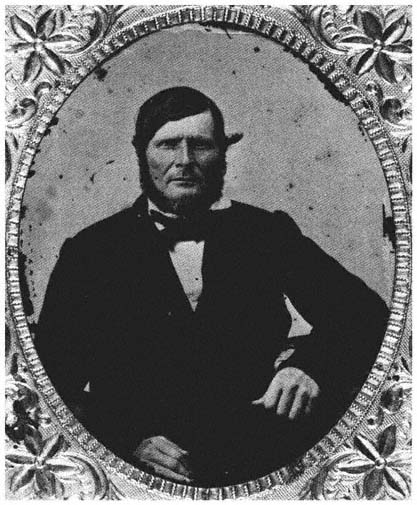
Antonio Smith
presence of close kin who had succeeded in previous moves. There is also evidence that the Smiths had a history of migration to Alta California and back to Baja California. Family lore tells of the Smiths' coming from Alta California, from the residence of Antonio's brothers in El
Cajon. Town archives are corroborative. The following entry is from the Mulegé marriage records of 1895.
José Estrada Jr. and Ramona Smith (married) in San José de Las Flores, November 10, 1895. He is 34 years old, widower, native of El Triunfo, mason, legitimate son of José Estrada and Presentacion Garcia: both from El Triunfo; She is twenty-three years old, native of Monterey Alta California, legitimate daughter of José Maria Smith and Trinidad Romero, both deceased. [The latter were the parents of Manuel Smith.] (emphasis added)
These ties to the north offered security and knowledge of the area los Smith were about to enter. Further security came in the actual move out of Comondú as an extended family unit. Los Smith were not only traveling to waiting kin but were accompanied by close kin.
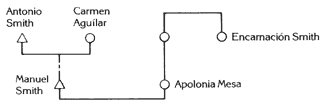
Diagram 2.
The extended kin unit of los Smith-Mesa when they left
Comondú in 1894
Manuel Smith and Apolonia Mesa de Smith left Comondú accompanied by Antonio Smith, his wife and immediate family, and Apolonia's maternal aunt, Encarnación Smith. The families traveled up the Gulf Coast some three hundred miles as a kin unit, offering support and security in a manner that was to become common among families traveling between peninsular mining towns and later when they crossed into the United States. Then Antonio and Manuel took separate routes. Antonio went north to the valley of Santo Tomás. He later crossed the border into San Diego, moving to the home of his brothers, who were living in El Cajon, a farming area about twenty miles east of San Diego. Encarnación, Apolonia's aunt, remained in Ensenada.
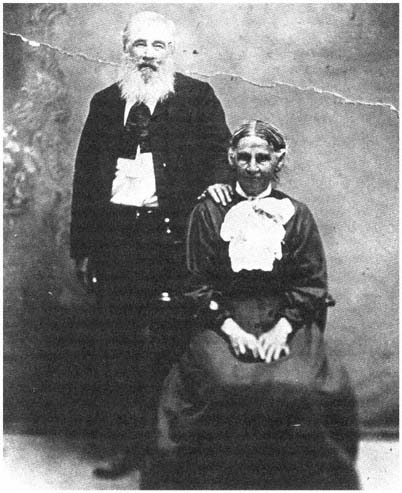
Antonio Smith and Carmen Aguílar, who left Comondú with Manuel and
Apolonia Smith just before the turn of the century. This photograph was
taken in Ensenada in 1900.
(Courtesy of Fidel Mesa Smith)
Once in Las Flores, Manuel began working in the mines. He soon established himself as a leñador, cutting, collecting, and delivering wood for fuel used in the processing boilers of the mines.[6] Two children
were born to Apolonia and Manuel in Las Flores. Adalberto (my grandfather) was born in 1895, and a daughter, Francisca, was born shortly after. The family remained in Las Flores until about the turn of the century, then moved south to the town of Calmallí.
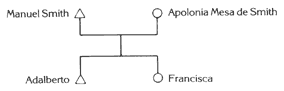
Diagram 3.
Los Smith when they left Las Flores around
the turn of the century
Los Castellanos:
Mining Circuit Friendship
The migration of los Castellanos demonstrates the usefulness of continuing family ties in the northward journey of peninsular families; it also reveals the early friendships with other mining circuit families that began developing prior to Calmallí.
The Castellanos began their journey in Peru and followed the Manila galleon route north to the cape region. Slowly, over a period of fifty years, they made the trek north through the mining boomtowns of the desert. Tiburcio Castellanos landed in the cape region of Baja California in the early part of the nineteenth century and settled in the La Paz region with his wife, Juana Almenares. There they had two offspring:[7] María del Rosario and Narcisso (my paternal great-grandfather: fa mo fa). It is not certain how long the family remained in La Paz, but both Narcisso and María del Rosario entered the Mulegé district in the late nineteenth century. At the age of eighteen Narcisso married Cleofas Gaxiola, sixteen, and soon after migrated north. The Gaxiolas were a family with roots in Sinaloa and were well established in La Paz. Soon after their marriage, Cleofas and Narcisso began a northward migration. Their first child, Ramona (my paternal grandmother), was born in Comondú in 1886. But their stay here was short, for Ramona reminisced and spoke of her early adolescence in the mining towns of the mid-peninsula rather than in Comondú itself.
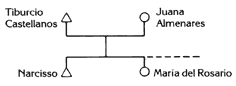
Diagram 4.
Los Castellanos when they left the cape region
Before moving into the mining circuit Narcisso and Cleofas spent some time in the Mulegé area. There María del Rosario (Narcisso's sister) had settled, having married José Estrada. This marriage linked the Castellanos not only to los Estrada but also to los Villavicencio, a large and well-rooted family in this sector of the peninsula. The Villavicencios continued close communication and ties with los Castellanos and visited San Diego some thirty years later. María del Rosario passed away in 1892 at the age of twenty-seven. By that time Narcisso, Cleofas, and Ramona had entered the mining circuit.
Like so many other families, los Castellanos went to the Minas de San Juan in the valley of Las Flores, where they met other migrant families and began establishing social relations that led to strong social and kin ties in later years. Such relations were begun with the Sotelos, a family with roots in the southern peninsula.
For los Sotelo, as for los Castellanos, their residences and prolonged stays can be determined by the birthplaces of offspring. Francisco Sotelo (Don Pancho) was born in Mulegé in the second half of the nineteenth century. He met and married Angelina Arce in San Ignacio, her hometown. Soon after their marriage (c. 1898) they entered the mining circuit and moved to Las Flores. Like the offspring of the Castellanos, Smiths, and other families, the Sotelos' eight children were born in various mining towns on the peninsula. The birth dates of the children coincide with those of children of other migrants in the same towns and indicate both the period of residence in particular places as well as the opportunities for acquaintanceships to spring up during peninsular migration. The first two Sotelo children were born in Las Flores, Teodora around 1898 and Prudencio in 1901. Guillermo was born in San Fernando, across the peninsula on the Pacific (about 150 miles northwest of Las Flores) in 1903. The family then moved south to El Marmol where Federico was born in 1905 and back to San Fernando where in 1907 Refugio was born. The family remained in
the northern peninsula from this time. Francisco was born in 1912 in El Rosario and Amalia in Mexicali in 1917.
In Las Flores the two families struck up a close relationship that has continued through the 1980s. Narcisso Castellanos and Francisco Sotelo became companions and friends on the mining circuit. In San Diego Don Pancho often reminisced about their joint experiences in the mining towns: "I was the judge and my buddy Chicho (Narcisso) the sheriff." Their close ties were later formalized in San Diego, through the marriage of two of Don Pancho's daughters into the Castellanos family.
There are no clear records for the Castellanos departure from Las Flores, but their next stop was Calmallí. The Sotelos and a host of other families also trekked south, crossed the sierra, and dropped into one of the most productive gold mines known on the peninsula.
Calmallí:
The Social Nexus
Los Marquez, los Smith, and los Castellanos arrived in Calmallí as experienced miners. They came knowing the jobs, the life-style, and many of the people supporting themselves on the mining circuit. The underlying base of all social interaction between kin and nonkin was, of course, the mining economy, which had pulled the various families together into a specific community. The permanence of these people in Calmallí led to full, meaningful social ties that later afforded a social base from which friendships and ties became paramount factors in adaptation in the U.S. These families created social environments that revolved around the work and life-style of Calmallí (and other mining sites). The long production of Calmallí provided the economic security that allowed continuous contacts between mining families who were now a permanent part of the mining economy. The mining economy was the landscape of their social environment and the basis for a life-style that became permanent in family lore. The pioneers of this study identified with the mines, with the technology of the time, and associated all of this with the social relations that evolved during this period.
Don Loreto Marquez
Don Loreto met the Smith, Castellanos, Bolume, Alvarez, and other core families in Calmallí. He remembers them as vividly as he remem-
bers the work and its technology. The work played a great role in family relations and in the quality of life in Calmallí. Don Loreto's recollections illustrate the spirit of life in Calmallí, the miners' perspective on company labor, and the pride they took in their work.
The first time we were there plenty of time. There were lots of people and plenty of gold there at that time. The company from San Francisco set up a very large mill in Calmallí. They spent many thousands of pesos there. Well, the mines paid out. Three or four mines that were worked silver, the crushing of the ore and throwing in quick silver. And there in the quicksilver they got the gold. (2/18/76:5)
The mining mill was pretty far back. I believe about two or three miles. There was a wagon road, just for mule wagons. From up there, where the people were in the mines, the company carried out the ore. With machinery, I'm telling you, with "donkeys," as the machines were called. The machines pulled and there were some huge braces. The ore was taken out and dumped into some very large chutes, and from those chutes the wagons were filled. The filled wagons were then taken to the mill.
I worked in the mill. First, I worked in the furnace where wood was used. It was a hell of a job; steam was raised to move the machinery. The work of the mill . . . nothing else. Most people have no idea . . . it's a very specific type of work, beautiful work and very costly. Because there is a lot to be done. No, not just taking the pure ore and letting water run. No!
Here in front . . . is a type of chute where the ore falls. A piece of steel from the actual millstamp strikes and turns a small wheel as the ore is already falling inside where the stamp is striking. You see? But if too much falls—there can't be too much at the same time—the stamp doesn't rise and it doesn't work well. Because that's the way the stamp's stroke is. Each stroke is five inches, just this much, of height. It lifts only this much . . . five . . . and it drops and drops. The five stamps drop like this, almost at the same time.
Along with his pride in the mining way of life, Don Loreto demonstrated an awareness of the situation in which he and other mining families found themselves. They were company miners and had come
to the mines looking for security in employment and in the social relations common to the towns of Baja California. Calmallí, like other mining towns, also attracted gold seekers and fortune hunters who flocked to the larger strikes and roamed the nearby crevices and dead streams in their attempts to strike it rich. Don Loreto talks about this contrast between company labor and independent prospecting.
There in Calmallí . . . many people worked in the mines. But for salary, understand? There were lots of people who moved over here, over there, in the small ravines searching for a little gold with small contraptions that they made themselves.
A lot of people did that and that's how they earned a living. Many took out gold. They were lucky, they extracted little nuggets of one adarme [one sixteenth of an ounce]. As many as two, three adarme . The little gold nuggets. But not others. It was very fine gold. They had to use quicksilver.
He also remarks on the richness of the strikes: "Over where the mill was breaking the rocks, the company was extracting the gold. It was very rich, very rich. Many people succeeded [in getting some gold]. Those who were not foolish. We were very foolish because we didn't succeed. We weren't smart enough to grab even just a small amount" (2/18/75).
Don Loreto described his meeting with the Castellanos.
R. Alvarez: It was there then, that you met Narcisso Castellanos?
Don Loreto: Yes, in Calmallí.
R. Alvarez: Were they already there?
Don Loreto: I can't say for sure if they were there already. But that is where I met them. I was still very young at that time. Well, you know, when you're young you don't notice people too much. Yea . . . and we worked the mines there. Castellanos, the senior, Narcisso, he was the mayordomo of the mines, of the mine laborers who worked right inside the mines. About fifteen or twenty men worked inside, you see? He was the boss and gave orders there. He was called "capataz " there. (3/8/76:4)
Narcisso Castellanos continually helped Don Loreto in the mines and later provided support when Loreto first arrived in San Diego. In addi-
tion, los Marquez and los Castellanos became formally tied through multiple compadrazgo relations in the north.
In Calmallí Don Loreto also met Ursino Alvarez (my paternal grandfather), another compadre, who worked directly under Narcisso Castellanos in the mines. Don Loreto mentions the company "neighborhoods" that brought them together.
Ursino? I met him down there in Calmallí. In the placers of Calmallí, that's where I met him. He worked in the mine . . . the Castellanos family was there too, my father, everybody. There was plenty of work in the mines when I met him there. Well, I would see him but I was very young and I didn't know much, like when one is older. But there he was. He always came to the house, to talk, like all the working people. People met at night to talk there in the houses. That is when I met him. Later when all the Castellanos came here to San Diego, he came too . . . following his girlfriend. [Ursino wed Ramona Castellanos in San Diego.]
Families shared work and social experiences and developed the trust that became a basis for reciprocity along the mining circuit to the north as well as later in the frontera. Don Loreto met los Bolume in Calmallí. A Bolume daughter, Guadalupe, married Jesus Castellanos, and they became compadres in San Diego. The Simpsons were also in Calmallí in the late 1880s, and Don Loreto's sister (while on the mining circuit) married into another Calmallí family, los Lopez, who had also arrived from the southern cape. Los Smith and los Marquez also became close acquaintances in Calmallí. Don Loreto clearly expresses the friendship between the families.
We met Apolonia there. That's where we came together. When I went to work I passed about twenty feet from the door of her house, to the job I was working in those times. Manuel was there. Adalberto. Adalberto was about ten or twelve years old, less, I believe. He went around with Manuel, because Manuel had burros to haul firewood to the work there. He went to the mountains, he cut firewood and . . . he took it to the company and they paid him . . . by the cord. They made their living from it.
Los Smith
The history of the Smiths on the mining circuit illustrates the formation of friendships and close ties with nonkin as well as the maintenance of home kin ties. Although other families also maintained such ties, evidence of this communication is not seen until they are in the northern section (e.g., the Castellanos received Gaxiolas and Villavicencios in San Diego during the 1920s). Los Smith, however, left Comondú with immediate kin, were received in Calmallí by kin, and aided and received kin throughout their residence there.
In Calmallí[8] the Smiths were no longer the inexperienced pueblo dwellers that had come to seek work in the mines. Manuel came as a leñador, a job specific to the mines which he had practiced in Las Flores. The necessity of fuel for the boilers in the mines as well as for horne cooking created the small economy by which Manuel and a host of other independents became tied to the mines. Where there were mines, there was work for Manuel. Los Smith arrived in Calmallí along with their two children, Adalberto and Francisca (who had been born in Las Flores). In Calmallí a third child, María, was born.
Along with immediate family and friends like Loreto Marquez, los Smith had close kin in Calmallí. Manuel's sister Ramona was in Calmallí with her husband, Charlie Howard, an American who was working the placers of Calmallí. María, although quite young at this time, recalls visiting her Tía Ramona with whom, she says, her parents spent much time. When Ramona died in Calmallí, of complications at the birth of twins, both Manuel and Apolonia were with her. Charlie Howard left Calmallí with the twins and was never heard from by the family again.
In Calmallí the Smiths kept close ties with kin in Comondú. Letters to Apolonia's parents and sisters kept home kin in continual communication with los Smith. During Apolonia's pregnancy with María, her mother became ill and died (c. 1901). Martina and Antonia, Apolonia's sisters, knew she was in the last months of her pregnancy and wrote Manuel of the seriousness of Apolonia's mother's condition. They informed Manuel but asked that the news be kept from Apolonia, fearing for her health and the child's. This constant communication kept all kin informed about their relatives. It also facilitated the reception of kin who were on their way north as well as kin who would come north later in the century. The Mesas, for example, were received by Apolonia and Manuel Smith in Calmallí.
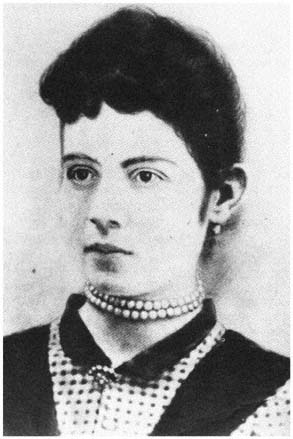
Ramona Smith de Howard (c. 1890), sister of Manuel
Smith, married Charlie Howard, an American working on
the mining circuit. She died in Calmallí, from complications
at the birth of twins, who were taken to the United States
and never heard from again.
(Courtesy of Ernestina Ignacia Mendoza Allen)
The Mesa family migration north illustrates not only the Smiths' hometown kin ties but also the nature and the significance of kin ties in family migrations from hometowns into the central and northern peninsula. Salvador and Juana (Apolonia's paternal aunt) Mesa left Comondú, according to (their daughter) Paula, because their eldest
son had left for the north and their mother wanted to be close to him. In Comondú Salvador had packed grapes and figs destined for Santa Rosalía. From Comondú Salvador and Juana traveled to San Ignacio with six children and stayed in that mission town, where Salvador managed fruit fields (administraba las huertas ). Although successful there, the family left San Ignacio to follow kin who had gone further north. They left in October and traveled through the central desert to the northern boundary town of El Rosario, arriving on December 3, el Día de San Francisco . On their way they passed through the mining towns of Calmallí and Julio César. In Calmallí Apolonia and Manuel Smith received Salvador, Juana, and the children. They stayed several days, resting, visiting, and exchanging news with Apolonia. Juana and Apolonia had been close friends and Juana was continually thinking and asking about Apolonia (so reports Hirginia, Juana's daughter). Los Mesa moved on to the north, arriving in San Quintín, where they later received los Smith when Calmallí ended production.
Among the important network relations of los Smith in Calmallí were friendships formed with nonkin. Friendships established at this time with los Bolume, los Marquez, los Simpson, and others were to have significant meaning in later years. An informal network of social relations between los Smith and los Castellanos later developed into kin ties through marriage and compadrazgo . A good example of one such link is Guadalupe Bolume, a close friend of Apolonia's during the years on the mining circuit. Guadalupe was born in Calmallí and later became comadre to the Mesa-Smiths as well as to los Marquez, and she married into the Castellanos family. This cluster of families—los Smith, los Castellanos, los Marquez, los Simpson, and los Bolume—was identified by a close friend of them all, Señor Villavicencio, who now lives in Pozo Alemán. He recalls their long stay in Calmallí and their relations as a group.[9]
Los Castellanos
Narcisso and Cleofas Castellanos were among the earliest of arrivals to Calmallí, and they spent a great deal of time in that town. When Narcisso entered the mining circuit, Ramona was an only child. By the time the family left Calmallí, six more children had been born and three others would be born in more northerly mining towns. For the Castellanos Calmallí was truly a nexus, the landscape in which specific social
ties formed a basis for future marriages, compadrazgos, offspring, and future generations.
La familia Castellanos consisted of Narcisso, Cleofas, Ramona, Jesus, Juana, Espiridiona, Francisca, and Abel. Like other core families
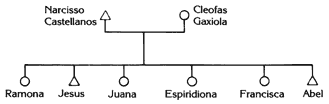
Diagram 5.
Los Castellanos when they left Calmallí
in Calmallí, los Castellanos did not actually marry during this period, but the bases for later marriages and compadrazgo relations were laid in Calmallí. Of the Castellanos children who grew up and were socialized in Calmallí, all of these married into Baja California families. But three married into core families. Courtships for some of these marriages began in Calmallí, as is illustrated by Don Loreto Marquez: "It was in Calmallí where I met him [Ursino Alvarez]. Later when all the Castellanos came here, he came too . . . following his girlfriend. My comadre Ramona worked [in San Diego], I'm not sure for whom. But she wasn't married yet. She was being courted by Ursino."
Other similar courting relations developed in Calmallí and in other mining circuit towns. Guadalupe Bolume recalled dancing with Vicente Becerra, who played guitar at social affairs in the mining towns and who played for her wedding decades later in San Diego. Vicente himself was married in San Diego to Guadalupe Gonzales, who had also been on the mining trail with her parents.
Numerous marriages and compadrazgo relationships based on mining friendships occurred later in San Diego. Offspring of these marriages then intermarried and further reinforced the solidarity of these families in the frontera region. Overlapping formal compadrazgos also united families. Don Loreto, recalling Jesus Castellanos, stated, "Jesus married my comadre Lupe [Bolume]. Jesus, the brother of my comadre Ramona."
The Calmallí period, for Narcisso and Cleofas Castellanos, was not a brief interlude or simply part of a migration north. They, like the
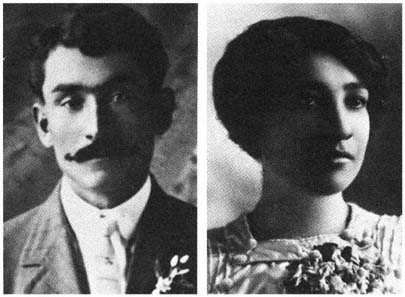
Ramona Castellanos and Ursino Alvarez, San Diego. c. 1915
majority of others, saw themselves as permanent settlers in Calmallí. But when the mines fluctuated, they were forced to seek jobs and homes elsewhere. In many ways these individuals were locked into the mines. Narcisso, as capataz of barreteros had developed a skill specific to the mining economy, and he built his life and his family's life around that security. His children were born and raised in this environment, as were the children of the Sotelos, the Bolumes, the Smiths, the Simpsons. When the Calmallí mine could no longer support the families of workers, people moved on. Many were encouraged to head north because El Marmol, Julio César, and other small mines were producing and employing mine laborers.
North to the Frontera:
A Period of Transition
Los Smith, Marquez, Castellanos, and other families left Calmallí when production in the mines declined. Although many migrants eventually
arrived at towns on the U.S. side of the border, the march from Calmallí was a long one. Some families went to the border following El Camino Real, hitting the various mining spots along the way. Others, like the Castellanos and Marquez, went first by land, then boarded company steamers that took them directly into the United States. But even these journeys were long episodes interwoven with specific landscapes, mining towns, and social interrelations.
This period was not simply a continuation of the mining circuit; rather, it was a period of transition. The towns of the mining circuit were slowly fading from importance as fewer and fewer booms followed busts. Migrants now turned to the frontera region, whose economic sustenance derived from the development of the border towns of Calexico and San Diego. As migrants crossed the border they left not only the Mexican peninsula but also the life-style of the desert. This transition is clearly visible in the last trek of the Smith, Marquez, and Castellanos families. Los Marquez and Castellanos returned more than once to the Baja mines after crossing the border, but ultimately the mines failed and the border economy accelerated, luring families across the line to settle.
Los Castellanos:
To San Diego and Back
In addition to the collapse of the mining economy, the Castellanos gave other reasons for their northward migration. Francisca states that an American foreman persuaded them to head north. Furthermore, Narcisso, who had hired a tutor for his older children, was worried about the education of his offspring. This concern too figured in the final move to San Diego.
Narcisso and Cleofas first traveled to the small town of San Regis (about forty miles north of Calmallí) where a third son, Narcisso, was born in 1904. After his birth the family crossed the desert to the Pacific landing of Santa Catarina (about fifty miles south of El Rosario), a port that fed a variety of company towns in the adjacent interior. Francisca Castellanos (my godmother) told me of the trip, which I recorded in field notes: "Nina [my godmother, Francisca Castellanos] remembers traveling by land through the desert with the family. Most of this travel was done on burro or horseback. [She remembers that] it was hot. A guide who was with them would keep his head covered with a sheet for protection against the sun. He was carrying Chicho [Narcisso], an
infant at the time" (12/17/75). "Un viejito" (a little old man), Cevero, accompanied the family from Calmallí to Santa Catarina. There at the port, along with others, they boarded a steamer, the St. Denis, which was going to San Diego. From shore small rowboats lightered passengers and cargo to the waiting steamer. The St. Denis made regular trips between the northern peninsula and San Diego, stopping at San Quintín and Ensenada before going across the international border into San Diego bay. The Castellanos arrived in 1905 and "immigrated" at the Port of San Diego.
The Castellanos' initial move across the border, however, was not permanent. In the next four years they returned twice to the Baja California mines before finally settling in the border zone. In 1906 and again in 1908 Narcisso Castellanos and the family returned to the peninsula. Both of these return trips were for the birth of children. Narcisso had insisted that all the children be born in Mexico. In 1906 Cleofas was with child and the family returned to Santa Catarina, as they had left, by steamer. From the Santa Catarina landing Cleofas, the children, and Narcisso made their way to the small mine of Julio César, some ten miles inland from the coast. There in January of 1906 a son, Tiburcio, was born. When Cleofas was well enough to travel, the family embarked again for San Diego. "As soon as my mother completed her diet we returned to San Diego" (Tiburcio Castellanos, 7/21/76). Within two years the family boarded for Santa Catarina again, this time for the birth of Ricardo. Landing once more at Catarina, the family made its way to the onyx mines of El Marmol, about fifty miles inland from the coast. That same year, 1908, the family packed up and returned to San Diego. This trip was the final one and the move to San Diego became permanent. "It was the same thing, my mother completed her diet and we returned to San Diego" (Tiburcio Castellanos, 7/21/76).
The Castellanos' return visits to the district proved beneficial because they renewed contacts with many old family friends. Los Sotelos, los Simpson, and others were still in the mining circuit. And Ramona Castellanos had the opportunity to see Ursino Alvarez, who was apparently working at the inland mine. Don Loreto tells of the romance and of the mining environment of El Marmol.
He was courting since they were down there in El Marmol. They [Los Castellanos] were also down there in El Marmol which is in a mountain area down below San Quintín.
I don't know how many years the mine lasted. They stopped
mining just like that . . . and then began again. It was a company from San Diego. A very large steamer went to the port there. The port was called Santa Catarina. It was a small pueblo with a spring. The wagons passed through there. They pulled the wagons with mules, from El Marmol to the edge of the beach. Just imagine. It took them two days. That's right.
In San Diego Narcisso and Cleofas joined other families that had traveled the mining circuit, and in turn they all received incoming peninsular families. Within the next decade the Castellanos traveled to Calexico where they reestablished numerous acquaintances.
Los Smith:
The Trek To Calexico
As Calmallí production dwindled and work there diminished, families dispersed and moved to other towns. Most went to mining sites within the central desert. Los Marquez traveled northwest along El Camino Real to Punta Prieta. Guillermo Simpson and family went farther north to San Fernando, and los Castellanos to San Regis. It is probable that many families went south and home. Los Smith, however, went north to the valley of San Quintín.
During the years 1906–1908, after leaving Comondú, Manuel and Apolonia Smith traveled at least four hundred miles. They moved to Calmallí, then followed El Camino Real through Punta Prieta, Laguna Chapala, San Fernando, El Rosario, and into the then small agricultural zone of San Quintín. In San Quintín they arrived at the home of Juana and Salvador Mesa. (Los Mesa had previously stopped in Calmallí, and although they had remained only a few months, this stay reinforced the two families' ties.) Hirginia Mesa, who now resides in Maneadero (about seven miles south of Ensenada), remembers the visit of Manuel and Apolonia. They had come very far and were looking for work. Manuel worked there during the harvest in the agricultural fields. Later Hirginia and her sister Paula ventured into the north and renewed ties with Manuel, Apolonia, and their children.
From San Quintín Manuel went further north to El Alamo, where a new strike had attracted people to the mines. But like other mines, El Alamo lasted only a short time. As contemporary reports illustrate:
On the western side of the plain, some forty-five miles south of Real Del Castillo, is the Santa Clara placer district and what remains of the old mining camp of El Alamo. Here, early in 1889, several thousand gold seekers converged, and Goldbaum, representing the government, helped to collect mining fees and give possession to claimants. (Lingenfelter 45 in Goldbaum 1971:52)
The rush only lasted a few months, however, although quartz mining continued in the vicinity off and on for many years. (Southworth 74, 89 in Goldbaum 1971:52)
In 1905 Nelson described El Alamo: " . . . with its vacant houses and dilapidated appearance [it was] a typical broken mining camp. There were many signs of former activity here in considerable scale, but at this time only a few men were working. New supplies were being sent in and a revival of work was being announced with the usual sanguine expectations."
In El Alamo Manuel worked the mines while Adalberto, now older, took to the campo (countryside) as a leñador . Rosa Salgado,[10] a native Palpal, Indian, who was to become part of the Smith network, recalls their arrival and also reveals the close ties that developed in the mining community.
R. Alvarez: Aunt Rosa, did you ever meet the parents of my grandfather Adalberto?
Rosa Salgado: Yes, I met them when they had just arrived from the south. At that time I was working for a lady.
R. Alvarez: Where, Aunt Rosa?
Rosa Salgado: There in El Alamo. They arrived there. They had come from the south.
R. Alvarez: Did they stay there very long?
Rosa Salgado: Yes, they stayed there a while because their father Manuel was working there. Ooh! There was a lot of people working there in the mines. He started working there as soon as he arrived. Working there in the mines. He had Adalberto with him . . . Adalberto was very young.
I have a brother and Adalberto came to the house and would invite him way up to the hills to collect firewood. They took
burros. My brother would go with him and bring firewood. Adalberto collected [firewood] and loaded the burro, and he would leave firewood for us too. Adalberto and two sisters came with the family. One, Maria, she's the one that's still alive, right? The other sister was Panchita. The two girls looked exactly the same. Then there was another boy. I don't remember what his name was. (6/18/76)
Apolonia had her fourth child, Manuel, here but lost a child, Panchita, who had come ill from Calmallí. While Panchita was ill, Apolonia sent her to los Larrinagas in Ensenada. They were kin from Comondú and they cared for her while they sought medical help. But she came back to El Alamo, where she passed away. "The girl didn't last the year. She got sick, I believe. I went with them when they buried her there in El Alamo. Such a beautiful girl. She had long braids, all the way to her waist" (6/18/76). The loss of Francisca played a strong role in the family's next move north. María states that this was the crucial reason for the move to Calexico. Her mother was grieving and wanted to be in another location.
Around 1914 Manuel and Apolonia went north with a stream of other families to the developing region of Calexico. Following the pattern established when they first left Comondú, they left El Alamo with a group of other families from the home region, As described by Maria, the surviving daughter, "Era una carpatada de familias" (It was a carpet of families). That included los Blackwell and other friends.
When the families arrived in Mexicali, they went directly across the border to Calexico. In 1910–1915 Mexicali was only a region of ranches and farms, but Calexico, across the line, was the center of activity for the Mexicali valley. There los Smith were reunited and received families from the south. Among these families were a host of kin who sought out los Smith in Calexico and reestablished close ties in a social cluster that merged with other mining families later.
Don Loreto Marquez:
El Cajon and the Mines Again
Don Loreto lived as a miner throughout his traveling through the peninsula. In the boom days of Calmallí, as in Las Flores and Santa Rosalía, he had always succeeded in working good jobs. He learned
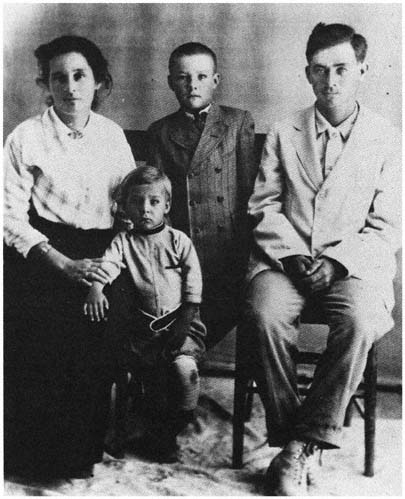
Los Smith in Calexico, c. 1915. Left to right, Apolonia Mesa-Smith, Jesus,
Manuel, and Adalberto.
(Courtesy of Flora Fernandez de Smith)
skills that he used in mining as well as later in life. He learned blacksmithing and he worked in the foundries of various towns. Around 1905, when he left Calmallí, it was not solely a departure from a job and friends. The move marked a transition into the north that would
take him and his family into the United States and that would present a new and different way of life.
The move north for Loreto Marquez was slow, as for many other individuals. He first stopped and worked in the Punta Prieta mine, which died a quick death. Forced to work elsewhere, he went to San Quintín around 1909. Then, like the Castellanos, he headed to San Diego. This initial move to San Diego was not permanent and the old life in the mines beckoned him. He returned to the mining circuit with an old "boss" and remained for six years before returning to his parents in San Diego county. The hardships of the mining life are clear in the Marquez case.
I came here to San Diego first in 1910. My sister . . . was already here. She had come from the mine down there in Punta Prieta. But we stayed there in Punta Prieta, me and my brother, my mother and father. But there was no work. We were there in the desert, that's it.
When the work ended we stayed in Punta Prieta. We were there, moving over here and over there looking for any little pebble to survive. The boss gave us whatever he could get He came from Ensenada and brought whatever little thing in the boat. And he maintained us there. I don't know what they did with the mill after the company abandoned Punta Prieta.
When they put the mill up, it was an eight-stamp mill, that's all. It was very small. The company wasn't able to work any longer because they spent so much to put up the mill. It was very costly and a lot of work.
The company brought an engineer, a German, who had been the engineer in the Port of Ensenada. He got along with everyone there. My boss, Brown, took him to Punta Prieta. And that German put up the mill. Flick was his name. Flick . . . big as hell. He was a very good person, that's for sure. Remember that when the work ended they all went to the United States. The German came up here to Los Angeles; he had a job to do around there. But we stayed there in Punta Prieta without work.
When the boat from Ensenada arrived . . . they brought us a letter for my father. The German . . . got a contract in San Quintín and he wanted my father to send us there to work with him. San Quintín is located below Ensenada. (2/18/76:13–14)
The valley of San Quintín lies approximately 190 miles north of Punta Prieta on the Pacific Coast. Along with Ensenada, the town had been a major northern port of trade during the nineteenth-century otter trade; it later became a major agricultural experiment First owned by Americans, then later by a British company, San Quintín was converted into a wheat-growing district. A large flour mill was built and dry farming of wheat was practiced for many years. Mexican, English, and American colonists began settling the region, but successive droughts brought doom to the colony. Well-conceived plans for a northern connecting railroad, for which some track had already been laid, died along with the crops.
The mill, railroad tracks, and other machinery were all that remained of the venture, and a crew was hired to dismember the mill and salvage all that was possible. Don Loreto and his brother, Doroteo, went to San Quintín as part of the salvage crew.
Well, there had been a flour mill in San Quintín, but I don't know when. A very rich company from England, owned by an Englishman, planted who knows how many sacks of wheat there. There are beautiful lands in San Quintín close to the water marsh. They built good houses and everything; they put in a train that was to go to Ensenada. They wanted to reach Ensenada with the train, to haul the flour and everything . . . Well, I'm not sure when that was because that is what people said. I don't know because I wasn't there at that time. But when we arrived, people told us that when the mill was in full swing they milled flour. We came because the German, Flick, got the contract to dismantle everything there.
Well, the German sent a letter to my father that he should take us to San Quintín to work there with him. He already knew me and my brother. Well, after we opened the letter . . . my father looked for some mules right away. He brought them and left them in San Quintín. It took us two days of traveling [about 192 miles] from Punta Prieta to San Quintín [laughing]. On mules!
When we arrived . . . he gave me and my brother a room and everything we needed to work. He had about ten or twelve men working, razing everything . . . dismantling and taking everything out.
Don Loreto stayed in San Quintín with the crew for six or seven months until the work was done. He worked as a blacksmith, making tools and various parts for disassembling machinery and for its shipping. Once the work was done, Don Loreto tells how the parts were loaded onto barges and hauled by small steamers out to a ship that would carry it all away.
The big ship that the company sent to pick up all the machinery stayed anchored outside . . . where it was deep; a ship of immense size. It came to pick up everything . . . from the shore two small steamers pulled the cargo by barge. They made only two trips per day . . . (2/18/76)
The ship took all the machinery that was inside the mill and the railroad track and platforms. [Laughing.] It took everything in only one trip! (2/18/76)
Once the work was finished, Don Loreto and his brother went north to San Diego, in 1910, and sent for their parents. The decision to move north was instigated by their boss, Mr. Flick, who had planned to take both Loreto and Doroteo to Los Angeles. But Don Loreto's immediate supervisor suggested that San Diego, where they had family, was a better destination. So they decided on San Diego, where they immediately sought out friends from the mining circuit.
We came in the Bernardo Reyes to Ensenada. We stayed there just four or five days with some acquaintances. From Ensenada we came here to El Cajon. My sister already lived here. She was the married one. (2/18/76)
When we arrived to San Diego we went to the home of los Castellanos. Narcisso Castellanos lived here, the father of the Castellanos who are from San Diego. He was already living in San Diego. We arrived there because he had always been very good to us and we were very close from down in Calmallí. . . . (2/18/76)
Loreto's old mining friend, Narcisso Castellanos, received them and took them out to El Cajon where Don Loreto's sister was living. Once settled the young men sent for their parents. Their mother and father also arrived on El Bernardo Reyes, never to return to Baja
California again. Don Loreto, however, was back in Punta Prieta before the year was out.
Life in the United States was not easy for many of the new immigrants. For Don Loreto, like others, the work was demeaning and the pay was bad, as he himself states:
And I didn't like it. The work here payed very poorly, very poorly. It was $1.25 a day. I worked with the water company of the district of La Mesa . . . you heard me mention that company . . . I worked making ditches with only a pick and shovel. For one dollar twenty-five [laughing]. A person threw his soul into that work. But I had very good work in Baja California with the boss, Mister Brown, who ran the business in Punta Prieta. Well, anyway I didn't like the work here, but I kept it up because my father and mother were here . . . They also came after we did on the Bernardo Reyes . (2/18/76)
San Diego in the early decades of the century was the major business center of both Southern California and the northern frontera. The small steamers commuted regularly between the Pacific port towns and a few went as far as the cape and across to the mainland. San Diego was still a major outfitter and center of negotiations for the business and mining efforts of the northern peninsula.
On a Saturday outing in San Diego, Don Loreto ran into his old boss's son, Kenneth Brown, who advised him of a new job his father had taken in Punta Prieta. Before the day was out, Don Loreto had contracted to work for Brown again.
I went to San Diego one Saturday night. Well, who for all my great sins, while I was in the store, I ran into my boss Brown's eldest son, Kenneth [Brown had two sons and three daughters] who was walking around the stores making purchases when I was shopping for shoes or I don't know what, when I ran into him there.
"What are you doing here, Loreto?" said Brown's son, the boss's son.
"Well, nothing, I came to look around," I told him.
"Listen," he says, "do you want to go to Punta Prieta?"
"What am I going to do there?"
"My father is going again to work the mines. We're getting
ready," he said, "loading the ship and it's going to leave in three days, the ship to Punta Prieta. Do you want to go?"
"Yes," I said.
That's how I responded. That "yes." And no one here in San Diego knew anything.
Then . . . he asked me: "Don't you want an advance?"
"Yes," I said. "Why not?"
Well, there we go.
"My father has the office close to the Grand Hotel. That's where he has an office. Let's go over there."
We went there right away and I greeted the boss, Brown. And Kenneth told him, "Loreto is going with us too."
"Oh yea, that's good," he said.
Then he gave me a thirty-dollar advance. Well, I was rich. In those days everything was cheap.
That same day, in late 1910, Don Loreto purchased his gear, then went to his old friend Narcisso and advised him of his return to Punta Prieta.
"Hey, listen, Chicho."
"What are you doing here?" I told him the whole story.
"Ah, that's good," he said.
I told him, "I'm going to El Cajon. And tomorrow I'll be back and I'm going to leave this suitcase here."
"Sure," he said.
Boy, I'm telling you. I came home in the early morning so that my father could see me. And ooo! He got madder than hell . . . He got very angry. He didn't want me to go. "No, I'm going to go," I told him. "The work here isn't worth it. I'm going to work for Brown." Well, if he wanted or didn't, in the morning that next day, I left. I went to San Diego on a small train that passed by El Cajon, early in the morning. And there I went, and that's how I left. (2/18/76)
Don Loreto returned to Punta Prieta with Mr. Brown where he worked for about two years. In Punta Prieta he married Ramona Rubio and then, along with Brown, went to the island of Cedros. On Cedros Brown had been contracted as manager of a copper mine. But the
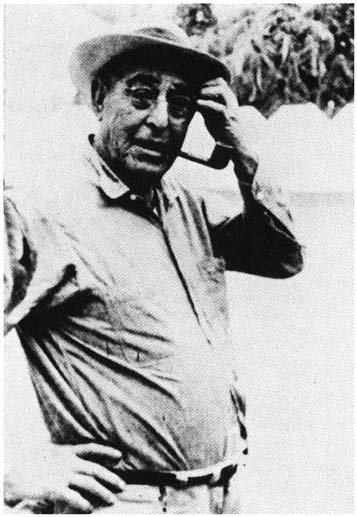
Loreto Marquez in El Cajon c. 1950. He turned twenty in 1900 while
working in the El Boleo mining concession granted to the French in
Santa Rosalía.
(Photo courtesy of María Marquez and family)
work there lasted only a short while (two years) and Don Loreto soon returned to the border again. His wife gave birth to their first child, and for their safety Don Loreto sent them to San Diego. He later joined them in 1914. Once back in San Diego, Don Loreto never left again for the south. His mining days were over, but for the next half century his closest friends continued to be those families he had met in Calmallí and the mining circuit.
The migration of los Smith, Castellanos, and Marquez through the mining circuit, from Calmallí to the frontera region, illustrates the beginning of the social relations that formed the basis of a network that was to last through the next half century. The life-style of the mines and the geographic points within the migration north formed a social landscape that was the basis for the interrelations of families and individuals making their way north. Throughout this migration these families demonstrated an internal social order that despite constant uprooting became progressively stronger as a result of the migration experience. Close ties were formed with new friends and kin, ties that outlasted even the first generation's offspring.
Various factors, including conditions in home regions, economic opportunities created by the mining booms, and changes in mine productivity, influenced the families' decision to move north and then across the border. People did leave the southern peninsula for better economic opportunities, but such moves were sanctioned by kin and friends who traveled with or received migrants in the host communities. Furthermore, in mining towns new relations were created providing greater security and further inducement for later travel north. As people traveled north, the desert towns and the work and social communities of the mines became a way of life, important in securing and producing new relationships. Calmallí was not just another mine, it was the mine and community where families met, shared births of children, social events, and friendships.
The final move to the northern border marked the end of the mining migration. Once established along the border, these families remembered the mines of the central peninsula, like their hometowns in the cape, as places important to their families for social relationships and as a basis for a shared recognition of historic, geographic, and social ties.