
A—
The Encounter and Departure (774–909)
This final section of the Lemnian sojourn possesses an extended ring structure much like that of the description of Jason's cloak. To summarize what was said above: it begins with Jason's approach to and arrival in Myrine (a, 774–90a) and ends with his departure from the city and the island (a , 910a). A conversation between Jason and Hypsipyle follows Jason's arrival (b, 790b–841) and precedes his departure (b , 886–909), and during both conversations Hypsipyle offers her kingdom to Jason. After the first conversation the Argonauts proceed to Myrine (c, 842–60) and before the last they leave the city (c , 875–85). In the middle stands the assembly of the Argonauts (d, 861–84), which corresponds to the assembly of the Lemnian women in the first half. The central positioning of a significant section once again proves to be instructive. For the Argonautic assembly not only contains a reference to an Odyssean episode that will emerge as an important subtext in this half of the Lemnian sojourn, but also herein Heracles makes an assertion that evinces his approach to the heroic


In her first speech to Jason, Hypsipyle gives her explanation for the absence of men on the island and invites the Argonauts to visit her city; she even goes so far as to offer Jason rule of
[34] E. Phinney called to my attention that the spear also "hints at bad luck in love, as Atalanta attracted Meleager, only to set in force a chain of events that led to Meleager's death."
her kingdom. The men, with the exception of Heracles and a few others, accept the invitation to come into the city and go to the homes of the women. They stay for an unspecified time and give no indication of being about to leave until finally Heracles calls an assembly, reminding them of their need to fetch the golden fleece. Only then do the Argonauts leave the island. Hypsipyle and the women of Lemnos have thus become the first real threat to the expedition; for had Jason accepted Hypsipyle's offer, the mission would have come to a halt and failed. In this way, the Lemnian sojourn parallels Odysseus's encounters with Calypso, Nausicaa, and especially Circe, all of whom, like Hypsipyle, live on islands.
When Jason arrives within the city, the women rejoice at the sight of the first man they have seen in their midst in a year. In their eagerness to meet Jason, they almost attack him (

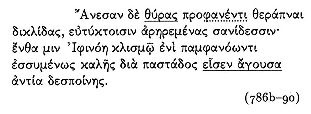
[35] Fränkel ad 1.769–73 has pointed out the irony in Jason's reception in Myrine: he had refused to take Atalante along because problems would have arisen with her, the only woman in the midst of unruly men; Jason now finds himself the only man among very aggressive women.

folding doors , fitted with elegantly made louvers.
Here Iphinoë escorted him eagerly through the beautiful
colonnade and sat him upon a radiant couch
opposite her mistress.
When Odysseus arrived at Circe's cottage, she herself opened the doors and led her guest to his seat:
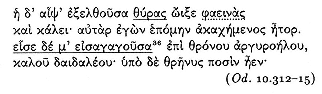
Immediately she [sc. Circe] came out and opened the

and invited me in; and I followed, distressed in my heart.
She escorted me to a beautifully made couch, with inlaid silver,
and had me sit down. There was a stool for my feet.
Jason, dressed in his splendid cloak, thoroughly captivates Hypsipyle, whose face now reflects the color of his cloak. His royal host proceeds to explain the absence of the men on Lemnos and then goes on to offer Jason the throne of the island (793ff.). Apollonius describes her account of the Lemnian crime as "wily":


[38] Cf. Ardizzoni ad 790 and M. Fantuzzi, "Omero 'autore' di Apollonio Rodio: Le formule introduttive al discorso diretto," MD 13 (1986) 101.
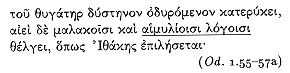
His [sc. Atlas's] daughter keeps him a prisoner in his sorry,
wretched state,
always beguiling him with deceitful and wily words
so that he might forget Ithaca.
Hypsipyle's intention, like Calypso's, is to get Jason and the Argonauts to stay; and just as Calypso (Od. 5.160–70) misled Odysseus by suggesting that she was letting him go of her own volition (she never mentions the command she received from Hermes [ibid. 97–115]), Hypsipyle misinforms Jason by averring that the Lemnian men are still alive and living with their Thracian captives and legitimate sons. If Jason is taken in by these wily words, he runs the same risk that Odysseus did, of forfeiting his

At the end of her account, Hypsipyle offers Jason the throne of Lemnos:
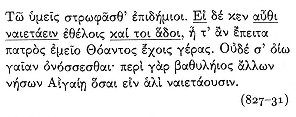
And so, move about among the people, and if you should
want to live here and this pleases you , by all means then
you may have the office of my father, Thoas. I do not think
you will fault our land, for it is fertile beyond the other
islands that lie in the Ægæan Sea.
After Odysseus's bath on Phæacia, Nausicaa marveled at his appearance, much as Hypsipyle does here upon Jason's arrival. The Phæacian princess then made a wish that Odysseus remain as
her husband, a prospect that Alcinous later invited Odysseus to consider:[40]
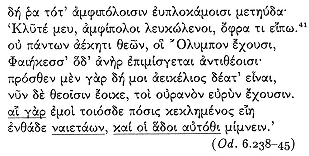
Then she spoke to her long-haired servants:
"Hear what I have to say, my fair-armed servants.
Through the will of all the gods who inhabit Olympus
this man mingles with the godlike Phæacians.
Before he appeared to me to be unseemly,
but now he seems like the gods who inhabit the wide vault of
heaven.
If only such a man might be called my husband,
living here, and if only it might please him to remain here ."
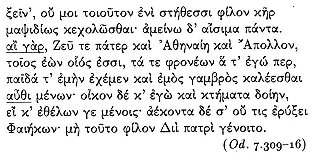
Stranger, I do not have such a mind as to be angry
without a good reason. It is better when things are as they should
be.
If only , O Father Zeus, Athena, and Apollo,
being such a man as you [sc. Odysseus] are, of one mind with me,
[40] Ardizzoni and Campbell ad 1.828 observed the allusion to Od. 6.238ff. A. W. Bulloch brought the relevance of Od. 7.309ff. to my attention.
[41] you might take my daughter and be called my son-in-law,
living here . I would give you a house and property,
if you would stay here. But no one of the Phæacians will keep
you here
against your will. May such behavior not be pleasing to Zeus.
The similarity of the offers in language and context invites us to see Hypsipyle as something of a Nausicaa, an innocent princess whose hand in marriage will bring with it the island kingdom of Lemnos but also take away the eagerly desired

Hypsipyle concludes her speech by bidding Jason to go to his ship and bring back his comrades:
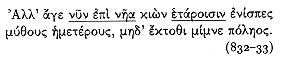
But go now to your ship and tell your comrades
of our offer, and do not remain outside the city.
Circe similarly invited Odysseus to bring his men to her house:
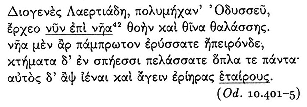
Zeus-born son of Laërtes, devious Odysseus,
go now to your swift ship and to the seashore.
First of all, drag your ship to the shore;
then set all your possessions and ship cables within the caves.
You yourself then return and bring back your trusty companions .
Thus in her initial encounter with Jason, Hypsipyle attempts to do what the wily Calypso, the innocent Nausicaa, and the sorceress Circe all tried and failed to do with Odysseus: to keep Jason on her island, an eventuality that would also have kept him from fulfilling his mission. Jason, however, fully aware of what her invitation
[42]entails, politely refuses:

Hypsipyle's seductive invitation thus fails to divert Jason from his


Reference to the Circe episode continues. Upon returning to the ship Jason reported Hypsipyle's invitation to the men (847). Some time thereafter, the women came to the shore with gifts and escorted the men to their homes. This, as we learn, was encouraged by Aphrodite, who, as a favor to her husband, Hephæstus, took advantage of the Argonautic sojourn to repopulate the island with men (850–52). But not all the Argonauts went up to the city; Heracles and a few comrades remained behind:
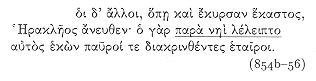
And the others ended up where chance had led each,
except for Heracles. For he had been left behind at the ship
of his own accord, together with a few chosen comrades.
This minor detail also pertains to the Odyssean sojourn on Ææa. Thoroughly terrified by his previous encounter with Circe, Eurylochus criticized what he thought was Odysseus's reckless behavior in his desire to return to the cottage (Od. 10.431–37). Odysseus would have killed him were it not for the others who intervened:
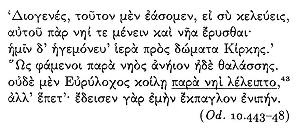
"O Zeus-born, we shall leave him behind, if this is your command,
to remain here alongside the ship and to guard the vessel,
but lead us to the sacred home of Circe."
Thus speaking they left the ship and the sea.
And Eurylochus had not been left behind along the ship ,
but followed us, for he feared my terrible reprimand.
Like Eurylochus, Heracles wants nothing to do with the female inhabitants of the island, and he will voice his hostility toward their stay at the assembly he calls. On the other hand, unlike Eurylochus, Heracles does not fear Jason and chooses to stay on the beach.
At the center of the second half stands the assembly of the Argonauts, which begins with another reference to the Circe episode. When day after day passes and the Argonauts still do not leave the island, Heracles finally calls together the group and reminds them of their mission:
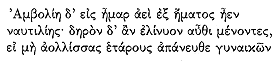
Day after day they kept putting off their
journey, and they would have stayed there inactive for a long time
unless Heracles had assembled the comrades apart from
the women and upbraided them in these words:
"Fools ! Does the shedding of native blood restrict us
from our fatherland? Have we come from there in need of
marriages, because we despise the women of our cities? Have we
decided
to live here and to plow the fertile land of Lemnos?"
Similarly, after a year on Circe's island the men assembled and reminded Odysseus of their goal, their

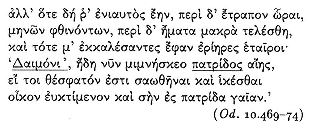
But when a year had passed and the seasons had made their circuit
as the months receded and the long days were completed,
it was then that my faithful comrades summoned me and said:
"Fool , now is the time to remember your native land,
if indeed it is fated for you to be saved and to reach
your well-made home and the land of your fathers."
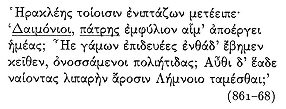
Jason, then, is no different from his Homeric model in temporarily forgetting his mission; the delay on Lemnos does not per se mark Jason off as nonheroic. Heracles' speech, however, goes on to underscore the essential difference between Jason and himself with regard to their attitude toward heroic action. Heracles, ironically recalling the words of Polyxo (870–71 » 685–87), asserts that one does not earn


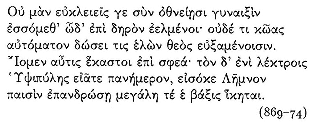
Certainly we shall not become famous by cooping ourselves up
here for a long time with foreign women. The fleece does not move
on its own, and a god will not seize it and hand it over to us if
we say
a prayer. Let us go back to our own homes; let him stay in bed
all day with Hypsipyle until he repopulates Lemnos
with male children and great renown comes his way.
Yet Heracles is absolutely wrong in this assertion; for Jason, making foreign women fall in love with him is one of his special skills through which the mission will ultimately succeed. In Heracles' view, the hero is a man of bold physical action. Jason, however, will complete his mission and thereby attain


Apollonius not only reveals Heracles' attitude toward heroic action; he also subtly calls into question the hero's credibility by casting him in a role that, although sharply contrasting with it, nonetheless provocatively recalls that of the cowardly Eurylochus. Significantly, part of Heracles' speech recalls another Homeric coward, Thersites. At the beginning of his speech, Heracles asked if the Argonauts left Greece because there were no suitable women:

("Did we come here from home in need of

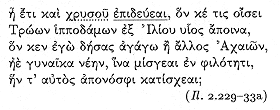
Do you still need

Trojans will bring you from Ilion as a ransom for his son,
someone whom I, or another of the Achæans, have bound and
led away?
Or perhaps a new woman so that you might lie with her,
someone whom you will keep apart for yourself?
At the end of his speech, Heracles tells the others to let Jason spend all day in bed with Hypsipyle while they go home (872–74, quoted above). In addition to envisaging Agamemnon in bed with Briseïs, Thersites likewise goes on to suggest that they go home, leaving Agamemnon to enjoy his prizes:
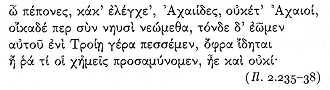
Cowards, objects of base reproach, Achæan women, no longer
men,
let's sail home in our ships and abandon this one [ sc. Agamemnon]
here in Troy to enjoy his prize, so that he might know
whether we shall be of any help to him or not.
The image of a Heracles who talks like a hero, but in words that recall Homeric cowards, creates a striking dissonance. His decision to remain at the shore with the ship and his reminder to continue the mission have led some to think of Heracles as a kind of
[44] Cf. Mooney ad 1.873, Vian 91 n. 2, Campbell ad 1.872ff.
Stoic saint.[45] On the contrary, Heracles' words and actions, when seen through the Homeric subtexts, lose their edge. Moreover, the shallowness of his heroic bluster becomes clear when, soon after they leave Lemnos, Heracles is completely undone at the loss of his boyfriend, Hylas; he will discover just how powerful love, or rather passion, can be. Jason, on the other hand, never loses control in love; in fact, he never loses lovers, but only discards—or tries to discard—them.[46]
The reminiscence of the assembly of the Greeks at Troy in Iliad 2 continues as the poet tells of the Argonauts' departure from Myrine. When the Lemnian women hear the news that the men are leaving, they rush out of the town in tears to greet the Argonauts for the last time. Apollonius compares them to bees pouring out of a hive gathering "fruit" from flowers:
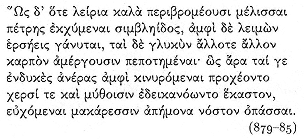
When bees engage in noisy flight around beautiful lilies
after pouring out of their nest among the rocks, and the dewy
glen all about appears happy, they fly to one flower and then to
another
gathering their sweet fruit. Just like this the women
ardently rushed out among the men in tears,
bidding each farewell in words and gestures,
and praying to the blessed gods to grant them a safe return.
The action of the women prompted by the departure of the Argonauts corresponds to that in the scene of their arrival, when the women rushed out fearing an invasion (in particular, cf.

[45] See A. Ardizzoni, L'Eracle "semnós" nel poema di Apollonio (Catania 1937), and Vian 259 ad 856; cf. G. Karl Galinsky, The Herakles Theme (Oxford 1972) 113.
[46] On the contrast between Jason's and Heracles' attitudes toward love in this episode, see C. R. Beye, "Jason as Love-Hero" (supra n. 28) 31–55.
635 » 883). The second rush is quite different. Earlier they were armed for battle and tried to ward off the Argonauts; here, more like devoted wives than threatening warriors, they bid them a tearful goodbye and pray for a safe

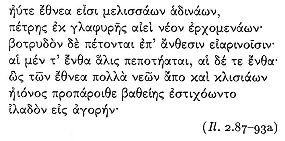
Just as the various hives of bees go forth in great number
from a hollow rock in continual motion
and fly in a swarm upon the vernal flowers,
going here and there in their flight;
so too the many nationalities of men, leaving their ships and tents,
fell into ranks along the wide beach,
entering the assembly by company.
Ancient critics were divided over the success of the Argonautic simile. The scholiast ad 1.879–83d believed that the simile failed because the joy of the image did not match the gloom of the occasion. On the other hand, the comment preserved ad 1.879–83e defended the simile, arguing that the point is "beauty alone and ecphrasis." No scholar, however, (ancient or modern) has observed that the comparison presupposes apicultural theory in vogue in the ancient world, in particular the belief that bees collected their young from the flowers upon which they lighted.[48] In
[47] On the allusion, see Mooney ad 1.879, Ardizzoni ad 880, Vian 91 n. 3, Campbell ad 1.879ff. In addition to the points of contact seen thus far between the two assemblies on Lemnos, I would add that Apollonius informed both with Homeric models, and that both models come from assemblies found in the same books of their respective epics: Od. 2 »Il. 2.
[48] Cf. Aristotle, HA 2.51, GA 3.10; Vergil G. 4.200–202; Columella 9.2.4. See Olck, "Biene," RE 3.1.434. I would now point out that W. Kofler, "Bienen Männer und Lemnos: Beobachtungen zu einem epischen Gleichnis beiApollonius Rhodius (Arg. 1.878–885)," Hermes 120 (1992) 310–19, has recently addressed this issue. It is nice to see that the following interpretation, first made in my 1983 doctoral dissertation, has received independent support from Kofler's more detailed argument.
the first assembly, Polyxo advised the Lemnian women to take advantage of the presence of the Argonauts to reestablish their society and to provide for future generations. Aphrodite aided this plan as a favor to her husband, since the Lemnian men had helped him when he was in need. In fact, Heracles calls attention to the plight of the Lemnian women in his accusation that Jason was trying to repopulate the male segment of Lemnos singlehandedly. Thus, the simile can be seen as hinting at a central issue of the Lemnian encounter, the acquiring of children—an issue with which the episode will conclude. Inasmuch as bees were thought to gather their offspring from flowers, the simile intimates the success that the Lemnian women have had in their plan; like the bees, they have found a source for rejuvenating their population.
As the Lemnian women bid the Argonauts farewell, Apollonius reports the final words exchanged by Jason and Hypsipyle as a counterbalance to their first conversation. Hypsipyle speaks first (888–98). She prays for the successful completion of their mission and reiterates her offer of the kingship of her island. Realizing that Jason will probably never return, she begs to be remembered and asks for instructions about children, if she should become pregnant. In his reply (900–909), Jason accepts her prayer and again refuses the kingship on the ground of his


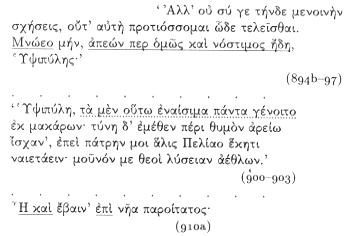
"But you will have no desire
to do this; I can see that this will not turn out so.
Remember , then, both while you are away from home and when
you return ,
Hypsipyle."
. . . . . . . . . .
"Hypsipyle,

through the will of the gods! But have a better opinion
regarding me, since it is enough for me to live in my fatherland
by the good graces of Pelias. May the gods only free me from
my labors!"
. . . . . . . . . .
He spoke , and was the first to get aboard the ship.
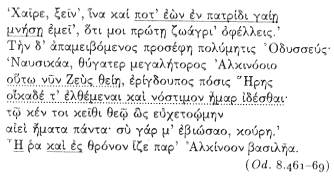
"Farewell, stranger. When you are once again in your native land,
remember me, since you owe me first and foremost for saving your
life."
In response, wily Odysseus said to her:
"Nausicaa, daughter of great-souled Alcinous,


At that time I would pray to you as a god
forever; for you, young woman, have restored my life."
Thus he spoke , and sat upon the couch alongside King Alcinous.
As the episode comes to a close, the reader is left with the image of a Nausicaa-like Hypsipyle; as beautiful and innocent as she may seem, her invitation, like that of her model, nonetheless threatens the hero's


I would like to return briefly to a point that I suggested above; namely, that the Argonauts risked their masculinity in their contact with the women of Lemnos. In the first half, Apollonius concentrates on the Lemnian women, who take on male roles both at the textual and subtextual levels. In the second half, where the structural focus is on the Argonautic assembly, one discerns hints that the Argonauts might be acting in a less than manly fashion. Not only did the women assume a more aggressive role in establishing relationships with the Argonauts, but there is allusion to several passages that suggest that contact with the Lemnian women has threatened to unman those Argonauts who left the shore.
First, in having Jason bring a charm and weapon on his first visit with Hypsipyle—which, as I have shown, in several details recalls Odysseus's encounter with Circe—Apollonius would seem to suggest that the former risks becoming


response to Heracles' rebuke. Like Jason as he entered the city of Myrine (cf. 784), they too keep their eyes on the ground as they leave the assembly in silence:
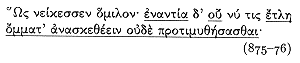
Thus he rebuked the group, and not anyone dared
to lift up his eyes toward him , nor to say a word .
This description recalls the condition of Anticleia, Odysseus's mother, when the hero met her in the underworld:[50]

And she [sc. Anticleia] sits in silence near the blood and does
not dare
to look up at her son , nor to say a word .
Recalling that Heracles had just told the men that they would not become


In sum, like Odysseus, Jason choses


wherein he differs from his Homeric model. His request that Hypsipyle give up her son to take care of his own parents anticipates his future request of Medea that she too give up her sons.[52] In this request, Jason reveals the selfish side of his personality so unforgettably portrayed by Euripides in the Medea . The Argonautic hero may look and act like an Odysseus when confronted by the feminine threat to his mission, but, as in his departure from home, comparison with his Homeric model underscores the great difference: Odysseus gave up Circe, Calypso, and Nausicaa and the immortality or life of ease they offered so that he could return to his wife and child. Years later Jason will be willing to give up his wife and children and accept the offer of a foreign king to marry his daughter to provide himself with a life of security. Upon comparison with his Homeric models, we may find Heracles' heroic rhetoric empty, especially when we see how he behaves in Mysia; at least he comes across as honest. Jason, on the other hand, proves both here in his concluding speech to Hypsipyle and later in his marriage with Medea (outside the limits of the poem) to be far less committed to the preservation of a family than Odysseus, his primary model in this episode. Such an unhappy contrast between Jason and his Homeric model recalls the unfavorable comparison with Hector in his departure from home.
The encounter with the masculine and aggressive women of Lemnos has indeed threatened to unman the crew of the Argo and thus prevent the expedition from continuing. The Argonauts in the company of the Lemnian women temporarily lost sight of their goal until Heracles got them back on course by appealing to the


[52] This, I argued in Chapter 5, was the point behind the wrath of Thetis, which provided the Argonauts with the "Aulis" suited to their leader. For specific points of comparison between Jason's encounters with Hypsipyle and Medea, see Hunter ad 3.956–61, 975, 1008. To these I would add that the association of Hypsipyle with Circe, Medea's aunt, in the Lemnian episode, is yet another link between the two women.
his own violent "heroism." While it took Heracles, the more traditional type of hero, to remind the Argonauts of their goal, it is the longing to complete their


