
Business Decisions
With Parisian consumers paying thirty centimes per cubic meter, good management was almost irrelevant to the profitability of the PGC. Slov-
[1] For definitions of the "modern enterprise," see Roger Price, An Economic History of Modern France , 1730-1914 (London, 1975), pp. 118, 147; Alfred Chandler, "The Railroads: Pioneers in Modern Corporate Management," Business History Review 39 (1965): 16-40; Alfred Chandler, The Visible Hand: The Managerial Revolution in American Business (Cambridge, Mass., 1977), pp. 1-3. For a general view of French business history, see Maurice Lévy-Leboyer, "The Large Corporation in Modern France," in Managerial Hierarchies: Comparative Perspectives on the Rise of the Modern Industrial Enterprise, ed. Alfred Chandler and Herman Daems (Cambridge, Mass., 1980), pp. 117-160.
[2] Among the relatively small number of studies dealing with large French enterprises are Jean Bouvier, Le Crédit lyonnais de1863 à 1882 , 2 vols. (Paris, 1961); François Caron, Histoire de l'exploitation d'un grand réseau: La Compagnie du chemin de fer du Nord 1846-1937 (Paris, 1973); Reed Geiger, The Anzin Coal Company , 1800-1833 (Newark, Del., 1974); Pierre Guillaume, La Compagnie des mines de la Loire (1846-1854) (Paris, 1966); Robert Locke, Les Fonderies et forges d'Alais: La Creation d'une entreprise moderne (Paris, 1978).
Table 9. Comparative Costs of Operation, c. 1880 (in francs per thousand cubic meters of gas) | |||||
PGC | London | Berlin | Brussels | ||
Production costs | |||||
Labor | 25.8 | 14.7 | 19.6 | 16.5 | |
Coal | 89.5 | 66.3 | 87.5 | 31.8 | |
Administration | 7.9 | 8.1 | 12.8 | 13.8 | |
Distribution | 9.8 | 10.6 | 6.7 | 11.4 | |
Other | 1.8 | 2.4 | 6.0 | 20.4 | |
Gross production costs | 134.8 | 102.1 | 132.6 | 93.9 | |
Less revenue from | 85.0 | 42.0 | 75.1 | 46.6 | |
Net production costs | 49.8 | 60.1 | 57.5 | 47.3 | |
Source: AP, V 8 O1 , no. 709. | |||||
enly administration, irresponsibly generous settlements with labor, and technological backwardness would not have prevented the company from returning respectable yields. Nonetheless, the earnest and hardworking engineers who ran the firm expected better of themselves, and they gave a great deal more effort to their jobs than mere competence would have required. Balance sheets, capable of exposing waste and inefficiency when examined comparatively, show that by international standards the PGC was a well-run firm. The sense of inferiority that some French industrialists felt toward their British and German (and sometimes toward their Belgian) counterparts was unwarranted in the case of the gas industry (table 9). The PGC's above-average gross production costs were largely the result of the high price of coal—inevitable given the lack of large deposits of the right grades in France. Its net production costs, however, were enviably modest owing to substantial revenues from by-products.
The comparison invites a reevaluation of French entrepreneurship, examined from the distinctive perspective of this case study. Historians have developed some strong stereotypes about French business practices— heavily committed to the production of high-quality goods, disinclined toward mass marketing, oblivious to commercial considerations, valuing stability over growth. The term "Malthusian" inevitably arises, by which
is meant a determination to avoid opportunities for expansion. Proponents of these views often root such behavior in the cultural predispositions of the French bourgeoisie. One grand interpretation of the Third Republic posits an implicit contract between economic elites, on the one hand, and peasants, on the other. In return for conservative economic leadership, the rural masses safeguarded society from the demands of the proletariat. In contrast to such assertions, some leading economic historians have argued that there was nothing pathological about French business practices, that on the whole, entrepreneurs responded rationally to the market situations they faced.[3]
Whereas the debate is usually framed in terms of the owner-entrepreneur, the case of the PGC reflects on decision making in a different and increasingly important milieu, that of salaried managers. The officers of the gas firm were representative of men who were soon to fill a large number of industrial posts and hold disproportionate economic power. They gained influence at a time when mass marketing emerged as a possibility and sometimes a necessity. There is reason to take special interest in the entrepreneurial spirit guiding the PGC.
It is well known that respect for entrepreneurship and for the morality of the marketplace was more deeply embedded in the social fabric of Anglo-Saxon countries than of France.[4] Nonetheless, the managers of the PGC came to their jobs armed with a set of values that helped them to be mercenary and calculating about business matters. Their earnestness about making the PGC a well-run firm displayed itself most clearly in the drive to cut expenditures. Unnecessary spending was a deeply felt affront
[3] The vast literature on the subject includes David Landes, "French Entrepreneur-ship and Industrial Growth in the Nineteenth Century," Journal of Economic History 9 (1949): 45-61; François Crouzet, "French Economic Growth in the Nineteenth Century Reconsidered," History 59 (1974): 167-179; Claude Fohlen, "Entrepreneurship and Management in France in the Nineteenth Century," in Cambridge Economic History of Europe (Cambridge, 1978), 7(1): 347-381; Maurice Lévy-Leboyer, "Le Patronat français a-t-il été malthusien?" Le Mouvement social, no. 88 (1974): 3-49; James Laux, "Some Notes on Entrepreneurship in the Early French Automobile Industry," French Historical Studies 3 (1963): 129-134; Robert Aldrich, "Late Comer or Early Starter: New Views on French Economic History" Journal of European Economic History 16 (1987): 89-100. For an investigation of the industrial-agricultural ties, see Herman Lebovics, The Alliance of Iron and Wheat in the Third French Republic, 1860-1914: Origins of the New Conservatism (Baton Rouge, La., 1988).
[4] For an interesting study of American businessmen's attitudes, difficult as they are to pin down, and a source of comparisons with French business leaders, see Thomas Cochran, Railroad Leaders , 1845-1890: The Business Mind in Action (Cambridge, Mass., 1953).
to their professionalism as engineers and to their class values. They did not relax their concern about waste simply because profit levels were so high as to excite the jealousy of the public. The minor annual expenditure of 5,026 francs for omnibus rides by agents whose jobs took them across the city created consternation on the executive committee and stern demands for strict accounting. Managers, from the director to factory superintendents, treated water as an expensive commodity that had to be husbanded. Worn-out equipment and plants with leaky roofs signified the inclination to postpone capital improvements until absolutely necessary. For the same reason, the chief clerk of the customer service department had to receive clients in a room that he claimed lacked dignity.[5] Sometimes the drive for thrift could seem counterproductive. The chief of the factory division warned that a large corporation could not be run "with the mentality of a greengrocer" and demanded larger maintenance budgets. Yet he was equally an advocate of cutting corners whenever possible.[6] Managers accepted frugality as a virtue for its own sake and as a duty to the stockholders.
Though top managers were trained in state institutes and belonged to a corps that inculcated dedication to public service, they had no difficulty transferring their loyalty from the public interest to the private firm when they accepted their posts. They displayed no impulse to apologize for the exploitative features of the corporate charter; that the concession was legal and profitable seemed to answer all objections. They even had the ability to put aside ethical niceties when the firm stood to gain. A conspicuous example of the managers' amoral approach to business dealings came during the Franco-Prussian War. The executives of the PGC did make small patriotic gestures, undoubtedly in complete sincerity. But when the government, in desperate need of horses for the army, sought to purchase them from the firm's team, managers consciously selected the oldest and weakest animals and sold them at a high price. An internal memorandum on the matter, far from expressing shame, boastfully concluded that the sale was "not at all a bad piece of business."[7] If policymakers at the PGC
[5] The executive committee asked factory superintendents to file monthly reports on their efforts to economize: AP, V 8 O , no. 665, deliberations of May 23, 1857. On the economy-consciousness of managers, see no. 751, "Rapport annuel de 1869 (2 janvier 1870)"; no. 768, "Usines de Batignolles et de Saint-Denis," report of April 14, 1861; no. 668, deliberations of April 27, 1861; no. 671, deliberations of June 6, 1866. The phrase l'esprit de l'économie resounded continually and with reverence throughout the superintendents' reports.
[6] Ibid., no. 1062, report of March 10, 1859; no. 715, "Voyage en Angleterre, année 1875."
[7] Ibid., no. 753, "Inspection de la cavalerie," report of December 23, 1870.
did not behave as model entrepreneurs, it was not because they had scruples that led them to eschew maximizing profits.
The energetic pursuit of revenues and thrift brought managers to rationalize most aspects of gas production. Those steps were partly responsible for the good showing of the PGC in comparison with Europe's other major gas firms. The production methods inherited from the pre-merger operations had not been up to the highest standards of efficiency at the time. Alexandre Arson, the head of the factory division in 1856, sought to change them radically and immediately. He replaced the iron retorts used by the early companies with earthenware ones because they were less expensive and conducted heat better. In the plant on the rue de la Tour, which the PGC inherited and continued to operate for a few years, each furnace heated only one retort, a situation requiring lavish use of fuel and manpower. Once in Arson's hands, that plant quickly received new furnaces that heated five to seven retorts. Purchasing coal was the major production cost, and the pre-merger companies did not even have scales to measure how much of it they used.[8] Efficient use of coal became a preoccupation for Arson and his staff. Their initiatives in this area led to a significant innovation in the gas industry, the use of Siemens furnaces, which recirculated heated air. The PGC was the first to apply the more efficient furnace to gas production in France and realized savings of 36 percent in fuel.[9] The basic change did not fully satisfy Arson, however, and he continued his search for still less costly methods of roasting coal. After spending thirty-six thousand francs on experiments, he had not yet found the best possible equipment, but the director overruled further expenditures.[10]
The engineers managed to reduce the production cost of gas by about a third between 1857 and 1868 (figure 9). The essential breakthrough permitting the reduction entailed a new approach to distillation.[11] Previously,
[8] Ibid., no. 665, deliberations of May 13, 1856; no. 615, report of Arson to director, February 15, 1884.
[9] Ibid., no. 715, "Etude sur les résultats comparatifs de la Compagnie de 1856 à 1870 (14 décembre 1871)"; no. 712, "Fours Siemens et fours à générateur (7 avril 1891)"; no. 671, deliberations of June 11, 1864.
[10] Ibid., no. 676, deliberations of May 24, 1873.
[11] On the new distillation process, see ibid., no. 715, "Etude sur les résultats"; Procès-verbaux et rapport de la commission nominee [e 23 janvier 1880 en exécu-tion de l'article 48 du traité intervenu le 7 janvier 1870 entre la ville de Paris et la Compagnie parisienne de l'éclairage et du chauffage par le gaz (Paris, 1880), pp. 30-38. On some of the results of the new process, see AP, V 8 O , no. 714, report of November 7, 1874; report of June 24, 1875; no. 716, "Salaires des chauffeurs (16 mars 1880)"; no. 711, "Etude sur les réductions qu'il est possible d'introduire dans les prix de revient."
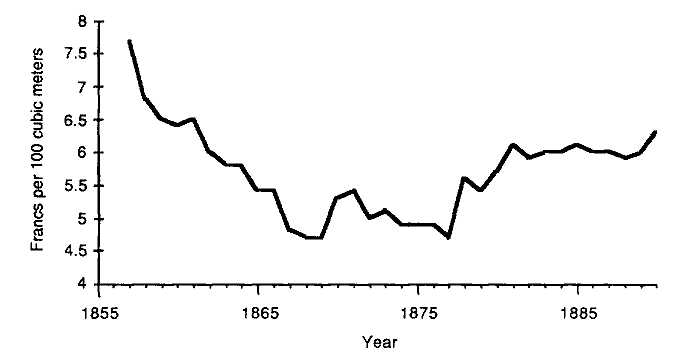
Fig. 9. Cost of Producing One Hundred Cubic Meters
of Gas (in francs). From AP, V 8 O1 , nos. 718, 1016.
gas works roasted coal at relatively low temperatures, both to save fuel and to keep the lighting power of the gas high. The production staff of the PGC learned (whether through experimentation or imitation of industry leaders is not clear) that dramatic improvements in efficiency were possible by distilling at very high temperatures (1,150-1,200 degrees Centigrade).[12] Without compromising the lighting power, hot roasting raised the yield of gas from almost all grades of coal. Moreover, the larger the retort, and the more tightly packed it was, the better the results. And with larger retorts the company could save on labor and fuel. In 1855 the average retort received 60 kilograms of coal per charge; in 1869 charges had grown to 127 kilograms.[13] Arson once announced his guiding principle to be "pitilessly exploiting labor, fuel, and maintenance expenses to the complete utilization of capital."[14] He made that principle a reality during the 1860s.
Other departments could not easily replicate such success in reducing costs, but most realized significant savings. The cost of producing retorts dropped from about one hundred francs to thirty-eight francs even as they became bigger and lasted longer. The distribution division found new technologies and materials that cut the cost of laying and installing gas
[12] The superintendent of the Passy plant was given a bonus of ten thousand francs for raising productivity in 1863. He may have been responsible for the use of the new method of distillation at the PGC. AP, V 8 O , no. 725, deliberations of March 12, 1863.
[13] Ibid., no. 711, "Rapport no. 32 (8 mars 1868)."
[14] Ibid., no. 716, "Salaire des chauffeurs (16 mars 1880)."
mains. Whereas being near consumers was once the central consideration in locating plants, improvements in distribution technology gave the company more freedom to use inexpensive tracts of land and allowed it to deal effectively with the greatest logistical problem, handling coal. The PGC was able to build its newer plants (eventually numbering nine) on railroad lines or near canals.[15] One of the largest expenses in increasing output was building facilities for storing gas. Production managers searched all of Europe for the best sorts of storage tanks and finally found the solution in Britain's expanding tanks, which were relatively inexpensive to build and required less land.[16] Isaac Pereire had once criticized the business sense of engineers, bemoaning their indifference to costs in the pursuit of technical perfection, but his own PGC was hardly a victim of that malady.[17]
The PGC's excellent comparative performance owed even more to raising revenues than to reducing costs. The director of the Lille Gas Company once remarked that the price of coal and the value of by-products were the keys to profitability in his industry.[18] That comment goes far to account for the advantages that the PGC held over gas producers in London or Berlin. Aside from the enviable results of receiving thirty centimes for each cubic meter of gas, the PGC obtained great profits from the derivatives of coal distillation. Indeed, management displayed its most creative handling of emerging technologies and its most masterful entrepreneurial decisions in producing and marketing by-products.[19]
The coal tar (goudrons ) that condensed when gas cooled had been regarded as a nuisance rather than a source of revenue by most gas companies through the 1850s. The pre-merger firms of Paris sold some of the tar to distillers, who refined it for a limited number of established uses, but threw much away. The newly formed PGC continued the practice in its early days. In 1857 it had no by-products department; it subcontracted the treatment of tar to an outside firm and burned some as fuel. Yet this unwelcomed residue was about to become an essential raw material for a
[15] Ibid., no. 715, "Etude sur les résultats," summarizes the improvements. See also no. 669, deliberations of April 19, 1862; no. 673, deliberations of February 3, 1869; no. 1067, "Service des usines: Briqueterie"; no. 25, report of Charles Singly to Paul Lependry, February 6, 1884; report of Servier to director, June 19, 1865.
[16] Ibid., no. 715, "Voyage en Angleterre, année 1875."
[17] Pereire's remarks are cited in John Armstrong, The European Administrative Elite (Princeton, 1973), p. 186.
[18] Compte rendu des travaux de la commission nominee par Monsieur le Ministre de l'Intérieur le 31 janvier 1890 en exécution de l'article 48 . . . (Paris, 1890), p. 31.
[19] For an overview, see the brochure prepared for the Exposition of 1878, "Produits dérivés de la houille," AP, V 8 O , no. 1290.
major new industry, organic dyes.[20] That industry was born about the same time as the PGC. The young gas firm took advantage of the market opportunities, at first stumbling a bit; but eventually it became an innovator and a model of efficiency.
The artificial-dye industry arose with the development of aniline purple in the mid-1850s. Aniline was a product derived from refining coal tar. Within three years numerous aniline dyes were appearing on the market. The PGC was not prepared to leap into extensive production of the chemical, though; its lack of administrative structure and its subcontracting arrangement stood in the way. Still, top management was aware of the opportunities and soon appointed Paul Audouin to head a new department and undertake the treatment of coal tar internally.[21] This was not a decision management would regret, for Audouin would make his operation exceedingly profitable through good fortune and through attention to market opportunities.
Lack of technical expertise in industrial chemistry prevented the company from rushing to profit from the enhanced value of aniline. Not until 1864 was the PGC able to market the product, and then only after some trouble. The proud graduates of France's finest technical institutes were completely dependent on temperamental British workers to show them how to manufacture aniline. The workers mounted one delaying tactic after another, and the engineers experienced problems in mastering the secrets of production on their own.[22] The incident verified the criticisms of engineering education in France, but the PGC adapted much more smoothly to a second phase of the dye industry that started with the perfection of synthetic alizarin at the end of the 1860s.
The new development in dye production required anthracene, another residue of coal distillation, and transformed it into a valuable—often exceedingly valuable—commodity. Audouin was able to lead the PGC smoothly into its production as its price soared.[23] His accomplishments were impressive enough to justify foreign manufacturers touring the
[20] On the development of organic chemicals, see Paul Hohenberg, Chemicals in Western Europe , 1850-1914: An Economic Study of Technical Change (Chicago, 1967), and L. E Haber, The Chemical Industry during the Nineteenth Century (Oxford, 1958).
[21] AP, V 8 O , no. 723, deliberations of June 13, 1857. Before Audouin was named to head the department, a subcontractor of coal-tar distillation was named "directeur du service de l'exploitation des goudrons." The new department was soon integrated completely into the firm under Audouin's management.
[22] Ibid., no. 670, deliberations of March 30, August 1, and November 26, 1864.
[23] On the development of the anthracene market for the PGC, see Procès-verbaux et rapport de la commission nominée le 23 janvier 1880 , pp. 10-14. The firm's scientific consultant, Henri Regnault, recommended caution in the face of the new industry, but Audouin's energetic policies prevailed. See AP, V 8 O , no. 675, deliberations of January 31, 1872.
PGC's by-product operation. So much had the company improved its handling of organic chemicals over the false steps with aniline that the Gas Light and Coke Company of London used the Parisian plant as a model for its own.[24] The PGC produced anthracene of high-enough quality to satisfy the exacting Badische Anilin- und Soda-Fabrik, its principal customer, and continued to improve production methods. In 1875 the PGC patented its admired system for conserving heat during the distillation process.[25]
Revenues from refining coal tar contributed substantially to the gains of the stockholders and peaked just as critics were growing irate over the prosperity of the firm. The income derived from a hundred kilograms of coal tar rose from 2.3 francs in 1865 to 6.9 francs in 1880 and had been as high as eight francs in 1876, when anthracene was still a new product and especially scarce. The PGC found itself in the enviable position of having an ever-growing stock of tar as the result of increasing gas consumption, and the value of the tar appreciated rapidly. Moreover, Audouin had reduced production costs by almost a third.[26]
The ammonia water produced in purifying coal gas was another commodity that early gas companies had trouble utilizing profitably Some sold it to alum manufacturers, but much found its way into the Seine River.[27] The newly formed PGC decided to produce ammonium sulfate and wasted little time moving into the market for chemical fertilizers, which was expanding with capitalistic agriculture. It strove to develop a loyal clientele in the heartland of commercial cultivation, the Beauce and Picardy. The sale of ammonium sulfate grew from five hundred thousand kilograms in 1869 to 2.1 million eight years later. The company could well tout its contribution to French agricultural progress. Until then, cultivators had had great difficulty procuring reliable chemicals. Fraud was rampant, and farmers had frequently renounced the use of fertilizers because of deceptions, widely fluctuating prices, or unreliable supplies. The PGC sought to encourage the use of ammonium sulfate by offering a high-quality product, keeping the price stable, and ensuring supplies to regular customers. It largely succeeded in this task, but it was also true that the
[24] Sterling Everard, The History of the Gas Lighting and Coke Company, 1812-1949 (London, 1949), p. 263.
[25] AP, V 8 O no. 677, deliberations of April 7, 1875.
[26] Ibid., no. 1060, "Rapport des sous-produits, 1882"; report of February 20, 1877.
[27] Rapport , March 23, 1871, p. 29. For early subcontracting arrangements, see AP, V 8 O , no. 720, "Marché avec MM. Mallet et Laming."
PGC did not resist the temptation of using its monopolistic power to charge prices not at all justified by production costs.[28]
Led by the imaginative Audouin, the PGC actively sought outlets for other by-products as well. As advances in printing machines made mass-circulation newspapers more common, the company was able to sell some residues for the manufacture of ink. The new photography industry opened an additional market for ammonium sulfate.[29] The success of the PGC in exploiting such opportunities was all the more noteworthy in that the firm did not lavish resources on Audouin's department. The byproducts chief was the sole engineer, and he had to handle commercial arrangements, direct production, and oversee personnel matters. The company had one chemist, and poor pay led to frequent turnover in that post.[30] In the end, the company profited handsomely from a department it treated as marginal.
In many ways the development of coke sales challenged the commercial acumen of managers more than the chemical by-products operation did. The market for coke was small in 1855, and there were competing commodities. Parisian households had traditionally used wood for heating. Coke had had some limited uses, mainly in smelting. Expanding industrial consumption seemed at first the only viable option, for management did not anticipate residential customers. The PGC had begun with the intention of creating a vast new market for its gas as a source of heating in homes and industry. The name of the firm, the Parisian Company of Lighting and Heating by Gas, proclaimed the ambition, but it soon proved beyond its reach: within a year after the company began, it experienced difficulties in applying gas heat to domestic uses.[31] Although it did not abandon research for proper heating equipment, the company left developments dormant for another two decades. In the meantime, coke was piling up on the distillation floor faster than it could be used for fuel. Getting coke accepted into homes seemed advisable from every point of view. In 1859 the firm created a coke department, which quickly became a large and lucrative unit.
Selling coke for domestic heating engaged managers in some moder-
[28] AP, V 8 O , no. 666, deliberations of June 5, 1858. The PGC began to sell ammonium sulfate in 1858. On commercial policies, see no. 626, "Sulfate d'ammoniaque"; no. 749, "Résultats obtenus du traitement des eaux ammonicales en 1868"; no. 1060, "Résultat du traitement des eaux ammonicales en 1871."
[29] Ibid., no. 669, deliberations of January 14, 1863; no. 671, deliberations of February 25, 1865.
[30] Ibid., no. 156, "Produits chimiques." On the poor pay for chemists, see no. 161, "Charles Steiner."
[31] Ibid., no. 723, deliberations of November 27, 1856.
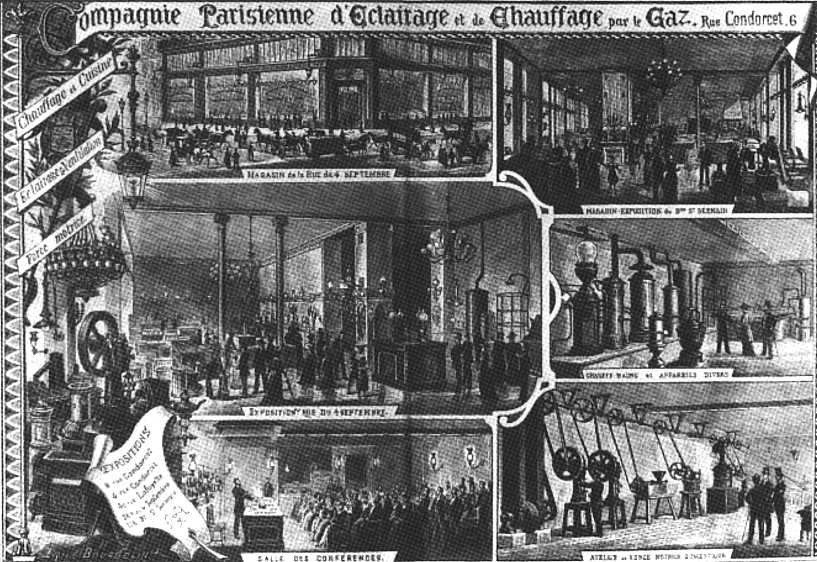
ately ambitious technological and (especially) commercial activities. When the PGC tried to encourage the use of coke in homes, the practice was so uncommon that effective heaters did not exist. The company's engineers had to work with inventors and develop their own appliances that burned coke cleanly and distributed heat as evenly as possible. Having accomplished that task, it had to persuade residents to use the apparatus. The PGC turned to demonstrations and showrooms to interest clients. It put coke stoves in conspicuous places, such as omnibus stations. It opened a showroom on a major thoroughfare, the rue du 4-Septembre. On display were a range of coke stoves, simple ones for modest clients and elegant ones that might suit the drawing rooms of well-appointed residences. By 1885 the company had sold nearly fifty-five thousand stoves on its own. The coke market was greatly expanded by the Franco-Prussian War, during which other sources of energy were hardly available at any price.[32]
Delivering the coke also had to evolve into a large-scale operation. The company at first transported coke only to its industrial customers; but in 1860 it created a domestic delivery service. It eventually employed more than two hundred carters. The wagons and uniformed deliverymen quickly became familiar sights of Parisian street life. The firm began to build its own wagons in 1867. Inevitably the new trade that the PGC had engendered became an essential public activity. During the winter of 1879-1880 especially cold weather and snows created shortages of coke and delivery problems. The result was public panic and rioting outside the PGC's coke yards.[33]
The company was rewarded handsomely for its effective commercial ventures entailing by-products. As Table 9 makes dear, its superior performance over other European firms resulted from the sale of byproducts. That trade brought in about twice as much revenue as the Brussels or London firms received. The income more than compensated for a somewhat less efficient use of labor, higher administrative costs, and the higher costs of coal. The ability of the PGC's managers to lower certain production expenses and raise revenues offers a most flattering portrait of their entrepreneurial role. However, this picture requires a broader focus. The activities analyzed so far show the engineers taking advantage of opportunities that for the most part came to them without serious risk and
[32] Le Gaz: Journal des producteurs et des consommateurs , no. 15 (October 31, 1861): 184; Rapport , March 26, 1885, p. 27; March 28, 1872, p. 30. The annual reports to the stockholders provided figures on the sale of coke stoves.
[33] AP, V 8 O , no. 667, deliberations of August 8, 1860; no. 672, deliberations of May 25, 1867; no. 768, "Usine de Belleville,' reports of November 6 and December 11, 1870; Rapport , March 25, 1880, p. 33. Customers waited in line all night for coke during the Franco-Prussian War.
without exceptional effort. The successes did not test their will to struggle for customers and to develop markets methodically in a competitive environment. In truth, the gas managers were not entrepreneurial in this way.
The energetic defense of a monopoly over gas sold in Paris at high, fixed prices was not an exception to an otherwise competitive spirit among the PGC's managers. In fact, restricted market conditions were a model and an ideal they strove to emulate for the other products the firm sold. That managers were so often able to realize this goal says much about the compartmentalized and localized state of the French economy of the Second Empire, during which more open, national markets ostensibly emerged.
In 1857 the executive committee approved a report that called for the construction of a plant to purify ammonia water at an expense of 415,000 francs. The projected annual profits were 315,000 francs, a return of more than 75 percent—and from the very first year.[34] It is not difficult to understand why the company pursued the marketing of by-products aggressively: it was able to anticipate such profits because the residues of purification would not be sold in a competitive market. Under the direction of board member Louis Margueritte, the corporation entered into price-fixing arrangements for ammonia products. It had similar terms for marketing alkalies and pitch.[35] Engineer Audouin's strategy for selling ammonium sulfate was aimed at preserving control over prices. The PGC was the largest producer of the chemical in France, and Audouin ruled out selling any to fertilizer manufacturers, thereby cutting off competitors' supply of the essential raw material. The company effectively made fertilizer into a "luxury" commodity sold on the basis of quality rather than price. When a firm that made alkalies from cesspool refuse threatened to enter that market, Audouin counseled lowering prices temporarily in order to drive the competitor out of business. In most instances, though, lower prices were not part of his commercial strategy not even temporary. Perfected equipment had brought huge increases in the yield of ammonium sulfate, from 74 liters per metric ton of coal to 106 liters. Yet the price of the chemical rose steadily from twenty-eight francs in 1867 to forty-five francs in 1875 and forty-eight francs in 1877. Thus customers did not benefit at all from the PGC's technical prowess.[36] Similarly a cartel
[34] AP, V 8 O , no. 665, deliberations of January 24, 1857.
[35] Ibid., no. 672, deliberations of January 16, 1867; no. 1063, "Note sur la Société du charbon de Paris." Pernolet, the owner of the Société du charbon de Paris, referred to the PGC as "master of the market" for pitch and asserted that it derived a profit of 25 percent on its invested capital as such.
[36] Ibid., no. 1060; no. 626, "Sulfate d'ammoniaque."
of coke producers from the department of the Nord opted to invade the PGC's "fief" by selling at lower prices, and the gas company responded with an agreement to restore the prices it traditionally charged.[37] The managers of the PGC fitted perfectly Adam Smith's description of businessmen: they were ready to pursue the invisible hand of profit—and to collude in restraint of trade whenever possible.
The efforts of the PGC to launch and develop new businesses were distinctly limited. Management eschewed patiently building markets, competing with other firms, and anticipating initial losses. The company deided to enter a venture if and when it could set high prices and extract large profits immediately. Management's aggressiveness in creating the coke trade represented the pursuit not just of profits but especially of monopolistic profits. A commission appointed by the interior minister noted, in pointedly euphemistic language, the "elevated prices at which [the PGC] has had the talent to make its coke accepted by the Parisian consumer"[38] Engineer François Hallopeau, the head of the coke department, contrasted two sorts of clientele. Manufacturers in the suburbs of Paris found the PGC's coke far too costly; if his salesmen were too aggressive, "they were shown the guard dog." But Hallopeau found urban residents to be pliant customers: 'Accustomed to paying a good deal for wood or oil, they will not hesitate to pay a few francs more for coke." In fact, the company sold coke to the public at four and eventually five times the cost of production and distribution. It chose to maintain these prices rather than reduce the stock when sales were slow.[39] The company's behavior in the retort trade was little different. For a while, the PGC manufactured retorts and sold them to other gas companies, but at a markup of about 100 percent. When a smaller firm mechanized the operation and undersold the PGC, the latter quickly withdrew from the business.[40] Thus it was not at all remarkable that a newly appointed coke engineer aspired to create a monopoly over the sale of all combustible energy sources in Paris by using
[37] Ibid., no. 25, reports of Brissac to director, January 7, 1887, August 13, 1888, and February 16, 1897.
[38] Compte rendu des travaux de la commission nominee le 4 février 1885 en exécution de l'article 48 du traité intervenu le 7 février 1870 entre la ville de Paris et la Compagnie parisienne d'éclairage et de chauffage par le gaz (Paris, 1886), p. 47.
[39] AP, V 8 O , no. 752, "Rapport sur la vente de coke (7 juillet 1866)." Lower coal prices were slow to be reflected in coke prices. See no. 752, "Chauffage," and no. 25, report of February 16, 1897.
[40] Ibid., no. 1067, report of Audouin to director, March 9, 1882. The firm be-hayed in a similar manner regarding gas motors and meter rentals. See no. 1257, "Rapport sur la machine à gaz (22 mai 1885)"; no. 24, "Service extßrieur. Renseignements divers," report of November 18, 1891.
the firm's influence over suppliers.[41] Ultimately, management regarded the exceptional level of returns from gas sales as a situation they might hope to duplicate in all other operations.
The PGC was usually able to sustain high prices and profits because markets were imperfect. In the case of coke, customers had no initial notion of what a fair price would be since the PGC practically originated the trade and accustomed the customers to high prices at once. Competition failed to whittle down prices because most potential competitors conspired with the PGC to keep prices high. The smaller merchants in the coke trade charged as much as the PGC or more. Similarly, the markup on retorts was sustainable as long as competitors took the same profits.[42] As we have seen, the PGC readily found partners in price-fixing arrangements for byproducts or used its market power to drive holdouts from the scene.
The final result of such entrepreneurship was that the PGC, as a pioneer of large-scale enterprise, did little to strengthen market forces or renew business practices. The company fit into—and even reinforced—the localized, stratified, and anticompetitive features of French economic life. Although the corporation pioneered new markets, its high-price, high-profit policies condemned those markets to limited size. The PGC may have represented an aggressive sort of management, but it was aggressive in limited ways that solidified the weaknesses of national economic life.
The types of market the PGC entered or constructed had clear implications for its technological decisions. The modest size of the markets dampened pressures for innovation, with predictable results.[43] The company did not take full advantage of its breakthrough in distilling techniques; in 1905, 40 percent of the gas was still produced in ordinary furnaces rather than recuperative ones.[44] The mechanization of labor-intensive operations was also exceptionally slow. As we shall soon see, the absence of market pressures allowed the PGC to make decisions in this area almost entirely on the basis of the need to control its work force. The ministerial commissions that evaluated the corporation in 1880, 1885, and 1890 were careful not to criticize the firm for technological backwardness but still left the
[41] Ibid., no. 25, report of Hallopeau to director, December 30, 1859.
[42] Ibid., no. 671, deliberations of August 10 and 24, 1864; no. 672, deliberations of January 16, 1867; no. 626, report of Audouin to director, April 22, 1874; no. 1062, "Note sur la Société du charbon de Paris"; no. 1257, "Rapport sur la machine à gaz."
[43] Conversely, management was most effective in promoting efficiency when it was under pressure for increased output. The rationalization of gas production occurred while immediate demand remained unfulfilled (that is, up to 1866). See ibid., no. 726, deliberations of June 14, 1866.
[44] Ibid., no. 620, "Etat dormant le nombre et le type des fours de distillation . . . (19 juin 1905)." Of 6,746 retorts, 2,856 were heated by ordinary furnaces.
impression that it was exceedingly cautious and complacent. As the corporate charter neared its term, the goal of avoiding capital expenditures reinforced the caution. No wonder the new Société du gaz de Paris, which succeeded the PGC in 1907, found the assets it had inherited decidedly old-fashioned and immediately undertook an ambitious modernization program.[45]
<><><><><><><><><><><><>
The practices that management developed for its subsidiary products applied equally to the main business, selling gas. The director repeatedly asserted his desire to expand the clientele as much as possible, to make gas a part of daily life, "like air and water." Moreover, the corporate charter imposed on the PGC the obligation to do what was necessary to facilitate the use of gas.[46] But the director did not really mean what he said; or if he did, the policies he pursued were inappropriate. The market for gas, it will be recalled, was limited in important ways.[47] The PGC had virtually saturated the commercial sector, but the domestic market was largely untapped. By 1885, at the end of the golden era only one in six apartment houses had mounted mains; only 15 percent of apartments were adjacent to the mains; only 5 percent of households actually used gas. Such results raise questions about how the company went about marketing its principal product.
The superficial penetration of the residential clientele was generally the result of the managerial policies pursued during the golden age. The PGC treated gas much as it did by-products. It recognized a large and profitable "natural" clientele, created for the most part by beneficent forces beyond its control. These customers—commercial enterprises, in the case of gas—would pay dearly for gas, either because they had to use it or did not care about the cost. As for the potential users that might have been won over with some judicious enticements, the managers were indifferent to them. Not even the marginal profit of twenty centimes on each additional cubic meter sold interested officers in pursuing the customers who needed to be convinced. As a result, the clientele remained relatively small throughout the golden era.
Corporate policies regarding the ancillary costs entailed in using gas illustrated a cynical realism about markets—the view that some customers would employ gas at almost any price and the rest of the population was not relevant. Rather than supplying meters, connector pipes, and
[45] Parisian officials were well aware that they would soon inherit antiquated and in some cases unusable plants. See Frederic Sauton, Etude sur la question du gaz à Paris (Paris, 1902), p. 3.
[46] Rapport, March 7, 1857, p. 4; March 12, 1862, p. 24; March 28, 1874, p. 6.
[47] See chapter 1.
valves at nominal cost to encourage gas use, the company took a heavy profit on each. It earned a 40 percent return on the rental of the pipes connecting residences to the mains. Yields on the sale or rental of meters were between 20 and 30 percent.[48] So high were such charges that the PGC earned three to four times the income that the London or Berlin gas companies derived from their accessory charges. The Parisian firm even included a payment for the "upkeep of connector pipes" that was fictitious; the fee involved no work and was simply a supplementary cost of using gas.[49]
In addition to charging customers a steep installation fee, the PGC failed to make gas easily accessible. Mounted mains (first used in 1860) were the central means for bringing gas to residences. The firm elaborated a threefold package of incentives for lighting with gas between 1866 and 1872, but the policies did not receive enough thought or financial commitment for success. Management sought to stimulate owners of apartment buildings to install mounted mains and prepare at least three apartments for gas use (with connector pipes and fixtures) by offering a hundred francs. The payment just about covered the cost of installation, so the real encouragement was presumably the increased value of apartments with gas. Tenants in lodgings accessible to a mounted main were eligible to receive thirty francs for installing the necessary equipment. Again, that sum barely covered the cost of the work. The company also promised forty-franc incentives to gas fitters (appareilleurs ) for finding tenants who would take gas and giving them the means to do so. The payment yielded a profit of about ten francs for the fitters.[50]
The marketing effort fell far short of achieving the announced goal of diffusing gas lighting broadly. Its provisions were poorly publicized. The company relied on the gas fitters to find interested landlords and tenants but failed to provide enough incentive for them to make a real effort. Managers explicitly recognized that ten francs did not excite much activity but declined to raise the bonus. In one important way the company provided the fitters with a disincentive: it had convinced them to construct mounted mains at rates below cost on the grounds that the mains would soon bring additional business from tenants who would order connector pipes and fixtures. In effect, the company had found an indirect means of
[48] AP, V 8 O , no. 25, report of Mayniel to director, July 31, 1858; no. 1064, "Album de divers tableaux graphiques."
[49] Ibid., no. 709; Pierre Mongéaud, La Question du gaz à Paris et le régime nouveau (Paris, 1908), p. 103.
[50] AP, V 8 O , no. 671, deliberations of April 21 and June 13, 1866; Compagnie parisienne du gaz, Instruction à l'usage du personnel du service extérieur concernant la fourniture du gaz (Paris, 1879), p. 16.
pushing some of the costs of the mains on the customer again. Yet fitters failed to benefit as promised because tenants usually did not respond to the opportunity that the mounted main offered.[51] Moreover, landlords had to agree to so many provisions to receive the mains that they were confused or suspicious rather than eager.[52] Ultimately, management refused to regard the mounted-main program as an investment that could readily yield a return of 30 to 40 percent with some nurturing and careful planning. Instead, it treated the program as an expense that had to pay off at once or be cut.
Concerned about the high proportion of mains that were underutilized, managers decided to curtail the incentive program rather than pursue it with renewed vigor. In 1874 the director announced that the PGC would no longer install them simply at the request of landlords and now would favor only the buildings that were likely to be the most lucrative. Soon the company formalized the restrictions by limiting the buildings that would receive mains to those with apartments renting for at least eight hundred francs annually. The PGC thereby excluded all but the wealthiest 5 or 6 percent of Parisian tenants from gas use. In 1880 the company canceled the hundred-franc bonus to landlords; now it would install mains at its own expense, but only after the owner deposited a hundred francs, which would be returned if and when three tenants became customers.[53] Thus, the mounted-main program—the principal means for reaching residential customers—became a faithful reflection of management's cynical fatalism. The company drew the line at investments returning less than 30 percent, the yield of mains on the most luxurious buildings.[54]
The policy of withholding gas from all but the wealthiest Parisians is revealing on a number of counts. Corporate engineers calculated in 1876 that mounted mains on apartment buildings where rents were below eight hundred francs brought a 9.6 percent return on the investment.[55] That yield was of course substantial by most standards, and management's disdain underscored the inflated expectations within the firm. Furthermore, the abandonment of less wealthy tenants (not to mention the common people) announced the PGC's indifference to the marketing of gas. Profits
[51] AP, V 8 O , no. 671, deliberations of April 21, 1866.
[52] Ibid., no. 678, deliberations of February 14, 1877.
[53] Ibid., no. 677, deliberations of April 14, 1875; no. 680, deliberations of December 24, 1880; no. 30, report of Forqueray to director, February 7, 1876; Rapport , March 23, 1875, p. 8.
[54] AP, V 8 O , no. 30, "Statistique des conduites montantes au point de vue du prix des loyers (2 avril 1875)." For evidence that profits might have been even higher, see no. 1064, tableau no. 11.
[55] Ibid., no. 30.
from the mains were "only" 9.6 percent because so few tenants saw fit to install gas fixtures, yet the company took no useful steps to make gas more attractive to the hesitant. The disappointing returns from the mounted mains were the firm's own doing. The free-installation program implemented at the end of the 1880s was an admission that earlier incentive plans had failed.
The same refusal to consider long-term growth and the maximization of profit was evident in the company's policies toward gas motors. The managers began by predicting a brilliant future for gas motors in a city with so many small workshops. Noiseless, clean, safe, and free from the requirements of police inspection, they had advantages over steam engines. The company declared its intention of supplying motors at a nominal charge in order to reap huge profits from enhanced gas consumption. Quickly, and perhaps without consciously confronting the matter, managers displaced the goal of the policy from expanding consumption to gaining immediate profits from the sale of motors. The company placed a markup of at least 20 percent on the motors it sold.[56] Once again the officers were attempting to exploit the "natural" customers who would use gas motors at any price. The trouble in this case was that the natural clientele remained tiny. The company discontinued the production of motors and bemoaned the poor performance of this operation but took no imaginative steps to build a market, which happened to be very large in capitals like Berlin.
In spite of its commercial policies, the PGC prospered. Managers were able to serve customers that needed their products regardless of cost. Otherwise, their attitude toward markets was arrogant, exploitive, and restrictive in all but rhetoric. The managers could well afford to sell gas as a "luxury" commodity during the golden age, and the brilliant corporate balance sheet raised few questions about the quality of policy-making. The passing of this era and the curtailment of a natural clientele offered a test of the managers' entrepreneurial mettle.
<><><><><><><><><><><><>
Management probably did not foresee the loss of its most lucrative gas customers and the crisis of consumption of the 1890s. If it did, it took no steps to anticipate the necessary adjustments.[57] Nonetheless, when circumstances forced the executives to act, they analyzed the options coher-
[56] Ibid., no. 1257, "Machines à gaz"; no. 776, "Analyse du prix de vente des moteurs Lenoir' (fols. 88-94); no. 775, "Rapport sur la situation de l'exploitation" (fols. 476-486).
[57] Ibid., no. 1062, report of Lefebvre to director, February 3, 1876. More common than underestimating the potential of electricity was ignoring the competitor.
ently and took logical steps to create a niche for gas in the era of electricity. Management's performance was not especially innovative or imaginative. It merely became open—in a conservative fashion—to reasonable options it had not considered before.
The loss of large business customers to electrical lighting renewed management's interest in gaining residential customers and in promoting gas appliances. The shifts in marketing strategy found symbolic expression in the nature of firm's participation in the universal expositions, held every decade during the second half of the century. Industrial prowess was the theme of the corporate exhibit at the Universal Exposition of 1878. Visitors were shown vials of coal tar, piles of coke, displays of gas valves, and the latest sorts of mains.[58] Probably few tourists found this showcase to be the highlight of their visit; nor did it convince them that the PGC was any closer to the way they lived their lives than was a steel mill. The motifs of the exhibit showed that the PGC was not fundamentally interested in winning customers.
The harsh decade that followed that exhibit forced the firm to reexamine its position in basic ways. The theme of the corporate pavilion at the Exposition of 1889 symbolized the direction and the extent of the reas-sessment. The pavilion took the form of a home furnished with all the latest gas appliances. Visitors could marvel at gas stoves, water heaters, room furnaces, and toasters. Gas motors in the kitchen scraped vegetables, rinsed bottles, and cleaned utensils. Below the domestic quarters was a restaurant with as much gas equipment as the company could invent. Despite the unkind cut by the Gazette nationale that the pavilion was like a museum of medieval artifacts, visitors could at least see some ways that gas would make their homes more comfortable and agreeable.[59]
The strategy for marketing gas in an age of electricity was implicit in the exhibit. The company would pursue domestic and commercial cusomers and do so by accentuating gas appliances as much as lighting.[60] To this end, the director charged the mechanical service department with devising and perfecting domestic appliances. Lefebvre, the engineer who headed the service, identified cooking as the most fruitful area of expansion. Not only did gas have technological advantages over electricity for that purpose, but also the strategy was recommended by deeply rooted mores. As the engineer pointed out, Frenchmen knew that it was "better
[58] Ibid., nos. 1290-1291, "Exposition de 1878."
[59] Ibid., no. 1292, "Exposition de 1889."
[60] The PGC finally created a sophisticated lighting laboratory in 1897. Auguste Lévy, Communication faite au nora de la Compagnie parisienne du gaz par Monsieur Auguste Lévy (Paris, 1900), pp. 3-4.
A corporate handbill illustrating the appliance showrooms. Courtesy Archives de Paris.
to eat by poor candlelight and have great food than to have brilliant light and poor food."[61] His department also perfected gas heaters and found manufacturers to produce them on a large scale. The company used its showrooms, which had specialized in coke appliances for the previous decades, to publicize and sell the ranges and furnaces. To stimulate interest in cooking with gas, the company engaged a Madame Mees to give public lessons and to write a cookbook. Between February and December 1892 nearly three thousand people attended her talks, held at the various showrooms. The company also arranged with the Dufayel department store, one of the largest in the city, to sell stoves and heaters manufactured under the corporate label in 1897.[62] The new quest for gas-powered devices sometimes brought engineers to a dead end, as well. They tinkered with gas-driven elevators, tramways, and automobiles.[63] At least these failed efforts demonstrated a determination to make gas relevant to the machine age. Such a determination had not been evident before competition from electricity intensified. The PGC also tried to recapture some of its large commercial clients, this time for the use of appliances rather than lighting. It willingly gave subsidies to well-known restaurants for the installation of stoves or grills.[64] Management may have hoped that, beyond selling more gas to cafes, it would also be familiarizing the public with meals prepared by gas.
In order for the promotion of appliances to be effective, the PGC had to find ways of convincing Parisians to install gas lines in their homes. With sixty-seven thousand apartments ready to be served by existing mounted mains, there was a large potential market close at hand but previously neglected. In 1887 the company finally took a meaningful step to build markets through a free-installation program, which lent to tenants already at mains the internal pipes, a stove, and a chandelier for the dining room. At last managers had begun to come to terms with investments designed to reap returns over the long run. Their approach to the new policy was cautious and limited, however. Nothing that the PGC did to attract residential customers was original. Gas companies in provincial cities had long lent appliances to customers; indeed, they often offered a wider range of equipment and imposed fewer restrictions. Moreover, Di-
[61] AP, V 8 O , no. 1292, "Rapports et notes émanant des divers services."
[62] Ibid., no. 1303, "Exposition culinaire"; no. 693, deliberations of November 13, 1897. The PGC maintained display spaces on the boulevard St-Germain, rue Condorcet, rue du 4-Septembre, and rue Lafayette.
[63] Ibid., no. 1303, "Voitures actionnés par moteurs à gaz"; no. 691, deliberations of November 13 and 20, 1895.
[64] The deliberations of the comite d'exécution record these agreements. See Ibid., nos. 691-694.
rector Camus at first insisted on the awkward provision that only new customers could receive free stoves; a faithful customer who had used gas prior to 1887 had to purchase a stove.[65] In spite of the success of the program in attracting new customers and expected returns of 50 percent on the investment, management was halfhearted in its commitments.
Efforts to seek a genuinely mass clientele required still more daring— almost more than management could muster. Some engineers continued to seek business exclusively among the well-off. Thus, Lefebvre, the strategist for the 1889 exposition, rejected a plan to place in the pavilion a simple restaurant serving biftecks; he wanted an elegant café that would attract the grande bourgeoisie (his term).[66] Nonetheless, the company eventually resolved to democratize gas use, provided the city would compensate it for sacrificing some of its prerogatives. One indication of management's growing acceptance of democratization was a more favorable attitude toward reduced gas rates. In 1880 the company had dismissed protest over thirty centimes as the work of outside agitators. Twelve years later, the PGC sought to organize consumer groups for the purpose of pressuring the municipal council.[67] In the Sauton project of 1892 the company agreed to gas at twenty centimes, with full compensation for the reduction, and to the fee-free program, which made gas readily available to renters paying less than five hundred francs a year (about 75 percent of all Parisian tenants). As we have seen, the agreements were not realized at once because the Sauton project fell apart; certain aldermen kept insisting on a fee-free program.[68] Faced with falling consumption in 1892, 1893, and 1894, the company finally found the courage to accept it. With that consent, gas entered petit bourgeois households.
The new mass-marketing arrangement had excellent economic justifications and a political payoff as well. Mounted mains were much more lucrative than ever before as a result of free installations and free stoves. The financial projections made by the PGC's engineers in 1892 predicted returns in the range of 30 percent on investments in mounted mains, pipes, and stoves—less than half the yield from supplying gas to regular
[65] Ibid., no. 24, "Transformation de l'éclairage dans Paris (14 novembre 1892)"; no. 30, report of November 1, 1887; Rapport , March 28, 1888, p. 6. For the policies of provincial and foreign gas companies, see AP, V 8 O , no. 1002, "Note sur les moyens qu'il conviendrait d'employer à Paris pour augmenter le hombre des abonnés . . . (25 octobre 1890)."
[66] AP, V 8 O , no. 1292, "Rapport et notes émanant des divers services."
[67] Ibid., no. 1257, Jules Aronssohn to director, November 23, 1892. In 1900 the director finally admitted to stockholders that Parisians did genuinely want lower prices. See Rapport, March 28, 1901, p. 56.
[68] AP, V 8 O , no. 615, 'Exonération des frais accessoires."
customers but still handsome.[69] Moreover, management could anticipate valuable political benefits. Thousands of small customers complaining about expensive gas and eager for immediate relief would provide a splendid instrument for softening opposition to a renewed charter on the municipal council. The director could imagine dictating terms to the city, and the strategy almost succeeded with the Chamon project of 1901-1902 (see chapter 2).
With such advantages, it is worth asking why the PGC left the initiative for the fee-free program to the municipality and then implemented it cautiously. The few problems that managers repeatedly cited were simply not so serious as to raise grave doubts. There was the concern that regular customers might resent the special treatment modest renters were about to receive. The head of the customer accounts department worried that the program would vastly complicate the bookkeeping operations and raise the incidence of delinquent accounts—which it did to a small extent.[70] Surely these objections masked a fundamental aversion to change and risk. The PGC had every reason to expect comfortable profits from the fee-free initiative, yet the decision makers fretted over the large capital expenditures a mass market would require.[71] In the face of uncertainty, limited though the imponderables were, the status quo had its attractions. Thus leftist aldermen found themselves urging capitalists to pursue a profitable venture and even offering financial incentives for the sake of democratizing consumerism.
Characteristically, the engineers proceeded slowly, cautiously, and conservatively with mass marketing. Rather than using the program as a vehicle for embracing as many customers as possible, the PGC restricted access. The director insisted on verifying the rent levels of applicants and petitioned the prefect to check the claims against tax records. The com-
[69] Ibid., no. 30, "Conduites montantes"; no. 689, deliberations of August 18, 1892. The returns on mounted mains that the engineers reported for the 1890s were much higher than those cited earlier in the chapter for the 1870s. The free-installation and fee-free programs were responsible for the larger yields. Not only did more tenants per building take gas, but their free stoves and fixtures used more of it. Thus each main generated more income.
[70] Ibid., no. 24, "Renseignements concernant les recettes sur conduites mon-tames"; no. 90, "Tableau du personnel du bureau des recettes." The PGC might have tried to supply the common people with gas while avoiding these problems by offering prepaid meters. (The British companies had been doing so for years.) Yet the PGC never permitted this approach to mass marketing.
[71] The PGC would eventually spend twenty million francs on equipment for the program. See ibid., no. 617, "Charges supportées par la Compagnie du fait des abonnements sans frais." The firm purported to have saved small consumers forty-six million francs between 1894 and 1902. The large sum attests to the burden of accessory charges.
party even went so far as to question the qualifications of an alderman who claimed to be eligible. The PGC would not provide buildings with mounted mains until landlords put up a security deposit—a payment many no doubt refused.[72] Such hesitancy was not justified by the market testing that the company had done prior to the agreement nor by the final results. Accepting mass marketing had been the correct decision. Fee-free clients consumed 80 percent of the increase in gas sold after 1895 and restored, in the firm's last years, the high profit levels of the golden age.73
The quality of the managers' entrepreneurial decisions lacked a simple, uniform profile, so it is easier to describe what that profile was not than what it was. Clearly, the PGC's salaried executives were not Malthusian in any thoroughgoing sense. Nor were they profit maximizers (though they did not eschew huge profits). The engineers of the gas company manifested three valuable talents: they strove tirelessly to reduce costs and found appropriate techniques to do so; they exploited monopolistic opportunities successfully especially when mass marketing was not involved; and they knew how to construct protected markets. Such talents did not lead to basic innovations in business practice; nor, if generalized, did they promise that the rise of large-scale enterprises in France would make the economy function more efficiently. The PGC's managers wished to remain aloof from market forces and largely succeeded in doing so. Even their drive for efficiency in production owed less to the pressures of the marketplace than to their sense of duty and professionalism as engineers. The strengthening of competitive pressures, such as they were by the 1890s, barely changed the quality of decision making.
The debate about whether French entrepreneurial behavior was shaped by a particular mentalité or was entirely a matter of rational responses to the economic environment is impossible to resolve with finality even for one isolated firm. In any case, the more important point is that the managers' cultural presuppositions weighed heavily in their business judgments. They may have displayed an immediate responsiveness to empirical realities on matters of detail, but the engineers' ideology and outlook guided policies regarding larger matters—at least until reality forced adjustments. Moreover, their professional backgrounds imposed certain predilections and expectations. Neither by training nor by vocation were
[72] Ibid., no. 691, deliberations of January 9 and May 4, 1895; no. 693, deliberations of March 13, 1897; Conseil municipal, deliberations of December 8, 1893 (the remarks of Councilman Brousse, in particular).
[73] AP, V 8 O , no. 617, "Augmentation dans la consommation de l'éclairage particulier."
the managers entrepreneurs. They were engineers, destined by their scholastic achievements to responsible posts. Their intellectual formation, reinforced by class values, taught them what a centime saved meant. Their training did not prepare them to take risks nor to proffer their wares to a hesitant public of consumers. The engineers leaned toward administration; their career expectations required stability and orderly change, if change was inevitable. The good fortune of the PGC's officers was that these requirements were consistent with handsome profits for most of the life of the firm.
Culturally shaped expectations especially influenced corporate policies regarding the labor force. In this area, however, frugality and efforts to stay aloof from market forces created results that proved visibly more problematical. Personnel management had no equivalent to gas at thirty centimes for concealing failures.