
Environmentalism and Suburban Victories
"We are witnessing a truly historic moment, something that never could have happened . . . five years ago," declared Assemblyman Albert W. Merck on a March day in 1972, as the New Jersey Assembly overwhelmingly rejected the Turnpike Authority's proposal to build a $322 million, thirty-eight mile extension through Middlesex, Monmouth, and Ocean counties. To Merck and
[37] Quoted in Gladfelter, "Jets for the Great Swamp?" p. 305.
[38] The Hughes position was also adopted by Robert B. Meyner, campaigning in 1969 for the governorship. Meyner's opponent, Congressman William T. Cahill, went even further, indicating that he was opposed to the construction of a jetport anywhere in the state. Two days after his election in November of 1969, Cahill joined the other members of the New Jersey congressional delegation in a successful move on the floor of the House to delete a provision from the Aviation Facilities Expansion Act of 1969 that would have empowered the U.S. Secretary of Transportation to select a site for the fourth jetport if state officials in New York and New Jersey were unable to agree upon a site within three years. While that provision was opposed by the New Jersey congressional delegation, it was favored by Brooklyn and Queens congressmen, who preferred a fourth jetport to further expansion of facilities at Kennedy Airport, which would bring further discomfort to residents of their areas.
the coalition of environmentalists and suburban spokesmen, whose towns would have been carved apart by "the most carefully planned road ever conceived in the United States," this successful fight signaled the "end of the American love affair with the automobile."[39]
Two decades of massive road-building came to a close in the early 1970s. Due to several interrelated developments, the willingness and the ability of suburban areas to resist the highway agencies grew incrementally until, by the mid-1970s, it was almost as difficult to construct a major arterial highway in the New York region as to build a fourth jetport.
A major underlying reason was increased concern with environmental issues among articulate segments of the general public. In the New York area, the battle of the Great Swamp jetport had heightened the sensitivity of newspaper editors and other suburban spokesmen to the negative ecological and other environmental impacts of large-scale public construction. Nationally, widespread concern with air and water pollution had led to the creation of the federal Council on Environmental Quality in 1969 and the Environmental Protection Agency in 1970.
Even before environmental issues generated broad public interest, the highway agencies had been under attack because of their alleged narrow approach to transportation problems, and because of their tendencies to operate in isolation from the public. Since the 1950s, the highway coalition had been criticized intermittently if ineffectually for its failure to coordinate roadbuilding programs with broader transportation and land-use planning.[40] In addition, highway officials had made little effort to involve local residents in the evaluation of specific routes; public hearings on general alignments were often held years before construction commenced, long before affected communities learned of detailed route plans, and could consider their concrete impact on specific towns and the countryside.
By the mid-1960s, these concerns began to affect the structure and regulations of highway agencies, even if not their operating behavior. Several states, including New Jersey, created departments of transportation that combined mass transport with highway programs. Federal regulations required highway plans to be developed in the context of "comprehensive planning" guidelines for particular regions.[41] In 1967, the federal Department of Transportation was created, with the federal highway agencies shifted from the Department of Commerce to the new department. Under the DOT statute, the Secretary of Transportation was given broad formal authority over federal
[39] Quoted in Ronald Sullivan, "Jersey Assembly Rejects Major Extension of Pike," New York Times, March 17, 1972. The view that this was "the most carefully planned road ever conceived . . . " was that of the Turnpike Authority's executive director, William J. Flanagan, quoted in the same article. The extension project was not finally killed until 1975, after further legislative and court battles.
[40] See, for example, Michael N. Danielson, Federal-Metropolitan Politics and the Commuter Crisis (New York: Columbia University Press, 1965) and Jameson W. Doig, Metropolitan Transportation Politics and the New York Region (New York: Columbia University Press, 1966).
[41] Federal "comprehensive planning" requirements date from the enactment of the FederalAid Highway Act of 1962, which conditioned federal highway grants in metropolitan areas on the existence of "a continuing comprehensive transportation planning process carried on cooperatively by state and local communities." New Jersey combined its highway department with mass transportation and air transport functions in a new Department of Transportation in 1967.
highway planning, and was charged with assessing highway programs in the context of broader transportation and community concerns.
Federal highway officials now required highway plans to include assessments of the "environmental impact" of each major arterial proposal, and the department adopted a "two-hearing" rule, which ended the traditional reliance on a single early public hearing, and required a second round of public testimony when detailed plans had been developed. By changing the rules to make highway determinations more accessible to local interests, the federal government has increased suburban influence over highway locations at the expense of the power exercised by state highway officials.
By the early 1970s, therefore, those who perceived proposed highways as direct threats to their towns and open areas had greater access to highway planners—especially through the second hearing—and a wider base for effective challenges. They could ask whether the highway plan had been developed in coordination with other transport and land-use concerns, or whether there had been a careful assessment of environmental impact. Moreover, the opponents no longer faced the technical skills of highway engineers, armed only with generalized fears for the destruction of community life. Now they could draw upon sympathetic technicians: the environmental experts at EPA and in state agencies, whose evaluations of pollution and ecological damage were scientifically sophisticated and dealt with matters of legitimate concern to increasingly wide segments of the public, particularly well-educated upperincome suburbanites. In addition, the highway opponents had, through long experience, developed greater political skills: greater abilities to organize community residents, to use newspaper publicity and public hearings to good effect, and to utilize technicians in challenging the highway coalition's traditional control over expertise.
Finally, the historical tendency of towns not directly in the path to favor a new highway—as a stimulus to economic growth in their own areas—was undercut by heightened sensitivity toward air pollution, as well as the first suburban glimmerings of another, basic question: was growth of population, industry, and the economy generally always to be applauded and encouraged?
These factors joined to produce yet another effect. No longer was roadbuilding a zero-sum game, as in the previous two decades, with suburban communities wary of aiding neighboring towns threatened with new arterials, for fear that the route might be shifted to their own communities. Instead, it now seemed possible to stop an arterial route altogether. As a consequence, it became possible to build suburban coalitions linking many municipalities that had once shunned cooperation.
All of these factors combined to make grass roots interests more influential in highway controversies, and to make regional political leaders more responsive to adverse constituency reaction. "The people have spoken," conceded one of the region's most enthusiastic proponents of new roads, New York's Governor Nelson A. Rockefeller, in pronouncing "the proposed Hudson River Expressway and the five alternative routes . . . a dead issue."[42] Rockefeller's 1971 announcement ended six years of conflict between state
[42] Quoted in David Bird, "Hudson Expressway Plan Is 'Dead,' Rockefeller Says," New York Times, November 21, 1971.
and local officials, environmentalists, and other interests in a slice of Westchester County bordering the Hudson River.
As the legitimacy of highway-building as a goal in itself declined, and as opponents acquired new tools and broader areal scope, the highway agencies found their own resources dwindling. In part the problem was inevitable: the major arterials constructed first were those that were cheaper and easier to build in terms of engineering difficulties, people displaced, communities disrupted. The early highways, such as the New Jersey Turnpike, and the Narrows Bridge, joining Staten Island and Long Island, were also the most essential in terms of traffic patterns. By the early 1970s, the remaining potential arterial routes were more costly per mile, more difficult to design, more likely to displace population, and less essential to the region's basic traffic flows. In addition, under pressure from the environmentalists and other opponents, the highway agencies' budgets did not increase proportionately with rising costs, so that the ample resources of the 1960s became the limited budgets of the 1970s.[43]
During the past few years, these factors were joined by two others that also affected airport development in the 1970s: the energy crisis, and the gradual slowing of economic growth and population increase in the tristate area. Both developments reinforced the arguments of those who urged sharp curtailment or termination of major arterial construction in the New York region.[44]
So the era of the highway-builders—vigorous, resourceful, and singleminded entrepreneurs whose projects both responded to consumer demands and also powerfully shaped those demands—came to a close. Their activities left an indelible imprint on the region's pattern of residential and commercial development. In the next two chapters, we look more closely at their resources, their strategies, and the impact of their efforts. For the present we note their decline, and with the two following examples illustrate the crucial role of suburban actors in curtailing these once-powerful regional enterprises.
The Long Island Sound Bridge and I-287
A number of examples might be used to illustrate these pronounced changes in the road-building arena. The most important project to be halted in the 1970s, measured in dollar cost and dramatic appeal, was a new bridge across the Long Island Sound. As one observer noted, it led to "one of the region's longest and hardest fought controversies over public works."[45] The
[43] In New Jersey, for example, all three transportation bond issues put forward by the state department in the years 1972–76 were rejected by the voters. In May, 1977, it was reported that the federal highway trust fund contained $514 million designated for New Jersey projects; the funds could not be spent for lack of matching state money. See Mark Brown, "Jersey Has $514 Million Claim on Unused U.S. Highway Funds," Trenton Times, May 4, 1977.
[44] The 1974 annual report of the New Jersey Turnpike Authority captures some of these themes in its opening paragraphs, referring to "a year dominated by the energy crisis and adverse economic conditions," in which traffic "fell short" of earlier levels. By 1975, all the major roadbuilding agencies in the New York region were devoting most of their energies to modest improvements in parking facilities, landscaping, and repair of existing roadways and structures.
[45] John Darnton, "Many Groups Engaged in Battle over Bridge," New York Times, June 21, 1973.
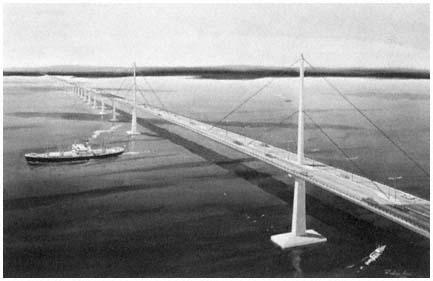
Artist's rendition of the Long Island Sound
Bridge proposed by Robert Moses.
Credit: Triborough Bridge and Tunnel Authority
effort to complete Interstate 287 was more typical, involving extension of an arterial route that generated more effective opposition than earlier sections had in the 1960s, leading to doubts as to whether the highway would ever be completed. The evolution of each of these two controversies is outlined below.[46]
A bridge across Long Island Sound was proposed in the mid-1960s by the region's premier builder, Robert Moses.[47] The span would extend 6.5 miles from Oyster Bay on Nassau County's north shore, to Rye, a Westchester community just below the Connecticut border. When completed, it would provide a shorter connection between central and western Long Island and the mainland, thus decreasing traffic congestion on existing vehicular routes. Moreover,
[46] Other controversies in the 1970s that illustrate the changing environment of highwaybuilding politics include the continuing battle over the proposed Hudson River Expressway noted in the text, the New Jersey Turnpike extension project (also discussed in the text) and the conflicts over the completion of Interstate 95 in central New Jersey, the proposed widening of the Garden State Parkway through Union County, and the construction of a new freeway along the path of Route 7 in Connecticut, among others. The status of the region's highway projects is reported regularly by the Tri-State Regional Planning Commission; see for example its report, Maintaining Mobility (New York: 1976).
[47] Moses outlined the project in a brochure released to the press in February 1965, and in a revised plan made public in July 1965. See Joseph C. Ingraham, "Moses Is Seeking Bridge from Long Island to Port Chester," New York Times, Febrary 15, 1965; Roy R. Silver, "Bridge Authority Split on Long Island Plan," New York Times, March 11, 1965; Stanley H. Schamberg, "Moses Retreats on Long Island Bridge Bill," New York Times, March 19, 1965; Phillip Benjamin, "Triborough Commission Ends Differences," New York Times, March 23, 1965; and Joseph C. Ingraham, "Moses Revises Plan on Long Island Sound Bridge," New York Times, July 17, 1965. For a detailed discussion of the controversy over the Long Island Sound crossing, see Marilyn Weigold, "Bridging Long Island Sound," New York Affairs 2(1974), pp. 52–65. Proposals for bridges spanning Long Island Sound had been made by Moses and others intermittently in earlier decades.
argued those who favored the new span, by reducing the isolation of Long Island communities, the new bridge would enhance their opportunities for attracting new commercial and industrial development.[48]
Although the proposal generated early opposition in Rye and Oyster Bay, it was endorsed by the county executives of Nassau and Suffolk, the Long Island Association of Commerce and Industry, the Builders Institute of Westchester and Putnam counties, and representatives of organized labor. "It is generally acknowledged," wrote New York Times analyst Joseph C. Ingraham, that a bridge across the Sound was "needed."[49] For the Times's editors, "the growing population and economy of Long Island" made it imperative in 1967 that "the Oyster Bay crossing . . . should be started without delay."[50] Governor Rockefeller also gave the plan vigorous support, and in 1967 the state senate and assembly passed legislation authorizing the state's Metropolitan Transportation Authority (MTA) to build the bridge. Local officials then turned to the judiciary, but in 1969 the courts rejected a suit, and it seemed likely that construction would soon begin.[51]
The opponents did not give up. Employing a strategy used earlier by the anti-jetport coalition in the Great Swamp controversy, Oyster Bay generously donated 3,000 acres of shorefront in the bridge-approach area to the federal government as a wildlife preserve. "Citizens for Sound Planning" and other local groups raised money, hired a public relations firm, and argued in nearby towns and legislative halls that the bridge would seriously damage the ecology and recreational value of the sound, as well as generate more traffic that would burden surrounding roads and communities. In 1971 and again in 1972, opponents succeeded in obtaining favorable votes in the state senate and assembly for bills to prohibit the MTA from carrying out the project, only to have Governor Rockefeller vigorously defend the bridge proposal and veto the legislation. In October 1972, the Nassau citizen groups persuaded the county's planning board to alter its position, and the board denounced the bridge as "detrimental to Nassau County residents," because of its impact on traffic conditions, air pollution, and other environmental concerns.[52]
[48] For some proponents, a bridge over the Sound was viewed as "the key to the economic well-being of the eastern half of Long Island"; see Frank J. Prial, "Long Island Bridge Dispute," New York Times, May 9, 1973. See also Hoover and Vernon, Anatomy of a Metropolis, p. 253, and the comments on the bridge's positive impact quoted earlier in this chapter in the text associated with notes 6, 8, and 9.
[49] Joseph C. Ingraham, "Moses Is Pressing for Long Island-Westchester Bridge," New York Times, February 23, 1965.
[50] "To Ease the Traffic Flow," editorial, New York Times, March 24, 1967.
[51] Developments during the 1960s in the battle of the bridge are summarized in Joseph C. Ingraham, "Moses Is Seeking Bridge from Long Island to Port Chester," New York Times, February 15, 1965; Joseph C. Ingraham, "Plan for Bridge Across Sound Arouses Rye and Oyster Bay," New York Times, February 16, 1965; "Rye Residents Move to Counter Plan for Bridge over Long Island Sound," New York Times, July 18, 1965; Ronalo Maiorana, "Governor Urges Bridge from Oyster Bay to Rye," New York Times, March 23, 1967; "Nassau Asks State Not to Build Long Island Bridge," New York Times, March 28, 1967; Ronalo Maiorana, "Transit Program Sent to Governor; Long Island Bridge Voted," New York Times, April 1, 1967; and John Sibley, "State Court Backs Rye-Oyster Bay Bridge," New York Times, April 25, 1969.
[52] See Harvey Aronson, "The Fury Over the Sound," New York Magazine 2 (October 19, 1970), pp. 32–34; Francis X. Clines, "Assembly Says No to Long Island Sound Span," New York Times, April 21, 1971; Frank Lynn, "Rockefeller Expected to Veto Bill Barring Bridge Over Long Island Sound," New York Times, April 27, 1971; David A. Andelman, "Long Island Opponents ofBridge Assail Report," New York Times, January 31, 1972; and "Nassau Planners to Oppose Bridge," New York Times, October 22, 1972.
The suburban opponents were dealt a severe blow a month later, in November 1972, when the Federal Highway Administration approved the 318-page environmental impact report prepared by the MTA and New York State's highway department, which concluded that the bridge would have a "minimal" impact on plant and animal life along the waterfront. But before the MTA could hold the public hearings that were then required, the opponents produced their own experts, challenged the impact statement in court, and obtained a court ruling in January 1973 finding the impact statement inadequate and requiring it to be set aside. By now the New York Times had added its voice to the growing chorus of opponents of the bridge. Condemning the project in an editorial entitled "Un-Sound Bridge," the Times emphasized environmental and community concerns rather than the traffic considerations it had focused on earlier. The once imperative link in the regional highway network was now seen as a "mammoth threat to the water, air, wetlands, housing and tranquility of Oyster Bay and Rye" that would "require an evergrowing network of supporting roads, constantly to be widened at the expense of the retreating green. . . . "[53]
Meanwhile, the anti-bridge forces took their case to Washington, winning two crucial victories in March and April 1973. The Department of Interior, responding to the environmental concerns of area residents, ruled that the bridge could not pass "over, under, through or on" the new National Wildlife Refuge that Oyster Bay had donated. An active campaign also brought several area congressmen, as well as Connecticut's Senator Abraham Ribicoff and Governor Thomas Meskill—who were concerned about additional traffic from the bridge in lower Fairfield County—into the opposition camp. These efforts finally resulted in votes on Capitol Hill to prohibit the use of federal funds to pay for access roads to the bridge. The House bill went further than the Senate version, prohibiting any connection between the new span and the interstate highway system.[54]
Finally, in June 1973, Governor Rockefeller, the bridge's most vigorous advocate, yielded. While noting with approval that the project offered economic and traffic-related advantages, the Governor concluded that citizens "have gradually come to adopt new values in relation to our environment," and to "forego certain economic advantages to achieve these values." It was now, Rockefeller explained, a matter of public debate whether "all growth is automatically good." The Governor directed that there be a halt to all work on the Long Island Sound Bridge, which he termed "a lightning rod in this period of evolution."[55]
[53] "Un-Sound Bridge," editorial, New York Times, February 1, 1973.
[54] See Frank J. Prial, "Proposed Bridge on Sound Passes Environmental Test," New York Times, November 29, 1972; "Suit Filed Against Long Island Sound Bridge," New York Times, February 8, 1973; Steven R. Weisman, "U.S. Blocks All State Plans on Rye-Oyster Bridge," New York Times, March 17, 1973; Richard L. Madden, "Governor Says U.S Opposition Won't Stop Long Island Sound Bridge," New York Times, April 6, 1973; "House Votes to Tie Up Long Island Bridge Aid," New York Times, April 20, 1973; "The House Delivers a Sharp Blow," New York Times, April 22, 1973; and Frank J. Prial, "Rye-Oyster Bridge Dispute," New York Times, May 9, 1973.
[55] John Darnton, "Many Groups Engaged in Long Battle at the Bridge," New York Times, June 21, 1973.
In New Jersey, the road builders faced a simpler task—completion of the northernmost section of Interstate 287, a sixty-three-mile, $226 million artery that traversed part of Central New Jersey and then turned northward, through Hunterdon, Somerset, Morris, Passaic, and Bergen counties. As I-287 had pushed northward during the 1960s, the state transportation department had employed the usual strategy, developing detailed route alignments incrementally, as construction moved north. Construction of the segment through Morristown, referred to earlier in the chapter, represented another chapter in the successful battle to divide and overcome suburban resistance.
In the early 1970s, however, the battle of I-287 was renewed ten miles north of Morristown by the "I-287 River Route Committee." Rather than simply objecting to the destruction of homes along the route preferred by the state, the committee set forth an alternative route, and used skilled advisers to argue that the state's preferred route would cause extensive drainage and sewage problems along the remaining twenty-mile route to the New York State border. Confronting widespread and sophisticated opposition, the state Department of Transportation finally yielded in 1976, adopting the alternative route along the river, which promptly generated fierce opposition from the newly affected towns. The following years, local opponents used a new round of hearings on environmental and pollution problems to ensure additional delay in the project's completion, raising doubts in the view of the state commissioner of transportation whether this last section of Interstate 287 would ever be completed.[56] In fact, as the New Jersey transportation department noted, the northern section of I-287 was but one of several "vital sections" of the region's arterial system with a "questionable future." Unless current environmental, financial and other difficulties were resolved, the department concluded in 1973, the completion of these suburban highways "may be abandoned."[57] Eight years later, no further work had been under-taken on the disputed highway, although New Jersey's transportation chief insisted that the missing section of I-287 in Morris and Passaic counties was "the last vital link in what is otherwise a completed system."[58] And as the 1970s drew to a close on Long Island, unsuccessful attempts were made to revive the moribund scheme to bridge the Sound. For supporters of the Long Island Sound crossing, the span was "as inevitable as death and taxes"; while for local residents, environmentalists, and their representatives, Moses's dream remained "a bridge too far."[59]
[56] See Martin Gansberg, "A New Highway Irks Morristown," New York Times, April 19, 1973; Michael Monroe, "Route I-287: Change Unlikely," New York Times, May 17, 1973; Martin Gansberg, "Local Opposition Again Blocking Highway Work," New York Times, December 27, 1976; and Robert Hanley, "Bergen Protests I-287 Extension, Asserting Road Would Skirt a Park," New York Times, September 9, 1977.
[57] New Jersey Department of Transportation, 1973 Report of Operations (Trenton: 1974), p. 16.
[58] Louis J. Gambaccini, Commissioner of Transportation, quoted in Alfonso A. Narvaez, "State to Winnow Highway Program," New York Times, September 2, 1979.
[59] State Senator John Caemmerer, Williston Park, Nassau County, N.Y., chairman of the New York State Senate's Standing Committee on Transportation, quoted in John T. McQuiston, "Long Island Sound Span Remains a Bridge Too Far," New York Times, November 4, 1979.