
The Politics of Publishing Under the Old Regime
In November 1788, Augustin-Martin Lottin l'aíné , printer-bookseller and devoted member of the Paris Book Guild, set out to publish his Catalogue chronologique des libraires et des libraires-imprimeurs de Paris .[6] This trade directory cum genealogy of one of the most privileged and exclusive sectors of cultural commerce in early modern France, the Paris Book Guild, burst into print in the same few months that the Estates General proclaimed itself the National Assembly; abolished all "privileges," at least in principle; and in the Declaration of the Rights of Man and the Citizen announced that "the free communication of thought is one of the most precious rights of man. All citizens can, therefore, speak, write, and print freely."[7] With the declaration of the freedom of the press, a mania to produce and consume the printed word swept across the nation. Over the
[6] Augustin-Martin Lottin, Catalogue chronologique des libraires et des libraires-imprimeurs de Paris, 1470–1789 (Paris: Lottin, 1789).
[7] Article 11 of the Declaration of the Rights of Man and the Citizen, promulgated August 26, 1789; an edited version appears in Jacques Godechot, ed., Les Constitutions de la France depuis 1789 (Paris: Flammarion, 1979), 34.
next several years new printing presses popped up left and right, igniting France, and especially its capital, with the flames of incendiary pamphlets of every political bent. Along with so many other trade manuals, legal handbooks, and government directories, Lottin's Catalogue became obsolete—not to say antiquarian—almost overnight. Or did it?
It is worth pausing briefly over Lottin's Catalogue because, broadly conceived, it presents us with a view of the world from one of the key nodes of state regulation of the printed word in Paris on the eve of the Revolution. In both its form and intent it reveals the place that one of the more conservative members of the Paris Book Guild sought to preserve for this institution in the larger order of things.
The title page of Lottin's work (plate 1) is in itself a kind of catalogue of the essential features of licit publication of the printed word under the Old Regime. The symmetry and classical beauty of this work is a modest, but nonetheless monumental, testimony to Colbert's programmatic vision of the organization of commerce under the absolutist state. Reading from the bottom up, we find the king and his approbation of the publication of the work; the royally licensed printer-bookseller in Paris; and the dedication to the university, which was, at least in title, the governing body under whose purview the Paris Book Guild fell within the infrastructure of the royal administration.[8] Finally, the printers and booksellers themselves are announced, chronologically and alphabetically, by edict, in royal procession. The author of this tableau of the official process of publication figures nowhere on the title page. The king, as God's first representative on earth, is depicted as the sponsor of all knowledge made public through the medium of the printed word. Thus the work discloses its divine origin through the approbation of the king.[9]
On one side of his chronological tableau, Lottin presents the practitioners of the typographic arts, including not only printers and book-sellers, but engravers and type and paper manufacturers as well. Listed alongside in parallel columns are the individuals whom Lottin describes as the "judges and protectors" of the typographic arts, those royal officials who inspected all printed matter and assessed its quality in both
[8] In 1789 the Paris Book Guild still appeared under the rubric for the university in the Almanach royal (Paris: Debure-d'Houry, 1789).
[9] The legal privilege to publish a book began with the formula "Louis, par la grâce de Dieu, Roi de France. . .." The text of the privilege, by law, had to appear at the beginning or end of any work published with official approbation in France in the eighteenth century.
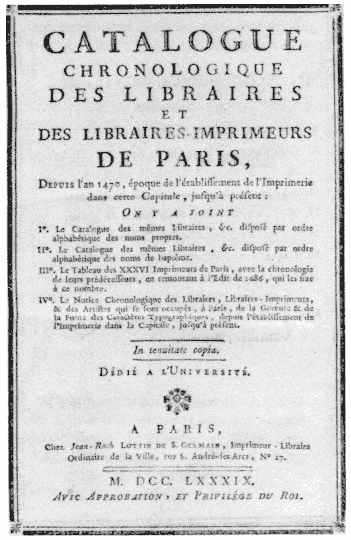
Plate 1.
Title page of Augustin-Martin Lottin's Catalogue chronologique
des libraires et des libraires-imprimeurs de Paris, 1470–1789
(Paris, 1789). General Research Collection, The New York Pub-
lic Library, Astor, Lenox and Tilden Foundations.
formal and substantive terms before it reached the public. Beneath the king and his ministers, the prescribed audience of printed works is divided into four columns: (1) the university, (2) the Parlement, (3) the royal police at Châtelet, and (4) the king's Council of State.
Time divides neatly into centuries, reigns of kings, directorships of the Paris Book Guild, and, most importantly, family cycles, ordered chronologically and also alphabetically by both first and last names so as to emphasize every possible genealogical link. As centuries roll by, we see families rise and fall and rise again. The figures change, yet the essential structure persists. The Catalogue is organized to place Paris at the center of French publishing, to disclose and stress the continuity and coherence of a closed corporate system of production, and to facilitate and encourage its persistence.
The Chambre Syndicale de la Librairie et Imprimerie de Paris (the Paris Book Guild) was a self-regulating corporation of printers and booksellers in Paris, who by royal privilege enjoyed an exclusive monopoly on the production and distribution of printed matter in the capital city.[10] Since 1686, when Louis XIV had fixed the number of printers in the city at thirty-six, channels of entry into the Parisian printing trade had narrowed steadily in proportion to the increase in population and demand for printed works.[11] Successful entry into the guild required an apprenticeship and examination by both guild masters and the university. To become a printer also required the timely death of one of the select thirty-six and considerable savings to buy a shop and pay the stiff entrance fees exacted by the guild.[12] Except for widows of guild members who chose not to remarry, the law prohibited women from printing, publishing, or selling printed works. According to Lottin, in 1788 the guild comprised 241 printers and booksellers.[13] Initially under the jurisdiction of the University of Paris and the Parlement of Paris, over the
[10] See the Almanach de la librairie (Paris: Moutard, 1781); Chartier and Martin (eds.), Histoire de l'édition 2:64–93; and Philippe Minard, Typographes des lumières (Seyssel: Champ Vallon, 1989).
[11] Henri-Jean Martin, "La Prééminence de la librairie parisienne," in Chartier and Martin (eds.), Histoire de l'édition 2:262–282.
[12] On apprenticeship in the eighteenth-century printing and book trades, see Paul Chauvet, Les Ouvriers du livre en France, 2 vols. (Paris: Marcel Rivière, 1964); and Minard, Typographes des lumières, esp. 74–100.
[13] Lottin, Catalogue chronologique des libraires . An edited version of Lottin's list appears in Paul Delalain, L'Imprimerie et la librairie à Paris de 1789 à 1813 (Paris: Delalain, [1900]), li–lx. The 1788 capitation tax roll for the Paris Book Guild shows 213 members, of which 37 are printers and 32 are women; see Bibliothèque Nationale (hereafter cited as BN), Fond Français (hereafter cited as mss. fr.) 21861, "Registre de la communauté des libraires et imprimeurs de Paris, 1787–1791" (see table 2).
course of the seventeenth and eighteenth centuries the guild became tied ever more closely to the royal administration.[14]
Three separate branches of the Crown's administration were intimately related to guild affairs. The single most important was the Administration of the Book Trade, a division of the Great Chancellery. The director of the book trade reported directly to the keeper of the seals, who in turn consulted, in particularly sensitive matters pertaining to the book trade, with the king's Council of State. This administration occupied itself at the national level with the organization of the book guilds in the major cities of France and supervised a national network of royal inspectors of the book trade. The royal inspectors oversaw the activities and duties of the guilds in the cities to which they were assigned and, in conjunction with the postal service, were charged with surveillance of the foreign book trade at designated ports of entry into France.
The Administration of the Book Trade also dispensed and registered literary "privileges," which were at once an official approbation of a work, a permission to print, and a kind of copyright, in that they gave the bearer an exclusive monopoly on the publication of a particular work or on publications in a given area of knowledge. Finally, this office was charged with the delegation of manuscripts to the appropriate member of the corps of royal censors. In light of the censor's report, the Administration of the Book Trade then determined the legal status of a work submitted for publication.[15] By the end of the eighteenth century a work might receive one of six categories of legal sanction: (1) a privilège en librairie, which gave an exclusive monopoly on the publication of a work for a fixed period of time (usually ten to twenty years) to a particular licensed guild publisher; (2) a privilège d'auteur , which gave the author of a work and his or her heirs an exclusive monopoly on the publication of the work in perpetuity; (3) a permission simple , which gave legal authorization to a publisher to produce a single edition of a particular work; (4) a permission tacite, which gave no legal sanction to a work but insured that the authorities would permit and protect its publication and circulation unless
[14] Henri-Jean Martin, "Conditions politiques. La Librairie et les pouvoirs," in Chartier and Martin (eds.), Histoire de l'édition 2:64–93.
[15] See Daniel Roche, "Censorship and the Publishing Industry," in Revolution in Print: The Press in France, 1775–1800, ed. Robert Darnton and Daniel Roche (Berkeley and Los Angeles: University of California Press, 1989), 3–26.
it was denounced, whereupon they might withdraw the permission; (5) a tolérance , which simply meant that the authorities would tolerate at their contingent discretion the circulation of an illegal work; and finally (6), a suppression , which meant that a work and its publisher would be actively pursued by the authorities, the work confiscated and destroyed, and the publisher and author fined and perhaps arrested or banished.[16]
By law, no one but a registered member of one of the officially sanctioned royal book guilds was allowed to engage in the activities of printing, publishing, or selling printed works in France. In 1777 this regulation was modified to permit authors to publish and sell their own works.[17] Sample copies of every printed work over three printer's sheets in length produced or marketed in the city of Paris had to be deposited and registered at the offices of the Paris Book Guild.[18] Shorter publications were registered directly with the lieutenant-general of police. The guild then sent the manuscript to the Administration of the Book Trade, where it was again registered and then sent on to a royal censor for evaluation. Upon the censor's report, the administration determined whether the publisher would be permitted to circulate the book and, if so, what level of approbation and protection the edition would receive. Any pirate editions or illicit works not bearing the name and address of a licensed guild publisher, a royal "privilege," and the approbation of a royal censor printed at the back of the book were confiscated to the advantage of the actual privilege holder, the Paris Book Guild, and the Administration of the Book Trade. The printers and publishers of the city thus enjoyed protection against competition for their labor force and the licit literary market that they monopolized.
Two other branches of the royal administration concerned themselves with the production and dissemination of printed works in the capital under the Old Regime. Of second most importance, in Lottin's view, was the Châtelet, the law courts and offices of the royal police force
[16] Raymond Birn, "The Profits in Ideas: "Privilèges en Librairie' in Eighteenth-Century France," Eighteenth-Century Studies 4, no. 2 (Winter, 1971): 131–168.
[17] Codes of the book trade for 1723 and 1777; see Almanach de la librairie . An arrêt of the king's Council of State of 1700 prohibited authors from selling their own works. The arrêts of 1777 reversed this decision, making it possible for authors to sell their own works. See H.-J. Martin, "Conditions politiques"; and Birn, "Profits in Ideas"; also Carla Hesse, "Enlightenment Epistemology and the Laws of Authorship in Revolutionary France, 1777–1793," Representations 30 (Spring 1990): 109–137.
[18] On this procedure, see Robert Estivals, Le Dépôt légal sous l'ancien régime de 1537–1791 (Paris: Marcel Rivière, 1961).
of Paris, under the jurisdiction of the minister of Paris and, in particular, the lieutenant-general of police and his corps of inspectors of the book trade and undercover spies. These men were charged with the censorship of works printed and published in the capital shorter than three printer's sheets. They made regular visits, in conjunction with the book guild officers, to the establishments of the printers and booksellers of the city. They were further charged, along with the postal service and the Paris customs officers, with the inspection of shipments of printed matter moving into or out of the city.[19] Finally, the minister of foreign affairs controlled the dispensation of "privileges" for the publication of periodical literature and surveillance of the foreign book trade.
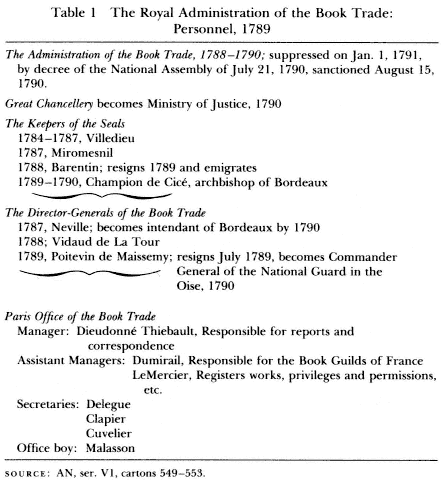
The research findings of historians of eighteenth-century literature and the book trade allow us to flesh out the scheme left to us by Lottin and to situate his Paris-centered depiction in the context of the national administration of the book trade.[20] The system of legal publishing on the eve of the French Revolution is shown graphically in figure 1, table 1, and map 1.
This corporatist system, the godchild of divine-right absolutism, was not, however, without its imbalances. The most striking disproportion, concealed by diagrams and maps, involved the increasing preeminence of the Paris Book Guild within the national system over the course of the seventeenth and eighteenth centuries.[21] Parisian commerce as a whole tended to be privileged by the monarchy as the crowning jewel of royal civilization, the more cultivated and protected because it lay close beneath the royal eye. It was also the most susceptible to surveillance. By royal decree, the number of Parisian printing establishments was fixed at three
[19] For vivid depictions of the careers and activities of these officials, see Darnton, Literary Underground; and Robert Darnton, "A Police Inspector Sorts His Files: The Anatomy of the Republic of Letters," in The Great Cat Massacre and Other Episodes in French Cultural History (New York: Basic Books, 1984), 145–189.
[20] See, in particular, Estivals, Dépôt légal; Robert Estivals, La Statistique bibliographique de la France sous la monarchie au XVIIIe siècle (Paris: Mouton, 1965); H.-J. Martin, Livre, pouvoirs et société; Chatier and Martin (eds.), Histoire de l'édition; Birn, "Profits in Ideas"; François Furet, "La Librairie du royaume de France au 18e siècle," in Bollème et al., Livre et société; E. P. Shaw, Problems and Policies of Malesherbes as Directeur de la Librairie in France (Albany: State University of New York Press, 1966); J.-P. Belin, Le Commerce des livres prohibés à Paris de 1750 à 1789 (Paris: Belin frères, 1913); John Lough, Writer and Public in France (Oxford: Clarendon Press, 1978); and Nicole Hermann-Mascard, La Censure des livres à Paris à la fin de l'ancien régime (1750–1789) (Paris: PUF, 1968).
[21] See Martin, "Prééminence de la librairie." See also Jean Queniart, "L'Anémie provinciale," in Chartier and Martin (eds.), Histoire de l'édition 2:283–284.
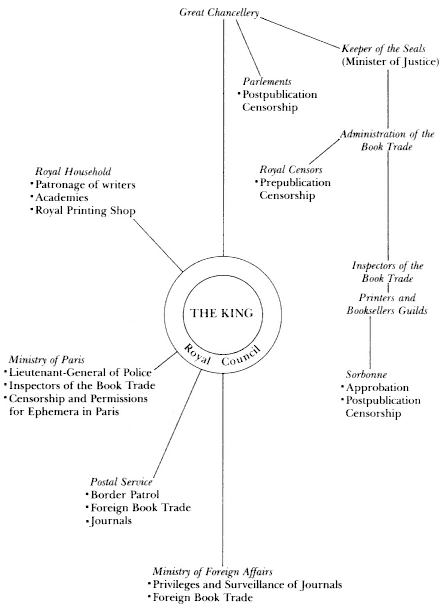
Figure 1.
The Royal Administration of the Book Trade: Administrative Organization, 1789
Source: AN, ser. V1, cartons 549–553.
times the number of any provincial city.[22] In terms of location they also benefited from the most intensive, if not extensive, reading market in France. As Lottin's attention to genealogy suggests, during the seventeenth and eighteenth centuries Paris-centered family empires steadily consolidated a hegemonic grip on licit publishing under the Old Regime. Lottin was right to put Paris at the center of official publishing. It was.
[22] See Roger Chartier, "L'Imprimerie en France à la fin de l'ancien régime. L'Etat général des imprimeurs de 1777," Revue française d'histoire du livre, n.s., no. 6 (1973): 253–279; and Roger Chartier, "La Géographie de l'imprimerie française au XVIIIe siècle," in Chartier and Martin (eds.), Histoire de l'édition 2:290–291. The figures for 1701 are fifty-one printing shops in Paris to thirty in Lyon (nearest competitor); and for 1777, thirty-six in Paris to twelve in Lyon (nearest competitor).
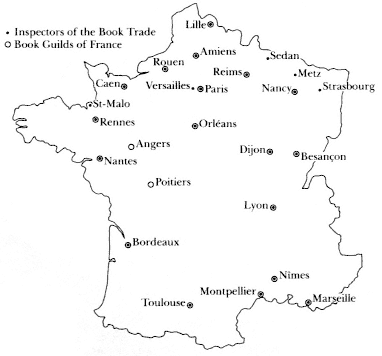
Map 1.
Royal Inspectors of the Book Trade and the Book Guilds of France, 1789.
Source: AN, ser. V1, cartons 549–553.
Advantageously positioned at the heart of national administrative life, police power, and royal patronage, Parisian publishers steadily accumulated monopolies on the most lucrative privileges for the major texts of classical literary, religious, and legal civilization. In general, Parisian establishments were large and specialized in what the French call grande édition : the publication of multivolume editions, standard reference works, and educational and religious texts with huge press runs.[23]
Massive bibliographic studies of the registers of the literary privileges and permissions granted by the royal Administration of the Book Trade and of officially sanctioned periodical literature in the eighteenth century have provided us with a fairly clear sense of what this system of licit publication produced. The picture of official literary culture that emerges from the studies of François Furet, Robert Estivals, and Jean Ehrard and Jacques Roger is essentially one of cultural stagnation and a steadily consolidated reproduction of the traditional religious and literary inheritance of the seventeenth century.[24] Heavily patronized, protected, and policed, Paris publishers dominated official publishing. And, with a few notable exceptions, they also proved relatively inflexible in the face of new literary and intellectual movements or shifts in the demands of the reading market.[25] Seeking the literary civilization of the eighteenth century, literary historians who have studied licit publishing have found instead the cultural inheritance of the seventeenth century. The official world of corporate publishing in Paris was preeminent, but fossilized.
But Lottin himself, despite his desire to present a world of coherence and symmetry, was unavoidably aware that licit publishing was not the only publishing in Paris or in France. And in the mere act of documenting the official system over time, history inevitably intruded in Lottin's account. "Interesting facts," "clandestine presses," and "supposed presses that do not exist" could not be ignored and had to be tacked on, disrupting the symmetry of his picture.[26] Moreover, in his neat four-column classification system, some columns bulge at the expense of others. Thus, as the centuries of the tableau roll by, the thirty-six printers of Paris become slowly engulfed by increasing numbers of royal officers.
[23] H.-J. Martin, "Prééminence parisienne"; and Queniart, "Anémie provinciale."
[24] Estivals, Statistique bibliographique ; Furet, "La 'librairie' du royaume de France au 18e siècle," in Bollème et al., Livre et société , 3–32; Jean Ehrard and Jacques Roger, "Deux périodiques français du 18e siècle," in Bollème et al., Livre et société , 33–60.
[25] Martin, "Prééminence parisienne."
[26] Lottin, Catalogue chronologique des libraires , xx, xxiii.
While the columns of names under the university and the Parlement remain essentially static, those under the police of Châtelet and the king's Council of State run wild: sometimes they must be doubled; finally whole pages must be given over to them. The business of "judging and protecting" the printed word clearly thrived in the eighteenth century.[27]
Clues like Lottin's unintentional revelations have led historians to uncover and map out a labyrinth of illegal publishing, which seethed underground and across the borders of France during the eighteenth century. Following the theses of Alexis de Tocqueville and Daniel Mornet, these scholars have sought to retrace the dissemination of revolutionary ideas in the century before the Revolution became a reality.[28] They have revealed widespread production and diffusion of subversive ideas through the medium of the printed word, beyond the laws and institutions of the Old Regime.[29] Thus, despite the picture that emerged from studies of official registers of literary privileges, we now know that Enlightenment literature was widely diffused in eighteenth-century French society, and that the spread of this new cultural movement was intimately linked with the elaboration of an underground subculture of printers, publishers, literary smugglers, and book dealers in border cities like Neuchâtel, Bouillon, Geneva, Avignon, in the Low Countries (especially Amsterdam), and in Kehl, Germany.[30] This illicit world also spread within the borders of France, in cities like Troyes and Lyon, in Paris and its suburbs (such as St-Denis, Bourg-la-Reine, or Petit Montreuil), and especially in the Palais Royal.[31] The realities of eighteenth-century pub-
[27] Ibid., 244.
[28] Alexis de Tocqueville, The Old Regime and the Revolution (New York: Doubleday, 1955); and Daniel Mornet, Les Origines intellectuelles de la Révolution française, 1715–1787 (Paris: Armand Colin, 1967 [orig. ed. 1933]).
[29] Robert Darnton, "Philosophy Under the Cloak," in Darnton and Roche (eds.), Revolution in Print: The Press in France, 1775–1800, 27–49.
[30] On Neuchâtel, see Darnton, Business of Enlightenment; Darnton, Literary Underground; and Robert Darnton, "Le Livre prohibé aux frontières. Neuchâtel," in Chartier and Martin (eds.), Histoire de l'édition 2:342–361. On Bouillon, see Raymond Birn, "Le Livre prohibé aux frontières. Bouillon," in ibid., 334–341. On Geneva, see B. Lescaze, "Commerce d'assortissement et livres interdits. Genève," in ibid., 326–333. On Avignon, see René Moulinas, "La Contrefaçon avignonnaise," in ibid., 294–303. On the Low Countries, see Ch. Berkvens-Stevelinck, "L'Edition française en Hollande," in ibid., 316–325. And on Kehl, see Henri-Jean Martin, "Le Voltaire de Kehl," in ibid., 310.
[31] On Troyes, as well as Paris, see Darnton, Literary Underground, 122–147. On Lyon, see Darnton, Business of Enlightenment . On Paris, see Belin, Commerce des livres prohibés; and Henri Carré, "Quelques mots sur la presse clandestine à la fin de l'ancien régime," Révolution Française 25–26 (1893–1894): 102–126. And on Parisian suburbs and the Palais Royal, see BN, mss. fr. 22070, fols. 198–199, "Mémoire sur l'introduction des libelles dans le royaume et chez l'étranger" (n.d.).
lishing and literary culture thus lay hidden beneath the Colbertian ideal depicted by Lottin and inscribed in the laws, institutions, and programmatic vision of the absolutist state.
Under the Old Regime there were thus two intersecting yet distinct systems of cultural production. In political terms, the one was legal and privileged: it received its justification and legitimation in the idea of the divine origins of all knowledge and in the right of the king as God's first representative to interpret God's knowledge and grant or revoke the privilege to make it public within his kingdom.[32] The other, in contrast, was illegal and unprivileged: its legitimation inhered solely in the notion of the author as the originator and first owner of a work, freely alienated by contract to a publisher, as with any other form of property. Economically, the one relied on corporate monopolies and closed markets; the other depended on market demand in the "booty capitalist" world beyond the law.[33] Geographically, the one was centered in Paris and the traditional provincial cities; the other operated underground, beyond the borders of France, or in free zones like the Palais Royal in Paris, which enjoyed immunity from surveillance by the king's police. Culturally, the one was dominated by the classical, legalistic, and religious worldview of the seventeenth-century court; the other propagated les lumières and the romantic spirit of Rousseauism.[34]
Of course, characterizations of this sort are never as neat as they seem. By the end of the eighteenth century many, if not most, publishers, printers, and book dealers, as well as the royal officials who policed them, in reality conducted their businesses on both sides of the law. Nonetheless, it should now be apparent that when, in 1789, Chénier denounced the "seventeen inquisitions exercised in France upon the minds of citizens," he was calling for the destruction of the entire institutional infrastructure of legal publishing under the Old Regime and for the legalization of the commercial literary culture that lay beyond the law. Alternately, when Lottin, the former chief officer of the Paris Book Guild and official printer for the city of Paris and the king, set out to
[32] This is the actual language of the royal literary privilege, which appeared at the end of all works published with official approbation.
[33] See, for example, Darnton, Business of Enlightenment , 520–530.
[34] On the eve of the Revolution, for example, the Oeuvres of Voltaire were being published in Kehl, Rousseau's Oeuvres in Geneva, the Encyclopédie in Neuchâtel, and Mirabeau's pamphlets in Avignon.
publish his Catalogue in 1789, he had no intention of singing a commemorative swan song to a world he had lost. Rather, he intended to be the Paris Book Guild's most erudite polemicist.