
Introduction
This book concerns illustrations of the Ramayana[*] , an epic poem with epic implications for contemporary India. I have chosen, however, to focus upon the single region of Orissa—rich rice-growing plains along the eastern coast, between Bengal and Andhra, a region relatively homogeneous, traditional, and peaceful (see maps). Orissa is known for its elegantly carved and architecturally ambitious temples, dating from A.D 600 to 1250. The illustrations considered here, however, are less familiar sequences of pictures from the nineteenth and twentieth centuries. My reason for addressing this topic is not that of the mountaineer who climbs a peak "because it is there" (and unclimbed). Rather I should profess a tripartite personal agenda.
First, having spent most of my scholarly career studying the ancient art of South Asia, I was tantalized by questions that seemed unanswerable. For example, in the process of analyzing reliefs of the life of the Buddha from the fifth century A.D. , the Gupta period, I considered earlier images and Buddhist texts as alternative sources for iconography.[1] When neither image nor text corresponded to a particular Gupta carving, it was tempting to credit the sculptor with creating a new version of the story Yet it was also impossible to be certain what verbal guidelines were actually current in written, let alone in oral, form. Comparison required a body of art in which it was clear what written text the artist actually knew and for which oral traditions were preserved. I must admit in advance that the recent material upon which I settled is not without its own problems and includes two genres with potentially different relationships between image and word. Moreover the projection of recent patterns onto the ancient past requires caution. This book presents information essential for that analogy but does not take understanding ancient art as its goal.
Second, having chosen to work in Orissa, I reflected on why interesting and beautiful pictures here had been largely neglected in the overall framework of Indian art, whereas the images of some traditions (e.g. Gupta sculpture or Mughal painting) had been examined and reexamined. A litany of accusations about scholarly biases does not seem to me productive. Yet one of many reasons for such neglect is worth considering—the "folk art" status of the two genres considered here. As I studied both, I found a continuum between rough work, rooted in a
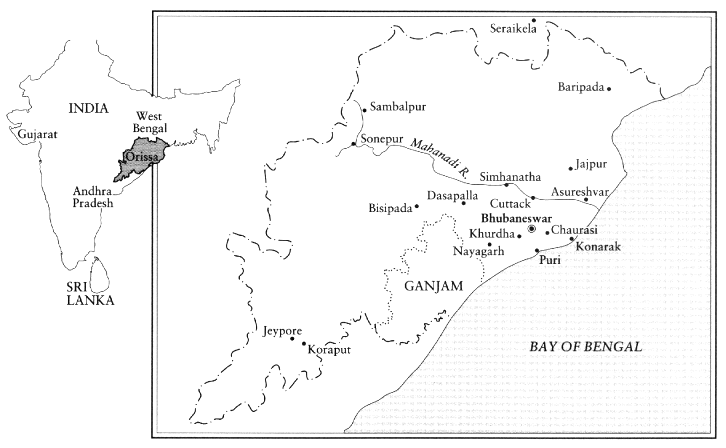
Map 1.
Orissa
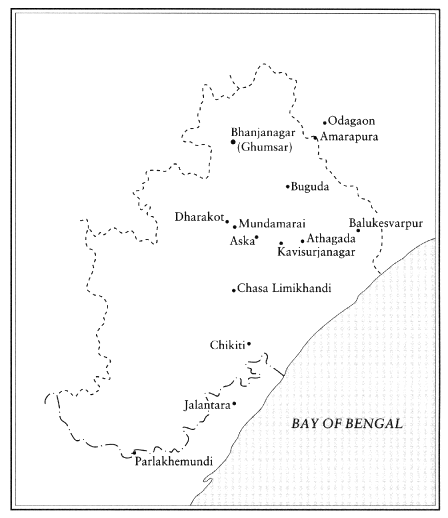
2.
Ganjam District
village or popular context, and refined, complex images, some produced by the same artist, others within the same generic form. I became uneasy with the polarization of folk and elite art, even in its Indian formulation, desi (local) and margi (mainstream). Such dichotomies have been uneasily transferred from the realm of verbal lore to that of visual, and the terms merit fuller theoretical analysis. In this book I have deliberately included some images that most art historians would classify as folk art. Part of my hidden agenda is to make both the rough, gutsy and the refined parts of the Orissan pictorial tradition interesting and accessible to a wide audience.
A third incentive to undertake this particular study came in the course of looking at a fine set of illustrations of a poetic text in a museum with a discerning American collector of Indian painting. He remarked as we considered the tenth picture: "What a waste to have these together, where they become boring; each one would be a masterpiece by itself." This reaction is symptomatic of our treating as separate pictures images designed to be seen in sequence.[2]
Formal analysis need be performed on only one member of a set whose style is consistent. Likewise the content of a single picture can be addressed in isolation. But for a series with narrative content, we must consider several images in sequence to understand how the story is told visually Indian illustrated manuscripts have usually been analyzed on the basis of draftsmanship and design in the isolated page. Such qualities need not be neglected. Yet to restrict oneself to them is to omit dramatic qualities such as variety, surprise, and emotional development sustained over a sequence of images. The present study attempts to talk about sequential content without dismissing formal qualities in individual images. My goal is to present this material as interesting even to the collector whose reaction galled me, and at the same time to demonstrate that the pictures have another dimension, missed if one is seen in isolation. This task is not peculiar to Orissa, so I focus upon images of the epic Ramayana[*] , some version of which is known to virtually every Indian and which ought to have a place in the world's literary canon.
For methodological guidelines, three comparisons between pictures and other sequential art forms come to mind. The first is cinema, a medium that comprises sequential images as well as words and other sounds. However fine the photography, it would be difficult to judge a movie from isolated frames, omitting other "filmic" qualities. My own experience of Indian culture began with the films of Satyajit Ray What captivated me most in the Apu trilogy was the unfamiliar mixture of emotions depicted and evoked, the sense that one could move rapidly back and forth between grief and amusement. My bafflement at so meandering a plotline perhaps reveals the limitations of a viewer raised on American cinematic aesthetics in the 1950s. When I eventually read Bibhuti Banerji's novel, on which the movies were based, I realized that Ray had tightened up the plot and reduced the number of emotional reversals. Nonetheless, I would claim that the films do reveal a structure based on the development of several complementary moods, the rasas that will figure m my own analysis, which contrast with an Aristotelian preoccupation with plot or structure based on a coherent sequence of action.
A powerful film concerning contemporary life in Orissa, the very region of this book, suggests an analogy with the pictures discussed here. The title of that movie, Maya Mriga (The Magic Deer), alludes to a theme in the Ramayana[*] central to this study In the film, the deer is an emblem of the illusory nature of traditional family values, such as respect for parents and support for siblings, in an age when education (itself traditionally valued) encourages the young to put themselves first. Unfortunately that film is not easily accessible to an English-speaking audience, so I shall not pursue the comparison. The immensely popular version of the Ramayana[*] shown on Indian public television in 1987 and 1988 will be more familiar to many readers; thus references to the TV series occur throughout this book.
Finally, one must note that cinema and video are usually more collaborative media than the painting and book illustration considered here, even in the case of a strong director such as Satyajit Ray, who guided both photography and music with care. Hence the analogy is not inevitably useful as a means to understand the production of images. Furthermore, the existence of a film, like theater, in time that is not reversible (despite the existence of the video cassette) gives it a different status from pictures whose order the viewer participates in determining.
The comic strip forms a yet more apt comparison for the illustrated book. One might argue that today's most vital sequential graphic art form is the comic, both in India and in the West.[3] In the Orissan book, the same artist normally executes pictures and text, and the text is presumably copied from another manuscript. The comic, likewise, may be produced by one artist, although many comics result from collaboration between artist, author, and letterer. The fact that the Western comic usually presents a new story makes recognizability a major issue, whereas any images of the Ramayana[*] have an initial legibility As the distinguished man of letters A. K. Ramanujan has put it, no Indian ever reads the Ramayana[*] for the first time.[4] Nonetheless, the interpretation of its depiction requires the reader's cooperation. Thus it seems fruitful to bear in mind several devices of the comic throughout this book: framing, the spectator's position, and variations in the number and size of panels to indicate the passage of time.
A third tradition analogous to narrative images is purely verbal narrative. This comparison is perhaps most promising as a source of theoretical models, having attracted the most attention. The burgeoning field of narratology provides frameworks rooted in literary criticism but readily applied to pictures that tell stories.[5] Some Westerners and educated Indians may feel that because older images do not tell stories clearly to us, they were not intended to tell stories at all. One could counter, however, that the stories were clear to the knowledgeable.[6] One could also argue, as I do, that clarity is not the only possible goal of a story. In Chapter 51 shall attempt to construct a narratological framework suited to Indian pictorial images.
Here I shall simply sketch some elements of the theoretical models from literature that I do find useful and not specific to Western culture. In the first place, the Russian formalists have distinguished story (the underlying "argument" or chronological sequence of events) and discourse (the form in which argument and events are actually presented).[7] When we turn to images, it would be easy to reduce these concepts to a verbal story and a visual discourse, but it is worth remembering that there is also a discrepancy between the two at the verbal level and hence that the text illustrated need not constitute the story. The story in fact lies in the mind of the artist, and its retrieval requires looking at the pictures in addition to reading the accompanying words. In this book, pictorial discourse is the primary concern.
Roland Barthes begins his seminal essay, "The narratives of the world are numberless" and I admire his generally pluralistic vision of the subject.[8] Barthes notes the fallacy described in the scholastic formula post hoc, ergo propter hoc , linking consecution (order) and consequence (causation). He also remarks that elements in a story may have a phatic role, that is, communicate feelings rather than ideas. Most important for me, Barthes provides an exemplary framework in which
narrative structure functions as a code, limiting but not determining the tale that ensues.[9] In other words, he admits the freedom of the artist, which I find particularly necessary in dealing with Indian traditions too readily treated as formulaic. Thus he avoids both mechanical classification of imagery and complete ram domness.
Gérard Genette, in focusing on one major novel, Proust's À la recherche du temps perdu , provides a large body of analytic concepts.[10] These seem most helpful in considering the temporal dimension of the story, and my discussion of matters of order is indebted to him. Hence the terms "anachrony" (departure from chronological order), "analepsis" (flashback), and "prolepsis" (flash-forward). Matters involving the narrator, which Genette classifies as mood and voice, are more problematic in the realm of pictorial narration in general. His term "focalization," roughly identified with a narrative point of view, has been questioned but not discredited, and visual equivalents have been suggested.[11] Given the broad impersonality of Sanskrit literature, I consider our stories as "nonfocalized" in general, but the concept may he helpful in several cases where an entire sequence is presented as an illusion.
In organization, the present work takes on some of the labyrinthine complexities of Indian storytelling. I have been tempted at points to separate out entirely my different concerns for various readers. But I do not want the student of art history to be able to bypass the rich Indian stories. Nor do I want the student of Indian literature or of narratology to be able to bypass the visual adventure of Orissan pictures. Chapter 1 presents a variety of verbal versions of the story of Rama. Chapter 2 introduces Orissan painting and manuscript illustration as a whole in traditional formal, historical, and contextual terms, as they survive from the late eighteenth century on. Chapter 3 addresses earlier sculptural images of the subject of Rama in the same region, as a visual precedent for the pictures. Chapter 4 compares systematically the diverse pictorial versions (our discourse) of ten events in the story. Chapter 5 considers each pictorial discourse in sequential terms, returning to theoretical issues. Chapter 6 attempts to draw conclusions about meaning, indeterminate as that may be, about the artists' storytelling choices, and about our judgment of the success of the pictorial narratives.
Finally, I feel compelled to underscore a philosophical point that might be lost, coming from an art historian telling a complex, pluralistic story that suggests complete relativism. The fact that we all make mistakes is trivial but true. This is comparable to pointing out that there are germs everywhere; we are not therefore justified in performing surgery in a sewer. There are mistakes as well as germs, and I would like to minimize both. But it does interest me that two or more answers to one question may be correct. This modified form of relativism underlies my argument in several ways.