
14
Today's Masks
Our discussion of the syncretic nature of the Yaqui pascola mask properly brings to a close our consideration of the mask as metaphor in indigenous Mesoamerican spiritual thought and practice. It suggested metaphorically the nature of spiritual reality as an animating and sustaining force since the lifeless mask must be animated by the wearer in order to "live" in ritual, thus demonstrating the integral relationship of spirit and matter. Although the mask and the wearer might be discussed separately, they existed as one; just as the idea of a mask by its very nature compels one to think of the person under the mask, the existence of vivified material reality testified to the existence of spirit—the vivifying force. Without a face under it, a mask would be a meaningless conception, and without spirit, from the Mesoamerican point of view, the material world would be inconceivable. As we have seen, this fundamental metaphoric conception underlying mask use existed as early as the village cultures that preceded the growth of the high civilizations of pre-Columbian Mesoamerica and is still fundamental to modern indigenous groups, the distant heirs of those civilizations.
But what is to come? Eric Wolf, for one, sees a bleak future for the cultures of the indigenous peoples of Mesoamerica.
Until 900 B.C. . . . the community [i.e., what we have earlier called the village culture] was the autonomous unit of social life; and the growth of ties beyond its limits was still to come. And when we look at this unit in long-term perspective, we find that in Middle America it was never obliterated. The simple inventory of farm tools and kitchen equipment, the tasks of farming, the religious concepts geared to the cycle of planting and harvesting, the style of life centered upon the community of one's birth—these have remained basic and stable until today. Empires and conquests sweep over the land, cities arise, new gods announce salvation, but in the dusty streets of the little villages a humble kind of life persists, and rises to the surface again when the fury of the conquest is stilled, when the cities crumble into ashes, and when the new gods are cast into oblivion. In the rhythm of Middle American development we recognize phases of great metabolic construction, followed by catabolic processes which gnaw at the foundations of temples and citadels until they collapse of their own weight or vanish in a fury of burning and destruction. Yet until today the community of cultivators has retained its capacity to turn in upon itself and to maintain its integrity in the face of doubt and disaster—until today, and perhaps not much longer, because the modern world is engaged in severing once and for all the ties which bind people into local unity, in committing them to complete participation in the Great Society. This is a one-way street along which there is no return. The Middle American world has survived many destructions; our present cycle of time is now approaching its nadir.[1]
As with much else in the development of the spiritual core of Mesoamerican civilization, this fundamental change, which Wolf describes in terms of the "shape" of cyclical time basic to Mesoamerican thought, can be seen in the changing use of masks in the festivals in which the ritual defining that spiritual core is enacted, festivals for which Donald Thompson suggests an equally bleak future. "Perverted ceremonies, costumes, and dances will probably remain as an attraction for tourists to the economic advantage of the natives. It is a sad thought that a unique religion of four centuries'
growth may end as a tourist attraction."[2] As we have seen, that religion actually has far more than four centuries' growth, which makes such an ignominious end especially sad and an even greater loss to humanity.
Wolf and Thompson wrote these words thirty years ago, and the developments over those thirty years have borne out their truth. In most areas of Mesoamerica, the process of disintegration is well advanced. In an essay explaining the dangers to the indigenous way of life inherent in opening to further tourism the Sierra Norte de Puebla, an area whose relative inaccessibility has protected its indigenous way of life, Eduardo Merlo Juárez describes the situation in 1978 at the largest festival in the area, that of Cuetzalan which draws indigenous people from throughout the region. Traditionally, its focal point, indicative of its fundamentally religious but syncretic nature, is provided by dances; in fact, the festival begins with
all the different dance groups dancing in front of or behind the priest with the Eucharist and others with the images of the patron saints [to whom the festival is dedicated]. . . . The priest is accompanied to the church, where the first mass is celebrated. . . . In front of the church the different dances are performed, but first the groups enter the church to dance inside for the saint.[3]
According to Merlo Juárez, this emphasis on the religious nature of the dances in particular and the festival in general is changing. In 1978, the high point of the festival came with the arrival of the regional officials, as those in charge were bent on impressing these secular authorities. The dancers, whose efforts were "merely" meant to please "the divine authorities," were interrupted so that the focus of attention might be on the more spectacular Voladores. Cameramen crowded around, obscuring the view of the seemingly unimportant local people in their festival garb, and "the crowning touch was supplied when a tiny, charming dancer barely five years old was brought to the place of honor." All the other activity ceased so that
certain women, I believe they were "Miss Tourism" or "Miss Who-Knows-What," could pose for the press photographers at the side of this child, pretending to give him a kiss, but only placing their lips near the terrified face of the child who had no comprehension of what was going on. He understood even less the action of one of the retinue who offered him, in the view of all, a banknote of high denomination.[4]
This tawdry example makes strikingly clear that the indigenous people of Cuetzalan are well on their way to "complete participation in the Great Society," and that the commercialization of the masks and dances, and ultimately of the whole proud tradition of indigenous Mesoamerican spirituality, is among the means by which that sad conversion is being accomplished. Material reality—in the form of cute children, sexually attractive young women, money, publicity, and political power—has become an end in itself and is to be celebrated through its own peculiar ritual. Earlier, in 1952, Redfield characterized this development precisely when he wrote that while it once was an
intensely sacred act made by the village as a collectivity composed of familially defined component groups, with close relationship to the system of religious and moral understandings of the people, the festival has become, in the more urbanized communities, chiefly an opportunity for recreation for some and of financial profit for others, with little reference to moral and religious conceptions.[5]
Despite the changing nature of the Mesoamerican festival, masks continue to be produced. Some of them, like those of the tigres and the pascolas, continue to play their traditional roles in the festival enactment of ritual, a significant portion of which still serves the ancient ends of linking matter to spirit so that human life may be sustained. These masks testify to the continuing vitality of that spiritual tradition in its ability to incorporate elements of the "Great Society" without losing the focus of its own spiritual vision. As James Griffith and Felipe Molina point out, pascola masks "do not appear to have changed appreciably in the past hundred years,"[6] indicating that the strength and vitality of the tradition they represent enables them to encompass the new realities. Griffith, describing a pink pascola mask made especially for him, says that "in response to a question concerning the somewhat unusual color, the carver stated that it represented an 'americano pascola.'"[7] While designed for an "outsider," the mask shows both the careful craftsmanship of the masks meant for the pascola dancers themselves and an imaginative grasp of the essentials of the tradition represented by the mask in its ability to integrate an alien tradition into its features. In this and similar cases, the masks themselves indicate that the battle between the old and new traditions is at times still being won by the representatives of the ancient ways.
But not all masks produced for outsiders—and tremendous numbers of them are being made by the cottage industry turning out tourist goods in Mexico—are so profound, and not all of them record a victory for the old traditions. Throughout Mexico, wherever tourists might go, a different sort of mask is to be found. Some of them are modeled on masks that play a part in the festival dances we have described, while others result from the maker's ideas of what his potential buyers—urban Mexicans and U.S. tourists—might want.[8] Regarded in the light of indigenous ritual mask use, these are
often absurdities, brightly painted, leering, horned faces adorned with crawling insects, reptiles, or animals. In their garishness, they reveal far more about the taste and minds of the buyers of such monstrosities than about the sensibilities of their makers. To one familiar with the spiritual depth of the tradition of Mesoamerican mask use and with the unique beauty of many of the masks produced by that tradition, a walk through Mexico City's Sunday market at Lagunilla, for example, with its piles and piles of those masks meant for tourists, can be a truly depressing experience. These masks symbolize a victory for the new tradition.
The Yaqui "americano pascola" and Lagunilla's tasteless tourist masks provide examples of the two extremes of the impact of the traditions of the "Great Society" on the making of masks, but there are still other types of contemporary masks besides those that are still a vital part of a living tradition and those that pervert the beauties of that tradition in the service of a new, materialistic vision of reality. One of them demonstrates the difficulties one might encounter in attempting to classify contemporary masks as either traditional or commercial.[9] A recent discussion we had with Lino Mora, a young mask maker in the small town of Naolinco, Veracruz, illustrates the source of that difficulty. He talked about his masks and the variant of the Dance of the Moors and Christians in Naolinco in which they were worn and showed us a "report," prepared by students of the local primary school and illustrated with locally taken photographs, detailing the background and meaning of the dance. Unfortunately, the information had been taken from readily available sources and did not pertain to the local dance, but the photographs were particularly interesting as they showed townspeople dressed as dance characters wearing masks carved by Mora, masks that would generally have been identified by "experts" as designed for the tourist trade. This encounter made two things clear. First, the dance not only continues to exist in Naolinco but its continued existence is a source of pride and satisfaction to the community. Second, masks continue to play an important part in the dance, and the mask maker is seen as making a significant contribution to the community's ceremonial life.
But the masks themselves suggested that the tradition was in the process of fundamental change. Señor Mora had two finished masks for sale. One of them, a skull mask, had been used, while the other was a new mask, identical to those worn by the local dancers, which had been carved for a shopkeeper in Xalapa. After some discussion, it was agreed that we could buy both and that Señor Mora would carve another to be sold, presumably to a tourist, in the shop in Xalapa. We returned home with the mask, but along with it we brought a question. How can one distinguish between a mask meant for ritual use and one meant for sale to tourists? In the case of the work of Lino Mora, at least, they may well be the same mask. And that double market he serves suggests a crucial possibility in the development of the tradition: the features designed to please the tourist and collector might find their way into the dances. There is an interesting piece of evidence in this case that that has happened. When we arrived home with the mask that had been destined for the Xalapa shopkeeper, we discovered that it was remarkably similar thematically to a mask, also from Naolinco, that Covarrubias had acquired sometime before 1929 when it was published in Mexican Folkways.[10]
The similarity, however, served to emphasize some striking differences. Both our new mask (pl. 69) and Covarrubias's old one (pl. 70) have realistic human faces with prominent eyebrows, noses, and teeth, and in each case, the face is encircled by a snake, but all of the symbolic features of the new mask are more dramatic. Furthermore, unlike the features of the old mask, they are clearly designed to suggest a modern, Hollywood-style Satan. This identity, of course, coincides with the serpent whose head, in marked contrast to the one on the earlier mask, is carved and painted to suggest its similarity to the human face of the mask. Señor Mora identified the mask as that of a Moor, but those opponents of the Christians have clearly coalesced in his mind with Satan, the archenemy. And the source of his mental image of Satan could be guessed from the fact that immediately to the right of the masks displayed for sale sat a television set, and next to the masks on the wall were tacked a number of pictures clipped from popular magazines. Like the rest of us, Señor Mora is bombarded by the images generated by what Wolf calls the Great Society, and those images, as we would expect, emerge in his art, an art worn on the streets of Naolinco in the syncretic celebration of the festival of the town's patron saint.
What happens under these circumstances to the symbolic meanings communicated by the masks? It seems likely that these new images will ultimately convey a new symbolism in the same way that the masks used on All Hallows Eve in the United States and some areas of urban Mexico are a part of festivities that today have a vastly different meaning from the original religious celebrations. Halloween is now a recreational event for children, an event that uses masks but strips them of their meaning—and their power. The Naolinco Moor's mask resembles a Halloween Satan, a Satan whose menacing countenance is all in fun. Naolinco has not yet reached the stage of development of the cities of the United States or the large cities of Mexico, but one suspects that it is on its way, propelled by the potent symbolic images of the television screen and the magazine's glossy
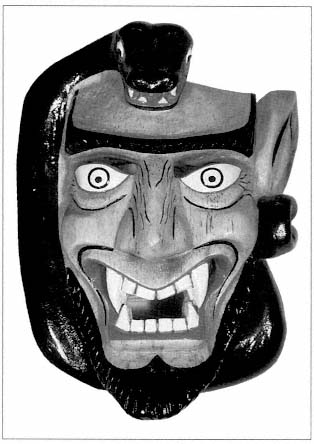
Pl. 69.
Mask for a Moor carved by Lino Mora, Naolinco, Veracruz
(collection of Peter and Roberta Markman).
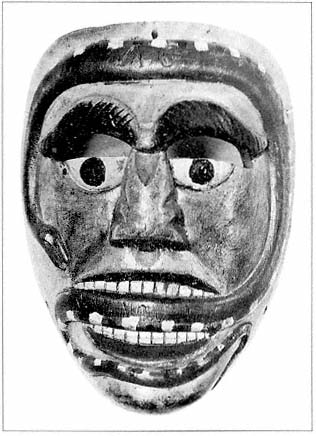
Pl 70.
Mask from Naolinco, Veracruz,
in the collection of Miguel Covarrubias.
pages, which are designed to sell not only the products but ultimately the value system of "the Great Society."
Those concerned with contemporary Mesoamerican masks and the tradition in which they function take various attitudes toward these changes. Some, such as Donald Thompson, see such changes as marking the end of the tradition, while others believe they are natural developments, that all traditions change and that such change is healthy. Maria Teresa Pomar, for example, suggests that all artists work within the ambit of their cultures and that "each object produced corresponds to an epoch" and necessarily and properly reflects the culture of that epoch despite the tendency of some, which she sees as regrettable, to see objects produced in the past as better than those of today.[11]
That tendency can be seen nowhere more clearly than in the attitudes of many collectors of and dealers in Mesoamerican masks. Among such people, the desirability of a particular mask is determined to a great extent by its age and whether or not it has been "danced." Ironically, and somewhat humorously, the collectors' passion for patina has spawned a whole new genre of masks. Primarily fabricated in the state of Guerrero, these masks are a late development of the commercialization of mask making. According to Maria Teresa Sepúlveda Herrera they are often consciously imitative of old masks and are generally very well carved and given an artificial patina to mislead collectors. There are several styles, some realistic, others fantastic, that have been developed by particular carvers and that have been imitated throughout the region.[12] One type, perhaps developed from the fantastic masks that Donald Cordry attributed to José Rodriguez,[13] a shadowy figure who may or may not have existed,[14] features bizarre combinations of animals, reptiles, and human faces in beautifully carved and painted masks.[15] Masks of another type are quite large and designed to cover the head of the wearer in the manner of a helmet (pl. 71). Often painstakingly carved, they represent characters from the Dance of the Moors and Christians, and although they have been made to appear old, [16] there is no record of any such masks ever having been used. Other large masks exist as well, all of them designed for the collectors' market: some are gigantic insects, reptiles, or animals incorporating a human face and supposedly used in harvest celebrations, [17] others are large human faces with flowing beards supposedly representing dwarves in rain-petitioning ceremonies,[18] and still others are stylized crocodiles and mermaids that are often accompanied by large representations of those creatures designed to be worn around the waist.[19] In still
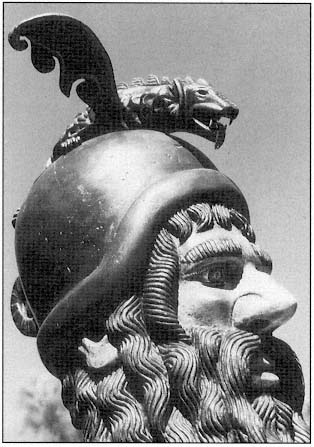
Pl 71.
Mask of Fierabraz, Iguala, Guerrero
(collection of Peter and Roberta Markman).
another category of such falsos , as these masks designed for collectors are called by now-knowledgable collectors and dealers in Mexico, is what Cordry referred to as the Barbones masks,[20] which are beautifully carved of hard wood with particular attention paid to the carving of the luxuriant beards.[21] The carving of these masks represents a high point in the development of the carver's art, but none of them was ever intended for use. Like the others, these were meant for collectors in Mexico and the United States, and those same collectors comprise as well the only market ever intended for the copper and silver masks also made in Guerrero.[22]
There is no evidence that the collectors' market has had any appreciable effect on the tradition of mask use within Mesoamerica, but it has had a substantial impact on the scholarly and curatorial approach to Mesoamerican masks within the United States. Unfortunately, Cordry's Mexican Masks , the only major treatment of the subject in English, represents either an attempt to legitimize such frauds as those described above or a complete lack of awareness of their spurious nature since, as Janet Esser points out, the book treats these masks as genuine while failing to document the existence of the dances to which these masks are attributed, a documentation that would, of course, be impossible because the masks were not designed for dancers but for collectors.[23] Even worse, as Esser also explains, this book, lavishly illustrated, published by a prestigious university press, and introduced by a well-known scholar, ultimately "addresses Mexican masks [both genuine and 'false'] as 'collectables.'"[24] A sad end, indeed, for a central metaphorical form of one of the world's great religious traditions. Just as the festival in which the mask has been used symbolically to reveal spiritual reality is succumbing to commercialization—the worship of the material as an end in itself—so the mask itself has become in such cases as these merely a "thing" to be "consumed" by the voracious new tradition.
But if we see this situation in Mesoamerican terms, in terms, that is, of the cyclical "shape" of time, as Wolf does, this nadir must presage rebirth just as midnight foretells dawn. But what will the dawn bring? The bleakness of Wolf's vision of the future for the "sons of the shaking earth" might well suggest William Butler Yeats's similar vision for a different people:
Turning and turning in the widening gyre
The falcon cannot hear the falconer;
Things fall apart; the centre cannot hold;
Mere anarchy is loosed upon the world,
The blood-dimmed tide is loosed, and everywhere
The ceremony of innocence is drowned;
The best lack all conviction, while the worst
Are full of passionate intensity.[25]
As Wolf puts it, "Our present cycle of time is now approaching its nadir." The "severing once and for all the ties which bind people into local unity, in committing them to complete participation in the Great Society," a society that defines reality as essentially material, has brought the indigenous peoples of Mesoamerica, along with the rest of humanity, to the point of seeing beneath a mask never before lifted. The breakdown of the "local" spiritual traditions, such as we find in Mesoamerica, requires either the birth of a new global tradition of some sort or the living of human life in the absence of any such tradition. In either case, we might feel with Yeats that "surely some revelation is at hand."
But what is that revelation? Joseph Campbell has addressed this question in more general terms than our concern with Mesoamerica, and his answer is instructive: "One cannot predict the next mythology any more than one can predict tonight's dream; for a mythology is not an ideology. It is not something projected from the brain, but something experienced from the heart, from recognitions of identities behind or within the appearances of nature," and it is the artist, he points out, "who brings the images of a mythology to manifestation." This insight is of crucial importance as "without images (whether mental or visual) there
is no mythology."[26] That function of the artist is precisely the transformative function attributed to the Mesoamerican artist. Thus, if Campbell and the Mesoamerican spiritual tradition are correct, while we cannot know the nature of the new dispensation, if there is to be one, we can know the source of the images through which it will be expressed: they must come from the creativity of the artist, who can transmute the essence of man's relationship to the wellsprings of his being into images painted on canvas, carved in stone or wood, cast in clay or metal, or described in words. Knowing what we know of Mesoamerican spiritual thought, we might well predict that the mask would figure prominently among the images embodying that new dispensation.
Interestingly, it is possible to see just such a development in the modern Mexican art through which its creators attempted to define a uniquely Mexican view of reality. If time and space in this study permitted us to outline the development of that modern art and to show its tendency to focus on the indigenous past in its attempt to create a truly Mexican art that could render the modern Mexican consciousness, we could trace that development from the nineteenth-century landscapes of José Maria Velasco which captured both the uniqueness and the spiritual quality of the Mexican setting to the landscapes of Dr. Atl in which that spirit appeared in images tempered by his fascination with both modern European art and Mexican popular art. We could then examine Diego Rivera's uses of indigenous images in the highly sophisticated art he developed, after returning to Mexico from four years spent as a cubist in Paris,[27] to place Mexico's heritage at the base of the Mexican revolution. In his art, especially the murals, as in the art of many of his contemporaries, the mask was a common feature, both because as an image it could convey the texture of indigenous life and because it fit Rivera's conception of a nation whose powerful native strength was contained under the "mask" of a decadent, Europeanized upper class. These political uses of the mask also appear in the powerful art of Rivera's contemporary, David Alfaro Siqueiros, and, to a somewhat lesser extent in the third of los Tres Grandes, José Clemente Orozco, as well as in the host of artists who followed in their footsteps.[28]
Such a discussion of the importance of the mask as an image in the art of the revolutionary period would lead to a consideration of the reaction against this nationalization and politicization of art by such sophisticated younger artists as José Luis Cuevas who also used masks and masklike images but used them to convey a conception of reality diametrically opposed to that of Rivera, Siqueiros, and Orozco. For Cuevas, the mask provided the perfect image for the peculiarly modern sense of the alienation of the individual in a world that forced that person constantly to "prepare a face to meet the faces that you meet," to mask the inner, spiritual self in order to live in a world that defined reality as material. Such an examination of the use of the mask by Cuevas, on the one hand, and by los Tres Grandes and their followers, on the other, would show the stark contrast between their bitterly opposed views of the proper aims and the proper means of art. Significantly, however, both used the mask in the service of rendering these two very different, widely held, but ultimately European (in the sense that we have used the term in this study) views of reality. In that sense, both use the image fundamental to indigenous art in an essentially nonindigenous way. Native Mesoamerican spiritual art, of course, has no monopoly on the use of the mask as a metaphor.
But more to the point of the concern of our study, there are two internationally acclaimed Mexican artists, one a contemporary of los Tres Grandes and the other a contemporary of Cuevas, who in themselves and in their art unite the indigenous with the European; Indian Mexico with modern Mexico. They are Rufino Tamayo and Francisco Toledo. Coincidentally, both were born of Zapotec parents in the state of Oaxaca and grew up surrounded by images generated by the indigenous culture. But both lived for a time in New York and Paris, and their temporary immersion there in the world of international art made it possible for each of them—in vastly different ways, as we shall seeto transmute their indigenous heritage into universal images capable of relating that heritage to the concerns of modern human beings, wherever they may have been born. For both, the mask is often central, but it is rarely an actual mask.
To understand the profoundly indigenous nature of their art in general and their metaphoric use of the mask in particular, however, it is necessary to understand their relationship to modernism in art. Paz puts it best in his discussion of Tamayo.
The modern aesthetic opened his eyes and made him see the modernity of pre-Hispanic sculpture. Then with the violence and simplicity of every creator, he took possession of these forms and transformed them. Using them as a starting point he painted new and original forms. Popular art had already fertilized his imagination and had prepared him to accept and assimilate the art of ancient Mexico. However, without the modern aesthetic, that initial impulse would have been dissipated or would have degenerated into mere folklore and decoration.[29]
That aesthetic allows Tamayo, and Toledo, to do what every great modern artist who would use his art to communicate his conception of the human condition must do—to "make it new," to express the oldest and most profound of human truths in the newest of forms so that the rest of us may see
them as our own. The past must be transformed through the artist's images.
Juan Garcia Ponce suggests this in his consideration of Tamayo's relationship to that past.
When most Mexican artists were attempting a return to the past, imitating its forms in a sterile attempt to revive them without really believing in the things that made these art forms possible, Tamayo definitely made a break with the past. Instead of cultivating it, he let it act upon him, not as a living presence, but rather as a memory. Thus, instead of representing those myths as dead matter of which only the external image remains without any true communication with reality, Tamayo tried to reinvent them, to give them new life, to re-create them. . . . In using daily life as his theme, he searches for what is sacred within this life, . . . making our immediate reality become a mythical reality and causing it to leave its own time.[30]
Although Toledo's art is vastly different in appearance from Tamayo's, the two painters' works share this impulse to reinvent the formal and mythic truths of their common past. Joanne Kuebler points out that it is in precisely this way that the older artist has influenced the younger: "Tamayo's influence on Toledo is strong; both artists address the existential dilemma of modern man through a reinterpretation of pre-Columbian mythology."[31] And it must have been in this sense that Tamayo meant his comment regarding the "two or three" young Mexican artists he regards highly: "The future of painting in my country is in their hands. . . . The best of them is Francisco Toledo."[32]
Tamayo's definitive connection to his pre-Hispanic past was formed early. Brought up in Oaxaca until the death of his parents when he was twelve, he was surrounded by the popular art of Indian Mexico. At twelve, he went to live with an aunt in Mexico City who made her living selling fruit, gradually became involved with art training, and finally as a young man was employed by the government to copy works of popular and pre-Columbian art in the National Museum of Anthropology to make them more readily available to artists involved in the government-sponsored mural painting program. According to Emily Genauer, Tamayo absorbed the pre-Columbian influence "emotionally, spiritually, intellectually, technically, simultaneously, and almost, he says, subconsciously."[33] A strange background for the man who was to become "Mexico's first artist unequivocally dedicated to the tenets of Modernism,"[34] but it was only part of that background.
Chafing at the limitations of Mexican art schools and Mexican life, Tamayo and his young wife fled to New York. Olga Tamayo recalled in 1965, "Thirty-two years ago... we went to New York moneyless, on the bus. The trip took seven days. When we arrived, Rufino took me right from the bus station to Fifty-seventh Street, which has the best galleries, the best art." And Tamayo himself recalled the impulse that brought him there: "I wanted to be in New York, a modern city in a modern age, a modern concept."[35] There he absorbed the art of that "modern concept," the art of Cezanne, Rouault, Matisse, Brancusi, Braque, but most of all Picasso. And from that art, he wrenched the means of expressing his vision. He no more imitated those artists, however, than he copied the forms of his native pre-Columbian or popular art. Rather, he combined these impulses in the formulation of what Paz has called his own "personal and spontaneous answer to the reality of our era." Through them he has "rediscovered the old formula of consecration"[36] and through that formula seeks to consecrate the forces at work in "a modern city in a modern age."
That old formula continues to prescribe the use of the mask. It often plays a vital metaphoric role in the large body of work Tamayo has created, a corpus that is itself an essentially metaphoric expression of the pre-Columbian, indigenous theme in modern images. "All of Tamayo's work seems to be a vast metaphor. Still-lives, birds, dogs, men and women, space itself are only allusions, transfigurations or incarnations of the dual cosmic principle which the sun and moon symbolize."[37] Or to put it another way, "that web of pictorial sensations which is a Tamayo painting is at the same time a metaphor. What does the metaphor say? The world exists, life is life, death is death: all is. . . . The world exists through the imagination that reveals it to us as it transfigures it."[38] Tamayo's is thus the unique vision of the artist, a vision resulting from his dual heritage that enables him to see beneath the mask with which our culture covers reality and to reformulate the essential stuff of that reality into a new vision, a new mask, expressive of the ancient truths in modern terms. In the service of that expression, he uses both images of actual masks and "composed" faces, often in the mode of Picasso, whose features form "masks."
Even in his early work, the faces are often masklike, and in some of the paintings of this period, masks are used in the service of symbolizing a larger vision. Two of these paintings, one from 1936 (pl. 72) and one from 1941 (colorplate 13), are illustrative. Both are entitled Carnaval , and in both, carnival masks like those that form a part of Tamayo's personal collection of popular art help to communicate their themes, themes that are, however, diametrically opposed. This is particularly significant as the fundamental opposition enunciated here was to provide one of the strongest currents of meaning, often defined through the images of masks, running through all the work of Tamayo's long career. The earlier of these two
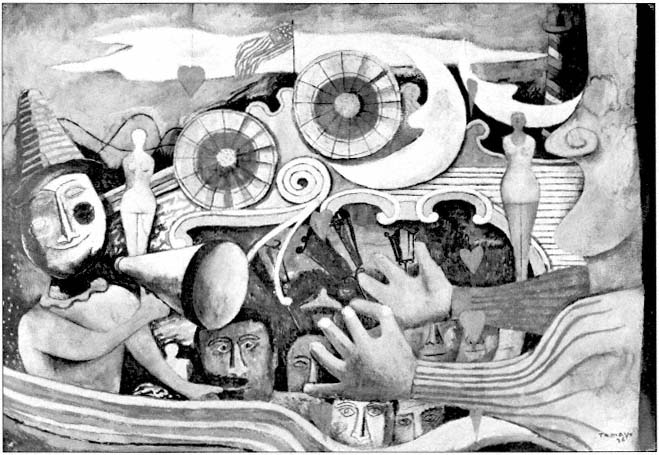
Pl. 72.
Rufino Tamayo, Carnaval, gouache on paper, 1936
(Harry A. Franklin Gallery; reproduced with the permission of Rufino Tamayo
and the Harry A. Franklin Gallery, Beverly Hills, California).
paintings presents a collage of images with a mask-faced barker on the left and a series of mask-faces receding into the background in the lower portion of the painting. The barker's mask, in a motif derived from indigenous masks, has a dark circle on one cheek and a light one on the other, representing in this case sun and moon, a reference repeated in the crescent moon's opposition to one of the ferris wheel circles, which suggest in turn the endless whirling of time. But the moon also finds a visual reference in the face on the right of the painting, while the ferris wheel echoes visually the barker's face on the left. A U.S. flag surmounts the carnival, and Valentine's Day hearts dangle in front of it, but beneath the glittery facade we see the darkness into which the mask-faces recede. Thus, the painting has reference after reference to "the dual cosmic principle which the sun and the moon symbolize," a principle manifesting itself in sun and moon, light and dark, male and female, human and mechanical, and ultimately, cultural and natural oppositions existing within the images of the painting. The surface of life, with all its frenzied activity, masks the eternal rhythms of the universe, and in this painting the Picassoesque representational techniques are used to reveal that ancient truth. In the revelation, however, we might sense a disturbing suggestion that all is not well under the frenzied mask of modern civilization with its nationalism and ersatz hearts. The riotous life of Carnival, as we know, precedes the "death" of Lent in the annual cycle.
The Carnaval of 1941 represents that same fundamental opposition in the service of a diametrically opposed theme, and it too revolves around the mask. This painting depicts a man and a woman apparently readying themselves to attend the festivities. The nude woman is tying the string that secures a mask over her face while her dressed and masked companion waits behind her. The striations on one side of her mask suggest a reference to Picasso's Les Demoiselles d'Avignon, a reference echoing those in other paintings of the period such as Mujer con Piña, also of 1941. But the painting in general looks very little like the work of Picasso because the forms of the figures are derived not from European models but from the west Mexican, pre-Hispanic ceramic figures found in the shaft tombs of Colima, Nayarit, and Jalisco (the male figure's hat is reminiscent of the single horn-like appendage often found on these figures) and from the figures of popular art, a dual source of the images that dominate Tamayo's numerous paintings of couples in this period. Though not overtly
sexual in any way, the painting in its emphasis on the nude female body, earthy in color, clearly suggests the fertility that springs from both the female and the earth. Further, its portrayal of a couple suggests as well all of the fertility implications of the union of male and female opposites. That fertility creates the flowers, symbolic of life, that twine above the couple's heads, and it is, of course, a fertility that exists eternally beneath the mask of our daily existence. Although the essence of woman depicted here may put on the mask of this or that particular identity, this or that individual woman living in the world, that essence is itself representative of the source of life which generates the cyclical flux of the universe. This theme, expressed so clearly here, is one to which Tamayo would return again and again. Carnival, as the earlier painting suggests, may precede the death symbolized in Lent and the Crucifixion, but both precede the cyclical rebirth of life. In this painting, then, we can see specifically what Paz says generally about Tamayo's work: "The relationship between Tamayo and popular art must . .. be sought on the deepest level; not only in the forms but in the beliefs that animate them."[39]
From this base, Tamayo's work evolved in the late 1940s and 1950s into paintings communicating a genuine "sense of terror"[40] at the loss of life's essential meaning in the frenzy of modern civilization, which he saw as haunted by "the specter of technology."[41] The frenzy suggested in the 1936 Carnaval became an obsession, and he "sought metaphors for the great anxieties of the age and, above all, for the dehumanization of man by technology."[42] The paintings of this period contain human figures very different from those of the earlier period. More stylized, more geometric, the paintings' figures seem less concerned with communicating the texture of life than the earlier ones and more devoted to revealing the tortured inner reality of alienated modern man. The titles, given here in their English translations, are instructive: The Cry (with its dual reference to Mexican history in its title El Grito and to Munch's painting, The Scream), The Tormented, Cosmic Terror, Man Pouring Out His Heart (referring both to the need for modern man to express his feelings and to pre-Columbian heart sacrifice), The Burning Man (suggesting Orozco's work). Such examples as these make clear Tamayo's preoccupation with the "cosmic terror" that grows from man's alienation from sustaining values and traditions. In these paintings, the mask often served as a vehicle for the expression of Tamayo's feelings. As Shifra Goldman points out, a number of these paintings "may have their sources in the grotesque masks of Mexican popular art or in the ubiquitous calavera,"[43] but these faces also owe a good deal to analytical cubism in their taking apart of normal human features in order to display them differently and more thematically as a "mask" revealing the essential truth.
Once that tormented feeling had been fully expressed, Tamayo seemed to become more open to the expression of the counterpart he had already explored in such paintings as the 1941 Carnaval. In the 1960s, his art
ceased to give us the "frisson, " the "scream in nature. " . . . Instead his art has become purified, more serene, more positive. If his figures are afraid, they have also found a philosophy with which to combat their fears and this is a gain in depth, in profundity. Again, his early influences—popular arts, ancient arts, Cezanne, Picasso, even Dubuffet—have mellowed, entering deeply into him to re-emerge completely his own.[44]
That profundity expresses itself in two distinct ways, both frequently using the mask. On the one hand, there are the paintings portraying mechanical figures with geometric mask-faces reminiscent of gas masks or the constructed faces one might imagine on robots. A painting from 1970 entitled Dos Hombres en el Espacio provides an apt example. These two "men" in space are machines; their "faces" contain features that represent eyes and noses, but they are not human faces. Their "bodies" are reminiscent of airplanes, and their interaction suggests an encounter between warplanes although the beautiful arrangement of the lush colors on the picture-plane belies the violence such an encounter would suggest. What we have is the serenity of a mechanical universe—clean and beautiful but not human. Here technology has triumphed, has absorbed or devoured and so replaced human beings. Such a painting as this surely grows from his stated concern with the disturbing realities of modern life.
"We are in a dangerous situation, and the danger is that man may be absorbed and destroyed by what he has created." The technology which has guided man to the moon, he says, could also be pushing him over the edge of our value system into a situation where reason, sensibility, and feeling all are sacrificed, and man becomes a kind of apparatus directed by electronics.[45]
The frenzy of Carnival has given way to the serenity of death. The "faces" here lack mouths, perhaps because they have no inner reality to express.
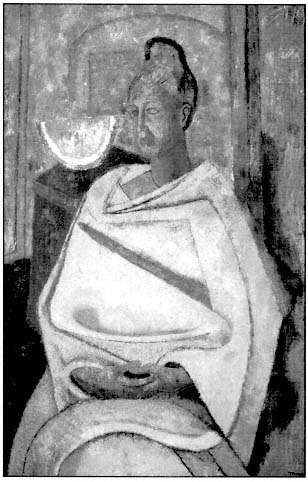
These figures, probably male, are diametrically and dramatically opposed to other archetypal figures in the paintings of this later period. The best example and perhaps the ultimate source of these images can be seen in a painting of 1964 which portrays Tamayo's wife. Entitled simply Retrato de Olga (pl. 73), it depicts her body encased in a shawl whose folds suggest pre-Columbian sculpture. Rising above the shawl her head is elegantly coiffed,
Pl. 73.
Rufino Tamayo, Retrato de Olga, oil on canvas, 1964 (Tamayo Museum, México;
photograph by Jesus Sanchez Uribe, reproduced with the permission
of Rufino Tamayo and the Tamayo Museum).
with the suggestion of flowers in her hair, and her face is at once both realistic and elegantly Mayan with its long, regal nose terminating at the top in raised eyebrows. The red of her mouth provides a focal point for the red of the flowers in her hair, of her dress under the shawl, and of the rear plane of color, a red that seems in deliberate contrast to the pink of the slice of watermelon resting on a table behind her. The only other visible physical feature of the woman is her hands; these are not the dainty, patrician hands of the Mayan ruler, however, but the strong, capable hands of a peasant woman, hands whose strength may well come from Picasso but whose power reflects the strength of the archetypical Mexican woman.
While it would be absurd to say that the most important feature of the painting is the watermelon, one who would understand Tamayo's art and its relationship to the long tradition of Mesoamerican spirituality should pay attention to that slice of fruit. The painting itself indicates its significance in at least two ways. First, the watermelon inevitably calls attention to itself by being the only identifiable object in the painting, an object that seems distinctly out of place in such a portrait. Second, Tamayo's composition places the watermelon directly next to Olga's face, suggesting an equivalence of the two. When one realizes that Tamayo painted watermelons, sometimes alone and sometimes as parts of larger scenes, from the beginning of his career, one begins to suspect that they represent something more than a pleasing shape and color. They, like the other fruit he painted, are a symbolic reminder of the indigenous world of his youth, of the markets of Oaxaca, central to the life of the Indian, as well as a reminder of his aunt, his surrogate mother, who sold fruit so that they might live.[46] And here we have the watermelon, symbol of the earth's fertility that sustains human life, equated with the woman, symbol of the fecundity of human life. Significantly, this woman is a very real human being in contrast to the starkly impersonal forms of the men in space.
The symbolic equation of the watermelon and human fertility is most precisely and symbolically displayed in two lithographs of the 1970s, and in both, the mask is a central feature. In the first of them, entitled Masque Rouge (colorplate 14), the watermelon has become a mask, and the female figure is depicted in the act of placing that mask over her face. Although far less realistic than the Carnaval of 1941 (colorplate 13), the image here is almost exactly equivalent to the female image in that painting. In both, the woman is shown covering her face with a red mask. In both, her nude body is earthy in texture and color. In both, her breasts are visually emphasized by being outlined in the red of the mask. In both, the fullness of her hips is emphasized by being contrasted to the straight lines of the doorway in which she stands. Both masks are smiling. This image, no less than the earlier one, is a visual representation of fertility, the force that creates and sustains life. Not directly sexual, it nonetheless evokes the duality of life which finds its unity in the sexual act that recreates life. The exuberance of the growth of the watermelon, symbolic of summer and the period of growth, is matched by the exuberance of the female body. And both exist in the greatest possible opposition to the machinelike men in space who may be able to destroy life but who can never create it. This essential woman wears the mask of nature as an emblem since her fecundity is the vital force that animates it.
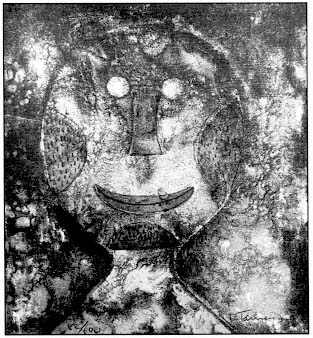
Another lithograph of this same period, Tête (pl. 74), suggests, however, that this vital force need not be associated only with the female. This round, masklike head, reminiscent in its shape and texture, but not its color, of pre-Columbian sculpture, has cheeks and chin indicated by semicircular zones of color. That these should be "read" as references to the watermelon is suggested by that shape as well as their color and the black, seedlike marks
Pl. 74.
Rufino Tamayo, Tête, lithograph, 1975
(collection of Peter and Roberta Markman,
reproduced with the permission of Rufino Tamayo).
within them. The mouth and nose are the same color, but the eyes are not. Gray-blue, they suggest the sky and reveal the possibility that we may be looking at a mask. If so, the mask betrays no sexual identity and would seem to be representative of humanity in general rather than the female, thus suggesting, through its watermelon associations, that human beings are the expression of the vital force of the universe and that through their fertility that force can enter the world. Read in that way, the symbolic simplicity of this lithographic image contains all we have said in this study concerning the metaphor of the mask in Mesoamerican spiritual thought and indicates the profound truth of Ponce's characterization of Tamayo's art.
Almost from the first Tamayo's art seems to be dedicated to the revelation of the other side of reality, the side which does not remain on the surface of appearances, but that rather penetrates them, conceiving the world as a living and open mystery which the artist has to capture and communicate to us through the effectiveness of his own peculiar language. . . . His painting destroys yet continues art and the mythical magic thought of Mexico in an ambivalent and vital manner. His purpose of reaching the transcendental, the origin and external source from which the essence of reality emanates, gives his art a religious character.[47]
It is vitally important to note that that religious character is intensely modern. Although it is built on ancient beliefs and finds expression in forms derived in part from ancient models, Tamayo has crafted an art for today's humanity. Its fears—of violence, of technology, of isolation and loneliness—are the fears of today's human beings, and as Tamayo's international acceptance testifies, its faith in the persistence of the life-force speaks to a common recognition of that force. Though built from Mexican materials, his is an art for all of humanity; he communicates the Mesoamerican spiritual vision to today's world and with it a "sense of release, almost of joy"[48] in the contemplation of the spiritual potential within humanity.
The success of the much younger Francisco Toledo in communicating the essence of that spiritual vision further testifies to its universality and vitality, especially since his art is vastly different in appearance and subject from that of the older artist. While Tamayo celebrates fertility and the vitality of life in paintings never referring directly to sexuality, variations on the theme of the sexual act involving all sorts of creatures as participants are a constant preoccupation of Toledo's art. But
it would be too simple to explain Toledo's painting as only the depiction of sexual acts linking humans to animals and vice versa. The sacralization of coitus in the inscription of an immense and definitive sexual act within the work implies a motive beyond the sexual act itself and places it within the category of ritual.[ 49]
Thus, the images through which Toledo celebrates fertility differ radically from those employed by Tamayo in that same celebration, but they have similar sources. Like Tamayo, Toledo was born of Zapotec parents in Oaxaca, but unlike the older artist, he grew up in Juchitan, close to rural Oaxaca, rather than in Mexico City. His sexual images reflect that background, redolent as they are of the images and folktales of rural life. His is not the often cold beauty of the archaeological museum but the teeming vitality of everyday indigenous life.
Through that vitality, however, he reached the same wellspring of indigenous belief that Tamayo found in the museum, and for that reason his is also an art of transformation. In fact, as Evodio Escalante observes, his art is transformation. "Toledo is not a painter, a sketcher, a ceramicist or a sculptor, he probably isn't even an artist—in the usual sense of the word. He is a universe of shapes and traditions that are incessantly being transformed, and that also transform everything within their reach."[50] Thus, Toledo's work embodies the idea most fundamental to pre-Columbian spiritual thought, the idea for which the mask has always served that body of thought as a central metaphor. It is the conception that the vital force manifests itself in the world of nature through transformation. To enter this world, that force must don the "mask" of a living being, and, conversely, only in the life of that being can the essential force be seen
by man. Toledo's often masklike images are created to make the life-force visible; they manifest the spirit in the world of nature.
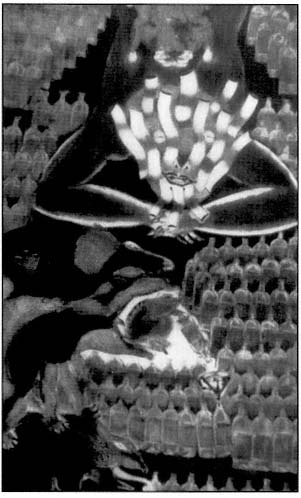
Many of them combine masked or composite faces with the sexual activity always symbolic of creation. The 1974 etching Botellas (pl. 75), for example, depicts a strangely masked figure entering the picture plane headfirst from above. On the figures's back is a toad, a significant fact as the masked figure is observing a series of similar toads mounted on each other and/or emerging from the mouths of larger toads. But the picture is entitled Bottles , thus calling attention both to the central image depicting the smallest of the toads inserting the neck of a bottle into the mouth of a funnel which is itself inserted into the mouth of another bottle and to the background of the etching which is formed of rows of similar bottles. What Toledo has given us is a complex visual metaphor for the cyclical nature of life as small toads emerge from larger toads and one bottle fills another. That human beings participate in this cycle as well is symbolically suggested by the toadskin mask worn by the central figure, a female figure clearly suggesting fertility. The toads mount each other, the phallic bottle is inserted into the vaginal funnel, and the strange, tubular devices on the toadskin mask may well be phallic. Although not obviously sexual, the images here express as clearly as Whitman's poetry the sexual underpinnings of the cycle of life:
Urge and urge and urge,
Always the procreant urge of the world.
Out of the dimness opposite equals advance,
always substance and increase, always sex,
Always a knit of identity, always distinction,
always a breed of life.[51]
Toledo's graphic images seem dedicated to depicting this "knit of identity" revealing the "procreant urge" that unites all life and from which life springs.
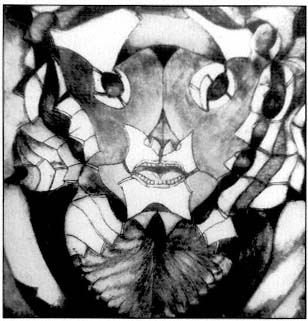
Another etching, also from 1974, contains the image of a mask in a different context. Part of a suite of etchings inspired by the Aztec folk beliefs recorded by Sahagún shortly after the Conquest, this etching represents "Witches and Sorcerers" (pl. 76) and relates to the belief in the nagual, or animal companion, which is discussed in Part II of this study. Toledo presents a text to accompany the image:
OF SORCERERS AND SWINDLERS
Witches and Sorcerers
The naualli is properly called a witch who frightens men at night and sucks the breath from children. He who has studied this craft well understands everything related to sorcery
and is smart and shrewd in using it without
causing harm.
He who is wicked or mischievous in this craft harms people's bodies with these spells, drives them mad, and smothers them. He is an imposter or enchanter.[52]
Pl. 75.
Francisco Toledo, Botellas, etching, ca. 1975
(collection of Peter and Roberta Markman; reproduced
with the permission of Francisco Toledo).
As is the case with all of the images in this suite, the relationship of Toledo's illustration of this text to the text itself is far from clear. What he gives us is a mask-face composed of geometric, shell, or bonelike parts. Although the specific organic source of those parts is not obvious, they suggest the segmented face formed by an insect's exoskeleton or the "segments" of a tortoise shell. Skeletal forms surround the mask-face, and tubular elements similar to those on the mask in Botellas form a beard or bib beneath it. The face is an artificial combination of natural forms and in that sense perhaps symbolic of human identity, of the power each individual derives from the commonly held life-force but necessarily expresses in his or her own way, for good or ill. Since Sahagún's sorcerer makes use of his animal companion as the source of his good or evil power, his human form can thus be seen as a mask covering the vital force symbolized by the animal companion. Or conversely,
Pl. 76.
Francisco Toledo, Brujos y Hechiceros, etching, 1974
(collection of Peter and Roberta Markman;
reproduced with the permission of Francisco Toledo).
Pl. 77.
Francisco Toledo, incised turtle shell
(private collection; reproduced with
the permission of the owner and Francisco Toledo).
the human being, in order to use that power, "becomes" the nagual, that is, puts the inner reality over his normal outer reality in the manner of a mask. The etching, however, depicts neither the human face of the sorcerer nor the animal identity. What Toledo presents instead is an almost abstract mask, perhaps to suggest the metaphorical essence of the nagual as the mask always did in Mesoamerican spiritual thought and to focus the viewer's attention on the transformation that lies at the heart of the idea of nagualism.
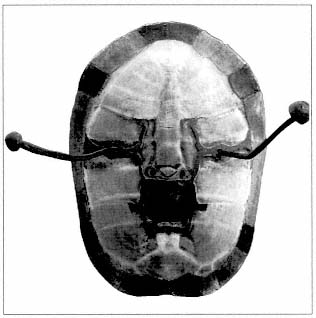
In its appearance and theme, this etching is reminiscent of two other kinds of masklike works Toledo created during the same period. Well known for working in all the possible media available to the artist, Toledo at times stretches those boundaries as he did in the construction of a series of masklike sculptures fashioned from whole turtle shells (pl. 77). Fixing a shell in a vertical position, he incised, painted, carved, and affixed things to its surface to render it masklike in its frontal appearance although it could never function as a mask since it was always the complete shell, both top and bottom. This suggests at least part of its symbolic significance as the turtle in indigenous folklore as well as in Toledo's paintings, drawings, and graphic works is a sexual symbol, due most obviously to the similarity in shape and movement in and out of the shell of the turtle's head to the male penis. Thus, the mask is again related to sexuality, on the one hand, and identity, on the other, for there is no more obvious symbol in nature of the opposition of inner to outer than the turtle, whose life is more clearly "inner" than that of any other creature. In this sense, too, the transformation of the turtle shell into a mask makes symbolic sense. The "mask" Toledo has fashioned on the turtle's shell makes visible the inner reality of a human being, a reality as "inner" and as vital as the turtle's. And that inner reality is just as fertile because, as we have seen again and again in our examination of Mesoamerican spiritual thought, it is essentially the life-force.
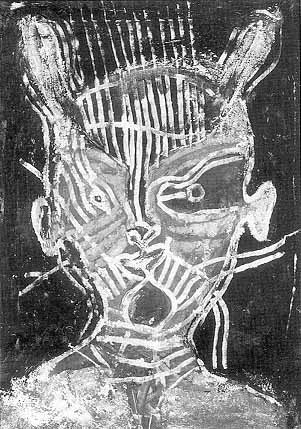
The etched mask of the sorcerer, however, is related not only to the turtle/mask but also to another, more fundamental, series of works that approach the theme in a somewhat different way. These are portraits, and Toledo has produced them in great numbers. Two portraits of a Mexico City art dealer, Armando Colina, are typical and indicate clearly Toledo's approach to portraiture. One of them provides a case in point (pl. 78); in it, the human facial features are exaggerated beyond recognition to reveal an animallike inner reality clearly related to the concept of the nagual—the animal companion symbolic of one's inner reality—which fascinates Toledo. He has given the world an inner portrait of Armando Colina, two of them, in fact, since there is another, quite different portrait, suggesting the complex, multifaceted nature of man's reality. While these physical features link the man to other forms of life, the composition of the painting also relates the subject to the world in which it exists. "The flattened, masklike face exists in a complex relationship to the surrounding areas. Striations define the forehead and mouth and extend to the adjacent areas, unifying figure and background space."[53] Thus, the figure exists in and is part of a context, and the nagual-
Pl. 78.
Francisco Toledo, Retrato de Armando Colina, oil on canvas,
1966 (Galeria Arvil, México; photograph courtesy of Galeria Arvil;
reproduced with the permission of Francisco Toledo).
mask suggests that that context is spiritual as well as material. To understand Armando Colina, Toledo's insight shows us, one must understand those contexts.
The great majority of Toledo's portraits, however, are not of others but of Francisco Toledo himself. He did a substantial number of these self-portraits in the mid-1960s and another series late in the 1970s. They are revealing works, as any self-portrait must be, but what they reveal is not what one might expect. In them, Toledo's face generally becomes a mask composed of seemingly organic elements often visually similar to those that comprise the sorcerer's mask. And in the construction of those masklike composed faces, he uses, as did his pre-Hispanic forebears, the metaphor of the nagual to conceptualize the natural, inner reality that is his identity. As a modem man, however, he knows that this identity is not unitary but multiple: he cannot paint a single portrait of Armando Colina, and since his knowledge of himself is much more extensive, there must be a multitude of self-portraits.
A fascinating drawing, or series of drawings, from 1965 makes clear Toledo's vision. Eight separate drawings originally designed and displayed mounted edge-to-edge and called collectively Self Portrait-Masks (colorplate 15), this composition is uniquely important to understanding Toledo's conception of the portrait, a conception that is both embodied in these drawings and stated in a text intended to be displayed with the visual images. The text is written in Zapotec, however, and mounted vertically rather than horizontally, perhaps to assure that the conception is not too easily grasped. Translated, it reads:
These are my portraits. I have the face of a dog, face of a cat, face of a pig, face of a coyote, face of an owl, face of an insect, face of a turtle, face of a monkey. An old man. They are all like masks. Although they do not look like it, they are my portraits.
Toledo, himself the old man (though he was in his twenties at the time), knows that looks deceive, that his true reality is inner and that if he is to be understood, he must project that inner reality. This, of course, is the logic of the mask, and true to that logic, Toledo constructs a mask that is his portrait.
Or, at any rate, one of his portraits. The unification of the eight drawings into one makes graphically clear his awareness that the complexity of the inner reality of human beings can never be captured in a single image, and the animal masks presented here suggest why. The vital force within Francisco Toledo—or any human being—contains the macrocosm. All life metaphorically exists within the single human being, and thus an understanding of life, both the life of the man and life itself, must be sought within. When Toledo draws the essence of himself, he simultaneously creates the essential cat, pig, coyote, and so forth. He expresses himself in their forms, and they live within his form. We have again, in a very different form, the "knit of identity" expressed in his sexual works, but here it is expressed through the metaphor of the mask. To understand the workings of the life-force, Toledo seems to be saying in the two sorts of works, one may look within or without, at the inner life of man or the teeming life of the natural world; both views present the same reality.
Thus, as did Tamayo, Toledo provides a fresh image to embody the age-old conception, and like Tamayo's, his is derived from indigenous sources but tempered by the fruits of his contact with European art. The individual portrait-masks that make up this work often suggest the drawings of Paul Klee—in their whimsicality, their line, their use of animal images, and their symbolism—rather than Picasso, but as with Tamayo, the lessons of European art have been completely internalized. One would never mistake these drawings for the work of Klee. And the fact that they are masks and that there are faces within the faces that compose the masks as well as the organic vitality of the forms within those faces demonstrate their derivation
from Toledo's indigenous roots rather than his European experiences.
These portrait-masks, typical of his work in the 1960s, give way in the 1970s to a different sort of portrait-mask. Often more painted than drawn, more controlled, cleaner and more elegant, these later self-portraits both continue and modify the basic theme. One of them, Autoretrato of 1975 (colorplate 16), a watercolor incorporating gold leaf, illustrates this new tendency clearly. Its composition is complex although seemingly simple. The background against which the human figure appears is composed of rectangular forms of varying dimensions and colors, in one of which a bird almost startlingly appears. On this ground, the human figure is placed in such a way that the torso divides the picture plane diagonally, itself filling the lower right-hand portion while the head occupies the upper left-hand segment. The result of all of this compositional sleight of hand is to focus the viewer's attention on the figure's head, which seems almost to project from the picture plane. And that head is striking. Its face, like a normal human face, is symmetrical with a clearly recognizable chin, lips, nose, eyes, and ears. But the face is not really human. It has more in common with the mask of the sorcerer we have examined than with the actual face Francisco Toledo daily presents to the world. Like that sorcerer's face, it is segmented, a segmentation made obvious by the gold leaf, but even more clearly than in the case of the earlier etching, this face is a mask. A careful examination reveals that there may well be a greenish-brown face beneath the beautiful blue, rose, and gold mask, a face that is hinted at under the deeply cleft chin of the mask, in the ears protruding beyond the sides of the mask, and in the forehead appearing above the eyebrows and beneath the organic forms surmounting the face of the mask.
There is a somber quality, a serenity, in this mask-face which is quite different from Toledo's earlier mask-faces, but the vitality of those earlier animal-related masks is here as well. It can be seen most obviously in the bird, strikingly depicted on an almost white ground in contrast to the rest of the painting. The bird's face confronts the viewer from the same angle, in relation to its body, as does the man's face, suggesting, as does the composition of the painting itself, that the bird is to be seen as the nagual, the alter ego of the man. Significantly, the bird suggests the perky, feisty birds of the barnyard rather than the somber composed man of the painting. And the mask worn by that man also has clearly animalistic overtones in the strange forms that compose the hair or hat or headdress. Unlike the bird, their precise identity is not clear. Toad-like in one way, in another they resemble slugs and can even be seen as phallic, but whatever their identity, they surely suggest the organic life in which the identity of the man here portrayed is rooted. However sophisticated his identity may become, that identity, like Toledo's art, has its origin in the vital force that for him is most clearly apparent in the rural Oaxaca of his youth. It is his great strength as an artist that all of his images, kaleidoscopic and forever changing and developing as they are, grow from that perception of the vital force. As Teresa del Conde puts it, his art reveals "an interminable chain of iconographic associations that refer to rural culture."[54] But as this painting makes clear, his art is rooted in that source because he is rooted there. This masked face is, after all, a self-portrait, and it demonstrates more clearly than words could the fact that for Toledo, his artistic development cannot be separated from his self development. He is his art, and his art reveals him in the most essential way. True to his heritage in these images, he uses the mask as a central means of his continuing exploration of the essentially spiritual vital force as it manifests itself, in and through him, in the world of nature.
Thus, the mask reveals the inner man, or if one takes into account the whole series of self portraits, the inner men—the series of inner realities that make up the individual known to the world as Francisco Toledo. Emblemlike, these masks make the inner reality outer and thus fulfill precisely the same symbolic function that the mask has always served in Mesoamerica. It is a testament to its essential nature that it can serve to define the inner realities of twentieth-century human beings as effectively as it did the inner reality of the human beings living in the village cultures of Mesoamerica 3,000 years ago. Much has changed, but the mask remains and serves, as it always has, not to conceal but to reveal the inner vision of that variant of human culture which developed in Mesoamerica.