
From Family to Kindred to Deme in Unalakleet and Wainwright
The bilaterally organized villages of Unalakleet and Wainwright are homes to families whose members reside in those villages and in more distant places as well. Their loose structures, which encompass all living relatives and memories of deceased ones, appear akin to large, nuclear, family-centered kindreds, yet those in which affines as well as kinsmen are recognized as members.
The natives in Unalakleet and Wainwright employ kinship terminologies that kinship analysts fittingly call "Eskimo" (Murdock 1949; Driver 1956). They are so similar to Anglo-American kinship terminologies that they require little definition. A person uses one term for a male sibling and another for a female sibling. The children of mother's brother, mother's sister, father's brother, and father's sister are all addressed and referred to as "cousin" (English gloss). Parents are distinguished from uncles and aunts, but uncles and aunts are not further distinguished as to whether they are on the mother's side (matrilateral) or father's side (patrilateral). Helpful, close relations obtain among cousins, much as they obtain among siblings, and between uncles and aunts and their nephews and nieces, much as they obtain between parent and child. Parental and sibling bonds, by proximity and duration, are usually, but not always, stronger than uncle/aunt bonds with nephews/ nieces.
Because bilateral descent, in conjunction with marriages, converts relations that are affinal (in-laws) in one generation to kinship (blood) in the next, a child's family kindred includes
both relatives (mother's kinspeople) who are his father's affines and relatives (father's kinspeople) who arc his mother's affines. So family flexibility, rather than rigidity of the ordering principles of membership, is the rule. Indeed, when a person marries, his or her affines become family to his or her children, as does his or her personal family of orientation.
Affines—that is, brothers-in-law, sisters-in-law, parents-in-law, and sons-in-law/daughters-in-law—develop and maintain strong bonds through joint activities, whether they reside in the same or in different villages. If they reside in the same village, on occasions, some male affines hunt and fish together; some female affines prepare meals together; and all affines attend community celebrations together, often establish camps dose to one another, and maintain close relations with the children of their sisters or brothers (their nieces and nephews). It is the kinship bond of uncle and aunt to niece and nephew that makes more secure the bonds between siblings-in-law and the kinship bond between grandparent and grandchild that makes more secure the bonds between parent-in-law and son-in-law/daughter-in-law.
If affines reside in different communities, bonds are maintained through visits, the sharing of foods, particularly those that are abundant in one place but scarce in the other, and resource extraction excursions, again often for resources locally abundant in one place but scarce in the other (such as roe-on-kelp, caribou, or berries).
Kindreds: Their Relations to Households and "Families"
Figure 11 is an idealized, schematic representation for Wainwright and Unalakleet of siblings' family kindred of orientation (the one into which brothers and sisters are born and reared) and a male's (ego's)[1] family kindred of procreation, a kindred that is added to his personal kindred of orientation. A woman ego adds her husband's family kindred to her new kindred of procreation.
[1] Ego refers to the person through whom relatives are reckoned (demonstrated or stipulated).
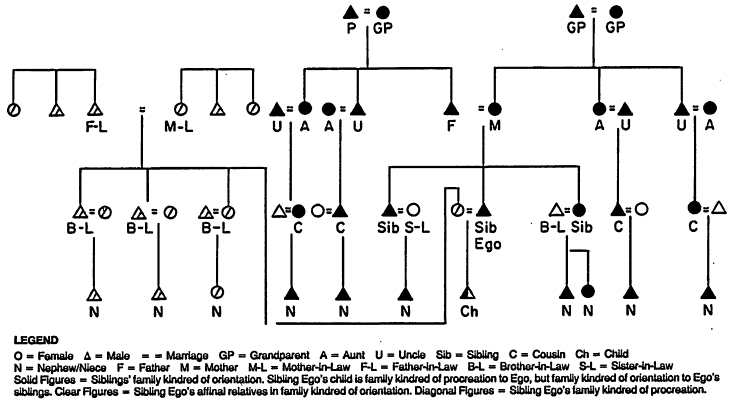
Figure 11.
Schematic Representation of Kindreds, Unalakleet and Wainwright, 1982
These kindred organizations are flexible, allowing for adoptions and for movements of persons from one household to another within the kindreds, as exigencies and interests dictate. The members are quick to specify the nature of their kinship relations to other members, if asked, or to volunteer such information to the fieldworkers ("he's my cousin, my mother's sister's boy"), if a family member's name is mentioned. We were always informed about relations if a person's name came up in reference, say, to a basketball game, a long-distance hunting trip, or participation on the village's dance team. That is to say, family members are proud of their relatedness, share many experiences, and want the uninformed person who mentioned the name, no matter what the context, to know how they are related.
In Unalakleet and Wainwright, family kindred is not mere descent reckoning: kinship relations entail a vast array of joint activities, and descent reckoning is in large part a memory of those activities. During the late 1970s and up through 1983 in Wainwright, some of the activities associated with subsistence, which provide the context for interactions with kinspeople and friends, were engaged in with less frequency than during the previous decades. But as Luton (1985: 141) cautioned, kin ties of great importance still existed within the community and should not be underestimated. They are always asserted in relation to marriage, social events, and task group formation. As conditions worsened in 1984 and 1985, kinship ties were invoked for subsistence pursuits, assistance, and mutual support. Relatives are proud to be relatives, and they enjoy sharing mutual responsibilities and obligations.
Family kindreds in Unalakleet and Wainwright, then, are more or less unbounded, because kindreds of orientation overlap with kindreds of procreation. At marriage, the spouses have more kinspeople, more obligations, and more persons to turn to for assistance than they had before. The side on which most emphasis is placed, husband's or wife's, is determined in largest part by residence. That is, the kindred located in the village in which the couple resides will provide the most daily connections of all kinds. If the marriage is endogamous, both husband's and wife's kindreds are emphasized, but the male hunting-fishing
activities will usually swing the weight to the husband's kindred of orientation. Children, however, receive succor, support, and attention from both sides and serve to increase the activities that are shared between them.
The "Family" In Unalakleet and Wainwright
It is here that we can solve the puzzle posed by the ill-defined, unbounded "family" discussed in chapter 8. Family kindreds can, and usually do, occupy several houses and thus comprise several households. An elderly person may have a house and choose to live alone; a young nuclear family may have a separate residence; and a third family, comprising mother, father, unmarried children, a divorced son or daughter, and a couple of grandchildren, may occupy a third house. Yet the three households may well be the core of a family, that is, the set of people who most frequently interact in hunting and fishing activities, food preparation, baby-sitting, meals, and the like.
But residence flexibility is such that some people come and go from one house to another (married couples, students, or divorced men or women may coreside with their parents or grandparents, or with an uncle and aunt, then move onto another house or return to school). Nevertheless, the kinship, nurturance, support, subsistence organization (extraction, distribution, consumption) bonds remain. A family, then, in Unalakleet and Wainwright is not a house or a household. It is an unbounded organization of bilateral kinspersons that expands at marriage. Each child sees his or her family as an ever-widening circle of relations.
Functions of the Family in Unalakleet and Wainwright
Each circle of family, in the wider sense, has its own history, traditions about its place of origin and its ancestors, and stories about memorable events. Wainwright is, however, a more recent village than Unalakleet, so that many of the family histories for persons in that community extend only three or four generations.
Native populations near what is now Wainwright, as we
know, had been in contact with, and in the service of, nonnative business operations for about 140 years. Some of the consequences of those contacts were disruptive to the small native communities between Point Hope and Point Barrow. The small villages in about a twenty-five-mile radius of the Kuuk Lagoon were not immune to these disruptions and dislocations. Families splintered away from small villages to serve or to join those operations. Diseases afflicted them, and an unusually high mortality rate reduced their numbers (see Luton 1986).
By the 1890s, several Inupiat communities, comprising mixtures of coastal and inland peoples, had coalesced—intermarrying, extracting resources of land and sea, and serving the nonnative enterprises that operated near Wainwright. In 1904, the Bureau of Education school and a reindeer herd were established there. Wainwright was born, as families in the region relocated there. The settlers came from several communities during the whaling and postwhaling periods. Families continued to immigrate to the village throughout the 1940s. The early settlement was, then, complex, as it was in Unalakleet following the epidemic during the early nineteenth century. The recent history of native emigration and immigration has seen more activity in Wainwright than in Unalakleet.
These historical-demographic caveats aside, each family has land that its members have customarily used as campsites—at least for three generations but usually for considerably longer periods than that—for harvesting native foods. Each family has names that reflect its continuity. Families of today continue the history bequeathed to them. They retell the smiles and traditions and pass on their store of knowledge to younger members. Every year they have set up camp on land recognized as theirs, either through allotment (a special act for Alaska natives, now rescinded by ANCSA) or through traditional practice or subsistence use. Some of those parcels have been claimed by families through ANCSA's provisions for conveyance. When Eskimo children are born, they receive Eskimo names in remembrance of past members of the family; sometimes the English names (first and/or middle) given to a baby also recall the memory of family members who have died.
Within an immediate family, nuclear or extended (the small-
est circle of kinspeople), each member holds responsibilities toward the others. Parents want the best for their children and work hard to provide for them. In Unalakleet, parents put food on the table largely by subsistence harvesting of the native resources. In Wainwright in 1982, parents put about half the food on the table from subsistence pursuits. In Unalakleet, most families obtain at least a portion, and in about one-third of the families most, of the cash needed to house, clothe, and otherwise provide for their children (e.g., to meet school-related expenses) by commercially harvesting the natural resources (fishing and trapping). As we know, Wainwright families in 1982 gained most of the cash they needed from earned and unearned income ultimately made available by the oil operations at Prudhoe Bay.
Yet in both Wainwright and Unalakleet, children are reared very similarly. Part of the instruction given to children and the knowledge handed down to them are the techniques of harvesting and processing native foods. When out in the country, upriver, or on the ocean, and involved in subsistence pursuits together, parents feel that they are giving their sons and daughters the same memorable childhood experiences that they fondly look back on.
Sons and daughters, as they grow older, take on increasing responsibilities within the family. As they become more adept at hunting, setting and checking nets, cutting fish, piloting boats on the river or ocean, and other aspects of subsistence, they take on more of the work and contribute more to the family's food supply. Their contribution increases in other areas of daily family life, too—taking care of younger sisters and brothers, cleaning the house and yard, making repairs, feeding the dogs (Unalakleet), and taking part-time or seasonal jobs. They care about their parents' approval, and they feel distress if they let them down in some way.
Brothers and sisters look after one another when they are children, giving protection and comfort. When older, they continue to watch after one another's welfare and will personally sacrifice to help in a pinch. They often provide each other with native foods and meals; but especially when one is having a hard
time and without a hunter, or unable to go into the country, they make it a point to bring food.
Brothers and sisters are among each other's best friends. Brothers pal around together when young; when older, they hunt together, and they talk over troubles and plans. Sisters are the same; they pick berries and cut fish and meat together; they care for each other's children; they talk over their hopes and cares, and in other ways, they give each other emotional comfort and support.
When brothers and sisters have families of their own, these families join in activities together. They visit and have meals together; they harvest subsistence foods together; they give each other, and their younger siblings, a place to stay. They often form joint families when one is divorced or becomes a widow or widower. Together, they sometimes join their parents to harvest foods, and they go to their parents' house to help with repairs and construction.
When siblings grow older and become grandparents, they are looked after by their children, grandchildren, nieces, nephews, grandnieces, and grandnephews. As spouses die, or as couples age, more distant relatives and friends in the village join in looking after these people. Yet even with advancing age, most of the older people maintain considerable physical activity and continue to give from their end. They hunt, fish, and pick berries and greens. They give part of what they harvest and part of what has been brought to them to their children and grandchildren as well as to relatives and friends their own age. They also help to give their adult children and grandchildren a start in life and help to ease any difficulties they may be experiencing. Their houses are always open, they have their adult children and grandchildren stay with them, they take their young grandchildren to raise, and they give financial help when they can manage.
Collateral kinspersons are very frequently as close as lineal kinspersons. Indeed, a special enduring closeness almost always develops between cousins and often between second cousins. This same degree of closeness links uncles and aunts with their nephews and nieces. These kin come to one another's aid and
generally look after one another. They hunt, fish, and cut fish together; they explore and travel the country together. The older teach the younger about subsistence techniques and a host of other subjects. If they are fairly close in age, these relatives are close friends who spend a lot of time in each other's company, who joke, who share good times and troubles, who know they can count on one another, who give each other gifts and in a multitude of ways express their friendship. They usually form same-sex bonds, that is, male collaterals with male collaterals, females with females.
The Demelike Organizations of Unalakleet and Wainwright
As we have observed, the Inupiat settlements of the North Slope historically were kinship-based units. In both Unalakleet and Wainwright today, kinspersons, no matter how distant, feel a measure of responsibility to each other. In fact, the common, local observation in Unalakleet is that practically everyone in the village is related in some way, either by blood or by marriage or by both. An agamous bilateral, localized descent group of this nature is called a deme, and the village of Unalakleet more or less fits such a description. Its core members surely comprise a deme. The fact that only four native couples are from villages other than Unalakleet is strong evidence for Unalakleet being a demelike organization.
The evidence for Wainwright is less conclusive. Given its brief history and its population fluctuations over the past half-century, it may not comprise a large, localized descent group. Kinship ties, however, are everywhere important in the community, and Luton (1985) argues that those ties are accompanied by ideological and emotional features that make the community distinct.
The recognition of kinship, combined with a sense of belonging through the generations, is one of the unifying forces among people in the village. This recognition translates into people putting differences aside and joining together in common action when circumstances require. It also translates into a general concern for one another and an immediate will-
ingness to help when circumstances, either small (such as running out of gas on the river or being on foot and needing to get to the other end of the village) or large (such as death, an accident, or a fire), render someone or a whole family in need of assistance.